To attend this auction live or leave absentee bids

Lot : 102
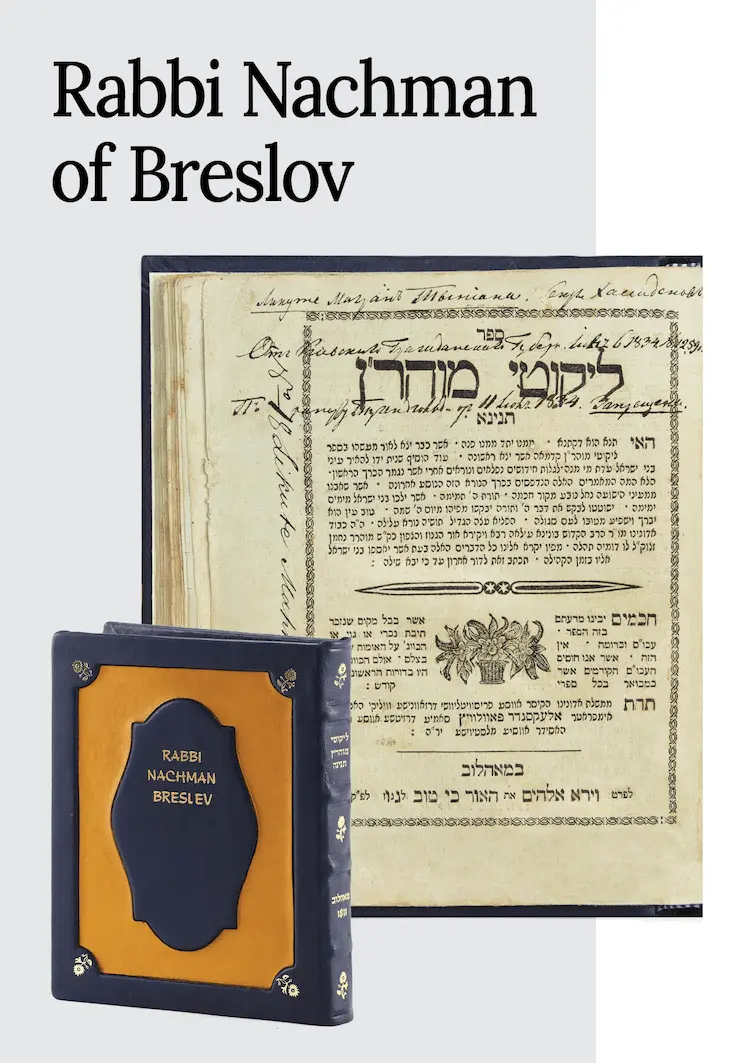
Likutei Muharan Tinyana. First Edition. Mogilev, 1811
Wondrous chiddushei Torah drawn from the wisdom and wellsprings of salvation by Rabbi Nachman of Breslov, edited and printed by his disciple Rabbi Nosson of Breslov.
In his preface, Rabbi Nosson explains that the essays printed in this volume “Are his final words that he taught and revealed after completing the sefer Likutei Muharan and that were heard by our ears from his holy mouth from that day and on, until his passing…”
Leaf [2] features
“Rhymes from a handwritten manuscript of Rabbeinu ztvk”l and his holy name and his father’s name [appear as an acrostic] at the beginning of the stanzas, doubled and tripled.” Leaf 2b presents secrets and allusions regarding the name of Rabbi Shimon bar Yochai.
Nachal
Novea
Mekor
Chochmah – The Flowing River
The famous expression “
Nachal
Novea
Mekor
Chochmah” (a flowing river, source of wisdom) is the acronym for Rabbi
Nachman, emerged from the holy lips of Rabbi Nachman himself, as Rabbi Nosson attests in Chayei Muharan (Letter 189).
This was the first time that this acronym appeared in print, and it is printed on the title page of the present sefer.
Mogilev, 1811. [2] 58 leaves. Page size: 20.5 cm. Light green paper with attractive margins. Slight stains. Handwritten markings in foreign language on title page. Good condition. Attractive new leather binding.
Stefansky, Sifrei Chassidus #286
............................................... .
Any inquiries about this lot ?
We are available also on WhatsApp >>>

Lot : 103
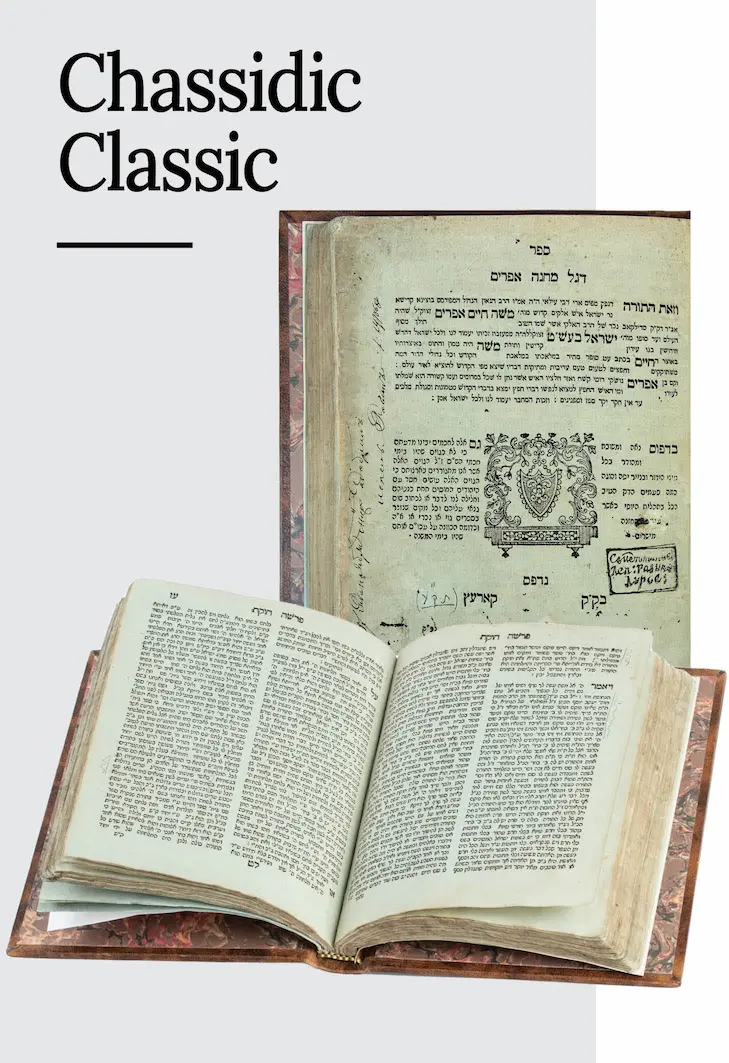
Degel Machaneh Ephraim. First Edition. Koritz, 1810
Chassidic commentaries on Chumash by Rabbi Moshe Chaim Ephraim of Sudilkov, grandson of the Baal Shem Tov.
The author of “Degel”, as he is affectionately referred to by Chassidim, was born in Mezhibuzh in 1747, to the Baal Shem Tov’s only daughter Udel. He was educated and dearly loved by his grandfather who was involved in raising and educating him. In his famous letter to his brother-in-law Rabbi Gershon of Kitov, the Baal Shem Tov refers to him as “A great genius in the essence of learning.”
Degel Machaneh Ephraim is a foundational work of chassidus which cites important concepts, learned from his grandfather the Baal Shem Tov.
There is a list of the author's dreams printed on leaf 114a. This list was discovered in the author’s handwriting and among the dreams it lists those in which he glimpsed the Baal Shem Tov and his disciples.
Includes approbations of Chassidic luminaries such as Rabbi Levi Yitzchak of Berditchev, the Maggid of Kozhnitz, the Chozeh of Lublin, the Ohev Yisrael of Apta, Rabbi Chaim of Czernowitz and Rabbi Menachem Mendel of Liska.
Koritz, 1810. First edition. [2], 114 leaves. 20.5 cm. Green paper, professional restoration of minor holes on last three pages. Minor stains. New leather binding. Good condition.
Stefansky, Sifrei Chassidus # 128, Stefansky Sifrei Yesod # 383
................................................
Any inquiries about this lot ?
We are available also on WhatsApp >>>

Lot : 104
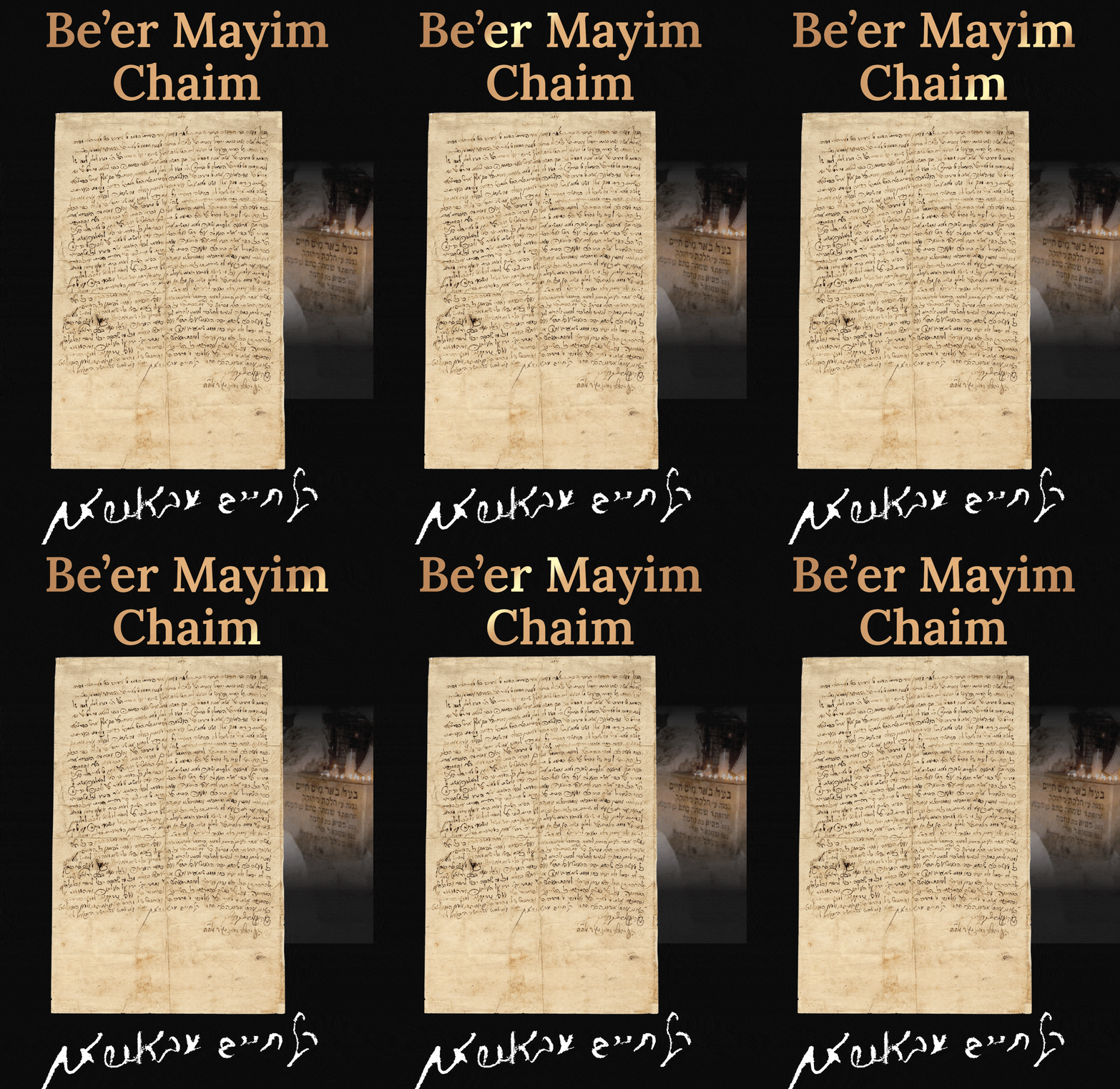
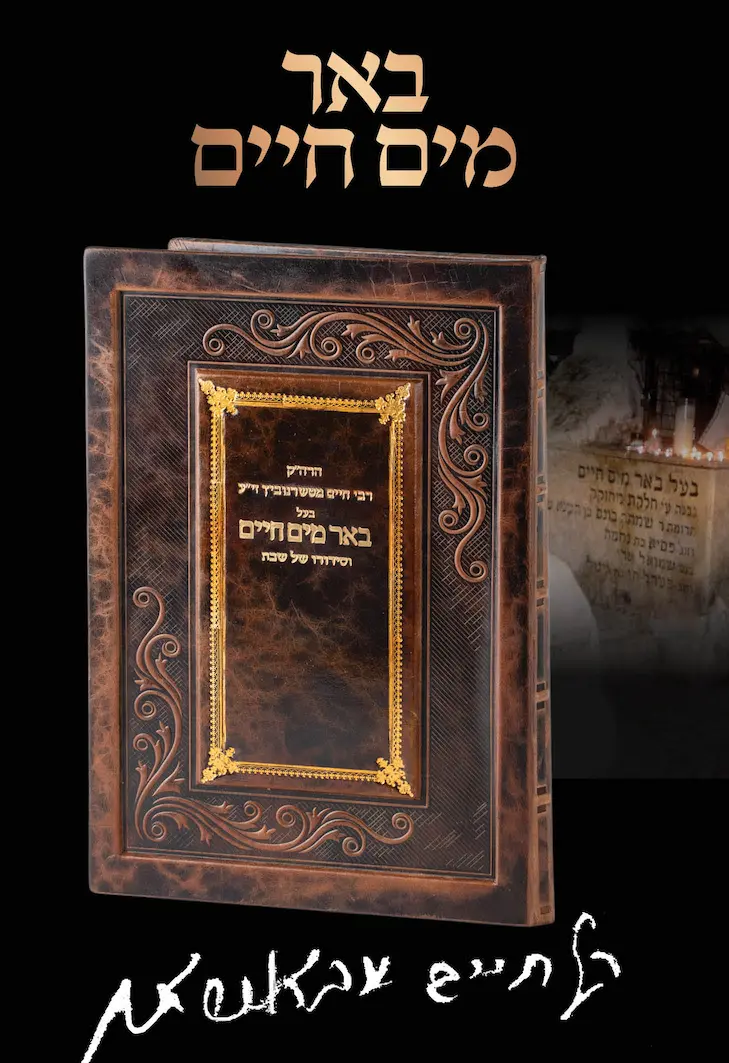
Holy Autograph of the “Be'er mayim Chaim” HaAdmor Rabbi Chaim of Czernowitz. Botoshan, 1813
The signature of the Admor Rabbi Chaim of Czernowitz, author of Be'er Mayim Chaim and Sidduro shel Shabbos written in his holy hands on a Beis Din deed.
The deed regards a case that took place in the Beis Din in Botoshan where Rav Chaim presided as Rav. It was created and signed on 23 Adar II, 5573 (1813) by the Admor Rabbi Chaim of Czernowitz whose signature appears first followed by the signatures of another two dayanim from the Beis Din.
The tzaddik and
Admor Rabbi Chaim of Czernowitz
(1760-1818), author of Be’er Mayim Chaim and Sidduro shel Shabbos, was among the progenitors of Chassidus, and a genius in both the Revealed and Hidden Torah.
His master in Chassidus was the Admor Rabbi Yechiel Michel from Zlohtchov, in the revealed torah Rabbi Chaim learned from the Neta Shaashuim alongside his close friend and contemporary Rabbi Avraham of Butchatch, author of Daas Kedoshim and Eishel Avraham. He corresponded frequently with Rabbi Meshulam Igra.
He served as Rav in the prominent communities of Czernowitz, Botoshan, Mohyliv, and Kishinev in Romania, and was one of the preeminent disseminators of Chassidus in Romania and Bukovina. Toward the end of 1813, he fulfilled his lifelong dream of journeying to Eretz Yisrael where he settled in Tzfas and dwelled until his passing five years later.
He is renowned throughout the Chassidic world by the names of his fundamental sefarim Be'er Mayim Chaim and Sidduro shel Shabbos which the Apter Rav describes as “sweeter than honey.”
Sidduro shel Shabbos, which describes the sanctity and attributes of Shabbos, is the primary Chassidic work on Shabbos. The author, Rabbi Chaim, was known to invest immense efforts to honor and safeguard Shabbos to the extent that people described: “After he immersed in the mikveh in honor of Shabbos, he appeared a head taller and his face glowed until the end of Shabbos.” All of his sefarim were printed in numerous editions and are regarded as Chassidic classics.
Content of deed: Sale of an apartment sold by the Beis Din; distribution of funds in order to repay a kesubah debt and support the orphans; and a deed of ownership issued to the new owner. All was carried out and signed by the Beis Din under the auspices of the Admor Rabbi Chaim of Czernowitz.
Botoshan, 1813. Page size: 37x22 cm. Professionally restored on margins and minor restoration to text.
................................................
Any inquiries about this lot ?
We are available also on WhatsApp >>>

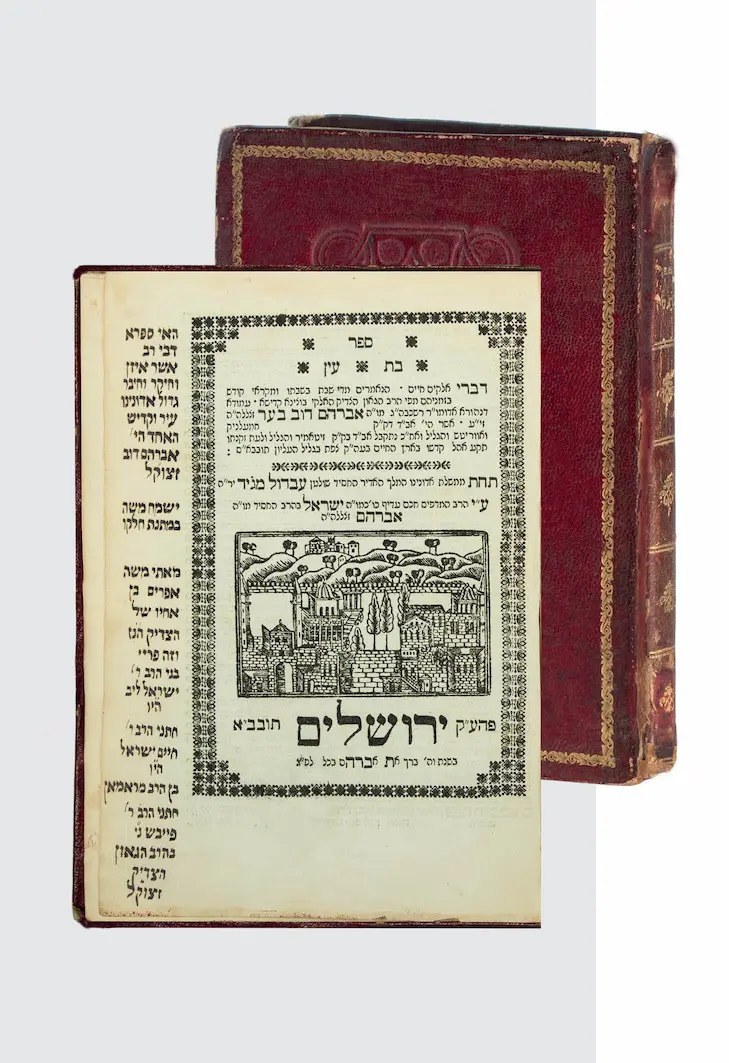
Lot : 105
Bas Ayin. First Edition. Jerusalem, 1847
Ornate copy originally owned by the author’s family!
The present item boasts the Bas Ayin’s illustrious family tree as recorded by the author’s nephew Rabbi Moshe Efraim of Tzfas.
Chiddushei Torah and drashos on the weekly Torah portions by the saintly Bas Ayin, the Admor Rabbi Avraham Dov of Avritch who “lectured every week on Shabbos with the holy spirit that descended upon him from the heavens”.
Beautiful copy with wide margins and original red leather binding engraved in gilded letters with the words “Belongs to R’ Yisrael Leib”. This was the personal copy of the Bas Ayin’s great-nephew Rabbi Yisrael Leib Avritcher.
The title page features an important list of family lineage handwritten by the Admor Rabbi Moshe Efraim of Tzfas, who was the Bas Ayin’s brother’s son and father of the said Rabbi Yisrael Leib who printed the sefer.
Rabbi Moshe Efraim inscribed in beautiful, large block letters that the sefer was authored by the righteous and saintly tzaddik
Avraham Dov ztvk”l and then lists his children: his son Rabbi Yisrael Leib; son-in-law Rabbi Chaim Yisrael son of the Admor of Ramen; and son-in-law Rabbi Feivish son of the gaon and tzaddik.
The Admor
Rabbi Avraham Dov of Avritch (1765-12 Kislev, 1841) was one of the exalted Chassidic Admorim and legendary figures in the era of second-generation disciples of the Maggid of Mezritch. Rabbi Avraham Dov was the prime disciple of the Admor Rabbi Menachem Nachum of Chernobyl and the son-in-law and successor of Rabbi Nosson Nutta of Avritch, who studied directly under the Baal Shem Tov.
Toward the end of 1830, Rabbi Avraham Dov embarked on a journey to the Holy Land and settled in Tzfas where he stood at the forefront of the Chassidic Yishuv in Eretz Yisrael and supported its members during the hardest of times. During the notorious earthquake in Tzfas which felled thousands, those standing in shul in close proximity to the Bas Ayin was miraculously spared death (Rabbi Moshe Podhotzer of Tzfas in the name of the elders of Tzfas, cited in Toldos Adam at the end of Bas Ayin, [Jerusalem, 1959] and by Rabbi Yehaya Halevi Horowitz in Eden Tzion p. 5). Several years later, when plague broke out in the holy city of Tzfas, and countless perished, suffering excruciating deaths, the Bas Ayin vowed that the plague would cease immediately upon his death, which is what indeed occurred (ibid p. 6).
Rabbi Avraham Dov of Avritch’s sefer Bas Ayin is one of the foundational Chassidic sefarim, and it is said that learning it is auspicious for personal salvation. Some attribute this miraculous phenomenon to the fact that the name בת עין is an acronym for י'שראל נ'ושע ב'ה' ת'שועת ע'ולמים, Yisrael is saved by Hashem with an eternal salvation.
Jerusalem, 1847. First edition. [2], 125 [1] leaf. Page size: 22 cm. Restorations to back cover and corners.
List of family lineage as handwritten on the title page:
Harav Hakadosh Rabbi Avraham Dov of Avritch
Author of Bas Ayin
||
Harav Hatzaddik Rabbi Yisrael Leib, Av Beis Din of Varchikov
Brother of the Bas Ayin
||
His son Harav Hakadosh Rabbi Moshe Efraim
||
His son Harav Hachassid Rabbi Yisrael Leib Avritcher of Tzfas[1]
His son-in-law Rabbi Chaim Yisrael, son of Harav of Ramen[2]
His son-in-law Rabbi Feivish[3]
[1] Brought the first edition of Bas Ayin to print.
[2] Son of the Admor Rabbi Yaakov Dov of Ramen, who was one of the noted followers of the Admor Rabbi Yisrael of Ruzhin and eventually settled in Tzfas. His name is mentioned among those who contributed to the printing costs of the sefer. For more about Rabbi Chaim Yisrael, see Igros Harav Hakadosh MiRuzhin Vol. 1 p. 517 comment 23.
[3] Also known as Rabbi Chaim Uri Feivish S'gan Leviim, son of the Admor Rabbi Aryeh Leib of Voltshisak. He is also mentioned among the donors who contributed to the sefer (See above Vol. 2 p. 70 comment 1).
............................................... .
Any inquiries about this lot ?
We are available also on WhatsApp >>>

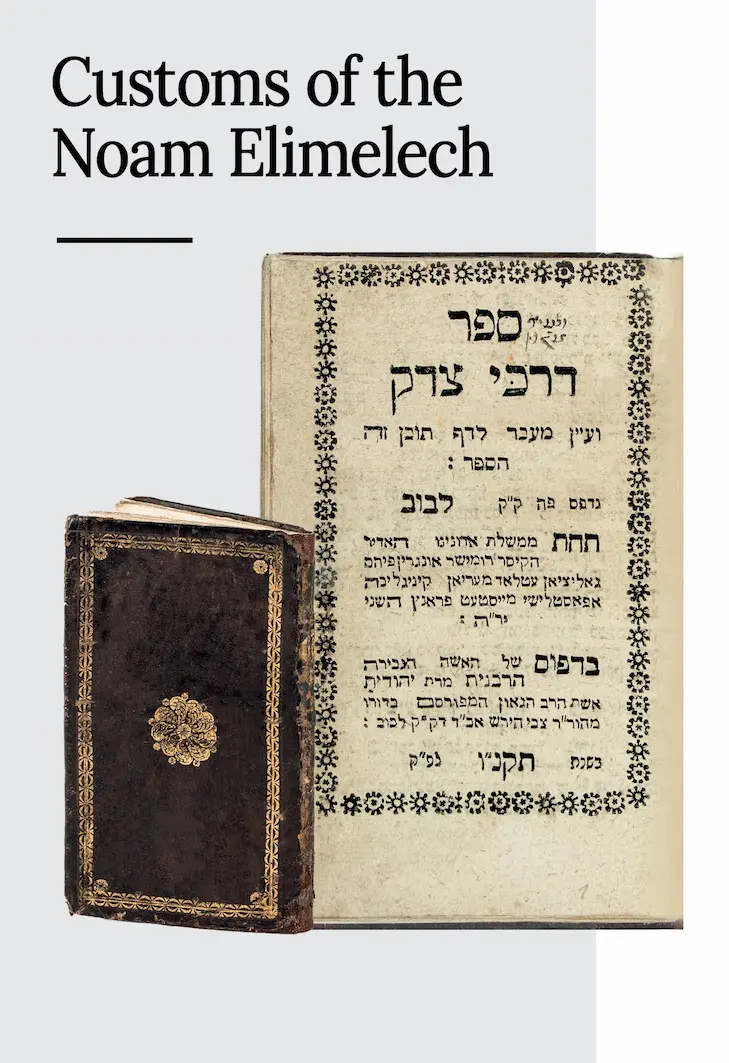
Lot : 106
Darkei Tzaddik by Rabbi Zecharyah Mendel of Yaroslav with Customs of Rabbi Elimelech of Lizhensk. First Edition. Lvov, 1796
Rituals and practices for serving Hashem according to Chassidic thought by Rabbi Zecharyah Mendel of Yaroslav, including practices from his spiritual master Rabbi Elimelech of Lizhensk, author of Noam Elimelech.
One of the first books detailing the customs of Chassidic Tzaddikim ever published!
The printer writes in his introduction, “…righteous practices…found copied by the well-known rabbi and Chassid… Rabbi Mendel, Av Beis Din of Liska. These practices are mentioned and practiced by one of the disciples of the great man of Elokim who is called holy, the well-known rabbi and Chassid, the holy light Rabbi Elimelech zt"l.”
Rabbi Zecharyah Mendel of Yaroslav was raised and educated by his uncle Rabbi Shmelke of Nikolsburg, and also guided by Rabbi Yechiel Michel of Zlotchov, yet his primary spiritual master was Rabbi Elimelech of Lizhensk. Rabbi Zecharyah was considered one of his greatest disciples, and it was he who authored the Iggeres Hakodesh printed at the end of Noam Elimelech as per Rabbi Elimelech’s instruction. As mentioned in the approbation of the Noam Elimelech, Rabbi Zecharyah was responsible for the first printing of the Noam Elimelech together with Rabbi Elazar.
Featured at the end of the sefer are “Hanhagos” of Rabbi Yechiel Michel of Zlotchov, a disciple of the Baal Shem Tov.
He also quotes concepts attributed to the Baal Shem Tov and Maggid of Mezritch.
Lvov, 1796. First edition. [24] leaves. Page size: 13.5 cm. Light professional restoration of last leaves, including text. Good condition. Antique leather binding with gold colored frames and decorations. Exceptionally rare.
Stefansky, Chassidus # 148
................................................
Any inquiries about this lot ?
We are available also on WhatsApp >>>


Lot : 107
Zera Kodesh by Rabbi Naftali of Ropshitz. First Edition. Lemberg, 1868
Two complete volumes of sefer Zera Kodesh by Rabbi Naftali Tzvi Horowitz of Ropshitz.
Vol. 1: Commentary on Torah
Vol. 2: Roshei Chodashim, Yomim Tovim and the Lekutei Moharam of his father Rabbi Menachem Mendel of Liska.
The author’s foremost disciple Rabbi Chaim of Sanz named the sefer Zera Kodesh (see the words of the publisher on the backside of the title page). His approbation appears in the sefer.
Chassidic masters treasured the Zera Kodesh and would study it diligently every Shabbos.
Rabbi Naftali of Ropshitz
(1760- 1827) was one of the great founders of Chassidus. He was born on the day the Bal Shem Tov passed away, and in reference to this Rabbi Chaim of Sanz said, “The sun rose and the sun set” (Ohel Naftali letter beis). He was the primary disciple of Rabbi Elimelech of Lizhensk and one of the great members of the chaburah of the Chozeh MiLublin. His uncle Rabbi Meshulam Igra taught him the Revealed Torah.
Rabbi Naftali paved a unique path in Chassidus and was always happy. He was brilliant and would often speak in riddles and in humor that concealed deep secrets. For this reason, his primary disciple Rabbi Chaim of Sanz referred to him as “the wise Admor” (Divrei Chaim Parshas Noach).
Lemberg, 1868. First edition. Vol 1: [2] [124] leaves. Vol 2: [1] 104 leaves. Page size: 22cm. Volume 2 has a separate title page. Title page of volume 1 has ink stains and erasures. Both volumes bound together in new leather binding. Good condition.
Stefansky, Chassidus # 208
................................................
Any inquiries about this lot ?
We are available also on WhatsApp >>>

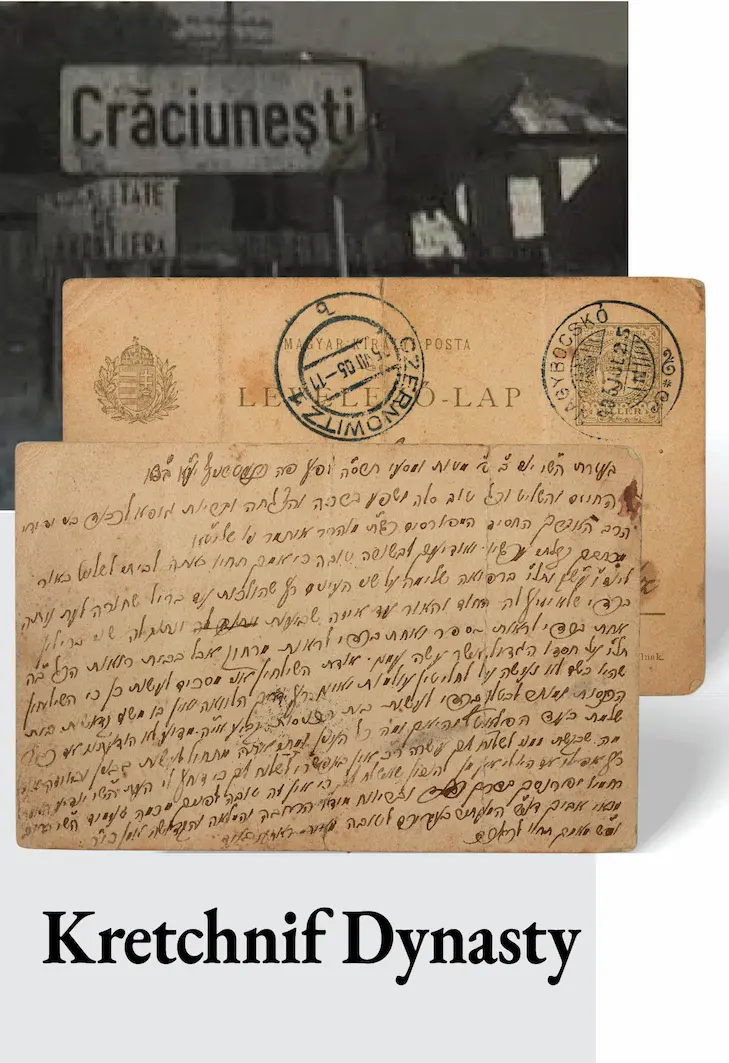
Lot : 109
“In His great compassion, may Hashem Yisborach grant you parnassah with dignity and comfort from His wide and open Hand”
Handwritten Letter by the Admor and Miracle-Worker Rabbi Meir of Kretchnif. 1905
Handwritten letter on postcard by the first Admor of Kretchnif, Rabbi Meir Rosenbaum to his son the Admor Rabbi Issamar of Nadvorna.
The
Admor Rabbi Meir Rosenbaum of Kretchnif
(1852-1908) was the son of the Admor Rabbi Mordechai of Nadvorna of the Nadvorna-Premishlan dynasty. He was appointed Admor during his father’s lifetime, and in 1896, moved to Kretchnif near Sighet where he soon gained repute as a holy tzaddik and pious miracle worker who distributed amulets to those in need and whose blessings were fulfilled. He was the only child whom his father permitted to write amulets. His fear of heaven and dveikus were so compelling that it was an inspiration to many. Rabbi Meir’s divrei Torah and lectures were compiled in the sefer Arba Arazim, and all of his sons and sons-in-law served as Admorim in different cities, most notably among them Rabbi Issamar of Nadvorna and Rabbi Eliezer Zev of Kretchnif.
The letter discusses the Rebbetzin of Kretchnif’s failing eyesight, progress on construction of Rabbi Issamar of Nadvorna’s beis medrash, and the son’s financial situation.
The addressee of the letter was the Admor of Kretchnif’s son,
Rabbi Issamar of Nadvorna (1886-1973). One of the great sages of the last generation, Rabbi Issamar first began acting as Admor in Czernowitz at the age of 15, and this letter was sent to him when he was only 19 years of age.
Kretchnif, 1905. Handwritten postcard by the Admor of Kretchnif. Postmarked in Czernowitz. Good condition.
............................................... .
Any inquiries about this lot ?
We are available also on WhatsApp >>>

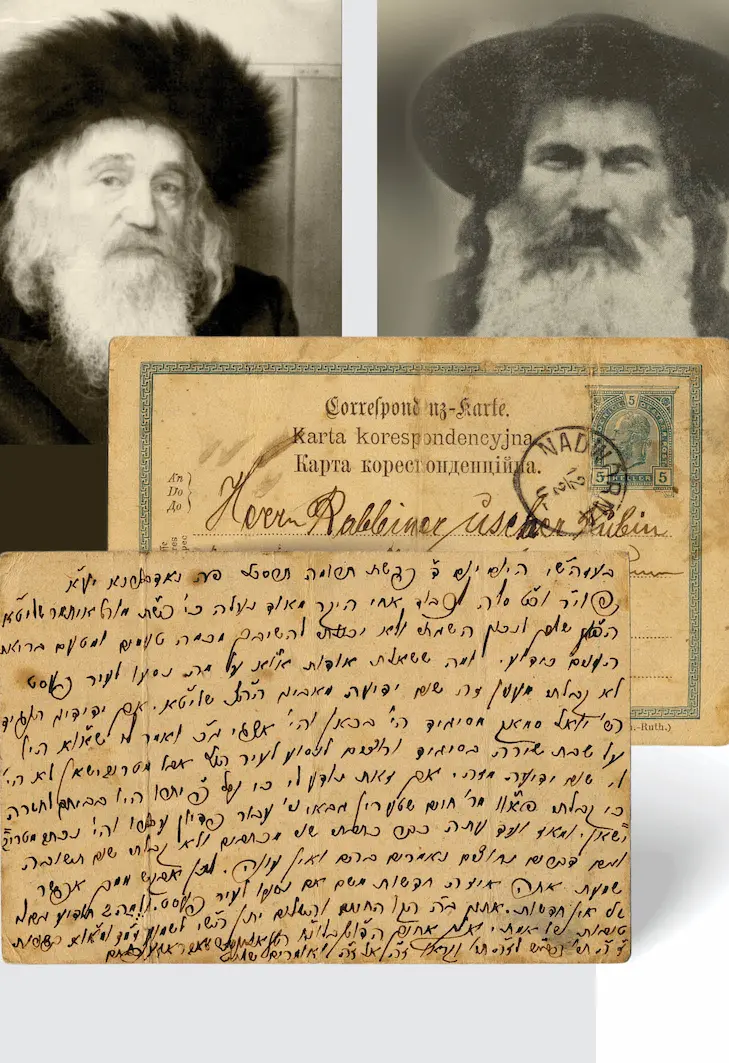
Lot : 110
Handwritten Letter by Rabbi Eliezer Zev of Kretshnif to His Brother the Admor Rabbi Issamar of Nadvorna. 1902
An early and rare personal letter in the holy hand of the Admor Rabbi Eliezer Zev of Kretshnif to his brother the Admor of Nadvorna concerning their parent's trip to Pest.
The Admor was only 22 years old when he wrote this letter.
The holy miracle worker, the Admor Rabbi Eliezer Zev of Kretshnif
(1880-1944) was the son of Rabbi Meir of Kretshnif. He lived in the city of Nadvorna and was supported by his father-in-law, the Raavad of the city. At the age of 16 he was already a community leader, and upon his father’s passing, assumed his position as Rav of Kretshnif. He later served as Rav of Sighet until he was murdered in Auschwitz. His life, and the wonders he performed are chronicled in Raza D’uvda.
He was the father of the Admor Rabbi Dovid Moshe Rosenbaum of Kretshnif, and the grandfather of the Admorim of Kretshnif-Chadera, Kretshnif-Kiryat Gat, and Premishlan-Bnei Brak.
Nadvorna, 1902. Autographed handwritten postcard.
............................................... .
Any inquiries about this lot ?
We are available also on WhatsApp >>>

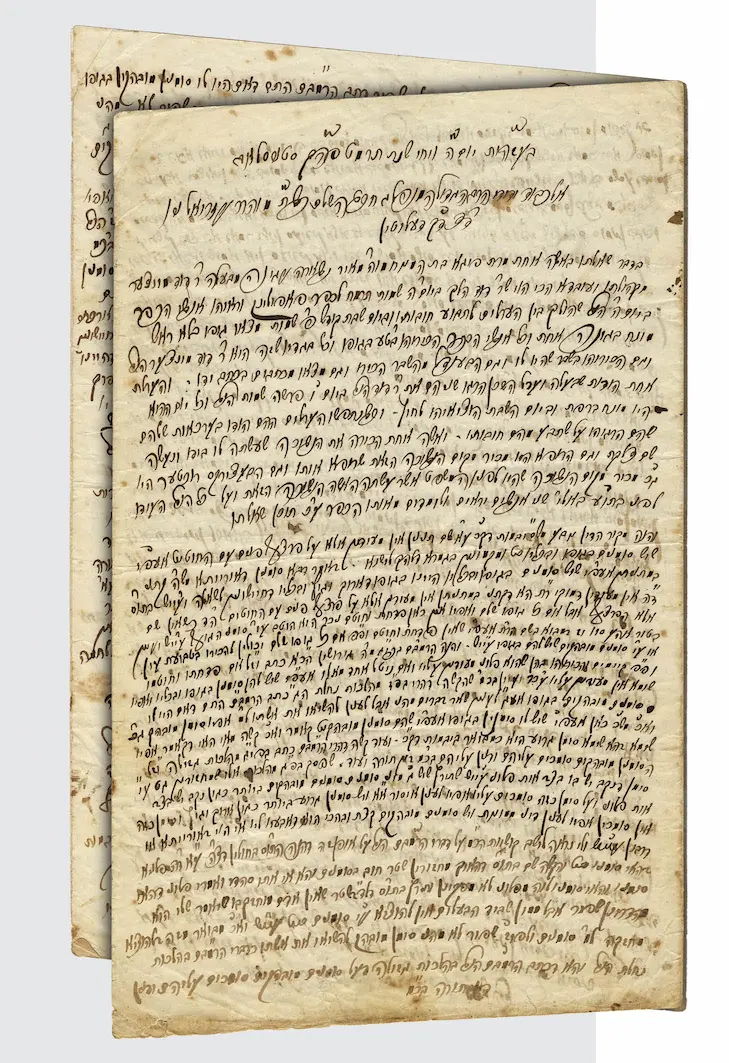
Lot : 111
Teshuvah by
Rabbi Yitzchak
Halevi Horowitz
Av Beis Din of Stanislav. 1889
Handwritten teshuvah by Rabbi Yitzchak Halevi Horowitz, Av Beis Din of Stanislav and author of Meah Shearim. Rabbi Yitzchak was the son of the famous Bar Levai, and the father of the Harei Besamim.
Teshuvah regarding an agunah. Stanyslav, 1889. 2 large leaves; 4 sides. This teshuvah was sent to the great kabbalist Rabbi Ezriel Halevi Landau, Av Beis Din of Delitin. (Rabbi Ezriel Halevi was a descendant of the Meir Nesivim, a disciple of the Mahar”i of Ziditchov.
Not signed.
Stanyslav, 1889. Size: 34x21 cm. • Page Count: 4 large sides.
............................................... .
Any inquiries about this lot ?
We are available also on WhatsApp >>>

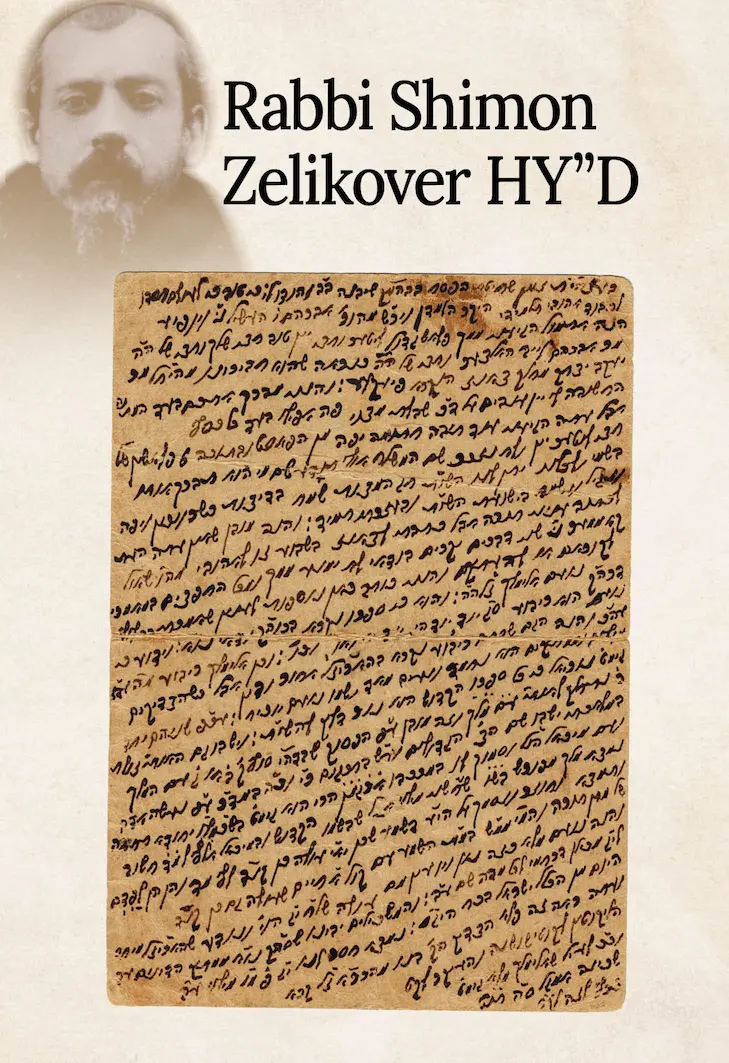
Lot : 112
The secret behind the name of the holy sefer Noam Elimelech, handwritten by Rabbi Shimon Zelikover HY”D
“The intelligent will understand that the sefer Noam Elimelech sweetens harsh judgments upon Klal Yisrael until today.”
A wondrous letter in which the holy gaon of Zelikov reveals amazing secrets concerning the naming of the sefer Noam Elimelech by Rabbi Elimelech of Lizhensk, based on the hidden Torah and the writings of the Arizal.
The body of the letter contains an addendum to the words he delivered upon the holy Noam Elimelech on his yahrzeit. He explains in great detail that “his sefer was named with ruach hakodesh.” Later he writes, “and now see the wonder of this holy tzaddik whose son called the compilation Lekutei Shoshanah, ” explaining that this name was also based on gematria and secrets of the Torah.
Rabbi Avraham Shimon Halevi Engel-Horowitz from Zelikov Hy”d
(1876-1943) was known in his time as Rabbi Shimmale Zelikover. He was one of Poland’s great Torah sages, who was, according to his foremost disciple the Shevet Levi, “a tremendous genius…and all the pathways of the Hidden and Revealed Torah were as clear to him as they were when given at Har Sinai.” He remained largely anonymous, a hidden tzaddik, until Rabbi Meir Shapira appointed him Mashgiach Ruchani of Yeshivas Chachmei Lublin, bringing him to the forefront of Torah dissemination in the Chassidic enclaves of pre-Holocaust Europe. Upon the liquidation of the Cracow ghetto, he was deported wrapped in tallis and tefillin along with the rest of the Jews. Hy”d.
Zelikov, 14th of Nissan, 1934. Double-sided postcard, good condition.
................................................
Any inquiries about this lot ?
We are available also on WhatsApp >>>

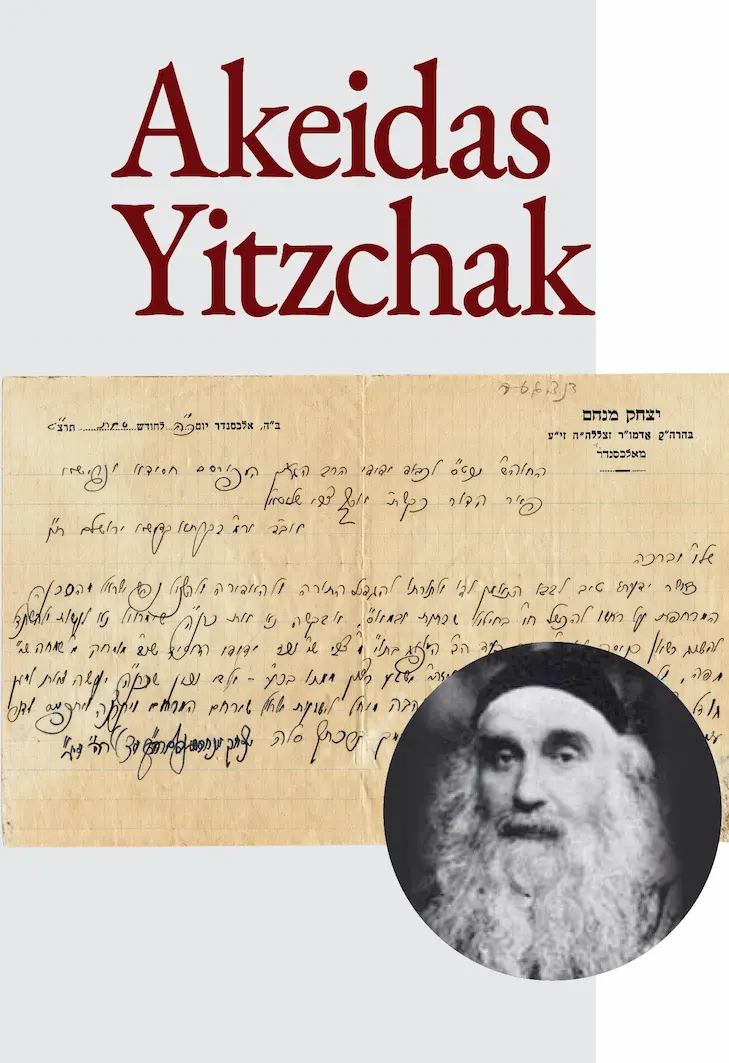
Lot : 113
Autographed Appeal to Rescue a Student from Polish draft, by the Akeidas Yitzchak. Alexander, Polin 1939
Autographed letter by the holy Admor of Alexander, Rabbi Yitzchak Menachem Danziger Hy”d to Rabbi Yosef Tzvi Dushinsky, Av Beis Din in Jerusalem.
In this letter, the Admor implores the Maharitz Dushinsky to urgently obtain an immigration certificate for a Polish bachur and to accept him into his yeshivah in Jerusalem in order to “Rescue him from the dangers hanging above his head, desecrating Shabbos and eating forbidden foods”—a reference to the Polish draft.
The
Admor Rabbi Yitzchak Menachem of Alexander Hy”d
(1880-1942) was one of the great Chassidic masters in prewar Poland, and author of Akeidas Yitzchak. In 1924, he was crowned Admor of Alexander which, at the time, was the second-largest Chassidus in all of Poland.
Rabbi Yitzchak Menachem was a disciple of both his grandfather, the Admor Rabbi Yechiel of Alexander, founder and progenitor of the Alexander Chassidus, and his uncle the Yismach Yisrael. During World War Two, he was one of the privileged few to receive an immigration certificate to Eretz Yisrael, yet he nobly refused to abandon his chassidim in the inferno. He suffered hunger and privation for two years in the Warsaw Ghetto and was then deported to Treblinka. Many tales of miracles and wonders that he engendered on behalf of others, healing the sick and bringing children to the barren, were published in Ro’eh Ne’eman.
Alexander, 1939. Autographed on personal stationery. Page size: 14x21 cm. Good condition.
............................................... .
Any inquiries about this lot ?
We are available also on WhatsApp >>>

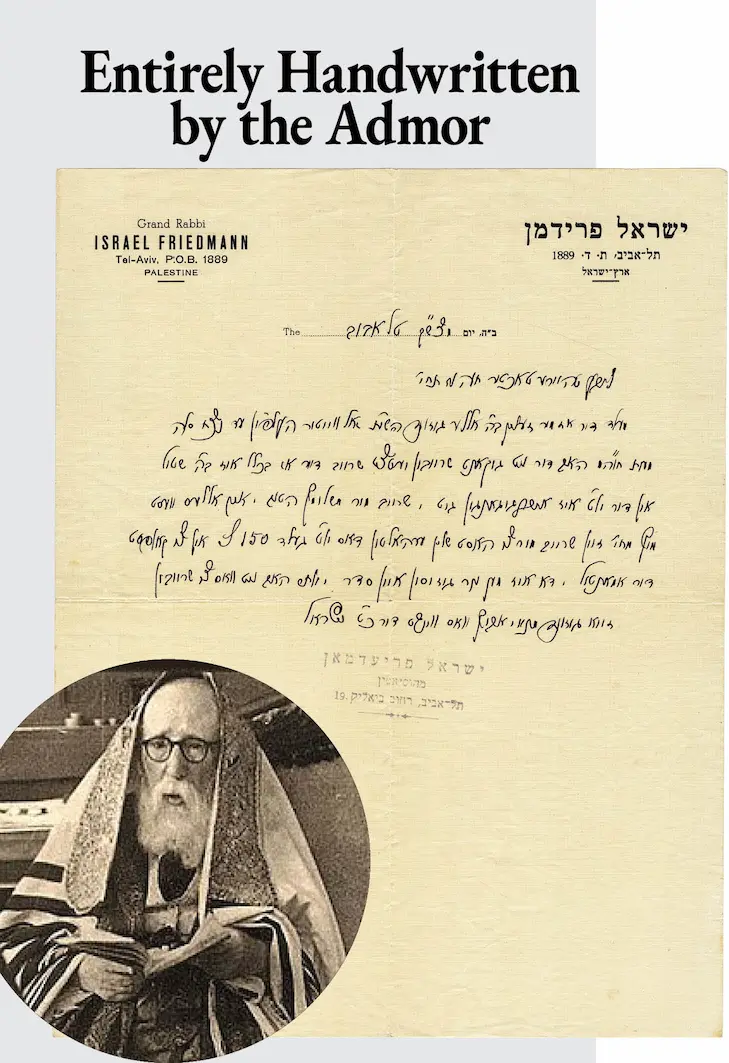
Lot : 114
Handwritten, Autographed & Stamped Letter by the Admor Rabbi Yisrael of Husyatin, Grandson of Rabbi Yisrael of Ruzhin. Tel Aviv, 1930s
The present letter was entirely handwritten and autographed by the holy Admor Rabbi Yisrael of Husyatin to his daughter Rebbetzin Chava (Chavenyi), wife of the Admor Rabbi Menachem Nachum of Husyatin.
The letter opens with the Admor’s salutation to his dear daughter, “
Dear beloved daughter Chavenyi” and concludes with his best wishes, “
Be well. From me, your father who wishes you all the best. Yisrael”.
The
Admor Rabbi Yisrael of Husyatin
(1858-1949) was the only grandson of holy Ruzhiner Rebbe. Was known as a genius and miracle worker whose blessings merited in bringing salvation for those in need , it was said that the ruach hakodesh that hovered upon him was nearly palpable, as it was for the great Admorim of generations past.
In 1894, Rabbi Yisrael succeeded his father Rabbi Mordechai Feivish (son of Rabbi Yisrael of Ruzhin) as Admor of Husyatin. During World War I, he emigrated to Vienna and subsequently embarked on a journey to Eretz Yisrael where he settled in 1937 and was venerated as the elder of all the Chassidic Admorim.
Tel Aviv, 1930s. Handwritten, autographed and stamped on personal stationery. Good condition.
................................................
Any inquiries about this lot ?
We are available also on WhatsApp >>>

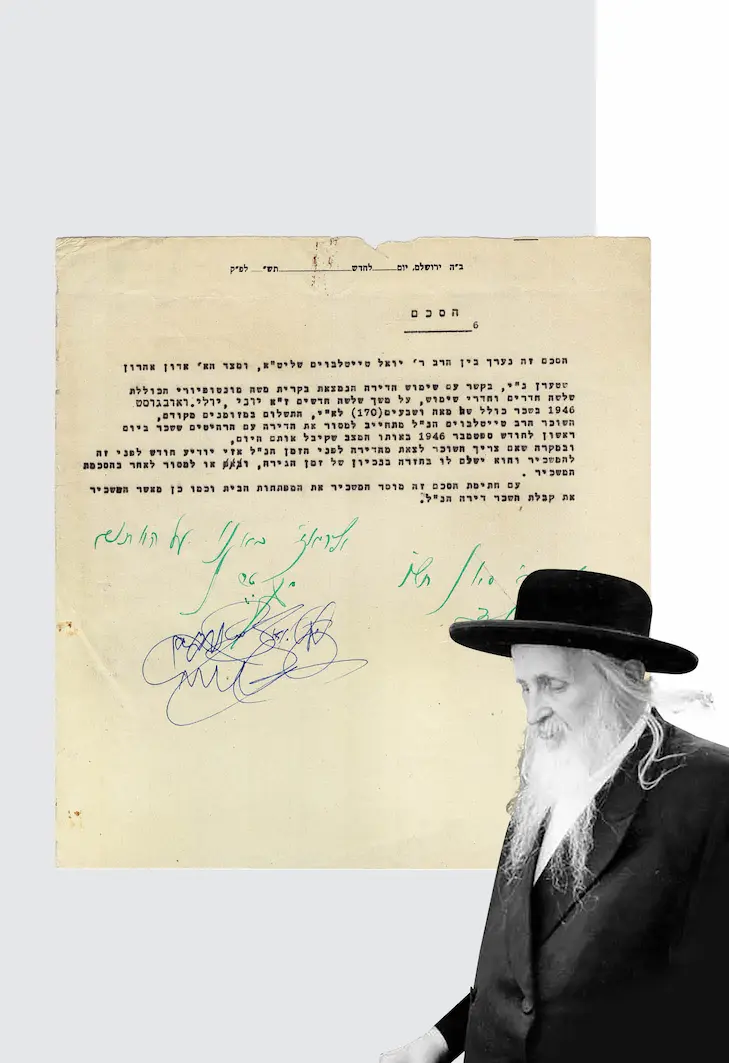
Lot : 115
Rare Document
Rental Contract of the Admor Rabbi Yoel Teitelbaum of Satmar upon His Arrival in Yerushalayim after the Holocaust. Jerusalem, 1946
Rabbi Yoel Teitelbaum arrived in Switzerland on the 21st of Kislev in the year 1945. After a few months of recuperation, he left Switzerland for Eretz Yisrael, spent a year in the Beis Yisrael neighborhood and then moved to America.
This contract was for a rental apartment in Kiryat Moshe during the summer months that was meant to provide the Admor with time to recuperate. In those times, it was common for Admorim to vacation in Kiryat Moshe, which was a short but significant distance from the bustling city.
The contract was signed in June 1946.
Jerusalem, 1946. Page size: 23x22 cm. The body of the contract is typewritten with handwritten signatures.
................................................
Any inquiries about this lot ?
We are available also on WhatsApp >>>

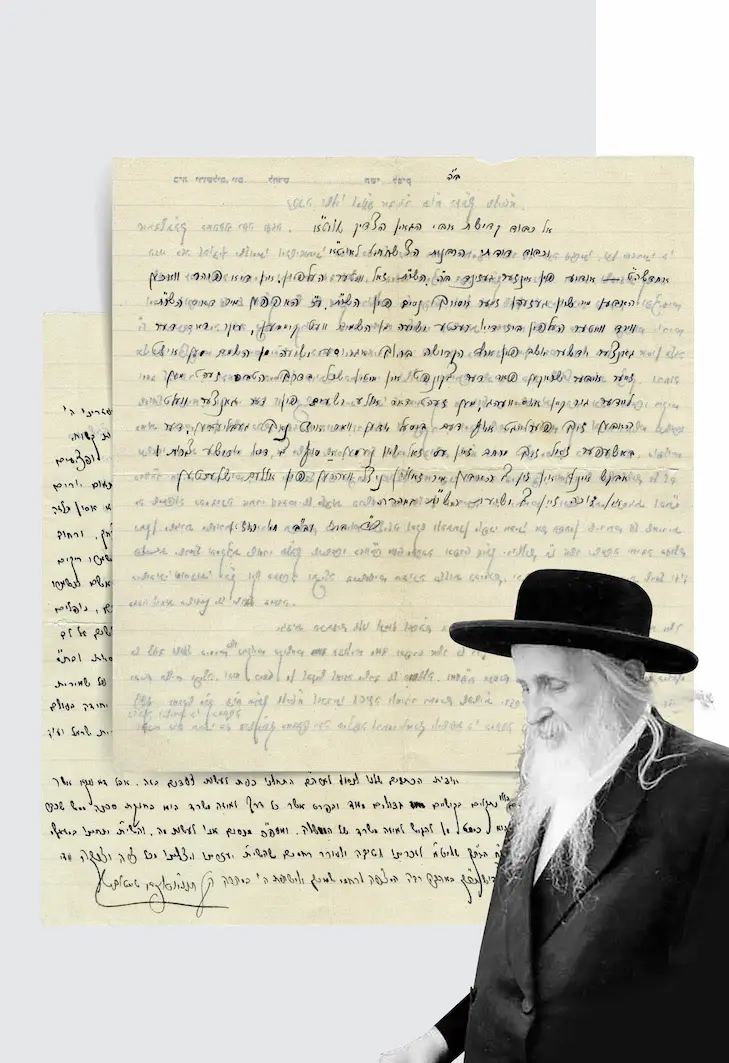
Lot : 116
Letter to the Admor Rabbi Yoel of Teitelbaum from His Daughter and Son-in-Law Rabbi Chananya Yom Tov Lipa Teitelbaum Regarding the Terror in Eretz Yisrael. Jerusalem, 1948
Two personal letters one from Rebbetzin Chaya Roiza Teitelbaum and the other from her husband Rabbi Chananya Yom Tov Lipa Teitelbaum, Av Beis Din of Szentmihály and Raavad of Satmar Institutions In Yerushalayim, to their father and father-in-law the Admor Rabbi Yoel of Satmar.
In his letter, Rabbi Chananya Yom Tov Lipa describes the tragic wave of pogroms and terror targeting the innocent Jews of the Yishuv that followed the United Nation’s proclamation to divide the State. He vividly conveys the dangers and terror felt when walking the streets, and the urgent prayers being held in shuls everywhere. He expresses his concerns regarding the impending departure of the British and entreats his father-in-law to pray for their safety and welfare.
The Admor
Rabbi Chananya Yom Tov Lipa Teitelbaum
(1836-1904) was the son of the Admor of Sassov Rabbi Chanoch Henoch, scion of the Alesk dynasty and author of the Ein Chanoch. He married the pious Rebbetzin Chaya Roiza, daughter of the Admor Rabbi Yoel of Satmar, and administered the famous yeshivah in Satmar. Rabbi Chananya Yom Tov Lipa was miraculously rescued with his wife from the flames of the Holocaust, and they made the harrowing journey together to the Holy Land. When Rabbi Yoel first visited Eretz Yisrael after the war, he stayed in their home, and eventually all three made their way to the United States. Sometime later, Rabbi Chananya Yom Tov Lipa returned to Eretz Yisrael where he founded Kiryas Yismach Moshe in Petach Tikva. His written legacy includes the sefer Minchas Yom Tov.
The righteous
Rebbetzin Chaya Roiza Teitelbaum (d. 1953) was the daughter of the Admor Rabbi Yoel of Satmar. She was renowned as a great tzaddekes who “Pursued charity and lovingkindness and built many homes on foundations of purity” (epitaph on her tomb in Teveria). She passed away at a relatively young age, and her death evoked tremendous pain and grief in her father and all Satmar chassidim as she was the very last remnant of his illustrious family.
Jerusalem, 1948. Page size: 20x22 cm. Harav Chananya Yom Tov Lipa’s letter is written in Hebrew, and his wife’s letter is written in Yiddish.
............................................... .
Any inquiries about this lot ?
We are available also on WhatsApp >>>

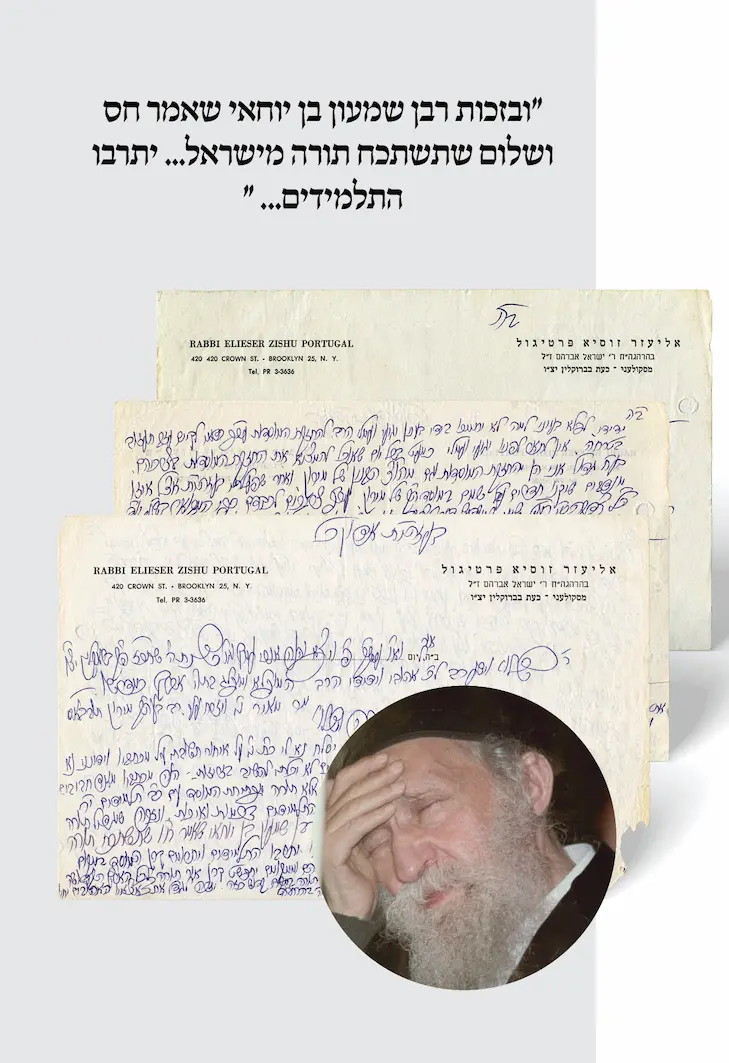
Lot : 117
“The institution shall be established at the resting place of Rabi Shimon Bar Yochai”
Handwritten and Autographed Letter by the Admor of Skulen, Rabbi Eliezer Zusia Portugal Concerning the Establishment of his Chessed L’Avraham Institutions in Meron
Brooklyn, 1967
As part of the Admor of Skulen’s intense efforts on behalf of Jewish children, he established a Talmud Torah and Yeshivah in Meron for the children of the Galilee who weren’t accepted into the mainstream school system.
In the letter, the Admor asks for plaques to be hung in the classrooms bearing the names of the donors, as well as photographs to show donors who helped fund construction of the building.
He also references a Chassidic thought told by the Baal Shem Tov upon the words of our sages, “Hamaschil b’mitzvah omrim lo g’mor.”
The Admor Rabbi Eliezer Zusia Portugal from Skulen
(1898-1982) was a great Torah sage who was connected to the Admorim of Ruzhin. He served as Rabbi of Skulen, Romania from the age of 17.
Later he was asked to move to Czernowitz were he established a Beis Medrash and devotedly cared for the Jews of Romania, especially child survivors of the war. He had an open home and supported many destitute children. He managed to leave Romania for America in the year 1960 where he established Mosdos Chessed L’Avraham to aid the children of survivors from Romania, Transylvania, Bukovina and Marmarosch.
The letter was sent to the Rabbi of Meron, Rabbi Meir Stern zt”l who was appointed by the Admor to oversee his institutions.
Brooklyn, 1967. Written on two small pieces of stationery. The first page is double-sided. Entirely handwritten and autographed. Minor tear and holes.
................................................
Any inquiries about this lot ?
We are available also on WhatsApp >>>

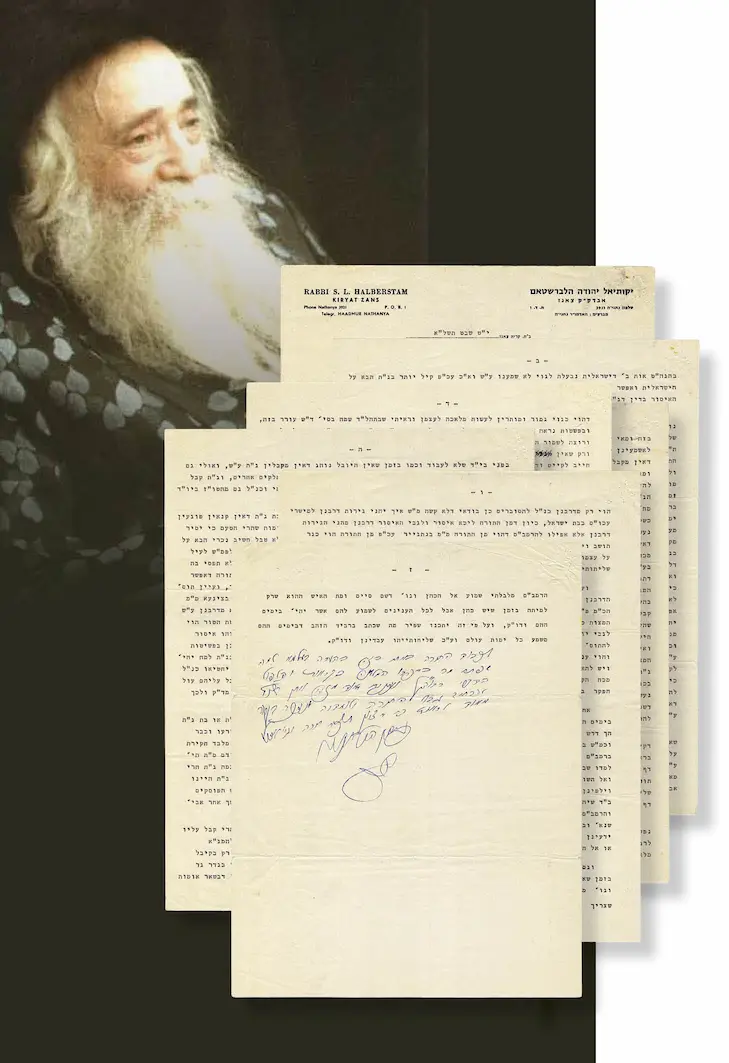
Lot : 118
Autographed Kuntress of Chiddushei Torah by the Admor Rabbi Yekusiel Yehuda Halberstam of Sanz-Klausenburg. Netanya, 1971
A lengthy pamphlet of chiddushei Torah on the subject of accepting converts in contemporary times authored by the holy Admor Rabbi Yekusiel Yehuda Halberstam of Klausenburg. This pamphlet was sent to the author of Einayim Lamishpat. The pamphlet was typewritten but features several handwritten glosses. The last page boasts 5 lines of a handwritten conclusion replete with blessings in the Admor’s handwriting and with his autograph.
The Admor Rabbi Yekusiel Yehuda Halberstam
(1905-1994), author of Shefa Chaim and Divrei Yatziv, renowned for his holiness and righteousness especially his tremendous mesirus nefesh during the Holocaust, was a genius in both the Revealed and Hidden Torah and a prolific author who inscribed many teshuvos. After surviving the Holocaust, he dedicated his life to facilitating his fellow survivors physically and spiritually, and rebuilt the decimated Sanz Chassidus on the holy soil of Eretz Yisrael where he established a wealth of Torah institutions, charity organizations and facilities in Kiryat Sanz in Netanya.
Netanya, 1971. 7 leaves. Page size: 28 cm. Printed in Shu”t Divrei Yatziv Vol. 6 Ch. 1 without the Admor’s concluding words.
................................................
Any inquiries about this lot ?
We are available also on WhatsApp >>>

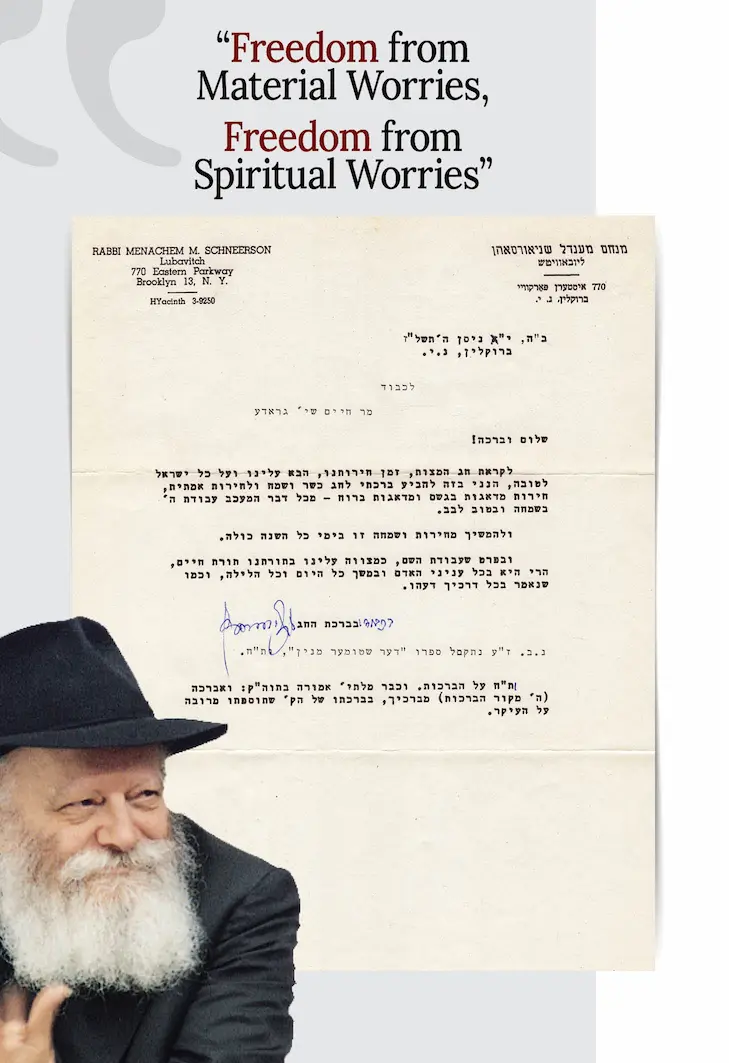
Lot : 119
Freedom from Material Worries, Freedom from Spiritual Worries”
Letter of Blessings for Pesach from the Admor Rabbi Menachem Mendel Schneerson of Chabad Lubavitch
Igeres Kodesh with warm blessings for Pesach 1977, autographed by the Admor Rabbi Menachem Mendel Schneerson of Chabad Lubavitch.
“As Chag Hamatzos approaches…I express my blessings for a happy and kosher Yom Tov and for true freedom…and to continue this freedom and happiness into the entire year.”
The
Admor Rabbi Menachem Mendel Schneerson
(1902-1994) was the seventh Admor of the Chabad-Lubavitch dynasty and one of the foremost Chassidic leaders in the last generation. Until this day, the Torah empire he built extends to countries throughout the world, where his emissaries engage actively in outreach and promote mitzvah observance in order to hasten the coming of Mashiach.
In the margins of this letter the rebbe thanks the writer for sending him a copy of his book, Der Shtumen Minyan.
Brooklyn, New York. The 10th of Nissan, 1977. Good Condition.
............................................... .
Any inquiries about this lot ?
We are available also on WhatsApp >>>

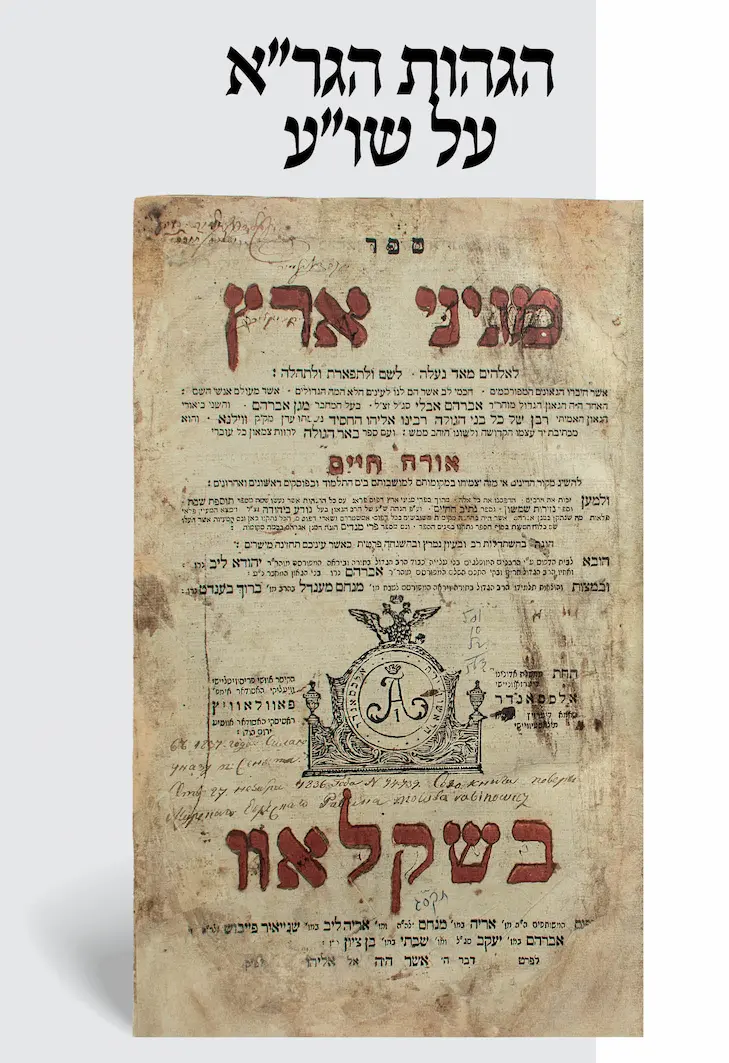
Lot : 120
The Vilna Gaon
Jewish Fundamental
The Vilna Gaon’s Commentary on Shulchan Aruch Orach Chaim. First Edition. Shklov, 1803
Distinguished provenance!
First edition of Shulchan Aruch Orach Chaim with Biur HaGr”a printed from “His holy handwritten manuscript in his own precious words.”
Shulchan Aruch Orach Chaim with Biur HaGr”a was brought to print by the Vilna Gaon’s sons Rabbi Yehuda Leib and Rabbi Avraham, and his prime disciple Rabbi Menachem Mendel of Shklov. It was edited and prepared for print by another disciple, Rabbi Yisrael of Shklov, and the Vilna Gaon’s grandson Rabbi Yaakov Moshe of Slonim, who was the son of Rabbi Avraham ben HaGr”a.
Biur HaGr”a is one of the contemporary fundamental sources of halacha, the Chafetz Chaim consistently rules accordingly, as written in the preface to Mishnah Berurah Vol. 1: “In every place where I see two opinions between two Achronim on the same matter, I did not shy of searching among the other Achronim, and
especially in the Biur HaGr”a z”l who was the luminary of Yisrael and the stake that all depends on it, and he is worthy of resolving a case.”
The sefer opens with the famous introductions of Rabbi Chaim of Volozhin and the Vilna Gaon’s sons who mention their father’s great disciples.
Biur HaGr”a on Shulchan Aruch was written directly by the holy hand of the Vilna Gaon (as opposed to being transcribed by his talmidim) and was written in very concise format, his talmid Rabbi Chaim of Volozhin wrote
“Although his words are short, they are as stars that appear small, but the entire world stands beneath it.”
The Gr”a’s in his commentary reveals the sources of the Shulchan Aruch’s rulings in the Talmud Bavli and Yerushalmi. Rabbi Chaim of Volozhin expresses in his preface to the Biur HaGr”a that “Here the Vilna Gaon established the foundations of his path of study, to mention in the course of learning Shulchan Aruch its source in Shas.”
This copy bears the distinguished provenance and and autograph of
Rabbi Yaakov Berlin of Mir
(1794-1870) on the title page and flyleaf. Rabbi Yaakov Berlin was the father of the Netziv of Volozhin. In 1854, he journeyed to Jerusalem where he served as one of the leaders of the Ashkenazic Yishuv.
The leaves of this sefer also contain numerous marginalia, one of which is sighed “Chaim Tzvi” from
Rabbi Chaim Tzvi Broide
(1841-1911), Av Beis Din of Zager and author of Shut”a She’aris Chaim who also settled in Jerusalem in his latter years. Rabbi Chaim Tzvi Broide’s daughter married Rabbi Zelig Reuven Bengis. Based on the handwriting, it is clear that other annotations in this sefer were written by him.
Shklov, 1803. First edition. [1], 3, 346, [1], leaf. Page size: Almost 35 cm. Printed together with Magen Avraham and Be’er Hagolah, who was the Vilna Gaon’s ancestor. Stains and signs of use; professional restorations of tears with missing parts of margins, especially on title page and first and last pages . New half-cloth and marbleized paper binding.
Winograd. Otzar Sifrei HaGr”a #747. Stefansky, Sifrei Yesod #169.
................................................
Any inquiries about this lot ?
We are available also on WhatsApp >>>

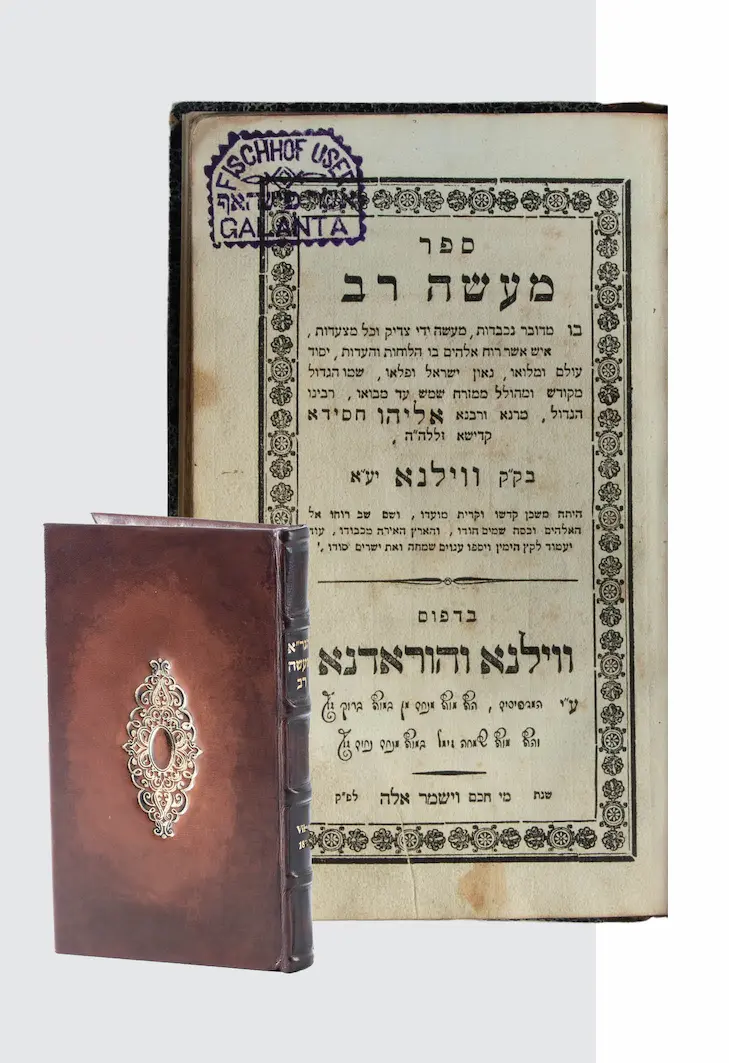
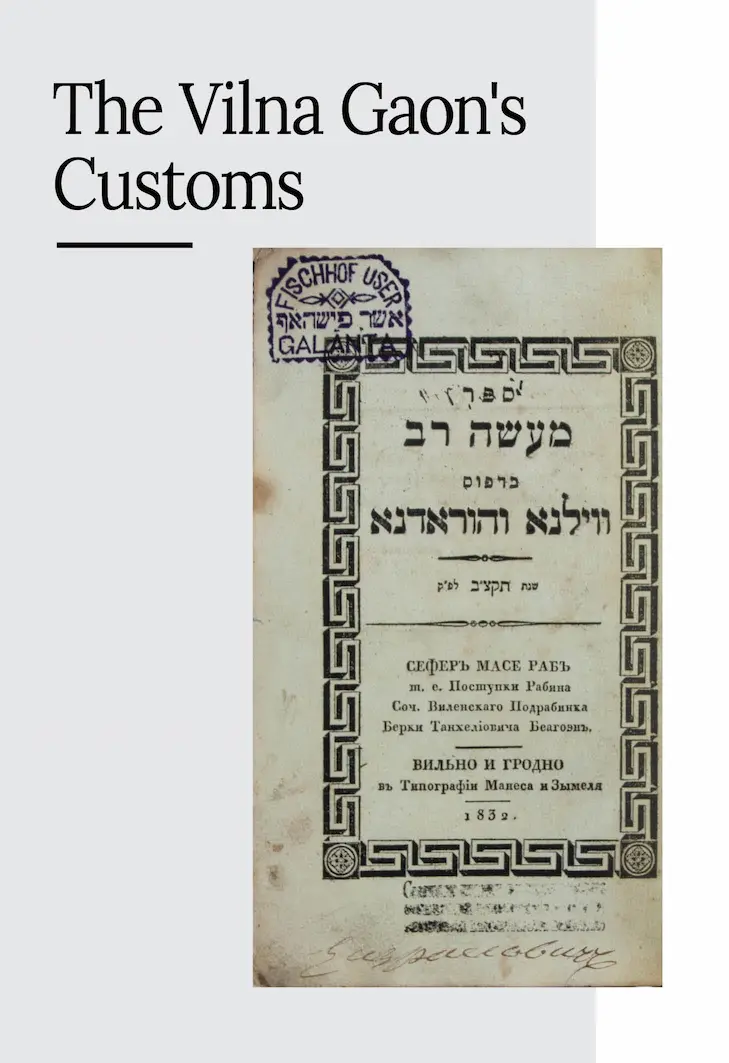
Lot : 121
Foundational Sefer of the Vilna Gaon’s Customs
Maaseh Rav. First Edition. Vilna-Grodna, 1832
The customs, rites, practices, and special prayers of the Vilna Gaon.
Edited and compiled by Rabbi Yissachar Ber ben Rabbi Tanchum of Vilna.
Beautiful copy complete with both title pages.
Sefer Maaseh Rav has been accepted as the most reliable source for the customs of the Vilna Gaon. The Torah sages of the following generations studied this sefer in depth in order to clarify the Vilna Gaon's customs, and the Chafetz Chaim cites most of the customs that relate to Orach Chaim in the Mishnah Berurah.
Written by
Rabbi Yissachar Ber ben Rabbi Tanchum of Vilna
(1779-1855) who was one of Vilna’s great dayanim and the spiritual leader of “The Gr”a’s Kloiz”. He compiled Maaseh Rav based on what he witnessed firsthand in the Vilna Gaon’s Beis Medrash, as well as on the writings of his disciples Rabbi Sa’adya ben Rabbi Nosson Neta and Rabbi Menachem Mendel of Shklov.
This first edition was published anonymously.
A letter by Rabbi Chaim of Volozhin appears at the beginning of the sefer, as do approbations of the Chayei Adam and Rabbi Avel Posvillier, Av Beis Din of Vilna.
Vilna-Grodna, 1832. First edition. [3], 67 leaves. Page size: 18.3 cm. Minor professional restoration of both title pages, good condition, new quality leather binding.
Winograd, Otzar Sifrei HaGr”a # 808/ Stefansky, Sifrei Yesod p. 63 in the appendix.
................................................
Any inquiries about this lot ?
We are available also on WhatsApp >>>

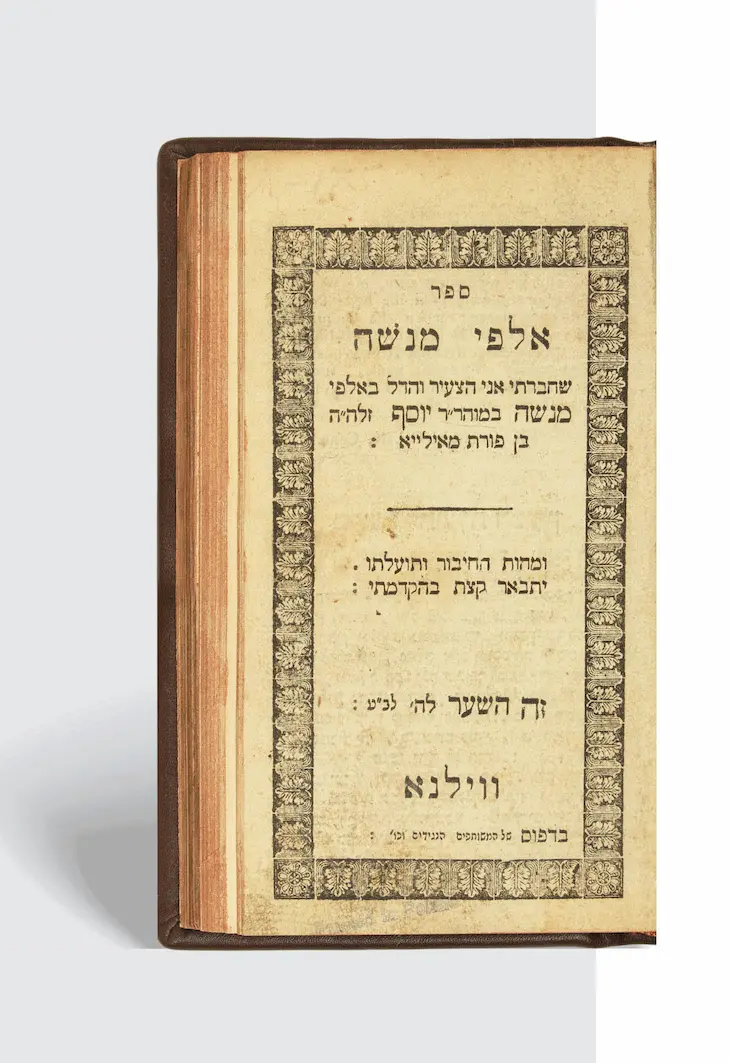
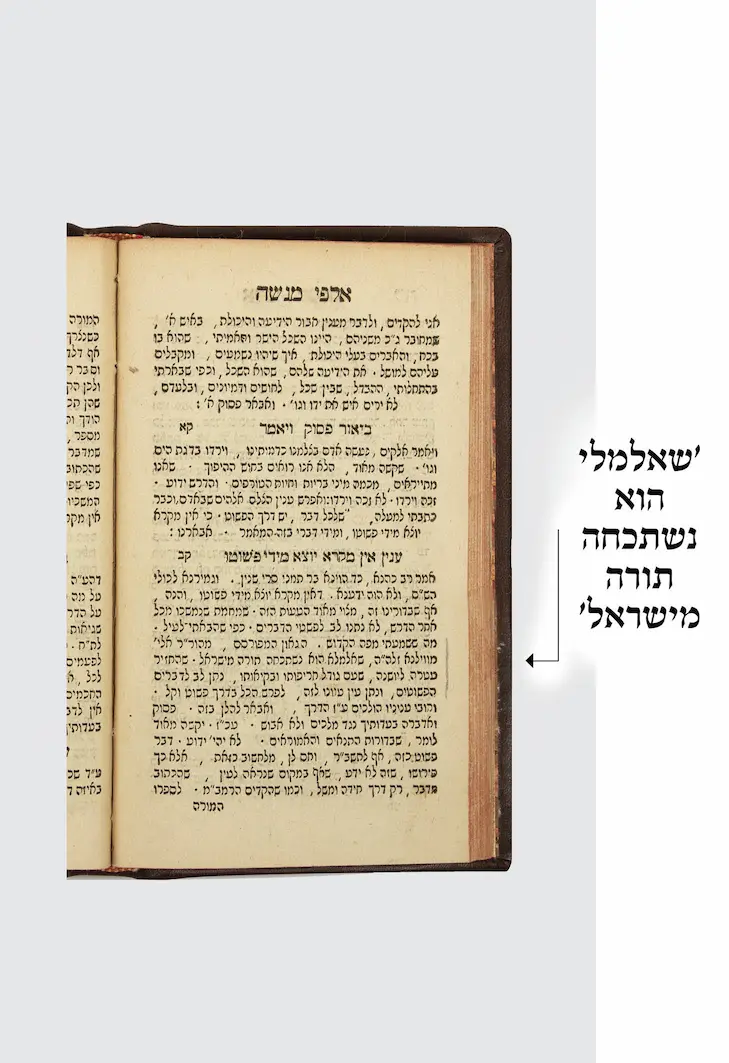
Lot : 122
Alfei Menashe by Rabbi Menashe of Ilya. First Edition. Vilna, 1822
Chiddushim and commentary on the Torah and Chazal; the essence of the world and its spiritual rectification; and mussar lessons by Rabbi Menashe of Ilya.
Rabbi Menashe of Ilya
(1767-1831) was privileged to study under the Vilna Gaon and perpetuate his legacy in Torah. In the present sefer, he writes “Without him [the Gr”a], Torah would have been forgotten among Yisrael” (Leaf 38b). Rabbi Menashe followed the Torah of the Vilna Gaon, focusing on the clarity of pshat instead of on pilpul (see Leaf 73b).
Adhering to the Vilna Gaon’s methods, Rabbi Menashe authored original chiddushim that had never been discussed by previous authors of sefarim. His sefer Alfei Menashe was highly acclaimed by the scholarly world.
Vilna, 1822. First edition. [2], 92 leaves. Page size: 16 cm. Good condition. Attractive new leather binding.
Winograd, Otzrei Sifrei HaGr”a #1568. Rabbi David Kamenetzky, Hagaon Rabbi Menashe Me’Iliya zt”l. Yeshurun Vol. 20 ppgs.
1969-2021.
................................................
Any inquiries about this lot ?
We are available also on WhatsApp >>>

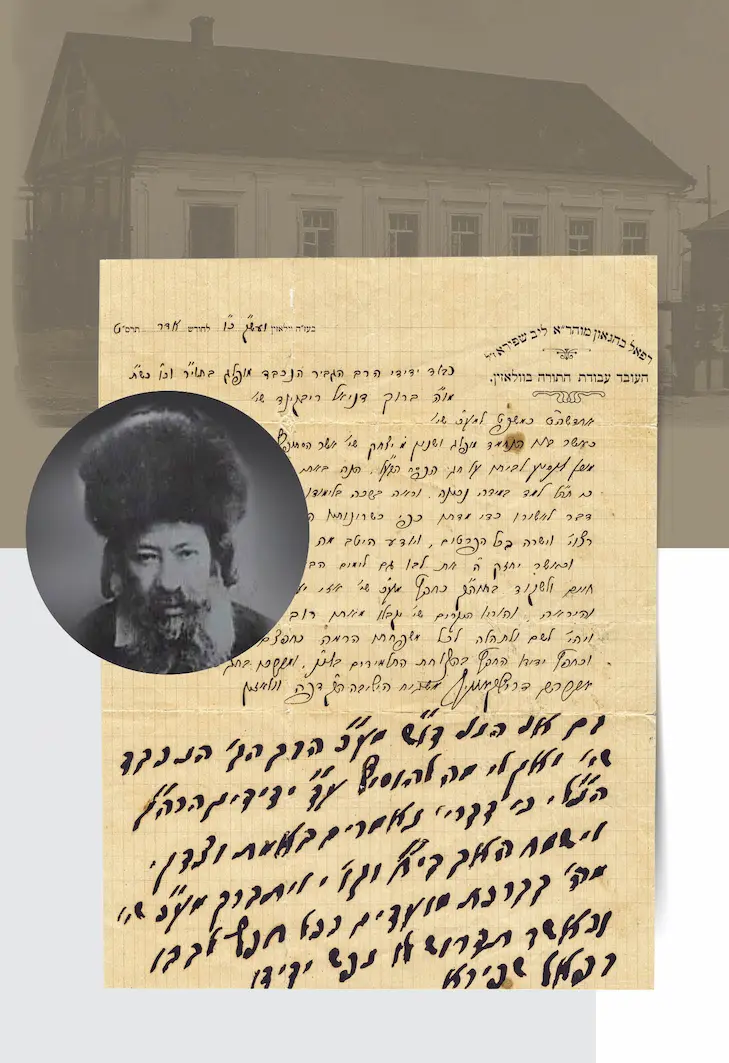
Lot : 123
Letter by the Rosh Yeshivah of Volozhin, Rabbi Refael Shapiro. Volozhin, 1909
letters written by Rabbi Avraham Drushkowiz Mashgiach of Volozhin with a letter from the Rosh Yeshivah of Volozhin Rabbi Refael Shapiro to the parents of a talmid of the Volozhin Yeshivah who returned home for Pesach after being in the Yeshivah for a while. In the letter, they describe the young man’s great achievements in learning and his fine comportment.
“His conduct was pleasing and proper in all matters, and he knows the material learned during the zman well.”
Rabbi Refael Shapiro of Volozhin
(1837-1921) was the son of Rabbi Leibele of Kovno. In his youth, he joined the yeshivah of Volozhin, where he quickly became a rising star and drew the attention of the famed Netziv of Volozhin who took him as a son-in-law. In 1865, he began relaying shiurim in the yeshivah which gained repute for their brilliance, sharp analysis, and stunning breadth of all realms of Shas and the Rishonim. Eventually, he accepted a position as Rav, and his position in the yeshivah passed to his son-in-law Rabbi Chaim Soloveitchik of Brisk. When the Volozhin Yeshivah reopened in 1899, he returned as Rosh Yeshivah and stood at its helm until his passing in 1921.
Rabbi Avraham Drushkowiz Hy”d was the Av Beis Din of Shat and last mashgiach in the celebrated Volozhin Yeshivah, a position he filled between the years
1904-1915. He was a disciple of the Alter of Kelm and studied under Rabbi Yitzchak Elchanan Spektor in the famous Prushim Kollel in Kovno where the latter conferred semichah upon him. Rabbi Avraham greatly influenced the study of mussar in Volozhin. He authored Shaarei Hora’ah on Yoreh Deah (Kovno, 1933) and published Chiddushei HaGr”a on Brachos and Shabbos (Kaiden, 1940). He perished in the Slabodka ghetto.
Volozhin, 1909. Personal stationery of the Rosh Yeshivah Rabbi Refael Shapiro. Page size: 27x20 cm. Fold marks. Good condition.
............................................... .
Any inquiries about this lot ?
We are available also on WhatsApp >>>

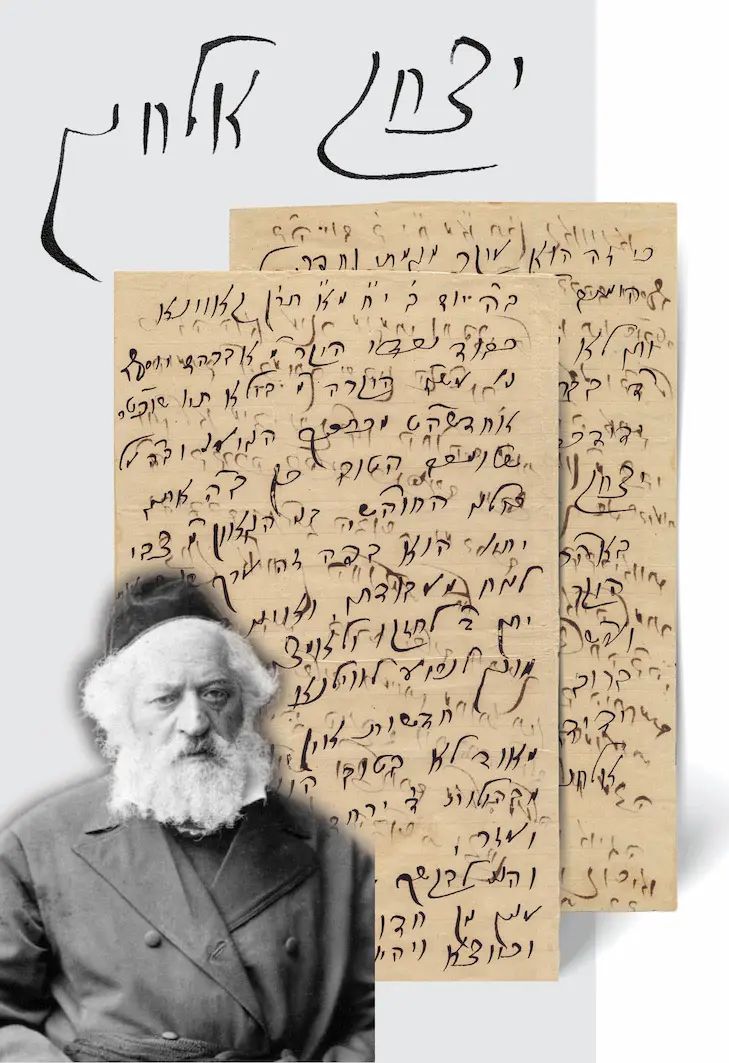
Lot : 124
“I request that you write me any chiddush or kashe, and it will bring me great nachas, for this is my life’s purpose and goal”
Heartwarming Letter by Rabbi Yitzchak Elchanan Spektor, Av Beis Din of Kovno, 1890
Heartwarming handwritten letter by Rabbi Yitzchak Elchanan Spektor, Av Beis Din of Kovno to his grandson Rabbi Avraham Yosef Rabinowitz whom he raised and loved as a son.
In this letter Rabbi Yitzchak Elchanan writes to his grandson “I request that you write me any chiddush or kushya, and it will bring me great nachas, for this is my life’s purpose and goal".
Rabbi Yitzchak Elchanan Spektor
(1817-1897) was an illustrious Torah luminary and the uncontested spiritual leader of Russian and Lithuanian Jewry in his era. Regarded as one of the greatest meishivim of all time, he authored countless teshuvos, many of which appear in Shu”t Be’er Yitzchak, Ein Yitzchak and Nachal Yitzchak.
Rabbi Avraham Yosef Rabinowitz was raised in the presence of his revered grandfather, Rabbi Yitzchak Elchanan Spektor, who treated him as a son, and learned a daily shiur in Gemara and Poskim with him (Toldos Yitzchak p. 25). In 1900, Rabbi Avraham Yosef printed his sefer Ohr Layesharim contesting the Zionist philosophy.
Kovno, 1890. Folded leaf with 2 handwritten sides. Page size: 21x13 cm. Good condition.
................................................
Any inquiries about this lot ?
We are available also on WhatsApp >>>

Lot : 125
Kollel America Polemics
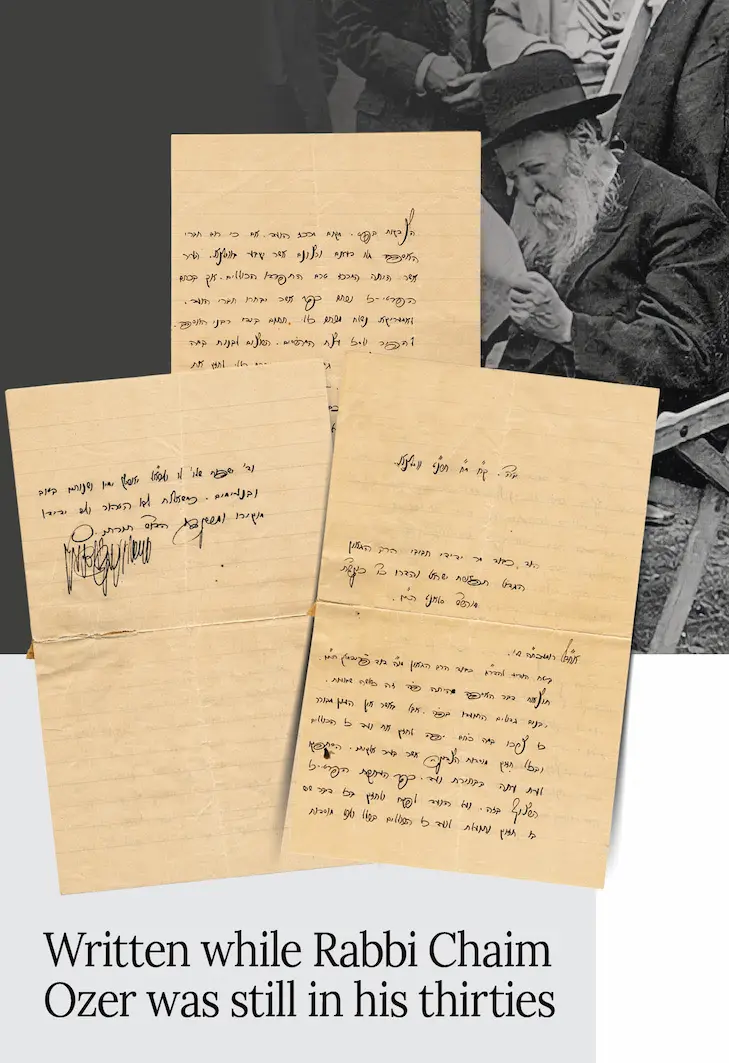
Letter by Rabbi Chaim Ozer Grodzinski to Rabbi Shmuel Salant. Vilna, 1899
Historic letter sent by Rabbi Chaim Ozer Grodzinski, Av Beis Din of Vilna, to the legendary Rav of Yerushalayim Rabbi Shmuel Salant regarding the conference of Rabbanim in Vilna to promote the Vaad Haklali and oppose the controversial founding of Kollel America.
Spanning two complete handwritten sides and several lines on a third side all written by Rabbi Chaim Ozer Grodzinksi with his autograph.
this letter Rabbi Chaim Ozer describes the recent conference of Rabbanim in Vilna which was attended by prominent Rabbanim, among them Rabbi Dovid Karliner. During the conference, the majority of the Rabbanim expressed their opinion that the base for collecting donations should remain in Vilna which was “the city that was the center before the Kollels divided, ” and he requests Rabbi Shmuel Salant’s opinion and consent.
He further expresses his fervent objection to the founding of Kollel America.
“A letter was sent to America, signed by the hands of the Rabbanim of the conference, to annul and rescind the plans of the destroyers who wish to create a separate platform.”
Written while he was still in his thirties, this is one of the earlier known letters penned by Rabbi Chaim Ozer Grodzinski.
Letters from him during this period are very rare.
The Kollel America Controversy
In 1896, American immigrants in Israel founded Kollel America with the goal of supporting American Jews who emigrated and settled in the Holy Land. The founding of this Kollel was strongly objected to by Rabbi Shmuel Salant and other Roshei Kollel in Jerusalem who feared that it would lead to the dissolution of the Vaad Haklali which had been supported primarily by American donations. This dispute continued for five years until 1901 when all sides finally reached a compromise (See Genazym Catalog 1 Lot #86).
Vilna, 1899. Folded leaf. Handwritten on 3 sides and autographed. Page size: 20x13 cm. Old reinforcement on margins of Leaf 1b. Preserved in its original envelope!
Printed in Iggros Rabbi Chaim Ozer Vol. 3 p. 198. The letter sent by Rabbi Dovid Friedman, Av Beis Din of Karlin, on this subject was printed by Rabbi David Kamenetzky in his work Rabban shel Kol Bnei Hagolah Vol. 1 p. 607 (also see ibid 606-609 for further information regarding this letter)
............................................... .
Any inquiries about this lot ?
We are available also on WhatsApp >>>

Lot : 126
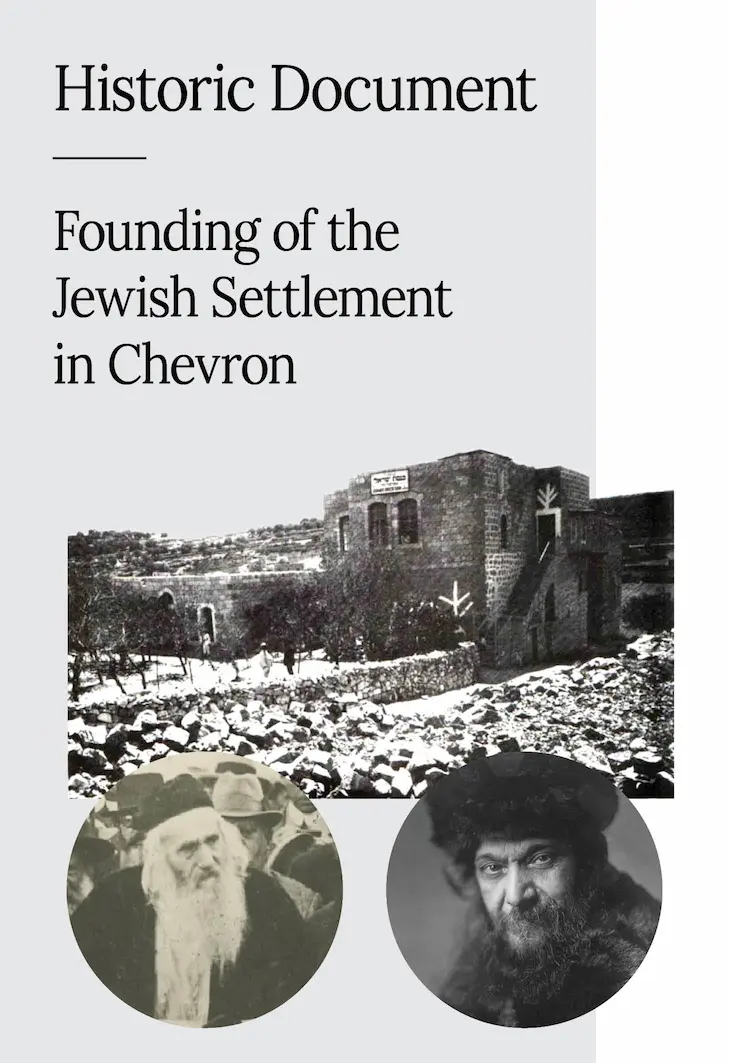
Yeshivas Knesses Yisrael – Slabodka, Chevron
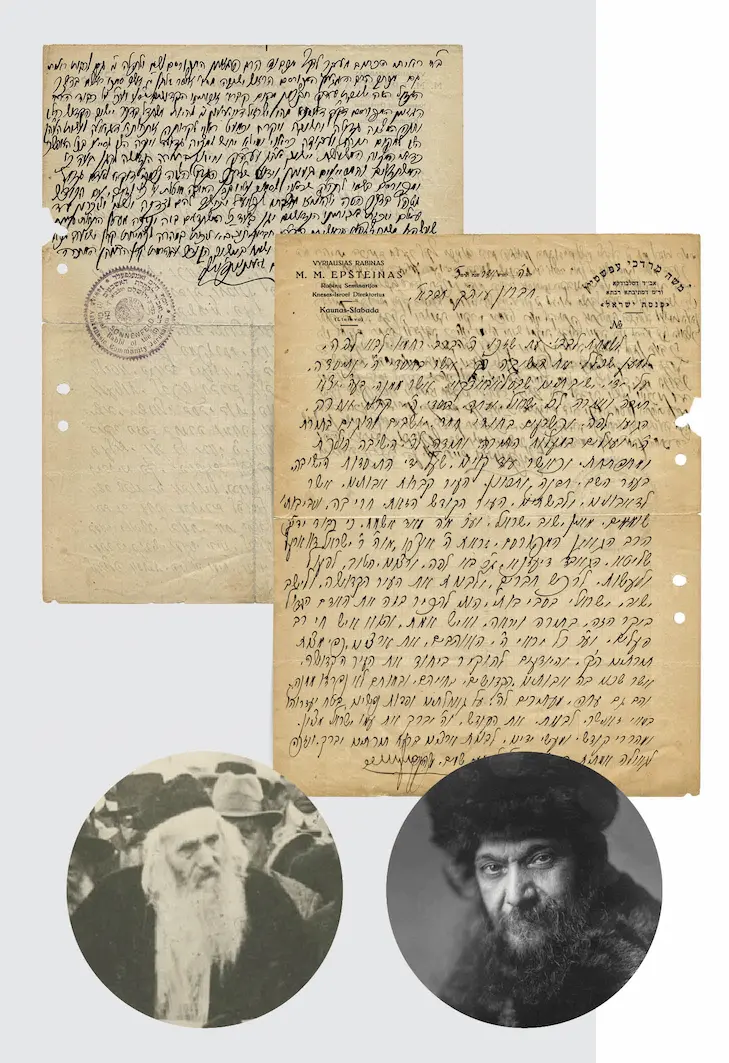
Letters by Rabbi Moshe Mordechai Epstein and Rabbi Yosef Chaim Sonnenfeld
Historical letters regarding the Founding of the Jewish Settlement in Chevron
Fascinating historic letters regarding the founding of the Jewish settlement in Chevron from the early days of the founding of Yeshivas Slabodka in the city of Chevron.
Following the relocation of Yeshivas Knesses Yisrael from the town of Slabodka to Chevron, Rabbi Yisrael Zissel Dvortz, Av Beis Din of Yasna, who had been the one to initiate the relocation of the yeshivah from Europe to Eretz Yisrael, began campaigning for the establishment of a Jewish community in Hebron that would be based around the yeshivah. His goal as Rabbi Moshe Mordechai Epstein describes in the present letter was to “acquire members and build the holy city, to [found] a Jewish settlement in its vicinity.”
In these letters, the Rosh Yeshivah Rabbi Moshe Mordechai Epstein and Rabbi Yosef Chaim Sonnenfeld, Rav of Yerushalayim, issue a public appeal to help establish a Jewish settlement in Chevron .
In his letter, Rabbi Yosef Chaim Sonnenfeld writes enthusiastically on the concept of a Jewish settlement in Chevron. “And it is nearly proper to call it Atchalta d’Geulah, the beginning of the Redemption’ to make this sacred city a place of Torah and service [of Hashem].”
The Establishment of Yeshivas Slabodka in Chevron
In 1924, the Lithuanian government issued an anti-Semitic decree annulling the rights of yeshivah students to defer their military service, unless the yeshivos would undertake to adopt a secular curriculum, as well.
The Alter of Slabodka vigorously objected this proposal, which was followed by the tragic draft-call of 50 bachurim to the Lithuanian army. As the yeshivah faced existential threat, a solution was proposed to relocate the entire Slabodka Yeshivah to Eretz Yisrael, to the ancient city of Chevron.
Indeed, in 1925, the first 70 bachurim emigrated from their native Lithuania and arrived on the shores of Eretz Yisrael, eager to rebuild their yeshivah. This letter is dated from that period, on 5 Adar, 5685 (1925).
Chevron, 1925. Letter written on official stationery of Rabbi Moshe Mordechai Epstein, with supporting letter by Rabbi Yosef Chaim Sonnenfeld on verso. The letter is hole-punched on the side, with damage affecting one of the words otherwise in good condition.
For further information press here
................................................
Any inquiries about this lot ?
We are available also on WhatsApp >>>

Lot : 127
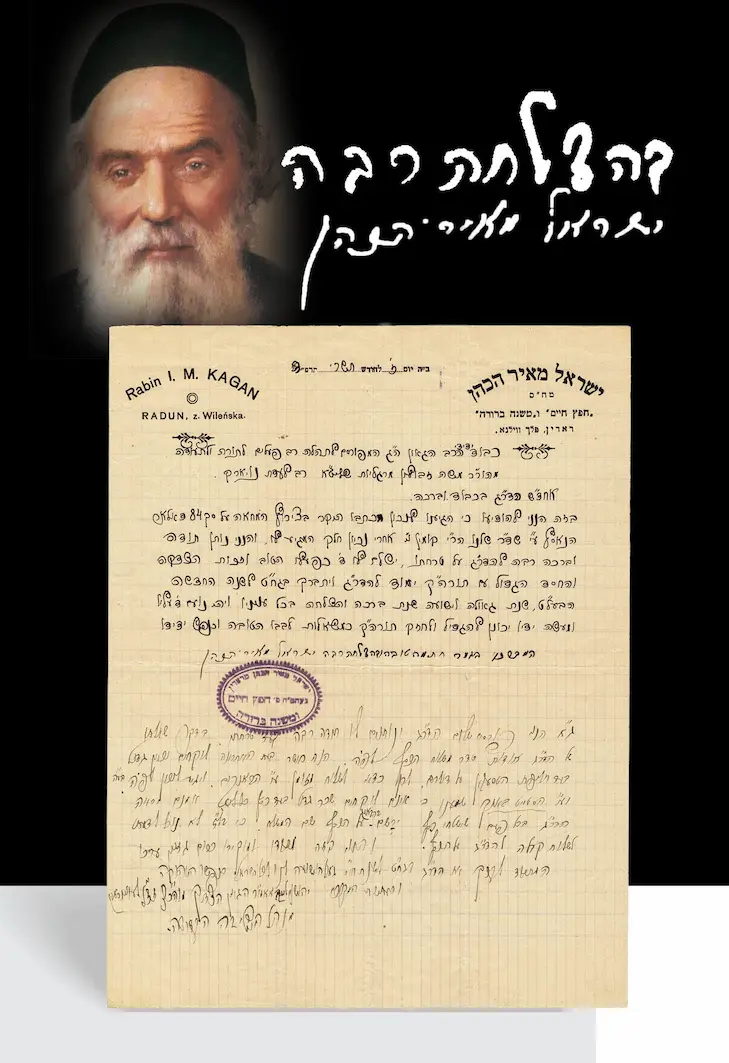
Letter of Blessing Autographed by the Chafetz Chaim. Radin, 1925 From Radin to New York
Letter replete with warm blessings from the Chafetz Chaim, to Rabbi Moshe Zevulun Margalies, elder of the American Rabbanim of his time. In this letter, the Chafetz Chaim expresses gratitude for his generous support of the great yeshivah in Radin.
The Chafetz Chaim added with his own pen
“Blessing you with a g'mar chasimah tovah and great success. Yisrael Meir Hakohein.”
The legendary Radin Yeshivah was founded by the Chafetz Chaim in 1869, and he endeavored tirelessly to sustain it attending to its needs and fundraising extensively in order to support his talmidim.
In the margins of the letter there is a personal note from the Chafetz Chaim’s grandson
Rabbi Yehoshua Leib Levinson Hy”d, who was his right-hand man and administrator of the Radin Yeshivah. The latter, who was the only son of the Chafetz Chaim’s son-in-law Rabbi Tzvi Hersh Levinson, was a student of the Kelm Yeshivah, a tzaddik with a noble spirit who guarded his tongue meticulously.
Following his father’s passing in 1921, the Chafetz Chaim assigned him to deliver mussar shiurim in the yeshivah. During the final decade of the Chafetz Chaim’s life, his grandson served him faithfully and assisted him in every realm. He delivered a tearful eulogy at the Chafetz Chaim’s levayah.
With the outbreak of World War II, Rabbi Tzvi Hersh Levinson was exiled along with the talmidim of the yeshiva to Eišiškės, Lithuania and later to the Kovno Ghetto. During these tragic years, he lifted the spirits of the downtrodden Jews, and risked his life to fulfill mitzvos. From Kovno, he was taken to the Dachau where he sacrificed his life al kiddush Hashem. (HaChafetz Chaim U’paalo Vol. 2 pp. 503-509).
Rabbi Yisrael Meir Hakohein Kagan
(1839-1933), universally renowned as the Chafetz Chaim after his famous sefer, was one of the last of the Achronim. He was “Rabban shel Yisrael” in every sense of the word. He was regarded as most brilliant, humble and pious among the Achronim, and there are few sages whose legacy impacts the contemporary Torah world as the Chafetz Chaim. His landmark sefarim, including Mishnah Brurah, Chafetz Chaim and Shemiras Halashon are studied universally by young and old, men, women and children alike.
Rabbi Moshe Zevulun Margalies
(1851-1937) was one of the great American sages of the 20th century. He was among the founders of Agudath HaRabbonim in America and stood at its helm for many years. Rabbi Margalies served as the primary address for supporting the great yeshivos in Lithuania and maintained close ties with the Chafetz Chaim and Rabbi Chaim Ozer Grodzinski.
Radin, 1925. Chafetz Chaim’s personal stationery. Page size: 27x21 cm. Good condition.
............................................... .
Any inquiries about this lot ?
We are available also on WhatsApp >>>

Lot : 128
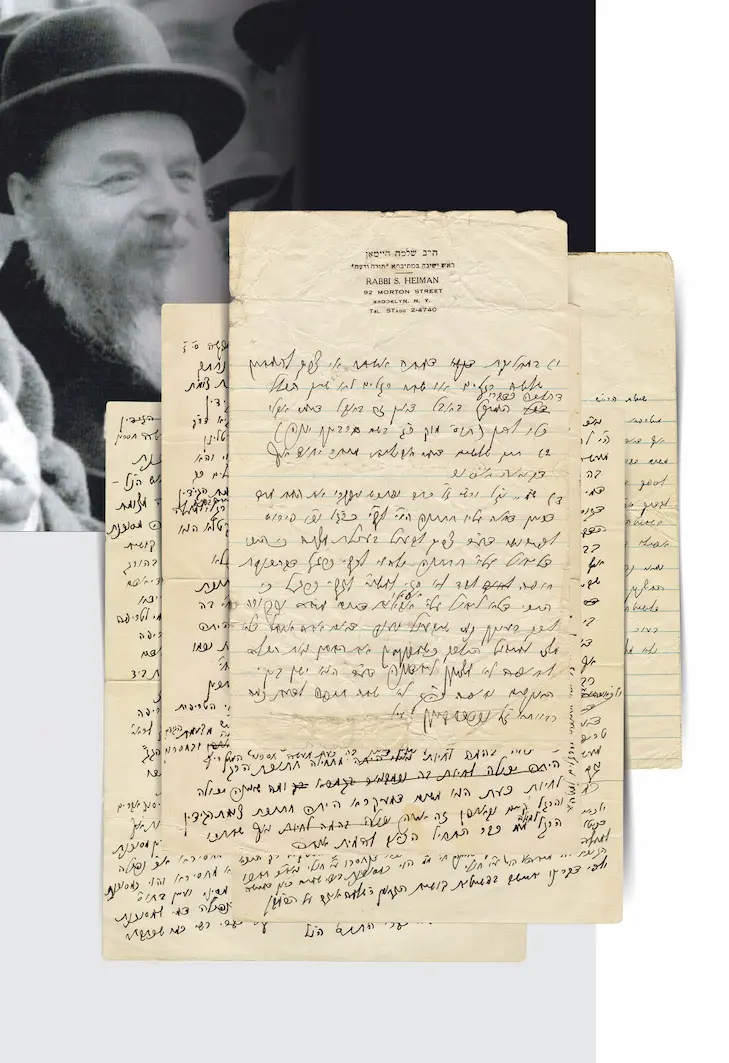
Handwritten Chiddushei Torah by Rabbi Shlomo Heiman, Rosh Mesivta of Torah Vodaath. New York, Circa 1940
Chiddushim on maseches Chulin and segments of chiddushim on masechtos Yevamos and Chulin by the holy hand of Rabbi Shlomo Heiman, Rosh Yeshivah of Mesivta Torah Vodaath and one of the progenitors of the Torah world in the United States.
Rabbi Shlomo Heiman
(1892-1945), beloved Rosh Yeshivah of Mesivta Torah Vodaath in New York, was one of the acclaimed 20th century Torah scholars who taught and disseminated Torah in Lithuania and the United States. As the prime disciple of Rabbi Boruch Ber Leibowitz, he perpetuated his distinct methods of Torah study. Rabbi Boruch Ber once inscribed that it was worth coming to the world just in order to teach a student like Rabbi Shlomo (printed in Yeshurun Issue 8, p. 177).
After World War I, Rabbi Shlomo Heiman began teaching in Yeshivas Ohel Torah of Baranowitz, under the auspices of Rabbi Elchanan Wasserman, and in 1927, at the request of Rabbi Chaim Ozer Grodzinski of Vilna, accepted the post of Rosh Yeshiva of the Ramailles Yeshivah, a position he held until 1935 when he was invited to New York by Rabbi Shraga Feivel Mendlowitz to lead Mesivta Torah Vodaath. After soliciting Rabbi Chaim Ozer’s approval, Rabbi Heiman accepted this position and was thus spared the horrors of the Holocaust. During his tenure at Torah Vodaath, the yeshivah underwent a marvelous period of growth. His written legacy includes Chiddushei Rabbi Shlomo and Shiurei Rabbi Shlomo.
The present item includes three large folios on the topic of treifos, these chiddushim were printed with minor amendments in Chiddushei Rabbi Shlomo p. 81 however the present folios include an additional 5 lines not printed there, 2 of the leaves on Mesivta Torah Voda’ah stationery.
New York, Circa 1940. 5 leaves. Good condition.
................................................
Any inquiries about this lot ?
We are available also on WhatsApp >>>

Lot : 129
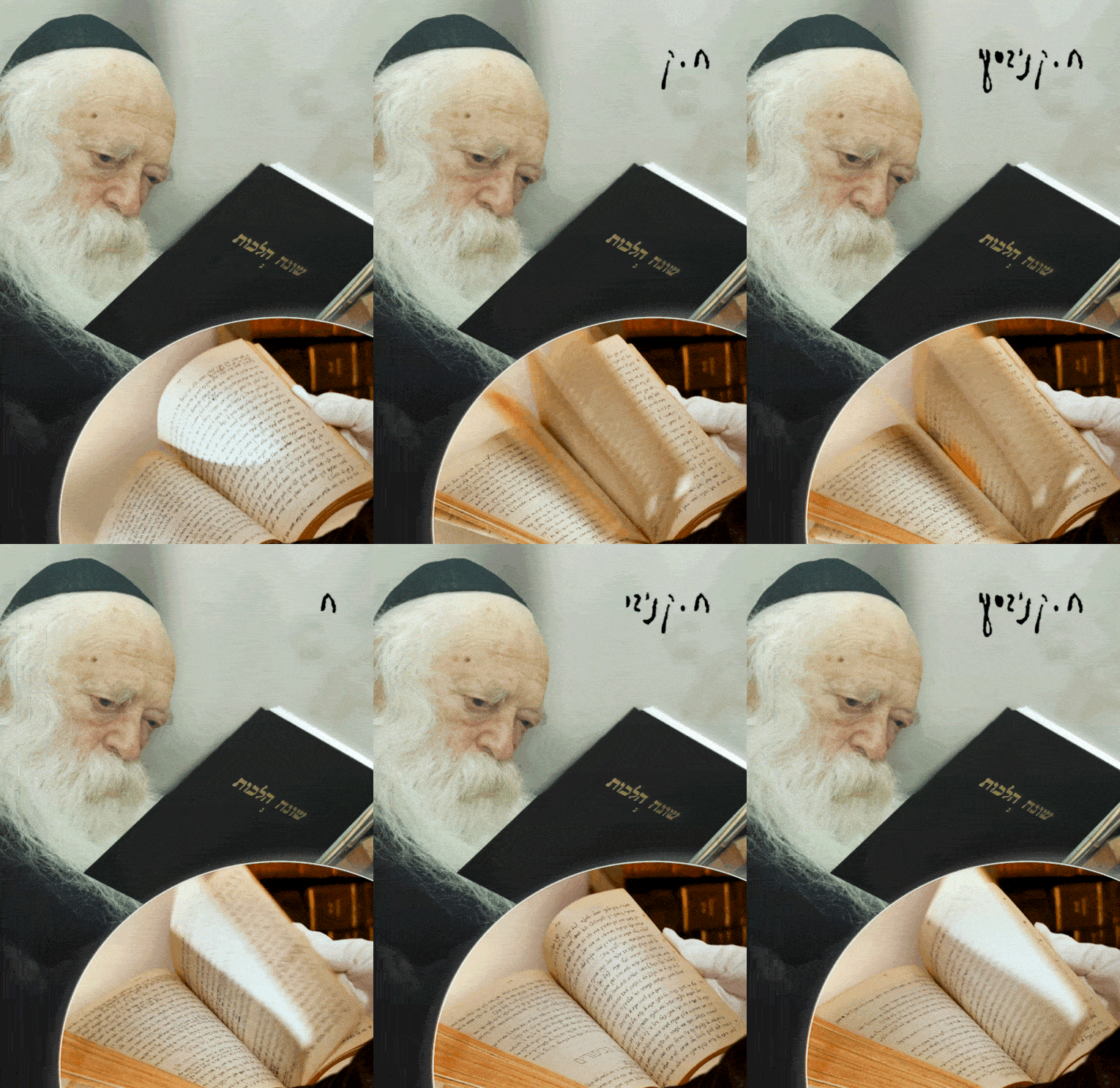
Handwritten and Autographed Manuscript of Shoneh Halachos Volume 3 by Rabbi Chaim Kanievsky
Shoneh Halachos is the well-known and fundamental halachic work of Rabbi Chaim Kanievsky; this is his original handwritten manuscript.
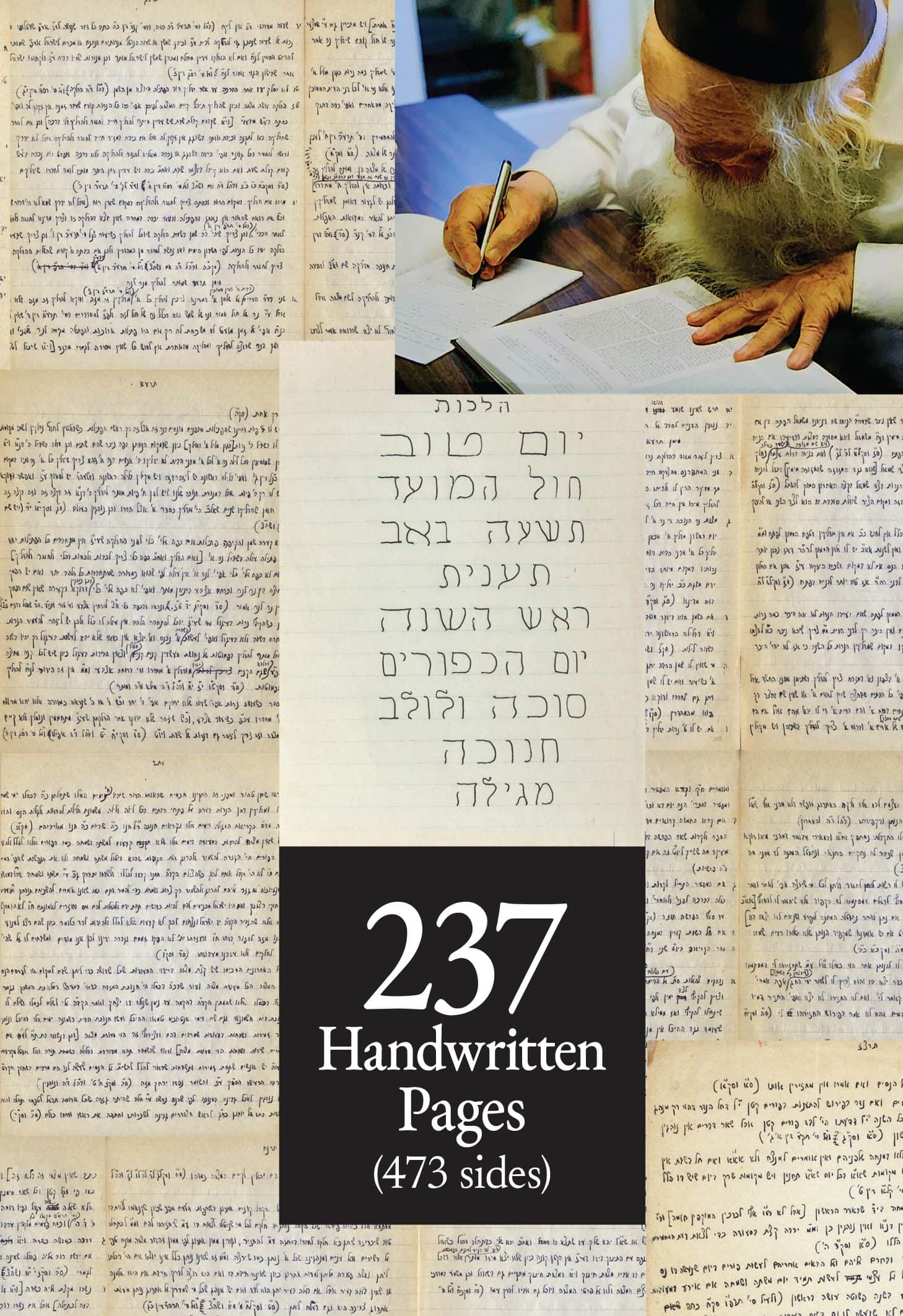
237 full pages, entirely handwritten by Rabbi Chaim Kanievsky!
Rabbi Chaim Kanievsky listed the Table of Contents on the title page in beautiful large block letters. The sefer contains
Hilchos Yom Tov, Chol Hamoed, Tisha B’Av, Taanis, Rosh Hashanah, Yom Kippur, Succah and Lulav, Chanukah and Megillah.
The cover is autographed
C. Kanievsky, and autographed again on the back cover with Rabbi Chaim Kanievsky’s full name for davening.
At the end of the sefer he inscribes:
“Completed with the help of Hashem Yisborach on Motza’ei Shabbos Kodesh Parshas Shekalim, 28th of Shevat, 1975.
Finished and completed, may K-l, the Creator of the World, be praised”
Shoneh Halachos
Rabbi Chaim Kanievsky
(1928-2022), known and beloved to all as “Rav Chaim” was called the Sar HaTorah and the Gadol Hador of our generation. He was renowned for his incredible fluency in every realm of Torah, and people around the world approached him to resolve intricate halachic questions, and to seek his counsel, prayers and blessings.
He authored dozens of sefarim on virtually every realm of Torah, yet he placed special emphasis on his Shoneh Halachos series which deals with practical halachah.
The sefer contains the words of the Mishnah Brurah and the teachings and rulings of his uncle the Chazon Ish. (He quotes the Chazon Ish approximately 70 times in this present manuscript.)
Fearful of erring in halachah and causing others to err as well, Rav Chaim invested untold hours and energies into formulating his Shoneh Halachos, reviewing, refining and clarifying each word repeatedly,
as clearly evident from this handwritten manuscript which features numerous corrections, erasures, additions and amendments. This is likewise the reason that he refused to allow anyone to translate his sefer into English, as instructed by his father the Steipler, explaining that if even one word was mistranslated, the entire topic could be misconstrued. (Rabbi Gedalyah Hoenigsburg in Hasefarim Shel Rabbeinu Harav Hagoan Rav Chaim Kanievsky, Bnei Brak, 2018, p. 66.)
Rav Chaim proofread each of his sefarim twice before they went to print, yet he proofread sefer Shoneh Halachos three times.
In this volume alone, Rav Chaim cites the Chazon Ish over 60 times, and his sefer is widely-acclaimed by students of the Chazon Ish.
Shoneh Halachos was distributed widely and reprinted dozens of times. It is a fundamental sefer often used for teaching Mishnah Berurah.
Bnei Brak, 1975. 237 leaves, 473 sides. Page size: 19x15 cm. Entirely handwritten in Rav Chaim’s beautiful, neat handwriting. The manuscript includes the third volume of Shoneh Halachos, excluding the halachos of Pesach. Good condition. Original binding, reinforced and restored, stored in a beautiful new box.
Rav Chaim quoted sefer Shoneh Halachos in many of sefarim and letters.
After publishing Shoneh Halachos, Rav Chaim took to quoting it in his letters and subsequently written sefarim in place of the Mishnah Berurah. He once explained that since Shoneh Halachos summarizes Mishnah Berurah, he was comfortable quoting Shoneh Halachos (Rabbi Gedalyah Hoenigsburg, Hasefarim Shel Rabbeinu Harav Hagaon Rav Chaim Kanievsky, Bnei Brak, 2018, p. 69).
............................................... .
Any inquiries about this lot ?
We are available also on WhatsApp >>>

Lot : 130
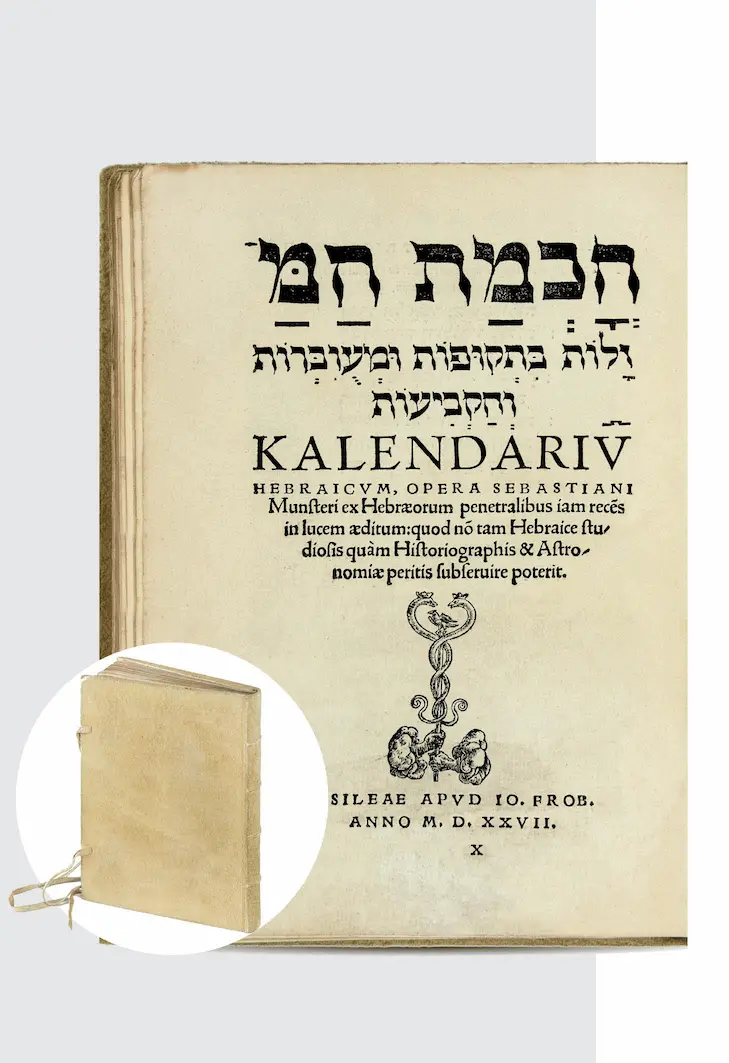
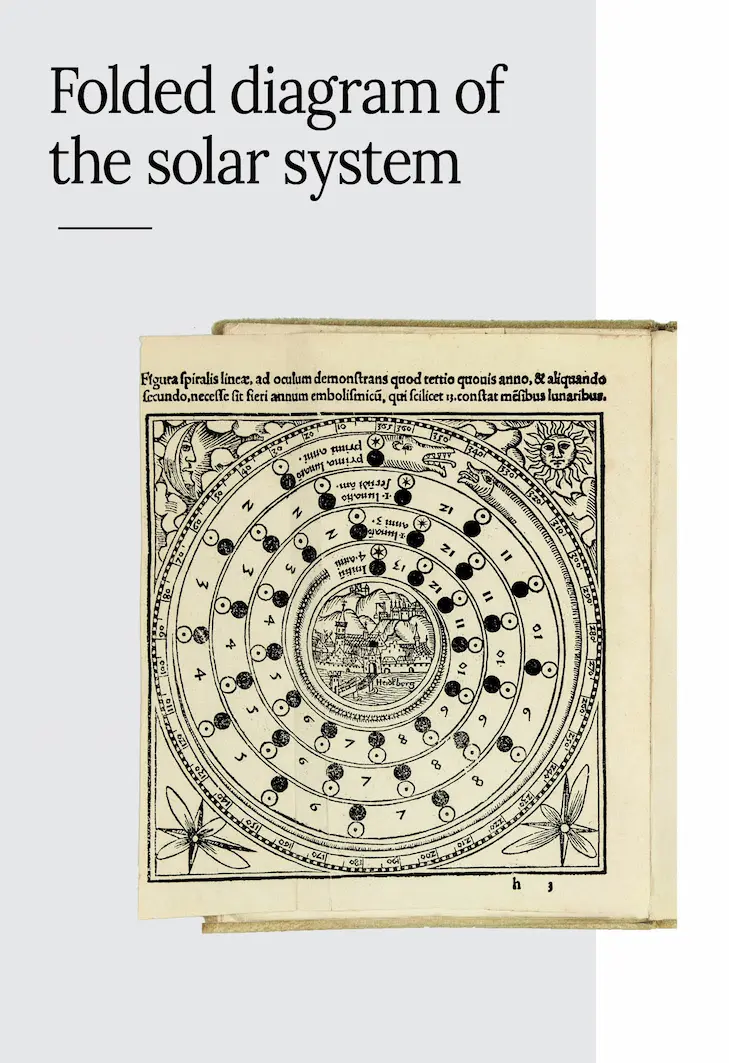
Chochmas Hamazalos with Folded Illustration of the Solar System. Basel, 1527. Rare Book on Astronomy
A very rare work on astronomy and calculating the Jewish calendar
Contains an anthology of essays and partial essays in Hebrew and Latin edited and published by the scholar Sebastiani Munsteri.
The book also includes sections from Olam Zuta and sections from sefer HaKaballah by Rabbi Avraham ben David (the first Raavad), Ibur Katzuv DRav Nachshon; Limtzo Molados U’Tekufos. All the above were printed with facing Hebrew and Latin sides, and the remaining collection of essays were printed in Latin only.
The present work contains impressive woodcut illustrations, diagrams and charts, along with 2 folded diagrams of the solar system. (These diagrams are extraordinarily rare and missing from the Mehlman Collection described in Ginzei Yisrael #1871)
Basel, 1527. First edition. [8], 200, [16] + [2] folded diagram. Page size: 19.5 cm. Ornate, beautiful printing with numerous initials. Attractive copy in good condition. Old velvet binding with laces.
For the complete description of this sefer, see Die Basler Hebraischen Drucke (Joseph Prijs) #24
Ginzei Yisrael # 1871
............................................... .
Any inquiries about this lot ?
We are available also on WhatsApp >>>

Lot : 131
Fundamental work on the Hebrew calendar and customs of Eretz Yisrael!
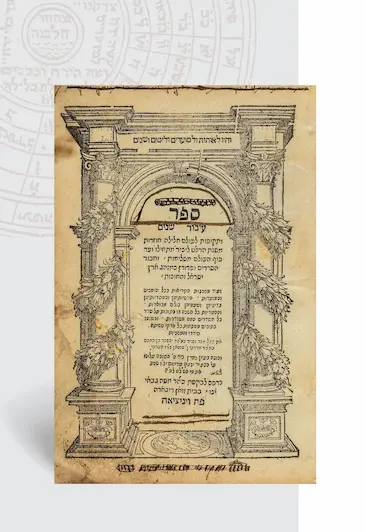
Ibur Shanim - Tikkun Yissachar on the Hebrew Calendar. Venice, 1579
Comprehensive composition on setting the Hebrew calendar, along with the calculations of the years, molados and seasons; rules on configuring the dates of Yomim Tovim and the order of krias HaTorah for the whole year; as well as laws and customs of krias haTorah and haftaros by Rabbi Yissachar ben Sussan, leader of the Congregation in Tzfas during the era of Rabbi Yosef Karo.
Rabbi Yissachar’s compilation of laws and customs regarding krias haTorah and prayers are based on his personal observations of his native community in Fez, testimonies of Jewish sages who fled Spain in the wake of the Expulsion, and the prevalent customs in Eretz Yisrael at the time, most notably those practiced in Tzfas.
Ibur Shanim was the first reliable source regarding customs of krias haTorah and tefillos practiced by Jewish residents of Tzfas in the early- and mid-16th century. Some of the greatest Poskim of all time, including the Knesses Hagedolah and Magen Avraham, cite his writings as a source in their halachic rulings.
This sefer presents the first testimony regarding the custom of calling every man and boy, including young children, to the Torah on Simchas Torah. Rabbi Yissachar attests that this was practiced by his rebbi the Ralbach in Jerusalem, and that it was likewise the custom in Tzfas (Leaf 56a). The sefer is also one of the earliest sources to mention the custom of eating fruit on Tu Bishvat (Leaf 22b).
In this work, the author describes his personal observations of halachos and minhagim practiced by Rabbi Yosef Karo and attests that the latter was a mohel (see Leaves 57a, 61a, 64a).
This work was originally printed in Constantinople in 1564 under the title Tikkun Yissachar without the author’s knowledge or consent. Rabbi Yissachar later printed the sefer with the title Ibur Shanim of his own accord in a revised format, with additions and amendments. In his preface, he adds a sharply-worded protest and criticism to the original printing to the sefer.
Rabbi Yissachar ben Sussan was born in Fez, circa 1510. In his youth, he journeyed to Jerusalem where he studied under the Ralbach, and later relocated to Tzfas to serve as leader of Kehal Adas Hamaaravim. Rabbi Yissachar was acquainted with Rabbi Yosef Karo, and on Leaf 57a notes that he assents to his ruling. Due to the abject poverty in the Holy Land, he was compelled to return to the Diaspora. The year of his passing is unknown.
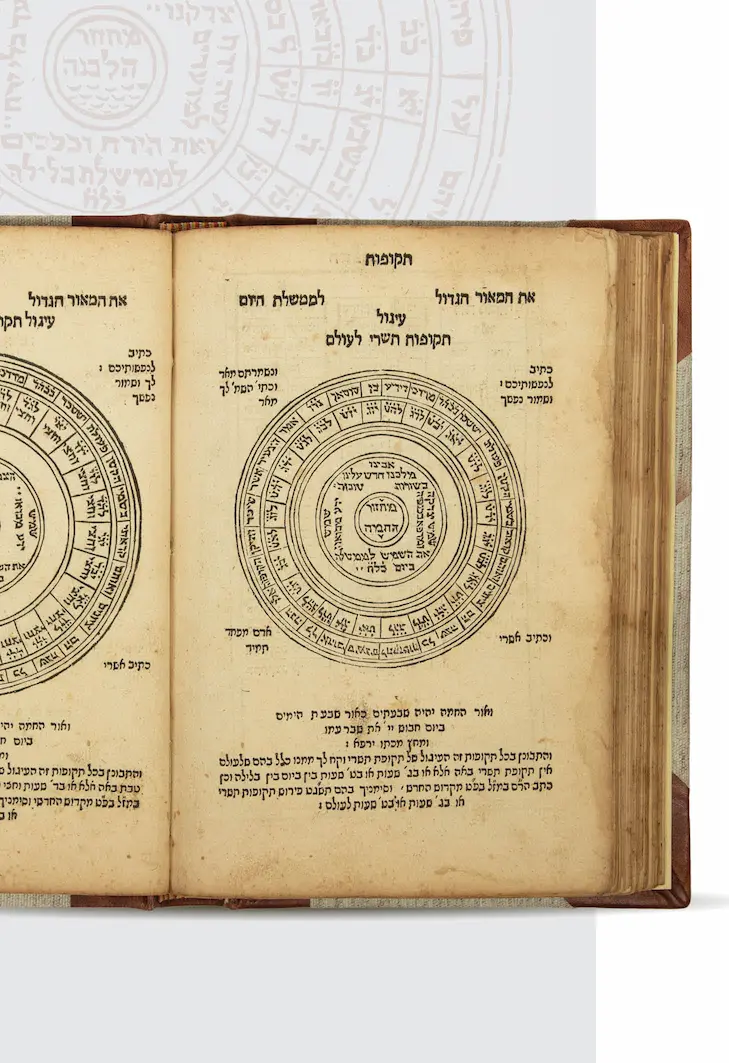
Venice, 1579. 136 leaves. Page size: 20 cm. This work features six sphere shaped illustrations of calculations for the Hebrew calendar as well as calendrical tables. Margins stained. Good condition. New half-leather binding.
Provenance: William L. Gross Collection
Item description from the 'William L. Gross Collection'
............................................... .
Any inquiries about this lot ?
We are available also on WhatsApp >>>

Lot : 132
Eye-opening peek into Ashkenazic life in Amsterdam!
Museum piece!
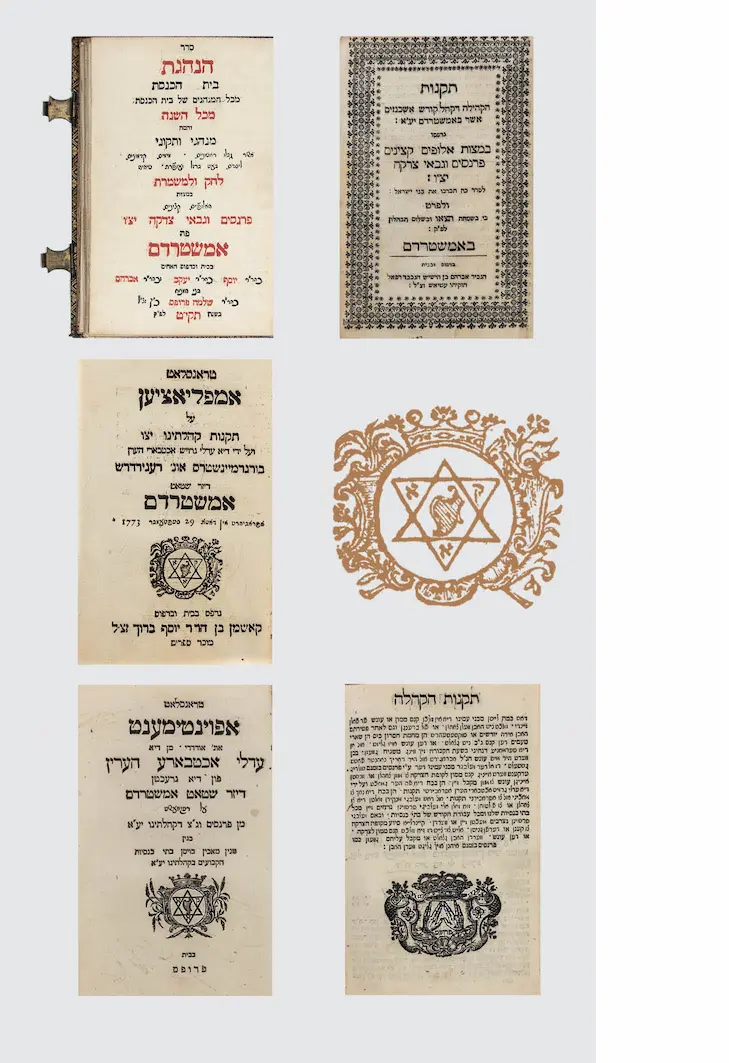
Rare 12-Volume Anthology of Ashkenazic Community Codes & Shul Policies in Amsterdam. Amsterdam, 1737-1772
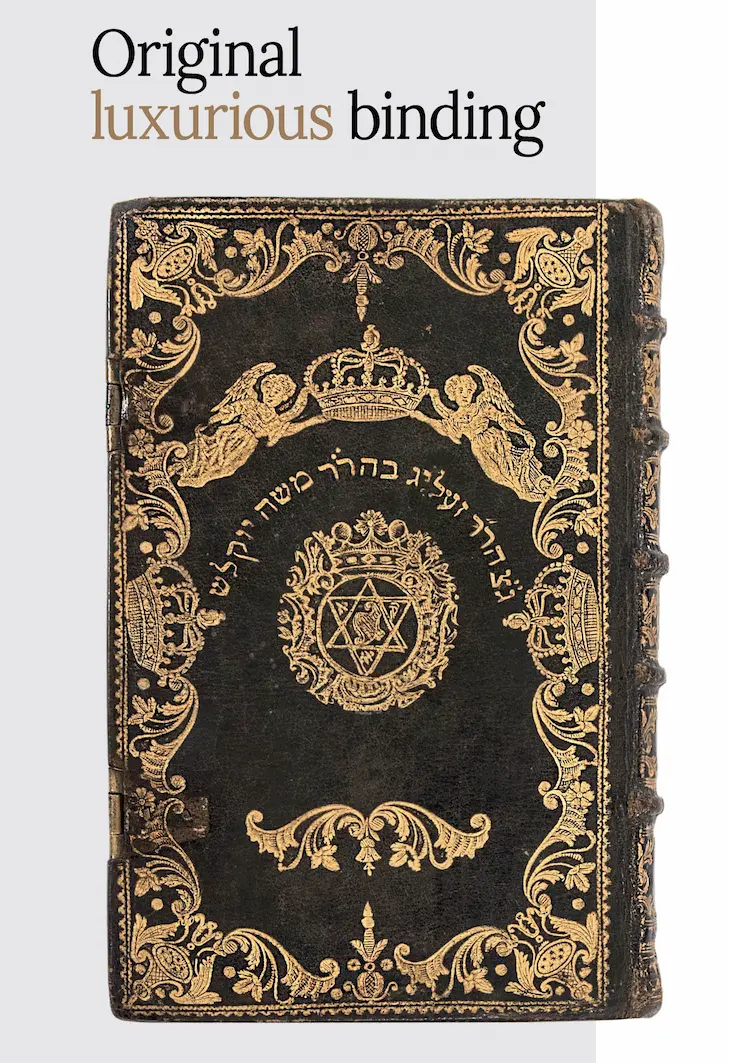
Captivating collection of 12 books and booklets presenting community codes and shul policies of Ashkenazic communities in Amsterdam. This anthology, still in its original ornate leather binding, belonged to R’ Zelig Yuklesh, gabbai of one of the local shuls.
These booklets, printed on high quality paper with only several copies per booklet, are rare finds since they were each printed internally for the community. The collection is maximally preserved, to the extent that it is rare to find such a vast, historic collection of this scope.
The collection encompasses the Fundamental Code of the Kehillah, 1737; Book of Customs of the Beis Haknesses of the Kehillah, 1759; and another ten booklets with amendments to the policies and code.
The Ashkenazic community in Amsterdam was founded in the early 17th century and functioned in strict accordance with community policies, following a detailed Community Code. This code vividly portrays Jewish community life in general and the policies and orders of the shul specifically.
In 1737, the Amsterdam Kehillah printed a detailed Code encompassing 102 regulations. The final regulation stated that the code and its policies could be revised, modified or revoked based on the needs of the time; and indeed, community gabbaim and philanthropists assembled occasionally to review and amend the Code based on need. These amendments were then published in smaller booklets which were attached to the original Code.
This anthology was the personal collection of community gabbai tzedakah R’ Zelig Yuklesh who had the booklets bound together in an ornate leather jacket with a metal clasp. The Kehillah’s name and emblem are impressively engraved onto the cover with gilded letters, and decorated with images of angels, crowns and decorative swirls.
The following is the list of booklets in order of their appearance:
1. Takanos Hakehillah D’Khal Kodesh Ashkenazim Asher B’Amsterdam. Amsterdam, 1737. [4], 33 leaves. Printed at the behest of community leaders, officers, patrons and gabbaim.
2. Seder Hanhagas Beis Kankesses Mikol Haminhagim shel Beis Haknesses Mikol Hashanah. Amsterdam, 1759. 6, [1] leaf. Title page printed partially in red ink.
3. Amendment to Community Regulations. Amsterdam, 1759. 4 leaves.
4. Regulations and Amendments on Amendment 35. Amsterdam, 1752. [3] leaves.
5. Regulations. Amsterdam, 1759. Single folded page; likely unknown.
6. Amendment to Community Regulations. Amsterdam, 1765. [4] leaves.
7. Amendment to Community Regulations. Amsterdam, 1768. [2] leaves.
8. Amendment to Community Regulations. Amsterdam, 1772. [2] leaves.
9. Amendment to Appointment. Amsterdam, 1771. [4] leaves.
10. Amendment to Community Regulations. Amsterdam, 1772. [1] 5 leaves.
11. Amendment to Community Regulations. Amsterdam, 1772. [1] 7-9 leaves (page numbers are continuation to previous booklet).
12. Amendment to Community Regulations. Amsterdam, 1772. [1] 11-16 leaves (page numbers are continuation to booklets 10-11).
The booklets feature the Kehillah’s emblem in several variations: A Star of David surrounded by a border with a crown on top and musical instruments with the letters .ק.א.א — Kehillas Ashkenazim Amsterdam.
Amsterdam, 1737-1772. Total 86 leaves. Page size: 15.3 cm. The booklets were printed in German Yiddish interspersed with Hebrew words and phrases. Several pages in #1 cropped at edges until text. Preserved in case.
Provenance: William L. Gross Collection
Item description from the 'William L. Gross Collection'
............................................ ....
Any inquiries about this lot ?
We are available also on WhatsApp >>>

Lot : 133
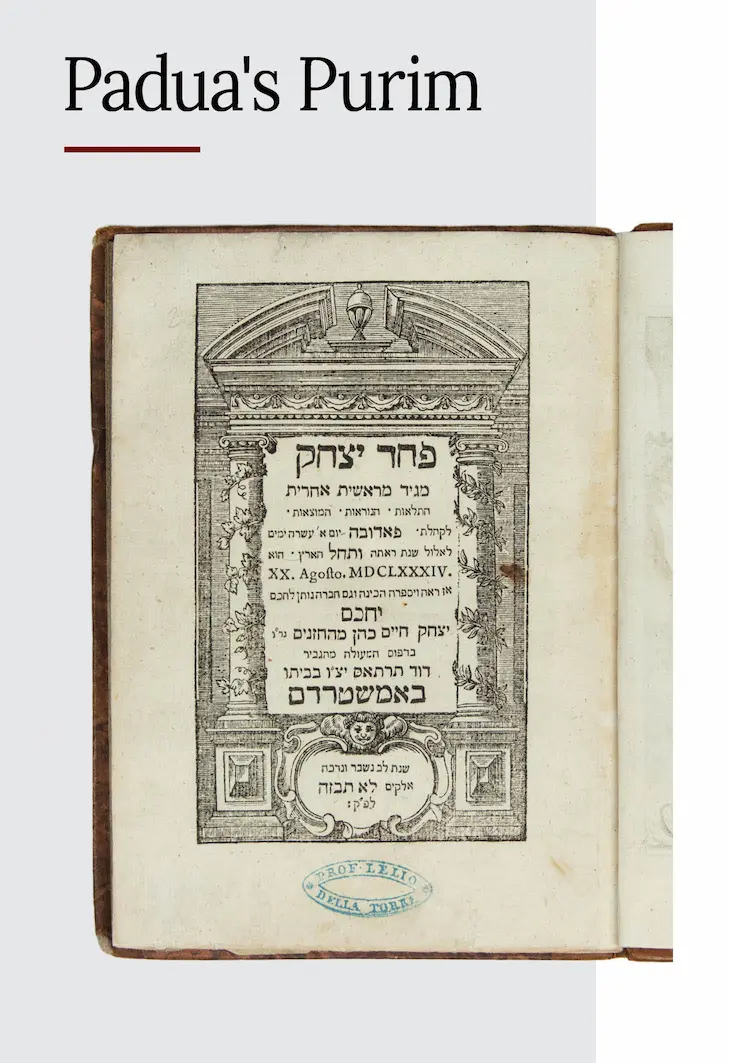
Pachad Yitzchak. Amsterdam, 1685
The History of Italian Jewry
Only Edition!
The tale of the miraculous salvation of the Jewish congregation of Padua during the Austrian-Ottoman War in the year 1684 by Rabbi Yitzchak Chaim Hakohen Mehachazanim.
Pre-title page with copperplate illustration of Akeidas Yitzchak. This title page is exceedingly rare and is missing in some copies.
The 10th of Elul: Purim Padua
War erupted between the Austrian and Ottoman Empires in the year 1684 over the city of Buda (today part of Budapest). The virulently anti-Semitic Christian ruler of Padua spread a libel accusing the Jews of supporting the Muslim Turks in their battle against the Austrian Empire. His incitement caused an enraged crowd to break into the Padua Ghetto, yet the Jews miraculously persuaded the Venetian government to subdue the outburst.
The Jews of Padua declared the 10th day of Elul as their Second Purim in gratitude for their miraculous salvation. This holiday was celebrated for many generations thereafter.
Rabbi Chaim Hakohen Mehachazanim, who was in the Padua Ghetto at the time, poetically recounts in vivid detail the miraculous story of the Jewish community’s salvation.
The sefer also includes many unknown details of the history of the Jewish congregation of Padua and its Rabbis.
Rabbi Yitzchak Chaim Hakohen Mehachazanim is also the author of Eis Keitz (Amsterdam, 1710), and was known by his initials Yachkim. He was one of the Gedolim of Italy and the teacher of both Rabbi Chaim Luzzatto (the Ramchal) and Rabbi Yitzchak Lampronti, author of Pachad Yitzchak. He was a gadol in Torah and his teshuvos were published in the works of the Italian sages.
He was also a physician and poet, and maintained a good relationship with government leaders. He lived for over 90 years and died in the year 1753. (Girondi, Toldos Gedolei Yisrael p. 154)
Amsterdam, 1685. Singular edition; never reprinted. [1], 53, [1] leaves. Page size: 18 cm. Professional restoration of margins of leaves 2-9. Good condition. Old half-leather binding.
Provenance: William L. Gross Collection
Item description from the 'William L. Gross Collection'
............................................... .
Any inquiries about this lot ?
We are available also on WhatsApp >>>

Lot : 134
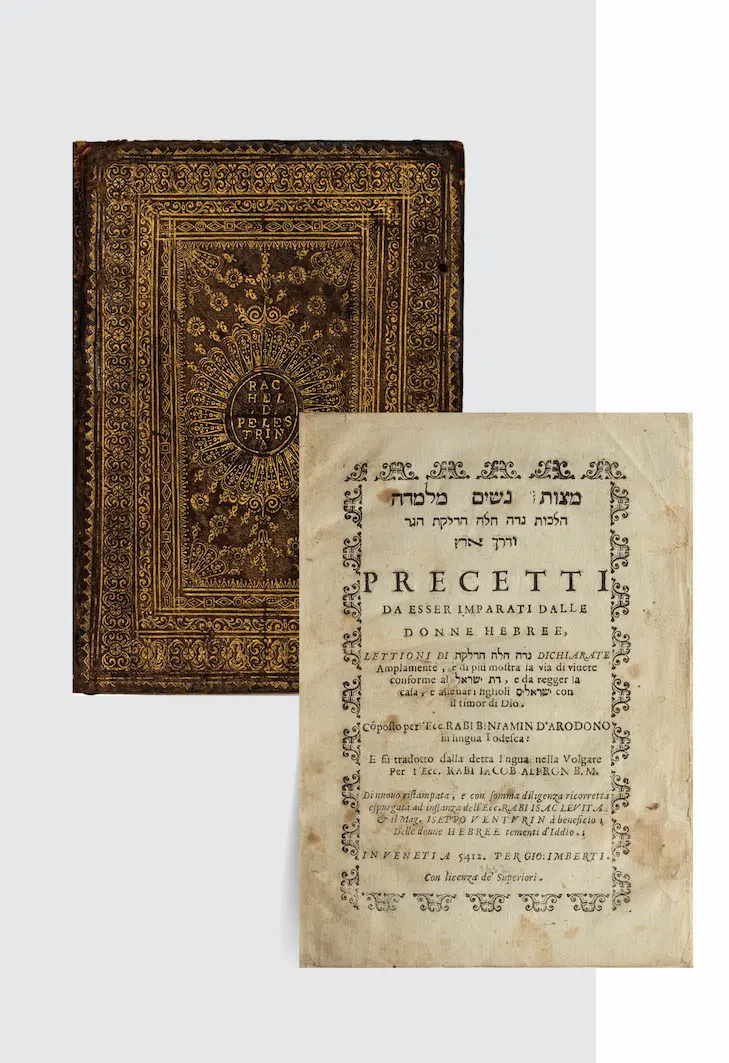
Mitzvos Nashim Melumadah, a Sefer of Halachah for Women in Italian. Venice, 1652
Exquisite antique leather binding
Halachah for Women
The laws of Challah, Niddah, and candle lighting with words of mussar and derech eretz—a special compilation for women.
The sefer was originally compiled in Yiddish by Rabbi Binyamin Salanik, author of Shu”t Masa’as Binyamin, and published in Cracow in the year 1577 under the title, Seder Mitzvas Hanashim. This edition is an Italian translation by Rabbi Yaakov Halperin, author of Shu”t Nachalas Yaakov.
This is an exceptionally rare sefer. Israel’s National Library only recently acquired one copy from the Valmadonna Trust.
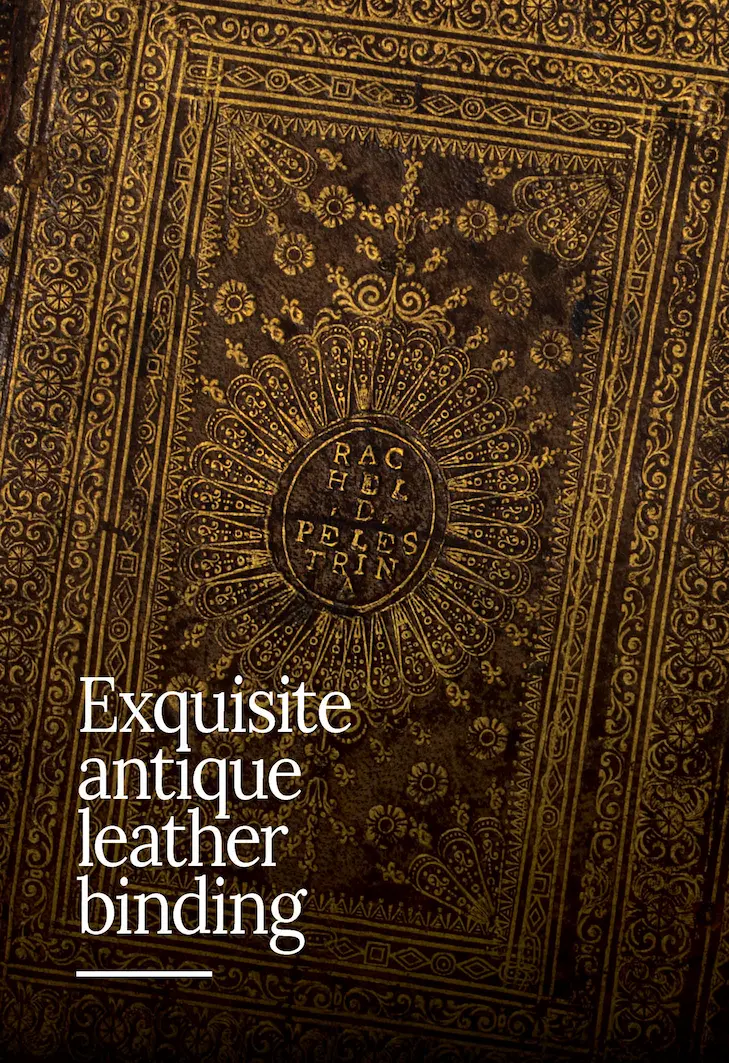
Unique and magnificent 17th century Moroccan leather binding with gold embossing, geometric designs, decorative frames, leaves and flowers.
The owner’s name, Rachel Di Pelestrina, is embossed on both the front and back of the sefer.
Venice, 1652. [16], [100]: sides Page size: 19 cm. Italian with Hebrew quotes. Good condition, minor wear of binding and corners. New matching case.
Provenance: William L. Gross Collection
Item description from the 'William L. Gross Collection'
............................................... .
Any inquiries about this lot ?
We are available also on WhatsApp >>>

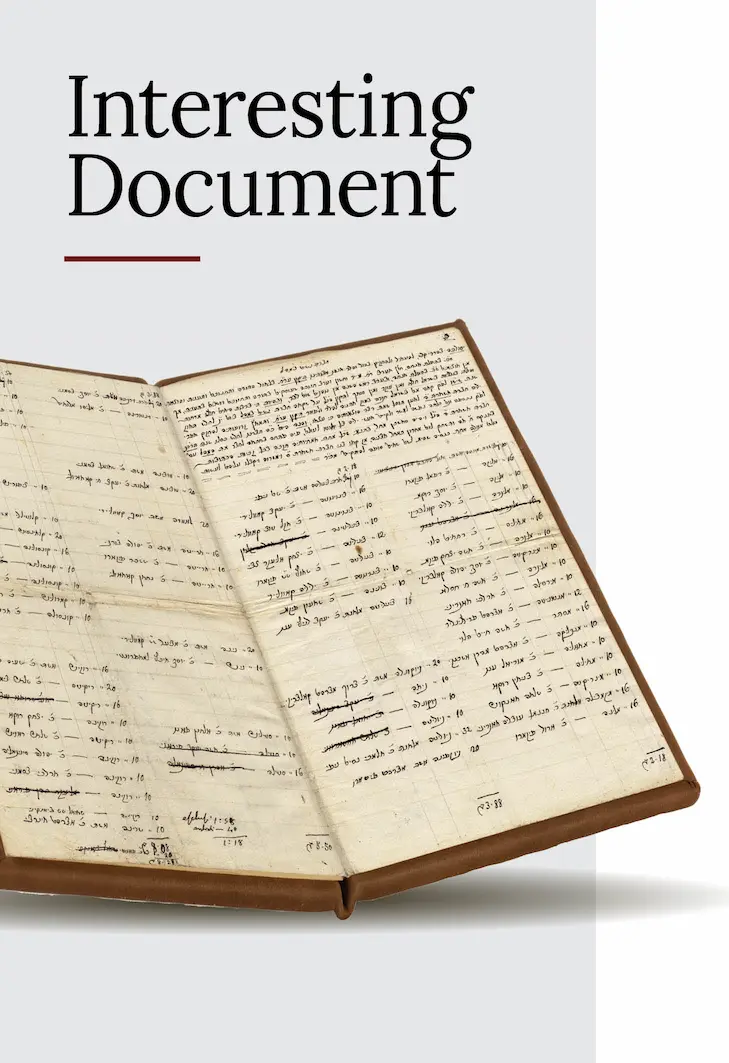
Lot : 135
Manuscript.
Historic Women Society document. Ferrara, Italy 1863
Rare, apparently one-of-a-kind document offering an eye-opening glimpse into the Jewish community of Ferrara!
Handwritten document describing the mission of the Nashim Ba’Ohel Society along with the list of righteous women who volunteered and supported the Society.
The
Nashim Ba’Ohel Society was founded in 1856 with a mission to support the
Mishmeret Hashem Society which hosted special days of learning and fasts on every Erev Rosh Chodesh. The latter fell into financial distress, which spurred the formation of a parallel women’s society to support its efforts.
The present manuscript was drafted in 1863, which was the same year when the two societies Nashim Ba’Ohel and Mishmeret Hashem merged into a single society.
The manuscript includes a handwritten list of close to 70 women who served as loyal members of the society; the names of the men they supported in the parallel men’s society; and other interesting lists and information.
Genazym assumes that this manuscript is from Ferrara due to the mention of
“Marat Puerita, wife of the honorable scholar Chacham Yehuda Aryeh Reggio” who was the Rabbi of Ferrara, as well as other last names that were popular among Jewish families in Ferrara.
Italy (Ferrara), 1863. 2 leaves (4 sides). Page size: 22 cm. Good condition. Preserved in attractive new leather binding.
................................................
Any inquiries about this lot ?
We are available also on WhatsApp >>>

Lot : 136
Rare find!
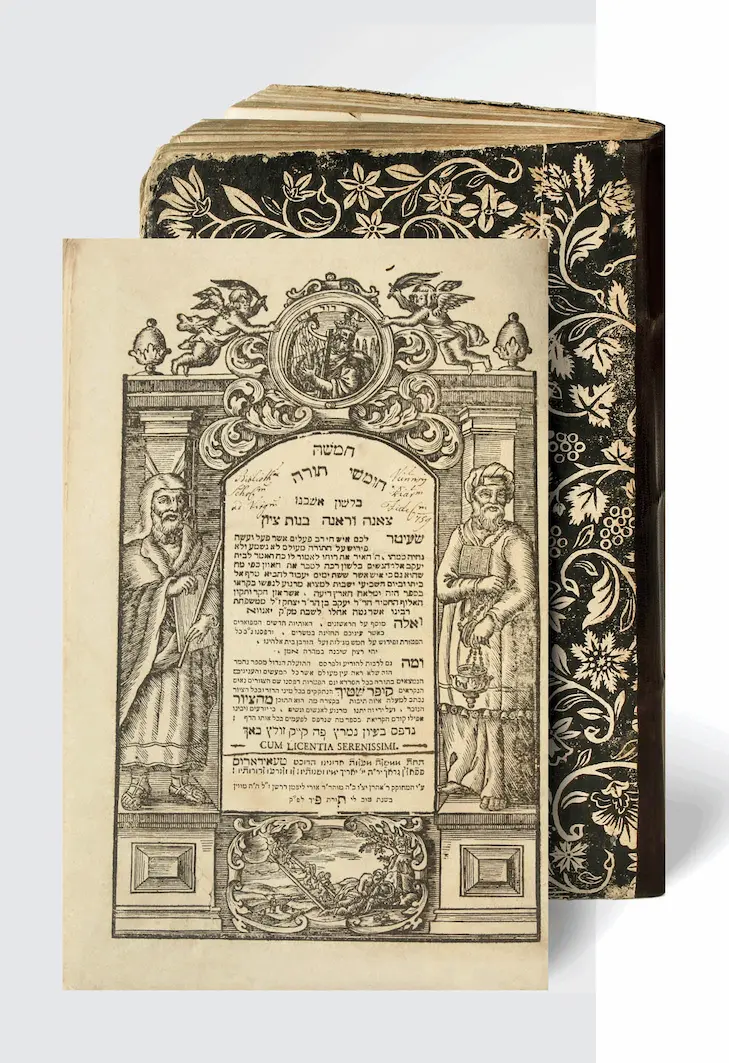
Tzena U’re’ena. Zoltzbach, 1720
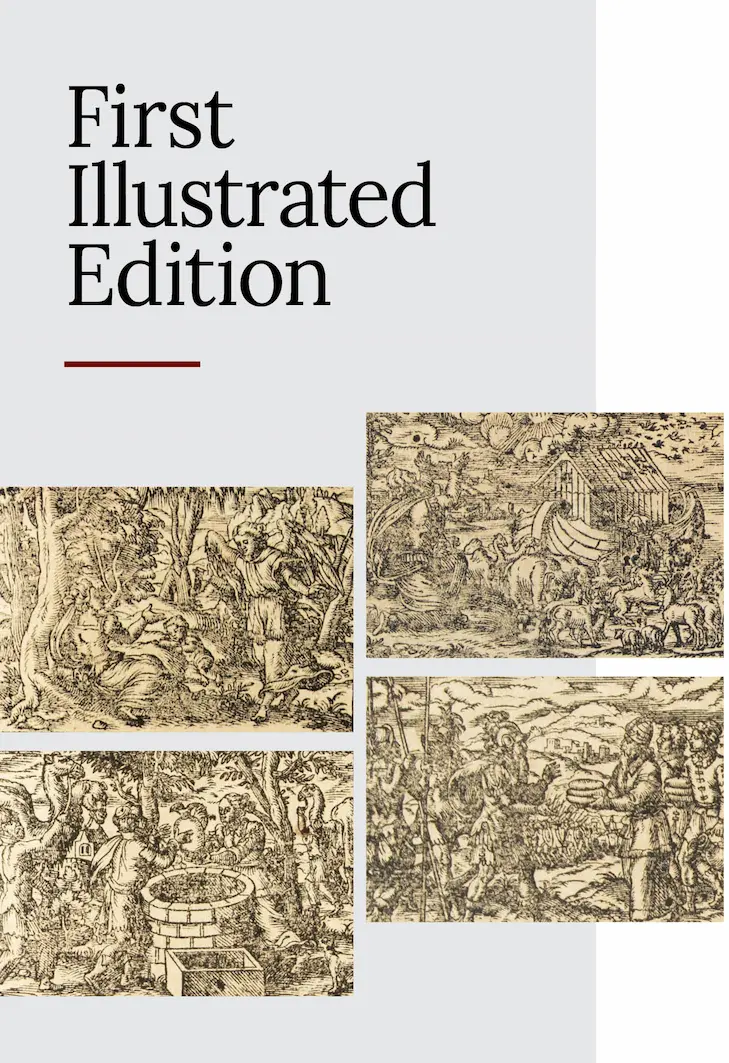
First illustrated edition with over 50 Biblical illustrations!
Yiddish commentary and anthology of midrashim and stories on the Chamishah Chumshei Torah, Haftaros and Five Megillos by Rabbi Yaakov ben Rabbi Yitzchak Ashkenazi of Yanov.
This sefer was written specifically for “the women and daughters of Israel”. this is the first edition printed with illustrations.
It is exceedingly rare to find an early 18th century copy of Tzena U’re’ena in mint condition!
Not extant in the Jerusalem National Library.
Indisputably, the most popular work in the history of Yiddish literature, the Tzena U’re’ena was originally compiled for Jewish women who wished to learn, but were mostly illiterate in lashon hakodesh. With his golden pen, the author brilliantly draws the reader into the fascinating stories of Tanach, superbly interwoven with famous midrashim, parables and stories. The sefer was enthusiastically received by Jewish women who would often read it together on Shabbos, as the Chafetz Chaim attests in his famous letter regarding the founding of the Bais Yaakov movement: “In previous generations, there was a tradition in every Jewish home to follow the way of Torah and religion and to read the sefer Tzena U’re’ena every Shabbos…”
Due to the immense popularity and extensive use of this sefer throughout the ages, there is not a single known extant copy of its earliest editions, and even 18th century copies of the Tzena U’re’ena are rarities.
The Illustrated Tzena U’re’ena
With the goal of drawing the hearts of the masses to learn and study this sefer, printers of the era began adding illustrated scenes from Tanach into the Tzena U’re’ena. Zoltzbach, in particular, was one of the premier printers of illustrated sefarim.
This early illustrated edition features 54 captivating woodcut illustrations, each with a caption explaining the illustration.
On the title page, the printer writes in regard to the illustrations:
“To notify and publicize the great benefits of this lovely sefer that has never yet been seen. For all the stories and topics written in the Torah and Haftaros, we included charming illustrations called kupper shtich, and above every illustration are several words describing the contents of the illustration. This way, men and women shall be at peace, for they shall know and understand what is printed on that page even before they read the sefer.
Zoltzbach, 1720. 158 leaves. Page size: Approx 33 cm. Additional title page for 5 Megillos and Haftaros. Small tear on leaf 148; final leaf with small holes. Otherwise complete and in good condition. Old cardboard binding covered with marbleized paper and new leather spine.
................................................
Any inquiries about this lot ?
We are available also on WhatsApp >>>

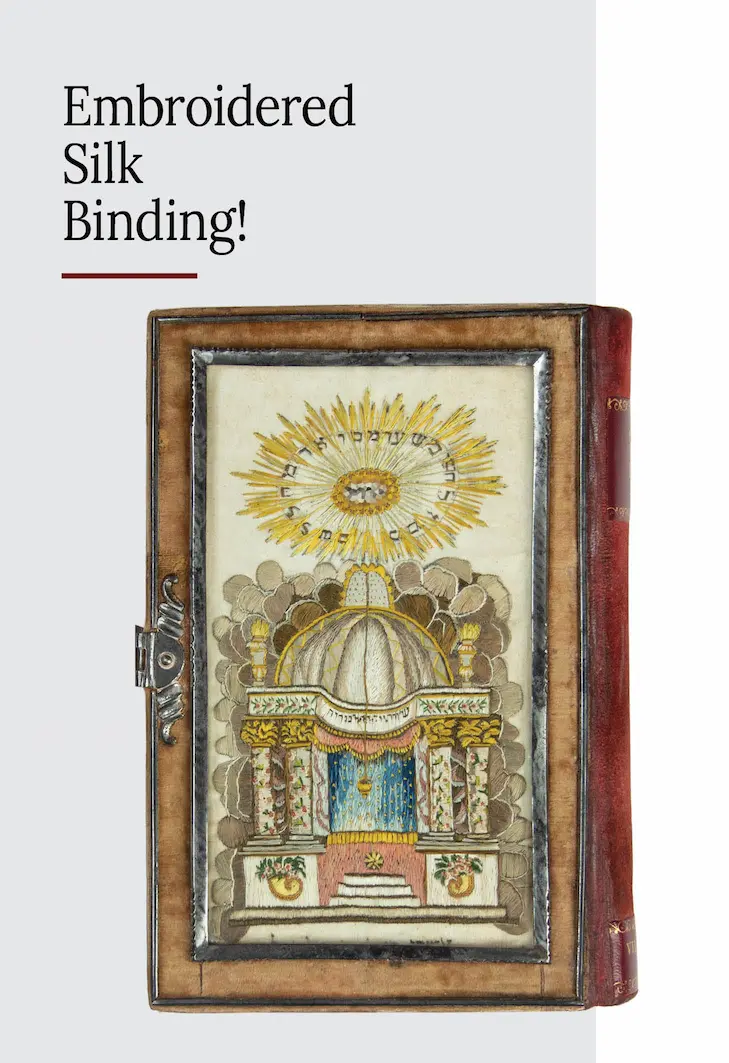
Lot : 137
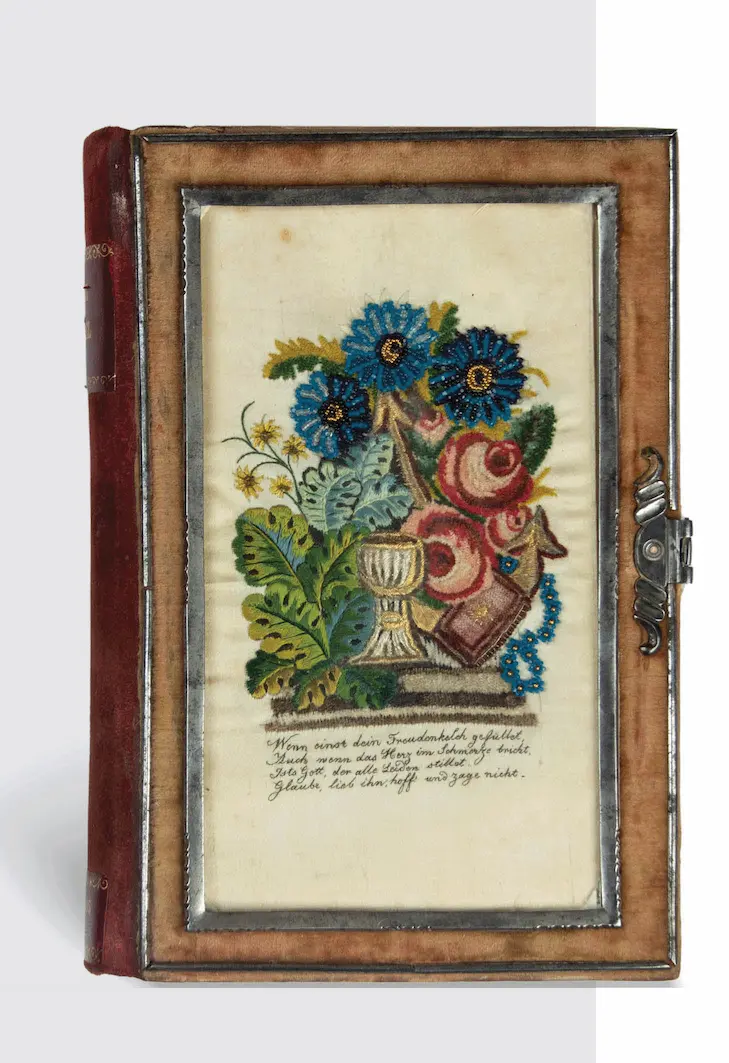
Magnificent Embroidered Binding
Siddur Tefillos Yisrael. Vienna, 1835
Siddur for year-round use with German translation. Exceptionally beautiful copy, pristine condition as new, with gilded edges. Binding is a spectacular work of art.
The front displays a silk embroidery of an Aron Kodesh with the words “Shivisi Hashem l’negdi samid”. The inside cover depicts a drawing of a sun surrounded by the words, “Mimizrach shemesh ad mevo’o mehulal shem Hashem”.
The other side of the binding depicts an embroidered vase of flowers with a siddur. Embroidered in the margins appears to be a religious poem in German.
The embroidery is protected by glass windows, surrounded by a metal frame on a velvet binding with the original clasp.
An exceptional binding both in design as well as in the quality of the embroidery.
Vienna, 1835. Original text and translation appear on facing columns. Two volumes bound together. [2], 306, [2]: 263, [2]. Page size: 19 cm. Preserved in a cardboard case covered in new fabric. Completely intact.
Provenance: William L. Gross Collection
Item description from the 'William L. Gross Collection'
............................................... .
Any inquiries about this lot ?
We are available also on WhatsApp >>>
of 3 pages
