To attend this auction live or leave absentee bids

Lot : 51
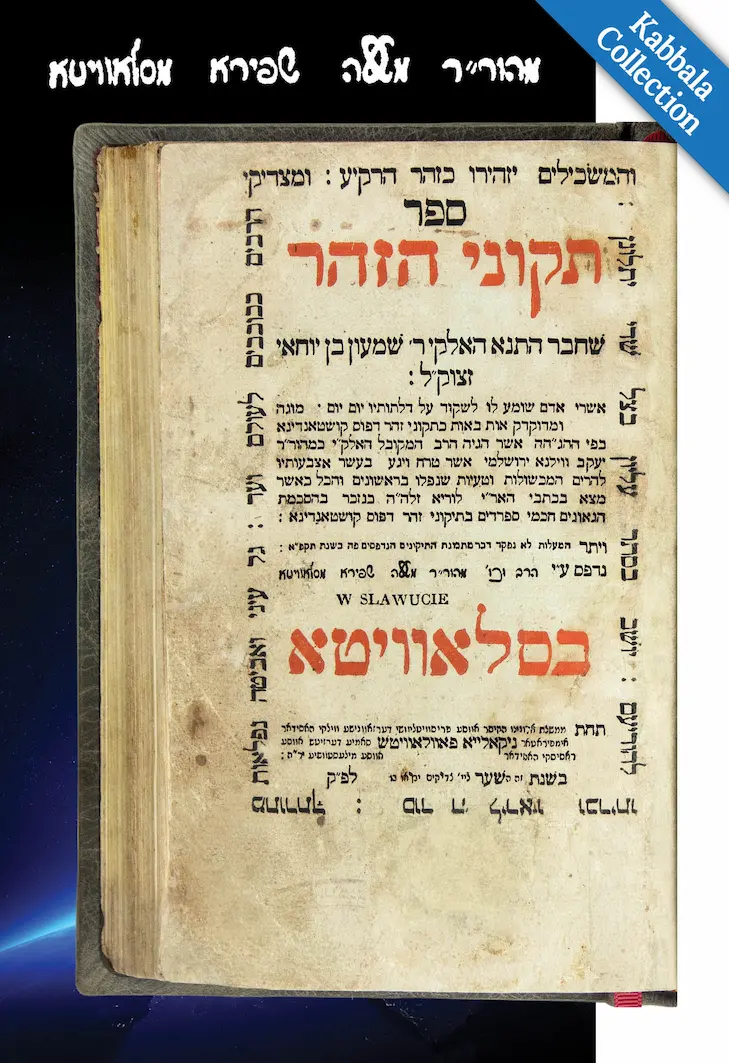
Tikunei Zohar. Rabbi Moshe Shapira Edition. Slavita, 1826
70 Tikunim on ”Bereishis” the first word in the Torah, by the holy Tanna, Rabi Shimon Bar Yochai. Precisely edited based on the Constantinople Edition. Nice copy in good condition.
With glosses of the Ramaz which are under the title Derech Emes (See lot # 56), as well as references to the sources mentioned.
Printed by Rabbi Moshe Shapira son of the holy Rabbi Pinchas of Koritz.
With approbation from the Rabbi Mordechai of Chernobyl.
Slavita, 1826. [2], 155 leaves. Page size: 20.3 cm. The name of the sefer and place of printing is embossed in red ink. New leather binding.
............................................... .
Any inquiries about this lot ?
We are available also on WhatsApp >>>

Lot : 52
Foundational Work of Kabbalah.
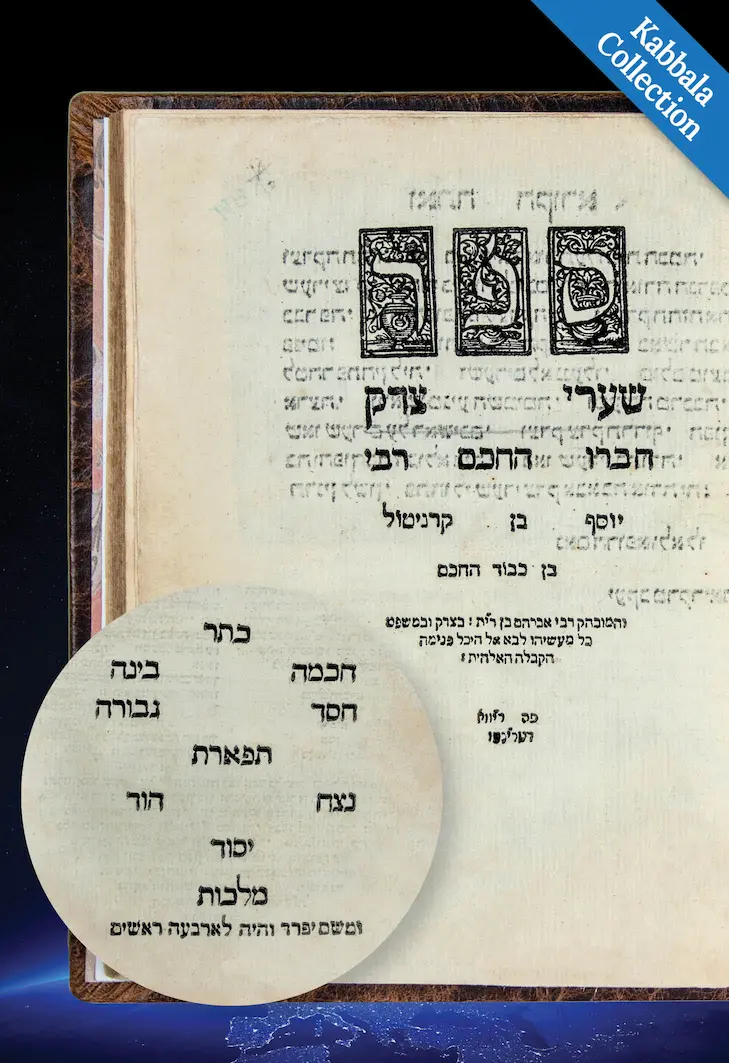
Sha'arei Tzedek. First Edition. Riva Di Trento, 1561
Introduction to the wisdom of kabbalah, primarily concerning the “Ten Sefiros” by the early kabbalist Rabbi Yosef Gikatilla.
A foundational kabbalistic work for beginners to the study of kabbalah.
Rabbi Yosef Gikatilla
lived in 13th century Spain. His sefarim, Shaarei Tzedek, Shaarei Orah and Ginas Egoz (Lot 53)are foundational works of kabbalah and were among the first sefarim authored after the discovery of the Zohar. “In Yisrael, his name is great in Torah and chassidus, and is extremely holy, ” (the Shl”a Hakadosh )
.
The Shelah Hakadosh wrote in his approbation of Ginas Egoz, “A holy man of Elokim speaks, Rabbi Yosef Gikatilla z”l, of previous generation, his name is great in Torah, chassidus and incredible holiness …”
Riva Di Trento, 1561. First Edition. 52 leaves. 18.5 cm. Good condition; new leather binding.
Stefansky, Sifrei Yesod # 340
............................................... .
Any inquiries about this lot ?
We are available also on WhatsApp >>>

Lot : 53
Fundamental kabbalistic work!
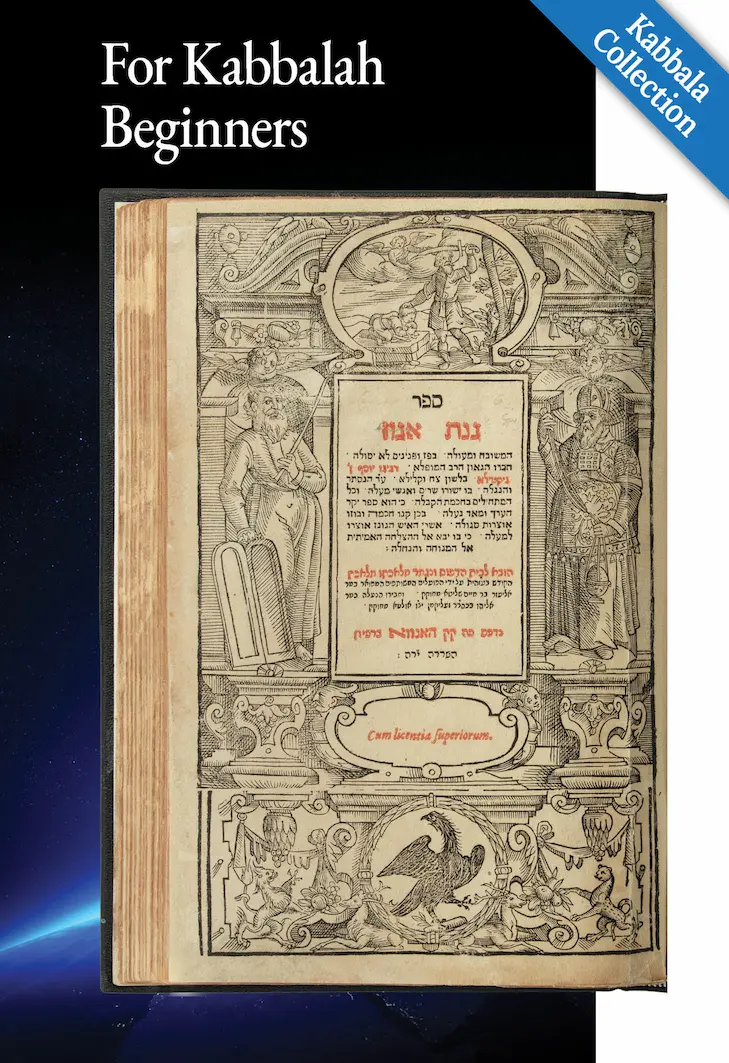
Ginas Egoz by Rabbi Yosef Gikatilla with Illustrated Title Page. First Edition. Hanau, 1610
Fundamental work for beginners studying the wisdom of kabbalah by the renowned kabblist Rabbi Yosef Gikatilla. The title page is magnificently illustrated with images of Moshe and Aharon, Akeidas Yitzchak, and drawings of birds and animals. The title page is partially printed in red ink.
Rabbi Yosef Gikatilla was one of the great kabbalists in the era of the Rishonim. “In Yisrael, his name is great in Torah and chassidus, and is extremely holy, ” from the praise of the Shl”a Hakadosh in the latter’s approbation to his sefer. Rabbi Yosef authored fundamental works of Kabbalah including Shaarei Tzedek and Shaarei Orah, which were among the first Kabbalistic works to be written after the discovery of the Zohar.
The sefer opens with an approbation by the Shl”a Hakadosh who effusively praises both the sefer and author and notes that printing and publicizing kabbalistic works is a segulah to draw the final redemption ever closer.
Hanau, 1610. First edition. 75 leaves (pages misnumbered). Page size: 28 cm. Title page slightly reinforced and professionally restored. Otherwise in good condition. American leather binding.
Stefansky, Sifrei Yesod # 341
................................................
Any inquiries about this lot ?
We are available also on WhatsApp >>>

Lot : 54
The Ramak’s Foundational Kabbalah Sefer
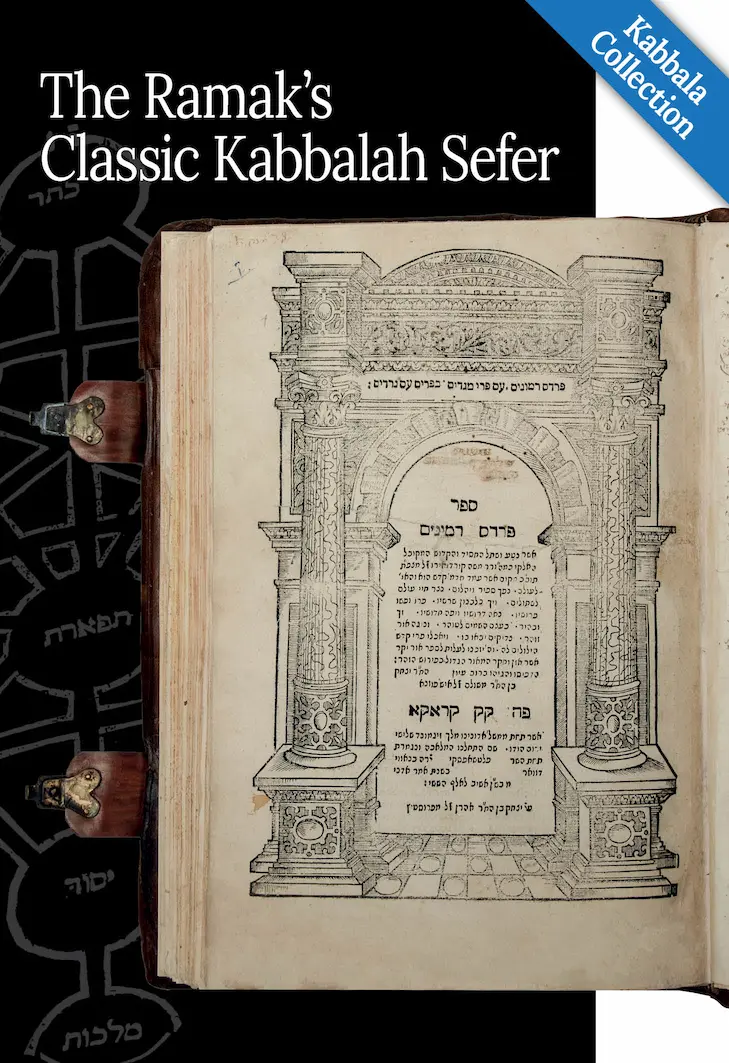
Pardes Rimonim. First Edition. Cracow, 1592
Introduction to the wisdom of kabbalah with many explanations on teachings of the Zohar, by the kabbalist Rabbi Moshe Cordova, known as the Ramak.
Includes an illustration of the tree of sefiros, as well as many other kabbalistic illustrations.
Rabbi Moshe Cordova’s Kabbalah
The light of the Arizal and the Ramak began to illuminate the world as the study of the Zohar first began to spread, and these tzaddikim became leaders in the wisdom of Kabbalah..
Rabbi Menachem Azarya of Pano explains the primary difference in the approaches of the Arizal and Ramak to the study of kabbalah in his introduction to Pelach Harimon. He says that just as the Torah has pshat and sod, so too in the study of kabbalah. The Ramak explains kabbalah through pshat, and the Arizal explains kabbalah through sod..
Rabbi Moshe Cordova
(1522-1570) was a disciple of Rabbi Yosef Karo in the Revealed Torah, and in the Hidden Torah he was a disciple of his brother-in-law Rabbi Shlomo Elkabetz. Eliyahu Hanavi revealed himself to him, and the Arizal testified that at the funeral of Rabbi Moshe Cordova he was accompanied by a Heavenly pillar of fire (Shem Hagedolim, Ramak).
Printing of Pardes Rimonim
The printing began in Cracow in the famous printing press of Yitzchak Prostitz until the outbreak of a terrible plague, which lead Yitzchak Prostitz to flee to Nowy Dwor with his printing press. It was in Nowy Dwor, adjacent to Warsaw, that the printing was completed. (See colophon and title page.)
Cracow- Nowy Dwor, 1592. First edition. [2] 211 leaves. Page size: 30 cm. Professional restoration of first 20 leaves and of several of the last pages. Antique wood binding covered in leather with clasps. Professional restoration of binding; new leather spine.
............................................... .
Any inquiries about this lot ?
We are available also on WhatsApp >>>

Lot : 55
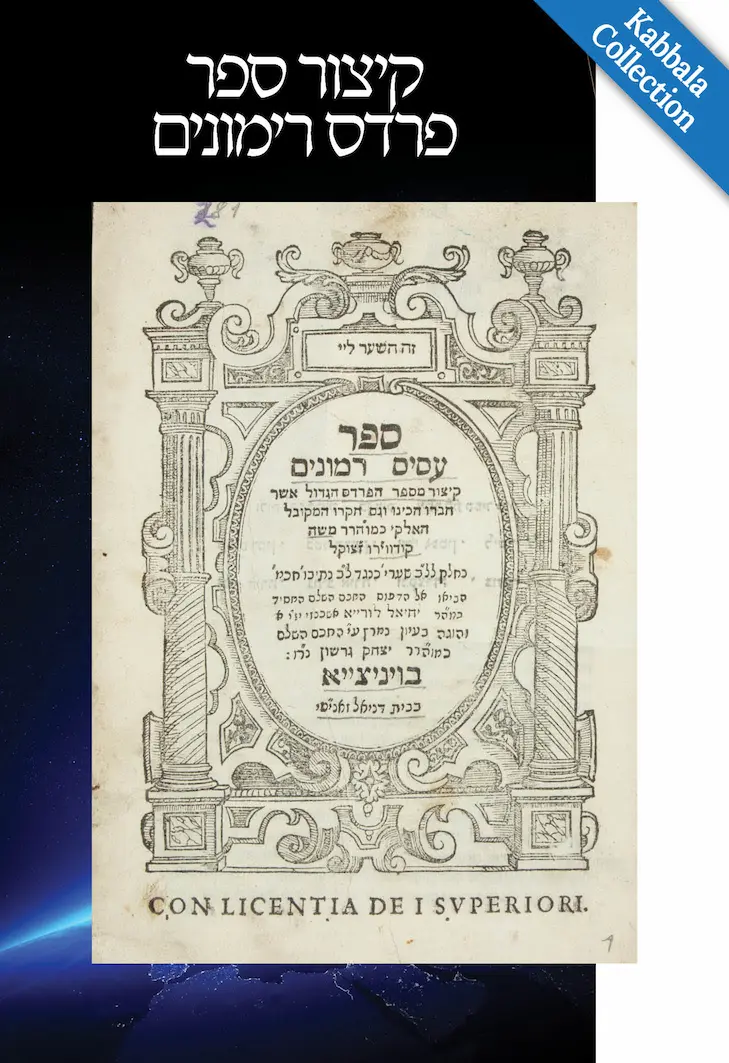
Asis Rimonim. First Edition. Venice, 1601
Abridged version of the sefer Pardes Rimonim by Rabbi Moshe Cordevero, the Ramak, by his disciple Rabbi Shmuel Galiko.
The sefer Pardes Rimonim (see Lot# 39) by the Ramak is described as an elemental work “for anyone who enters the pardes (orchard) of wisdom, ” which is the classic reference to the study of kabbalah. Since the Ramak’s writings were written in a profound and lengthy style, numerous kabbalistic scholars created abridged versions of his work. This sefer, Asis Rimonim, was the first such abridged work.
. Leaf 23a features a full-page flowchart of the Sefiros in the shape of a tree.
Venice, 1601. First edition. 86 leaves. Page size: 18.5 cm. Printed by Rabbi Yechiel Luria Ashkenazy. Minor restorations on title page. Good condition.
............................................... .
Any inquiries about this lot ?
We are available also on WhatsApp >>>

Lot : 56
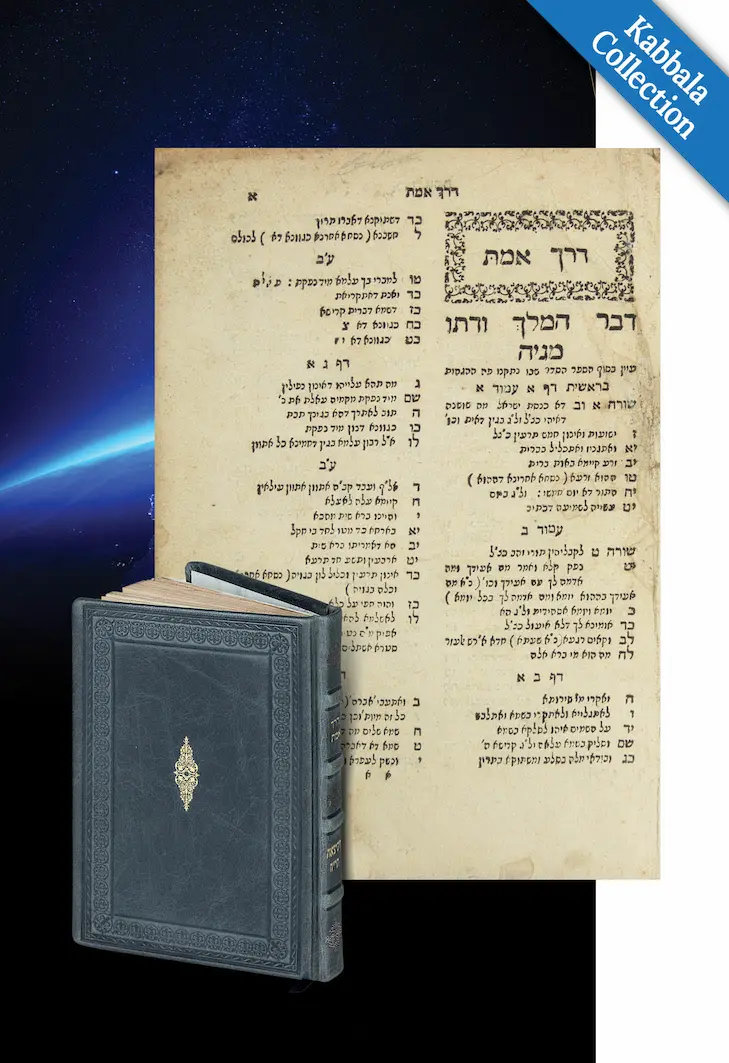
Derech Emes. The Arizal’s Glosses on Zohar Edited by the Ramaz. First Edition. Venice, 1658
The Arizal’s glosses on the entire Zohar, edited by Rabbi Moshe Zacuto, the Ramaz.
One of the foundational sefarim that established the correct nusach of Zohar.
The Ramaz writes the following in his closing remarks on the sefer, “The mistakes that…were found…in the Zohar with letters being exchanged and other matters…and missing text…are numerous…if it hadn’t been for the Ari….”
“This is my advice to every intelligent person: Hurry to purchase this sefer, even if it is very expensive, and correct the problematic parts of the Zohar by hand on the page” (excerpted from the words of the Ramaz).
Content up until leaf 33 was edited by the kabbalist Rabbi Yosef Chamitz who published the sefer, and from leaf 33 and on was edited by the Ramaz (see leaf 79b).
Venice, 1658. First edition. 36, 30, 70 leaves (inconsecutive pagination). Page size: 21 cm. Printed without title page. Good condition. Rare. New leather binding.
Stefansky, Sifrei Yesod p. 103.
............................................... .
Any inquiries about this lot ?
We are available also on WhatsApp >>>

Lot : 57
Teachings revealed by the Maggid to the Beis Yosef.
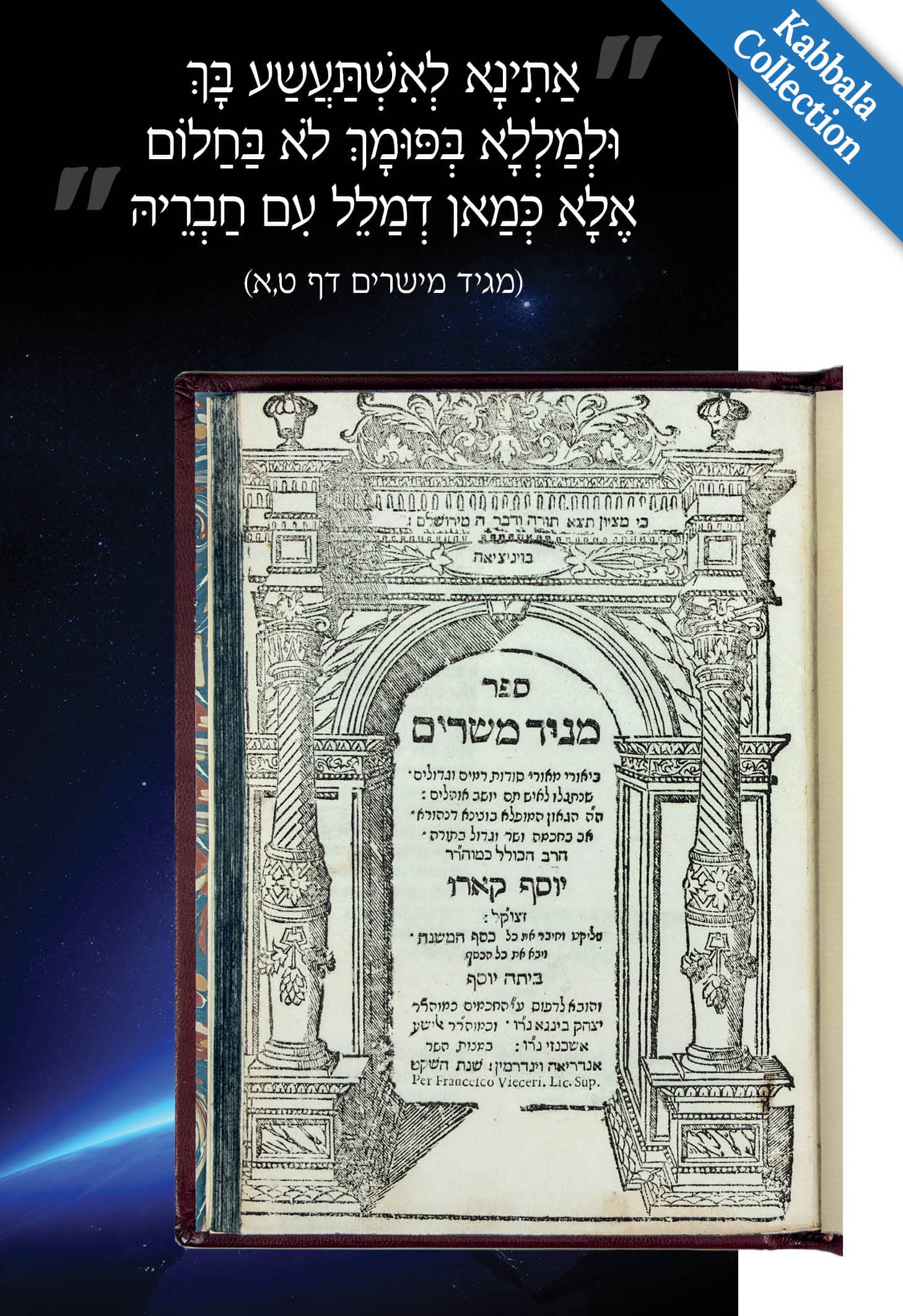
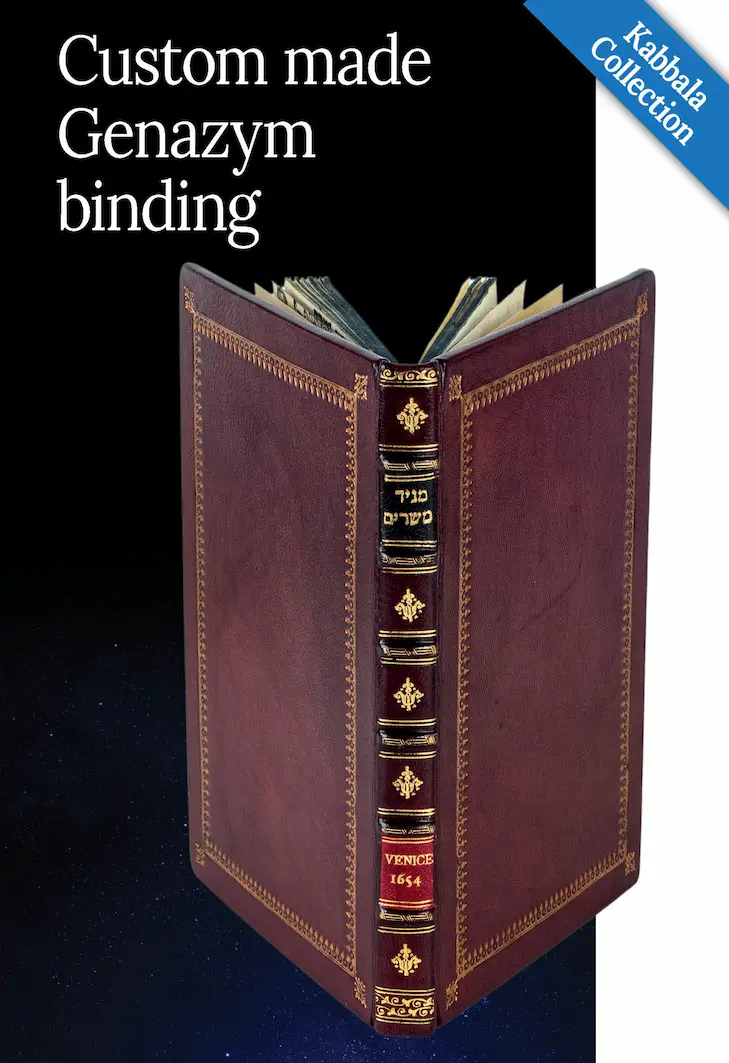
Maggid Meisharim by the Beis Yosef. First Edition. Venice, 1649
Secreted mystical teachings, warnings and practices revealed by the Maggid - angel from heaven, teaching and mentoring Rabbi Yosef Karo Author of the Beis Yosef and Shulchan Aruch.
“…I have come to enlighten you and to speak to you, not as if in a dream, but rather like a man speaking to his friend.” (Maggid Meisharim 9a)
Rabbi Yosef Karo merited having an angel sent to him to reveal the secrets of Torah and the wisdom of kabbalah along with other “astounding teachings”. The Maggid told the Beis Yosef that Eliyahu Hanavi would appear to him to teach him Torah, and further described to him how they rejoice with him in the Heavenly Yeshivah.
The Maggid commanded Rabbi Yosef Karo to write down everything he would reveal.
Rabbi Yosef Karo
(1488-1575) is renowned as the father of halachah. In the present sefer, we are offered a wondrous glimpse into his genius in the realm of the Hidden Torah and mysticism, as well. he was acquainted with all the great kabbalists of Tzfas of his era. He was a mechutan of the Arizal Hakadosh and studied kabbalah together with the famed kabbalist Rabbi Shlomo Elkabetz.
The first section of Sefer
Maggid Meisharim containing parshiyos Bereshis through Metzora, was first printed in Lublin 1646. The present Venice edition contains teachings from parshas Acharei Mos onwards as well as teachings on sections of Nac”h
Venice, 1649. First edition. [2], 58 leaves. Page size: 19 cm. Minor cropping of frame at the top of the title page. Good condition. Rare.
Stefansky, Sifrei Yesod #343
............................................... .
Any inquiries about this lot ?
We are available also on WhatsApp >>>

Lot : 58
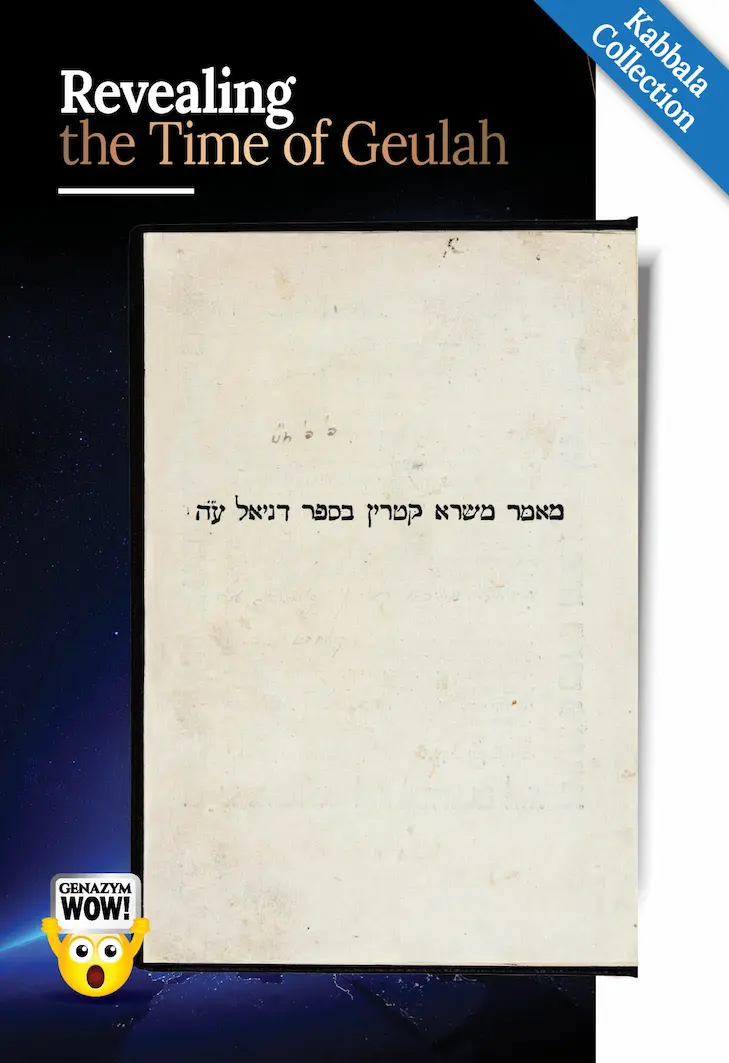
Revelation of the Time of Geulah
Mashra Katrin. Constantinople, 1510
Exceptional rare sefer!
The secret of the time of the Redemption described in Sefer Daniel by the Kabbalist Rabbi Avraham Halevi Hasephardi who lived in the era of the Spanish Expulsion.
According to the author’s calculation, Mashiach was supposed to be revealed in the year 1530. He intended to announce the upcoming revelation of Mashiach throughout the Diaspora.
Calculating the Time of the Geulah
The time of the Redemption and coming of Mashiach are alluded to in Sefer Daniel (see Megillah 3a, Rashi). Many have endeavored to solve the great mystery of Mashiach’s arrival. This was the first time such an attempt was published to the public.
Many were the sages who condemned the practice of calculating the arrival of Mashiach hinted to in Sefer Daniel (see commentary of the Ibn Ezra on Daniel 11:35). According to Chazal, one who calculates the end of times is fated to perish, yet the author responds to this challenge in the present sefer, as well.
According to the author’s calculations, Mashiach was supposed to be revealed in the Upper Galilee in the year 1530. He saw the events of his times, with the conquest of Istanbul by the Ottomans in the year 1453 and Spanish Expulsion in the year 1492, as part of the process of Redemption.
His conclusions are also mentioned by the Radbaz, who was a great Achron and Kabbalist, in his sefer Magen Dovid (Amsterdam, 1813 p. 39b):
“We have seen another holy sage…who wrote an essay entitled Mashra Katrin, and he cites a number of proofs that the Geulah was [supposed to be] in the year 1530…and it’s possible that the sins caused [it to be delayed].”
Rabbi Avraham Halevi Hasephardi Rabbi Avraham Halevi Hasephardi (circa 1470 – circa 1530) was a Spanish exile, and the brother-in-law of Rabbi Avraham Zacuto who authored Sefer Yuchsin. He fled to Italy and from there to Siriz, Greece where he wrote this sefer. He afterwords continued to Yerushalayim where he was appointed a Rosh Yeshivah.
Mashra Kitrin
The name of the sefer Mashra Kitrin is based on Sefer Daniel (5:12) as one of Daniel’s praises, who was “mashra kitrin, ” that is, he “opened bonds” (see Meturgaman Shoresh קטר), meaning Daniel revealed hidden things. In the present sefer, the author likewise reveals the secret of Redemption.
Constantinople, 1510. First and only printing Size: 20 cm • Page Count: 19 leaves • Condition: Artistic restoration on the first and last pages and repairs in the corners of the margins, new binding • Provenance: Private Collection, New York.
Bibliography: Yaari Istanbul 12. Malachi Beis Aryeh, wrote in his introduction to the microfilm editions of the sefer (Jerusalem, 1978, p. 12) that this sefer is
“Exceptionally rare.”
What is a Kshta Reish?
............................................... .
Any inquiries about this lot ?
We are available also on WhatsApp >>>

Lot : 59
Rare, valuable find!
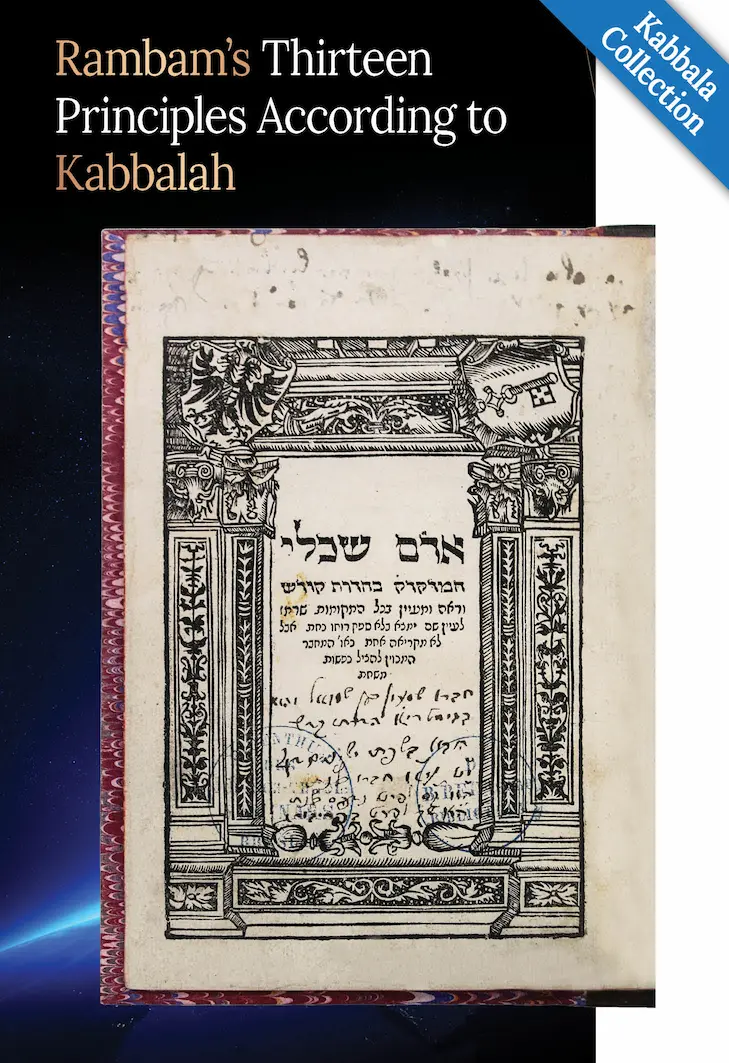
Adam Sichli. First Edition. Tiengen, 1560
A kabbalistic commentary on the Rambam’s Thirteen Principles of Jewish Faith, Yud-Gimmel Middos and Aseres Hadibros by Rabbi Shimon ben Rabbi Shmuel of France. This sefer features the Rambam’s Thirteen Principles of Jewish Faith with Rabbi Shimon’s commentary beside it.
The purpose of this sefer was to prove the connection between the Thirteen Principles of Faith and Yud-Gimmel (Thirteen) Attributes of Compassion. The author also expertly weaves the Ten Commandments into his commentary.
Rabbi Shimon ben Rabbi Shmuel of France was one of the great Ashkenazic sages of his era. He authored the present sefer in 1400 (as noted at the end of the work). Adam Sichli was widely disseminated and there are many handwritten manuscripts of this work, yet this was the very first printed edition of the sefer which was later reprinted in numerous editions.
At the top of the pages are the words Hadras Kodesh which is the second name of this sefer, as noted on the title page.
Leaves 19-20 present a brief description and commentary on the Ten Sefiros.
Leaves 21 and on present a long prayer for Yom Kippur which contains a form of viduy for one who seeks to repent.
The Rema in Toras Olah Vol. 3 Ch. 4 (leaf 73a in the Prague 1570 Edition) quotes this prayer and writes, “And so the great Rabbi Shimon instituted his prayer Hadras Kodesh after presenting the subject of the Ten Sefiros.”
Based on a comment in sefer Yosef Ometz (Frankfurt am Main, 1723) Letter 999, it seems that there were those who customarily recited this prayer on the night of Yom Kippur.
Tiengen, 1560. First edition. [24] leaves. Title page features rare decorative border.
............................................... .
Any inquiries about this lot ?
We are available also on WhatsApp >>>

Lot : 60
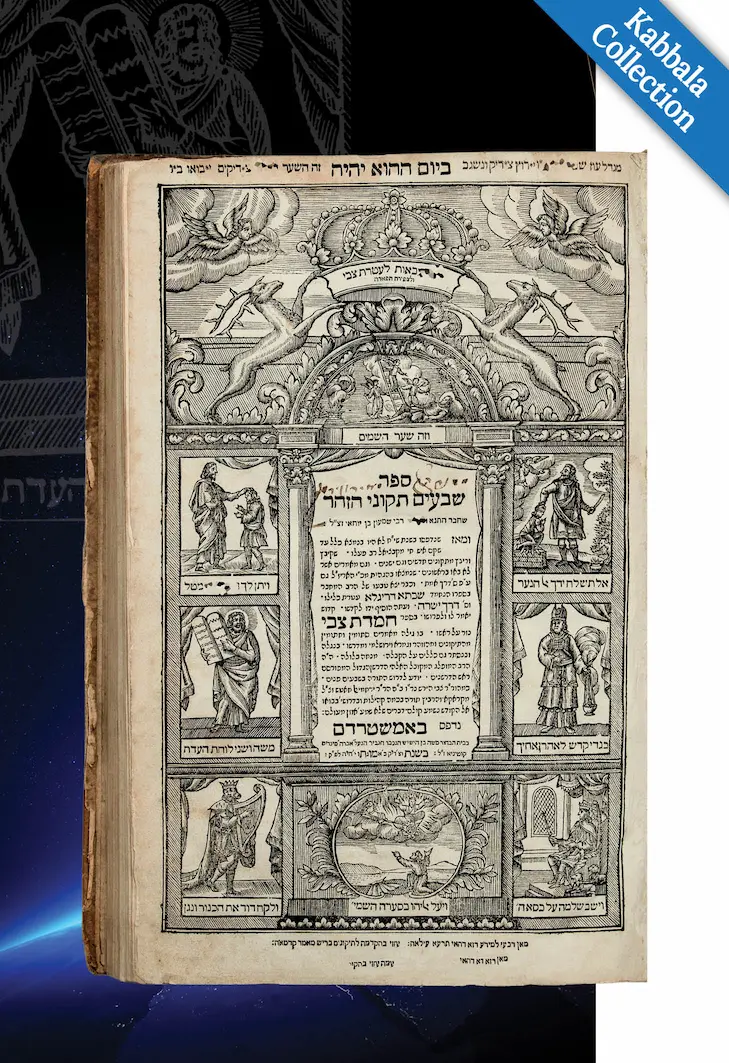
Tikkunei Hazohar with Chemdas Tzvi Commentary. Amsterdam, 1706.
only edition
Sefer Tikkunei Hazohar with the Chemdas Tzvi commentary by Rabbi Tzvi Hirsh ben Rabbi Yerachmiel Chatsh, author of Derech Yeshara and Shabsa D’regilah.
Rabbi Tzvi Hirsh Chatsh was born in Cracow where he ascended the spiritual ladder of Torah and halachah to became one of the transmitters of kabbalah throughout Poland and Germany. He also known for other important works: Derech Yeshara; Shabsa D’regilah; and Nachalas Tzvi.
The title page is completely illustrated with an exquisite copper plate and is regarded as one of the most impressive Hebrew title pages printed in Amsterdam.
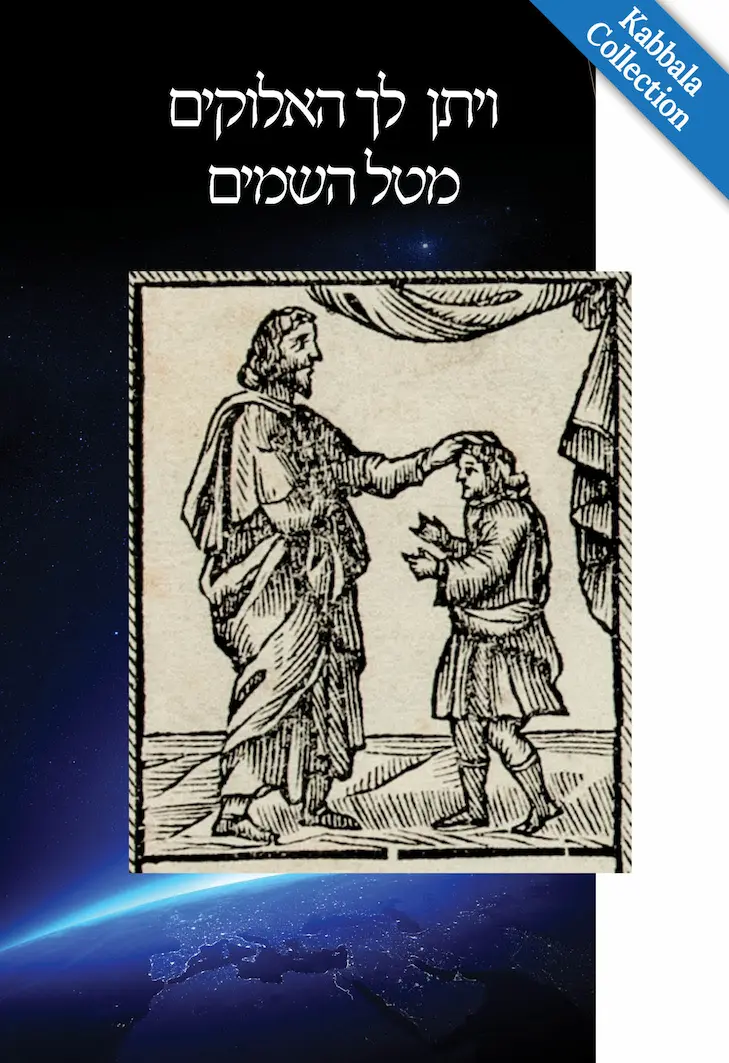
The top of the title page displays a kesser Torah held up by two deer with angels hovering above. It likewise features images of akeidas Yitzchak, Yitzchak’s blessing to Yaakov, Moshe Rabbeinu, Aharon Hakohein, David Hamelech playing the violin, Shlomo Hamelech on his royal throne; and Eliyahu Hanavi.
Includes approbation of the saintly kabbalist Rabbi Naftali Hakohein, author of Semichas Chachamim.
Some have suspected the author of this work as being affiliated with Shabbetai Tzvi (see Toras Hakana’us 71b)
Amsterdam, 1706. First and only edition. 164 leaves. Page size: 31 cm. Attractive copy in old binding in good condition.
Item description from the 'William L. Gross Collection'
................................................
Any inquiries about this lot ?
We are available also on WhatsApp >>>

Lot : 61
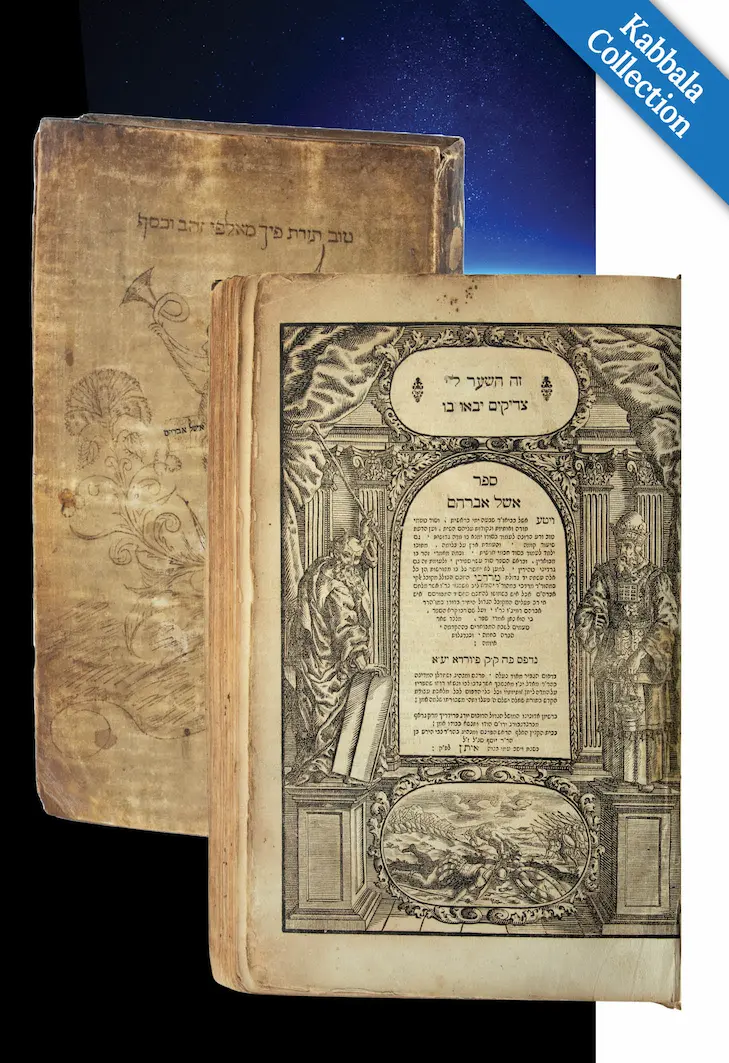
Eishel Avraham
Zohar Commentary
Fürth, 1701
Kabbalistic commentary and chiddushim on Sefer HaZohar by Rabbi Mordechai Ashkenazy.
The sefer opens with an impressive title page portraying the figures of Moshe and Aharon and the war between Dovid and Goliath. Leaves 45b-46a feature full-page kabbalistic drawings depicting the progression of the Sefiros as trees with branches.
Many of the chiddushim included in this sefer were relayed to the author by his master Rabbi Avraham Rovigo, a disciple of the Ramaz. The title Eishel Avraham is a tribute to his venerable teacher.
The renowned kabbalist
Rabbi Avraham Rovigo (circa 1650-1714) was a leading 17th century Italian kabbalist. He was the prime disciple of the Ramaz, and in his latter years, journeyed to Jerusalem where he founded a yeshivah for the study of kabbalah.
Fürth, 1701. Singular edition!
Size: 34 cm • Page Count: 186 leaves • Good condition • Provenance: William L. Gross collection.
Item description from the 'William L. Gross Collection'
............................................... .
Any inquiries about this lot ?
We are available also on WhatsApp >>>

Lot : 62
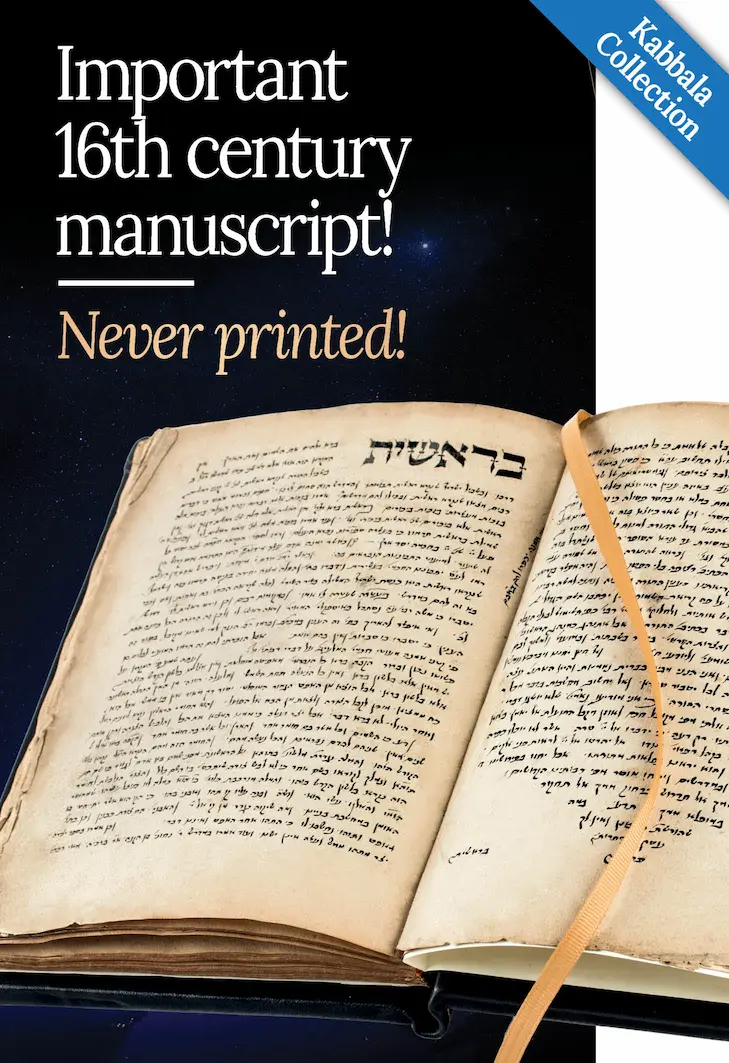
Important 16th century manuscript!
Shaarei Orah – Sodos HaTorah L’HaRamban. (Prague) 1575
Shaarei Orah – Sodos HaTorah L’HaRamban rare and unpublished 16th century kabbalistic manuscript contains the kabbalistic teachings and commentaries from the Ramban on the chumash. In addition the manuscript contains other teachings on topics in kabbalah.
Never printed!
The manuscript written in neat ashkenazic and features a long colophon that notes the year it was authored.
The Ramban’s commentary on the Torah encompasses many fundamental topics in kabbalah which the Ramban often refers to as “sod”. The author collected these from the Ramban’s commentary and created this sefer which he titled
Shaarei Orah.
The manuscript has many text varients from the traditional text we use today.
The end of the sefer features a long colophon that covers most of the leaf in which the author extols the wisdom of kabbalah and the Ramban’s commentary on the Torah.He concludes:
“With the help of heaven, I have completed the sefer
Shaarei Orah today, Wednesday, 4 Elul in the year 1575 ….
At the end of sefer are two important kabbalistic tracts:
1.
Calculation of the Combinations of the 12 Names of Havaya (leaves 53b-55b).
2.
Sod Temunas HaOisyos (leaves 56a-58b) by Rabbi Yom Tov Lipman Milhausen, author of Sefer Hanitzachon. This treatise is fundamental regarding the laws of the
shapes of the letter for writing a sefer torah, the Beis Yosef used it when compiling Hilchos Tefillin Ch. 36.
Leaves 13-14 include a summary of Sefer Harekanati al HaTorah, and the top of the leaf notes the year as 1594!
(Prague), 1575. Page size: 16x15 cm. 58 double-sided leaves in neat handwriting. Titles of parshiyos inscribed in large block letters. First leaf or two of the Ramban’s preface are missing. Good condition.
Father of Kabbalists
The Ramban was called “the G-dly kabbalist to whom all mysteries of wisdom and secrets of Torah were revealed” (Beer Hagolah by Maharal of Prague).He was from the early kabbalists who relayed the golden chain of the Hidden Torah to Klal Yisrael. The secrets of Torah ingrained in the Ramban’s commentary constitute many fundamentals of the wisdom of truth.
Rabbi Chaim Vital writes in his preface to Eitz Chaim in the name of the Arizal: “Regarding the authentic present sifrei kabbalah, my master told us that the chain of kabbalah from the Raavad and his son Rabbi Yosef are clean and pure, and his disciples until the Ramban all received the true kabbalah from the mouth of Eliyahu HaNavie who revealed himself to them.
Gedolei Yisrael throughout the generations referred to the Ramban as “Father of all kabbalists” and “Head of the kabbalists” (Ginas Vradim Orach Chaim Rule 2 Ch. 16; Shu”t Shemesh Tzedakah Orach Chaim Ch. 4).
............................................... .
Any inquiries about this lot ?
We are available also on WhatsApp >>>

Lot : 63
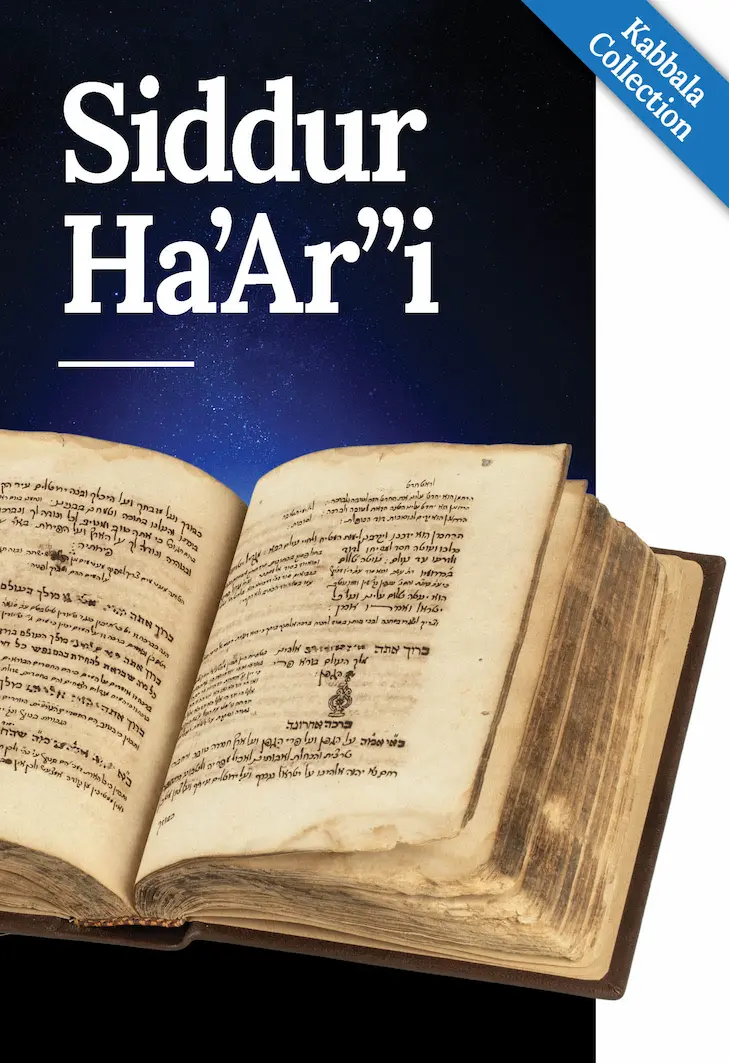
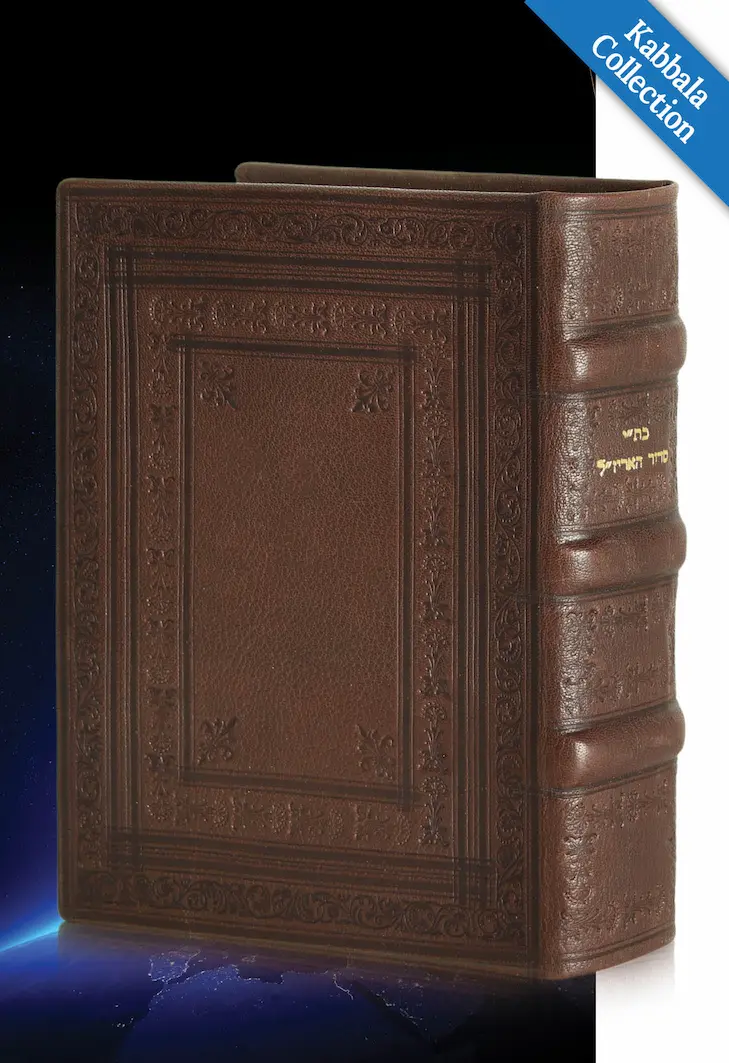
Manuscript
Siddur with prayers for the entire year with kabbalistic kavanos and customs based on the writings of the Arizal. The siddur was handwritten in handsome Ashkenazic
handwriting and is ornamented with attractive initials, windows, bordered titles, kabbalistic charts, and illustrations of the menorah.
The manuscript features handwritten glosses by various kabbalists who prayed from this siddur.
The siddur encompasses prayers for the whole year, beginning with Prayers for the Weekday, Shabbos, Yamim Nora’im, Festivals, Tikkun Chatzos, order of daily study, Zemiros Shabbos with commentary, Haggadah with kavanos, Sefiras Haomer with kavanos and Pitum Haketores, etc.
Europe, first half of 18th century. Size: 19.5 cm • Page Count: 269, [3] leaves. One leaf at the beginning is missing • Condition: Used, but good condition with light damage and several small tears at edge • Owners’ signature on last leaf. Sold Kedem March , 22. New leather binding.
Tefillah For Parnasah
Tefillah for Parnassah as appears in this Siddur
יְהִי רָצוֹן מִלְפָנֶיךָ ה' אֱלֹקֵינוּ וֶאֱלֹקֵי אֲבוֹתֵינוּ שֶׁתִּתֵּן לִי וּלְכָל בְּנֵי בֵּיתִי בַּיּוֹם הַזֶּה וּבְכָל יוֹם מְזוֹנוֹתֵינוּ בְּרֵיוַח וּבְכָבוֹד בַּעֲבוּר שִׁמְךָ הַגָּדוֹל (דיקרנוסא) הַמְּמֻנֶּה עַל הַפַּרְנָסָה הַיּוֹצֵא מִפָּסוּק וַהֲרִיקוֹתִי לָכֶם בְּרָכָה עַד בְּלִי דַּי וּמִפָּסוּק נְסָה עָלֵינוּ אוֹר פָּנֶיךָ ה' וּתְפַרְנְסֵנִי אוֹתִי וְכָל בְּנֵי בֵּיתִי וְאַל תַּצְרִיכֵנִי לִידֵי מַתְּנַת בָּשָר וָדָם כִּי אִם בְּשִׁמְךָ הַגָּדוֹל חָנֵנִי וּמְאוֹצָר מַתְּנַת חִנָּם תְּכַלְכְּלֵנִי וְתַשְׁפִּיעַ לָנוּ שֶׁפַע רָצוֹן וּמָלֵא בִּרְכַּת ה' אָמֵן סֶלָה.
............................................... .
Any inquiries about this lot ?
We are available also on WhatsApp >>>

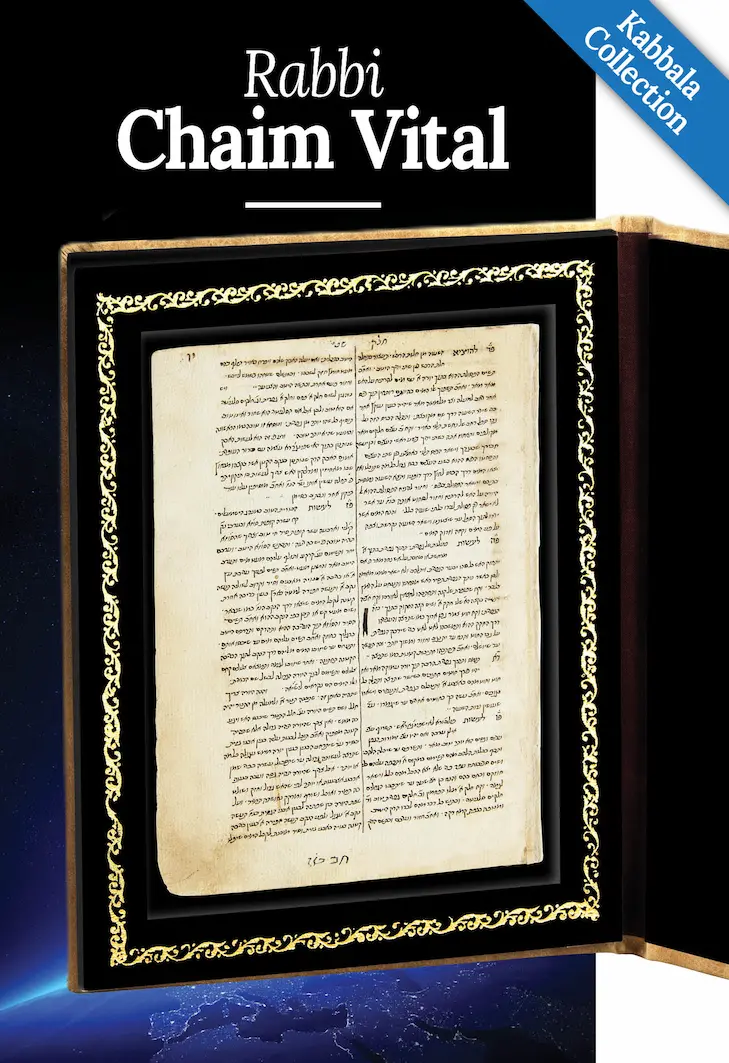
Lot : 64
Handwritten Leaf by Rabbi Chaim Vital.
A complete, double-sided leaf written by the holy hand of the saintly kabbalist Rabbi Chaim Vital, prime disciple of the Arizal who bequeathed his master’s Torah to the nation.
The kabbalist
Rabbi Chaim Vital
(1543-1620) is renowned for having possessed “an exalted soul” (Chida). He was the prime disciple of the Arizal and disseminated his kabbalistic legacy to the people. It is told that before he began teaching his pupil, the Arizal gave Rabbi Chaim Vital to drink from the Well of Miriam, thus opening a window to his lofty soul which allowed the Arizal to imbue Rabbi Chaim with the wisdom of truth, the wisdom of kabbalah. From that day, Rabbi Chaim became the Arizal’s faithful disciple, cleaving to his Torah and inscribed the wisdom that he acquired for posterity.
Following the Arizal’s passing at the age of 38, Rabbi Chaim became his spiritual heir, attracting all his contemporary kabbalah students to draw from the spiritual teachings of his master, the Arizal. In time, he was recognized as an astounding miracle worker who distributed amulets and segulos for protection and especially to banish evil spirits (dybbukim).
All of the Arizal’s sacred legacy derives from the copious writings of Rabbi Chaim Vital. On many occasions, the Chida presages strongly against the study of kabbalistic works other than those authored by Rabbi Chaim Vital or his students.
Rabbi Chaim Vital was a prolific author who authored many kabbalistic works, the most famous among them is surely Eitz Chaim which encompasses eight gates: 1) Shaar Hahakdamos 2) Shaar Maamarei Rashbi 3) Shaar Maamarei Razal 4) Shaar Hapesukim 5) Shaar Hamitzvos 6) Shaar Hakavanos 7) Shaar Ruach Hakodesh and 8) Shaar Hagilgulim.
Aside from his awe-inspiring sanctity and all-embracing knowledge of the wisdom of kabbalah, Rabbi Chaim Vital was also a skilled doctor who drew from practical kabbalah and alchemy to compile a brilliant, comprehensive text which was printed many years later under the title Sefer Hapeulos/Taalumos Chochmah. The present leaf derives from this manuscript.
The wisdom of ancient alchemy, which ultimately led to the development of modern chemistry, is based on the structure of elements in nature and the secrets of creation that Hakadosh Baruch Hu imbued in nature. Rabbi Chaim Vital called this part of his work, “B’peulos hanaasim al ydei hatevah, actions carried out through nature”.
One double-sided leaf, completely handwritten by Rabbi Chaim Vital. The handwriting is identical to those found in Eitz Chaim and Sefer Hachezyonos. Double columns per side; 40 lines per column. Total of 160 handwritten lines on 4 complete topics! Page size: 19x14 cm
Preserved in ornate leather binding with clear windows on both sides of the leaves and matching case. Good condition.
................................................
Any inquiries about this lot ?
We are available also on WhatsApp >>>

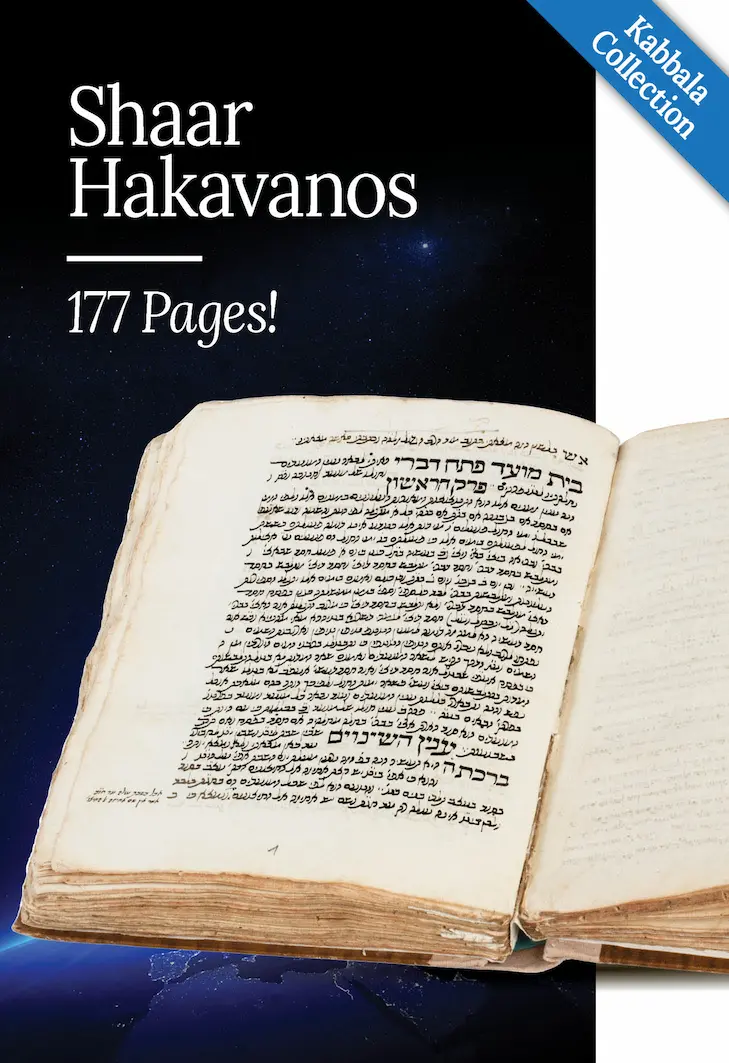
Lot : 65
Manuscript
Shaar Hakavanos by Rabbi Chaim Vital Handwritten by the Kabbalist Rabbi Yosef Zarka of Tunisia with Unknown Glosses. Tunisia, circa 1740
Manuscript of Shaar Hakavanos by Rabbi Chaim Vital on the prayers of Shabbos and Festivals , edited by his son Rabbi Shmuel Vital. This manuscript was handwritten by the holy kabbalist Rabbi Yosef Zarka, who was the greatest of Tunisian Rabbis in his generation.
Rabbi Yosef Zarka
(1722-1798) was one of the greatest spiritual masters and teachers of Torah in Tunisia. The Chida attests that “he had sixty disciples, among them the greatest of scholars” including Rabbi Yitzchak Taib, author of Aruch Hashulchan, and Rabbi Yehuda Najar, author of Limudei Hashem.
During this era, Tunisia had a group of select kabbalists, and Rabbi Yosef Zarka was recognized as the greatest kabbalist in the chabura. The Chida likewise writes that he was “a scholar and sofer, pious, pure and righteous” (Maagal Tov p. 57).
The Chida encountered Rabbi Yosef Zarka during a visit to Tunisia, and he inscribed that there was “great friendship” between them. Rabbi Yosef Zarka was known to write Sifrei Torah in a state of absolute purity and sanctity based on the kavanos of the Arizal. His written legacy includes Od Yosef Chai and Parpara’os L’Chochmah (Tunisia, 1904).
In addition this manuscript features handwritten copies of glosses by Rabbi Meir Poppirash on Shaar Hakavanos with various distinctions from the known printed glosses.
There are also glosses by a great anonymous kabbalist who signs his name only with the initials “A.C.” (see below).
Rabbi Meir Poppirash’ Comments on Shaar Hakavanos
Following Rabbi Chaim Vital’s kavanos for Shabbos and Yom Tov are two pamphlets that include copies of comments inscribed by the venerable kabbalist Rabbi Meir Poppirash on Shaar Hakavanos. The first pamphlet was written in Spanish-Dutch script, and the second in Italian script. These glosses vary slightly from the famous comments by Rabbi Meir Poppirash that appear in Shaarei Binah (Salonika, 1813).
Unknown Marginalia by Anonymous Kabbalist
The manuscript also boasts a large number of important handwritten glosses and marginalia by an unknown kabbalist whose wisdom and erudition in Torah and kabbalistic works are evident from his writings which reference many sefarim and offer profound insights on Shaar Hakavanos.
In his glosses, he compares the present manuscript of Shaar Hakavanos to the Shaar Hakavanos prepared and edited by the saintly kabbalist and Admor Rabbi Nosson Shapira, which is also only extant in handwritten manuscripts. He also cites other kabbalistic works which at the time were only available in manuscripts such as Adam Yashar, Siddur Chemdas Yisrael by Rabbi Shmuel Vital, Adam Yashar by Mahar”i Tzemach and Maaseh Choshev by Rabbi Avraham Azzoulay, as well as the writings of the Ramaz.
The kabbalist signs his name only with the initials A.C., and his identity remains unknown.
Tunisia, circa 1740. [177] leaves; original page count: 264-320; 2, 103, 15 leaves. Page size: 21x16 cm. Approximately 30 lines per page. The manuscript includes writings in three types of script: Tunisian Spanish (body); Italian and European Spanish. Many holes and old tape reinforcements throughout the manuscript ; last page of the pamphlet in Italian script has a small tear with a small amount of missing text. Simple old binding.
................................................
Any inquiries about this lot ?
We are available also on WhatsApp >>>

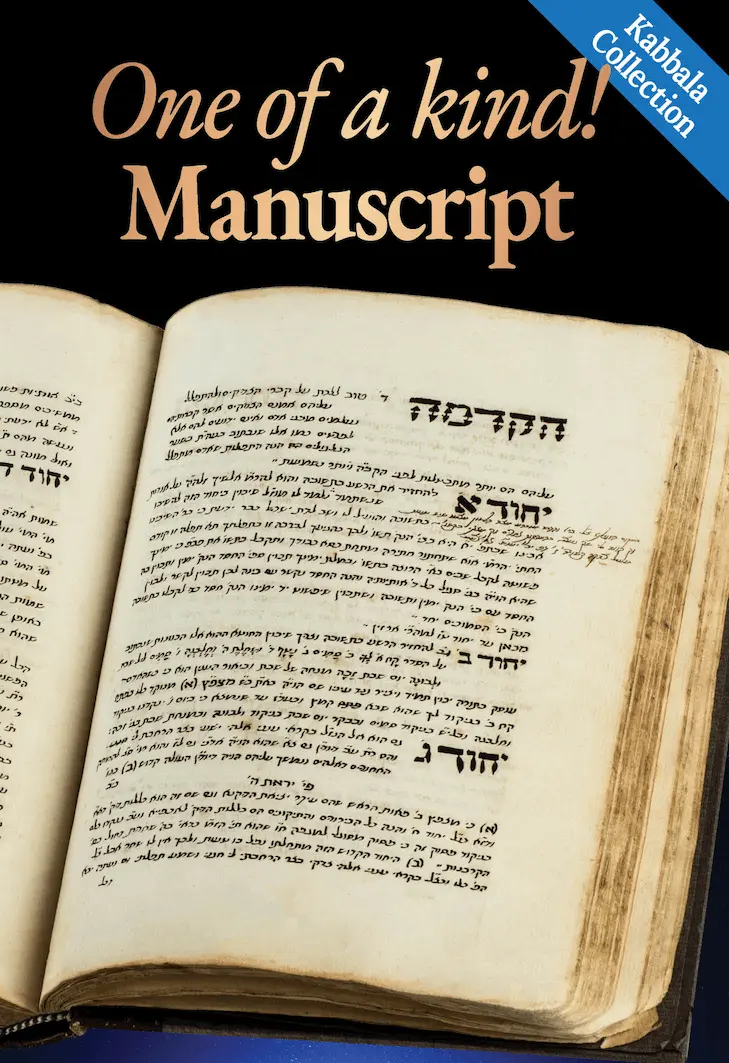
Lot : 66
One of a kind!
Manuscript
Shaar Ruach Hakodesh
with
Yiras Hashem
Commentary
by the Kabbalist Rabbi Yosef Sidbon of Tunisia
Shaar Ruach Hakodesh is the seventh “gate” taught by Rabbi Chaim Vital based on the lessons gleaned from the Arizal Hakadosh. This “Gate of Ruach Hakodesh” was illuminated by the present Yiras Hashem commentary, which was authored by the great kabbalist Rabbi Yosef Sidbon of Tunisia.
This commentary was first printed by the kabbalist Rabbi Yitzchak Kalamaro, in the Jerusalem 1874 edition of Shaar Ruach Hakodesh.
There is no other known complete handwritten manuscript of this sefer!
Rabbi Yosef Sidbon was famous for studying the Kavanos of the Rashash in great depth, On leaf 115a of the manuscript, he inscribes:
“For his zt”l’s words were given to Moshe Rabbeinu on Sinai.”
The holy kabbalist
Rabbi Yosef Sidbon was one of the great Tunisian kabbalists in the 18th century. The present essay was authored in the year 1780. During this period of time, there was a select group of kabbalists in Tunisia who dispatched their questions to the Rashash in what became known as the “Sheilot Chachmei Hamaarav, Questions of the Western Sages” and constitutes the basis of sefer Nahar Shalom. One of the esteemed members of this group of kabbalists was Rabbi Yosef Sidbon. In the present manuscript, Rabbi Yosef mentions the Rashash’s written replies that he dispatched to Tunisia.
neat script with variations from the printed version.
Tunisia, (1800). 158 leaves. Page size: 22x16 cm. Miniscule holes in margins. Simple half-leather binding.
................................................
Any inquiries about this lot ?
We are available also on
WhatsApp >>>

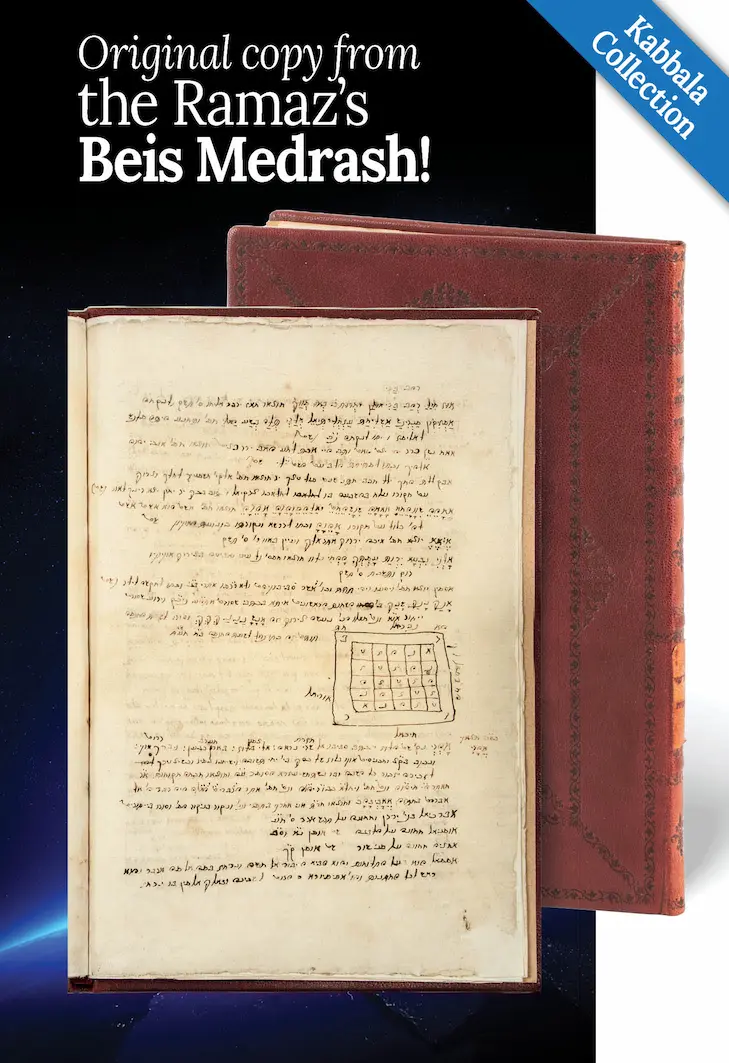
Lot : 67
Manuscript
Sefer Shorshei HaSheimos LaRamaz. Original Copy. Mantua, Circa 1685
Original copy from the Ramaz’s beis medrash!
The Holy Names of Hashem and names of angels, along with their explanations, all meticulously arranged in alphabetical order.
The first three leaves of the manuscript include explanations on Tikkunei Hazohar.
This manuscript was an original copy inscribed in the beis medrash of the Ramaz, written concurrent to the compilation and editing of the sefer. It was copied by one of the scribes in the beis medrash who sat before the Ramaz and engaged in copying his writings.
Rabbi Moshe Zacuto (1625-1698) was among the most influential Italian kabbalists of his time. He studied kabbalah under Rabbi Binyamin Halevi, a disciple of Rabbi Chaim Vital, thus becoming another link in the chain of kabbalah taught by the Arizal. His famous house of study for kabbalah in Mantua was among the most eminent in all of Italy, and its scholars produced many landmark works of kabbalah which were instrumental in transmitting the teachings of the Arizal.
.
The Ramaz compiled and edited numerous works of kabbalah, selecting what he believed to be the most accurate and entitled his writings Soles Nekiyah (clean from errors). He then relayed his compositions (this manuscript being one of them) to scribes who sat before him which they duplicated, in order to spread his teachings around the world. There are many references to his involvement in the writings of the manuscripts in Igros HaRamaz (see Y. Avivi, Soles Nekiyah, Peamim 96 (2003) pp. 71-106.
The margin of leaf 10b contains a handwritten gloss by the kabbalist Rabbi Moshe Sabon (1806-1888), who was an Algerian kabbalist (Malchei Yeshurun p. 178).
Mantua, circa 1685. [20] leaves (40 sides). Page size: 26x17 cm with many holes along the length of the manuscript, professionally restored. Attractive new leather binding.
............................................... .
Any inquiries about this lot ?
We are available also on WhatsApp >>>

Lot : 68
Handwritten Manuscript
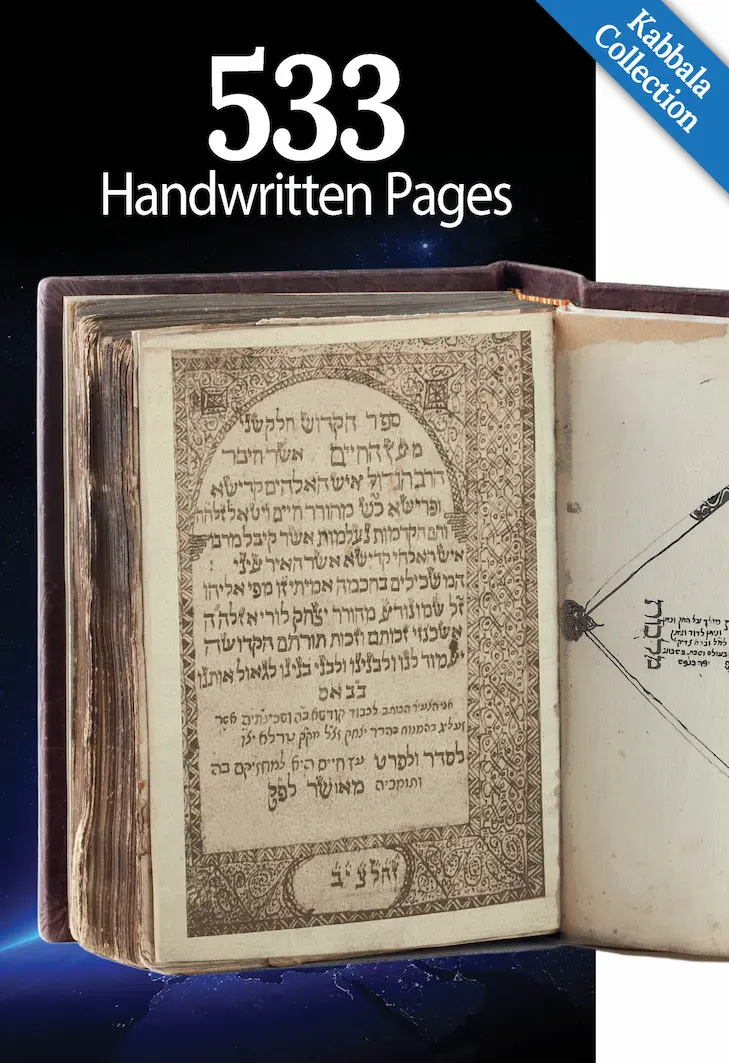
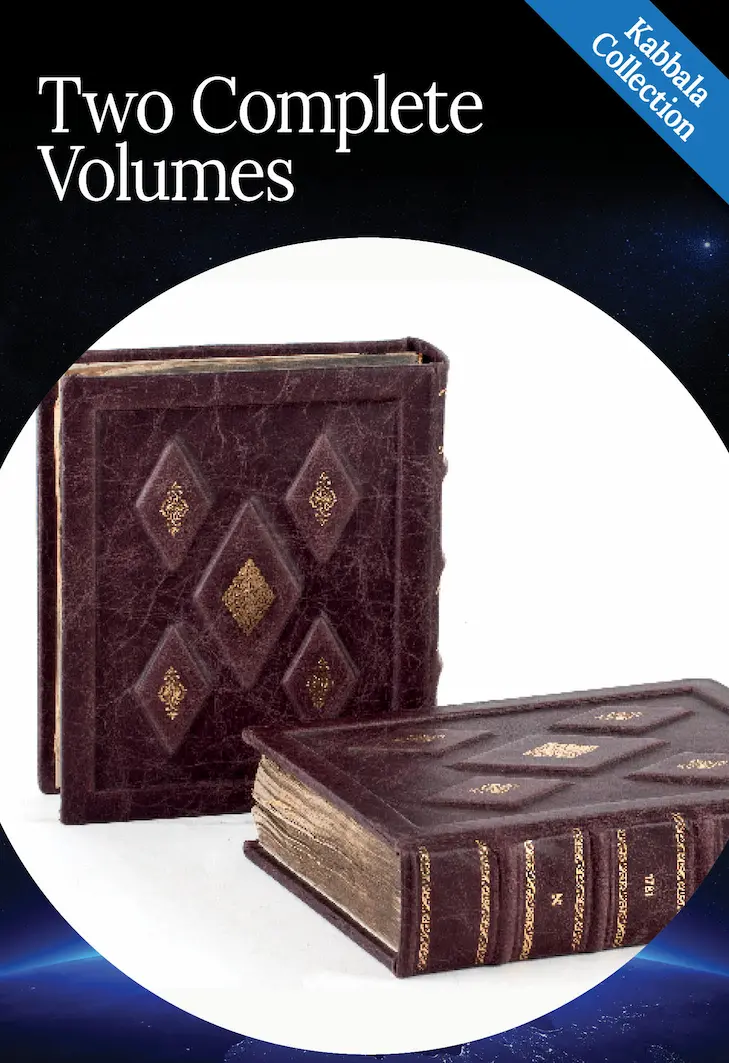
Eitz Chaim by Rabbi Chaim Vital. Two Complete Volumes. Tarlow, Apta County, 1781.
Large Folded Tree of Sefiros.
Two thick volumes with over 1000 handwritten sides in the handwriting of Reb Asher Zelig ben Rabbi Yitzchak the scribe. Written in neat Ashkenazic script. Contains unknown mystical glosses as well as additional compositions on kabbalah.
contains the 50 Gates of Rabbi Chaim Vital’s Eitz Chaim Sefer Eitz Chaim. Sefer Eitz Chaim is the foundational work of the Arizal’s kabbalah and includes all the principles, rules and introductions to the wisdom of kabbalah taught by his disciple Rabbi Chaim Vital.amd wascstudied by generations of kabbalists for the knowledge of the Arizal’s kabbalah.
Vol 1: Gates 1-24. Vol 2: Gates 25-50. Completely intact including the introductions of Rabbi Chaim vital and Rabbi Meir Poppirash.
Title pages and colophon
Each title page with the date: 1781 in a decorative border .
Inscription on title page of Vol. 2 : “I write for the honor of the Holy One Blessed Be He. The young Asher Zelig son of the late Rabbi Yitzchak zt”l from Tarlow.”
The colophon at the end of Volume 1 says,
“Upon completion, I bless the Creator, may His Name be blessed, Who gave me the merit of completing the first volume of sefer Eitz Chaim, today, Wednesday, the 3rd day of Menachem Av, in the year of “Eitz chaim hei lmachazikim ba usomcheha Me’ASHER (5541-1781)... I [am]the youth who writes for the sake of the unification of the Holy One Blessed Be He and His Shechinah, Asher Zelig ben Rabbi Yitzchak from Tarlow, near Apta in Poland Minor.”
Sefiros Tree and Kabbalistic Illustrations
A large folded chart in the beginning of Vol 1. depicting the order of the Ten Sefiros [based on Sefer Yetzirah].Two illustrations of an open palm, the “Kumas Hayad” with the order of the Aleph Beis alluded to in the joints of the fingers (see below).
There are also other kabbalistic illustrations in the body of the manuscript.
Unknown marginalia in the manuscript
Marginalia of several unknown kabbalists appear on the pages of the manuscript. Some begin with the words, “Shneur the youth says” and the like. Nothing is known of this anonymous Shneur. (See Vol 1: 43a, 63b, 117b.)
Additions
1) The end of Vol 1. includes an essay from the Arizal’s on the order of the Aleph Beis on the fingers after which it says, “the commentary on this holy and hidden essay was given by Hashem to my teacher and rabbi, the chassid and kabbalist…Rabbi Yaakov Temarlish Ashkenazi” (later printed at the end of Sefer Yetzirah, Warsaw, 1884).
2) Prayer and meditations for the rectification of the ill. It opens with the words, “Behold I have come to visit the ill and to rectify his root.”
3) “Whoever is unable to go to the mikvah should perform this tikkun.”
Tarlow, Apata County, 1781. Two large volumes. Vol. 1: [9], [1] large folded chart, 256, [6] leaves. Vol. 2: 261 leaves, total of 526 leaves. Page size: 21x18 cm. Minor tears and stains on last 8 leaves, otherwise good condition. New leather bindings.
............................................... .
Any inquiries about this lot ?
We are available also on WhatsApp >>>

Lot : 69
Special Prayer by the Ohr Hachaim Hakadosh. Livorno, 1740
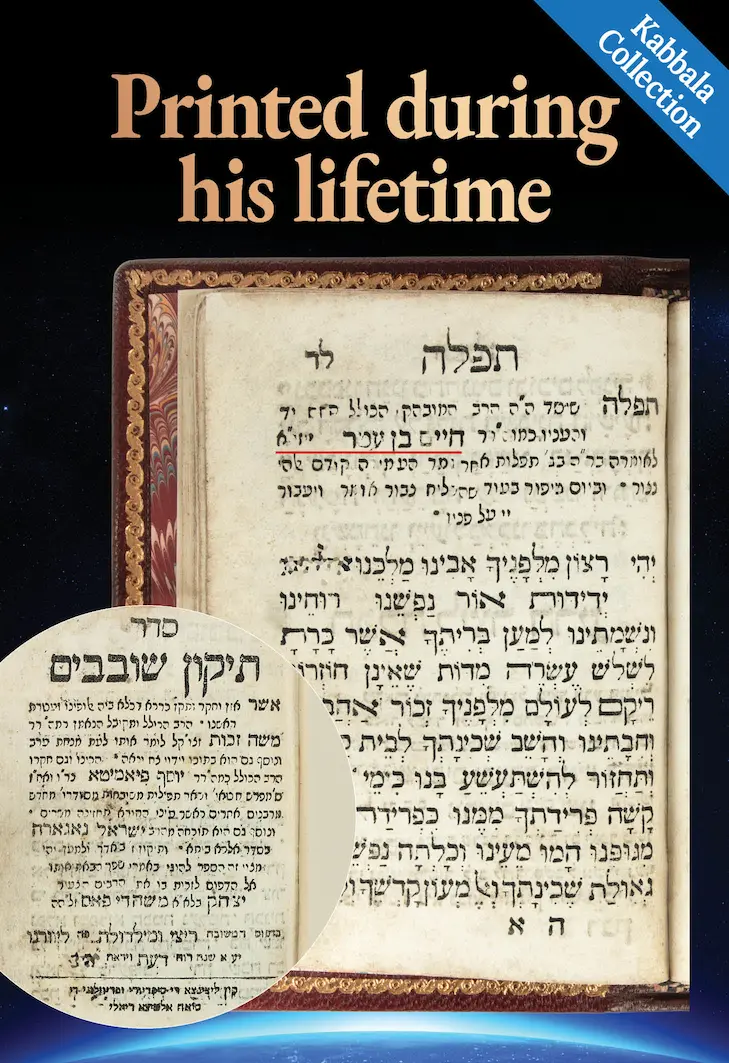
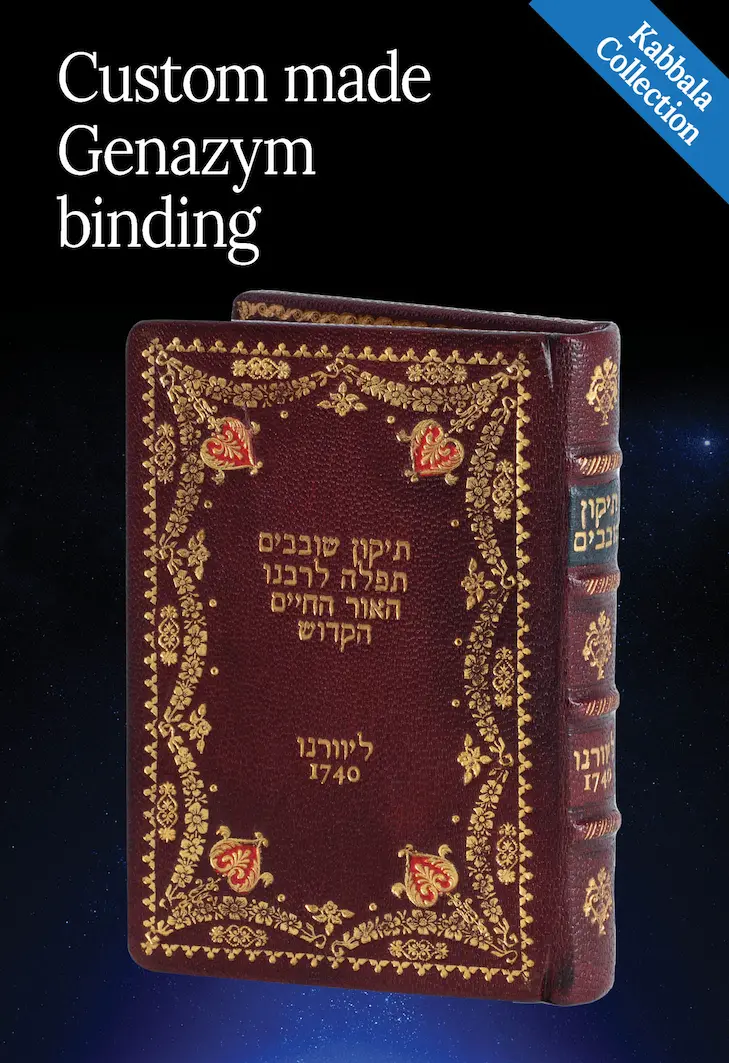
Seder Tikkun Shovavim which includes a special tefillah for Rosh Hashanah and Yom Kippur composed by Rabbi Chaim Ben Attar, author of the Ohr Hachaim. The tefillah was printed during his lifetime inside a rare edition of Seder Tikkun Shovavim which was published in 1740 in Livorno where the Ohr Hachaim sojourned on his way to Eretz Yisrael.
The tefillah was printed on leaf 34a which says,
“A prayer established by Harav…Rabbi Chaim Ben Attar, to be said at the end of all three tefillos of Rosh Hashanah before Elokai Netzor, and on Yom Kippur while the Shliach Tzibbur recites ‘Vayavor Hashem al Panav.’”
The basis of this tefillah is a yearning for Hakadosh Baruch Hu to restore His Shechinah to our midst, “and that He shall return to enjoy us as in the days of old, because Your withdrawal from us is [as] difficult as the departing of our soul from our body…”
Seder Tikkun Shovavim to be recited during Minchah during the days of Shovavim, by the Ramaz, with Viduy from the kabbalist Rabbi Yosef Piamita, and many other tefillos.
Livorno, 1740. 49 leaves. Page size: 10.8 cm. Good condition. New magnificent red leather binding with gold embossing.
................................................
Any inquiries about this lot ?
We are available also on WhatsApp >>>

Lot : 70
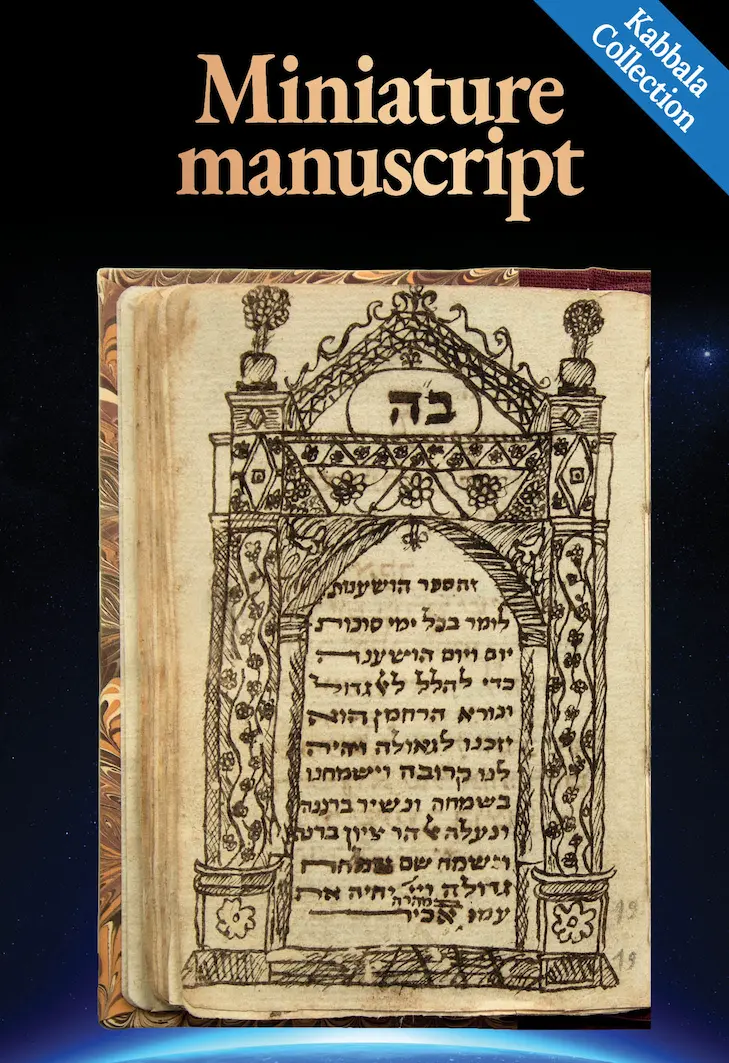
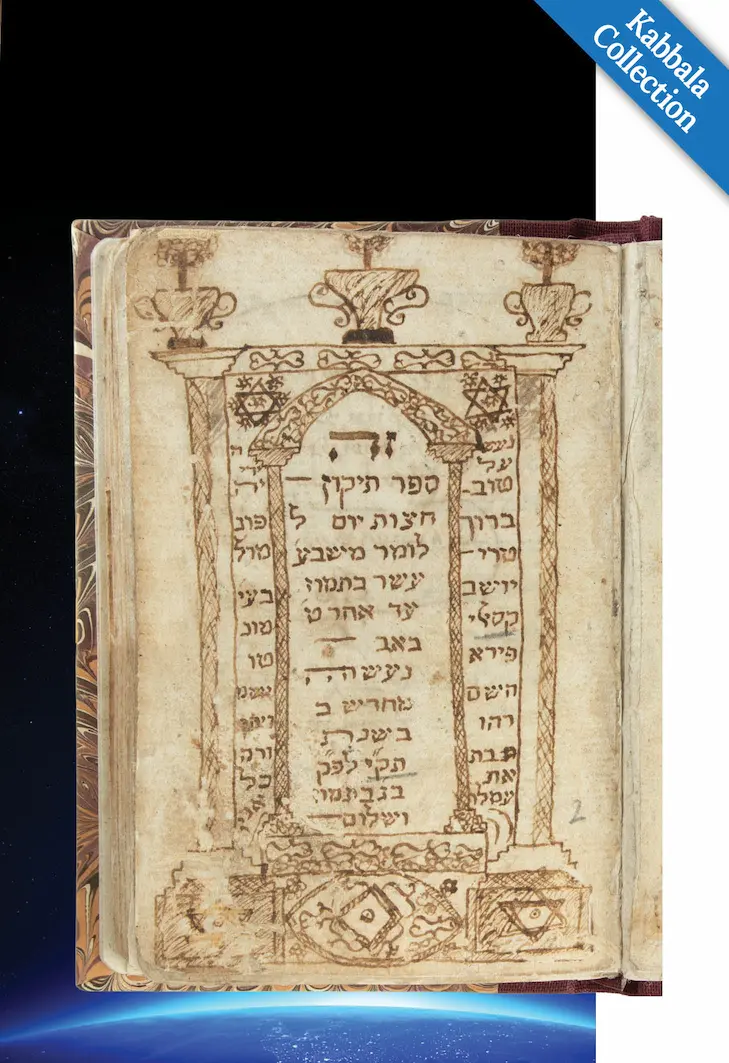
Miniature manuscript with illustrated title pages
Tikkun Chatzos and Hoshanos. Italy, 1750
Two 18th century Italian manuscripts bound together with illustrated title pages.
1) The Tikkun Chatzos Yom that is customarily recited during the Three Weeks between the 17th of Tammuz and Tisha B’Av.
2) Hoshanos for Sukkos and Hoshanah Rabba.
The title page of the Tikkun Chatzos reads: “The work of the hands of Tuvia Baruch Pontremoli who lives in the city of Casale Monferrato…made again in the year 1750."
Both manuscripts with artistic title pages. An additional title page designed by a resident of Casale was added, signed, “Moshe Yaakov Kohen from Casale.”
Italy, 18th century. [18]: [44] leaves. Page size: 12 cm. Minor tears and defects on many pages professionally restored. New half cloth and marbleized paper binding.
............................................... .
Any inquiries about this lot ?
We are available also on WhatsApp >>>

Lot : 71
Manuscript
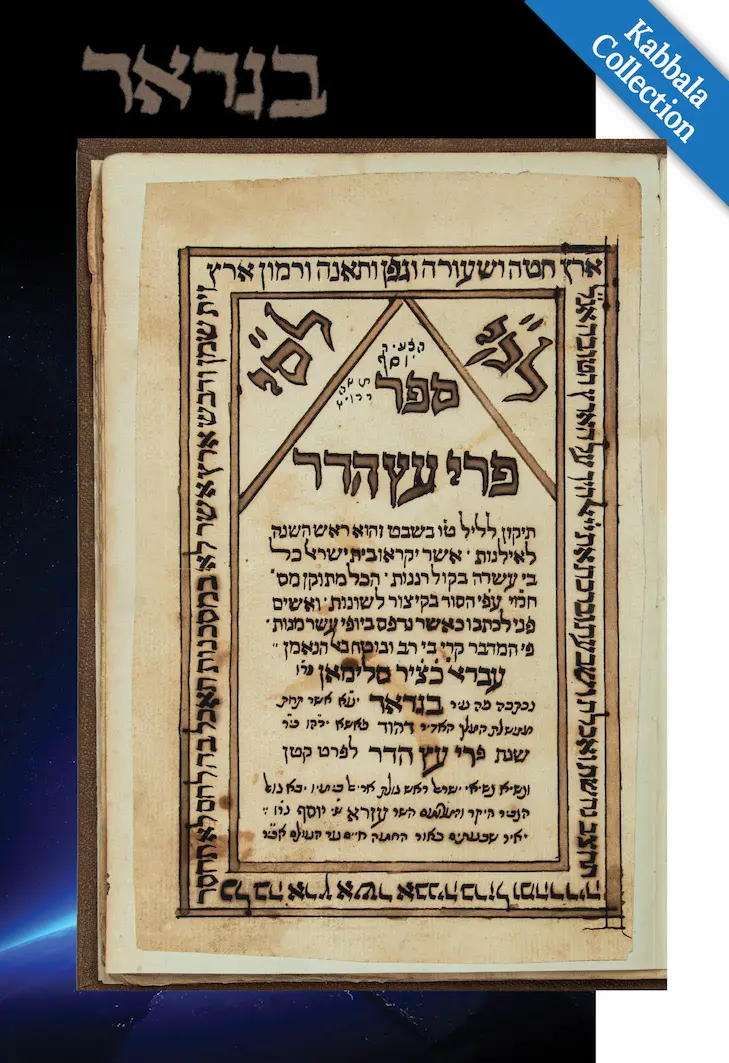
Kabbalistic Order
for Tu Bishvat
Bagdad, 1819
Order of study and customs for the night of Tu Bishvat. The manuscript was prepared and inscribed by Abdallah Kazir Suleiman of Bagdad, most likely on behalf of President Rabbi Ezra Yossef (see title page margin). Suleiman also included several poems that he composed into this work.
Page 10 features a list of 30 fruit that are customarily brought to the table on Tu Bishvat.
Bagdad, 1819
Size: 21x15 cm • Page Count: 62 sides. 4 pages (of them, 3 are end pages) are torn with approximately one third of the page missing • Owner's Signatures: Yosef Moshe Darwish • Provenance: Sassoon Manuscript #960 (Ohel David #8922).
For further information press here
............................................... .
Any inquiries about this lot ?
We are available also on WhatsApp >>>

Lot : 72
Important Kabbalistic Siddur
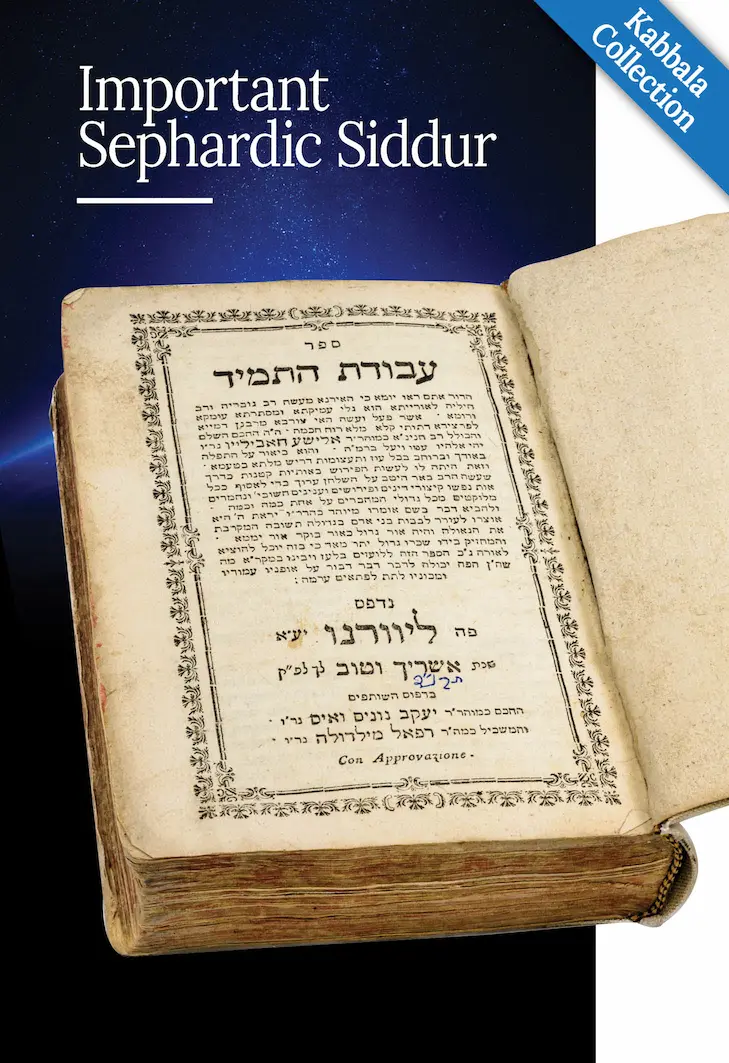
Siddur Avodas Hatamid. First Edition. Livorno, 1794
Siddur of all weekday prayers in Sephardic rite; laws and customs with kabbalistic teachings of prayer intentions; and a comprehensive commentary on the prayers by the saintly kabbalist Rabbi Elisha Habillo of Sarajevo. With an endorsement by the author’s Rabbi, Rabbi David Pardo.
On leaf 83b ‘Shivisi’ is printed across the whole page along with the verses of the psalm “Lamenatzeach b’neginos” in the shape of a menorah. The page also includes a depiction of the Ten Sefiros and assorted verses.
Rabbi Elisha Habillo was born in the
mid-to-late 18th century in Sarajevo, ( former Yugoslavia). He was the prime disciple of Rabbi David Pardo and published his sefer
Shafa’as Revivim. He spent a period of time in Italy and his lifelong yearning was to settle in Eretz Yisrael, although it is unclear if he ever fulfilled his dream. The year of his passing is likewise unknown. Rabbi Chananel Nifi, who was closely acquainted with Rabbi Elisha, wrote that “he was very humble” (see Toldos Gedolei Yisrael, Trieste 1853 p. 11). A list of his written legacy was published by Ben Menachem in Kovetz Sinai Vol. 60 p. 283-288.
Livorno, 1794. First edition. [12] 268 leaves. Page size: 18 cm. The flyleaf features a handwritten kabbalistic inscription regarding the attributes of prayer in Italian script. Good condition with original binding and new cloth spine. Siddur Avodas Hatamid is acclaimed as a very important sephardic siddur.
Stefansky Sifrei Yesod p.113 (Additions to Prayerbooks)
............................................... .
Any inquiries about this lot ?
We are available also on WhatsApp >>>

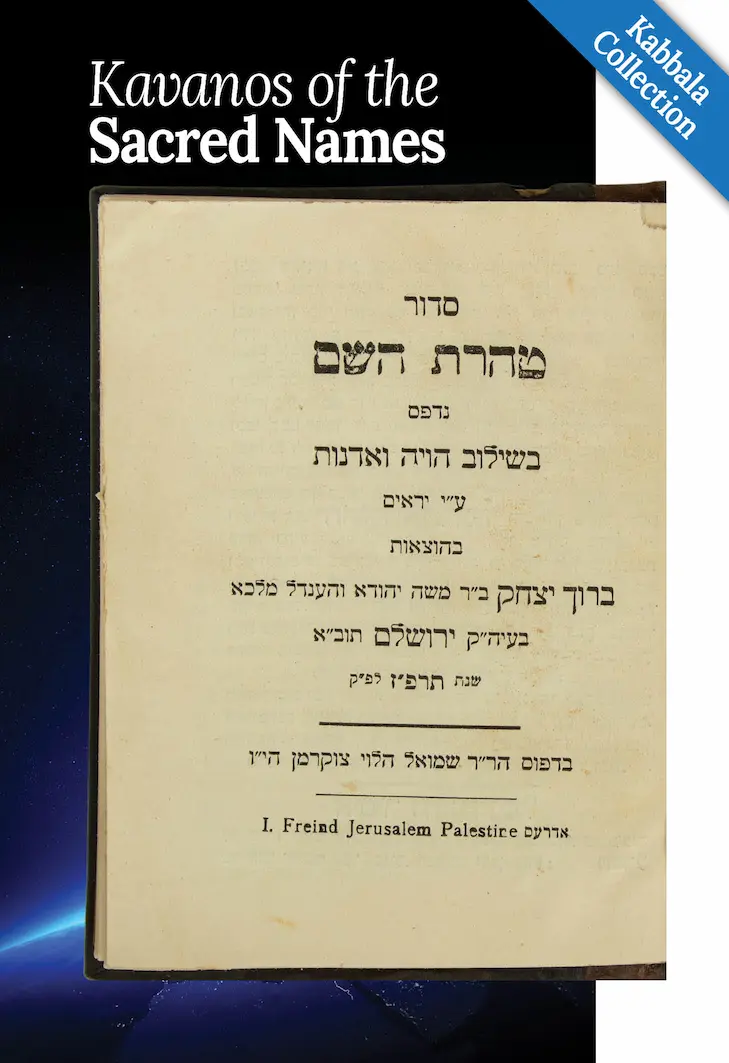
Lot : 73
Siddur Taharas Hashem with the Names of Hashem
Siddur Taharas Hashem. Jerusalem, 1927
Siddur Taharas Hashem,
Nusach Sephard (chassidic). This was the first Ashkenazic siddur to feature the correct kavana - meaning (הוי"ה and אדנות) integrated at every mention of Hashem's name.
This siddur was printed based on siddurim formerly printed in Slavita by Rabbi Moshe Shapira of Slavita. The editor inscribed in his preface to the siddur: “The text of this siddur was copied from a siddur printed by the Slavita Rav Rabbi Moshe Shapira zt”l, son of the Admor Rabbi Pinchas of Koritz zt”l.”
The title page notes that the siddur was printed by the famous Jerusalem tzaddik Rabbi Baruch Yitzchak Freund, renowned for his fervent and heartfelt prayers, was titled as one of the great “mechavnim” in Jerusalem.
Rabbi Friend's grandson, who assisted in the printing of the siddur, relates that his grandfather instructed him to relay the siddur only to a printer who immersed daily in a mikveh. “And, indeed, I paid the printer a special fee so he would go to the mikveh daily, and since then, the printer has become a ‘mikveh Yid’” (Sippurim yerushalayim Vol. 5 p. 88).
This siddur includes the famous melodies “Ka Echsof” by the Admor Rabbi Aharon of Karlin and “Gott fun Avraham” by Rabbi Levi Yitzchak of Berditchev.
Jerusalem 1927. 179 [1] page. 15 cm. Good condition.
............................................... .
Any inquiries about this lot ?
We are available also on WhatsApp >>>

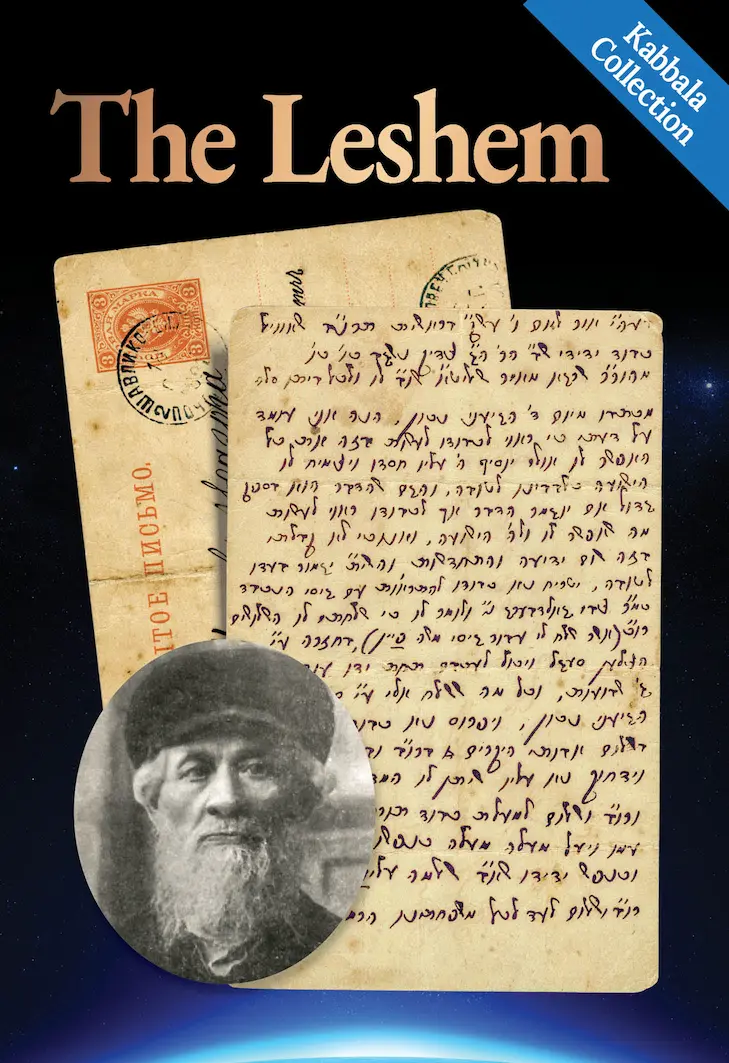
Lot : 74
The Leshem
The Leshem
Letter by the Saintly Kabbalist
Rabbi Shlomo Elyashiv
Shavil, 1892
Handwritten postcard by the saintly kabbalist Rabbi Shlomo Elyashiv, the “Baal Haleshem” to his dear friend and kabbalist Rabbi Shraga Meir (Leizerovitch).
The Leshem opens and concludes his letter with words of blessing,
“Hashem should add His loving kindness upon him …May Hashem Yisborach be with him, and may he ascend higher and higher.”
Rabbi Shlomo Elyashiv (1842-1926), renowned as the Baal Haleshem, was a descendant of the Arizal and Rabbi Shimshon of Ostropoli as he mentions in his introduction. From his early youth, he conducted himself with extreme holiness, piety and abstention, devoting the hours of his day to the revealed Torah and the night hours he devoted to studying the depths of the hidden Torah. It was said that since the times of the Ramak, there was never a sefer that so clearly illuminated the wisdom of kabbalah as Leshem Shvo V’achlamah.
Shavil, 1892. Postcard. Good condition.
............................................... .
Any inquiries about this lot ?
We are available also on WhatsApp >>>

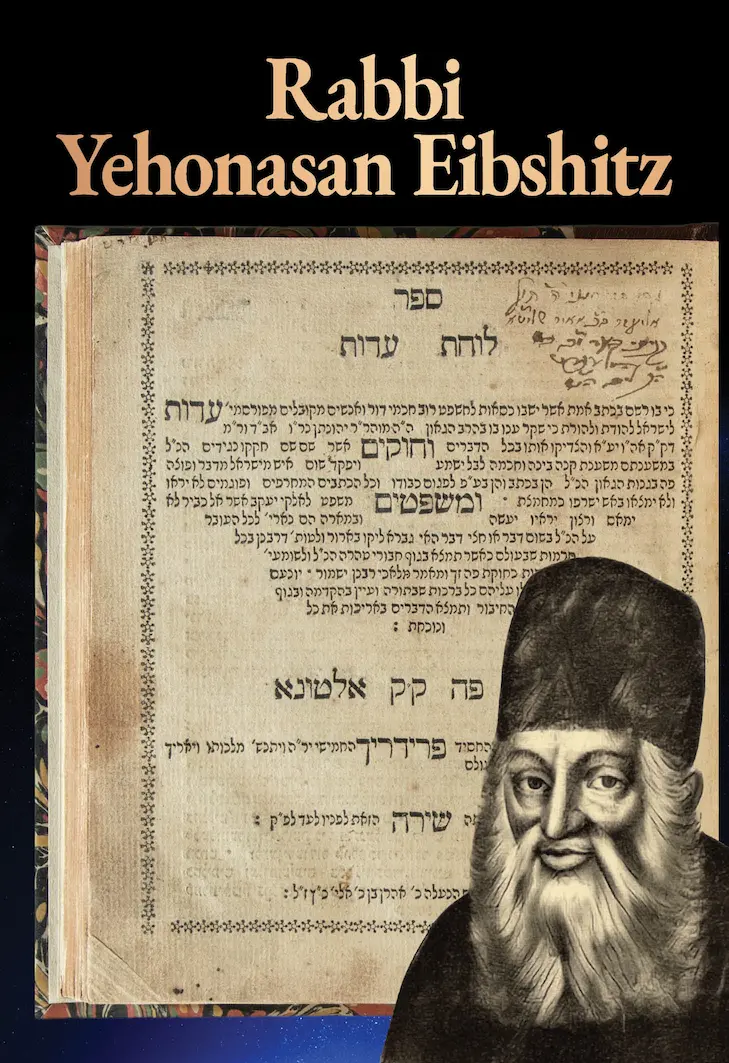
Lot : 75
Luchos Eidus
by
Rabbi Yehonasan Eibshitz
First Edition. Altona, 1755
Sefer Luchos Eidus by Rabbi Yehonasan Eibshitz contains letters and endorsements by the great rabbis and kabbalists of the era, defending Rabbi Yehonasan Eibshitz and condemning the rumors spread about him as false.
Shortly after Rabbi Yehonasan Eibshitz, Av Beis Din of Prague, arrived in the city of Altona, there were several tragic incidents of Jewish women who perished during childbirth. Rabbi Yehonasan, who was also a revered kabbalist, proceeded to write special amulets (kameah) for expectant women to carry for protection. When one of these amulets reached the hands of Rabbi Yaakov Emden, he suspected that it contained Sabbatean content and issued a public accusation of heresy against Rabbi Yehonasan Eibshitz, prompting the notorious Eibshitz - Emden Controversy which made waves across the Diaspora.
Rabbi Yehonasan Eibshitz dispatched the amulets he’d created (along with explanations) to his contemporary rabbis and kabbalists, and the vast majority responded with their support, vouching for his innocence.
Rabbi Yehonasan Eibshitz published their letters of support and endorsements in order to dispel any claim or suspicion of his so-called Sabbatean affiliation.
The Vilna Gaon, who was one of the Torah luminaries to whom Rabbi Eibshitz sent his amulet, responded with a powerful letter of endorsement that appears in this book on leaf 71b. In his letter he writes “..Who will give me wings like a dove, I will fly over and live to create peace, in order to extinguish the foreign fire of unjustified machlokes ”
Altona, 1755. First edition. Size: 18.5 cm • Page Count: 78 leaves • Condition: Good condition. Attractive new half-leather binding. Owners’ signatures on title page.
............................................... .
Any inquiries about this lot ?
We are available also on WhatsApp >>>

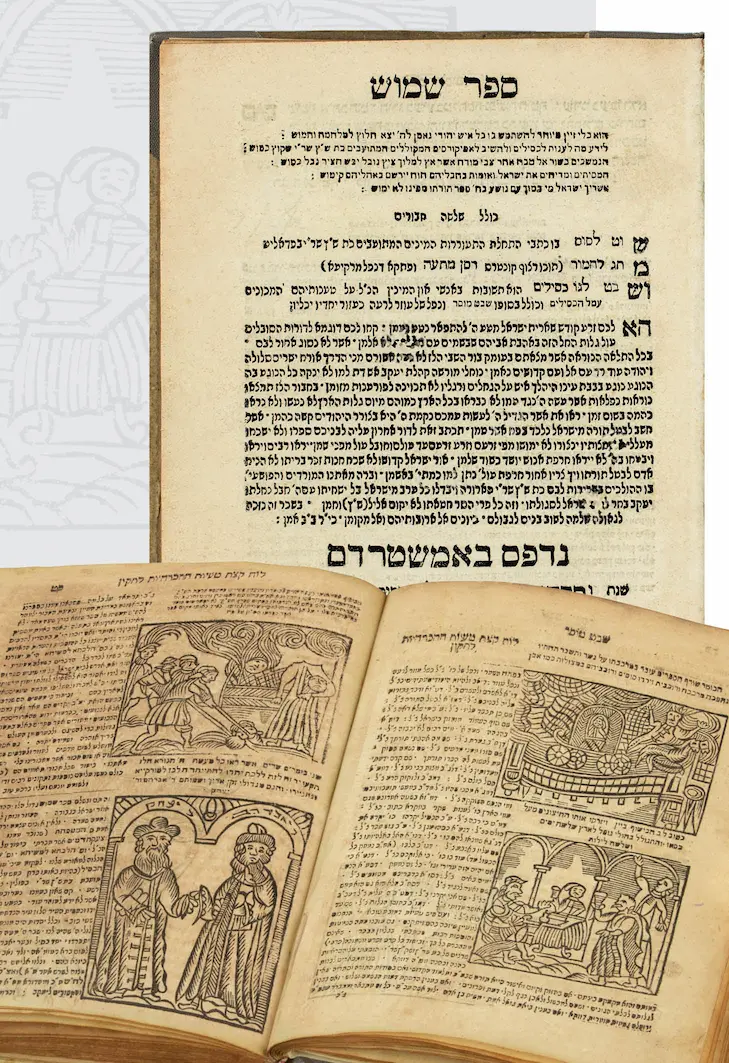
Lot : 76
The Yaabetz’s Opposition to the Last of the Shabbeteans and Frankists
Sefer Shimush by Rabbi Yaakov Emden with his Handwritten Revisions
Altona, 1758
Sefer Shimush is the primary historical source documenting the rise of Jacob Frank and his messianic Frankist movement. This work encompasses documents, certificates and exclusive testimonies regarding the abominable actions of Frank’s cult; as well as a description of the notorious debate in Kamenitz-Podolsk before Bishop Dembovsky that resulted in the catastrophic burning of sefarim; and arguments opposing the opinion of Rabbi Yehonasan Eibschutz in regard to the debate between Rabbi Yehonasan Eibschutz and the author, Rabbi Yaakov Emden (the Yaabetz). Please see the previous lot.
On The margins of the present sefer there are 5 corrections in the author’s handwriting, On Leaf 89a, the Yaabetz himself attests that he added glosses and revisions to his printed works.
This is a very rare sefer, as the author himself proclaims on the last page that only several copies of this work were ever printed and that
“the Sabbateans search for these sefarim in order to destroy them.”
The present sefer contains a few correction fixed by the Yaabetz himself.
The final pages feature 6 woodcut caricatures disparaging the Shabbeteans and Frankists; Bishop Dembovsky and his sorry end; the tragic burning of the sefarim; as well as an illustration of two priests who converted to Judaism following the affair. Each illustration is complemented by a detailed caption.
Sefer Shimush is divided into 3 sections:
Shot LaSus – Regarding the Frankists in Podolia.
Meseg LaChamor – Response to Rabbi Yehonasan Eibschutz’s arguments.
Shevet LeGav Ksilim – Response to Frankist arguments.
The title page notes that Sefer Shimush was printed in Amsterdam, although it was actually printed by Rabbi Yaakov Emden’s personal press in his home in Altona.
Altona, 1758-1762. Singular edition.
.
Size: 19.5 cm • Page Count: 89 leaves • Condition: Complete and in good condition.
Sefer Shimush is divided into 3 sections:
Shot LaSus – Regarding the Frankists in Podolia.
Meseg LaChamor – Response to Rabbi Yehonasan Eibschutz’s arguments.
Shevet LeGav Ksilim – Response to Frankist arguments.
Item description from the 'William L. Gross Collection'
................................................
Any inquiries about this lot ?
We are available also on WhatsApp >>>

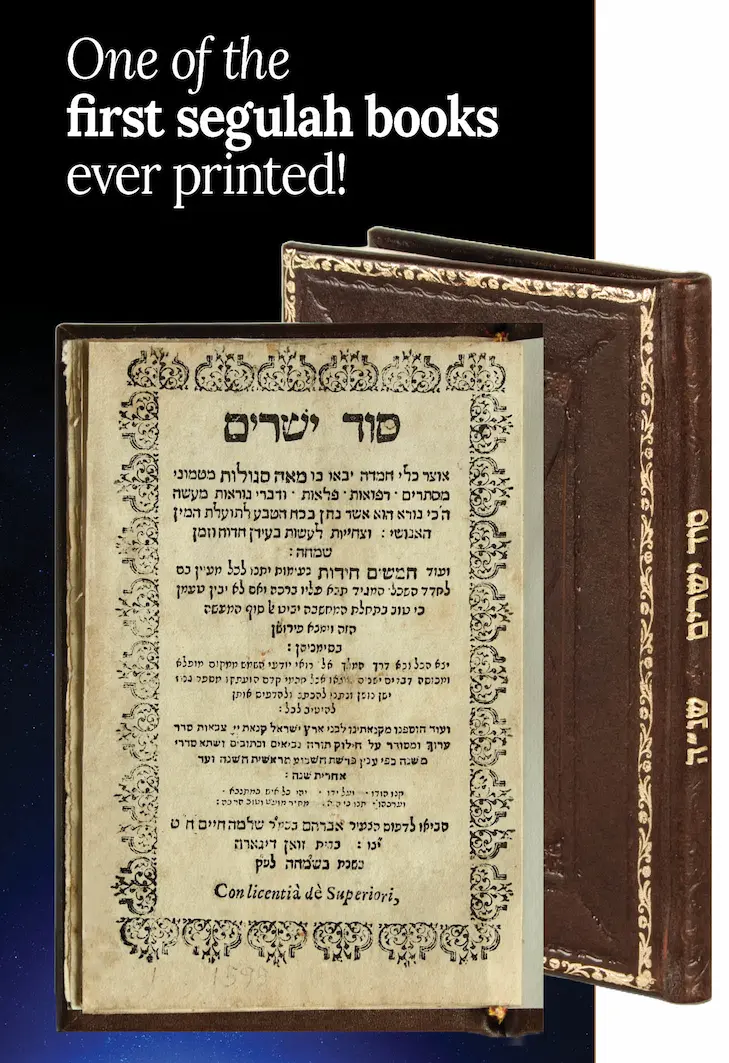
Lot : 77
Sod Yesharim. Venice, 1595
100 Segulos & 50 Riddles!
This book presents a collection of 100 segulos, medical remedies and natural wonders embedded in creation, as well as 50 riddles by the famed Rabbi Yehuda Aryeh de Modena.
This is the first work published by Rabbi Yehuda Aryeh de Modena, and it was printed when he was only 24 years old!
Rabbi Yehudah Aryeh of Modena (1575-1608) was among the venerated Rabbanim and authors in Italy.
Venice, 1595. First edition. Size: 14 cm • Page Count: 14, [1] leaf • Condition: leather binding, water stains. Good condition
Am Segulah
Books of segulos and healing began appearing in print in the early 18th century Over the years, scores of books and pamphlets detailing a wide range of segulos were printed and added to the Jewish library, most famous among them Toldos Adam and Sefer Zechirah. The present Sod Yesharim by Rabbi Yehuda Aryeh de Modena was of the very first works to be printed in this intriguing realm of Jewish literature.
............................................... .
Any inquiries about this lot ?
We are available also on WhatsApp >>>

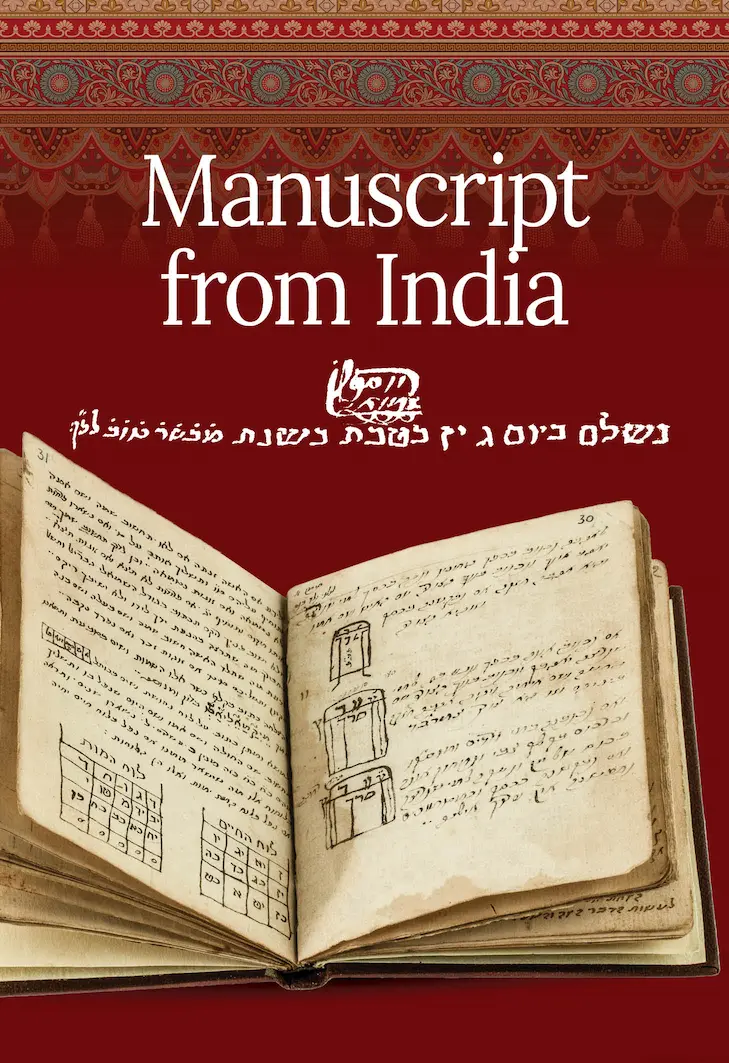
Lot : 78
Early Hebrew Manuscript from India
Sefer Goralos Usegulos. India, 1799
A handwritten compilation of essays on wondrous topics such as good-luck, how to play/win the with dices, fortune telling and other esoteric topics. Also includes segulos, riddles, calendars, charts, illustrations and other hidden topics.
Written in the writing style of the Jews of Cochin in 1799, which are the earliest Hebrew manuscripts from India.
The manuscript contains a work discussing the cube/dice goral, with illustrations of the possible outcomes and what they mean. sefer goral Achitofel, and sefer Niflaos Unisyonos from the Ibn Ezra’s on goralos.
Colophon on p. 52b states, “Completed on Tuesday, the 13th of Teves of the year
Mevaser Tov -1799.” Above the colophon is the autograph of Yosef Shmuel Rachbi.
There is a listing of birthdates from the years 1799- 1810 on pp. 27-28 of members of the following families: Rachbi, Tzaadi, Mizrahi, Ashkenazi and Nordin.
Cochin, 1799. 60 pages. Page size: 11x9 cm. Good condition. Few pages at the beginning and ending are missing. Tears and stains on front and back pages. old binding.
Provenance: Sassoon, D.S., Ohel Dawid, descriptive Catalogue of the Hebrew and Samaritan Manuscripts...(Oxford 1932), p. 1020
For further information press here
................................................
Any inquiries about this lot ?
We are available also on WhatsApp >>>

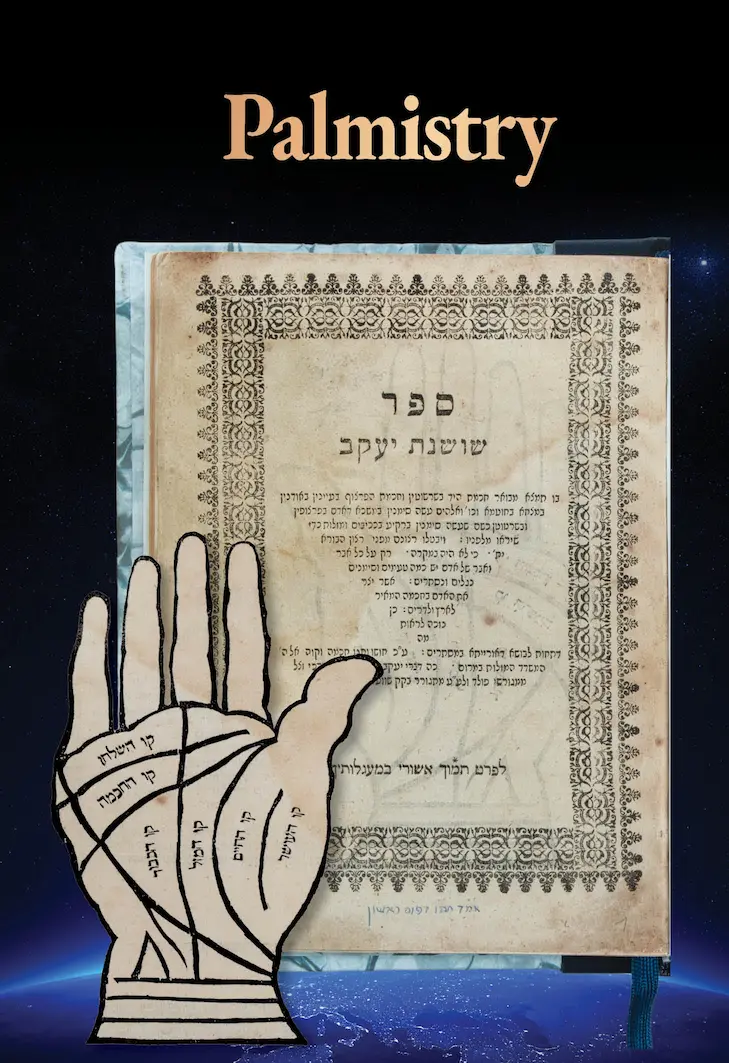
Lot : 79
Shoshanas Yaakov – Chochmas Hayad V’hapartzuf. First Edition. Amsterdam, 1706
Sefer
Shoshanas Yaakov on the wisdom of palmistry and physiognomy (reading the face and other limbs) to understand the inner workings of a human being, his soul and future.
This sefer also teaches the wisdom of the constellations in order to predict the future. by Rabbi Yaakov ben Mordechai of Fulda
The title page verso features a full-page illustration of the palm of the hand and a delineation of all the lines in the palm, along with their names.
The wisdoms of palmistry and physiognomy are ancient and lofty wisdoms mentioned in sources as early as the Zohar Hakadosh. In his letters, Rabbi Shlomo Shlomil and the Chida in Midbar Kadamos both attest that the Arizal was a master of these wisdoms.
Several pages in this work are blank, apparently in order to allow for hand-drawn illustrations which were added into the manuscript, possibly by the author himself.
Amsterdam, 1706. First edition. [2], 14 leaves. Light water stains. Good condition. Attractive half-leather binding.
................................................
Any inquiries about this lot ?
We are available also on WhatsApp >>>

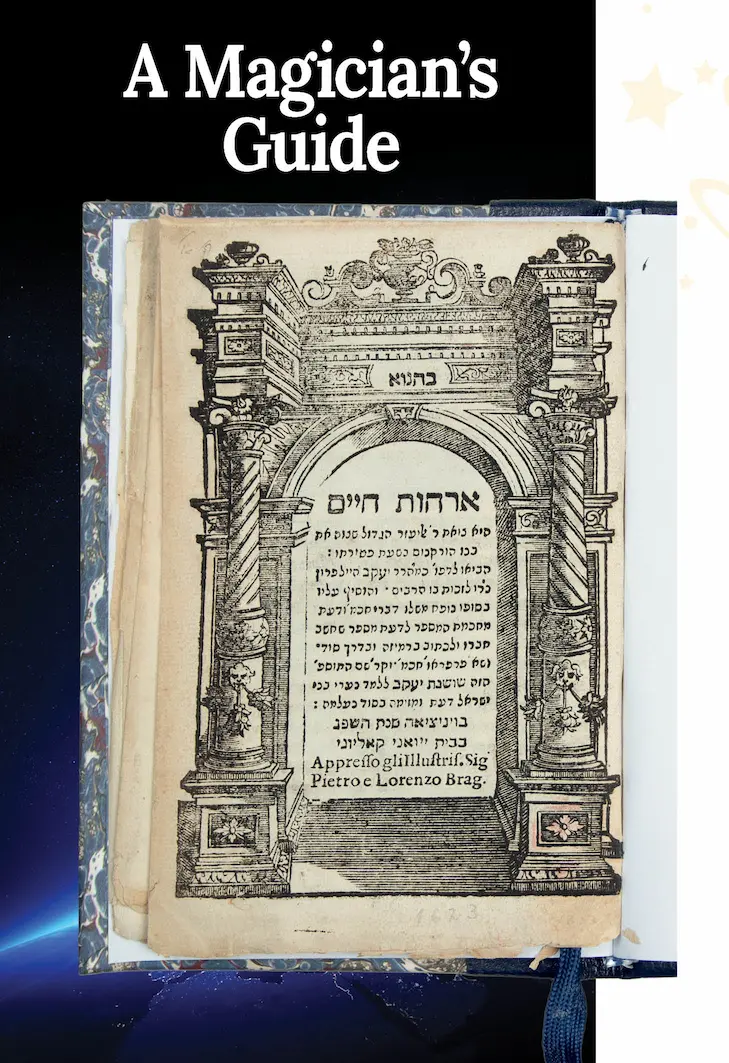
Lot : 80
A Magician’s Guide
-First Hebrew Edition!
Orchos Chaim-Shoshanas Yaakov. Venice, 1623
Orchos Chaim- the Will of Rabbi Eliezer Hagadol published together with Shoshanas Yaakov written by Harav Yaakov Heilprunn of Padua, author of Shu”t Nachlas Yaakov.
Shoshanas Yaakov contains deep wisdom and magic tricks! Examples are methods of surmising which number a person is thinking, revealing an item that a person chose without seeing it, making an egg hover in the air without touching it, writing secret codes, and speaking sign language!
On his journey to Eretz Yisrael, the Shl”a Hakadosh passed through Italy where he met the author and wrote an approbation to his sefer Nachlas Yaakov. In his inscription, he adds, “This is a work of the history of man…I have seen it, and it contains the wisdom of G-d…”
Venice, 1623. 12 leaves. Page size: 15.5 cm. Small and very rare booklet. Good condition. Leaves of sefer are uncropped and have remained as when they were printed. Attractive new half-leather binding
............................................... .
Any inquiries about this lot ?
We are available also on WhatsApp >>>

Lot : 81
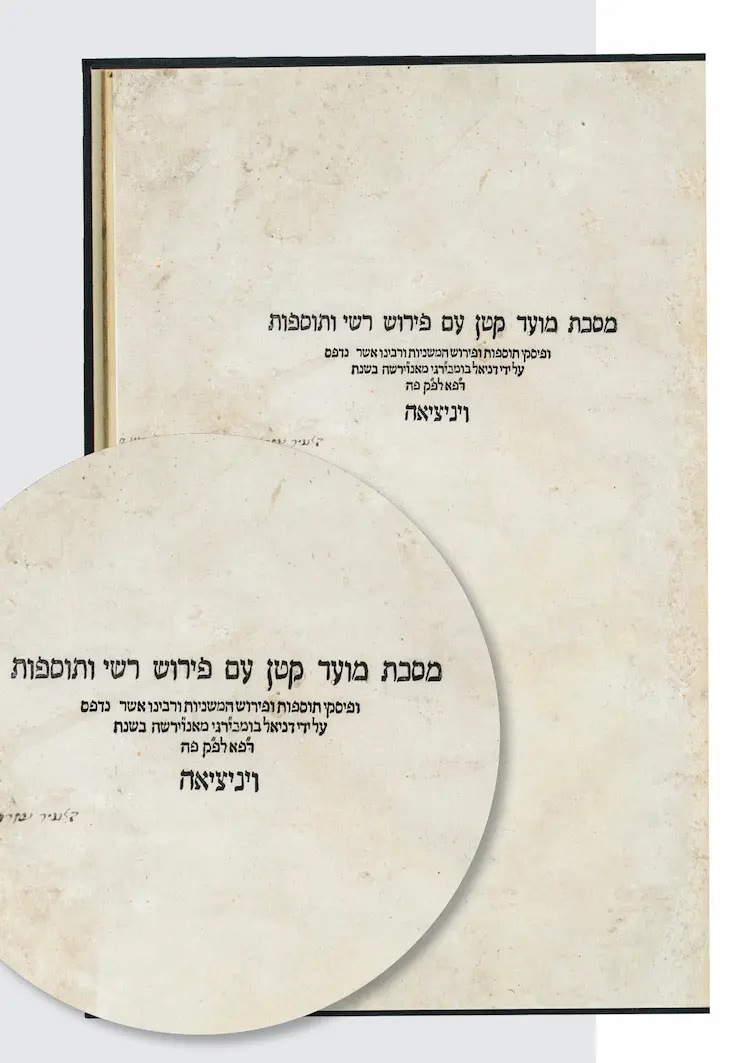
Maseches Moed Katan. First Edition
Venice, 1521
Talmud Bavli Bomberg Press
Maseches Moed Katan with the commentaries of Rashi and Tosafos. An entire volume from the first set of Talmud printed by Daniel Bomberg in his famous Venetian printing press.
The halachic rulings of Tosafos and the Rosh were printed for the first time in the back of this masechta. This was the first time that the Rambam’s Peirush Hamishnayos was included in the Shas.
Beautiful high quality printing in dark ink on thick paper.
This magnificent printing of this edition of Talmud Bavli is almost entirely free of censor-deletions. It also includes important additions printed here for the first time and it became the basis for every subsequent printing of the Talmud.
Shas Bomberg
Throughout the history of printing Jewish books, Bomberg Shas prints have been praised like no other print until present time.
The great 16th century printer, Daniel Bomberg was an innovator in the printing of many Jewish works, yet by far, his most impressive accomplishment was the printing of the Shas.
The Bomberg Edition was the first printing of the entire Talmud Bavli.
This magnificent printing of the Talmud Bavli is almost entirely free of censor-deletions. It also includes important additions printed here for the first time, based on handwritten manuscripts. Understandably, it became the basis for every subsequent printing of the Talmud.
The margins of page 45b feature a registro, [Italian for index, listing the opening words of each kuntress, to ensure the correct order for the book-binders] the registro appears in only some of the masechtos.
Venice, 1521. Daniel Bomberg Press. 45 leaves. Pages size: 34.7 cm. Wide bottom margins, minor holes, stains on title page, minor restoration of upper left corner of title page.
Stefansky Sifrei Yesod # 41
Daniel
Bomberg
(1475-1549)
Daniel Bomberg, the famous printer from Venice, was the most influential Hebrew printer in the 16th century. He developed new typefaces and invested huge sums in establishing the printing house, and indeed from his printing house came out the best Torah works that became 'prototypes' for all subsequent editions.
He established the gemara’s "Tzuras Hadaf" as well as the number of pages in each masechta. Since then, passages in the gemara are always cited using Bomberg’s page numbering.
He is the first to publish many important and basic Torah books, such as the present edition of Talmud Yerushalmi (see next lot) based on ancient and accurate manuscripts.
Rabbi Refael Nosson Nutta Rabinowitz, an expert on the printings of Talmud, wrote in reference to this project, "This Talmud is perfect in its magnificence and beauty, both in regard to its structure and aesthetics. The paper is beautiful and the letters are bright and black…" (Ma’amar Al Hadpasas Hatalmud p. 41)
Stefansky Sifrei Yesod p. 18, and in the addendum p. 168.
......................................... ...... .
Any inquiries about this lot ?
We are available also on WhatsApp >>>

Lot : 82
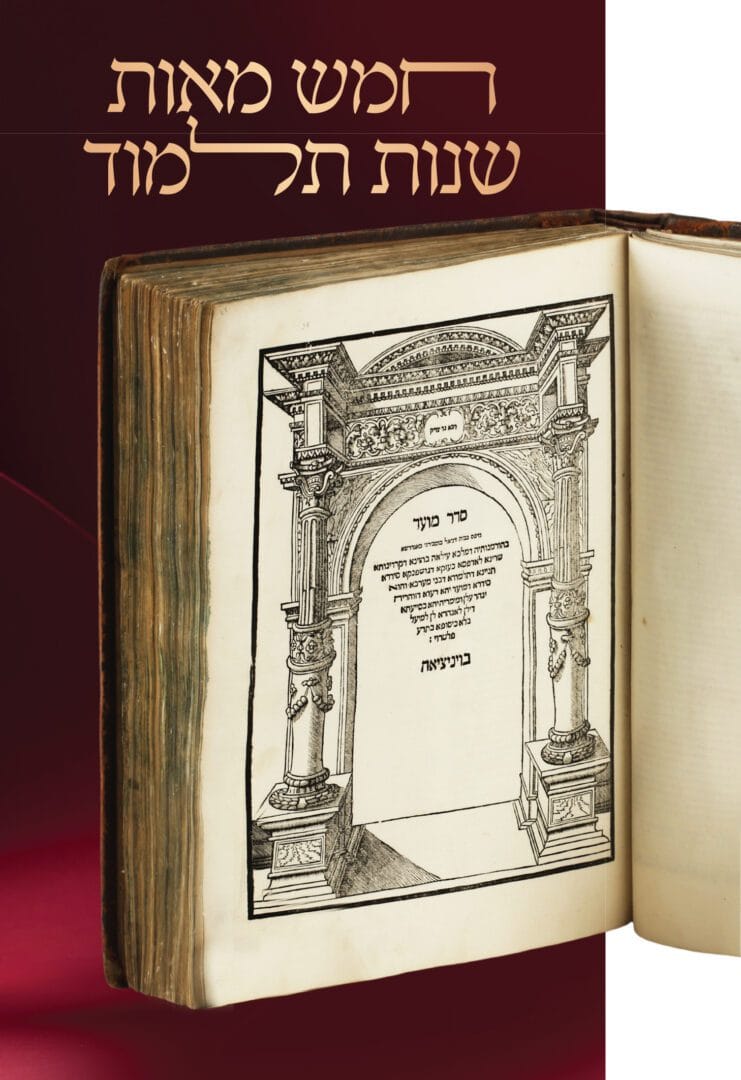
Five Hundred Years of Talmud!
1523-2023
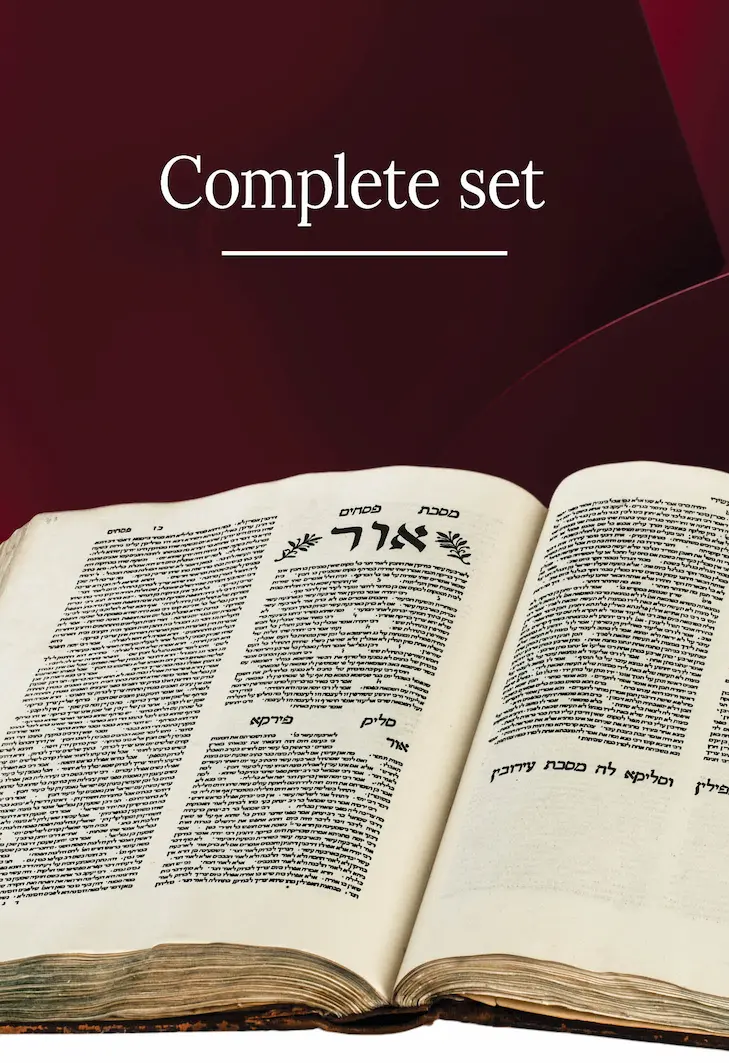
Entire Set! Talmud Yerushalmi. Bomberg Press. First Edition. Venice, 1523
The entire Talmud Yerushalmi printed for the first time based on handwritten manuscripts in Daniel Bomberg’s famous Venetian printing press.
Magnificent set all volumes complete with all title pages and wide margins. Extremely rare to find this set completely intact and in such good condition.
After Daniel Bomberg completed his landmark printing of the entire Talmud Bavli between the years 1520-1522, he then went on to publish the Talmud Yerushalmi which he completed printing in just one year in the same majestic style as the printing of the Talmud Bavli.
Every subsequent printing of the Yerushalmi is based on this edition.
The Yerushalmi was printed based on four manuscripts (see the colophon at the end of Maseches Shabbos p. 17b). One of those manuscripts is the one known today as the Leiden Manuscript, which is housed in Holland’s Leiden University. The Leiden Manuscript is the only known manuscript of the Yerushalmi to survive intact.
Talmud Yerushalmi
The Talmud Yerushalmi, referred to on the title page as Talmud D’Bnei Maaravah, is the compilation of the Talmud of the Amoraim of Eretz Yisrael. It was authored by Rabi Yochanan some 130 years before the Talmud Bavli.
The present item includes all four sedarim of the Talmud Yerushalmi that have survived: Zeraim, Moed, Nashim, Nezikin; and Maseches Niddah from seder Taharos.
Venice, 1523. Danierl Bomberg Press. Zeraim: 65 leaves.
Moed: 83 leaves.
Nashim: 66 leaves.
Nezikin: 51 leaves. Includes the original blank pages after Zeraim and Moed. Page size: 36 cm. Each volume has an artistic title page. Decorative initials at the beginning of each tractate, with exceptionally large initials at the beginning of each seder.
Professional restoration of first title page and margins of first eight leaves. Annotations in ancient handwriting on first pages. Antique leather binding with new leather spine.
Stefansky, Sifrei Yesod # 112
................................................
Any inquiries about this lot ?
We are available also on WhatsApp >>>

Lot : 83
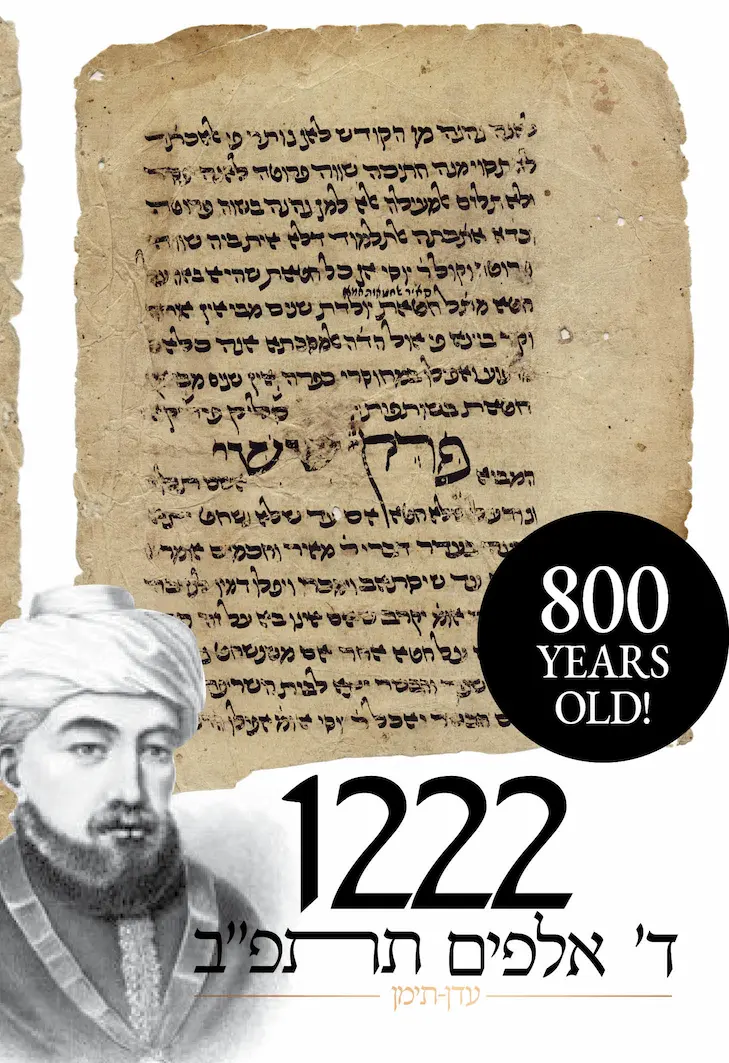
Rambam: Ancient Fragment. Aden, 1222
800-year-old page from the Rambam”s commentary on Mishnayos. Yemen, 1222
Only 18 years after the Rambam’s passing!
Folio of the Rambam’s Commentary on Mishnayos Inscribed by Saadia ben Khalfon El-Adani. Aden, Yemen, 1222
800 year old page from the Rambam’s commentary on Mishnah Seder Kodshim in his original Arabic. This manuscript was inscribed by the pious scribe Saadia ben Yichya ben Khalfon El-Adani of Aden, Yemen in the year 1222, only 18 years after the passing of the Rambam.
The present item is one of the earliest known Hebrew Yemenite manuscripts!
Double-sided handwritten leave of the commentary on Maseches Krisus contains the end of Ch. 5 and beginning of Ch. 6 , Page size: 20x17 cm.
Identification of the Manuscript.
The National Library in Berlin possesses a manuscript of the commentary on Mishnayos Seder Nezikin with a colophon proclaiming:
“With the help of Hashem, half of Seder Nezikin is complete… in the country of Aden… Written by Saadia the Scribe son of Yichya son of Rabbi Khalfon [who is[ known as El-Adani.”
The identical script, identical paper and other features of these folios indicate that these relics are parts of the above manuscript confirming the identity of the scribe and the time it was written.
The discovery and successful identification of ancient manuscripts, along with the identity of the scribe and year it was written, is a very rare phenomenon.
Genazym expresses its thanks to Professor Benjamin Richler for his efforts in identifying this manuscript. Another folio from this manuscript identified by the above, sold at the Kestenbaum Auction Lot 282 in March 2002 for $23,000!
................................................
Any inquiries about this lot ?
We are available also on WhatsApp >>>

Lot : 84
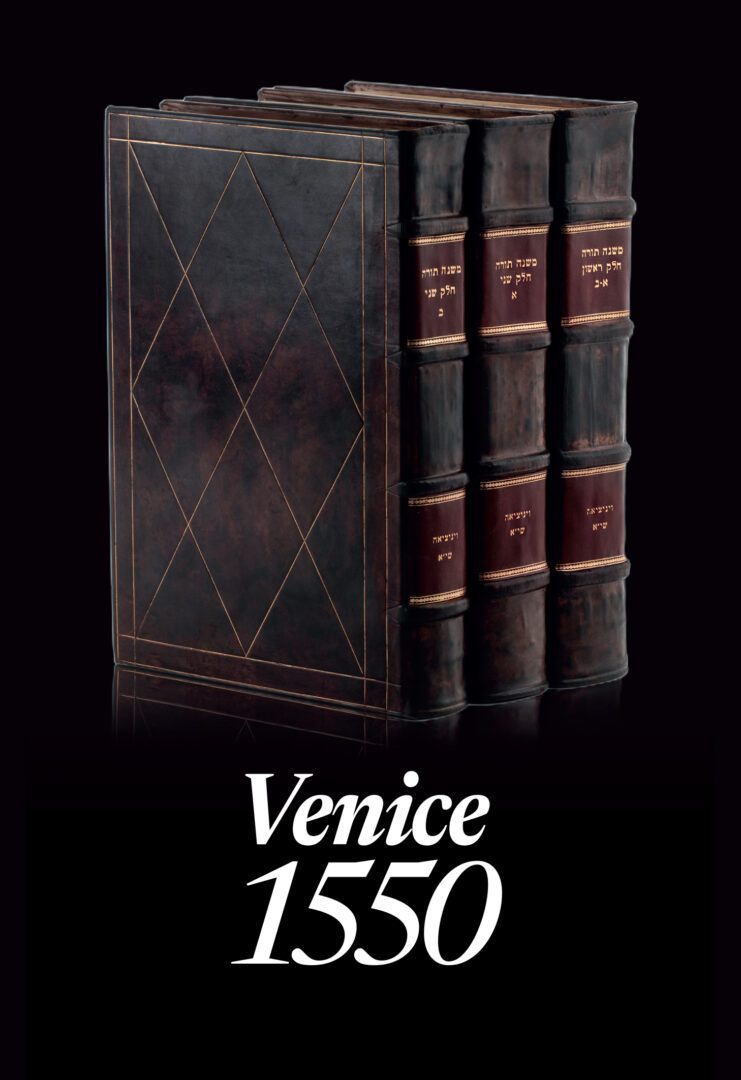
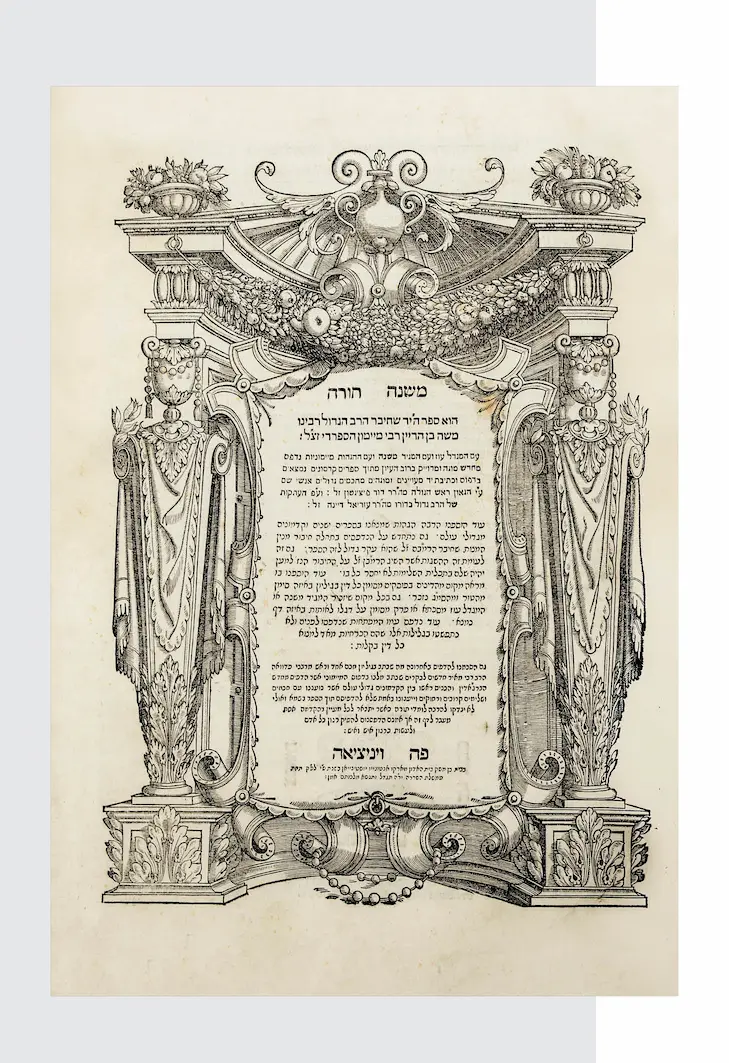
Mishnah Torah L’HaRambam. Giustiniani Edition. Venice, 1551
Complete, beautiful set!
The Giustiniani Edition of Mishnah Torah L’HaRambam is regarded as one of its most impressive and famous editions. This impressive find is a complete set that includes rare leaves missing from most extant copies of this nearly 500 year old set!
This exclusive set, which presents in 3 thick volumes, was preserved in complete, pristine condition and features all titles pages, index pages, and printer’s emblems. The printers made use of the highest quality ink, thick white paper, and wide margins, bound in ornate leather covers.
A complete set of the Giustiniani Edition of Mishnah Torah in superior condition as the present item is a rare treasure!
This edition of Mishnah Torah L’HaRambam, which includes the Maggid Mishnah, Migdal Oz and Teshuvos Maimonios commentaries, was meticulously edited based on earlier accurate editions, and proofread by 16th century Italian sages Rabbi David Pitzigitun and Rabbi Ezriel Diena, with glosses by the Maharam of Padua. The leaves include references to the Tur and Smag, and a reference sheet was added to Migdal Oz.
Bound in 3 volumes:
Volume 1: Sefer Mada, Sefer Ahavah and Sefer Zmanim, beginning with Sefer Hamitzvos L’haRambam, with additions and queries by the Ramban.
Volume 2: Sefer Nashim until Sefer Taharah
Volume 3: Sefer Nezikin until Sefer Shoftim with glosses by Maharam of Padua
Volume 1 opens with a concise list of the 613 imperative mitzvos and prohibitions [4 leaves].
The Hebrew Bibliography Institute records that this “Minyan Hamitzvos” (List of Mitzvos) was omitted from the Rambam’s preface to Mishnah Torah, yet the present copy includes the full List of Mitzvos! (Apparently, the list was inadvertently omitted from the original printing, yet the printers eventually noted their error and attached it to later copies of the same edition. This theory is supported by the fact that the list is printed out of order and appears on separate leaves before the first title page. Its actual place should be at the end of the Rambam’s introduction, at the bottom of the first column on leaf 2b).
2.
Sefer Hamitzvos L’HaRambam [leaves 2-24]. Leaf 24b features the printer’s emblem.
3.
Hasagos HaRamban on Sefer Hamitzvos [leaves 25-43];
Hasagos HaRaavad on Sefer Hamitzvos.
4.
List of 613 Mitzvos presented in the order of the 14 books of Yad Hachazakah [leaves 24b-26a + leaf 1].
5.
Maharam of Padua’s glosses are printed at the end of Volume 3.
Other leaves feature references to the Tur and Smag, as well as references to Migdal Oz.
In the mid-16th century, the two premier Hebrew presses in Venice, Italy, the celebrated printing capital of the world, were the Giustiniani and Bragadin Presses. These two printing houses vied for the most prestigious Jewish customers, but their rivalry evolved into an all-out war with the printing of Mishnah Torah L’HaRambam. The owners of the Bragadin Press accused Giustiniani Press printers of stealing the Maharam of Padua’s comments on the Mishnah Torah L’HaRambam, while the Giustiniani press printers vigorously denied the accusation. The controversy swelled to epic proportions and eventually reached the Beis Din of the Rema in Krakow (see Shu”t Rema Ch. 10).
Legend has it that following this bitter controversy, local Christians reported several sections in the Talmud that include disparaging statements about Christianity to Pope Julius III. The slanderous reports caused the Pope to sign a decree ordering the burning of the Talmud and immediate closure of Hebrew printing presses in Venice. Sadly, it would take a full decade before these establishments reopened.
In the introduction to the present edition, the printers of the Giustiniani Edition enumerate the advantages of their edition over the Bragadin Edition of the Rambam.
Venice, 1550-1551. Complete set! [4], 43, [1], 25-26, 1, 10-228: [1]: 394-767, [5] leaves. Large format measuring 40 cm. Three complete volumes in ornate leather bindings.
The present item boasts a distinguished provenance and ownership by eminent Rabbis and sages of Reggio, Italy.
1. All 3 volumes feature the autograph of the holy kabbalist Rabbi Eliezer Nachman Foa, who signed his name with his initials: “ARNN.” Rabbi Eliezer Nachman Foa was the prime disciple of the Rema of Pano and author of Midrash B’chiddush among others. He passed away in 1659.
2. Record of ownership of Rabbi Yechiel Foa of Reggio who inherited the sefer from his father. Rabbi Yechiel is apparently the brother-in-law of the Rema of Pano. (Yaari mentions the Foa brothers in a list similar to the present list in Mechkarei Sefer p. 333 #43.)
3. “It reached the portion of Mar Verdimos… who is Rabbi Verdimos Foa, brother of the abovementioned Rabbi Yechiel Foah, who was also a brother-in-law of the Rema of Pano and disciple of the kabbalist Rabbi Eliezer Nachman Foa. (See lists of his disciples in the beginning pages of Midrash B’chiddush.)
4. Other owners’ signatures include Gershon ben Rabbi Avraham Padua and Shimshon Meir Padua.
................................................
Any inquiries about this lot ?
We are available also on WhatsApp >>>

Lot : 85
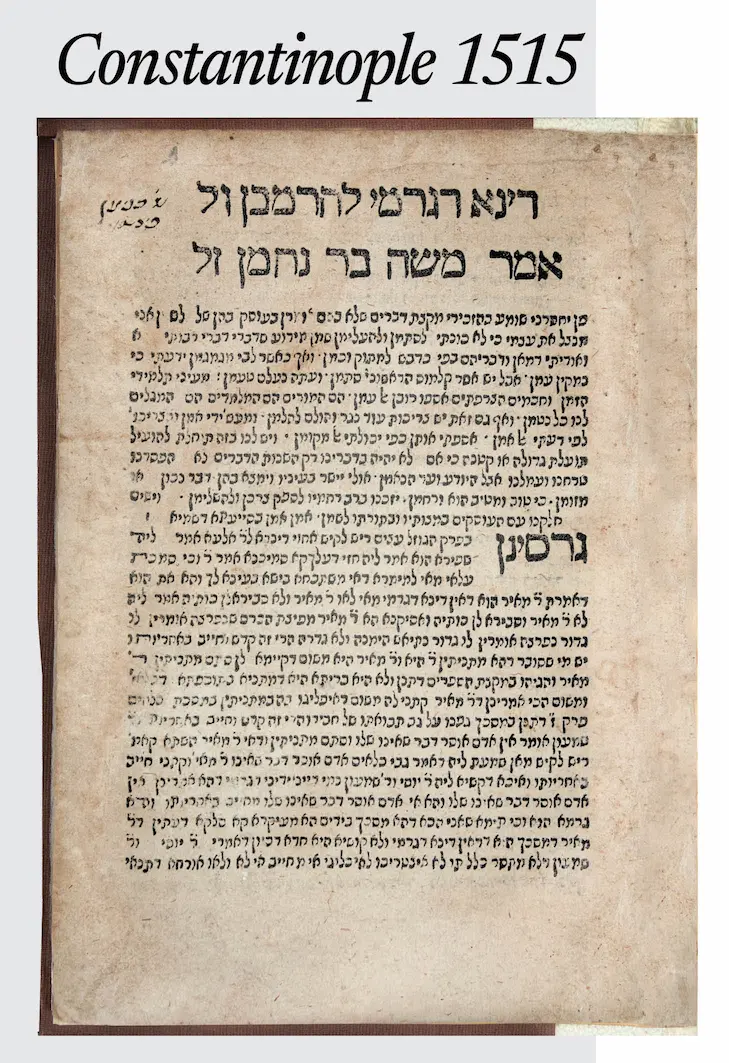
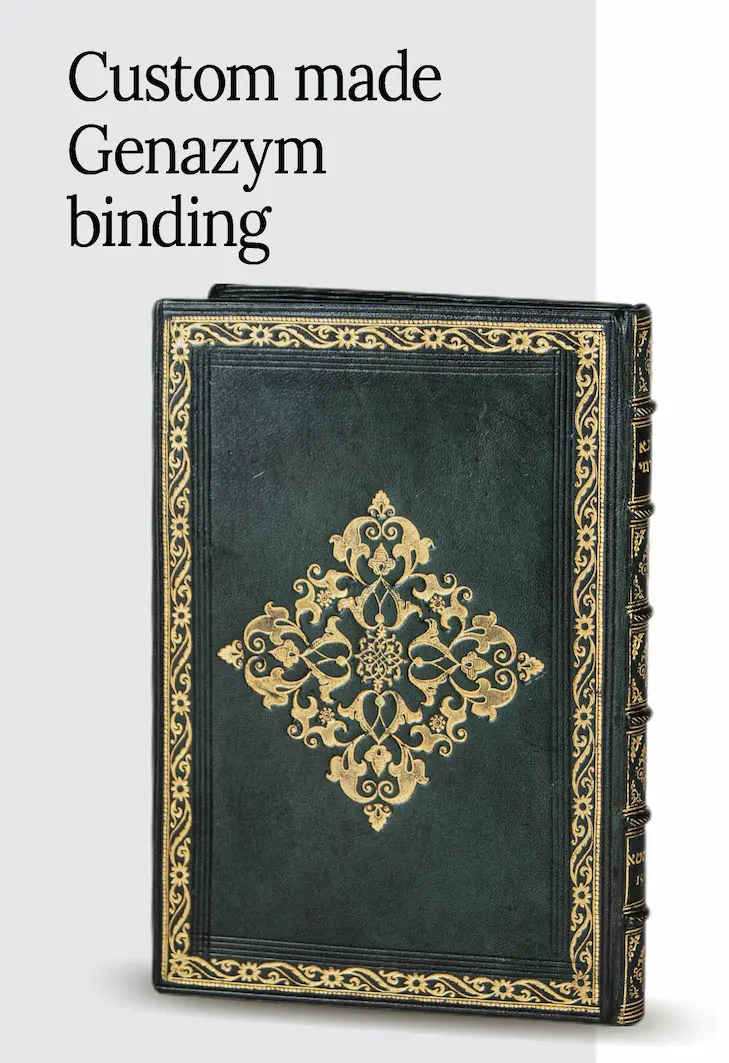
Dinei D’Gramei L’HaRamban. First Edition. Constantinople, Circa 1515
Fundamental kuntress on the laws of damages by the Ramban, Rabbeinu Moshe ben Nachman, one of the greatest of the Rishonim.
This small pamphlet is an exceedingly rare and valuable find!
Dinei D’Gramei discusses the laws of damages which a person can inflict either upon his fellow man or upon the latter’s possessions, not directly, but through what is halachically termed a “grama” - an indirect result of his action. The Ramban writes in the present kuntress that “These concepts are deep, and their differences are fine as a hairsbreadth, ” which is why he authored a special pamphlet on this topic.
This sefer was printed a second time within Chiddushei Ramban, Bava Basra (Venice, 1523) based on a different manuscript than the Constantinople edition containing several changes in the text. The writings of the Achronim, among them the Beis Yosef and Shach, indicate that the version they had in their possession was the later Venice edition, and that they never saw the earlier Constantinople edition.
Constantinople, 1515-1520. First edition. [10] leaves. Page size: 19.3 cm. Printed without title page. Complete. Yellow stains and tears in margins only; professionally restored.
Provenance: S. Binyamin Pinto
Bibliography: Yaari, Constantinople 69; Stefansky, Sifrei Yesod 235; Deinard, Atikot Yehuda p. 16
What is a Kshta Reish?
............................................... .
Any inquiries about this lot ?
We are available also on WhatsApp >>>

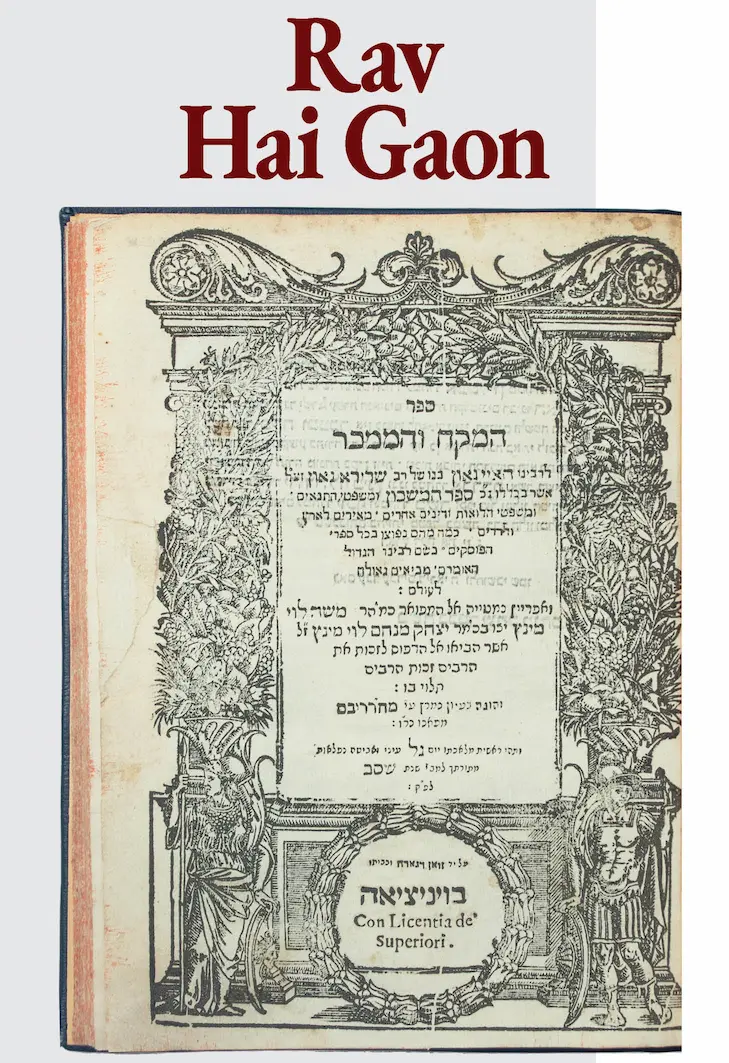
Lot : 86
Foundational Work on the laws of Choshen Mishpat
Hamekach V’Hamemkar by Rabbi Hai Gaon.
Venice, 1602
First Edition
Laws of business and monetary issues, loans and collaterals as established by Rav Hai Gaon.
Classic and fundamental Halachic work quoted extensively by the great Rishonim and Achronim.
Originally written in Arabic for the Jews of Babylonia, this sefer was translated into Hebrew just one generation later by Rabbi Yitzchak Albargeloni.
Venice, 1602. First edition. 97, [1] leaves. Page size: 19 cm. Minor tear in margin of title page, good condition, new blue leather binding.
Stefansky, Sifrei Yesod #222
................................................
Any inquiries about this lot ?
We are available also on WhatsApp >>>

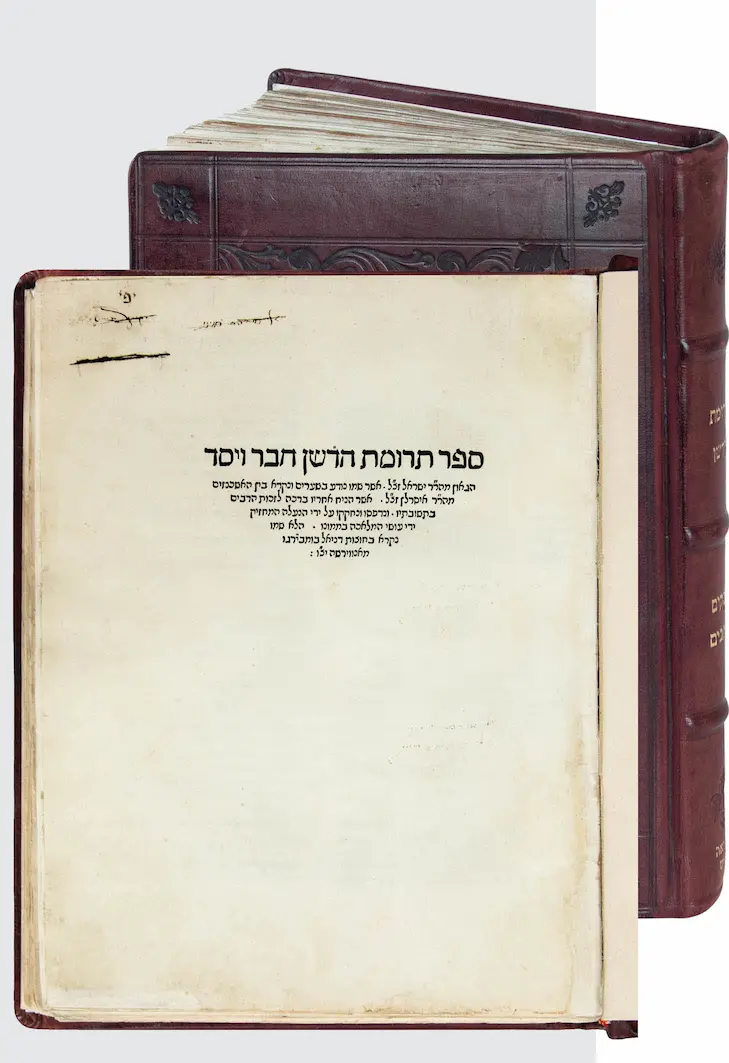
Lot : 87
Fundamental Sefer
Terumas HaDeshen. Daniel Bomberg Press. First Edition. Venice, 1519
Distinguished provenance.
Teshuvos, halachic rulings and writings of Rabbi Yisrael Isserlein, one of the great Ashkenazic Rishonim.
Rabbi Yisrael Isserlein (1390-1460), author of Terumas Hadeshen, was one of the great Ashkenazic Rishonim, and one of the last of his era. He had a close relationship with the Maharil, Mahariv, and Maharam of Mintz, who all held him in the highest esteem.
Terumas Hadeshen is one of the foundational halachic works, both Rabbi Yosef Karo’s Shulchan Aruch, as well as the Rama’s glosses on the Shulchan Aruch base many of their halachic rulings on the opinion of the Terumas Hadeshen.
The work includes two volumes:
Volume 1: Terumas Hadeshen which includes 354 teshuvos (354 is the gematria of ‘deshen’.)
Volume 2: Psakim U’Ksuvim which includes teshuvos in practical halachah.
The Achronim point out a fundamental difference with practical ramifications between the two volumes. The first volume is composed of the author’s own hypothetical questions, while the second volume is composed of practical halachic responses to queries posed to Rabbi Yisrael Isserlein and therefore carry greater authoritative weight. (see Shulchan Aruch Yoreh 196:20; and Shem Hagedolim; Letter yud; 402).
Each volume was published separately with its own title page; here both volumes are bound together. They are completely intact including all title pages and indices.
This book in such excellent condition is extremely rare.
Distinguished copy with owner’s signatures and marginalia.
1) Autograph of the kabbalist
Rabbi Avraham Rovigo (circa 1650- 1713) appears on title page of volume 1. Rabbi Rovigo was a disciple of the Ramaz and one of Italy’s great kabbalists. He relocated to Yerushalayim in his old age where he established a yeshivah for the study of kabbalah.
2) A lengthy note of Rabbi Yishmael Hakohen of Modena (1723-1811) appears on leaf 39b of Volume 1 along with his autograph. He was one of the great Torah giants of Italy and the author of Shu”t Zera Emes.
Venice, 1519. Daniel Bomberg Press. First Edition.
Terumas HaDeshen: [132] leaves.
Psakim U’Ksuvim: [53] leaves. Page size: 25 cm. restoration of margins on some pages, including the title page. Few pages with minor holes. New leather binding.
Stefansky, Sifrei Yesod # 274, 275
................................................
Any inquiries about this lot ?
We are available also on WhatsApp >>>

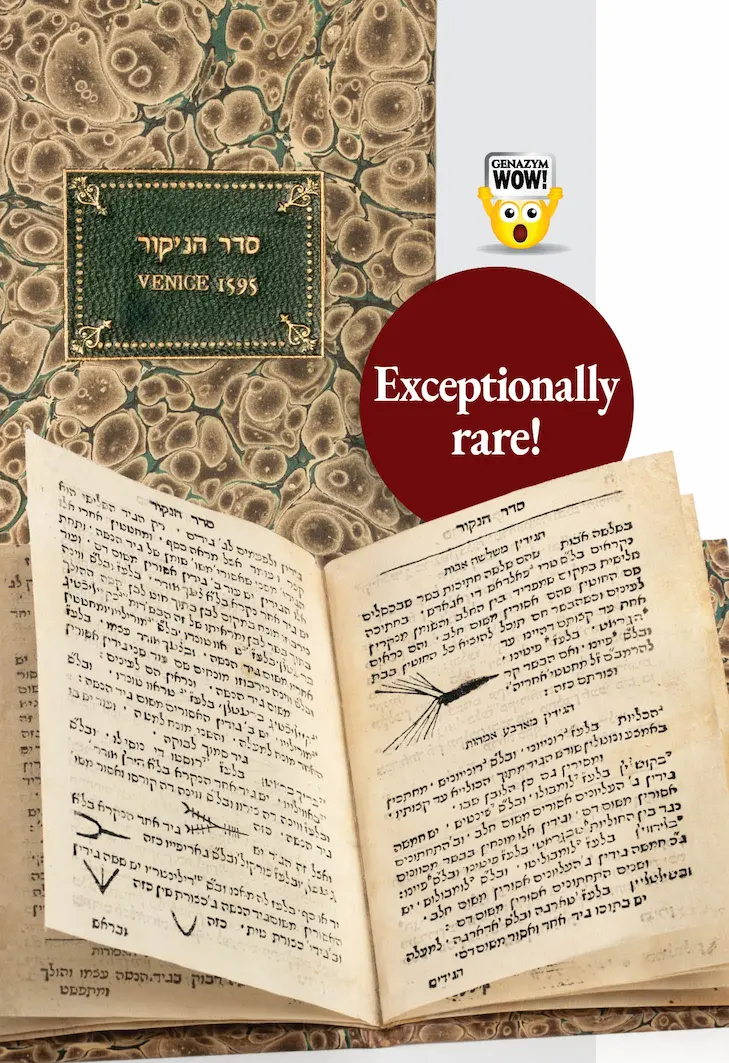
Lot : 88
Illustrated Seder Hanikur. Venice, 1595
Exceptionally rare!
Only 8 leaves!
Laws of nikur (concerns the removal of forbidden cheilev and sciatic nerve from an animal) by Rabbi Yaakov Sorzina Katz from Kastilatz, with translation of the names of the different parts of animal meat to Yiddish, Italian and Spanish. Includes illustrations of sinews.
An important and foundational sefer on the laws of nikur. Exceptionally rare.
This sefer is an abridged version of the laws of nikur set by the author’s Rabbi, Rabbi Tzvi Yaakov of Cracow, with various supplements. In his introduction, the author explains that after learning from his Rabbi in Cracow the Laws of Nikur, upon arriving in Italy he noticed that nikur was performed irresponsibly by unlearned Jews. He therefore published this sefer to educate and bring awareness as to the correct way of performing nikur.
Rabbi Yaakov Sorzina Katz Ish Kastilatz was the proverbial wandering Jew, starting out in Cracow where he attained mastery upon the laws of shechitah and bedikah under the guidance of the abovementioned Rabbi Hersh Buchtner and continuing to Italy where he became a printer and proofreader of sefarim, among them the landmark sefer Tiferes Yisrael by the Maharal of Prague (Venice, 1599). Two of his famous teshuvos, both concerning shechitah and bedikah, were printed in Shu”t HaRosh (Venice, 1607).
On the verso of the title page is a Cherem Form which was delivered by ten municipal officials of Venice regarding the printing rights of this sefer. The form also includes the approbation of the city’s Rabbanim, most notably among them Rabbi Shmuel Yehuda Katzenellenbogen, son of the Maharam Padua. This is one of the very first approbations to appear in a sefer printed in Venice (see Benayahu, Haskamah V’reshut B’dfusei Venice p. 247 #2).
Rabbi Tzvi Yaakov of Cracow, known as Rabbi Hershel Buchtner, was one of the great experts on the laws of Shechita and Bedikos in Cracow during the times of the Rema. He discussed these matters at length with the Rema, and his glosses that were published in the Mahari Vail’s Hilchos Shechitos U’Bedikos (Cracow, 1585) are later quoted by poskim under the name Maharatz.
Venice, 1595. First edition. 8 leaves. Page size: 13.7 cm. Few marginal restorations. Good condition. New binding.
................................................
Any inquiries about this lot ?
We are available also on WhatsApp >>>

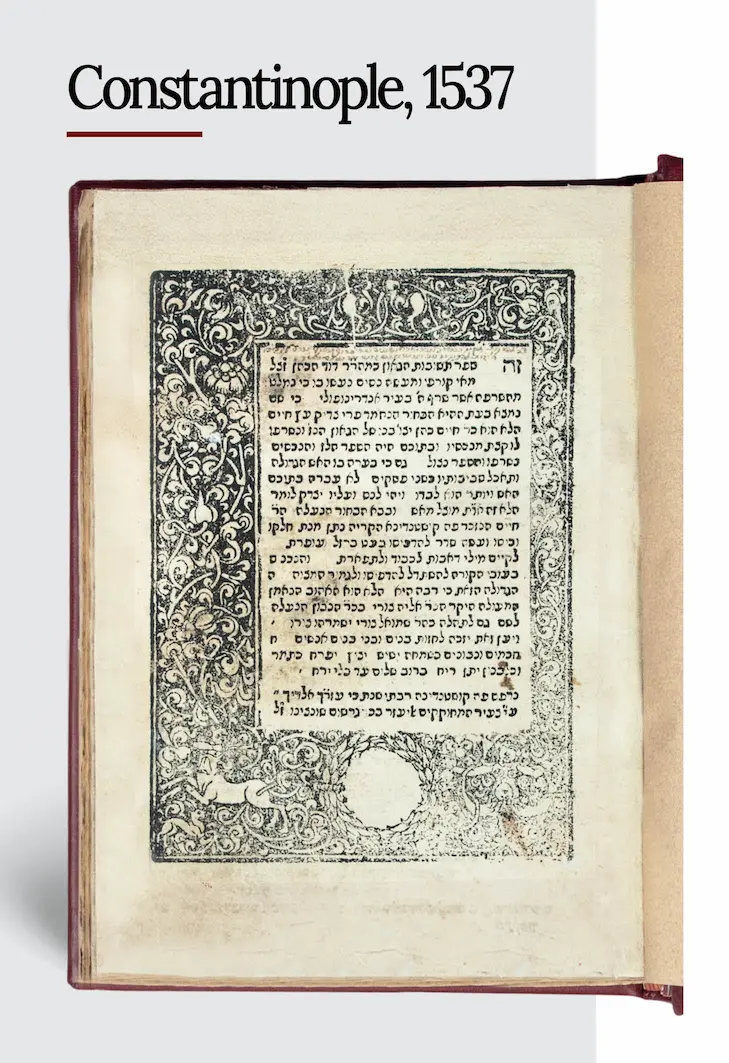
Lot : 89
The first Sefer Teshuvos of the Achronim to be printed!
Shu”t HaRadach. First Edition. Constantinople, 1537
Halachic questions and responsa by Rabbi David Hakohein of Corfu. This sefer was printed by Eliezer son of the famous printer Gershom Soncino.
The Radach, Rabbi David Hakohein of Corfu (d. 1530) was one of great European sages in the era of the Spanish Expulsion. He corresponded extensively with the Re’em, Maharam Alshakar and Mahari ben Chaviv, author of the Ein Yaakov, as well as his own mentor Mahari Mintz. Rabbi Yosef Karo cites the Radach’s teshuvos in over twenty places in his landmark work, Beis Yosef.
Shut” HaRadach was brought to print by the author’s son-in-law and disciple Rabbi David Vital, author of Kesser Torah (Constantinople, 1538).
Constantinople, 1537-8. First edition. Title page is dated 1537, the colophon is dated 1538. [224] leaves. Page size: 20.5 cm. Upper margins of title page and other pages with professional restorations. Water and light yellow stains. Attractive new leather binding.
Stefansky, Sifrei Yesod #278.
Provenance on title page bears the signature of
“Rabbi Yisrael Yeshaya ben Rabbi Baruch Norchi” who was a prominent Italian sage and kabbalist.
................................................
Any inquiries about this lot ?
We are available also on WhatsApp >>>

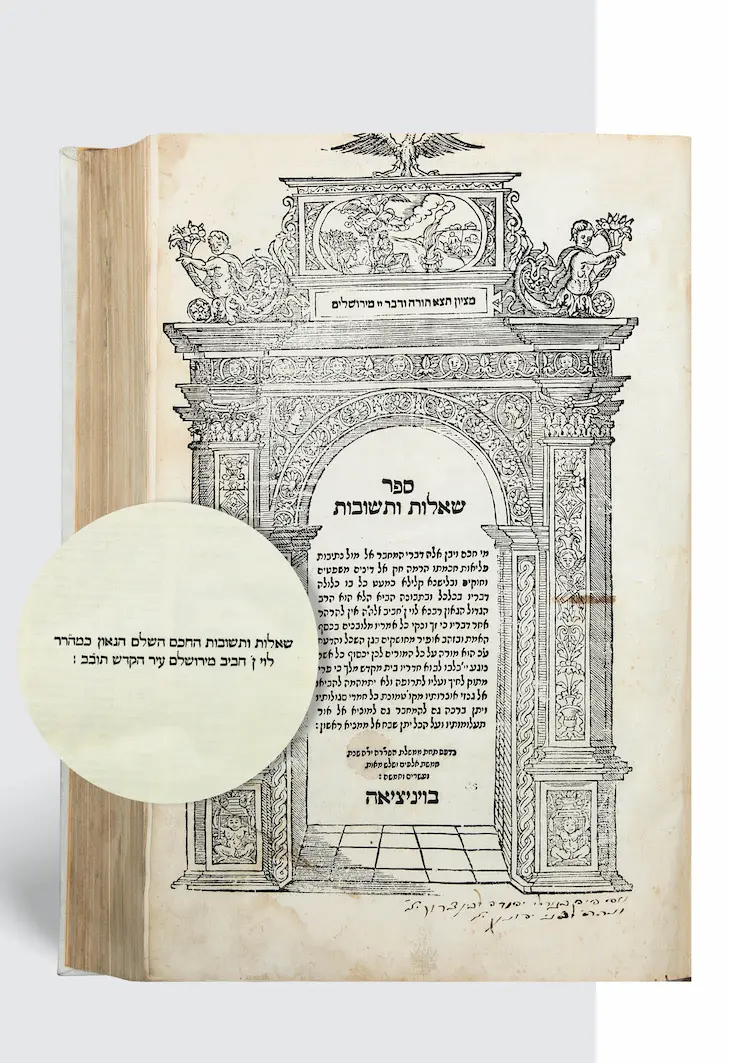
Lot : 90
Halachic fundemental
Shu”t Ralbach. First Edition. Venice, 1565.
Complete, beautiful copy.
Shailos and teshuvos by the Ralbach, Rabbi Levi ben Chaviv, with commentary on the Rambam's laws of Kiddush Hachodesh; and Kuntress Hasemichah.
This sefer is complete with all title pages, indexes and the pages of “list of errors”.(The two leaves of the “list of errors" are missing from many copies of Shu”t Ralbach.)
Kuntress Hasemichah begins on Leaf 277 and presents the great debate between Ralbach and Rabbi Yaakov Beirav regarding the reinstatement of semichah among the sages of Tzfas.
The Ralbach’s essay on the Rambam's laws of Kiddush Hachodesh, which encompasses illustrations and charts, was printed here for the first time and later included in subsequent editions of the Rambam.
Rabbi Levi ben Chaviv
(1480-1541 circa) known as the Ralbac"h was from the great rabbinical figures following the Spanish Expulsion.
He was born in Samurai, Spain to Rabbi Yaakov Chaviv, author of Ein Yaakov, and was exiled with his father from Spain. After his father’s passing, the Ralbach completed and printed the Ein Yaakov in Salonika, and then journeyed to Jerusalem where he settled and served as Rav for many years.
The Semichah Controversy.
458 years ago, Rabbi Yaakov Beirav of Tzfas determined that the time had come to reinstate the tradition of semichah, which is permission delivered from rabbi to disciple to rule in halachah and render judgment in a beis din. In the semichah process, the ordained rabbi/dayan awards the ordainee halachic prowess to rule in both monetary laws and laws pertaining to life and death. According to the Ramban in Sefer Hazechus, Gittin 36a, the tradition of semichah was terminated at the end of the Amoraic period.
One of Rabbi Yaakov Beirav’s primary objectives in reinstating semichah was in order to enable the Sephardic anusim who had begun streaming to Eretz Yisrael to atone for their sins with lashes, which only an ordained dayan is permitted to mete out to sinners.
In 1538, Mahar”i Beirav took initiative to obtain semichah from 25 of the venerable rabbanim and sages of Tzfas. Once ordained, he delivered semichah to a select group of disciples, most notably among them Rabbi Yosef Karo, author of the Beis Yosef and Shulchan Aruch, and the Mabit.
The Ralbach, Rabbi Levi ben Chaviv, who was the foremost Rav of Yerushalayim at the time, strongly condemned Rabbi Yaakov Beirav’s attempts to reinstate the long-buried tradition of semichah. Citing many halachic sources listed in the present Kuntress Hasemichah, he prohibited the practice and maintained that it was strictly forbidden. He based his opinion on the words of the Rambam himself, which was a source that Mahari Beirav cited when permitting the practice, and the fact that a musmach (ordainee) must be ordained by the majority of Rabbanim in Eretz Yisrael, as opposed to the sages of Tzfas alone.
At the time, the Ralbach’s opinion was not accepted by the majority of his Rabbinical colleagues, and those who had received ordination perpetuated the practice of ordaining their own talmidim. Famous examples include Rabbi Yosef Karo who ordained his talmid the Alshich Hakadosh who subsequently ordained Rabbi Chaim Vital. In Maggid Meisharim, Rabbi Yosef Karo writes that he was praised by the Maggid for “sacrificing your soul to restore the crown of semichah to its former glory.” Nonetheless, the Ralbach’s opinion triumphed four generations later, when his view was universally accepted, and semichah was abolished.
The primary source regarding the fierce Rabbinical debate that raged among the venerable sages of that generation is the present Kuntress Hasemichah which comprises approximately thirty leaves and was first printed within this sefer.
Venice, 1565. First edition. [6] 209, [1], 217-328 leaves. Page size: 28.5 cm. Owners signatures and censor licenses.
Stefansky Sifrei Yesod #292
Item description from the 'William L. Gross Collection'
................................................
Any inquiries about this lot ?
We are available also on WhatsApp >>>

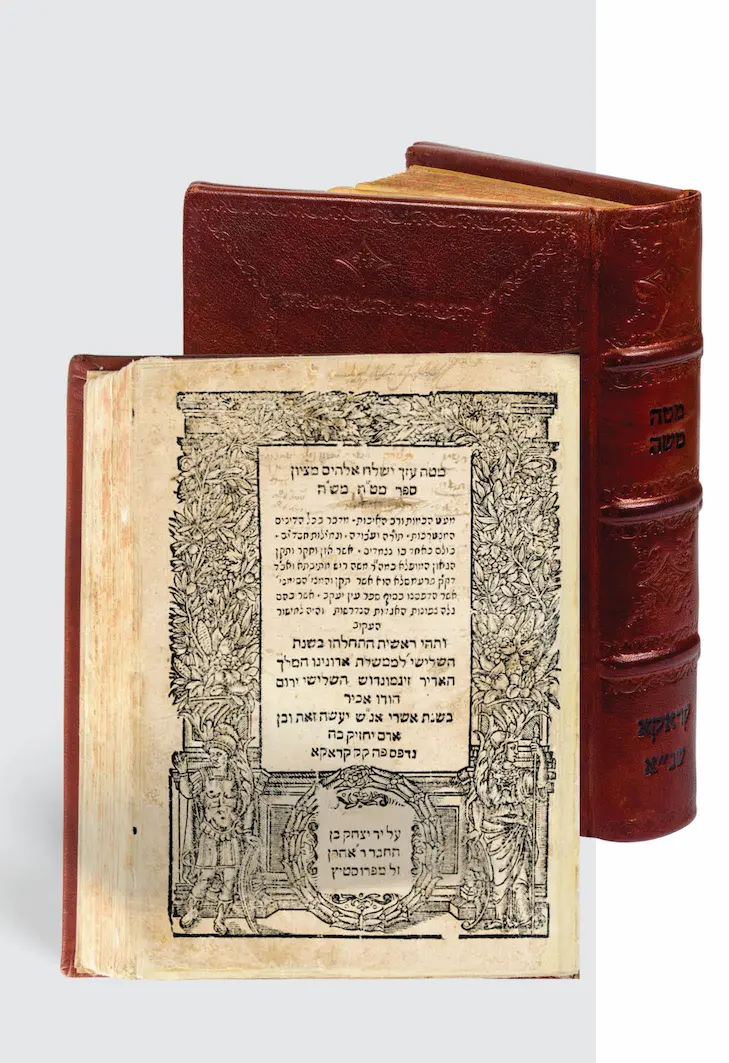
Lot : 91
Halachic fundamental
Matteh Moshe. First Edition. Cracow, 1591
Halachic rulings and Jewish customs for the entire year, along with essays on mussar and kabbalah arranged according to the three pillars; Torah, avodah and gemilus chassadim, by Rabbi Moshe Meth, Av Beis Din of Premishla.
The present sefer is a treasure trove of halachic rulings, customs and mussar concepts presented through all methods of Torah study (Pardes). Rabbi Moshe Meth is quoted extensively by the premier Achronim and Torah luminaries in the next centuries, including the Shl”a Hakadosh and Magen Avraham.
Rabbi Moshe Meth (circa 1540-1606) was Av Beis Din of the great Jewish cities of Belz, Apta and Premishla. He was of the prime disciples of the Maharshal and infused his sefarim with important customs that he personally witnessed in the home of his esteemed master. Rabbi Moshe was one of the leading scholars in his era and corresponded frequently with both the authors of the Bach and Mas’as Binyamin.
The title page verso boasts a beautiful poem by Rabbi Shabsai Sofer of Premishla, author of Siddur Rabbi Shabsai Sofer, praising the sefer and its eminent author.
Extremely Rare
Cracow, 1591. First edition. 212 leaves. Page size: 19.5 cm. Decorative title page border. Slight damage to several pages professionally restored. Miniscule holes. Good condition. Attractive new leather binding. Rare.
Stefansky Sifrei Yesod #196
................................................
Any inquiries about this lot ?
We are available also on WhatsApp >>>

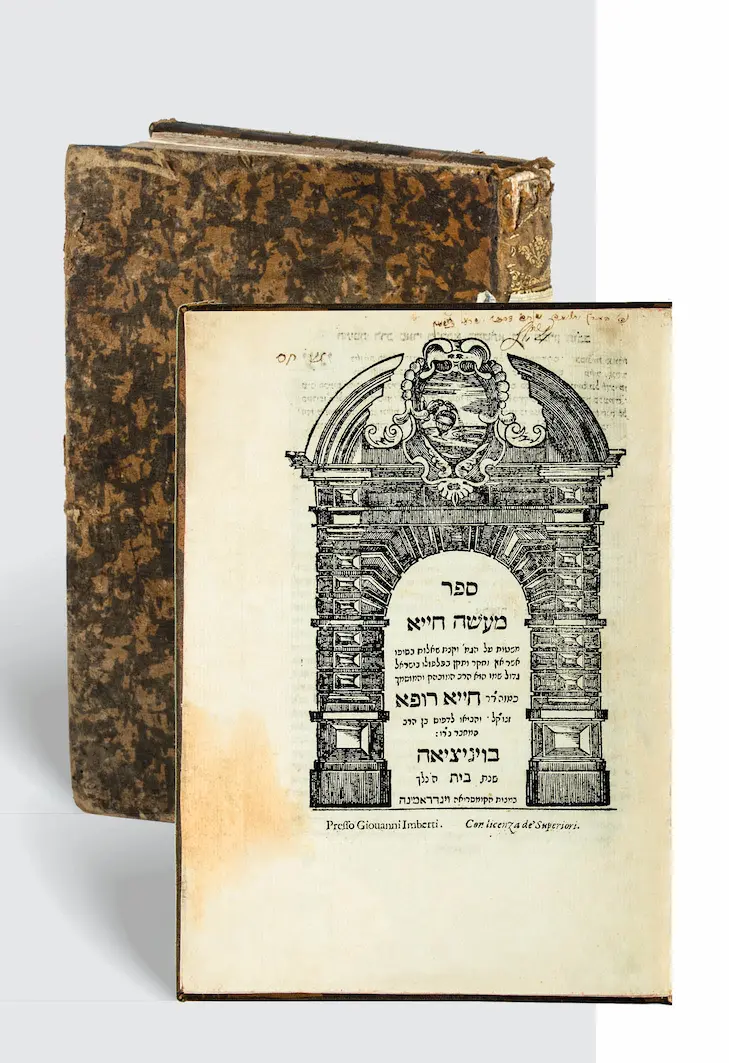
Lot : 92
Maase Chiyya by the Rav Hamusmach Rabbi Chiyya Rofeh of Tzfas. Venice, 1652
Chiddushim on Shas, shailos and teshuvos by the venerable Rav Hamusmach of Tzfas, Rabbi Chiyya Rofeh.
This sefer boasts impressive wide margins.
The
Rav Hamusmach Rabbi Chiyya Rofeh (circa 1550-1617) studied Torah in the yeshivah of Rabbi Shlomo Sagish together with the Maharit. He then studied the wisdom of kabbalah under Rabbi Chaim Vital and was one of the select disciples to transmit his sacred teachings to the future generations, teaching Rabbi Binyamin Halevi who subsequently taught the Ramaz.
Rabbi Chiyya Rofeh was one of the prominent scholars ordained by Rabbi Yaakov Beirav along with his contemporary sages, Mahrit Tzahalon and author of Sefer Chareidim.
Maase Chiyya was printed by the author’s son Rabbi Meir Rofeh who served as a Rabbinical emissary for the Jewish settlement in Chevron. The sefer boasts approbations by Rabbi Eliezer ben Orcha, Rabbi of Chevron. The sefer begins with an approbation and poem by the Ramaz.
Venice, 1652. First edition. [3], 155, [1] leaves. Architectural border on title page. Minor marginal restorations on a few pages. Water stains. Worn antique binding with gilded engravings on spine. Italian owners signatures.
Item description from the 'William L. Gross Collection'
............................................... .
Any inquiries about this lot ?
We are available also on WhatsApp >>>

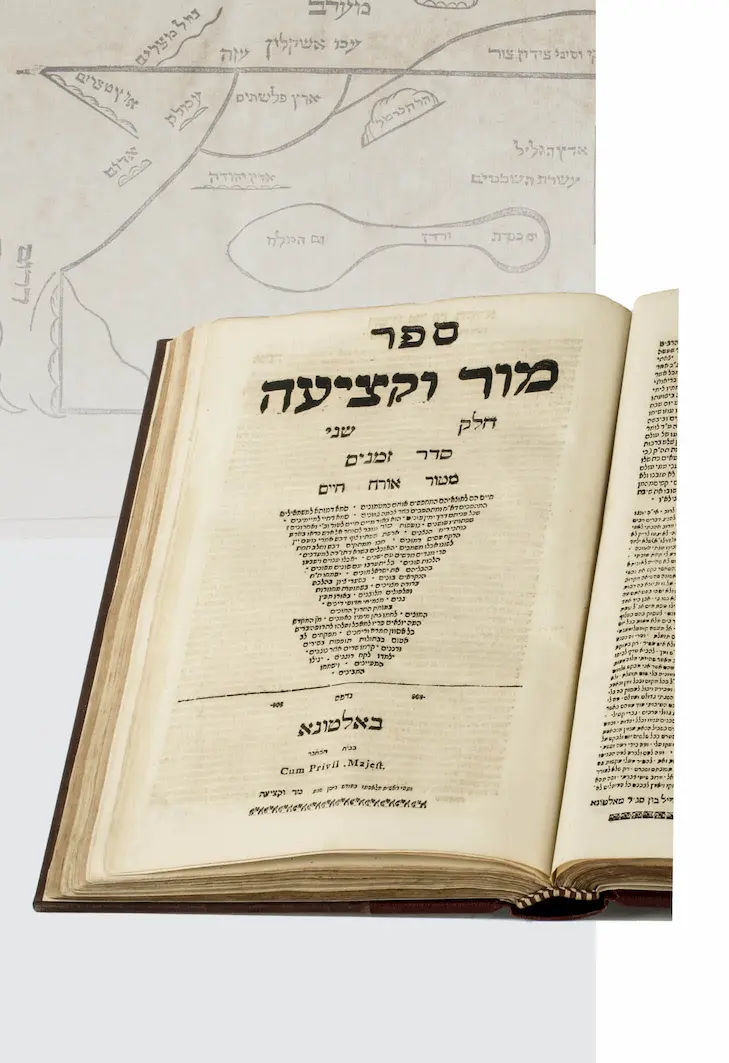
Lot : 93
Fundamental.
Mor U’Ktziah by the Yaabetz. First Edition. Altona, 1761-1768.
Chiddushim and explanations on Tur-Orach Chaim by Rabbi Yaakov Emden.
Two volumes complete, impressive copy.
The last page features a map of Eretz Yisrael as delineated by the Yaabetz.
Renowned as the Yaabetz,
Rabbi Yaakov Emden
(1698-1776) was the son of the Chacham Tzvi and among the greatest Achronim. His comprehensive work Mor U’Ktziah was accepted as a fundamental source on the laws of Orach Chaim and is cited by both his contemporaries and later halachic authorities, including the Chofetz Chaim in Mishnah Brurah.
At the end of Volume 1 the Yaabetz records miracles that occurred to him inspiring him to commemorate those days as a Yom Tov of thanksgiving. Among these miracles, he relates that one night while learning Tur Orach Chaim he fell asleep at the table and was nearly burned from the lit candle.
Altona, 1761-1768. First edition. Printed in the author's home. Vol. 1: [2], 103 leaves); Vol. 2: 95, 97-99 leaves. Page size: 31 cm. Restorations on the margin of the first two pages. Good condition with new half-leather binding.
Stefansky, Sifrei Yesod #176
Item description from the 'William L. Gross Collection'
............................................... .
Any inquiries about this lot ?
We are available also on WhatsApp >>>

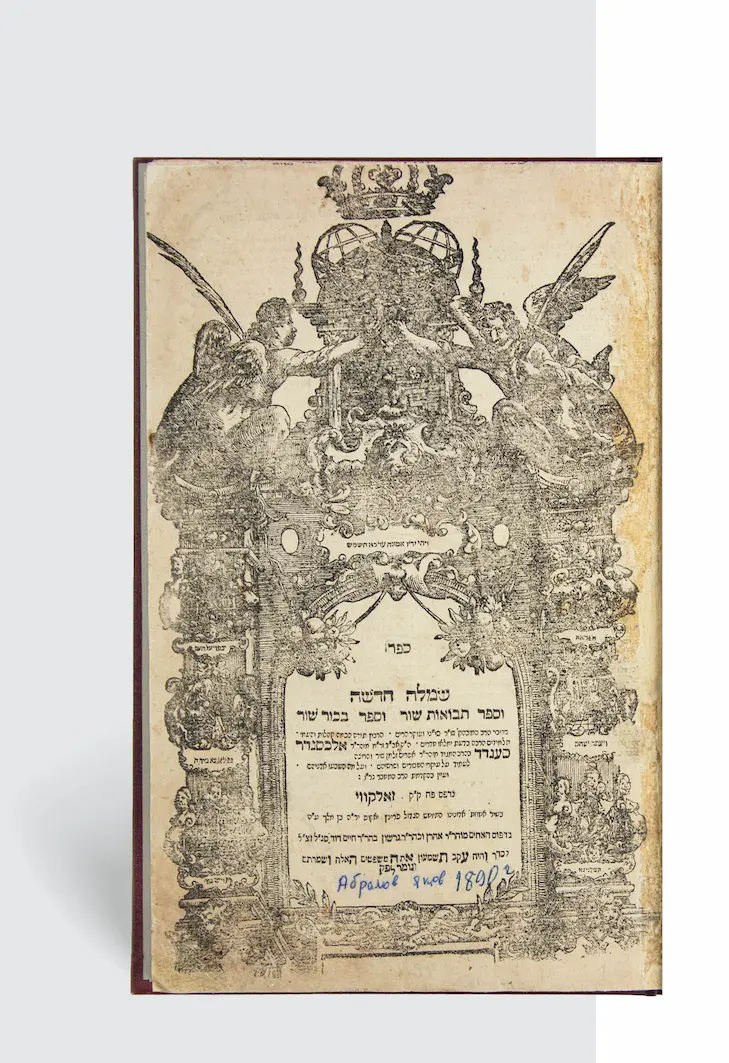
Lot : 94
“We live by the teachings of his mouth”
Foundational Sefer on the Laws of Shechitah
Tevuos Shor - Simlah Chadashah. First Edition. Zolkova, 1733
Halachic rulings regarding the laws of shechitah and treifos and chiddushim on Maseches Chulin by Rabbi Alexander Sender Shor.
The sefer consists of three parts:
Simlah Chadashah: Halachic rulings regarding laws of shechitah and treifos.
The main text is surrounded by
Tevuos Shor, a comprehensive commentary on the laws discussed in Simlah Chadashah.
This is followed by
Bechor Shor, which encompasses chiddushim on Maseches Chulin and other masechtos.
Exceedingly Rare
This sefer was extensively used and the first edition was hard to find already in the 18th century, as described in the title page of the second edition(Zolokova 1766).
“Due to the sefer being beloved by all, many are excited over it, and seize the opportunity to purchase any available copy, and they use it over and over and there are no copies left”.
Sefer Tevuos Shor is a foundational sefer on the laws of shechitos and treifos, has been held in great esteem by all the great Achronim as the Pri Megadim writes in his introduction to Hilchos Treifas HaReiah, “Rabbeinu Ner Yisrael, Hagoan Hamuvhak author of Tevuos Shor is our eyes in these halachos, and all his words are beautiful for the eyes.”
The Darkei Teshuvah (1:53) writes “It is customary to give kabbala (certification) to a shochet u’bodek only after he is proficient in the sefer Simlah Chadashah, because it is compiled from all the laws of shechitah and bedikah [from the Rishonim and Achronim], and Hashem is with him, and the halachah is as he says, and we live by his mouth.”
In his approbation to Simlah Chadashah (Munkacs, 1901): the Darkei Teshuvah writes “I heard from my holy father [Rabbi Shlomo Shapiro of Munkacs] in the name of his father zt”l [Rabbi Elazar, the son of the Bnei Yissachar], that it is accepted among tzaddikim, disciples of the Baal Shem Tov zy”a, that the words of the Simlah Chadashah…purify the soul of a shochet u’bodek, so that no mishap shall occur through him, just as the words of the Zohar purify the soul, he adds “ the shochet u’bodek who studies frequently the words of the holy sefer Simlah Chadashah, the sanctity of the author of Simlah Chadashah will protect him from stumbling, while he is slaughtering …”
Since then, many Gedolei Yisrael have based their teachings on the Tevuos Shor, as the sefer Levushei Srad by the author of Arvei Nachal , and Sefer Daas Kedoshim.
Rabbi Alexander Sender Shor (circa 1673-1737) taught Torah in several cities in Poland and had many students. He refused to serve as a rabbi, even though he was offered positions in large and important communities. All the leading Achronim hold him and his works in the highest esteem.
The beginning of the sefer features approbations from the Pnei Yeshoshua and from Rabbi Elazar Rokeach, Av Beis Din of Brod, author of Maaseh Rokeach, among others.
Zolkova, 1733. First edition. 126 leaves. Page size 32 cm. Professional restoration of margins on title page, upper margins cropped, several leaves with the upper title cropped. Minor holes. New binding.
Stefansky, Sifrei Yesod # 172
................................................
Any inquiries about this lot ?
We are available also on WhatsApp >>>

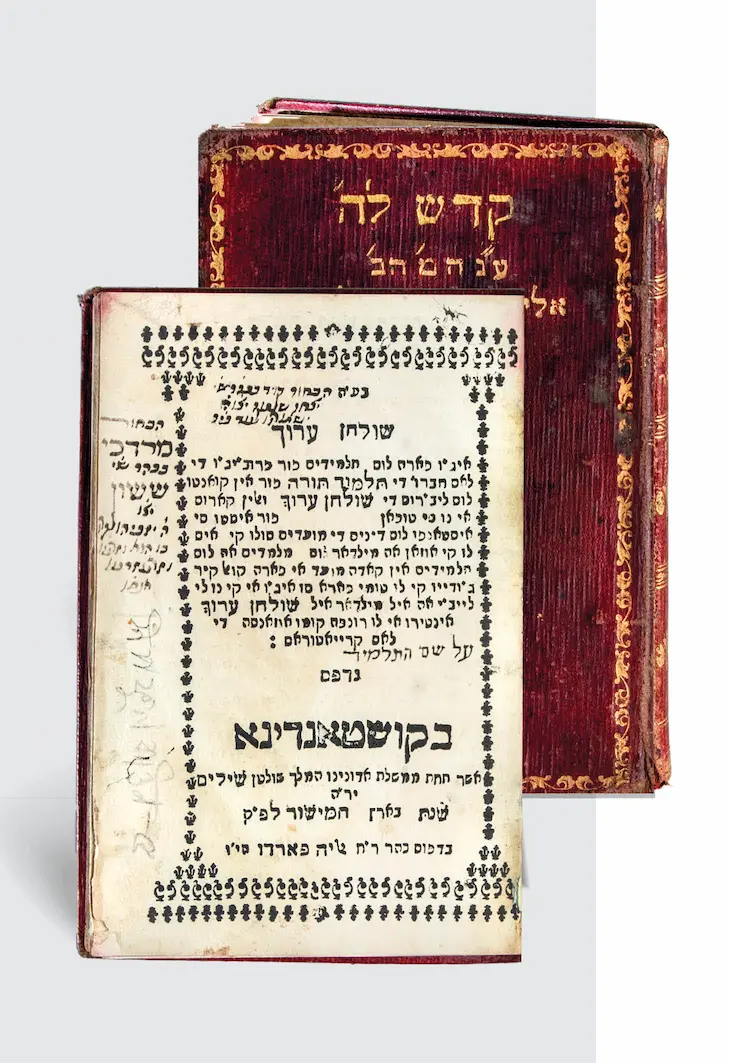
Lot : 95
Pocket Size Shulchan Aruch for Students with Title Page in Ladino. Constantinople, 1801
Complete copy includes a rare page with illustrations!
Extremely rare!
Pocket size Shulchan Aruch containing the halachos of Yamim Nora’im, Succah and Chanukah in a special format edition created especially for the students of the Talmud Torah in Constantinople.
The sefer opens with a title page in Ladino
The last page features two illustrations printed on both sides of the page. The first depicts Bnei Yisrael’s camp in the Wilderness around the Mishkan, and the second is of Yericho surrounded by seven walls. (See A. Yaari, Mechkarei Sefer ppgs. 466-469 regarding the second illustration.)
The title page contains the signatures of two students from the Talmud Torah:
Habachur Yitzchak Shlomo and
Habachur Mordechai Sasson
Constantinople, 1801. Refael Chaim Eliyahu Pardo Press. [1], 23, [1] leaves. Page size: 15 cm. Antique leather binding with gilded border and engraved gilded dedication. Minor, light stains. Very rare!
Provenance: William L. Gross Collection
Item description from the 'William L. Gross Collection'
............................................... .
Any inquiries about this lot ?
We are available also on WhatsApp >>>

Lot : 96
Invaluable Treasure!
Volume of Teshuvos and Halachic Rulings of the Rabbis of Morocco.
The Only Anthology of its Kind!
200 years of Moroccan Rabbinate, over 100 halachic rulings, shailos and teshuvos and approximately 200 original autographs, all bound into one unique volume.
The compilation contains a collection of individual teshuvos and halachic rulings, from prominent Rabbanim of Morocco spanning 200 years collected meticulously and bound into a single volume by
Rabbi Rafael Even Tzur, Av Beis Din of Fez.
The historical and religious value of this unique collection is exceptionally precious.
Contains dozens of teshuvos regarding practical halachah and halachic rulings, bearing the signatures of nearly 100 rabbis! Includes the signatures of the leading rabbis of Fez, Meknes and Sefrou who lived between the years
1690-1840, representing Morocco’s most distinguished rabbinical families including the
Pinto, Bardugo, Toledano, Ben Attar, Sereo, Elbaz, Monsenago, Even Tzur, Ibn Denan and Abutbol families, who produced generations of holy rabbis and dayanim who were exalted tzaddikim which performed miracles frequently, illuminating the world with their Torah and righteousness.
A detailed description of the rabbi’s whose signature appears in this compilation is available online, amongst them are:
Rabbi Shmuel Elbaz (1697-1749) also known as the Rashba, was held in great esteem by his close friend the Ohr Hachaim Hakadosh. His autograph appears on pages 131 and 120.
Rabbi Yaakov Even Tzur, known as the Yaavetz
(1673-1753), authored Shu”t Mishpat U’Tzedakah B’Yaakov.
Rabbi Mordechai Bardugo, the Marbitz (d. 1762), was one of the great sages of Meknes and the son-in-law of his teacher the Mashbir. He was the father of Rabbi Yekutiel Bardugo and Rabbi Rafael Bardugo whose signatures also appear several times in this compilation, along with the signatures of his grandsons Rabbi Maimon known as the Harav HaMavin, and Rabbi Petachya Mordechai author of Nofes Tzufim.
Rabbi Eliyahu Hatzarfati (circa 1715-1806), Av Beis Din Fez, was a disciple of the Ohr Hachaim Hakadosh, a Gadol Hador and the father of the Tzarfati rabbinical dynasty. The signature of his disciple, Rabbi Shaul Yeshua Abitbol, Av Beis Din of Sefrou and author of Shu”t Avnei Shesh also appears here.
The signature of
Rabbi Mattisyahu Sereo (1725-1827) and many of his descendants also appears here, along with the autograph of
Rabbi Baruch Toledano (1739-1819), Av Beis Din of Meknes and son of the Gadol Hador Rabbi Yaakov Toledano, known as Maharit. The Toledano family produced many generations of dayanim.
On this treasured collection it is written by Rabbi Yosef Ben-Naim in his book Malkei Rabanan(p. 105b).
Rabbi Rafael Even Tzur (1830-1914), Av Beis Din Fez, merited greatness in Torah and wealth, he authored teshuvos and chiddushim, and was proficient in the takanos of Moroccan Jewry.
He had a passion and love for jewish books which led him to collect and put together sefarim and manuscripts. “He would not let go of even a single handwritten leaf, he would gather scattered and random pages of torah and preserve them by binding them together into volumes.
Rabbi Yosef Ben Naim gleaned much historical knowledge from this manuscript, which he used in writing his monumental work on the sages of Morocco.
152 leaves (several blank). Page size: varies between 21-23 cm, with several smaller pages. Mostly in good condition.
Original Moroccan leather binding.
For more information click here
............................................... .
Any inquiries about this lot ?
We are available also on WhatsApp >>>

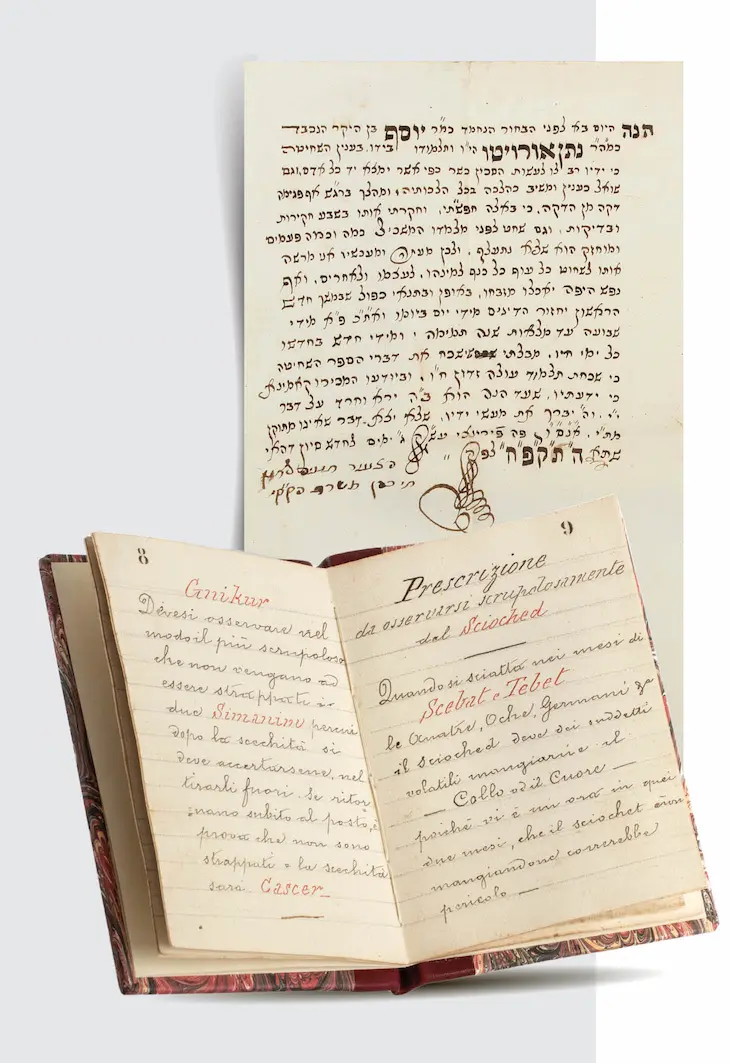
Lot : 97
Laws of Shechitah and Bedikah with Handwritten Semichah Letter by Rabbi Chananya Elchanan Cohen, Ab”d of Firenze, Talmid of the ‘Zera Shimshon’. Firenze, 1828
A beautiful handwritten semichah letter in impressive script by Rabbi Chananya Elchanan Cohen, Av Beis Din of Reggio and Firenze, prime disciple of the Zera Shimshon, bound together with a summary of the laws of shechitah handwritten by his talmid Rabbi Yosef ben Rabbi Nosson Orvito.
Rabbi Chananya Elchanan Cohen (1751-1834) was the prime disciple of the saintly kabbalist Rabbi Chaim Shimshon Nachmani, author of Zera Shimshon. Rabbi Chananya Elchanan served as Av Beis Din of Firenze, Italy, and included in his sefarim many sacred songs and poems which he’d learned from the Zera Shimshon whom he refers to as “Mori v’rabi.” He named his son after the Zera Shimshon, who passed away childless (see title page of his sefer Chanoch Lanaar [Venice, 1804]).
In The Order of Tikkun Chatzos that Rabbi Chananya Elchanan Cohen printed in Reggio, 1822 and again in Firenze, 1826, he included the stirring kinah “Bemar evkeh besoch Golah” that the Zera Shimshon composed for Tisha B’Av.
Rabbi Chananya Elchanan was born in the city of Reggio where the Zera Shimshon served as Rav, he disseminated Torah to the masses, and cultivated many talmidim who later became the spiritual luminaries and Rabbanim of Italy. Rabbi Chananya Elchanan was a genius in Torah and possessed myriads of talents; he was an profound orator, grammarian, composer of poems and songs and prolific author who wrote many sefarim. The most famous among them were Chanoch Lanaar and Reishis Lekach which he wrote for Italian Jewish youth in order to guide them along the path of Torah and yiras Shamayim. Most of his sefarim were printed in his press in Reggio.
Rabbi Chananel Nifi, Av Beis Din of Cento, relates a marvelous story that he heard firsthand from Rabbi Chananya Elchanan Cohen regarding his spiritual master the Zera Shimshon: A fire once broke out right next to the Zera Shimshon’s house, and grew until it reached the walls of his porch. The Zera Shimshon opened his window and stood facing the conflagration while immersed in prayer. All at once, by a miracle, the fire extinguished, and the Zera Shimshon suffered no damage (Toldos Gedolei Yisrael [Trieste, 1853] p. 325 #25; p. 105).
The semichah letter is bound together with a notebook which includes a handwritten summary of the laws of shechitah in Italian by Rabbi Chananya Elchanan Cohen’s talmid Rabbi Yosef ben Rabbi Nosson Orvito.
Manuscript: 14 sides on thick, high-quality paper + 2 large folded leaves. Page size: 14 cm;
Semichah letter: 22x13 cm. All in good condition; bound in attractive new half-leather binding.
................................................
Any inquiries about this lot ?
We are available also on WhatsApp >>>

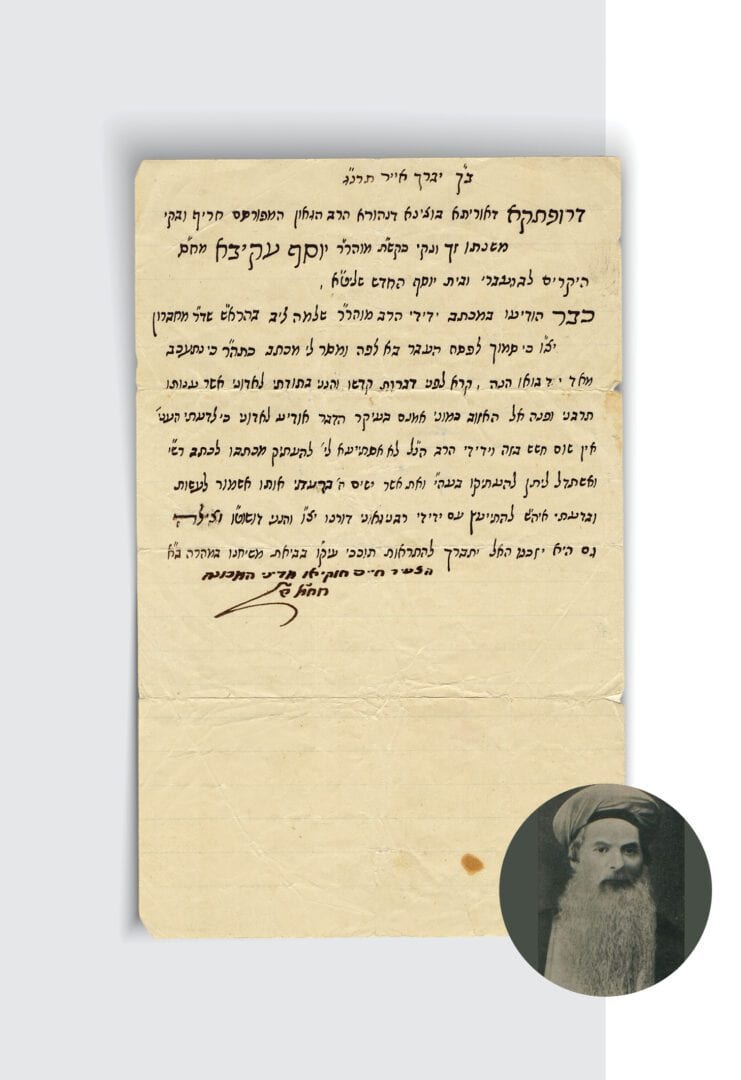
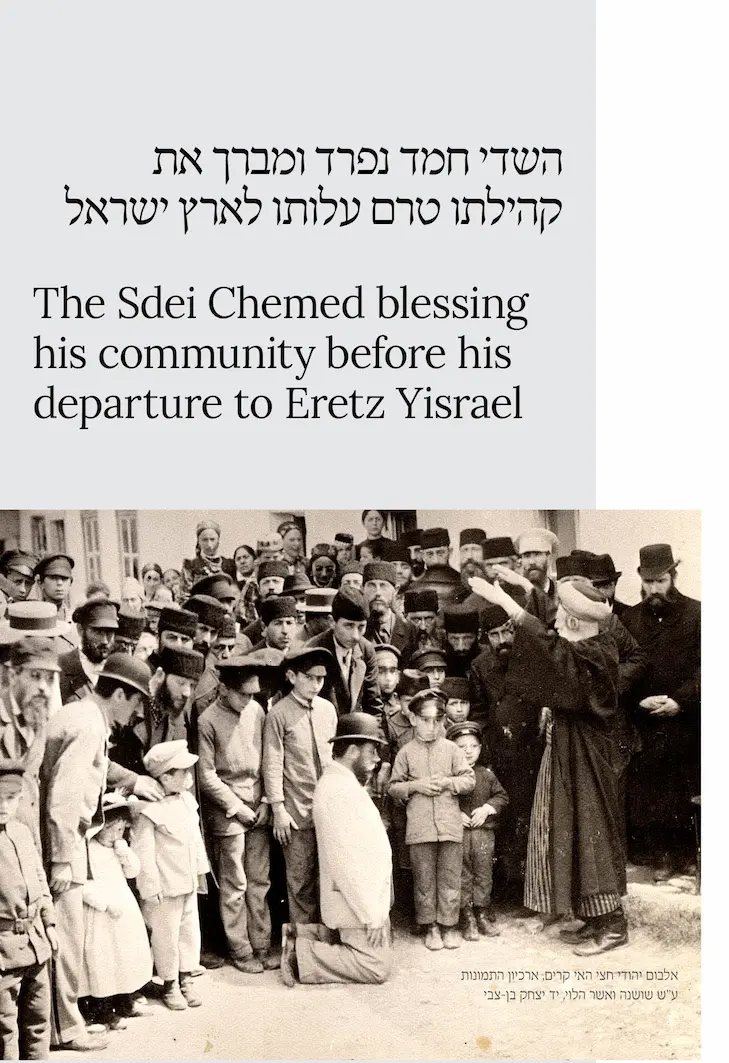
Lot : 98
Autographed Letter by the Sdei Chemed to Rabbi Akiva Yosef Shlesinger. Bilohirsk, 1893
This letter was written by Rabbi Chaim Chizkiyahu Medini, Av Beis Din of Chevron and author of Sdei Chemed to his contemporary Rabbi Akiva Yosef Shlesinger in Jerusalem.
The contents of the letter indicate that Rabbi Akiva Yosef Shlesinger had requested the Sdei Chemed’s approval regarding a specific action that he wished to take, and the latter replies that he needs to consider this course of action and consult with other Gedolim in the generation.
The “Rabbi Shlomo Leib Baharash, emissary of Chevron” mentioned in the beginning of this letter was Rabbi Shlomo Leib Eliezerov, who would subsequently serve as future Ashkenazic Rabbi of the Chevron Jewish community and was a close friend of the Sdei Chemed.
Rabbi Chaim Chizkiyahu Medini (1833-1905) was one of the great Sephardic sages, authors and scholars of Torah literature. His magnum opus Sdei Chemed, which functions as a Talmudic encyclopedia, earned him international acclaim.
Rabbi Chaim Chizkiyahu Medini was born in Jerusalem, but relocated to Constantinople in his youth. He was appointed Rav in Jewish Crimea, and in 1899 returned to the Holy Land where he subsequently accepted the coveted position of Chief Rabbi of Chevron.
This letter was written by a scribe in print and bears the Sdei Chemed’s autograph:
“Hatza’ir Chaim Chizkiyahu Medini, who is called ‘Chacham Sat’”.
Bilohirsk, Crimea, 1893. 1 leaf. Page size: 13x14 cm. Fold mark on width of page.
............................................... .
Any inquiries about this lot ?
We are available also on WhatsApp >>>

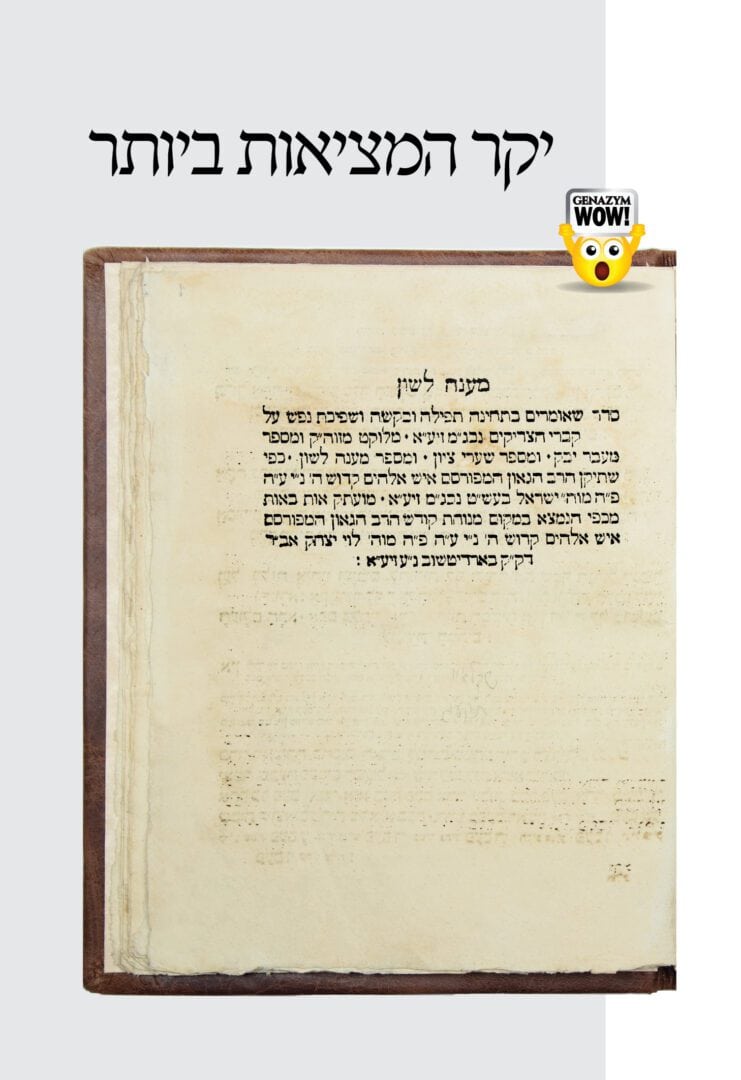
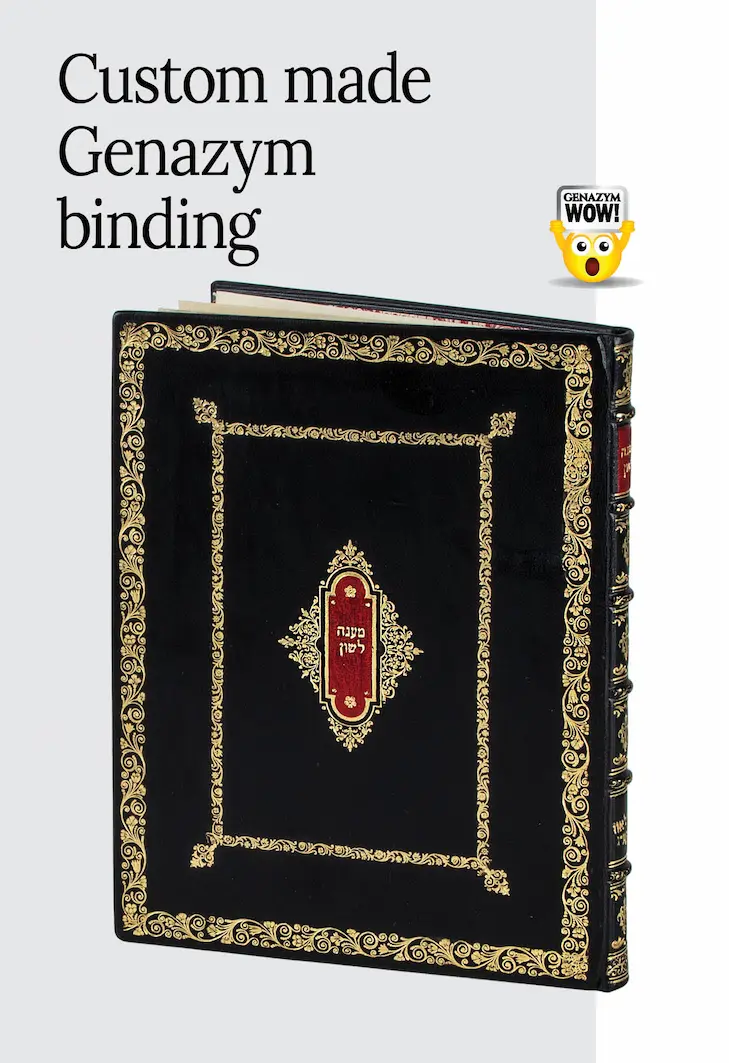
Lot : 99
Rare Find!
Tefillos to be recited at kivrei tzaddikim by the Baal Shem Tov!
Maaneh Lashon. First Edition. Shklov, after 1813
Complete, impressive copy!
Order of prayers to be recited at the burial sites of tzaddikim composed by
“The rabbi and renowned genius, holy man of G-d, candle of Israel and right pillar, Moreinu Harav Yisrael Baal Shem Tov”. This sefer was “printed based on texts found near the resting place of the holy Admor Rabbi Levi Yitzchak of Berditchev.”
First edition, and extremely rare copy! To the best of our knowledge, this sefer has never before appeared at auction.
Contents:
1. Seder Techinos U’bakashos – Requests and supplications recited at the burial sites of tzaddikim, composed by Rabbi Yisrael Baal Shem Tov.
“Copied letter for letter as found in the holy resting place of the famous genius and holy man of G-d, Moreinu Harav Levi Yitzchak of Berditchev" (sides 1-18).
2. “Essay to Understand the Concept of Prayer at the Tombs of Tzaddikim” by the Mitteler Rebbe, Rabbi Dov Ber Schneerson (sides 19-29).
3. Letter of Condolences by the Admor Hazakein to the residents of Eretz Yisrael following the passing of the Admor Rabbi Menachem Mendel of Vitepsk, with commentary on the letter (sides 29-31).
Maaneh Lashon was accepted among Chassidic congregations as the fundamental book of prayers to be recited at the burial sites of tzaddikim throughout the ages.
Admorim, chassidim and the pious would pilgrimage to the burial sites of tzaddikim, recite these prayers and chapters of Tehillim, following the order established in Maaneh Lashon.
This sefer was most widely disseminated among Lubavitcher chassidim, after the Mitteler Rebbe instructed his chassidim to recite it at the tziyun of his father, the Admor Hazakein. In 1812, the Admor Rayatz printed copies of this sefer in order to avail it to his chassidim who came to pray in the Ohel of the Baal Hatanya. Following the passing of the Rayatz, his son-in-law, the Admor Rabbi Menachem Mendel Schneerson, reprinted Maaneh Lashon so it could also be recited in the Ohel of the Rayatz.
The Lubavitcher Rebbe would recite this order of prayers whenever visiting the tziyun, and this custom is perpetuated by chassidim who pilgrimage to any of their sacred sites until this very day.
Contents of Prayers:
Prayers recited at a cemetery; order of chapters of Tehillim; order of Viduy “Ribon Ha’olamim"; “Shalom alecha Adoneinu, Moreinu v’Rabbeinu” prayer; chapters of Tehillim; passages from the Zohar.
When reciting Maaneh Lashon, it is customary to also recite Pidyon Nefesh at the burial site of the Admorim (side 11).
The present first edition of Maaneh Lashon has several variances from the current widespread edition.
Shklov, after 1813 (year of the Baal Hatanya’s passing). [31] sides. Page size: 23x18 cm. Instructions and customs in Yiddish. Thick, high-quality paper. Good condition. Attractive new leather binding.
Side [10] begins the page numbering of a new pamphlet (the essay and letter), which was also disseminated separately. In the present item, we have both sections complete and in good condition.
Stefansky, Sifrei Chassidus #354
............................................... .
Any inquiries about this lot ?
We are available also on WhatsApp >>>

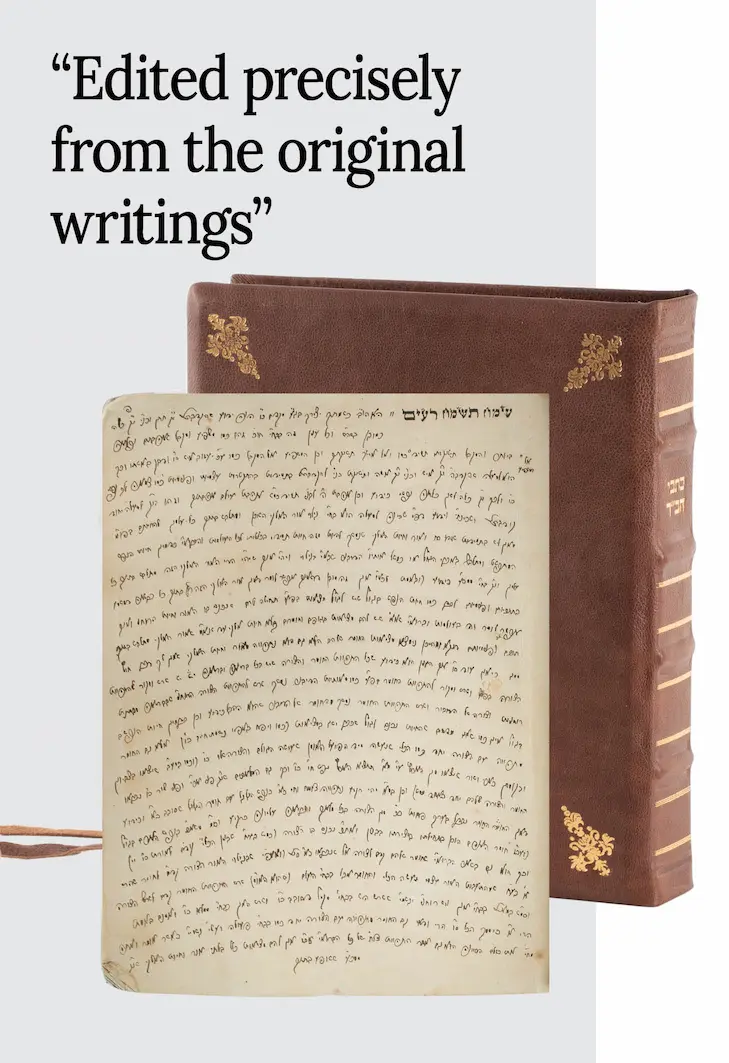
Lot : 100
Chabad Bichel
Manuscript
Early Essays by the Progenitors of Lubavitch
“Edited precisely from the original writings”
Chassidic essays related by the Admor Hazakein Rabbi Shneur Zalman of Liadi, the Baal Hatanya; his son and successor the Admor Rabbi Dov Ber Schneerson, the Mitteler Rebbe; and his grandson the Admor Rabbi Menachem Mendel Schneerson, author of Tzemach Tzedek.
Handwritten volume encompassing 13 essays on 146 sides, known in the Lubavitch community as a “bichel” (Yiddish for book). The first 3 essays were transcribed from speeches by the Admor Hazakein; the next 5 essays were delivered by the Mitteler Rebbe; and the last 5 essays were related by the Tzemach Tzedek.
[important information was found in this handwritten manuscript, in the essay entitled “V’asisa tzitz zahav.” The essay, which was printed in sefer Toras Chaim (Kehas Edition, Shmos Vol. 2 p. 605 in the list of manuscripts printed at the end of the sefer), states that these divrei Torah appear in several ‘bichels’
“but the dates and time they were said were not preserved in the manuscripts.” This particular manuscript notes the year as 5584 (1828).
At the end of the essay entitled “V’yisfu Anavim” by the Mitteler Rebbe, on leaf 48a, the scribe writes:
“Edited precisely from the body of the letter” which means that it was copied directly from the Admor’s original manuscript.
1. The holy
Admor Rabbi Shneur Zalman Schneerson of Liadi (1745-1813), called
“Admor Hazaken” or Baal HaTanya, was the author of Tanya and Shulchan Aruch. As one of the foremost Chassidic masters, he was the founder of the Chabad philosophy and progenitor of the glorious Lubavitch dynasty. Rabbi Shneur Zalman was the prime disciple of the Maggid of Mezritch who revealed to him that his soul drew from the Olam Ha'atzilus, and that his mission in this world was to reveal the methods and philosophy of Chabad in order to disseminate the sacred teachings of the Baal Shem Tov to the world.
2. The
Admor Rabbi Dov Ber Schneerson (1733-1828), the
Mitteler Rebbe, expounded upon the lofty teachings of his father the Baal Hatanya, and established the Lubavitch Chassidus. He succeeded his father as Admor in 1813 and led his flock until his untimely passing in 1828 at the age of only 54 years.
3. The
Admor Rabbi Menachem Mendel Schneerson (1789-1866), the
Tzemach Tzedek, was raised by his holy grandfather, the Baal Hatanya. He was the son-in-law and successor of his uncle, the Mitteler Rebbe, and became the third Admor in the Chabad-Lubavitch dynasty in 1828. His teachings on both the Revealed and Hidden Torah contain profound insights and are studied in great depth.
............................................... .
Any inquiries about this lot ?
We are available also on WhatsApp >>>
of 3 pages
