HOLIDAY AUCTION

Auction 15
May 21, 2023 | 1:00 PM EST
of 3 pages

Lot : 1

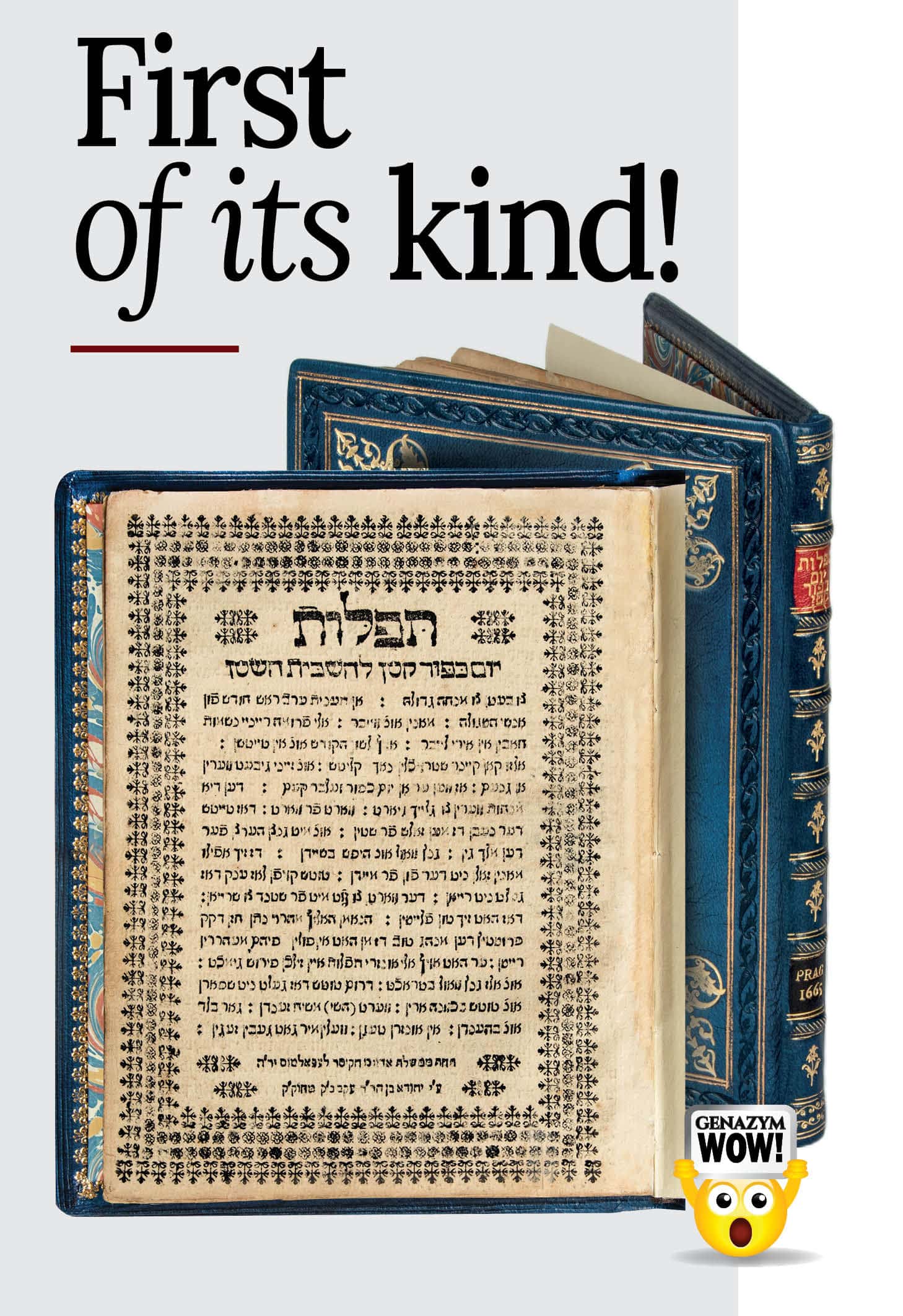
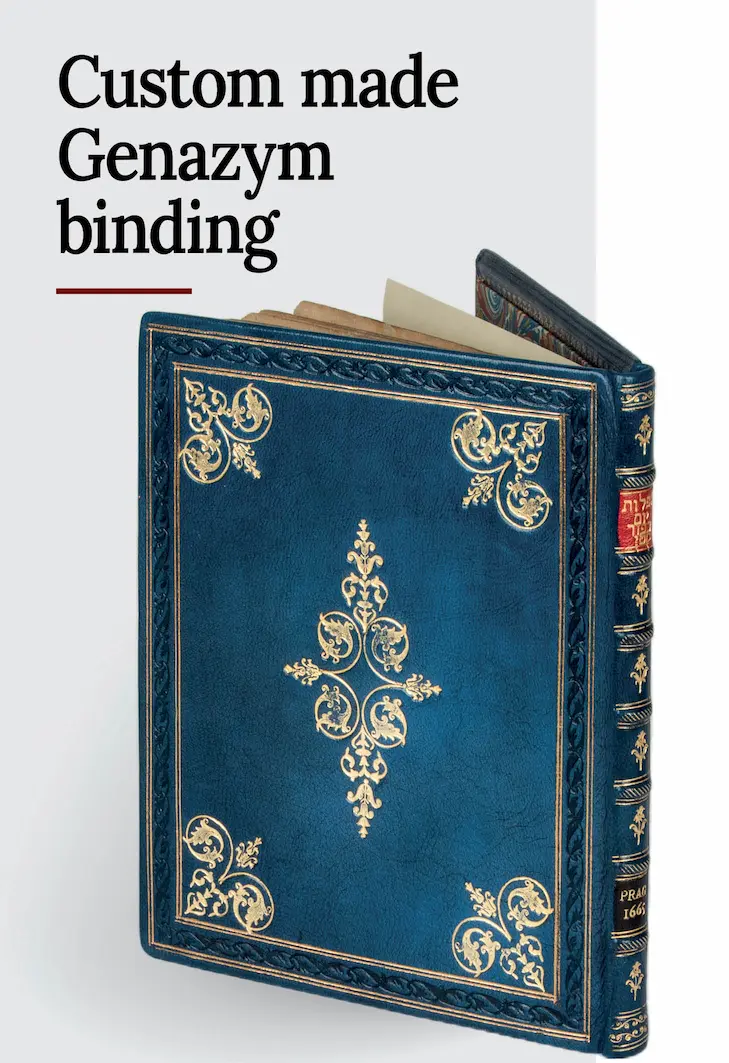
Unicum.
Order of Prayer for
Yom Kippur Katan.

Prague, circa 1665
Tefillos and Selichos for Minchah on Erev Rosh Chodesh with Yiddish commentary and translation by Rabbi Nosson Chazan of Prostitz.…

Lot : 2

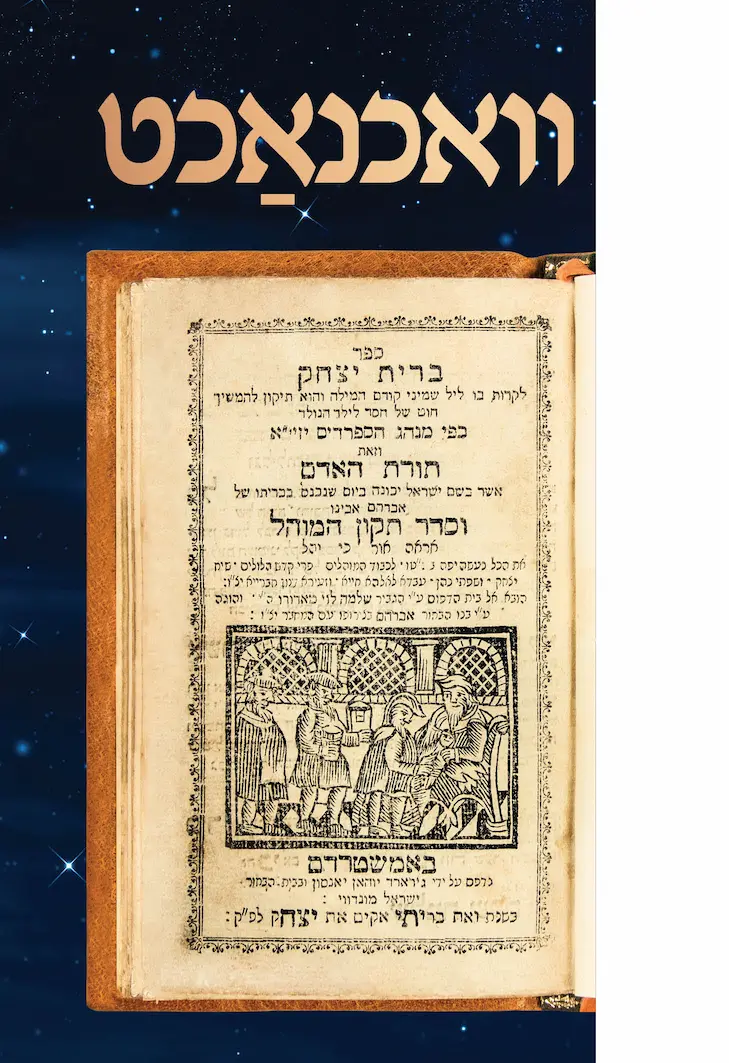
Bris Yitzchak. Amsterdam, 1768 Bris Yitzchak - Prayers and Tikkun consisting of
Bris Yitzchak. Amsterdam, 1768 Bris Yitzchak - Prayers and Tikkun consisting of Torah portions and prayers to be recited the night before a bris milah, as well as the order of prayers for bris milah, including piyutim and brachos. This copy also includes the order of circumcision for “Anusim (Marranos) who came from Spain and Portugal” (p. 12a), the order of circumcision and immersion for converts, the order of circumcision of slaves, orphans and illegitimate children. There is a dedication in Portuguese at the beginning of the sefer in honor of mohalim by the publisher Shlomo Levi Maduro. At the end of the sefer is a rare listing of mohalim who were active in Amsterdam, as well as those serving the Portuguese congregation throughout the world. Includes names in Surinam, South America, Curacao in the Caribbean, Hamburg, Germany and Bayonne, France, as well as the dates when they began to serve as mohalim. There is an engraving of a bris milah on the title page, and on the last page, an illustration of a bowl of warm water for washing the baby. (In the past, the baby was washed before and after the bris in warm water (Shabbos 134b)). Edited by Yitzchak Hakohen Belinfante, with an approbation of the rabbi of the Sephardic Congregation in Amsterdam, Rabbi Shlomo Shalem. Amsterdam, 1768. [2], 17, [1] leaves. Page size: 15 cm. Restoration of minor tears. Good condition. New fine leather binding. ................................................ Any inquiries about this lot ? We are available also on WhatsApp >>>

Lot : 3

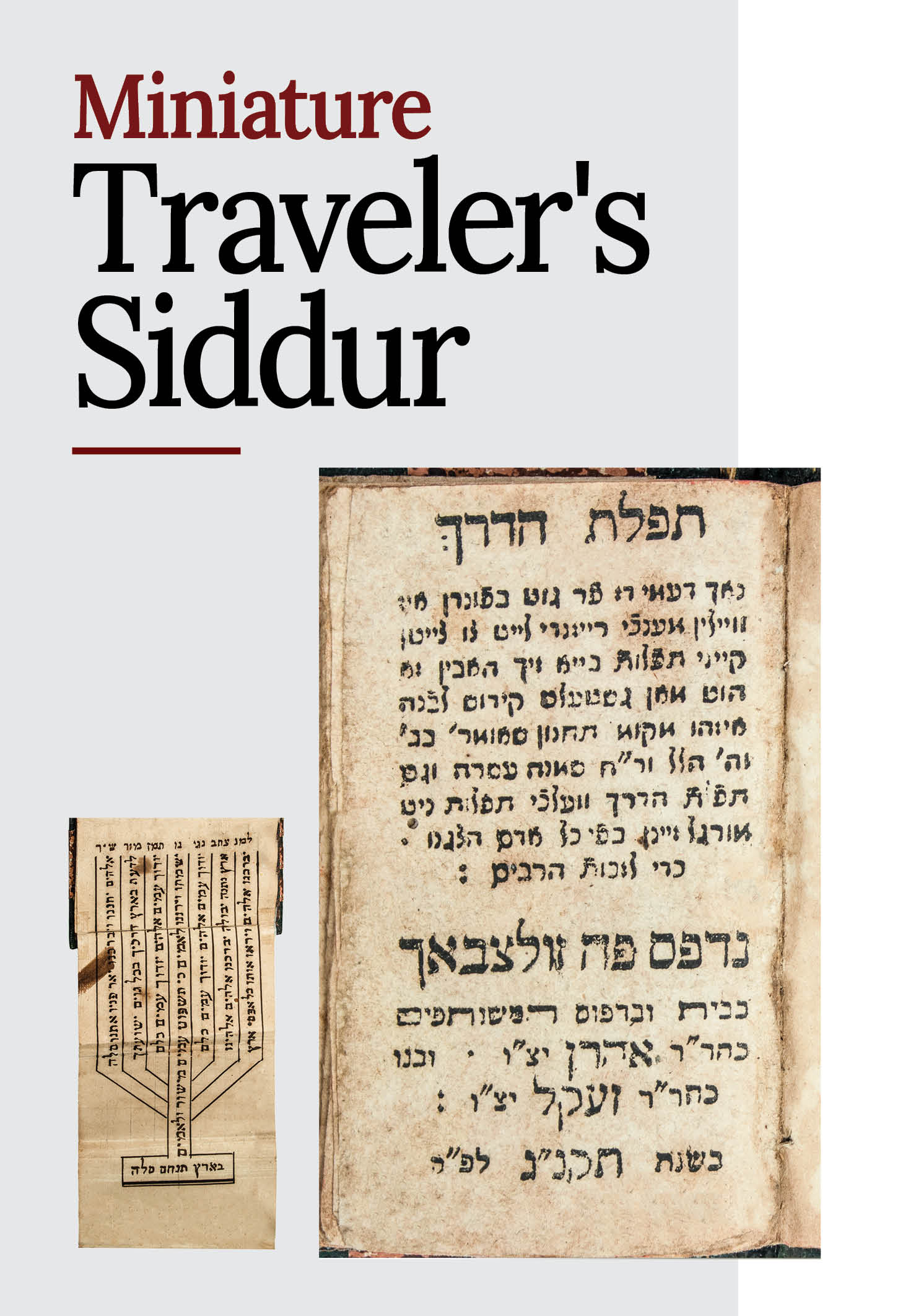
Tefillas Haderech 

Zoltzbach, 1793 


Miniature  

Siddur for Travelers 


Unknown! 
Small-format miniature travel siddur that includes Tefillos  many people do not know by heart. Seder Korbanos; Tachnun for Mondays and…

Lot : 4

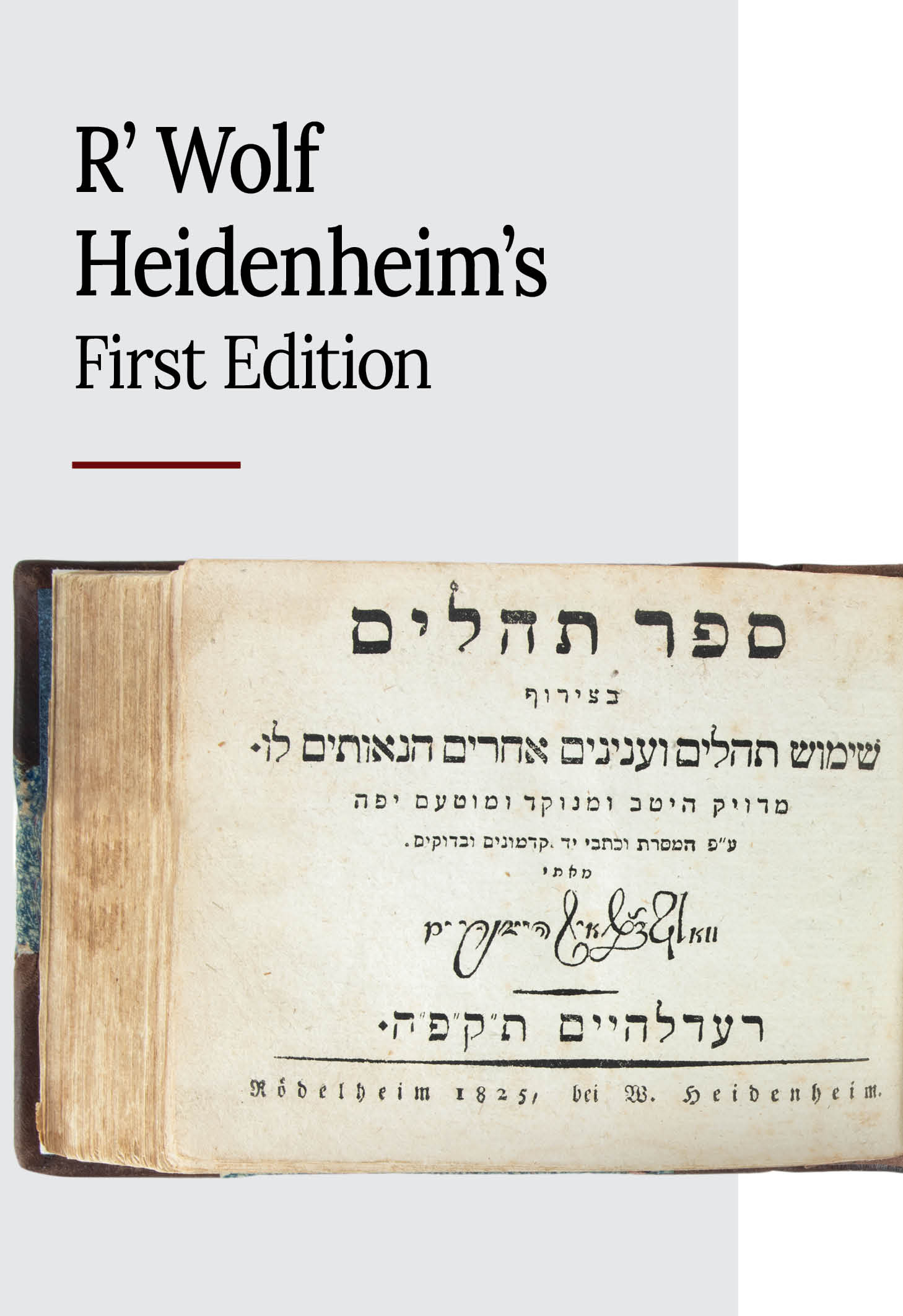
Pocket Sized Tehillim


R’ Wolf Heidenheim’s

First Edition


Rodelheim, 1825

This Tehillim is “precisely edited…based on tradition and ancient proofread manuscripts”.  Prepared for print by Reb Wolf Heidenheim, renown scholar…

Lot : 5

Tehillim

Slavita, 1824


with Ma’amados and Perek Shira 

Rabbi Moshe Shapira Press 

Sefer Tehillim divided by days of the week, with the meaning of each chapter inscribed before the beginning of the…

Lot : 6

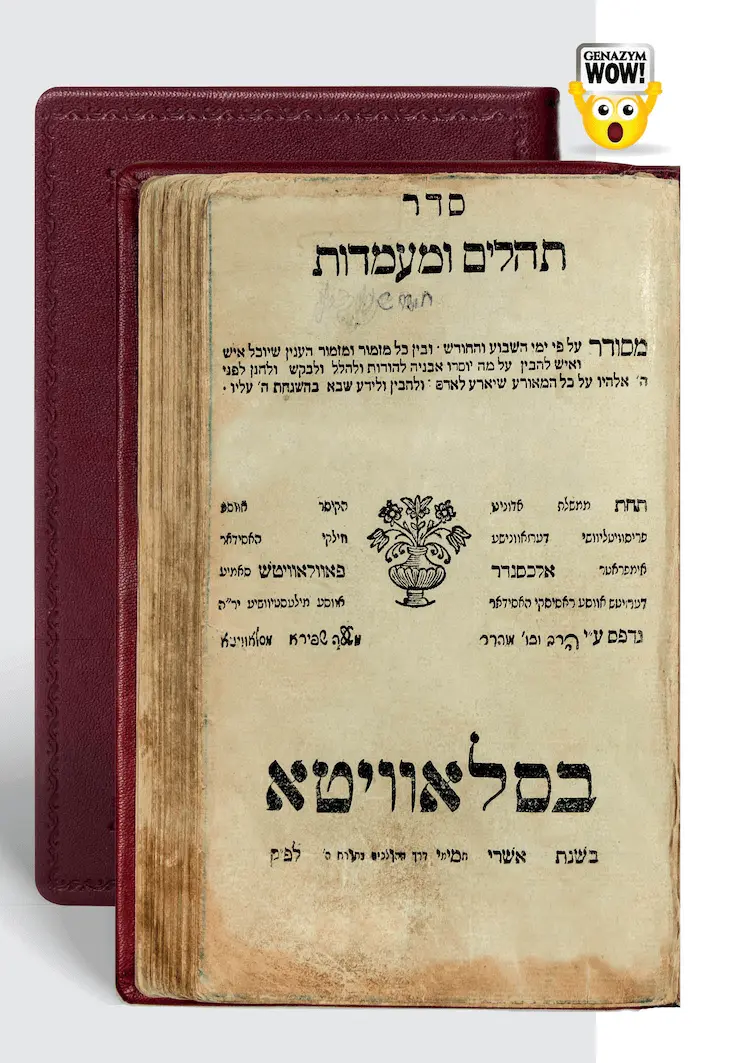
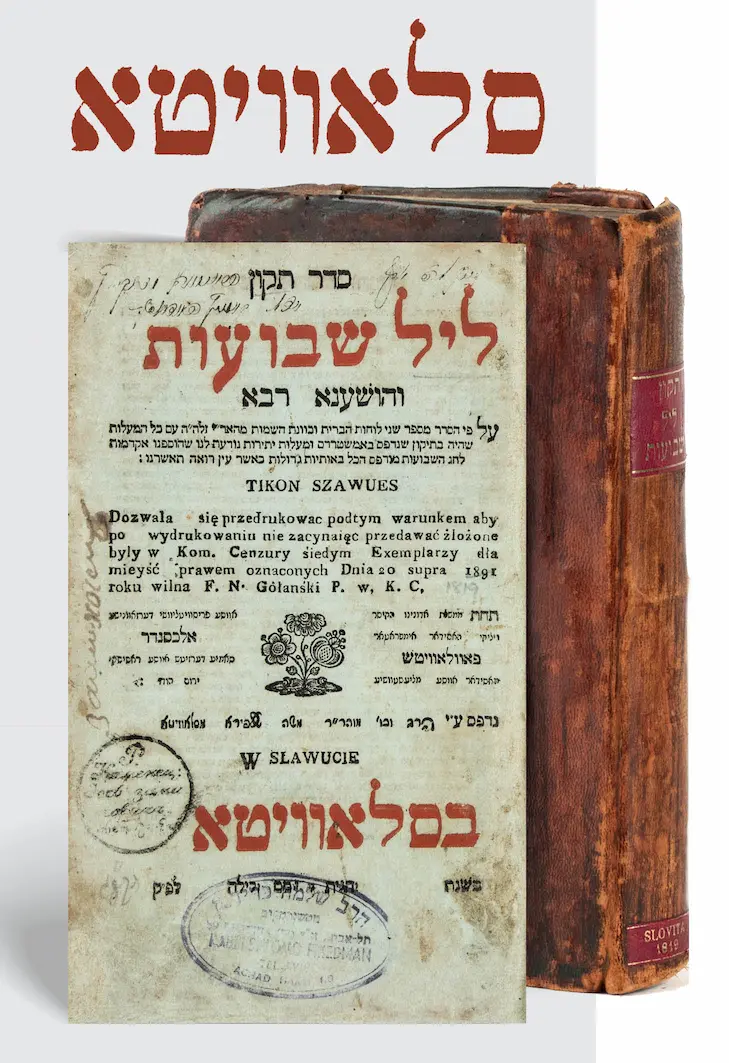
Tikkun Leil Shavuos


Rabbi Moshe Shapira Press

Slavita, 1823

Tikkun Leil Shavuos and Hoshanah Rabbah based on the order of the Shl”a Hakadosh with the kavanos of the Holy…

Lot : 7

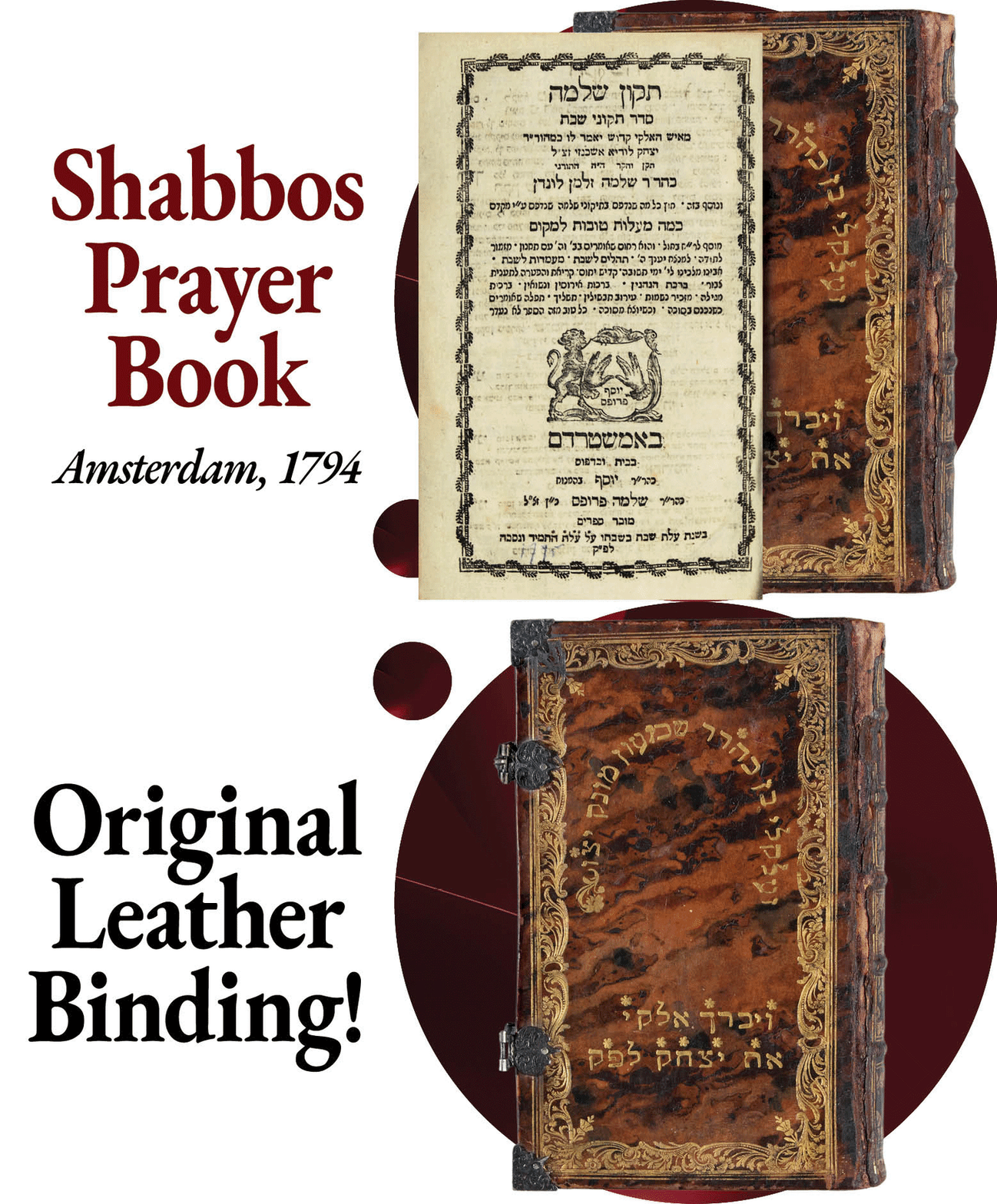
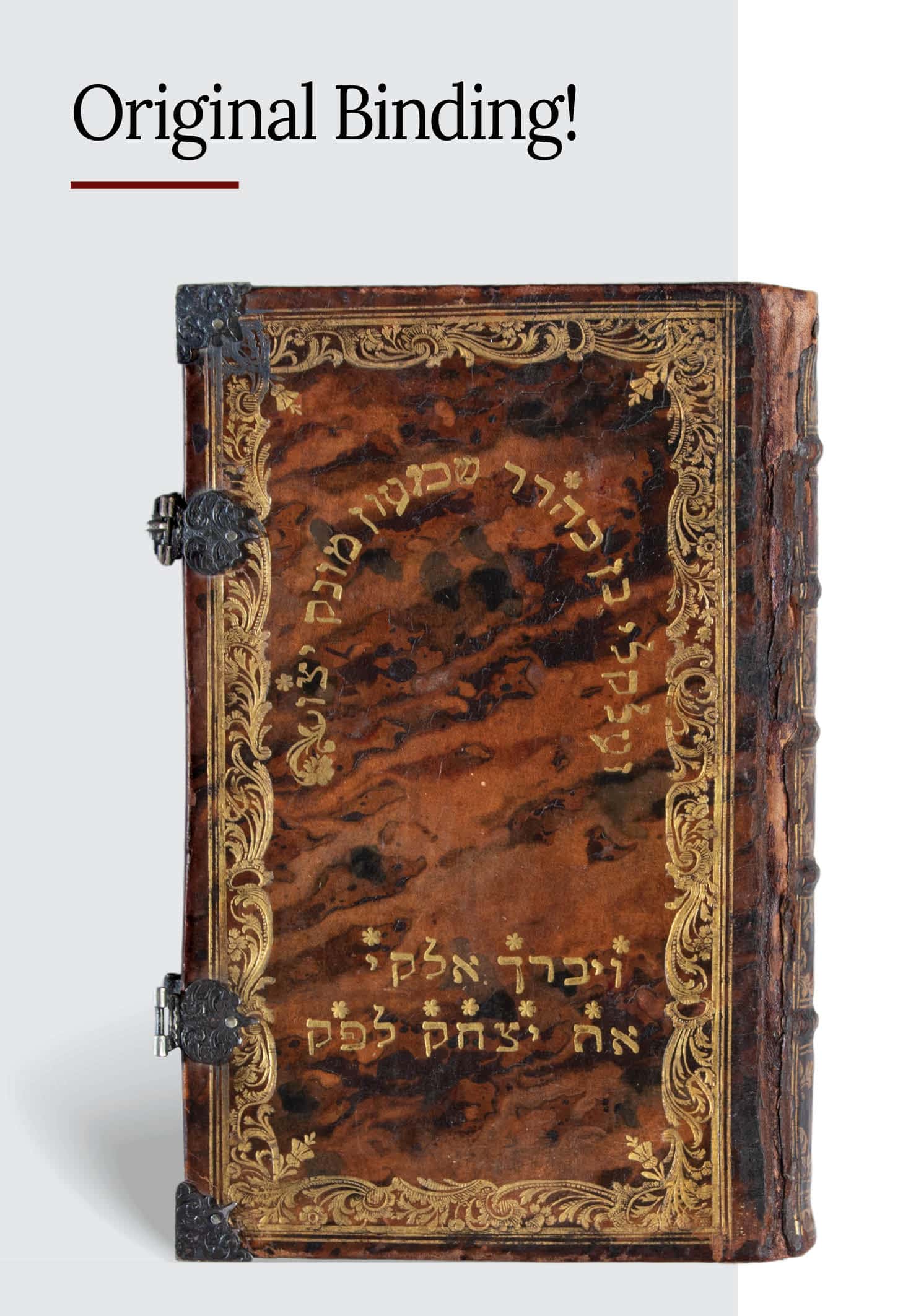
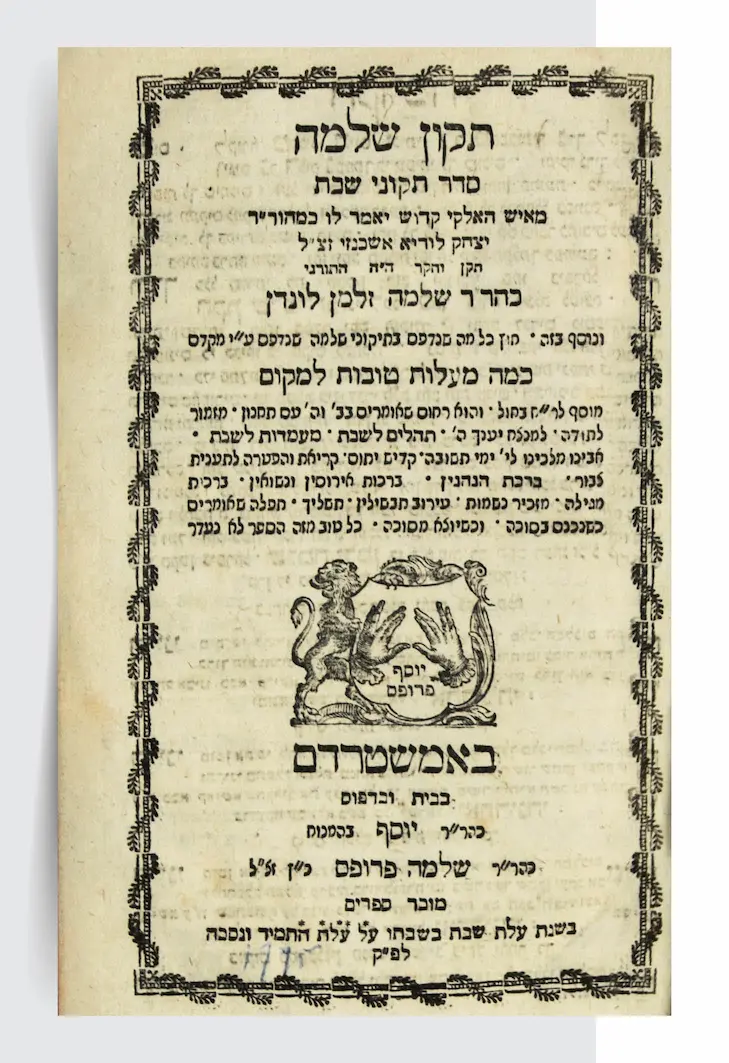
Tikkun Shlomo - Tikkunei Shabbos. Amsterdam, 1794 Magnificent copy with exquisite original
Tikkun Shlomo - Tikkunei Shabbos. Amsterdam, 1794 Magnificent copy with exquisite original leather binding! Order of tefillos for Shabbos with the Tikkunei Shabbos of the Arizal, edited by Rabbi Shlomo Zalman London. Tikkun Shlomo- Tikunay Shabbos  is a siddur special for Shabbos  with the  prayers beginning on Erev Shabbos and culminating on Motza'ei Shabbos. It includes all the tefillos and Torah portions, zemiros Shabbos, as well as instructions and customs. This was a very popular siddur in the past and was published in many editions. Exquisite copy with gilded pages. Magnificent original leather binding with gold engravings, Metal corner pieces and clasps. Engraved with owner’s name: Zelkli ben Rabbi Shimon Munk, and dated with the year of printing, 1794. Amsterdam, 1794. [2], 164 leaves. Page size: 16.3 cm. Broken bottom clasp, minor defects on spine. Preserved in a new cardboard case covered in cloth paper. ................................................ Any inquiries about this lot ? We are available also on WhatsApp >>>

Lot : 8

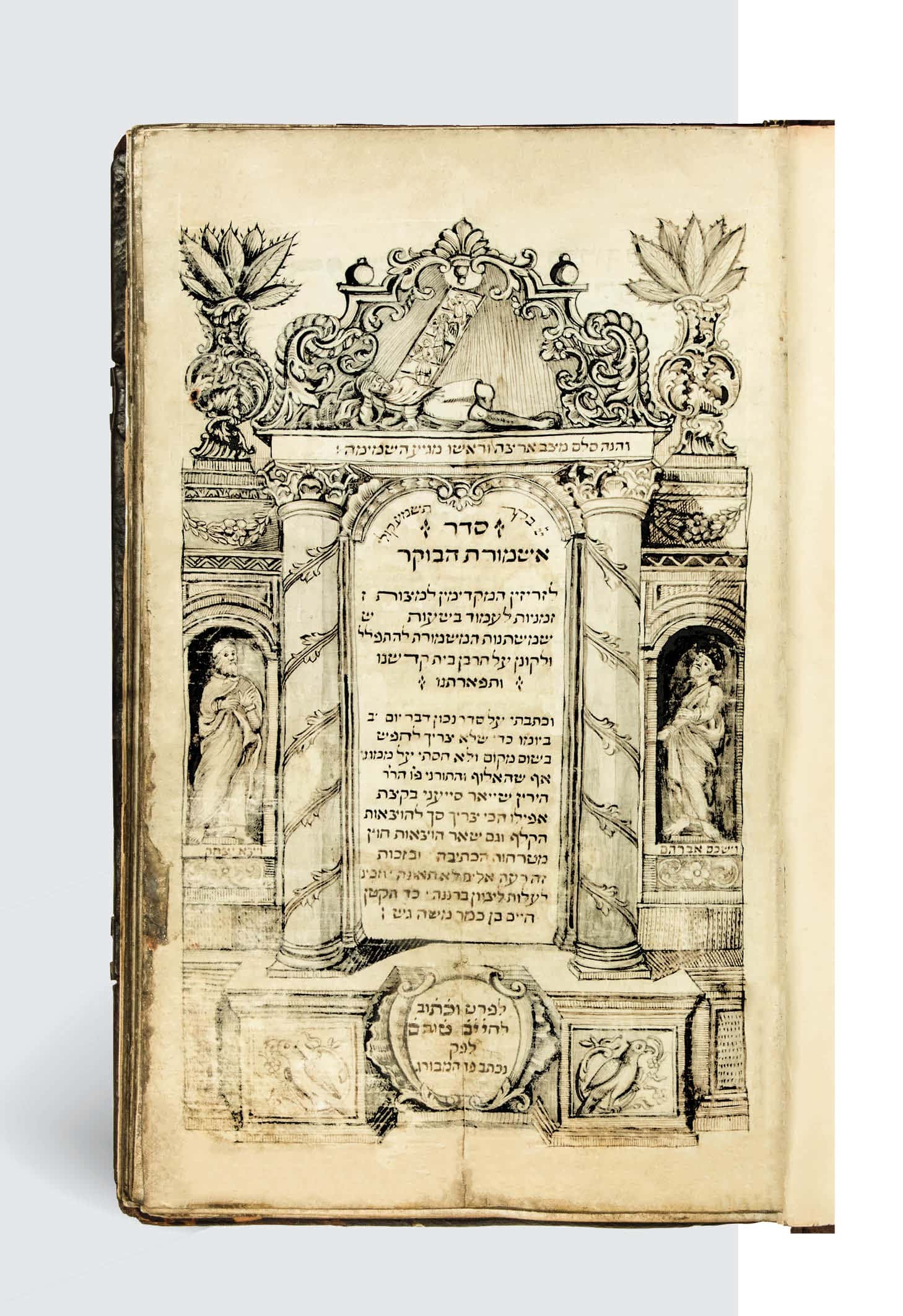
Spectacular illustrated manuscript! Ashmores Haboker Order of Prayers Handwritten on Parchment. Hamburg,
Spectacular illustrated manuscript! Ashmores Haboker Order of Prayers Handwritten on Parchment. Hamburg, 1769 MAGNIFICENT LARGE MANUSCRIPT  written entirely on parchment  in neat calligraphy script , with decorative accents , elaborate initials   Ashmores Haboker Order of Prayer includes Selichos upon the destruction of the Temple which are recited prior to dawn.  The title page is designed with an artistic border topped by vases of flowers and flanked on each side with drawings of birds. It features an impressive, unusual illustration of the 3 forefathers Avraham, Yitzchak and Yaakov. The illustration depicting Avraham is expressed by the caption “And Avraham arose early [in the morning]”. The illustration depicting Yitzchak is expressed by the caption “And Yitzchak went out [to speak in the field]”. The illustration depicting Yaakov’s dream of the ladder is expressed by the caption “And behold a ladder is stationed on the earth”. The present manuscript is the work of the scribe Chaim ben Rabbi Moshe G”S (presumably Goldschmidt) of Hamburg and was inscribed in 1769. see further below for the fascinating survival story of this manuscript  Ashmores Haboker  There was an old custom in Jewish congregations for the righteous to rise in the pre-dawn hours to lsay Selichos  upon the destruction of the Holy Temple. Contents of manuscript: 1. Order of Selichos for the weekday 2. Order of Selichos for days when Tachanun is not recited 3. Order of Yom Kippur Katan, including Minchah 4. Weekday Maariv 5. Prayer for the ill  In the colophon, the author inscribes: “By the hands of the writer, the humble Chaim son of my father Rabbi Moshe G”S shlit”a. Hamburg, 1769. Complete [1], 56, [1] leaf (116 sides). Size: 30x18 cm. Several leaves feature signs of use, stains or faded ink. The bottom lines of leaf 2a are blurred. Wax drippings (see e.g. leaves 23a, 34a). Last leaf reinforced. Original leather-coated wooden binding with remnants of clasps. Back cover fashioned of new leather. Accompanied to this lot is a printed copy of Ashmores Haboker Order of Prayer (Amsterdam, 1713) . Bound in antique leather-bound wooden binding with owner’s name engraved: Yezli ben Rabbi Elkana Levi. The Story of the Miraculous Rescue of the Sacred Manuscript For many years, the manuscript was in the famous library of Rabbi Amram Hisch (1833-1909), Av Beis Din of Hamburg. After his passing, his widow sold a significant portion of his library, including this manuscript, to Rabbi Yosef Tzvi Carlebach (1883-1942), the last Chief Rabbi of Hamburg prior to the Holocaust. Rabbi Yosef Tzvi Carlebach was known and respected by all German Jewry and devoted his life to helping others. After Nazi Germany banned Jewish students from attending German schools together with Aryan German children, Rabbi Carlebach set up a number of schools throughout Germany to educate Jewish children. His schools bore his name and were known as Carlebach-Schulen. As the Nazi persecution increased, evil decrees grew more alarming each day, Rabbi Carlebach feared for the fate of his precious library. He searched a hiding place where he could conceal his library. He hid the books and manuscripts in Krummhübel a small town in the Slisein Giant Mountains (Reisengebirge). With the outbreak of World War Two, Rabbi Carlebach was offered the opportunity to flee Hamburg, yet he valiantly chose to remain behind with his congregation alongside his wife and 4 young children.  In 1941, he published an article in Jewish newspapers expressing his objection to the war. His essay reached the office of the local S.S. commander who sent an order to Berlin to punish the author severely. Due to his venerated status, the Nazis didn’t arrest him in his hometown of Hamburg, yet deceitfully sent him, his wife, and 4 little children, along with several thousand Jews, on a long journey that ended in Riga, Latvia.  He was murdered together with his wife and his 3 little children on March 26, 1942, during the mass shooting of approximately 1600 Jews, mostly older people and children. This went down in history as the Dünamünde Actio. Hashem yikom damam. Of his younger children, the only one to survive was his son Rabbi Shlomo Carlebach (1926-2022).The Young Shlomo Carlebach was able to survive the Holocaust while suffering four years of internment in nine different concentration camps. Eventually, he made his way to the United States where he served as a mashgiach ruchani in Yeshivas Rabbeinu Chaim Berlin. After the war, Rabbi Shlomo went back to Germany in search of his father’s Library, hoping to retrieve his father’s precious sefarim. He was delighted to discover the entire library intact still hidden in the small town Krummhübel. He returned to the United States with the books and manuscripts. They remained in his possession until his passing last year in 2022 יהי זכרו ברוך. The present item is an original manuscript from the library of Rabbi Yosef Tzvi Carlebach and subsequently his son, Rabbi Shlomo Carlebach z”l.  ......................................... ...... . Any inquiries about this lot ? We are available also on WhatsApp >>>

Lot : 9

Handwritten and Illustrated Special Prayer Book for the Chazzan. Hamburg, 1829 Handwritten
Handwritten and Illustrated Special Prayer Book for the Chazzan. Hamburg, 1829 Handwritten manuscript listing special prayers, and various readings used particularly by chazzanim.  created for the chazzanim at the Ezras Achim congregation in the city of Hamburg, 1829. The notebook is graced with an illustrated title page in colorful watercolor depicting the images of Moshe, Aharon and two lions. Includes colorful initials, some of the initials were beautifully decorated The first letter of Birkas Hachodesh is adorned with a frame of leaves in red and green. Title page bears the title “Seder Amiros Hachazzan” and then in the center, “This was made in the year 1829,” and “Made by Elchanan Ben Simchah zt”l in Hamburg” in the margin. Includes Lecha Dodi, Mizmor Shir L’yom Hashabbos, brachos for the Haftarahs, Yekum Purkan, Hanosein Teshua L’melachim, Birkas Hachodesh, Yizkor, brachos for Megillah, and  different Mi-Shebeirachs. Pages 23-24 has a Yizkor list of members who have passed on. Features, rare uniquely designed paper windows to keep track of promised donations during mi’ sheberach upon receiving an aliya on Shabbos or yom tov. Appears right after the Mi-Shebeirachs’ on page 22. Hamburg, 1820. 25 leaves. Page Size: 26x22 cm. Stains and signs of use. Minor tear with intact text on the first page. Worn original binding with no spine, with green leather sticker stating, “Member of Ezras Achim 1829”. The manuscript includes additional useful items to aid chazzanim such as a double-sided copy of the Kel Maleh Rachamim, recited in honor of Jews who died sanctifying Hashem’s name handwritten on parchment , four different versions of Yizkor in Yiddish, and five pages of a calendar with molados for the years 1851-1890. (Provenance: Rabbi Shlomo Ben Rabbi Yosef Tzvi Carlbach; Av Beis Din Hamburg, Germany-Lakewood) ................................................ Any inquiries about this lot ? We are available also on WhatsApp >>>

Lot : 10

Shir Hashirim and Pirkei Avos. Amsterdam, 1766 Beautiful Copy! for  Murano  Jews 
Shir Hashirim and Pirkei Avos. Amsterdam, 1766 Beautiful Copy! for  Murano  Jews  Shir Hashirim with Ladino translation in the Latin alphabet, and Pirkei Avos with Spanish translation by Yitzchak ben Eliyahu Hakohen Belinfante.  Paraphrasis Caldayca en los Cantares de Selomoh Con el texto Hebraico, y Ladino; traduzido en lengua Espanola. Como tambien los Apophthegmas de Aboth, o Perakim... Corregido de los errores thypographicos, por R. Ishac de Eliau Acohen Belinfante The title page says that Pirkei Avos was translated so it would be recited on Shabbos between Pesach and Shavuos. This copy also includes a Spanish translation of the Aramaic translation (targum) of Shir HaShirim. The translation is done verse by verse and Mishnah by Mishnah. Amsterdam, 1766. Johan Janson Printing. 112, 109-144 leaves. Good condition. Antique leather binding with gold embellishments. Defects on spine. Provenance: William L. Gross Collection Item description from the 'William L. Gross Collection' ................................................ Any inquiries about this lot ? We are available also on WhatsApp >>>

Lot : 11

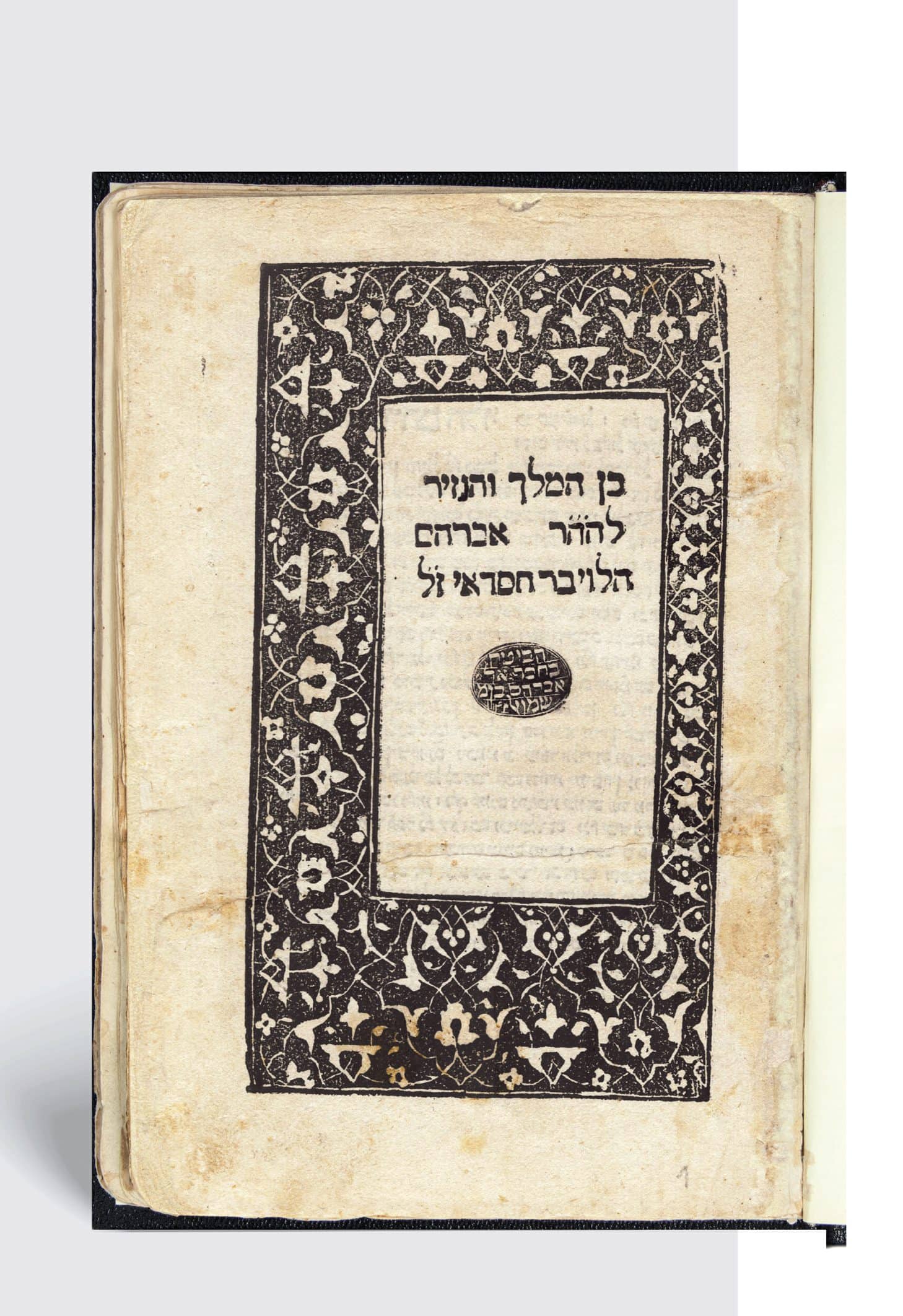
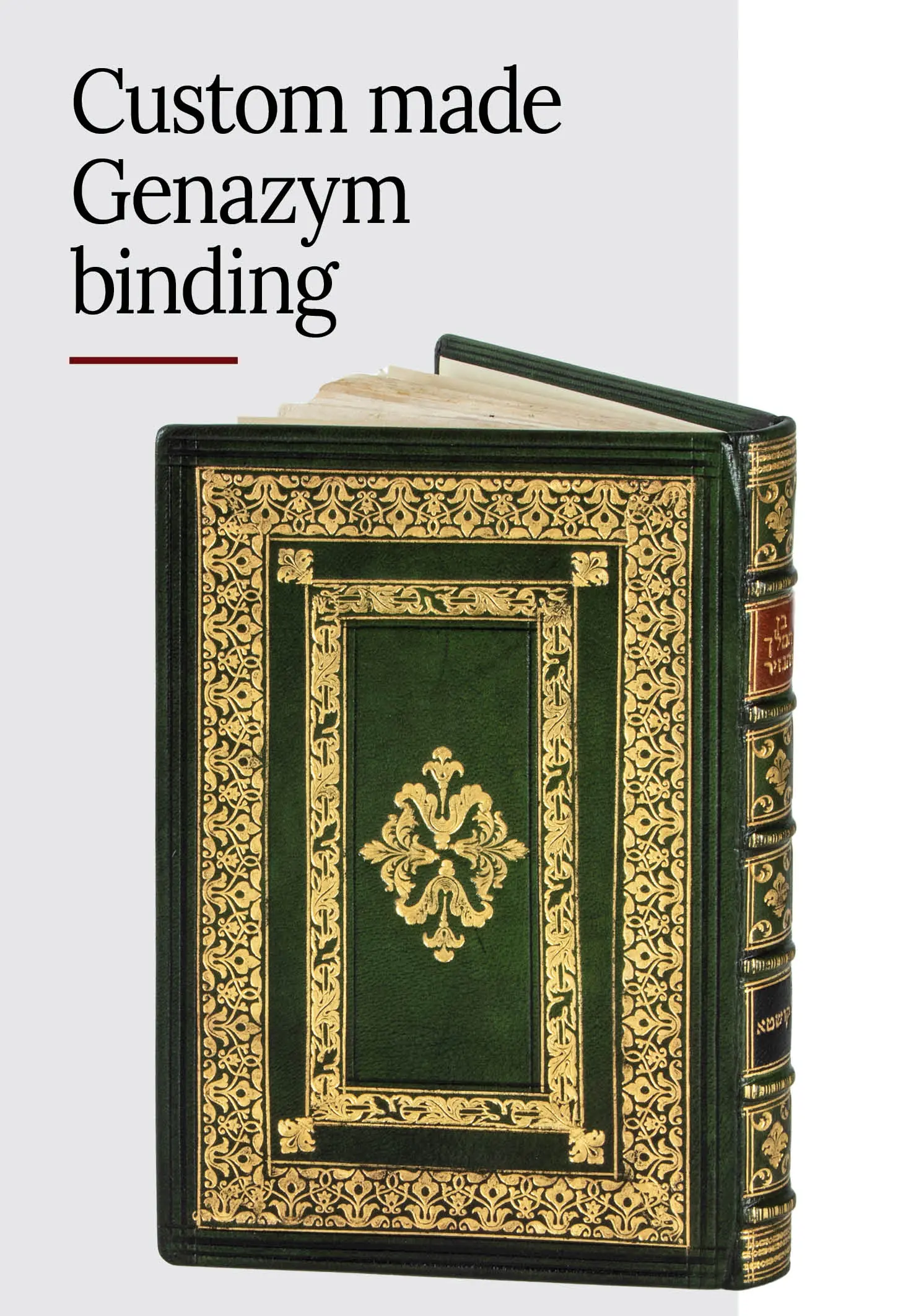
 Ben Hamelech V’hanazir. First Edition. Constantinople, 1518 Mussar sefer from the Time
 Ben Hamelech V’hanazir. First Edition. Constantinople, 1518 Mussar sefer from the Time of the Rishonim Rare find! Stories and parables conveying lessons of wisdom and Mussar presented in the form of a conversation between a king who is immersed in vanities and a nazir who abstains from all pleasures of the world. This book is an exceedingly rare and valuable find. The Jerusalem National Library has only a defective copy  Ben Hamelech V’hanazir is a timeless treasure of Mussar and Philosophy  that was adapted into lashon hakodesh by Rabbi Avraham Halevi Chasdai in the 12th century,    and was  enthusiastically received by Jews throughout the generations . Gedolay  Yisrael , Rishonim and Achronim such as the Meiri, Vilna Gaon and Chassidic masters studied and quoted  from Rabbi Avraham Chasdai’s words of wisdom. since its  first printed in Constantinople 1518 it was reprinted in dozens of editions. The printing year and place appear in the colophon: “The work was completed, a beautiful, heavenly work, pure and refined seven times – Ben Hamelech V’hanazir – and it was completed on the second day of the month of Nissan in the year “You are blessed” (1518) in the great city of Constantinople, which is under the kingdom of our master and king His Highness Sultan Salim, may his kingdom endure in his days, and in our days may Judah and Israel be redeemed and dwell in peace and fear of G-d.” Constantinople, 1518. First edition. [56] leaves.  Title page with decorative border. Yaari, Constantinople #57 What is a Kshta Reish? ............................................... . Any inquiries about this lot ? We are available also on WhatsApp >>>

Lot : 12

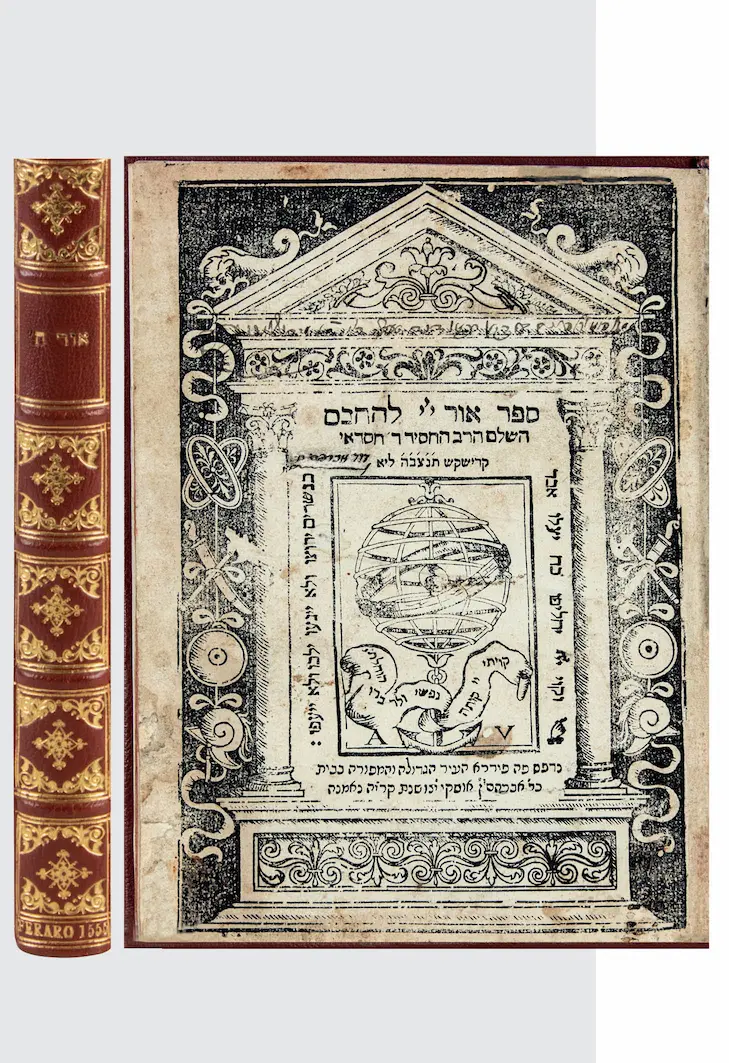
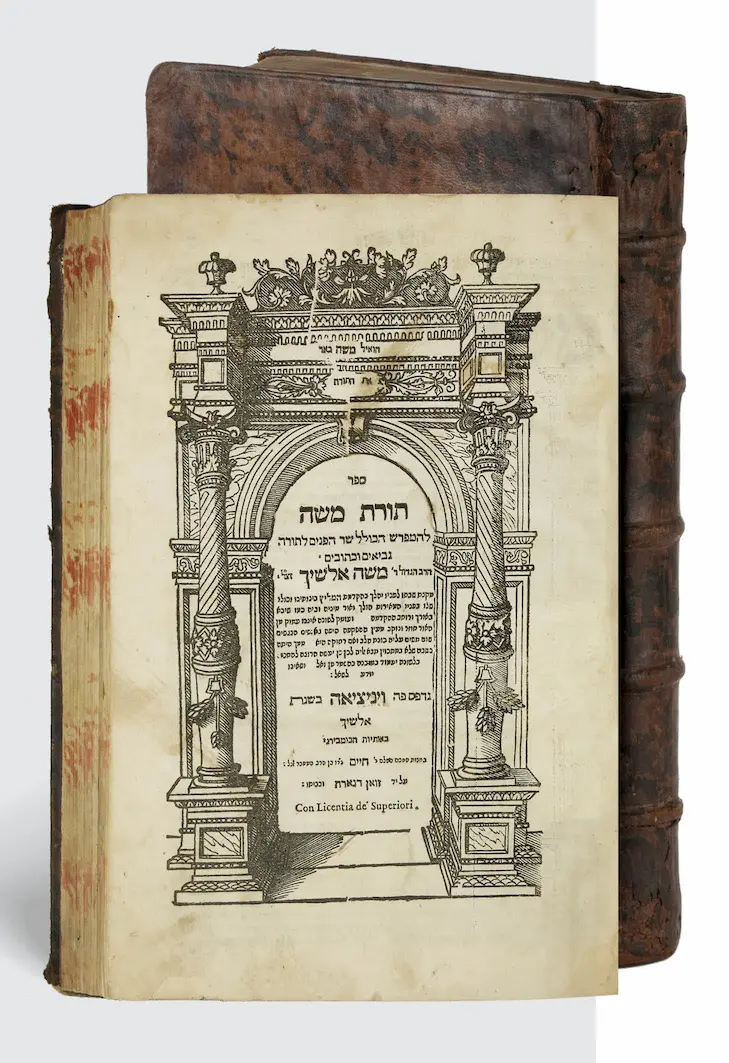
Ohr Hashem by Rabbi Chasdai Crescas. First Edition. Ferrara, 1555 This sefer
Ohr Hashem by Rabbi Chasdai Crescas. First Edition. Ferrara, 1555 This sefer by Rabbi Chasdai Crescas presents fundaments of religion and faith. and considered the First Sefer to reject Aristotle philosophy with  philosophical arguments Rabbi Chasdai Crescas (circa 1340-1410) was born in Barcelona, Spain and was a disciple of the Ran, close friend of the Rivash, and spiritual master of Rabbi Yosef Albo who cited Rabbi Chasdai’s teachings in his Sefer Ikrim. In 1372, Rabbi Chasdai was arrested in Barcelona together with the Ran and Rivash, and he lost his only son in the Massacre of 1391 when Catholic mobs assaulted and murdered Spanish Jews. He passed away circa 1410 at the age of 70 in Saragossa. Rabbi Chasdai was involved in defending the Jewish communities in the Christian-Jewish debates, which was the source of his  sefer Bitul Ikrei HaNotzrim . In this sefer, he contests Greek philosophy, and specifically the theories of Aristotle. Gedolei Yisrael who lived in the era of the Spanish Expulsion were effusive in their praises of his works. Rabbi Yaakov ben Chaviv writes in his sefer Ein Yaakov: “Pleasant words, sweeter than honey, are written in the sefer Ohr Hashem compiled by Rabbi Chasdai” (Ein Yaakov, Megillah 3a). Rabbi Yosef Yaabetz in his sefer Ohr Hachaim Ch. 12 likewise inscribed, “Rabbi Chasdai has surpassed all the philosophers of his era in his intellect, and even the scholars of Edom and Yishmael, ...... The Name of Hashem was sanctified by his hand, and many noblemen from the kingdom have converted to Judaism in their hearts… And he authored a sefer called Ohr Hashem.” Ferrara, 1555. First edition. [132] leaves. Page size: 19.5 cm. Good condition, small tear on left corner of title page, margin of leaf 2 and on last leaf. Title page with decorative border, printer’s emblem from Avraham ben Oshaki is printed on the title page and on the last leaf. Attractive new leather binding. ............................................... . Any inquiries about this lot ? We are available also on WhatsApp >>>
Lot : 13

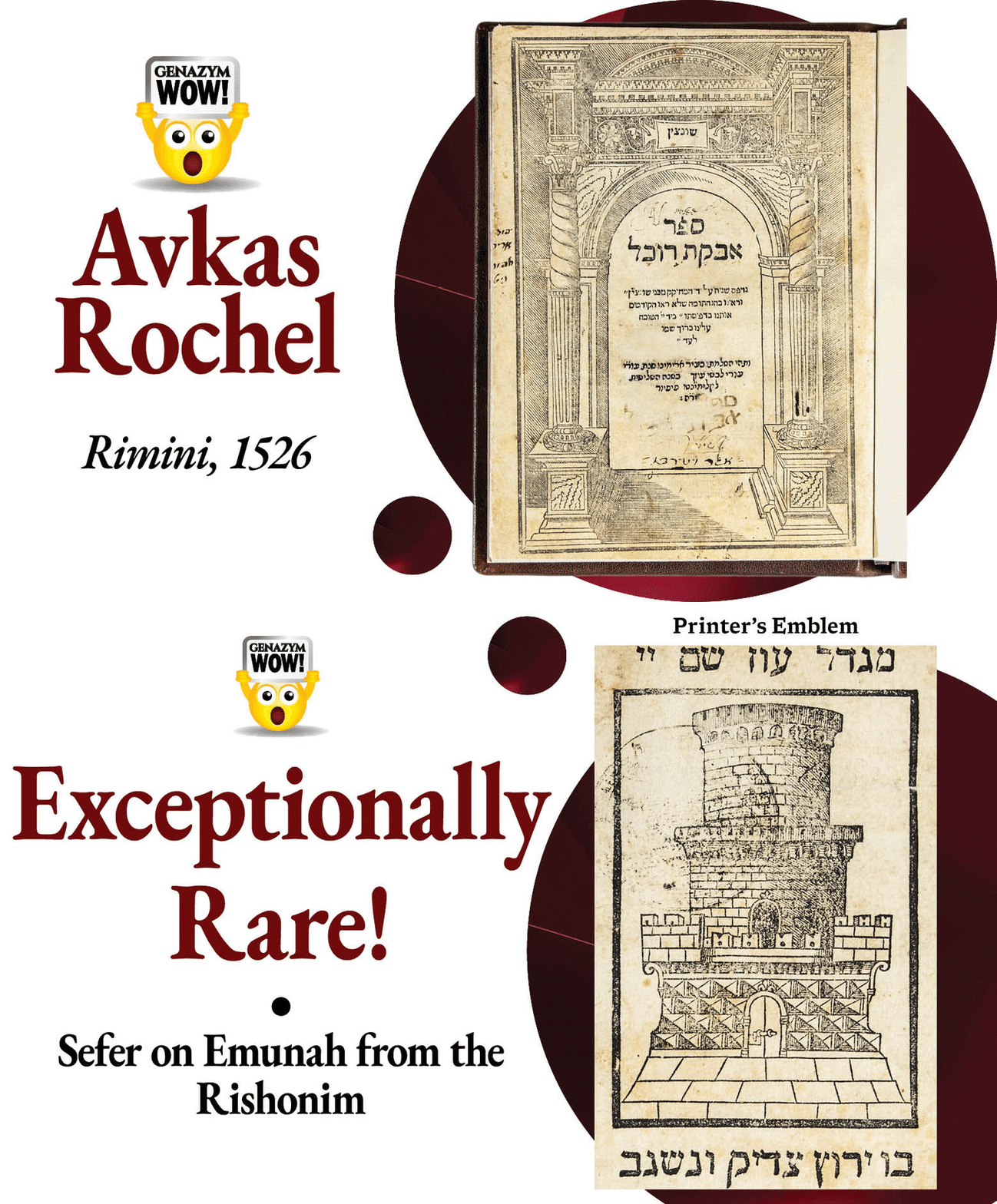
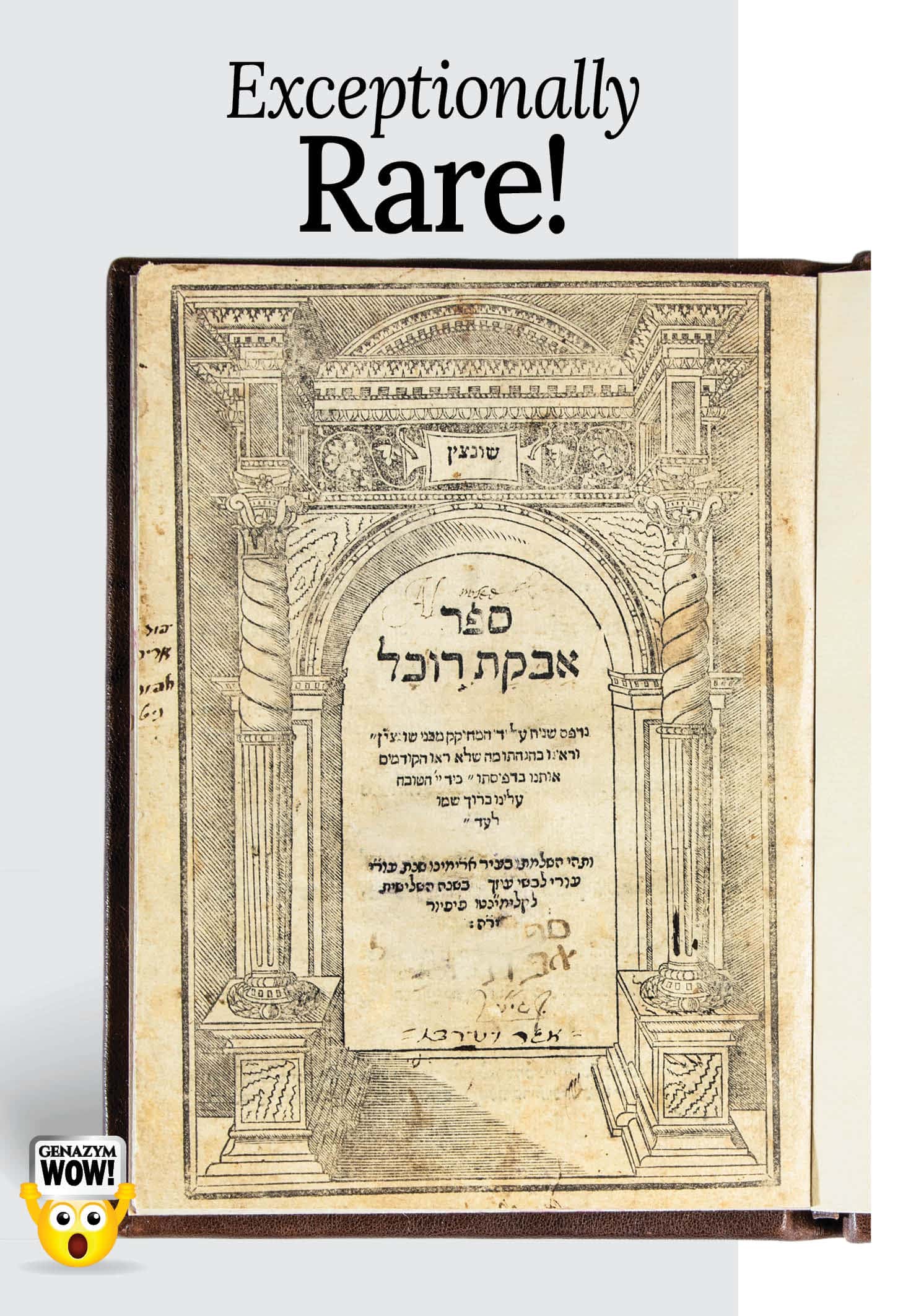
Exceptionally Rare! Avkas Rochel. Rimini, 1526 Wondrous lessons on Emunah and Geulah
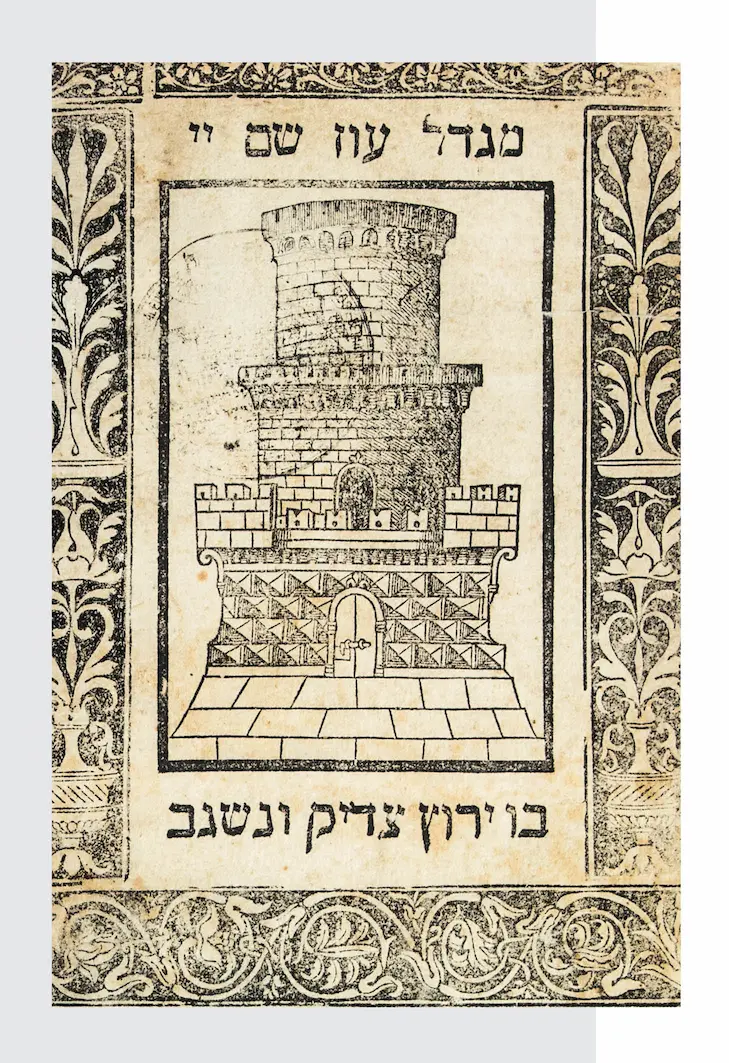
Exceptionally Rare! Avkas Rochel. Rimini, 1526 Wondrous lessons on Emunah and Geulah discusses topics of the birth pangs of Mashiach, the war of Gog U’Magog, future redemption, the eternity of the soul, Gan Eden, Gehinnom, the World To Come, mans creation, resurrection of the dead and words of mussar and comfort by Rabbi Machir ben Rabbi Yitzchak Sar Chessed. Rabbi Machir ben Rabbi Yitzchak Sar Chessed’s family traces its lineage back to the Kingdom of Dovid, and the father Rabbi Yitzchak Sar Chessed was among those expelled from France in1306. The author’s name does not appear in the sefer but Sefer hakabbalah attributes Avkas Rochel to Rabbi Machir (see Seder Hachachamim V’Koros Hayamim, Oxford, 1888, p. 105). The Rema’s glosses on Sefer Yuchsin indicate that the author lived in the times of Rabbi Yehuda ben HaRosh, during the late 13th century and early 14th century. Avkas Rochel was printed by the famous Jewish printer Gershom Soncino whose printer’s emblem of a fortress surrounded by verses from the Scriptures appears upon the entire last page. Soncino began using this emblem in the Rimini edition. This was the final book printed by the Soncino family in Italy. In 1528, Soncino repatriated to Turkey. Printer’s Emblem A printer’s emblem, also referred to as a mark, device, emblem or insignia is a symbol used as a trademark by early printers starting in the 15th century in order to clearly assign the book to the press. The practice came into effect in the early days of book printing. A complete study of Hebrew printers’ emblem was published by the famed Jewish bibliographer Avraham Yaari. This sefer was originally printed in Constantinople, 1516, but it was arranged differently in this edition with three volumes instead of six and edited precisely. It has since always been printed in this format. Very rare copy. No copy in the Jerusalem National Library. Rimini, 1526. Gershom Soncino Press. [18] leaves. Page size: Approximately 19 cm. New leather binding. Several stains and slight professional restoration of several page margins. Owners’ signatures in Italian: Asher Vitirbo (Paris rabbi);  For further description of content, see Ben Yaakov p. 6 #123 ................................................ Any inquiries about this lot ? We are available also on WhatsApp >>>

Lot : 14

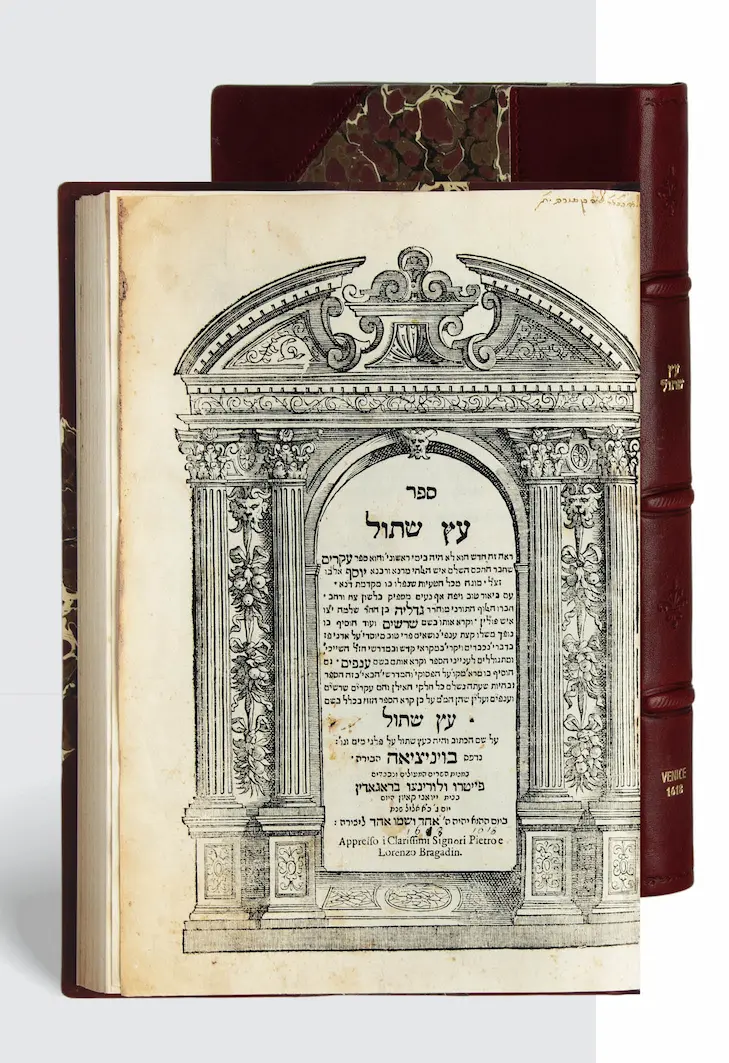
Foundational Sefer on Emunah. Sefer Ha’ikarim with Eitz Shasul Commentary. Venice, 1618
Foundational Sefer on Emunah. Sefer Ha’ikarim with Eitz Shasul Commentary. Venice, 1618 Includes rare additional leaves. The Foundational Principles of Judaism by Rabbi Yosef Albo with the commentary of Rabbi Gedalyah Lipshitz’s Eitz Shasul. Rabbi Albo bases the Jewish belief on three principles of faith: The existence of G-d, the fact that Torah is from Heaven, and the concept of reward and punishment. Eitz Shasul is the primary commentary on Sefer Ikarim. Most known copies include just 144 leaves while this edition has 146. The last two leaves include the post-printing writings of Rabbi Gedalyah which were added to just a few copies. Rabbi Yosef Albo (circa 1380-1444) from spain was a  disciple of Rabbi Chasdai Crescas, author of Ohr Hashem and disciple of the Ran. In his sefer, Rabbi Albo bases the principles of Judaism on three beliefs (as opposed to the Rambam’s Thirteen Principles of Faith): The existence of Hashem, Torah from Heaven, and ‘reward and punishment. The sefer was written in response to the Spanish pogroms of 1391, when Jews were forcibly converted to Christianity. Here the author attempts to strengthen their emunah. Rabbi Gedalyah Lipshitz was a relative of the Maharam of Lublin. At this time, he was in Venice overseeing the publishing of the Maharam’s chiddushim on Shas, as well as the sefer of his teshuvos. He moved to Eretz Yisrael and was later dispatched as a Rabbinical emissary by the sages of Yerushalayim to raise money for the Yishuv (see Shluchei Eretz Yisrael p. 268). Includes very important approbations by the Maharshah, Maharam of Lublin, Shlah Hakadosh and Kli Yakar. Venice, 1618. First edition with commentary of Eitz Shasul. 146 leaves. Page size: 28.5 cm.  Minor stains. Light restoration to margins of title page and last leaf. Beautiful new half leather binding. Title page lists ancient owners’ signatures in German “La’Hashem ha’aretz u’meloah. Yosef Yozvel Sgan Leviim of Furth” (Rabbi Yosef Yozvel published the Alshich’s Maros Hatzovos, Offenbach, 1719) Hakatan Tzvi Hersh Warrendorfer of Zell, 1764. ................................................ Any inquiries about this lot ? We are available also on WhatsApp >>>

Lot : 15

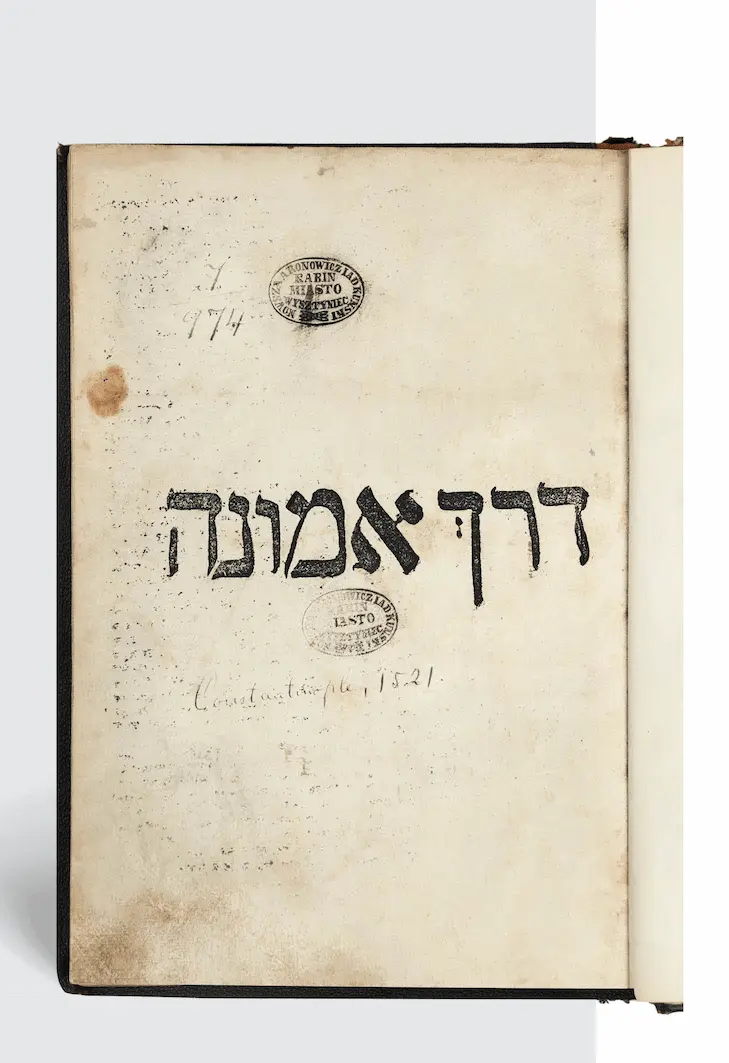
Derech Emunah. First Edition Constantiople, 1522 Discussions  on topics of emunah, and
Derech Emunah. First Edition Constantiople, 1522 Discussions  on topics of emunah, and commentareis  on Agaddos Chazal by Rabbi Avraham Bibago. Chacham Rabbi Avraham Bibago was one of the great Spanish rabbis during the period of the Expulsion and thereafter. He served as Rosh Yeshivah in Saragossa in northeast Spain, and he was renowned as an exceptional orator whose fiery lectures drew many from his generation back to Torah and mitzvos. He debated religious polemics with Christian scholars, defending the Jewish faith time and again. Rabbi Avraham once appeared in a public debate with a Christian scholar before King John II of Aragon  rabbis and scholars during the era of the Spanish Expulsion and ensuing period were influenced by the writings and sefer of Rabbi Avraham Bibago and praised it. The Yashar of Candia commends this sefer in sefer Metzaref L’Chochmah (Ch. 6) and writes that it is the source of many opinions of the author of the Sefer Ha’akeidah. Rabbi Yitzchak Abarbanel was also greatly influenced by Rabbi Avraham Bibago’s writings and cites it in his sefer Rosh Emunah. Rabbi Shlomo Elkabetz, author of Lecha Dodi, likewise mentions him in his writings. .  Constantiople, 1522. First edition. 102 leaves. Size: Condition: Colophon reads: “This sefer was completed for print on Cheshvan, 1522”. Bibliography: Yaari, Constantinople 94 What is a Kshta Reish? ............................................... . Any inquiries about this lot ? We are available also on WhatsApp >>>
Lot : 16

Classic !!!!! Reishis Chochmah. First Edition. Venice, 1579 A foundational work of
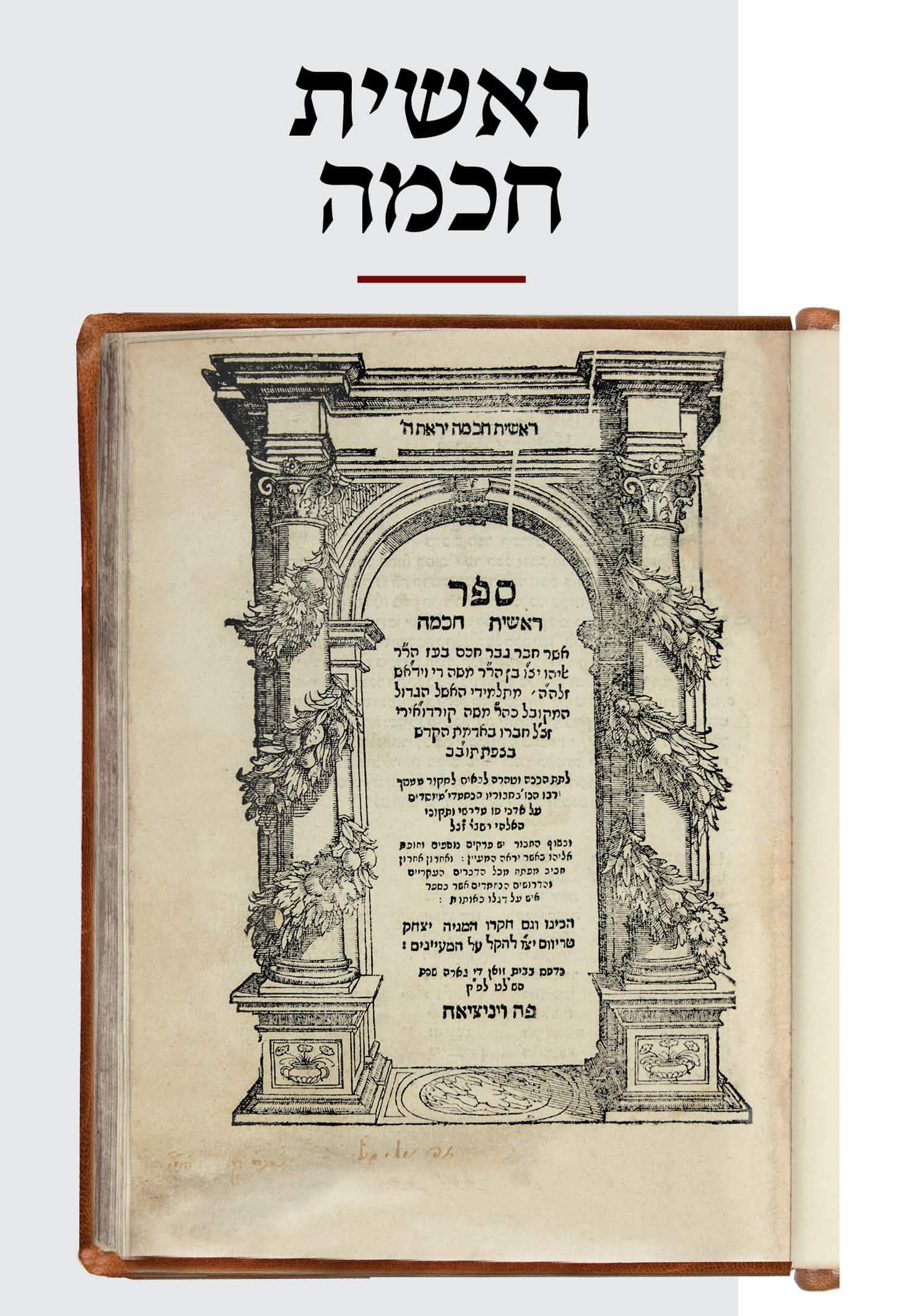
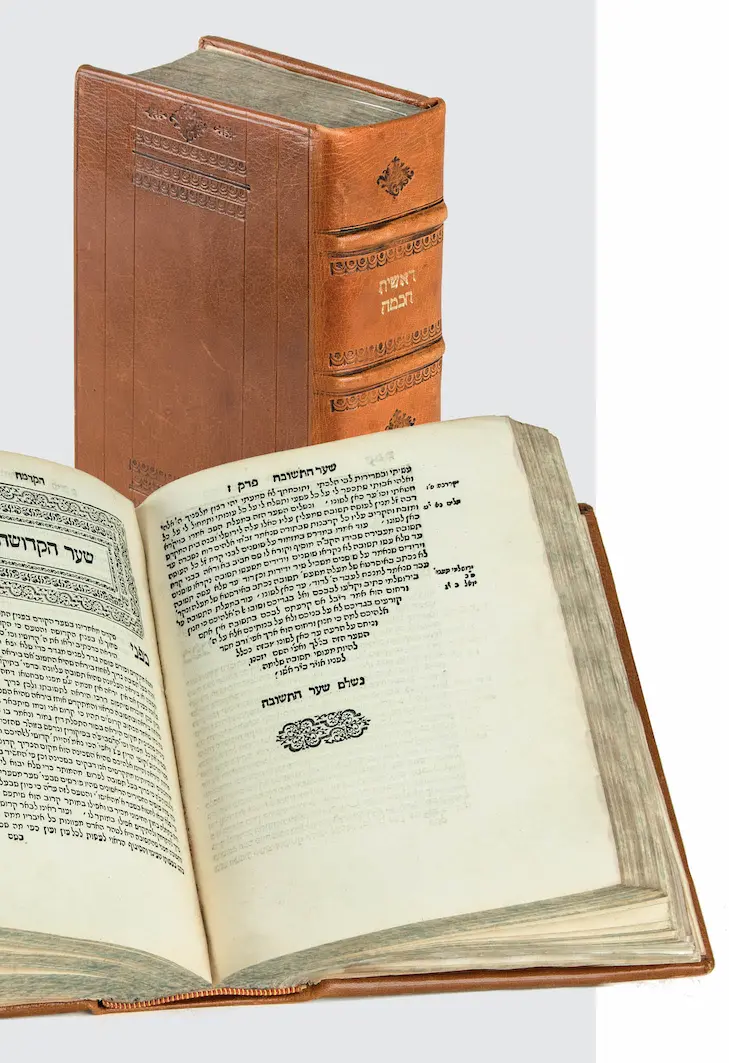
Classic !!!!! Reishis Chochmah. First Edition. Venice, 1579 A foundational work of mussar outlining the path to sanctity and repentance by the saintly kabbalist Rabbi Eliyahu di Vidash, prime disciple of the Ramak. Gedolei Yisrael and tzaddikim throughout the ages emphasized the importance of studying daily sefer Reishis Chochmah, and “fortunate is the man who learns this every day and establishes a regular study session in it, as a spark of sanctity and purity will surely shine in him” (Shem Hagedolim, Ch. Reishis Chochmah). The Admor Rabbi Shmelke of Nikolsburg wrote in the name of his spiritual master the Maggid of Mezritch: “Be sure to learn from sifrei mussar every day, and especially the holy sefer Reishis Chochmah, from which you should not sway” (Toras Hamaggid, p. 1).  Magnificint copy  It is rare to find a first edition copy of Reishis Chochmah in such good condition! The Reishis chochmah contains the --- First Edition of Iggeres HaRamban The world-famous Iggeres HaRamban first appeared in print in Reishis Chochmah, Shaar Ha’Anavah Ch. 6 (leaves 355b-356a). Iggeres HaRamban is a famous letter replete with mussar and inspiration that the Ramban sent from the city of Acco to his son Rabbi Nachman in Catalonia, Spain. The letter focuses primarily on the supreme attribute of humility, which is why the author of Reishis Chochmah included it in his unit on humility in his landmark mussar sefer. Rabbi Shlomo Algazi writes in Meulefes Sappirim (Constantinople, 1640): “He informed his son that on the day he reads this letter, the heavens will answer all that he requests. Those who recite it regularly will surely be spared from all trials and are guaranteed to enter Olam Haba.” The Chida writes in Shem Hagedolim in his chapter on Rabbi Nachman son of the Ramban that mussar giants exhort people to read this letter occasionally. Venice, 1579. First edition. 8, 421, [32] leaves. Page size: 19.2 cm. [32] end leaves include a detailed index by the scholar and proofreader Rabbi Yitzchak Gershon. The margins of the leaves containing the index, were expanded in an artistic restoration work, to fit the size of the book itself. Bound in two parts, in fancy new leather bindings. The index part is bound separately. Complete, impressive copy.  ................................................ Any inquiries about this lot ? We are available also on WhatsApp >>>

Lot : 17

Tapuchei Zahav. Kitzur Sefer Reishis Chochmah. First Edition. Mantua, 1623 Tapuchei Zahav,
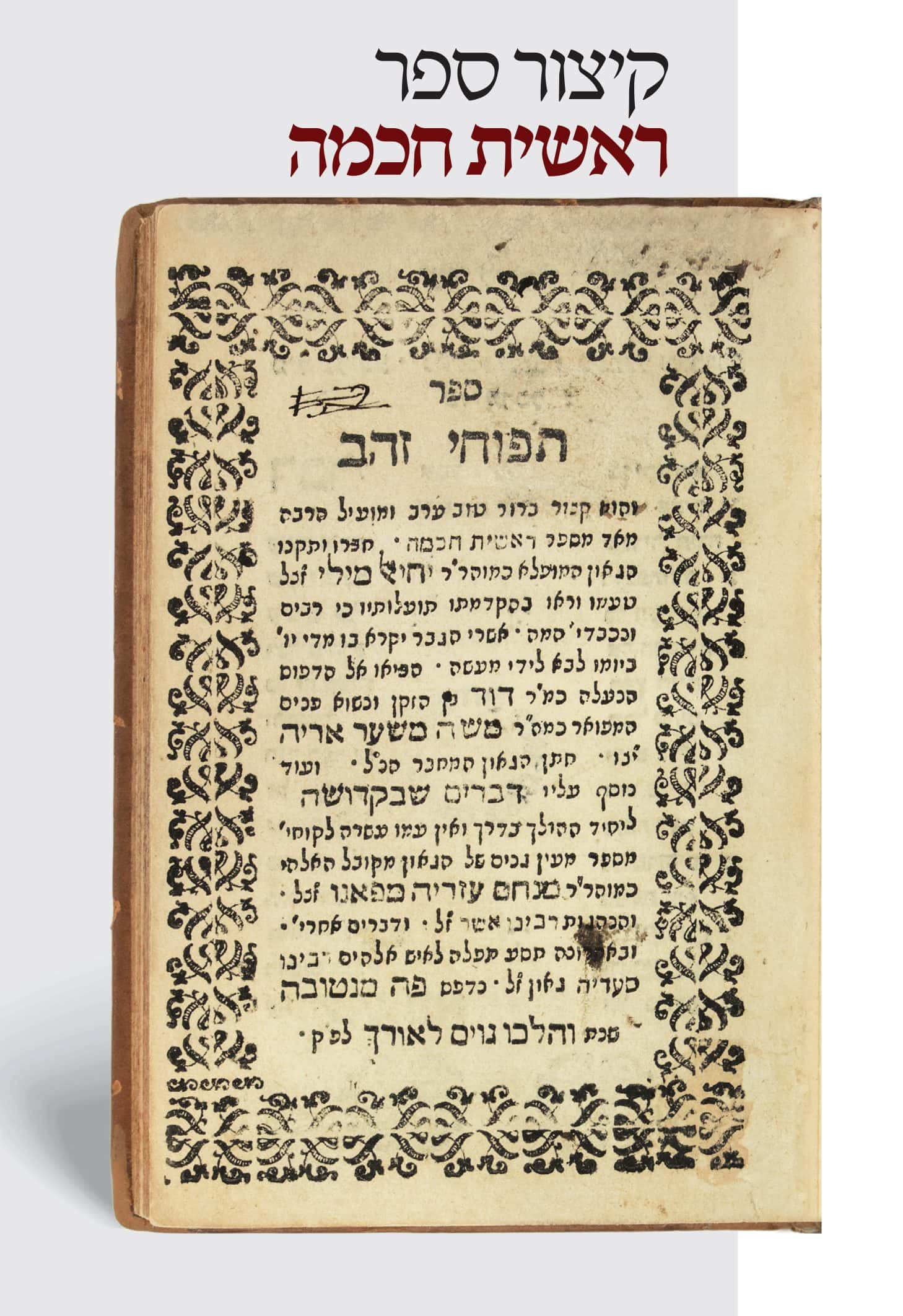
Tapuchei Zahav. Kitzur Sefer Reishis Chochmah. First Edition. Mantua, 1623 Tapuchei Zahav, written by Rabbi Yechiel Mili encompasses an outline and summary of the classic mussar sefer Reishis Chochmah by Rabbi Eliyahu di Vidash.  Along with his summary of Reishis Chochmah, Rabbi Yechiel also presents an anthology of prayers, some of which appear in print for the very first time in this sefer;  lessons by Rabbi Yehuda Hachassid and Rabbi Yosef Gekatillia; Orchos Chaim by the Rosh; the song ‘Bar Yochai’; Tefillas Hashachar by Rabbi Saadia Gaon; and lessons by the Rema of Pano from his manuscript Maayan Ganim; Iggeres HaRamban (second edition); This sefer was printed in a small format, “So every man can carry it with him, and it should comfort him , even  when on a boat or Wagon (Author’s Foreword). Mantua, 1623. First edition. [4], 132 leaves. Small format: Only 13 cm. Good condition with attractive antique leather binding with minor restorations to the binding. ................................................ Any inquiries about this lot ? We are available also on WhatsApp >>>

Lot : 18

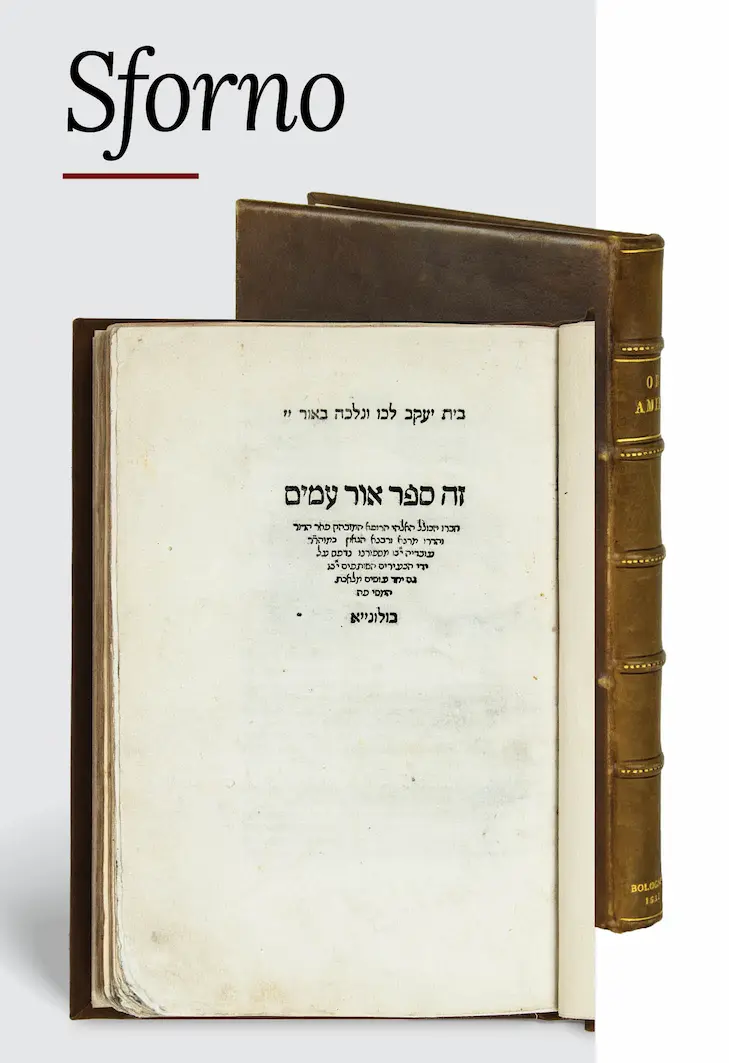
Fundamentals of Faith Ohr Amim by Rabbi Ovadia Sforno. First Edition. Bologna,
Fundamentals of Faith Ohr Amim by Rabbi Ovadia Sforno. First Edition. Bologna, 1537 The Sforno’s composition on faith and philosophy written to refute the teachings of Aristotle, whose philosophies are contrary to Torah and Jewish faith. In his preface, Rabbi Ovadia Sforno inscribes that Aristotle’s philosophical teachings were universally accepted and ingrained into public conscience, and therefore he was authoring this work to prove Aristotle's ideas to be wrong. Rabbi Ovadia Sforno regarded Ohr Amim to be an important work, sparing no effort to publish it and going so far as to edit the printed version himself and create a list of printing errors. He further translated this work into Latin and sent it as a gift to King Henry II of France, who was an avid collector of religious works. Rabbi Ovadia Sforno ( 1478-1550) is one of the illustrious commentators on the Torah and a genius who was versed in both religious and secular wisdoms. His beloved commentary on Torah was universally accepted by all Jewish congregations. He was likewise a famous physician who was termed ‘The Master of Healers’ in his generation. Bologna, 1537. First edition. 64 leaves. Page size: 21 cm. Title page has three miniscule holes. Bottom corners are slightly rounded. Good condition. New leather binding. ................................................ Any inquiries about this lot ? We are available also on WhatsApp >>>

Lot : 19

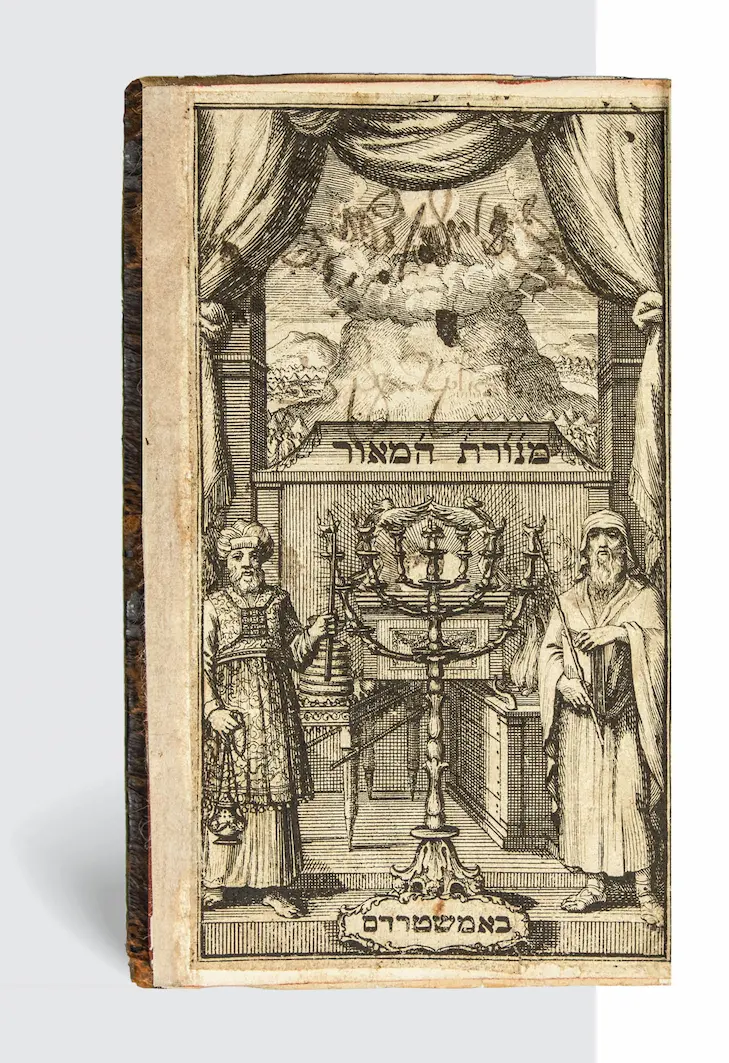
Menoras Hamaor with Nefesh Yehuda Commentary. First Edition. Amsterdam, 1700 Menoras Hamaor
Menoras Hamaor with Nefesh Yehuda Commentary. First Edition. Amsterdam, 1700 Menoras Hamaor by Rabbi Yitzchak Abuhav with the first printed edition of the Nefesh Yehuda commentary by Rabbi Moshe Frankfurter of Amsterdam. Menoras Hamaor is one of the fundamental works of Jewish ethics, and it was enthusiastically received and widely disseminated among Jewish communities around the world. The sefer contains two title pages. The first title page is magnificently illustrated with copperplate engravings that depict the Revelation on Mount Sinai, Moshe holding his staff, and Aharon lighting the menorah. Leaf 4b presents a poem shaped in the form of a menorah, likely an allusion to the title of the sefer. Rabbi Moshe Frankfurter (1672-1762) was a famous dayan in Amsterdam and the great-uncle of the Chasam Sofer of Pressburg. He is famous for Zeh Yenachameinu, a comprehensive work on the Mechilta, Mikra’os Gedolos Kehillas Moshe, and his Ba’er Heitev on Choshen Mishpat. His commentary Nefesh Yehuda, was his very first published work, and it was printed when he was only 28 years old! The first pages of the sefer feature approbations from the Rabbanim of Amsterdam and Rabbi Yosef Shmuel of Cracow, Av Beis Din of Frankfurt am Main and author of Masores HaShas. Amsterdam, 1700. First printing of Nefesh Yehuda. 330 leaves. Page size: 16 cm. Illustrated title page was reinforced at margins. Last page was professionally restored with all text intact. Good condition. Worn antique leather binding; spine engraved with gilded designs. Provenance: William L. Gross Collection Item description from the 'William L. Gross Collection' ............................................... . Any inquiries about this lot ? We are available also on WhatsApp >>>

Lot : 20

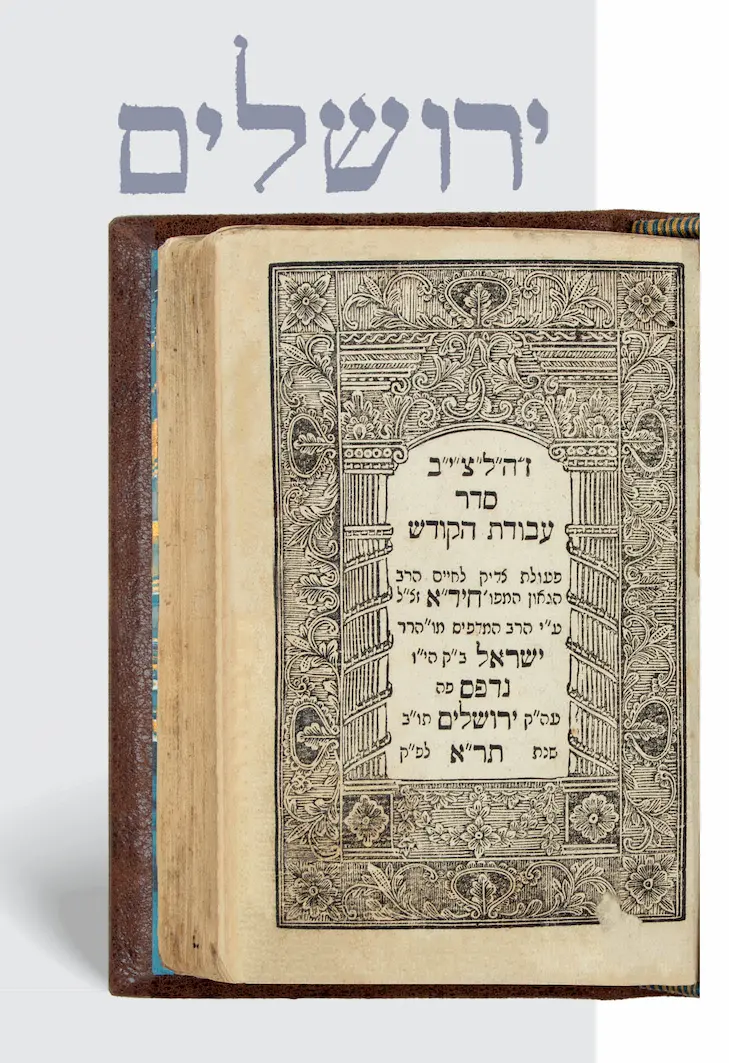
Historic !! First time ever a Sefer Printed in Jerusalem! Avodas Hakodesh
Historic !! First time ever a Sefer Printed in Jerusalem! Avodas Hakodesh by the Chida. Jerusalem, 1841 Sefer Avodas Hakodesh by the Chida, Rabbi Chaim Yosef David Azzulai. This sefer includes seven separate essays on halachah, customs, mussar, teshuvah, prayers and segulos. Theyare titled: Moreh B’etzba, Tziporen Shamir, Kesher Gadol, Kaf Achas, Yosef B’seder, Sonson L’Yair and Shomer Yisrael. This is one of the most important anthologies of the Chida’s sefarim, and many of the prayers instituted into our regular prayers were first written by the Chida in these sefarim. The preface to this anthology features a historical introduction by the first Jerusalem printer Rabbi Yisrael Beck in which he tells of his journey ascending to Eretz Yisroel, the establishment of his press in Tzfas, and its closure in the wake of the Syrian Peasant Revolt. He also recounts his journey to Alexandria to appeal to the authorities regarding the return of stolen Jewish property, the Damascus Affair, and mainly of the reestablishment of his printing house in Jerusalem. Jerusalem, 1841. Yisrael Beck Press. [4] 111 leaves. Page size: 15 cm. Two title pages, with one illustrated with eastern and western motifs. Antique leather binding. Preserved in a new, fabric-coated cardboard case. Good condition. S. Halevi, Sifrei Yerushalayim Harishonim #1. Provenance: William L. Gross Collection Item description from the 'William L. Gross Collection' ............................................ .... Any inquiries about this lot ? We are available also on WhatsApp >>>

Lot : 21

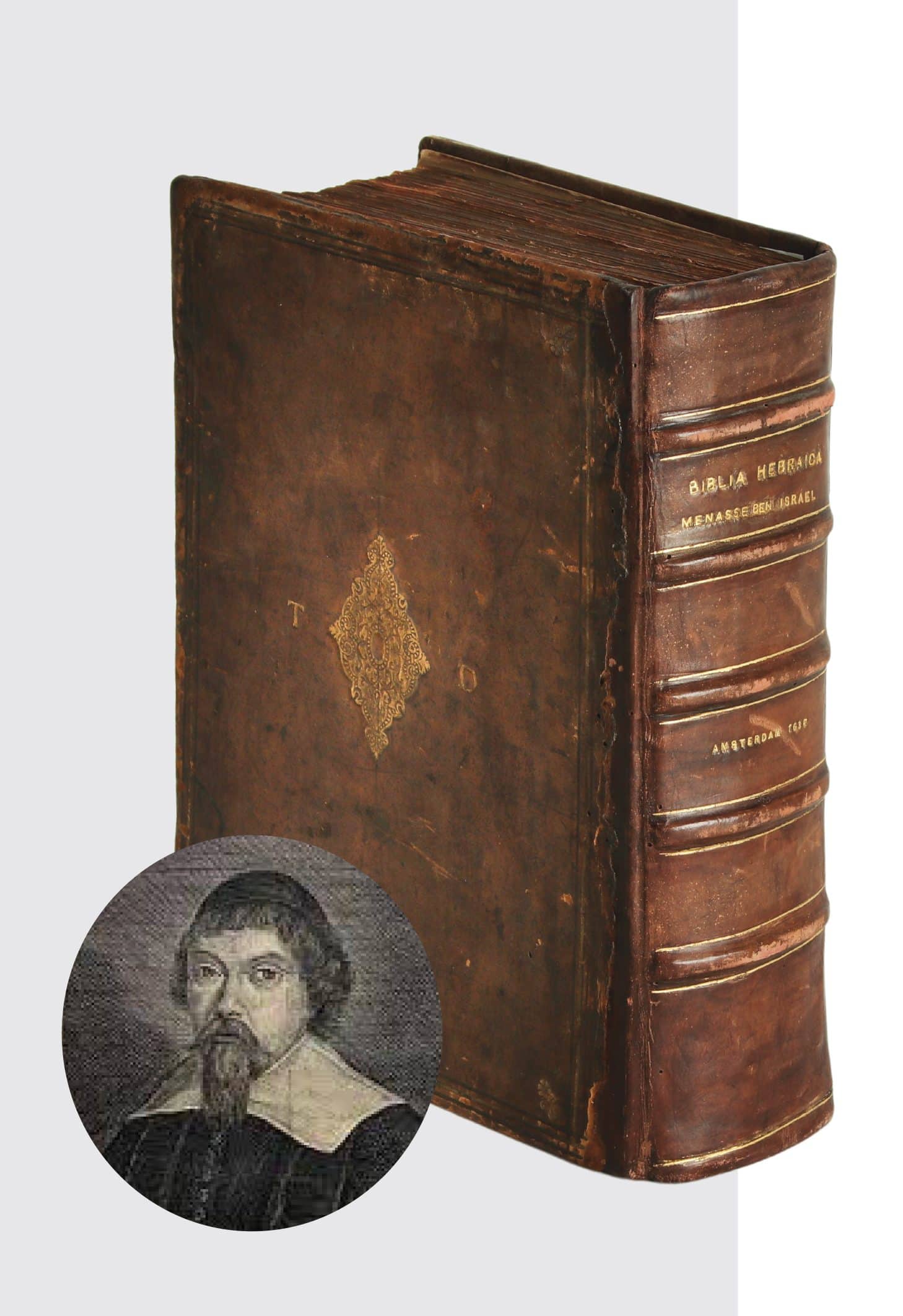
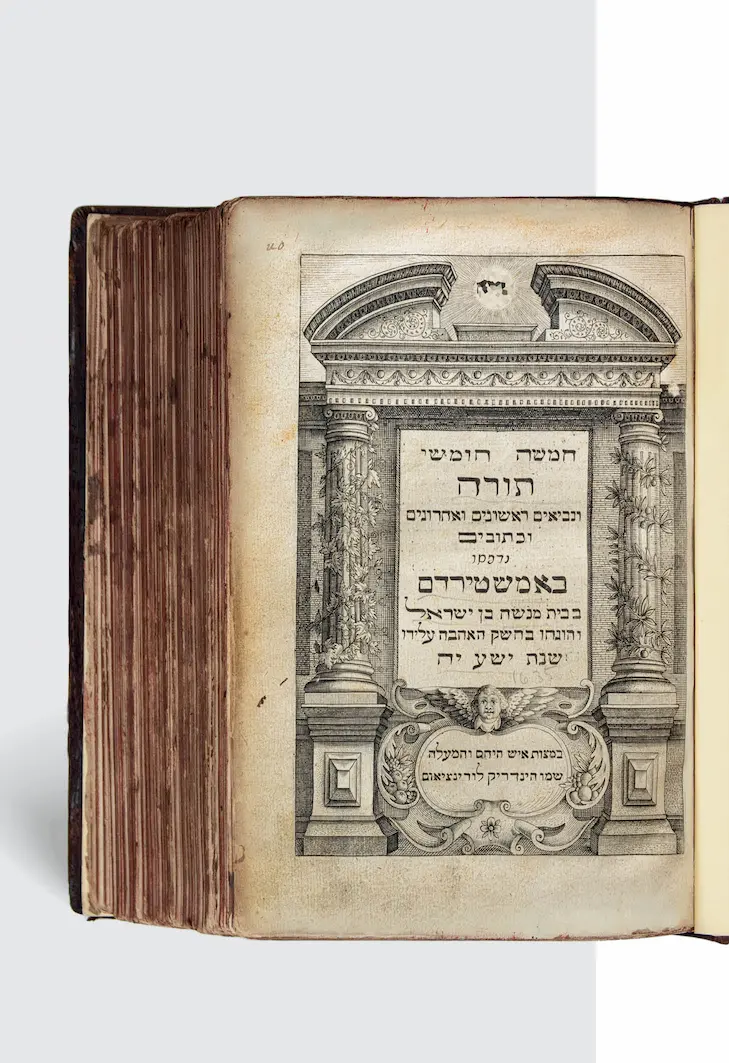
Menashe ben Israel. Tanach. Amsterdam, 1635. Complete, Exquisite Copy! Chamishah Chumshei Torah,
Menashe ben Israel. Tanach. Amsterdam, 1635. Complete, Exquisite Copy! Chamishah Chumshei Torah, Nevi’im and Kesuvim, meticulously edited and proofread by the famed distinguished Rabbi and scholar, Menashe ben Israel. This was one of the first editions of Tanach to be printed in Amsterdam. In his preface, Rabbi Menashe ben Israel attests that he meticulously proofread each word, as well as the nekudos and even the taamim (cantillation marks) of this edition. Beautiful copy, complete, includes the chart listing the “Haftaros According to all Customs” which appears only in some copies of this edition. The printing of this impressive edition of Tanach commenced in 1631 and took a total of four years to complete. Although the printings of all volumes were completed in 1635, on the title pages of the Nach the year 1631 was changed to 1636 by the printer in handwriting. Chacham Rabbi Menashe ben Israel (1604-1658) was one of the great sages of 17th century Europe, a scholar and a statesman. Born in Portugal to a family of anusim, he endeavored greatly to draw the descendants of anusim back to Judaism and public observance of mitzvos. He promoted dialogue between Jews and Christians and sought to explain the tenets of Judaism through an array of books that he authored and published in several languages. In 1627, Rabbi Menashe ben Israel gained fame for opening the first Jewish press in Amsterdam, which would swiftly become the metropolitan center for Jewish book printing. In 1655, he led a delegation to England pleading for the resettlement of Jews in England, which was permitted unofficially  Amsterdam, 1631-1635 . Page size: 22 cm. [1], 369: 124, [1] leaf. Markings of the pesukim with handwritten numbers. In this copy, Kesuvim appears after the Torah. Good condition. Antique leather binding with new spine. Owner’s name engraved in center of binding. T.D. Bibliography: Alfei Menashe #24. Ginzei Yisrael #35. Provenance: William L. Gross collection Item description from the 'William L. Gross Collection' ............................................... . Any inquiries about this lot ? We are available also on WhatsApp >>>

Lot : 22

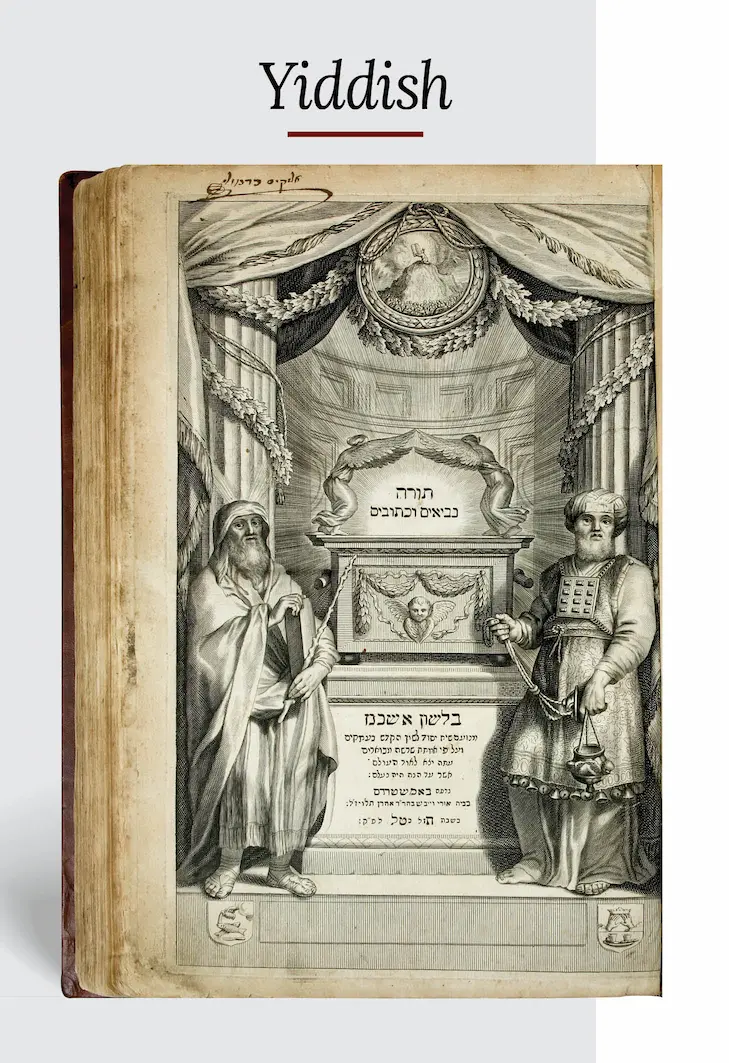
First Tanach Printed in Yiddish. Amsterdam, 1676-1679 Torah, Nevi’im and Kesuvim “translated,
First Tanach Printed in Yiddish. Amsterdam, 1676-1679 Torah, Nevi’im and Kesuvim “translated, elucidated and explained” in Yiddish by Rabbi Yekusiel Blitz. This Tanach, renowned as Tanach Blitz, was the very first Tanach translated into Yiddish. The present item includes a full set complete with all title pages. The first title page is impressively decorated with copperplate illustrations. In his preface, the printer writes that his motive in translating the Tanach into Yiddish was so “Ashkenazic [Jews] should be as well-versed in Tanach as their Sephardic [brethren], who already published several editions of Tanach with translations into their native language, and to ensure that Jews are able to respond to questions and refute the challenges posed by the Christians regarding Tanach.” In addition to this landmark translation, this Blitz Edition of Tanach is also the first containing Toaliyos HaRalbag on Nevi’im and Kesuvim with their Yiddish translation. The sefer opens with approbations by Rabbanim of the Vaad Arba Aratzos and rabbi's of Amsterdam that were written between the years 1671-1675 along with the  Authorization and Privilegium from the Polish King both in Latin and Yiddish. During that era, two publishers simultaneously commenced the monumental task of translating Tanach into Yiddish. The first project was completed by Rabbi Yekusiel Blitz, and the second by Rabbi Yosef Yozelen Weitzenhausen. The printing of the translations stirred a public conflict between the two prominent Dutch printers Atias and Halevi, with each accusing the other of Hasagas gevul, infringement on the others earned rights and is therefore forbidden to print his edition for it deprives the other of his income. The case reached the Dutch authorities, Vaad Arba Aratzos and even the King of Poland was asked to intervene and restore peace. (See Haberman, Toldot Hamadpisim HaIvriim p. 300)  Five title pages, the first general title page impressively illustrated. Separate title pages for Torah, Nevi’im Rishonim, Nevi’im Achronim and Kesuvim. Title pages are separately dated 1676, 1678 and 1679. Amsterdam, 1676-1679. Uri and Weibush Halevi Press. [7], 63, [1], 64-857: 18 leaves. 32 cm. The page featuring the license awarded by the King of Poland in Latin, is shorter and narrower. Minor tear on margin of first title page and slight signs of use in margins. New leather binding. ............................................... . Any inquiries about this lot ? We are available also on WhatsApp >>>
Lot : 23

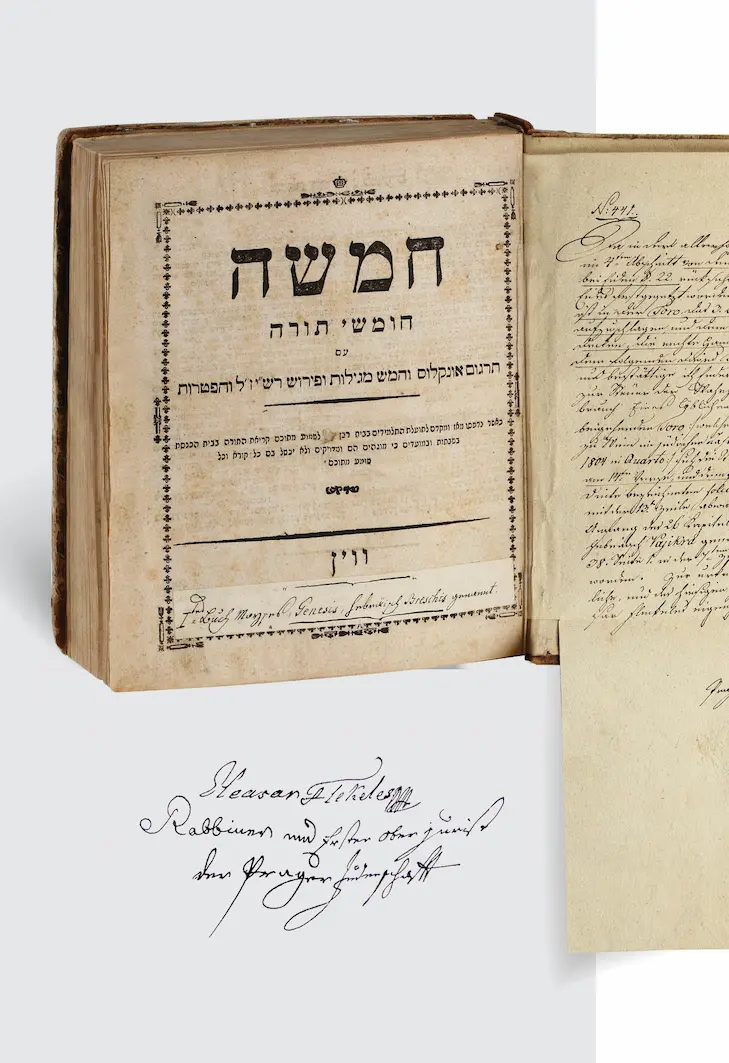
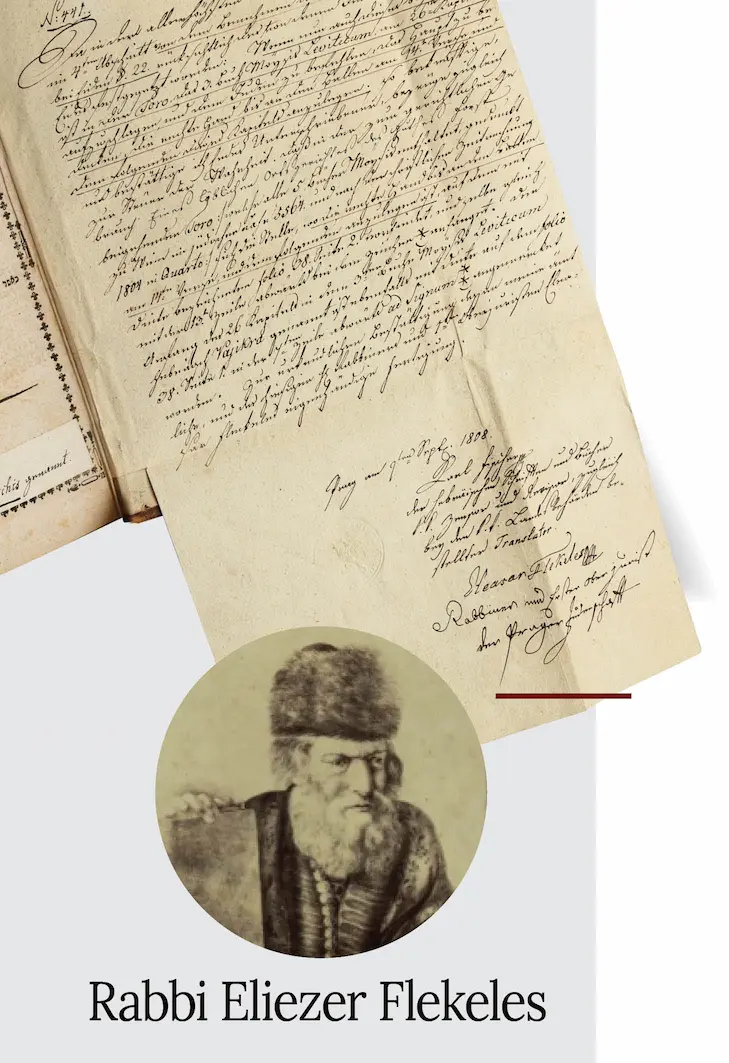
The Court of Prague's Chumash On Which the Jews  Stated Their Oaths 
The Court of Prague's Chumash On Which the Jews  Stated Their Oaths  Chamishah Chumshei Torah with Authorization by Rabbi Elazar Flekles. Vienna , 1808 Extremely rare historical chumash. On this Chumash, Jewish witnesses in the Czech Court of Law would place their hands and swear their statements to be true.  Four official government documents are attached to this Chumash, two of them were written and signed by Karl Fisher,   chief censor and reviewer of Jewish printed works for Emperor Franz . Fisher affirms that this book is the “Bible of the Jews” and worthy of being used in a court of law. Another document with the signature of Rabbi Elazar Flekeles, Av Beis Din of Prague, in German. In which he confirms the book's authenticity to be used in court. In the document he is described as “Chief Rabbi and legalist of Jews in Prague”. Rabbi Elazar Flekeles (1754-1826) was the Raavad of Prague and author of Shu”t Teshuvah Me’Ahavah. In the course of his Rabbinical duties, he corresponded with Sir Karl Fisher regarding the issue of swearing over a bible in a secular court (see Shu”t Teshuvah Me’Ahavah Vol. 1 Ch. 26). Vienna, 1808. Chamishah Chumshei Torah with Targum Onkelus and Rashi’s commentary; Chamesh Megillos and Haftaros. 74; 72; 53; 62; 70 leaves. Several miniscule holes on margins. Original binding. Fascinating historic item! Provenance: William L. Gross Collection) ............................................... . Any inquiries about this lot ? We are available also on WhatsApp >>>

Lot : 24

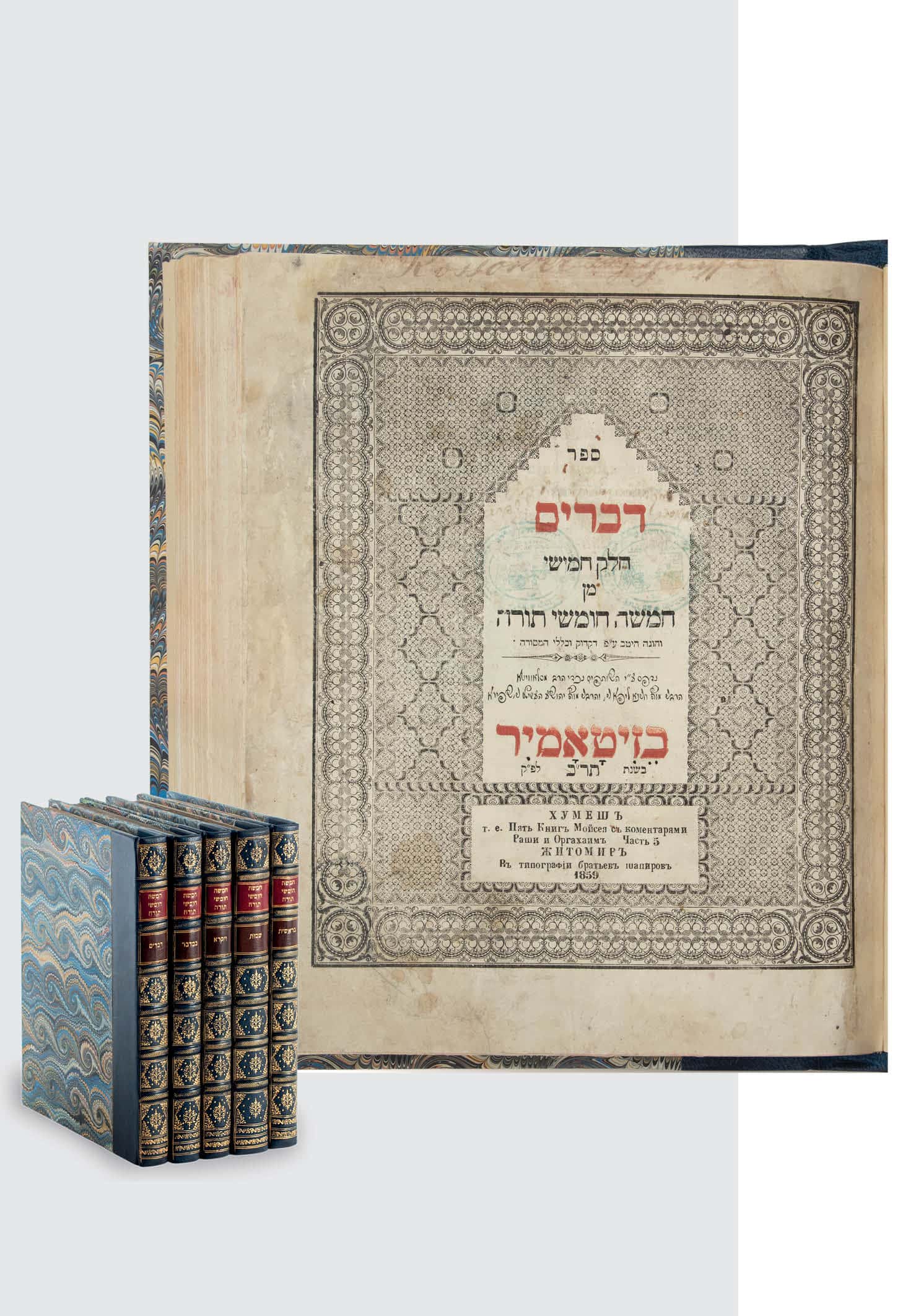
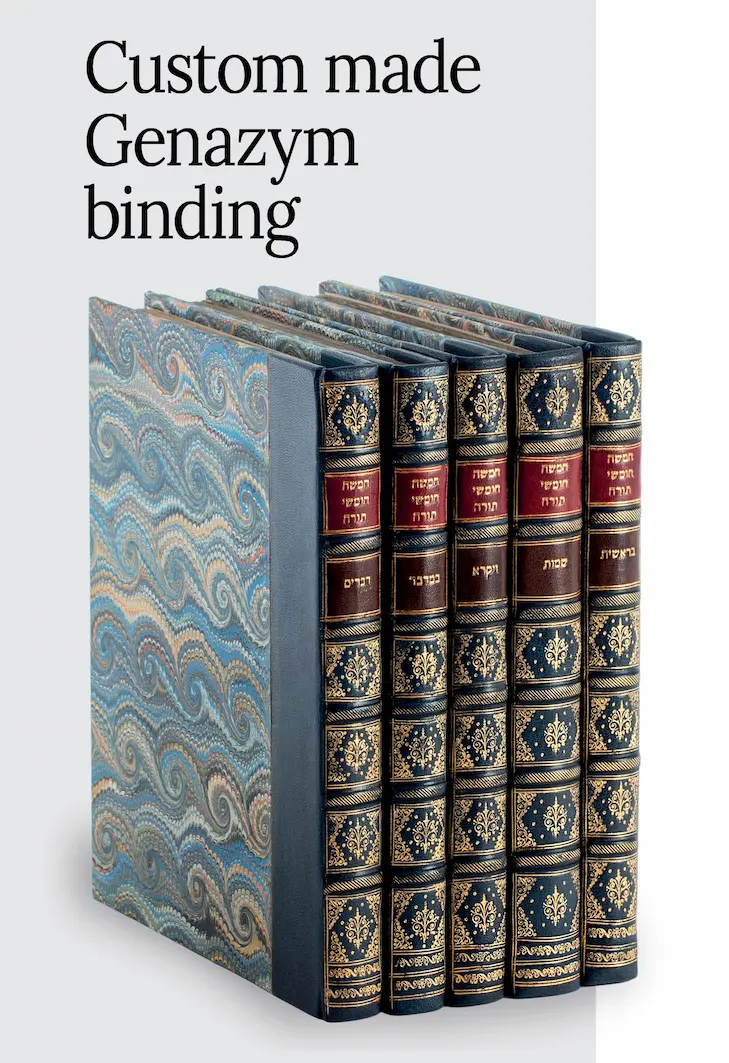
Set Chumash Ohr Hachaim  Shapira Edition. Zhitomir, 1860 with Siddur for Shabbos
Set Chumash Ohr Hachaim  Shapira Edition. Zhitomir, 1860 with Siddur for Shabbos Nusach Sefard. Chamishah Chumshei Torah in five magnificent volumes with the commentary of the Ohr Hachaim Hakadosh on Chumash. Each volume contains a siddur with the Shabbos prayers and yotzros in Chassidic nusach Sefard Printed by the grandsons of the Rabbi of Slavita, Rabbi Chanina Lipa and Rabbi Yehoshua Heschel Shapira. Five magnificent volumes bound in impressive new half-leather binding with matching case. The Chumash contains: Targum Onkelus, Targum Yonasan Ben Uziel and Targum Yerushalmi, Rashi, Baal Haturim, Toldos Aharon, Ohr Hachaim of Rabbi Chaim Ben Attar, and Nachal Kedumim of the Chida. The Haftarahs and Megillos include the Chida’s Nachal Sorek commentary, and the Megillos also have the Ohr Hachaim’s Rishon L’Tziyon. The end of each volume includes the Shabbos prayers in nusach Sefard along with a 26 year rcalendar listing the precise moment of the new moon. (Sefer Shmos does not have a calendar of new moons.) All volumes were printed in 1860 except for Sefer Shmos which was printed in 1854. 1. Bereishis. 343; 17, [1] leaves. 2. Shmos. [2], 328, 333-356, 32, 28 leaves. 3. Vayikra. 270, 29, [1] leaves. 4. Bamidbar. 246, 17, [1] leaves. 5. Devarim. 296, 17, [1] leaves. Zhitomir, 1854-1860. Page size: 26 cm. All volumes except for Shmos have an additional title page, printed partially in red ink. Title pages of Bamidbar and Devarim have slight damage with minute part missing, all professionally restored, as well as corrections in margins of the title pages of Bereishis. Staining of first pages of Bereishis and a tear on leaf 46, with all text intact.      ............................................. Any inquiries about this lot ? We are available also on WhatsApp >>>

Lot : 25

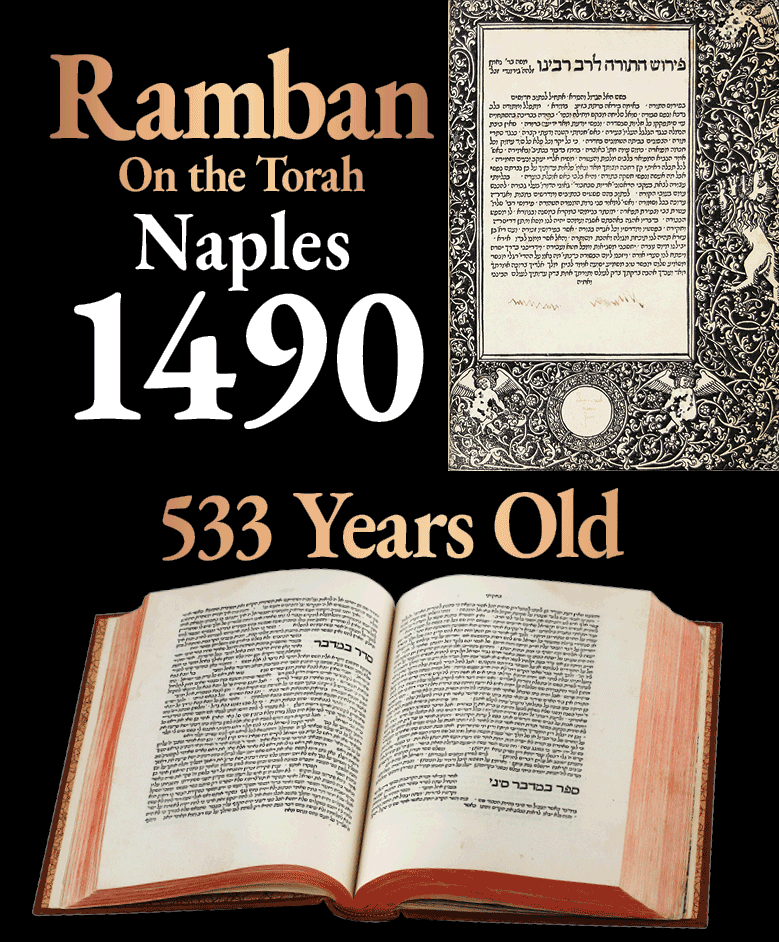
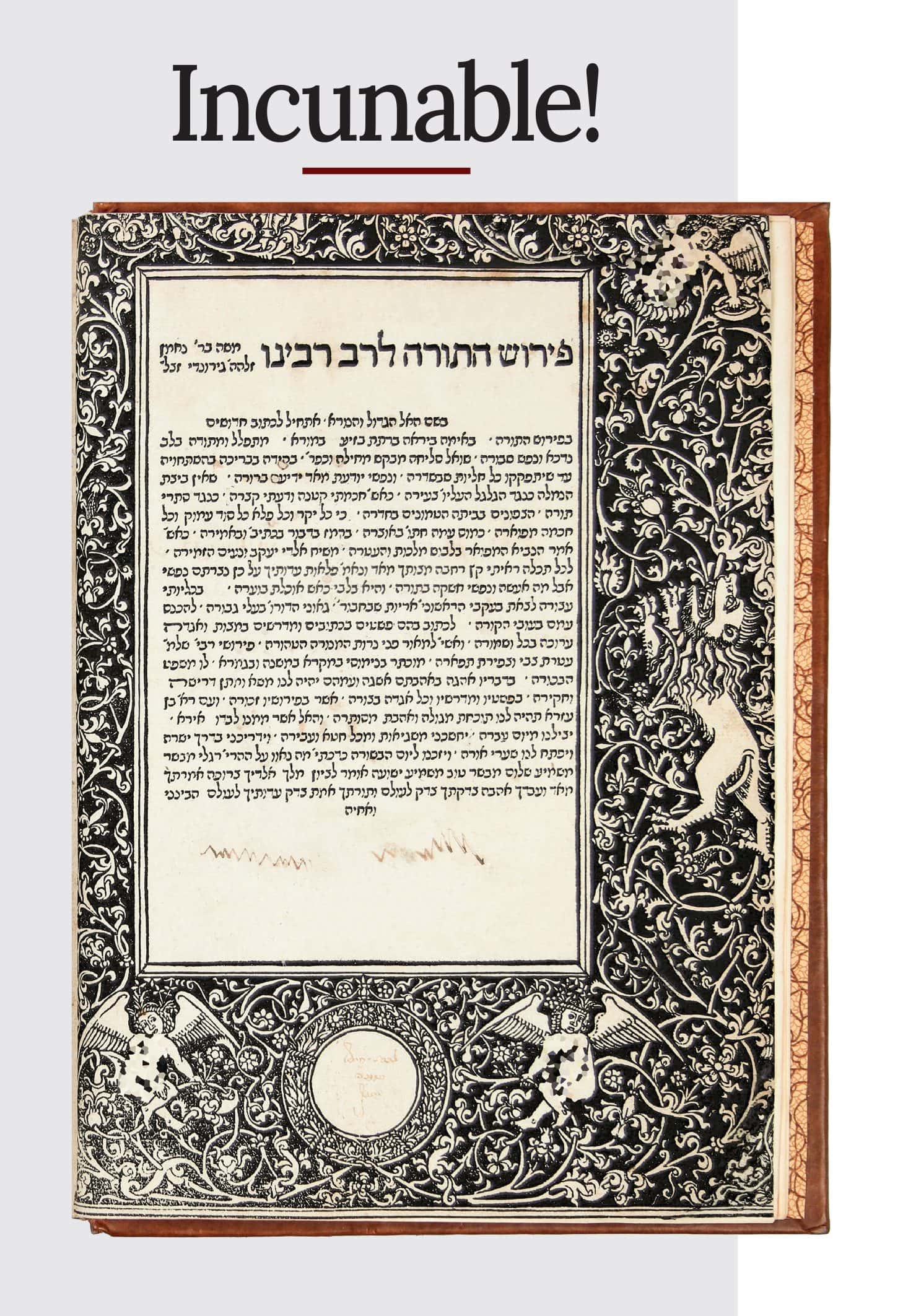
Incunable 533 years old! Ramban’s Commentary on the Torah. Naples, 1490 Pristine
Incunable 533 years old! Ramban’s Commentary on the Torah. Naples, 1490 Pristine Condition! “Commentary on the Torah by Rabbeinu Moshe ben Nachman of Gerona, zt”l” The Rambans commentary includes explanations based on pshat and kabbalah, and after Rashi, it is the most fundamental and comprehensive commentary on the Torah. The first leaf opens with the Ramban’s preface which is encased in an ornate lattice border adorned with leaves and flowers, and depictions of angels and a lion.  A long colophon states: “My heart goes out to the printers of Israel…the workers of the press spread Torah and wisdom among Yisrael, for the land is filled with knowledge. Those who speak disrespectfully against this trade shall bear their sin… And all the sefarim that we printed are worthy of praise and glory. Yet this holy sefer surpasses them all in its beauty and great meticulousness, for sefarim that were copied from them in print by scholars of Messina and also by the scholars of Spain are precise… And the labor was completed…on Friday, the thirteenth day of the month of Tammuz, year [5]250 Ne”R [l’ragli dvarecha] (1490). The famous Jewish printer Joseph Gunzenhauser of the city of Gunzenhausen, Bavaria (Germany) was one of the pioneers of the Jewish Italian press. He founded his printing press in 1487 and operated it for three years until his passing in 1490. The press continued functioning under the ownership of his son Azriel for another two years..Throughout its existence, their press in Naples produced only fifteen books. Iggeres HaRamban The Ramban’s Letter To His Son From Jerusalem The famous Iggeres HaRamban was printed at the end of the sefer. In 1267, the Ramban fulfilled his lifelong dream of journeying to Eretz Yisrael and settling in Yerushalayim. In a letter to his son Rabbi Nachman, he laments the desolate state of the devastated city, describing how Jews from Damascus and Aleppo still pilgrimage to the site in order to “see the Beis Hamikdash and weep upon it.” Further in the letter, the Ramban writes that he purchased a house “with marble pillars and an attractive dome” to use as a shul. This edifice is extant until this very day, just south of the Churvah Shul in the Old City of Jerusalem, and the marble pillars and dome that the Ramban described are still visible. The final leaves of the sefer contain the Ramban’s famous tefillah upon the ruins of Yerushalayim, beginning with the words “Omdos hayu ragleinu b’shaarei Yerushalayim.” In this prayer, he mourns the destruction of Yerushalayim and the Holy Temple and expresses his hope that Am Yisrael will soon merit seeing their Holy City rebuilt. Ramban Al HaTorah The Ramban’s commentary is one of the fundamental commentaries on the Torah. Rabbi Yosef Zundel of Salant, quoting his rebbi Rabbi Chaim of Volozhin, expressed: “One who learns Rashi in the Chumash without Ramban is as one who learns Gemara with Rashi without Tosfos.” The Chasam Sofer writes that the Ramban’s commentary is “The foundation of belief and root of faith” (Shu”t Chasam Sofer Vol. 6 Ch. 61). In his will, he instructed his children to learn the Ramban’s commentary together with their own children. The Ramban wove the foundations and principles of faith along with the wisdom of kabbalah into his commentary and imbued within it many profound secrets (Rabbi Chaim Vital’s preface to Eitz Chaim, citing the Arizal). Naples, 1490. Joseph son of Jacob Ashkenazy Gunzenhauser Press. [242] leaves. Includes blank page at end of Sefer Bereishis [leaf 66]. Page size: 27 cm. Printed in a single column with three types of letters in Spanish-Italian type. The commentary appears in Rashi script, while titles and opening words are in block letters. Opening words are decorative, and page titles present the names of the respective parshah. Owners’ signatures of the Foa family of Italy. Good condition; leaves 2-4 have a small tear on corner of right margin. Last pages with miniscule holes. Rare to find an incunable in such good condition. New leather binding with ornate spine. The “Messina” mentioned in the colophon refers to a large port city on the island of Sicily at the edge of the Italian Boot, in close proximity to the famous city of Reggio Calabria which was home to an ancient Jewish community dating back to the times of the Ramban. Two years prior to the printing of this sefer, the famous Mishnaic commentator Rabbi Ovadia of Bartenura visited Messina and related that it encompassed 400 Jewish families. During that era, Messina was under Spanish rule, and with the expulsion of the Jews from Spain in 1492, the Jews of Messina were banished as well. Bibliography: Yakirson. Catalog of Hebrew Incunabula. Vol. 1 pp. 249-254 A K. Offenberg, Hebrew Incunabula in Public Collections, Nieuwkoop 1990, no. 98. Stefansky, Sifrei Yesod Incunabula #32. Incunabula Incunabula (plural of incunable) are books, pamphlets, or broadsides printed in Europe prior to the 16th century. The word derives from the Latin term ‘cradle’ or ‘swaddling cloth, ’ connoting the infancy of the printed word. While the incunable period actually stretches across a half-century, from 1455-1500, the first Hebrew presses opened only two decades later, and thus the period of Hebrew incunabula is limited to a mere thirty years, from 1469-1500. The estimated number of Hebrew works printed during the incunable period is approximately two hundred. Incunabula are desirable collectibles, highly sought-after by antique Judaica collectors. The greatest libraries in the world vie for the number of incunabula in their treasured collections. ............................................... . Any inquiries about this lot ? We are available also on WhatsApp >>>
Lot : 26

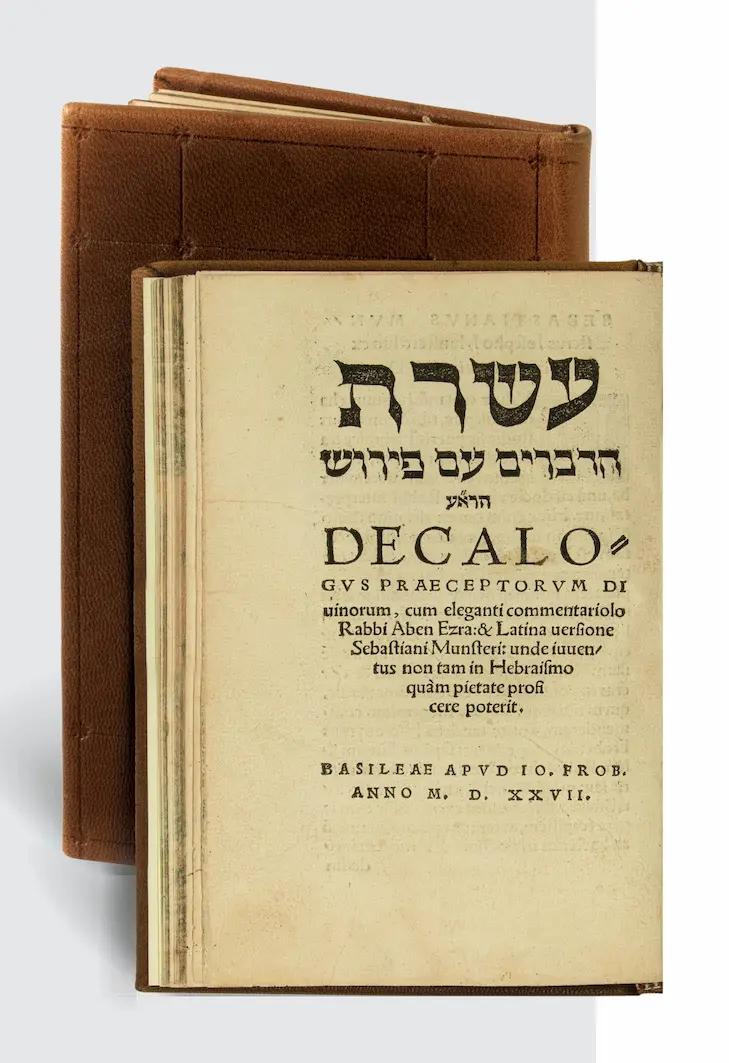
Ten Commandments with Ibn Ezra’s Commentary. Basel, 1527 The Ten Commandments with
Ten Commandments with Ibn Ezra’s Commentary. Basel, 1527 The Ten Commandments with the commentary of Rabbi Avraham ibn Ezra. With Latin translation by German Hebraist scholar Sebastian Münster appearing on the facing sides. Leaves 30, 32 present Onkelus’ translation of the Ten Commandments, along with Latin translation. The sefer also features a brief commentary on the Ten Commandments quoted from sefer Tzror Hamor by Rabbi Avraham Saba (Venice, 1523). Basel, 1527. [32] leaves. Page size: 16 cm. Decorated initials. The last page features the printer's emblem of Johann Froben. small marginal hole; faint water stains on margins; new leather binding. Provenance: William L. Gross Collection Item description from the 'William L. Gross Collection' ............................................ .... Any inquiries about this lot ? We are available also on WhatsApp >>>

Lot : 27

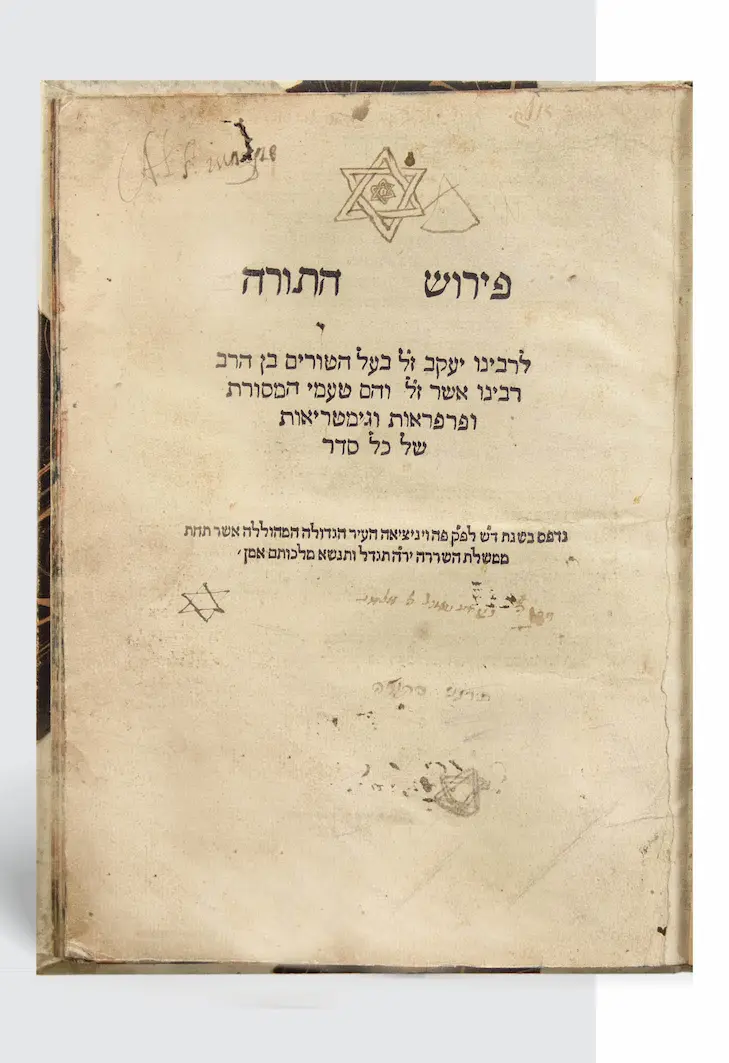
Baal Haturim’s Commentary on the Torah. Venice, 1544 Pearls of wisdom, gematria,
Baal Haturim’s Commentary on the Torah. Venice, 1544 Pearls of wisdom, gematria, roshei teivos and comments on Chamishah Chumshei Torah by Rabbeinu Yaakov son of the Ros"h the Baal Haturim. Rabbeinu Yaakov Baal Haturim’s commentary, authored in a distinct, concise style replete with allusions and codes, is one of the most popular and beloved interpretations of the Torah. The Baal Haturim commentary was included in hundreds of editions of the Chumash. Venice, 1544. Second edition. 65. [1] leaf. Page size: 19 cm. Lengthy colophon on last page. First 2 pages have small holes that were professionally restored. Top margins slightly cropped. Owner’s signature and handwritten annotations in Italian. New half-leather binding. ............................................... . Any inquiries about this lot ? We are available also on WhatsApp >>>

Lot : 28

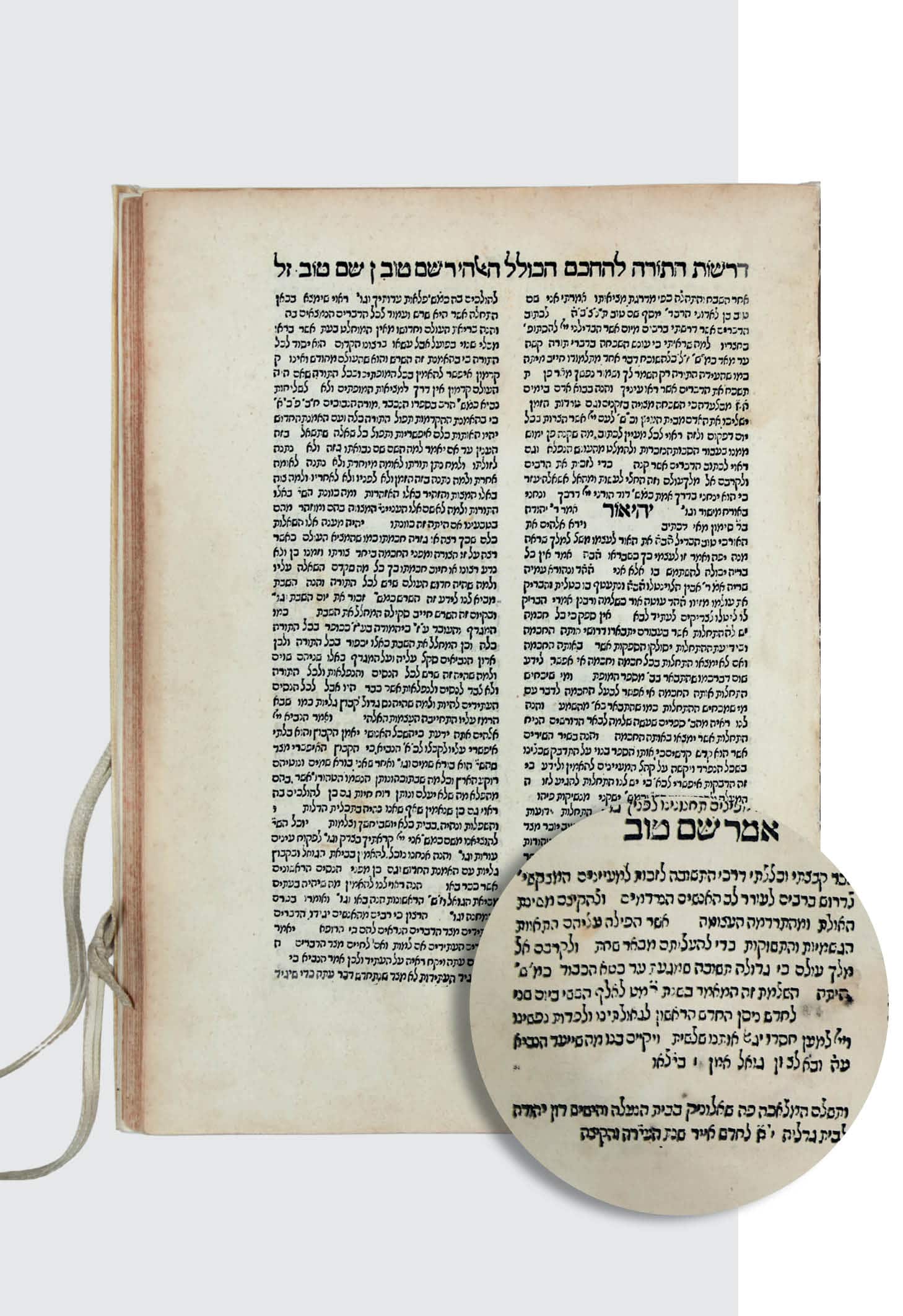
Drashos HaTorah by Chacham Rabbi Shem Tov. First Edition. Salonika, 1525 Drashos
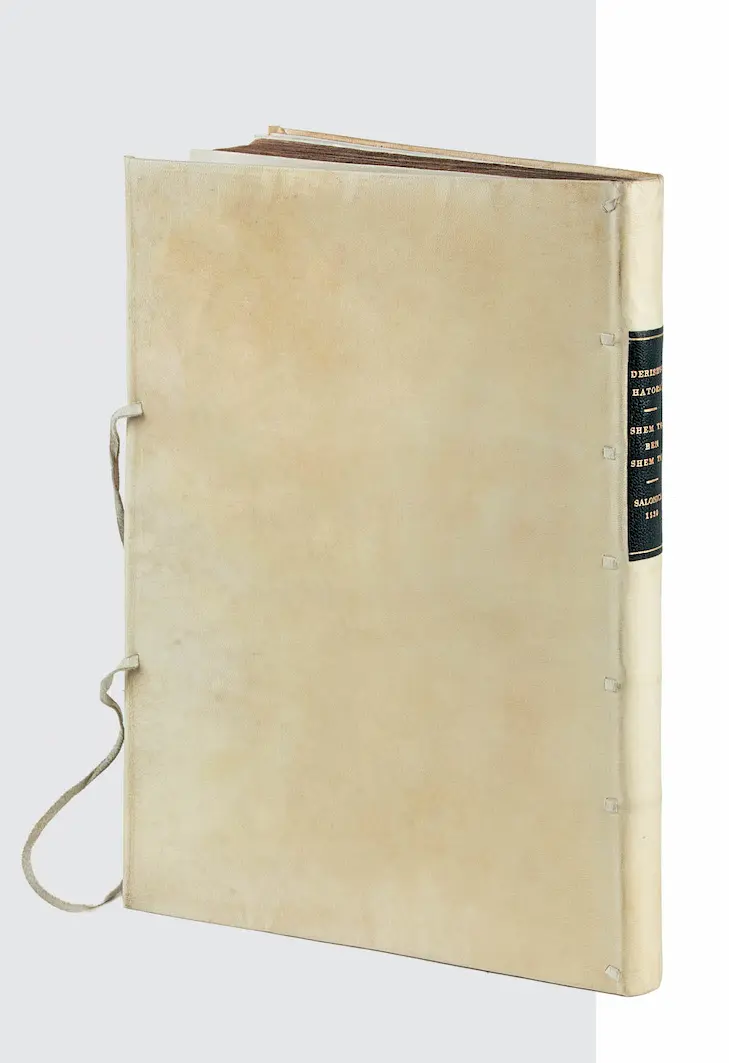
Drashos HaTorah by Chacham Rabbi Shem Tov. First Edition. Salonika, 1525 Drashos by Rabbi Yosef ben Rabbi Yosef Ibn Shem Tov arranged in order of the parshiyos. The sefer culminates with drashos for Rosh Hashanah and Yom Kippur, arousing his listeners and readers to repent and restore their hearts to their Father in heaven. This sefer was enthusiastically received and widely disseminated among the masses, as evident by the fact that it was reprinted twice within the next thirty years – in Venice, 1547 and in Padua, 1567. Rabbi Shem Tov lived in Spain shortly before the expulsion, and the present sefer was completed in the year 1489 (as noted in the sefer itself). He is most famously known for his Peirush Shem Tov commentary on the Rambam’s Moreh Nevuchim, which first appeared in print in the Venice edition of 1551. Rabbi Shem Tov was the son of Rabbi Yosef Shem Tov, author of the sefer Kevod Elokim (Ferrara, 1557). Rabbi Yosef was one of the spiritual mentors of the Abarbanel and a grandson of the kabbalist Rabbi Shem Tov Ibn Shem Tov, author of sefer HaEmunos (Ferrara, 1557). Rabbi Shem Tov venerated the Rambam, and the drashos in the present sefer reflect the Rambam’s philosophical approach. Salonika , 1525. First edition. 79, [11] leaves. Page size: 29.4 cm. Printed without title page. Colophon at end of sefer states: “The work was completed here in Salonika in the home of the exalted and elderly Don Yehuda son of Gedalya. 11 Iyar, 5285 (1525). Good condition with wide margins. Light water stains. Margins of leaf 61 torn with minor damage to text. Light damage to margins of last pages, although all has been professionally restored and completed. Attractive new parchment binding with ribbons. ............................................... . Any inquiries about this lot ? We are available also on WhatsApp >>>
Lot : 29

Terumas Hadeshen’s Commentary on Rashi. First Edition. Venice, 1519 “Commentary established by
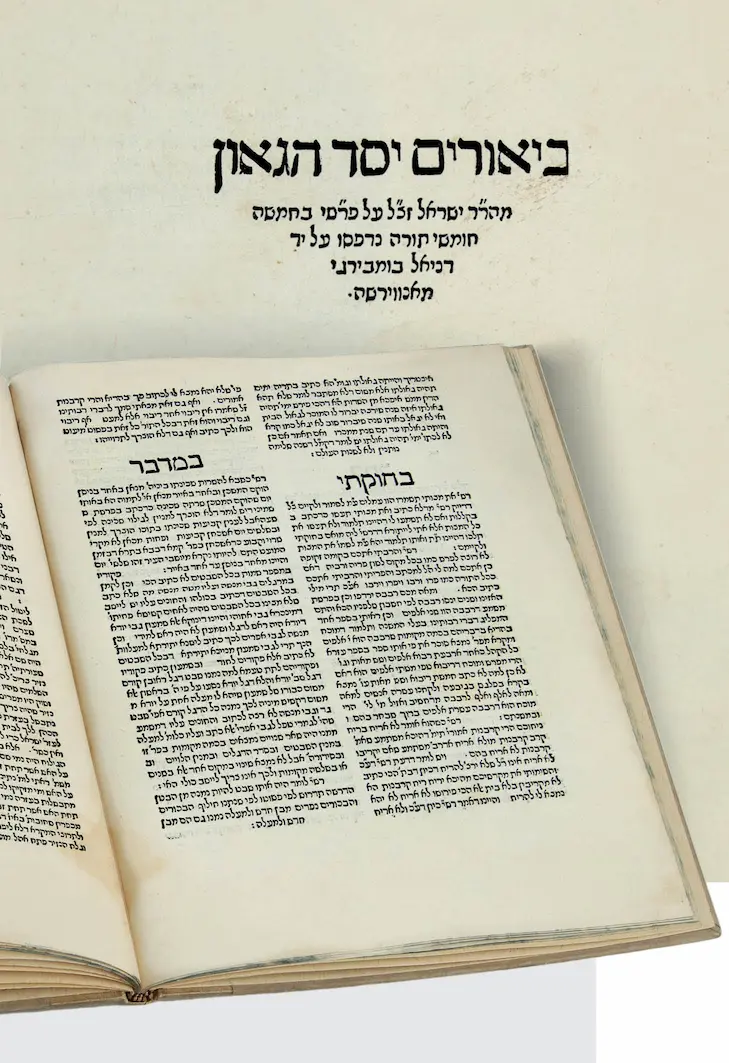
Terumas Hadeshen’s Commentary on Rashi. First Edition. Venice, 1519 “Commentary established by Hagaon Moreinu Harav Yisrael zt”l on Rashi’s commentary” Explanations on Rashi’s commentary on the Chamishah Chumshei Torah by Rabbi Yisrael Isserlin, author of Terumas Hadeshen. The Terumas Hadeshen’s commentary on Rashi is the singular composition on Rashi authored in the era of the Rishonim! While the majority of this commentary seeks to elaborate and clarify Rashi’s commentary on the Chumash, the Terumas Hadeshen also includes his own explanations and elucidations of various pesukim that do not reference Rashi’s words. Rabbi Yisrael Isserlin (1390-1460), most famous for his landmark sefer Terumas Hadeshen was one of the renowned Ashkenazic Rishonim and one of the last of this era. He corresponded in Torah and halachah with the Maharil, Mahari Weil, and Maharam Mintz, all of whom praised his works effusively. His own sefer Terumas Hadeshen also appears in the present Catalog. Venice, 1519. First edition. Daniel Bomberg Press. [17] leaves. Page size: 24.7 cm. Impressive copy in good condition. Title page stained. High-quality printing on thick white paper, true to the Bomberg tradition. New half-parchment binding. ............................................... . Any inquiries about this lot ? We are available also on WhatsApp >>>

Lot : 30

The Rema’s first sefer! Beautiful copy Mechir Yayin on Megillas Esther. First
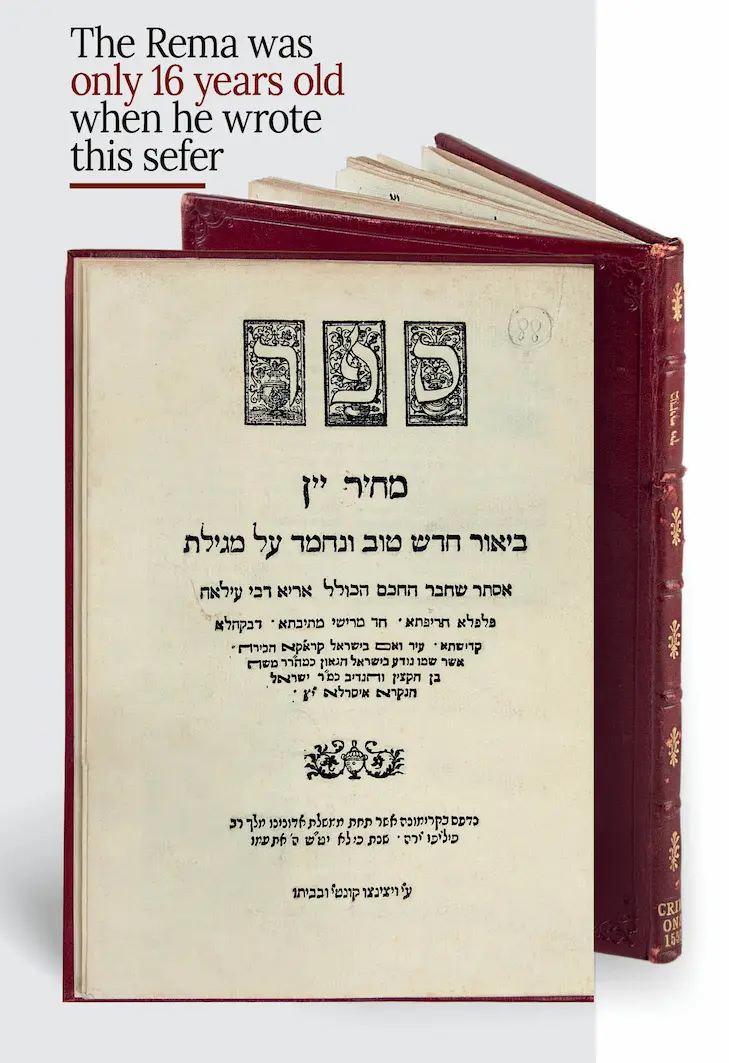
The Rema’s first sefer! Beautiful copy Mechir Yayin on Megillas Esther. First Edition. Cremona, 1559 An original commentary on Megillas Esther by Rabbi Moshe Isserlish, the Rema of Cracow, who composed this work on the day of Purim 1556 while in exile. This exceedingly rare item was the very first sefer published by the Rema! The Rema was born in the year 1540, and this sefer was thus written when he was only 16 years old. It was printed 3 years later when he was 19! In the preface to this sefer, the Rema writes that he composed this work in 1556 after fleeing his native Cracow, which was consumed by the plague, to the city of Shidlov, near Warsaw. The refugees were poverty-stricken and starving, lacking basic food and amenities. “There was barely water to drink, ” he writes, so surely there was no wine for them to drink on the day of Purim. “Thus we could not fulfill the Mitzvah  of Purim with drinking and joy...instead he composed this sefer  entitling it  Mechir Yayin, which literally translates into “the cost of wine.” In the preface  the Rema Cites  the Zohar, that Megillas Esther as all other Scriptures, encompasses both revealed and kabbalistic meanings. In this commentary, he illuminates the megillah as a parable to the life of a man, which is rife with battles against his evil inclination, from the day of his birth until his death. During this period, the printing presses in Cracow were not functioning; therefore the Rema dispatched his manuscript to be printed in Italy. Cremona, 1559. First edition. 24 leaves. Page size: 19.5 cm. Beautiful copy in excellent condition with new leather binding. ............................................... . Any inquiries about this lot ? We are available also on WhatsApp >>>
Lot : 31

Zera Beirach. Cracow, 1646. First Edition. Exceedingly Rare! Drashos and commentary on
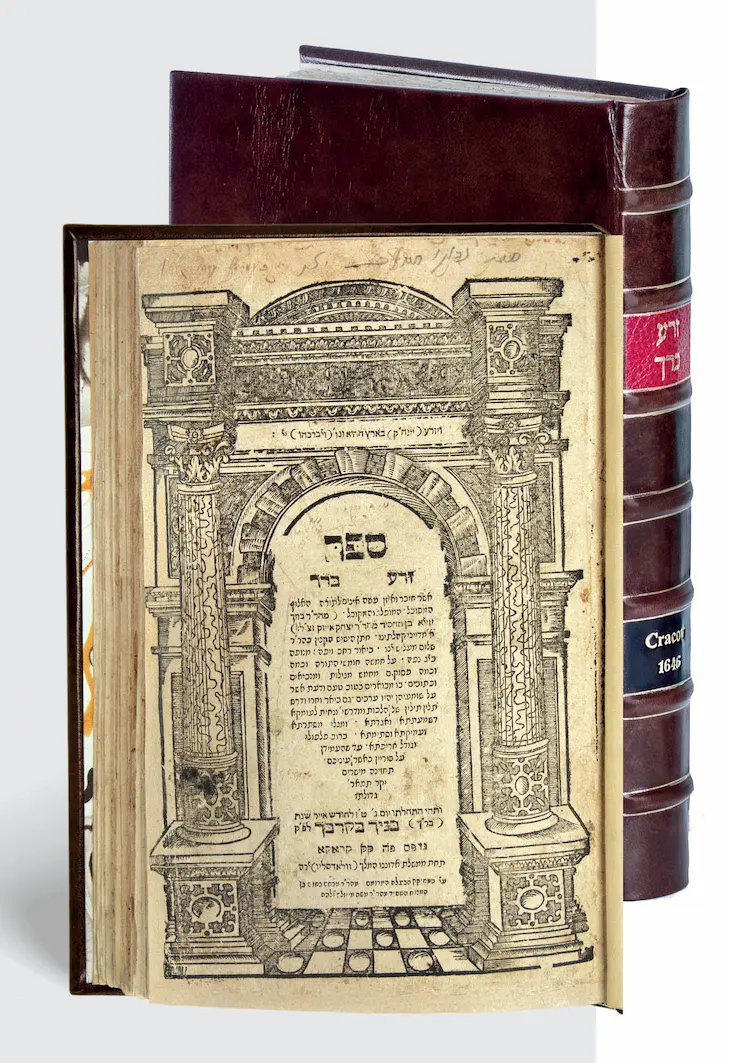
Zera Beirach. Cracow, 1646. First Edition. Exceedingly Rare! Drashos and commentary on parshiyos and aggados by Rabbi Berachia Beirach Shapira, Dayan of Cracow during the times of the Bach and the Tosafos Yom Tov. Includes sefer Ateres Tzvi - chiddushim of Rabbi Tzvi Hirsh, son-in-law of the Tosfos Yom Tov. Sefer Zera Beirach is an important work of drush, many of the teachings mentioned in this sefer were frequently quoted in the sefarim of other gedolim. All existent sefarim printed in Poland before the Cossack rebellion of 1648-49(גזירת ת”ח ות”ת) in which the jewish communities in Poland were horrifically destroyed are known to be very rare. This intact first edition is exceptionally rare. Rabbi Berachia Beirach Shapira was a disciple of the kabbalist Rabbi Nosson Shapira, author of Megaleh Amukos. He was a dayan and a lecturer of Torah in the Cracow community at a time when the city boasted Torah geniuses. Toward the end of his life he left Cracow for Eretz Yisrael, but died en route in the city of Constantinople on the 19th of Elul 1666. Ateres Tzvi-Chiddushei Rabbi Tzvi Hirsh, son-in-law of the Tosafos Yom Tov The author incorporates chiddushim of his brother-in-law Rabbi Tzvi Hirsh under the title Ateres Tzvi. Rabbi Tzvi Hirsh died at a young age and did not leave behind any offspring. (See the approbation of the Tosfos Yom Tov, and the author’s introduction.) Cracow, 1646-1647. First edition. [1] 153 [actualy 149] leaves. Page size: 29 cm. Rabbi Menachum Nachum Meizlish Press. Large woodcut illustrations on pp. 50b, 91a. The first illustration is of akeidas Yitzchak. Professional restoration of some margins, including restorations for some text on a few pages (58-62). Several pages cropped until the edge of the text with all text intact.  New  leather binding. (Stefansky, Sifrei Yesod p. 13 in notes) ................................................ Any inquiries about this lot ? We are available also on WhatsApp >>>

Lot : 32

The Alshich Hakadosh al HaTorah Fundamental sefer. Toras Moshe L’Rabbeinu Moshe Alshich.
The Alshich Hakadosh al HaTorah Fundamental sefer. Toras Moshe L’Rabbeinu Moshe Alshich. First Edition. Venice, 1601 Landmark commentary on Chamishah Chumshei Torah by Rabbi Moshe Alshich of Tzfas. The first complete printing of the premier sefer drush, which extracts the underlying content, meaning and messages of the text. It served as the basis for all future darshanim, maggidim and sifrei drush that followed. The Alshich Hakadosh’s works were universally extolled and accepted by Jews around the world, and the Arizal himself attested that “The Alshich attained the truth in his Derashos.” (see Shem Hagedolim by the Chida.) The Minchas Elazar of Munkacs writes that the Arizal expressed that “Since the complete pamalia shel maalah (heavenly entourage) descended to hear the Alshich’s lectures, he (the Arizal) went as well.” Miraculous rescue through learning the Alshich’s sefer Rabbi Yitzchak of Posen (the Magen Avraham’s Rabbi) told a miraculous story regarding the merits of learning the Alshich’s seforim, He writes that his Rebbi Rabbi Avrohom of Barr told him that during the harsh times of the Chmielnicki Massacres the Alshich Hakadosh appeared to him in a dream and told him ‘I have come to rescue you’ since you cherish my sefer and learn from it weekly, therefore hurry and escape from the city immediately for tomorrow there is a decree of death on the city,   (Printed in Kitzur Alshich. Amsterdam, 1698). Alshich Hakadosh There were four Sages in Eretz Yisrael who were titled “Hakadosh—the holy one”: the Arizal Hakadosh, the Alshich Hakadosh, the Shel”a Hakadosh, and Ohr Hachaim Hakadosh. This sefer was printed by the author’s son Rabbi Chaim Alshich who made the special journey from Tzfas to Venice in order to publish his father’s work. The end of the sefer features an index by Rabbi Yitzchak Gershon and approbations by Rabbanim of Venice, among them the kabbalists Rabbi Yosef Samiga and Rabbi Ezra of Pano Ish-Mantoba, who was the spiritual master of the Rema of Pano. Sefer Bereishis alone was first printed in a previous edition in Belvedere, 1598. This is the first edition on the entire Chumash. Venice, 1601. First complete edition. Giovanni Zuan Press using Bomberg type. 86: [85-] 198: 163-210: 211-251: 253-324 leaves. 29 cm. Title page with architectural border. First word in every Chumash encased in decorative border. Minor tear in title page margin; several water stains.  Antique leather binding. Stefansky, Sifrei Yesod 17 ............................................... . Any inquiries about this lot ? We are available also on WhatsApp >>>

Lot : 33

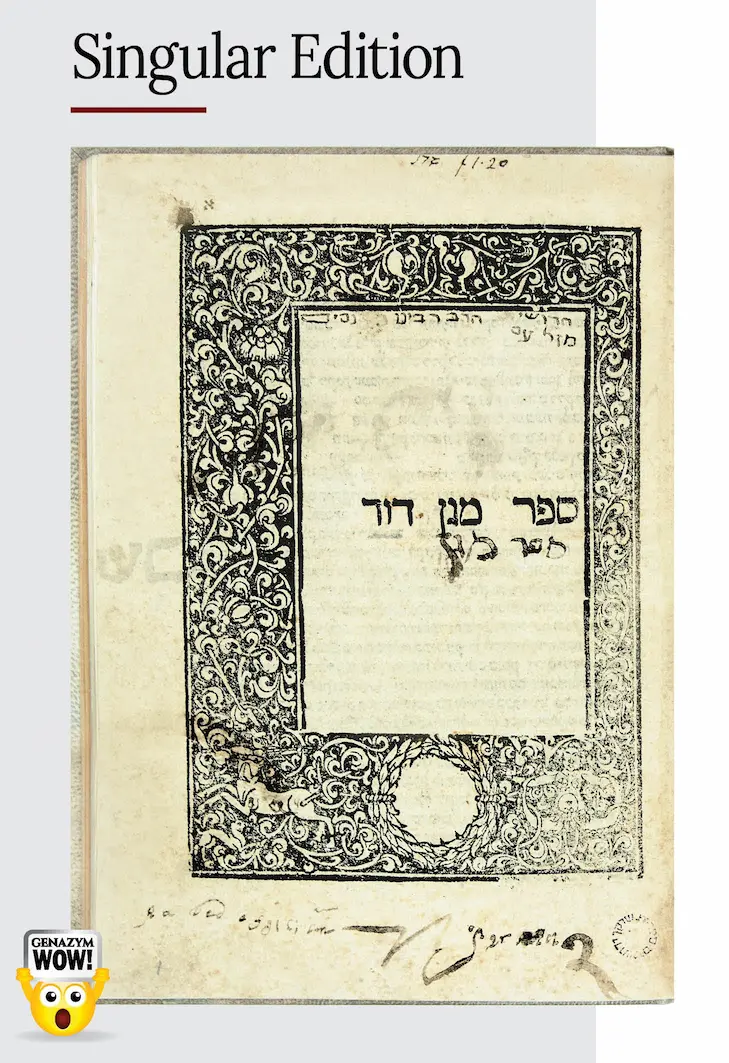
Rare, valuable find! Magen Dovid. Singular Edition Constantinople, 1517 A treatise defending
Rare, valuable find! Magen Dovid. Singular Edition Constantinople, 1517 A treatise defending the Radak    Magen Dovid  = Defending Dovid (Rabbi dovid Kimchi ) Responses to grammatical question and critique raised against the Radak's  principles and rules of grammar in sefer Maaseh Eifod and Lashon Limudim , by Rabbi Elisha ben Rabbi Avraham ben Rabbi Mattisyahu  from Portugal    Rabbeinu Dovid Kimchi, renowned by his initials Radak, was one of the great sages and grammarians in Jewish history, known to many as “Gadol Hamedakdekim, Greatest of the Grammarians”. His landmark sefarim on lashon hakodesh, including Sefer Hashorashim and Sefer Michlol, are both fundamentals in this realm. The Radak’s works spurred several responses that contested his principles and rules in grammar; the present sefer by Rabbi Elisha ben Rabbi Avraham seeks to defend the Radak’s position, and was thus aptly named Magen Dovid, literally, “shield of Dovid.” The colophon states: “This sefer was completed on Erev Pesach 5277 to Creation and printed in metropolitan Constantinople…” The author Rabbi Elisha ben Rabbi Avraham ben Rabbi Mattisyahu was one of the great Turkish sages who lived in the era of the Re’em. He was expelled from Portugal together with his Jewish brothers in 1517. Chacham Rabbi Yitzchak ben Moshe ,  also known as Profiat Duran Halevi was a philosopher and grammarian. He authored his famous work Maaseh Eifod in Catalonia, 1403, although the sefer didn’t appear in print until 1865. Rabbi Elisha possessed a handwritten manuscript of Chacham Yitzchak’s work which enabled him to formulate his responses to the questions posed. Rabbi Dovid ben Yichya was one of the great sages of Portugal in the era of the expulsion. He fled Portugal and settled in Turkey. His fundamental work Lashon Limudim was printed in Constantinople, 1506. The present sefer was proofread both by the author and the esteemed chacham Rabbi Shlomo Almoli, author of Mefasher Chalmin, Me’asef Lechol Hamachanos and others. Rabbi Shlomo Almoli also numbered among the refugees of the Portuguese expulsion, arriving in Turkey as a young child. Constantinople, 1517. Singular edition. [26] leaves. Page size: 19.4 cm. The title page features  in a decorative border. Good condition with new binding. Bibliography:  YAARI KUSHTA #52. SOTHEBY'S - SCHOCKEN 12/06/1993 What is a Kshta Reish? ............................................... . Any inquiries about this lot ? We are available also on WhatsApp >>>
Lot : 34

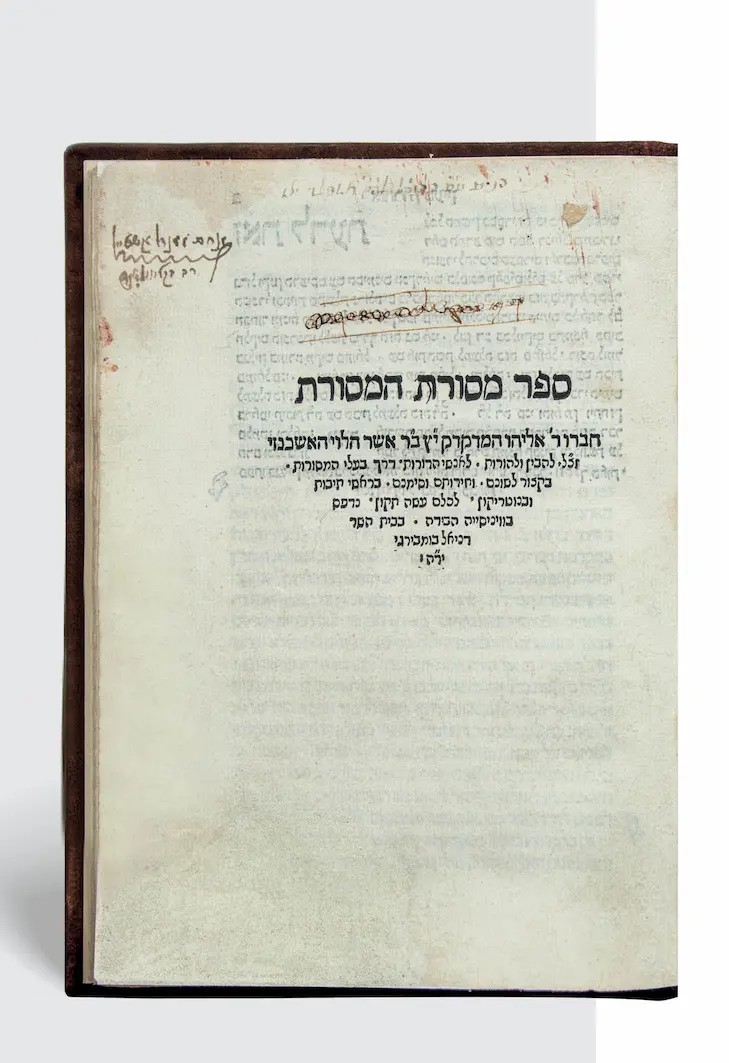
Mesores Hamasores. First Edition. Bomberg Press. Venice, 1538 Fundamental work on the
Mesores Hamasores. First Edition. Bomberg Press. Venice, 1538 Fundamental work on the tradition of the torah text, including an explanation of the methodologies of the authors of Masoretic texts, by the famed Hebrew grammarian Rabbi Eliyahu Bachur Halevi Ashkenazy. The Mesorah is an ancient resource and study tool used to preserve the precise text of Tanach. Amkng the authors of the ‘Mesorah, ’ renowned as the Baalei Hamesorah were Ben Asher and Ben Naftali. The Mesorah appears on the margins of many editions of Tanach. In this work, Rabbi Eliyahu Bachur Ashkenazy clarifies all the fundamental elements of the mesorah. In a special chapter entitled Shaar Shivrei Luchos, he explains the unique markings, expressions and acronyms employed by the Baalei Hamesorah and presents a brief biography of the famed Baalei Hamesorah and summary of precise ancient Tanach texts (as Halleli). Rabbi Eliyahu Bachur (1469-1549) was one of the greatest Hebrew grammarians of all times. He authored several fundamental works of Hebrew grammar among them the present Mesores Hamasores, Sefer Hatishbi and Sefer Meturgeman (also featured in this Catalog). Rabbi Saadia Gaon’s famous poem upon the number of letters in the Torah was printed for the first time in the last pages of this work (p. 82-87). Venice, 1538. First edition. Daniel Bomberg Press. 87 leaves. Page size: 19.5 cm. Attractive new leather binding. The printing year was based on the publication date of Tuv Ta’am which was printed together with the present sefer. See Stefansky, Sifrei Yesod #521 Lunzer-Valmadonna Collection ............................................... . Any inquiries about this lot ? We are available also on WhatsApp >>>
Lot : 35

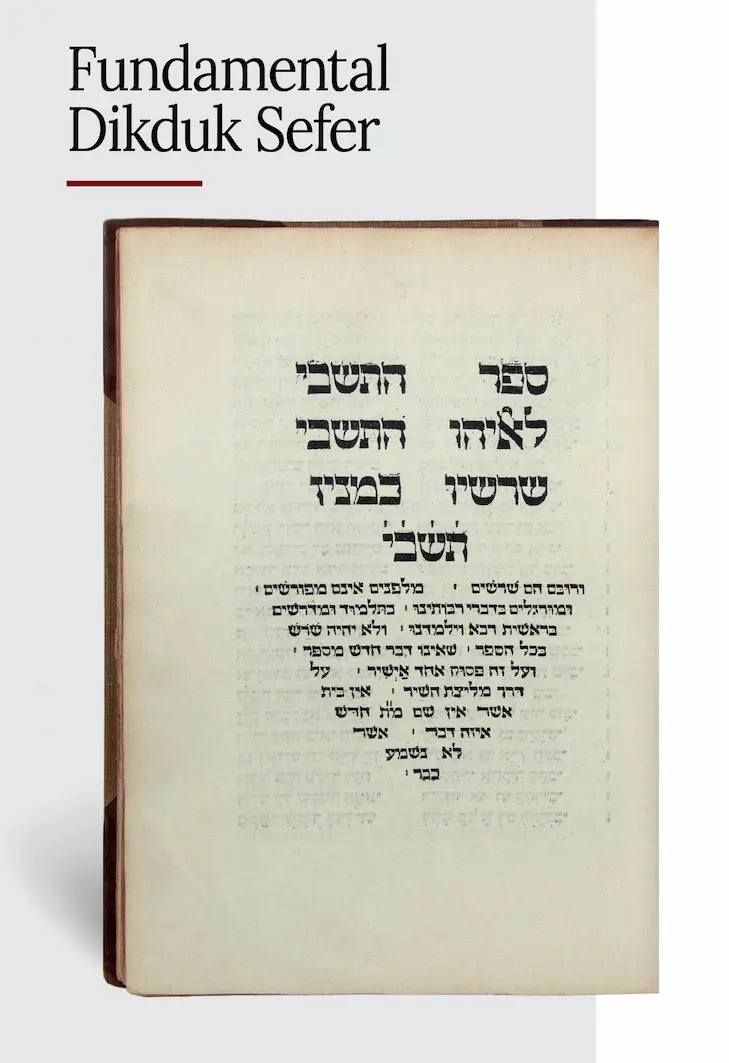
Fundamental Dikduk Sefer Tishbi. Izna, 1541 Fundamental sefer on the rules of
Fundamental Dikduk Sefer Tishbi. Izna, 1541 Fundamental sefer on the rules of dikduk by the great Jewish grammarian Rabbi Eliyahu Halevi Bachur Ashkenazy, with translation into Latin by the famous printer Paulos Baggios. The sefer includes 712 shorashim (root words) and their translations; 712 is the numerical value of title, Tishbi . The text is printed with facing columns of Hebrew and Latin. Rabbi Eliyahu Halevi Ashkenazy (1469-1549), commonly known as Rabbi Eliyahu Bachur, was one of the greatest Hebrew grammarians of all times. He authored several fundamental works on Hebrew grammar, although the most famous among them is undoubtedly the present Sefer HaTishbi which was widely disseminated and reprinted in many editions. Isny, 1541. 278, [5] sides. Page size: 21 cm. Last leaf features a Hebrew colophon with the emblem of the famous printer Paulos Baggios. Aside from a minor tear on side [2], it is a beautiful, complete copy in good condition. Half-leather  binding. Stefansky, Sifrei Yesod #519 (non-Latin edition) ............................................... . Any inquiries about this lot ? We are available also on WhatsApp >>>
Lot : 36

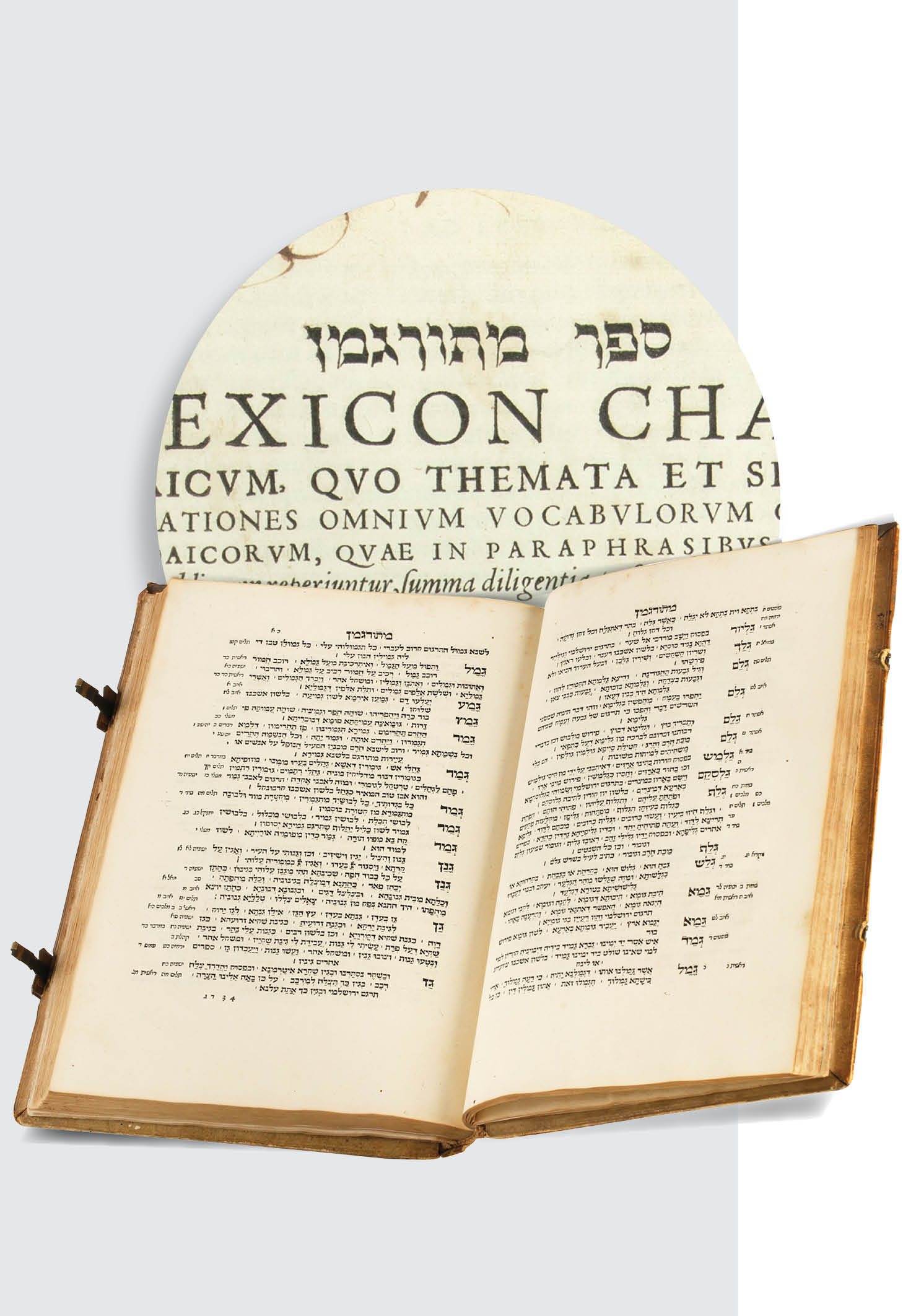
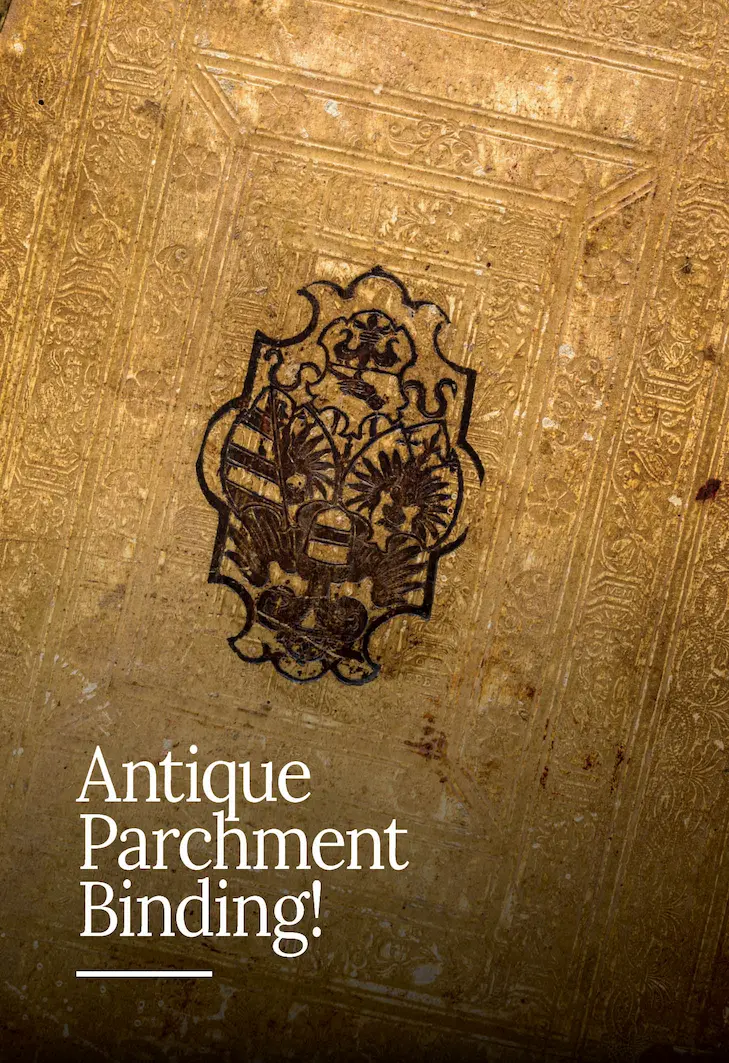
Sefer Meturgeman. Cologne, 1560 Impressive copy with ornate antique parchment binding! Elucidation
Sefer Meturgeman. Cologne, 1560 Impressive copy with ornate antique parchment binding! Elucidation of the roots of Aramaic words used in Targum Onkelus, Targum Yonasan and Targum Yerushalmi by famed linguist and grammarian Rabbi Eliyahu Bachur HaLevi Ashkenazi.  This work was beautifully printed on high-quality paper in calligraphy type. Striking copy with wide margins, bound in parchment-covered antique wooden binding with flower engravings and metal clasps. (A part of one clasp is missing). This book was originally printed in Isny (1541). However, when the printer Paggios of Isny was forced to relocate from Strassburg to England, he remained with numerous copies that he had not managed to sell. Paggios then revised the title page stating the book was printed in Cologne 1560 in order to sell the remaining books. A Hebrew colophon appears in the back bearing the printer’s emblem of Paulos Paggios. Rabbi Eliyahu Bachur (1469-1549) was one of the greatest grammarians, and authored fundamental books in this subject, the most well-known of which are this book and sefer HaTishbi. Cologne, -Isny 1560. [7], 164, [2] leaves. Page size: 32 cm. Title page and preface in Hebrew and Latin.  Antique provenance on title page. Miniscule holes on title page margins professionally restored with paper filler, all text intact. Provenance: William L. Gross Collection Item description from the 'William L. Gross Collection' ................................................ Any inquiries about this lot ? We are available also on WhatsApp >>>

Lot : 37

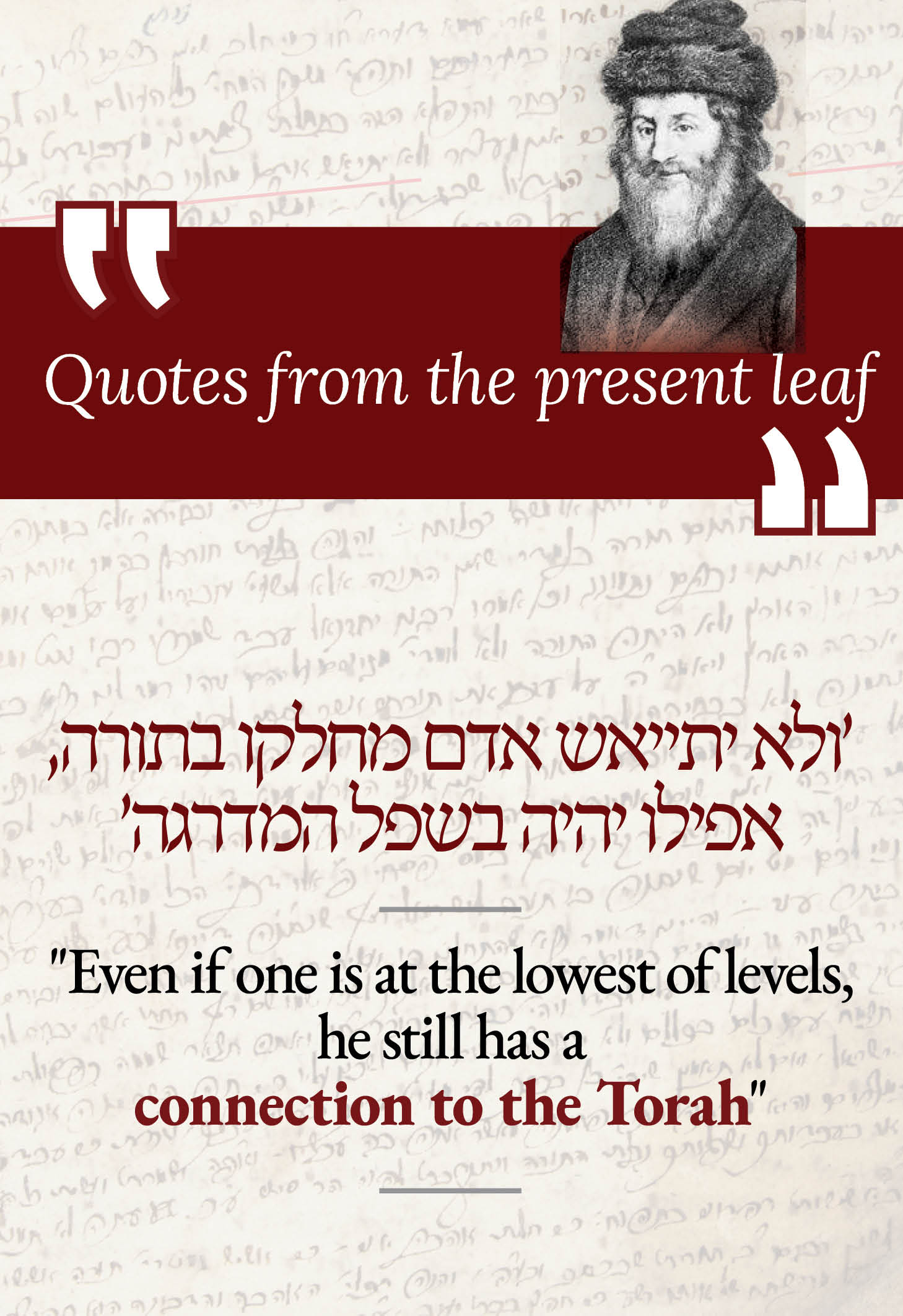
“ Even if one is on the lowest level he should not despair of his portion in Torah”
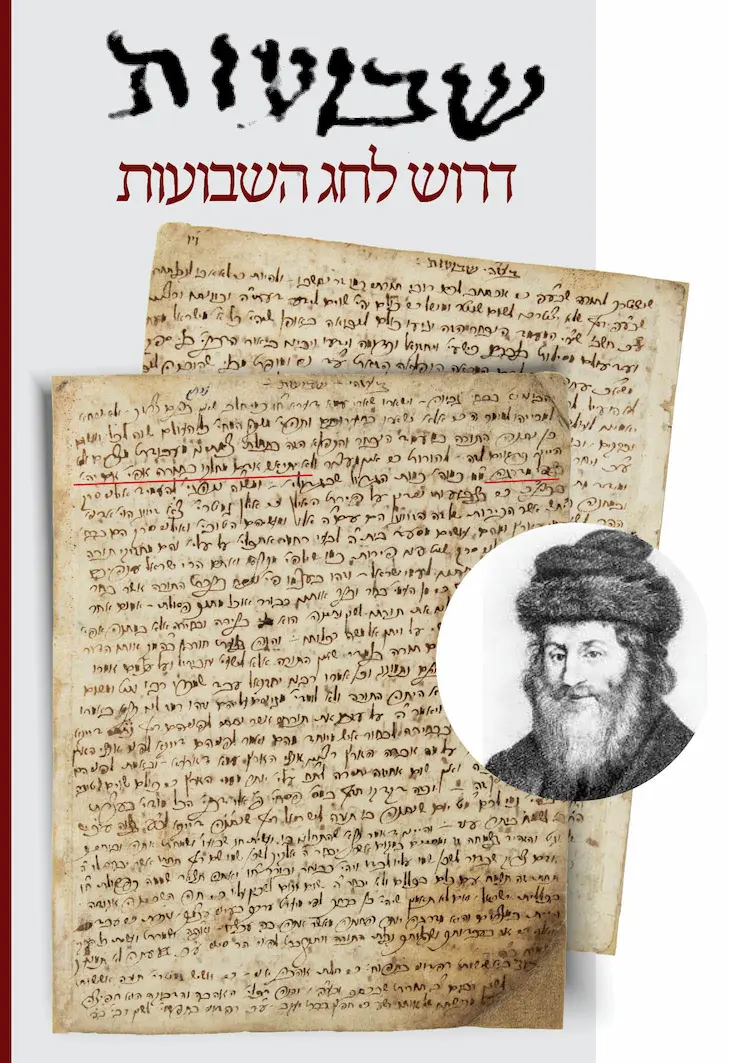
Handwritten Inspirational Chiddushei Torah and Explanation of Customs on Shavuos by the Chasam Sofer. Mattersdorf, 1802


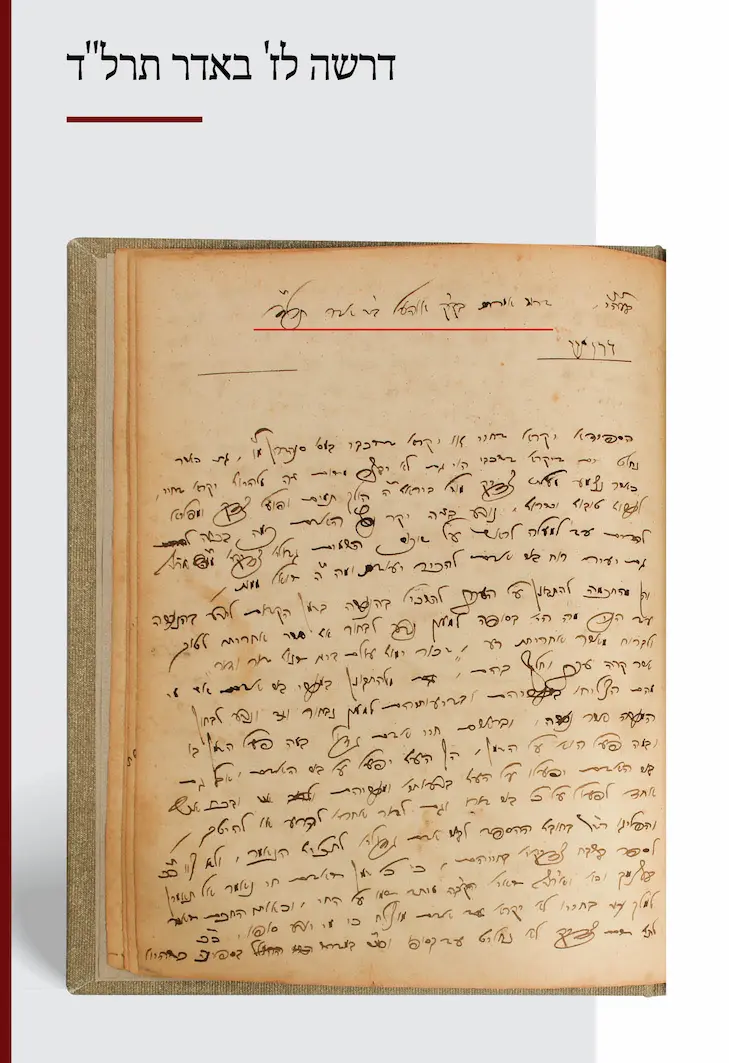
A sacred handwritten leaf from the holy Rabbi Moshe Sofer, author of Chasam Sofer, with fundamental explanations concerning receiving the Torah on Shavuos and the brachos recited prior to learning Torah.

Both sides of the leaf feature a handwritten title by the Chasam Sofer in block letters:“B’ezras Hashem Yisborach. Shavuos”. This essay was written in honor of Shavuot, 1802.

The manuscript was in the possession of Rabbi Naftali Stern, and was printed based on the present copy in Drashos Chasam Sofer (Klausenburg, 1929) p. 228a-b (see description ibid, preface p. 13 #2).

In this essay, the Chasam Sofer presents profound explanations to famous Jewish customs observed on the festival of Shavuos, among them eating dairy and stationing trees in a shul.

The underlying message of this essay is that“Torah was not given to individuals, but to Klal Yisrael as one unit…and Torah scholars do not possess a greater grasp of Torah than the masses, as they are all equally good…and one should not despair of his portion in Torah, even if he is on the lowest level…One whose enthusiasm is not ignited for Torah is destined to be ignited after several generations… And if he does not come, then his son or his grandson from his family will come, and he shall inherit the same legacy. Therefore every member of Yisrael is obliged to rejoice on the festival of Shavuos.”

Mattersdorf, 1802. Page size: 24x18 cm. 62 written lines. Minor tear at the end of the leters on the inner page on the left side. Small tear on bottom corner with several letters missing.
 Preserved in attractive new binding.

The Shechinah Speaks from His Mouth
The Chasam Sofer’s fiery lectures instilled awe and terror in the hearts of all who heard them, inspiring them to rectify their misdeeds and repent. Numerous handwritten accounts depict the rousing scene of the Chasam Sofer standing before the ark resembling an angel, his countenance aglow with compassion and humility, and his words fiery arrows that penetrated every heart, evoking repentance and desire to serve Hashem. As one author describes, “[The Chasam Sofer] fulfilled what he himself wrote, ‘[When] a Rabbi who preaches and rebukes for the sake of heaven, the Divine Presence speaks from his mouth.” (Toras Moshe, Parshas Mattos)

***********
“ Even if one is on the lowest level he should not despair of his portion in Torah” Handwritten Inspirational…

Lot : 38

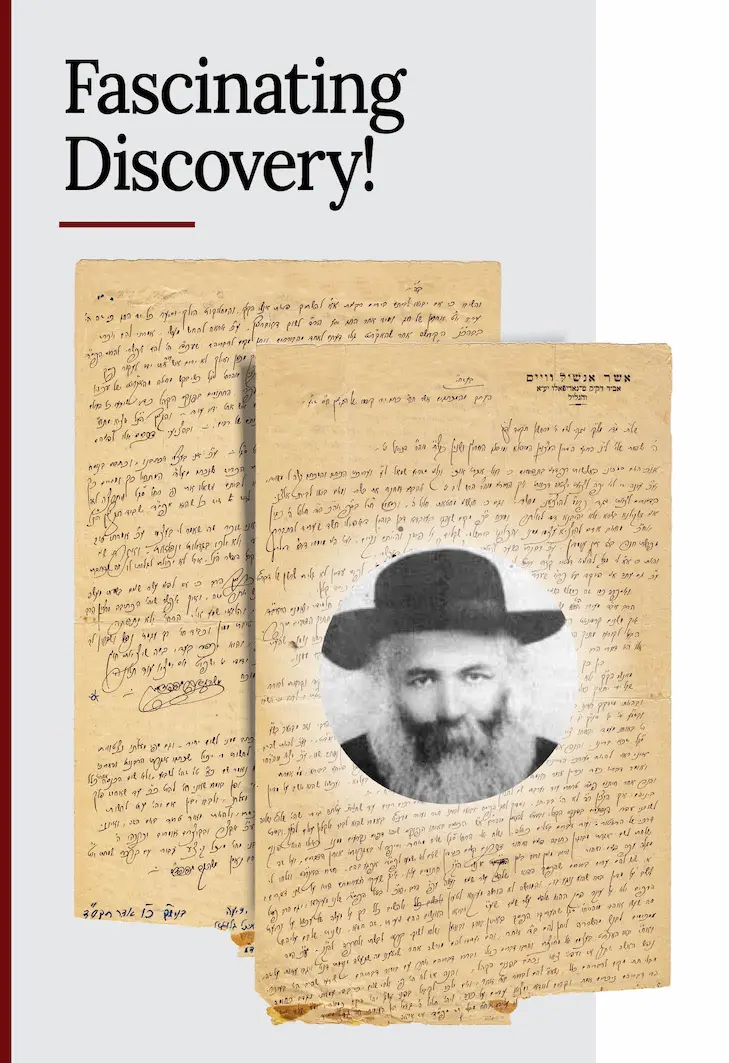
Handwritten & Autographed Kashrus Certificate by Rabbi Shimon Sofer, Av Beis Din
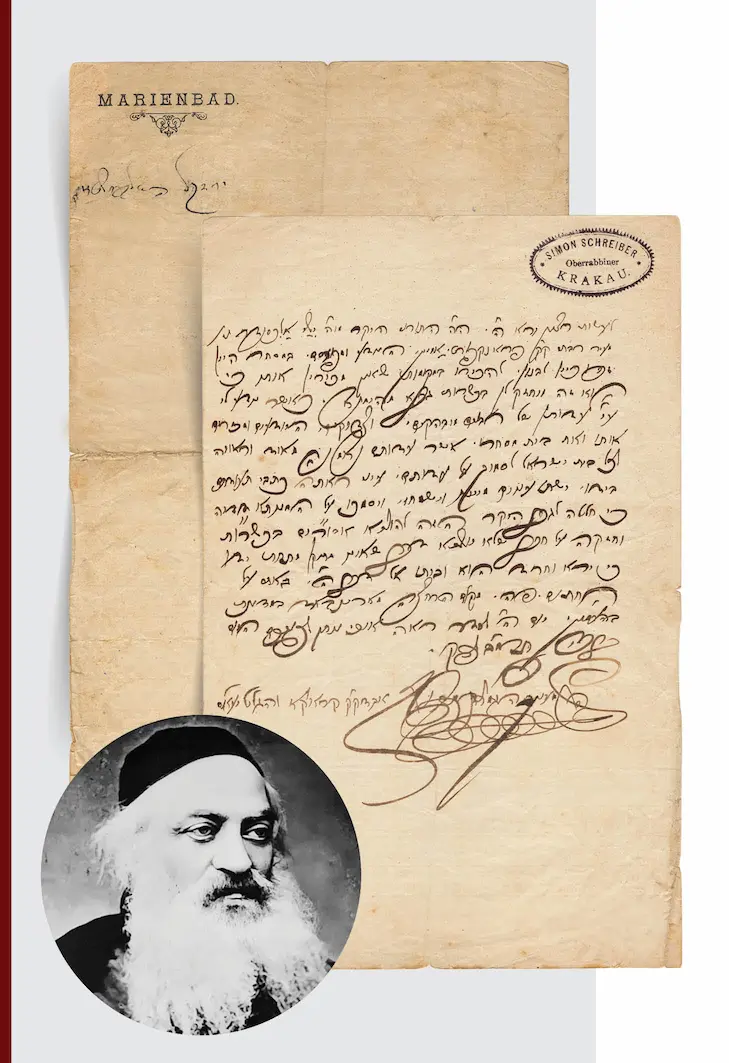
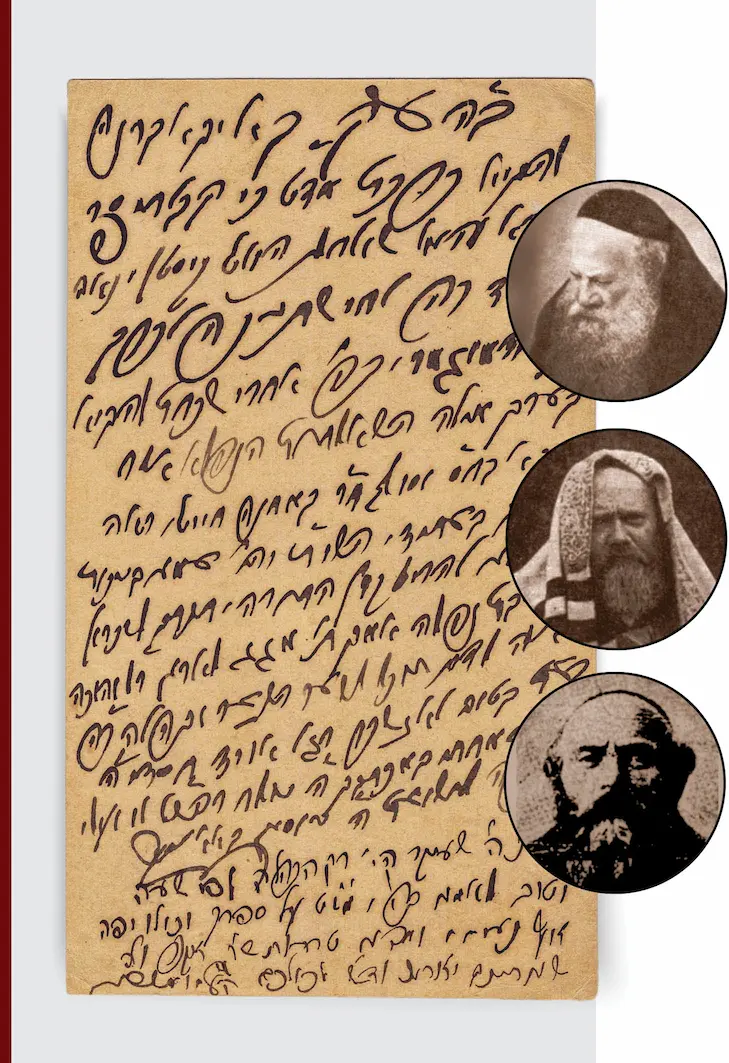
Handwritten & Autographed Kashrus Certificate by Rabbi Shimon Sofer, Av Beis Din of Cracow. Marienbad, 1882 Kashrus certificate for a wine store belonging to R’ Yishai Alexander of Frankfurt am Main, handwritten and autographed by Rabbi Shimon Sofer, Av Beis Din of Cracow and author of Michtav Sofer. In this kashrus certificate, Rabbi Shimon writes that he had received the testimony of “Outstanding rabbis and tzaddikim who are familiar with him and his store, whose statements are very reliable, and it is fitting for all the House of Israel to rely on their testimony.” And therefore… “Humble ones shall drink from his wine and rejoice.” The certificate was created and signed on “Thursday, Parshas Re’eh (25 Av, 5642), 1882 in the Marienbad resort area” approximately 6 months prior to the Michtav Sofer’s passing. The certificate is signed, “The humble Shimon son of Hagaon Mahara”m (Morenu Harav Moshe) Sofer zt”l, Av Beis Din of Cracow and its environs”. Rabbi Shimon Sofer (1821-1883), author of Michtav Sofer, was the son and disciple of his father the Chasam Sofer, perpetuating his sacred legacy of strengthening religious observance in the Diaspora. A genius who was fluent in both the Revealed and Hidden Torah, Rabbi Shimon Sofer was one of the foremost spiritual leaders of his generation, serving first as Rav and Av Beis Din in Mattersdorf and later in Cracow until his passing in 1883. His brilliance and versatile talents led him to serve as a member of the Austrian Parliament, where he acted as the liaison between the government and Jewish community. Marienbad, 1882. Stamped at top of the letter. Size: 23X14.5 Good condition. ............................................... . Any inquiries about this lot ? We are available also on WhatsApp >>>
Lot : 39

Manuscript on The Four Exiles. 4 Sides. Handwritten Manuscript by Rabbi Shmuel
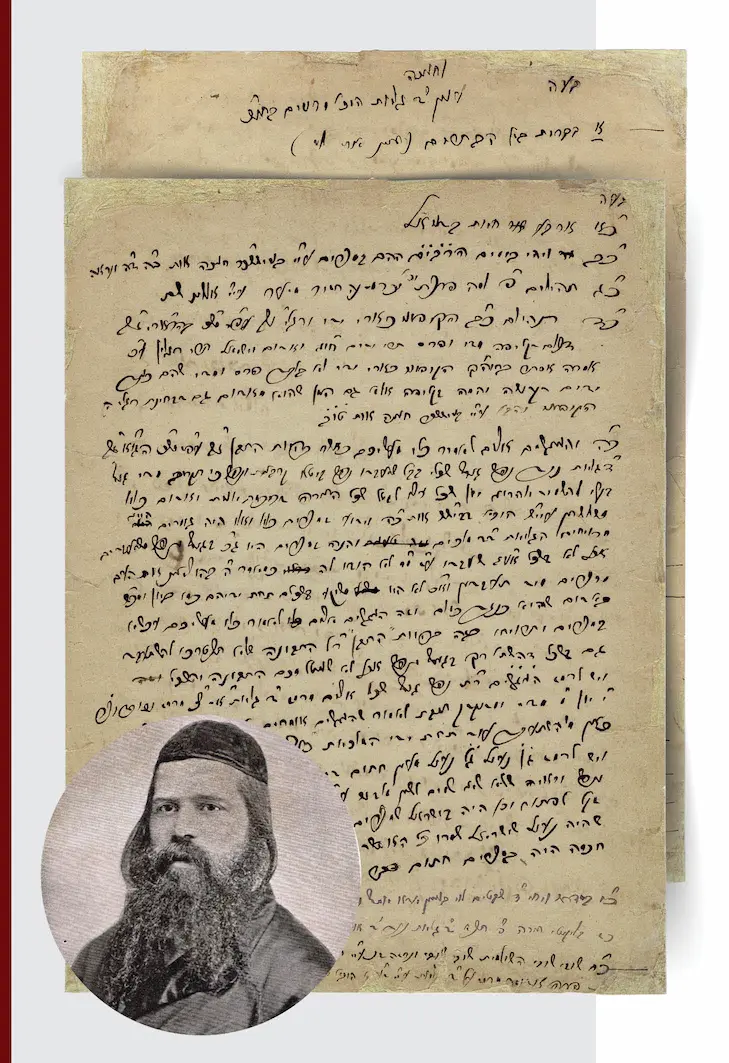
Manuscript on The Four Exiles. 4 Sides. Handwritten Manuscript by Rabbi Shmuel Ehrenfeld, Av Beis Din Mattersdorf Sources and commentaries on the four exiles that the Jewish People underwent at the hands of four different kingdoms by the holy hand of Rabbi Shmuel Ehrenfeld, Av Beis Din of Mattersdorf, beloved grandson of the Chasam Sofer and author of Chassan Sofer. The list is organized into 46 sections revealing a breathtaking knowledge of Midrashim, Rishonim, Achronim, Chassidic and Kabbalistic works. Rabbi Shmuel Ehrenfeld (1835-1933), Av Beis Din Mattersdorf and author of Chassan Sofer, was one of the greatest disseminators of Torah in his generation. He was the son of Rabbi Dovid Tzvi Ehrenfeld, a son-in-law of the Chasam Sofer and born through the blessing of his holy grandfather (see below). He was also the foremost disciple of his uncle the Ksav Sofer. The Chassan Sofer served as Av Beis Din in Betlen and Siksa, and then in the year 1876, was appointed rabbi of Mattersdorf. In 1874, he published his magnum opis Chassan Sofer, which awarded him wide recognition among the scholars of his generation. Rabbi Yosef Engel was very impressed with his sefer and studied it in its entirety. The Admor of Satmar, Rabbi Yoel Teitelbaum said that he studied the Chassan Sofer extensively in his youth and it guided him in his path of learning. His works were also published under the following titles, among others: Shu”t Chassan Sofer, Chassan Sofer al Orach Chaim, Chassan Sofer Al HaTorah. 4 sides. Page size: 28x22 cm. Light damage to margins with minor damage to text on one side. Professionally restored. “This is the child I have prayed for” The Chasam Sofer’s daughter Hindel did not have children for the first six years after her marriage. One day the Chasam Sofer heard her crying and reassured her that Hashem would have mercy on her. Upon Shmuel’s birth, the famous words of Chana were uttered: “El hanaar hazeh hispalalti”. The young Shmuel was like a beloved son to the elderly Chasam Sofer, who took great joy in his grandson and would bring him to the Beis Medrash and seat him on his lap (Chasam Sofer U’Talmidav p. 118). ............................................... . Any inquiries about this lot ? We are available also on WhatsApp >>>

Lot : 40

Autographed Semichah Letter by Rabbi Simcha Bunim Ehrenfeld, Av Beis Din of
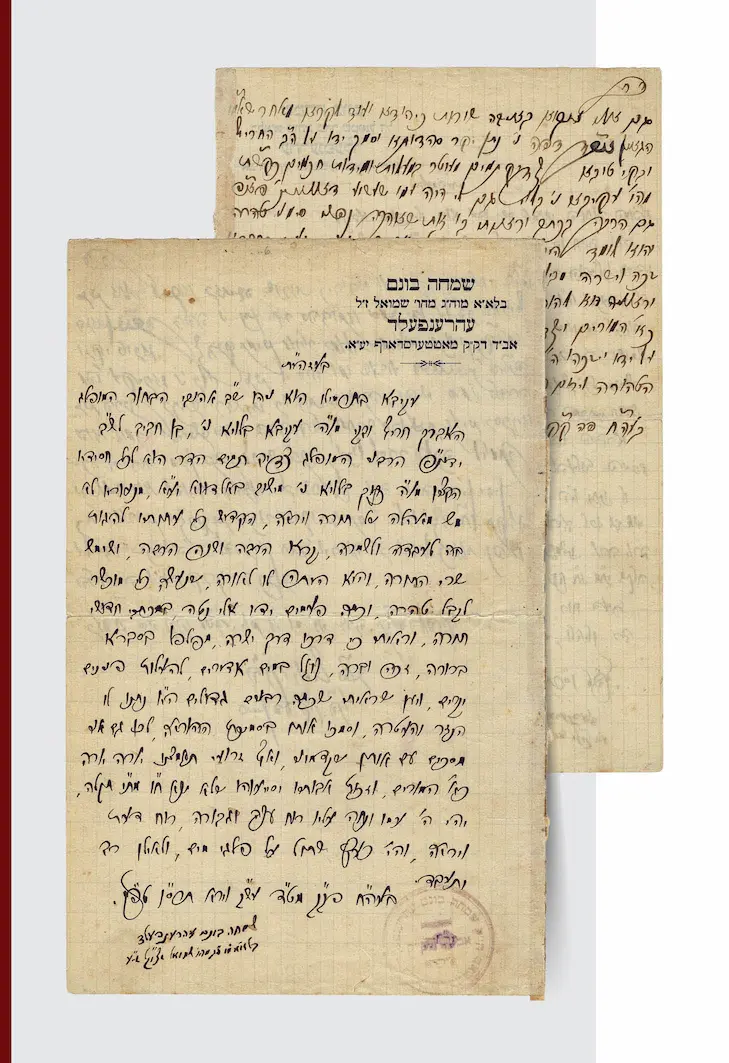
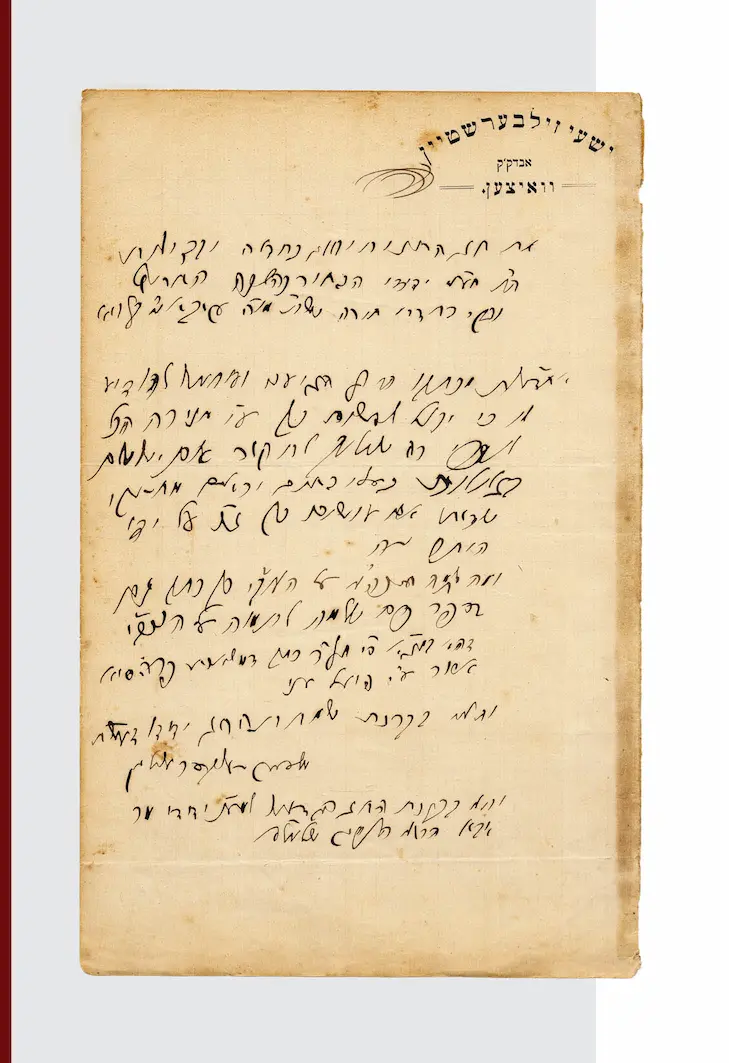
Autographed Semichah Letter by Rabbi Simcha Bunim Ehrenfeld, Av Beis Din of Mattersdorf and Author of Maaneh Simchah. Mattersdorf, 1906  Beautiful semichah letter written in verse and autographed by Rabbi Simcha Bunim Ehrenfeld, Av Beis Din of Mattersdorf and great grandson of the Chasam Sofer. On the verso is a semichah letter by Rabbi Yosef Pressburger, Raavad of Mattersdorf and author of Tiferes Yosef.  Rabbi Simcha Bunim Ehrenfeld (1856-1926), Av Beis Din of Mattersdorf and author of Maaneh Simchah, was the son and successor of the Chassan Sofer Rabbi Shmuel Ehrenfeld who was a son of Rabbi Dovid Tzvi Ehrenfeld, son-in-law of the Chasam Sofer. Rabbi Simcha Bunim, also known as the Mattersdorfer Rav, was a talmid of both his father and the Ksav Sofer. In 1883, he succeeded his father as Av Beis Din and Rosh Yeshivah of Mattersdorf. His written legacy includes Maaneh Simchah on various sugyos in Shas. Mattersdorf, 1906. Autographed personal stationery. Page size: 22x14 cm. Good condition. Rabbi Yosef Pressburger (circa 1847-1924) was the Raavad of Mattersdorf and a talmid of the Ksav Sofer, Mahari Asad and Rabbi Michael Pupa of Serdahel. He married the daughter of Rabbi Aharon Zinger, Raavad of Mattersdorf and a talmid of the Chasam Sofer, and succeeded his father-in-law in 1895. Rabbi Yosef lived a life of abject poverty and abstinence. His family history and chiddushim, entitled Tiferes Yosef, were printed by his son-in-law and successor Rabbi Yisrael Taussig, Dayan of Mattersdorf and Yerushalayim. ................................................ Any inquiries about this lot ? We are available also on WhatsApp >>>

Lot : 41

Handwritten Manuscript! Complete Volume of Handwritten Chiddushim of Rabbi Chaim Avraham Arnshtein,
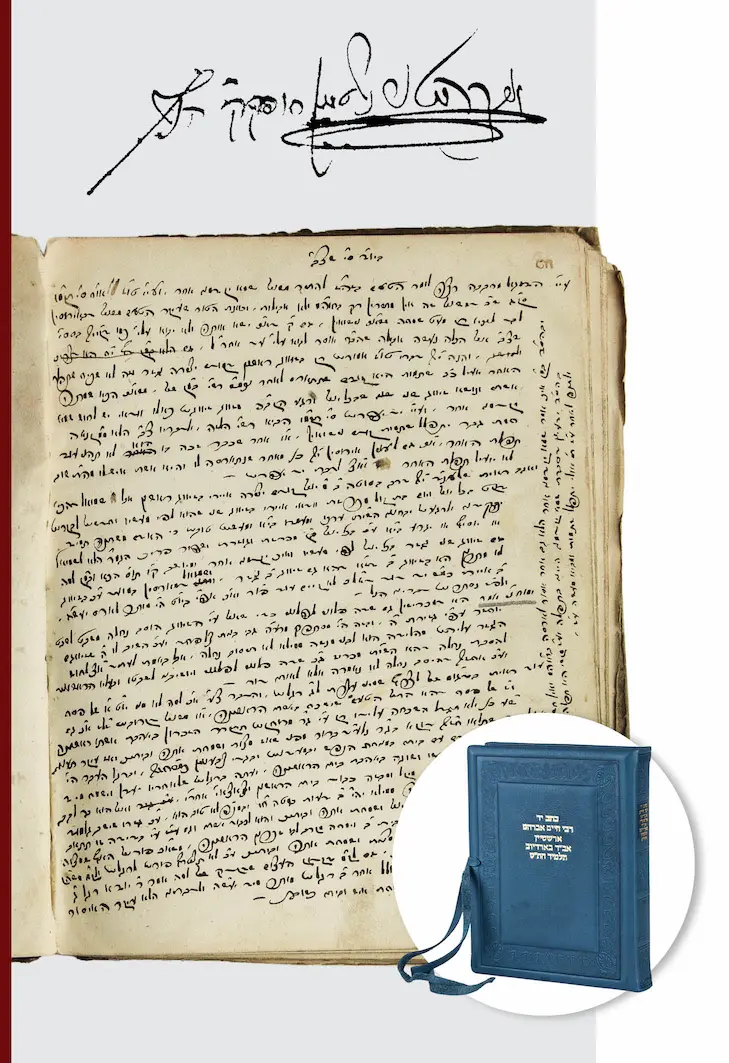
Handwritten Manuscript! Complete Volume of Handwritten Chiddushim of Rabbi Chaim Avraham Arnshtein, Av Beis Din of Bardiav and Disciple of the Chasam Sofer. Chiddushim and Torah lectures delivered in yeshivah by Rabbi Chaim Avraham Arnshtein, Av Beis Din of Bardiav. His autograph “Avraham Arnshtein” appears on the first page, whereas the name Chaim was added at the end of his life. Next to it appears a faded autograph: “Chaim Avraham”. The handwriting precisely matches the photocopy of his handwriting that appears in HaChasam Sofer U’Talmidav, p. 144. He quotes the Chasam Sofer in a number of places referring to him with the title “Maran” (64b, 78a). On leaf 74b, he cites a question of the Chasam Sofer. Rabbi Chaim Avraham Arnshtein (circa 1814-1871) Av Beis Din of Bardiav was a “famous genius and tzaddik and miracle worker” (Melitzei Eish). He was born in Pressburg and was a close disciple of the Chasam Sofer. The Chasam Sofer mentioned him in a letter to his future father-in-law, Rabbi Nosson Eliyahu Ehrman, Dayan of Irsha, “One of my special and elite disciples…I will not praise him at length. They will be fortunate to merit him, as he is especially gifted in Torah and crowned with yiras Shamayim…” (Igros Sofrim Vol 2 p. 26). He received semichah from the Chasam Sofer after his wedding. His friend, author of the Yalkut Eliezer, eulogized him saying, “He was a disciple of the Chasam Sofer and was also famous for his chassidus.” His widow married the Maharam Shick. There is a calendar of the molados for the year 1858 in the inner binding at the front of the manuscript. The inscription on the calendar says, “I calculated this calendar of the molados, with the help of Hashem, on the fourth day of Chanukah, 1857…” An index written in a different handwriting appears on the last page. The dates in the manuscript are between 1854-1858. 91 leaves, of which 25 are blank. Page size: 21x16 cm. Minor stains. Original worn binding. Complete Volume. For more information on the author see Divrei Avraham, Bnei Brak Edition, 1998, and Chasam Sofer U’Talmidav pp. 143-146 ................................................ Any inquiries about this lot ? We are available also on WhatsApp >>>

Lot : 42

Handwritten & Autographed Letter of Blessing by Rabbi Eliezer Zussman Sofer to
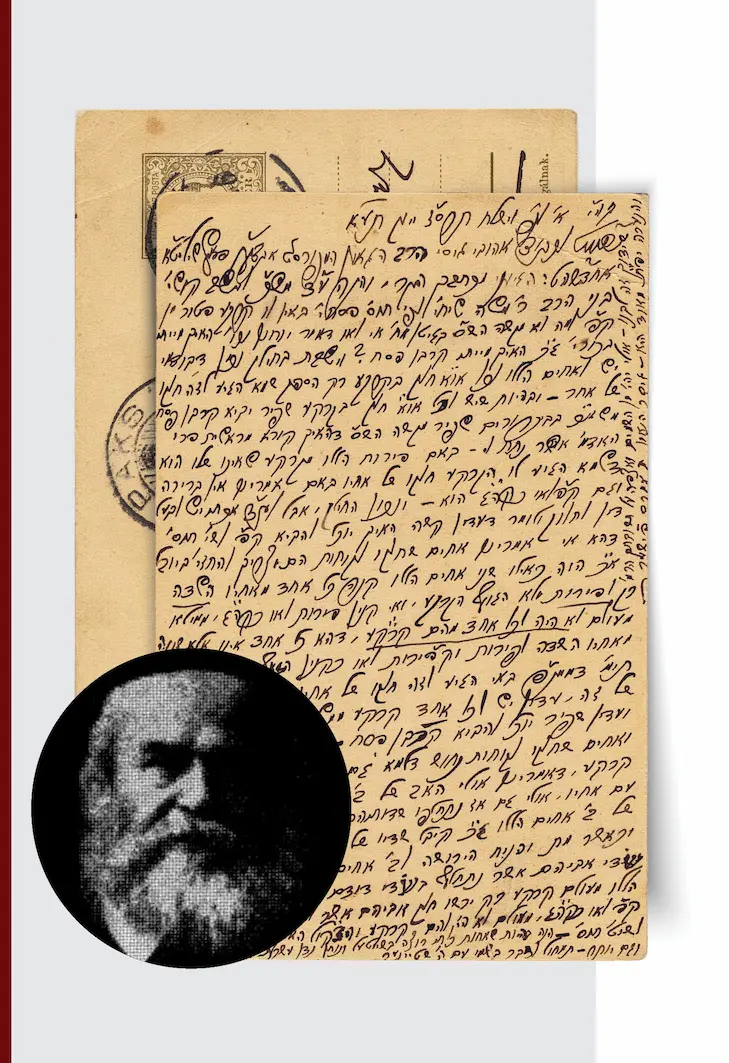
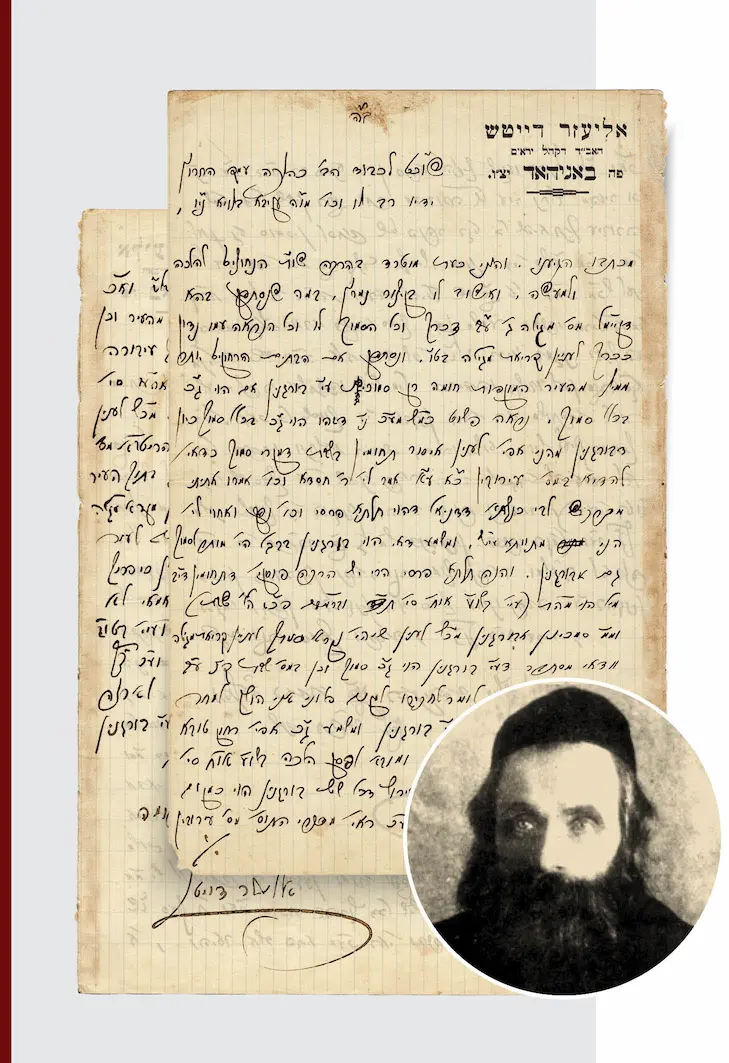
Handwritten & Autographed Letter of Blessing by Rabbi Eliezer Zussman Sofer to His Son Rabbi Yosef Leib. Paks, 1898 A handwritten and autographed letter replete with blessings and congratulatory words by Rabbi Eliezer Zussman Sofer, Av Beis Din of Paks and author of Yalkut Eliezer to his son Rabbi Yosef Leib Sofer, Av Beis Din of Derecske. The letter was written in honor of the publication of his son’s sefer Yalkut Sofer on Sefer Vayikra (Paks, 1898). In the letter, the father writes, “[I] come with joy and blessings of mazal tov, for I have received Sefer Vayikra… May you merit blessing upon its completion… May Hashem Yisborach be with us in the merit of our forefathers, to elevate the glory of Torah…” Later in the letter, the Yalkut Eliezer makes a point regarding the sefer and relates that his wife had recently fallen from the roof of their home, “and you can surely imagine the pain and alarm.” “The Sofer family is the famous, illustrious Rabbanim of Hungary, ” writes the Admor of Shinova in his approbation to the Yalkut Sofer on Shmos. Rabbi Eliezer Zussman Sofer (1825-1903) was Av Beis Din of Paks and author of Yalkut Eliezer and other famous sefarim. A venerable Hungarian sage and disciple of the Chasam Sofer, he was born in Pressburg and circumcised by the Chasam Sofer himself who taught him in his youth, although he absorbed the bulk of his Torah knowledge and wisdom from the Ksav Sofer and Maharam Schick. In 1886, he succeeded his father-in-law as Rav and Av Beis Din of Paks, Hungary, filling these noteworthy positions until his passing in 1903. He authored the 3-volume Yalkut Eliezer, Sefer Hamakneh and others. In the margins of the letter is a personal handwritten note from his son Rabbi Shmuel Binyamin Sofer (1873-1943). The latter authored Divrei Sofrim and succeeded his brother Rabbi Yosef Leib Sofer as Rav and Av Beis Din of Derecske. Paks, 1898. Postcard with postmarks from the cities of Paks and Derecske. Good condition. ............................................... . Any inquiries about this lot ? We are available also on WhatsApp >>>
Lot : 43

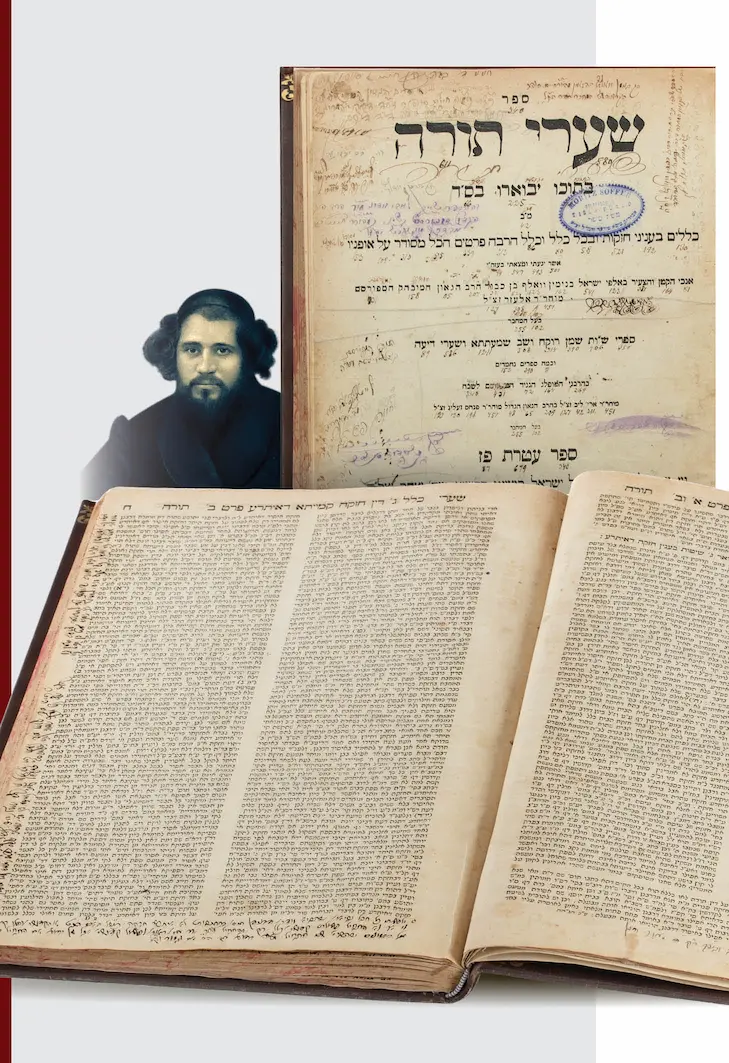
Shaarei Torah With Over 50 Handwritten Glosses by the Machaneh Chaim. First
Shaarei Torah With Over 50 Handwritten Glosses by the Machaneh Chaim. First Edition. Vienna, 1850 Sefer Shaarei Torah on the topic of chazakos by HaGaon Rabbi Binyamin Zev Wolf Loew of Verbov.  This sefer was the personal copy of his prime disciple, Rabbi Chaim Sofer, Av Beis Din of Munkacs and Budapest, who inscribed over 50 glosses and lengthy chiddushim in its margins! The title page bears his sacred autograph: “Hashem granted me this, the humble Chaim Sofer”. The same page also features his sons’ signatures. These glosses were written in great awe of his rebbi, Rabbi Binyamin Zev Wolf of Verbov, and some begin with the words, “And to me, the humble student, it appears that…” “I am as dust beneath the feet of my master and teacher, Hagaon z”l.” Whenever he seeks to resolve a question posed by Rabbi Binyamin Zev Wolf, he opens with “a request for forgiveness from the honor of his holy Torah.” According to the autographs and lists on the title page, this sefer was used extensively by the Machaneh Chaim for many years—from the period of his tenure as Rav of Bamberg to Munkacs and then to his final station in Budapest. This is also evident from the variations in the handwriting, some of which were clearly written in his younger years and others when he was already quite elderly. Unfortunately, the binder cropped the margins, and the majority of glosses are missing the last line or part of it. Rabbi Chaim Sofer (1822-1886), author of Machaneh Chaim, was born in Pressburg, his Bris was held on Yom Kippur and the Chasam Sofer served as his Mohel. At the age of 11, he was already accepted into the Chasam Sofer’s elite yeshivah and swiftly became one of his greatest talmidim.However, the Machaneh Chaim regarded Rabbi Binyamin Zev Wolf Loew, Av Beis Din of Verbov and author of Shaarei Torah as his primary spiritual master, and it was indeed the latter who conferred semichah and dayanus upon him, and loved him as a son. Rabbi Chaim Sofer often expressed that the Shaarei Torah’s blessing before their final parting escorted him throughout his life. In his teshuvos, the Machaneh Chaim frequently cites his rebbi’s sefer Shaarei Torah. Following the Chasam Sofer’s tradition, the Machaneh Chaim fiercely battled any attempt to introduce change or leniency into authentic Jewish tradition, and he was regarded as one of the greatest meishivim in all of Hungary. He served as Av Beis Din in Gyömöre, Sajószentpéter, and Munkacs, and was the Av Beis Din of Khal Adas Hayereim in Budapest, a position he accepted after the Chasam Sofer appeared to him in a dream and instructed him to accept the Rabbinate there. His written legacy includes the 8-volume Shu”t Machaneh Chaim. The Machaneh Chaim’s sons’ autographs appear on the title page: Rabbi Moshe Dovid Sofer (1861-1906), Av Beis Din of Sesregen Rabbi Yosef Tzvi Sofer (1860-1930), Av Beis Din of Shamshan Rabbi Binyamin Zev Wolf Sofer (d. 1925). After his signature, he notes that he was named after his father’s rebbi. Rabbi Akiva Yechezkel Sofer (d. 1902) The sefer also bears the stamp of Rabbi Moshe Sofer (1840-1907), Av Beis Din of Tissa-Fired, author of Maharam Sofer and a nephew and talmid of the Machaneh Chaim Vienna, 1850. First edition. [2], 163 leaves. Page size: 37.5 cm. Slight damage to several leaves; otherwise preserved in good condition, which is highly impressive given its extensive use. Attractive new leather binding. ................................................ Any inquiries about this lot ? We are available also on WhatsApp >>>

Lot : 44

Handwritten & Autographed Letter by Rabbi Amram Fischer, Av Beis Din of
Handwritten & Autographed Letter by Rabbi Amram Fischer, Av Beis Din of Yunk and Son-in-Law of the Yalkut Eliezer. Yunk, 1907 A letter abounding with chiddushei Torah by Rabbi Amram Fischer, Av Beis Din of Yunk, to his brother-in-law Rabbi Yosef Leib Sofer, Av Beis Din of Paks and author of Yalkut Sofer. Rabbi Amram Fischer (circa 1853-1925) was the son of Rabbi Akiva Fischer, Av Beis Din of Tet and author of Ateres Akiva. He was a talmid of the Ksav Sofer, Shevet Sofer and Rabbi Chaim Tzvi Mannheimer, Av Beis Din of Ungvar. Rabbi Amram married the daughter of Rabbi Eliezer Zussman Sofer, Av Beis Din of Paks, and settled near his illustrious father-in-law, accepting a position as dayan in the town of Halász. In 1879, he was appointed Av Beis Din of Yunk, a position he filled until his passing in 1925. His written legacy remains in Divrei Amram, printed within his father’s sefer, Ateres Akiva. Yunk, 1907. Postcard. Good condition. For further information press here............................................... . Any inquiries about this lot ? We are available also on WhatsApp >>>
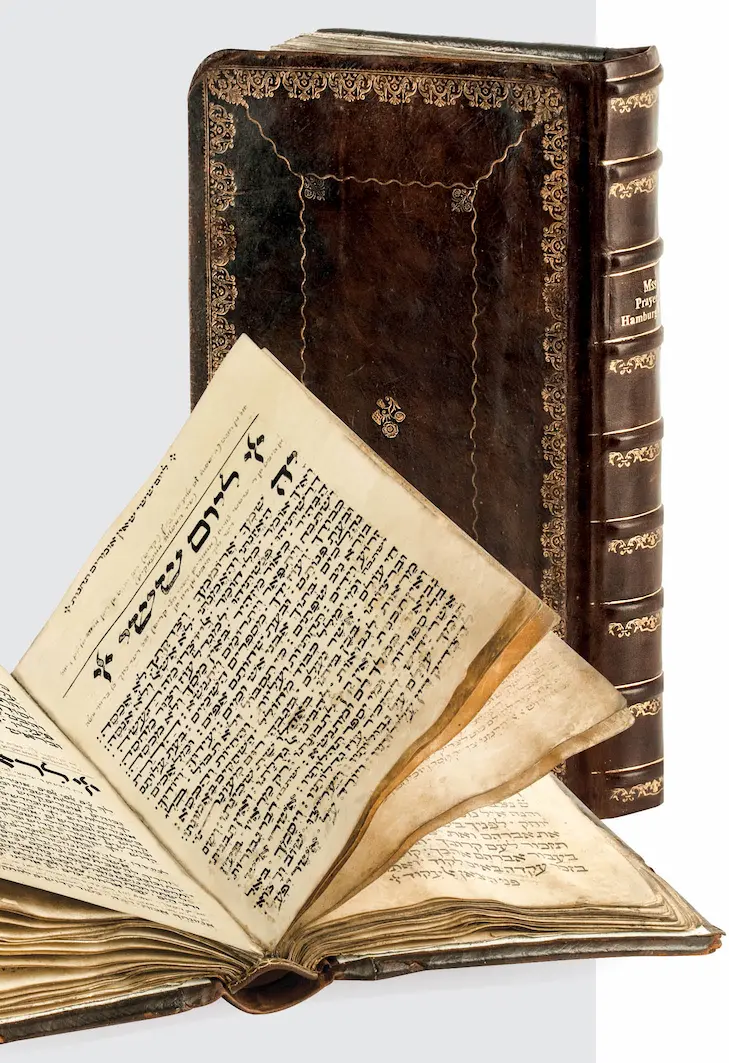
Lot : 45

Handwritten Drashah for 7 Adar, 1874 “I delivered this drashah in the
Handwritten Drashah for 7 Adar, 1874 “I delivered this drashah in the holy congregation of Ihel on 7 Adar, 5734.” This lecture, handwritten by Rabbi Yirmiyahu Loewe, Av Beis Din of Ihel, includes words of praise of the glory and greatness of Moshe Rabbeinu. In the past, it was customary for Rabbanim of Jewish congregations to deliver a drashah on the 7th of Adar, the yahrzeit of Moshe Rabbeinu. Rabbi Yirmiyahu Loewe (1811-1874), Av Beis Din of Ihel and author of Divrei Yirmiyah, was one of the great Hungarian sages of his generation. As a son of Rabbi Binyamin Wolf Loewe, author of Shaarei Torah, and grandson of the author of Shemen Rokach, he absorbed Torah and wisdom from his illustrious forebears. In 1844, he was appointed Av Beis Din of Magensdorf, and subsequently Av Beis Din of Verbov before succeeding his father as Rav and Av Beis Din of Ihel in 1856. Rabbi Yirmiyahu Loewe endeavored greatly to improve the lot of Hungarian Jewry. His written legacy includes Divrei Yirmiyah on the Rambam and Masechtos in Shas as well as several famous drashos. To the best of our knowledge, this drashah has never been printed. Ihel, 1874. [4] leaves; 7 handwritten sides. Page size: 25x19 cm. Good condition. New cloth binding. ............................................... . Any inquiries about this lot ? We are available also on WhatsApp >>>

Lot : 46

Fascinating Discovery! Long and Unknown Letter from the Chasam Sofer, Handwritten by
Fascinating Discovery! Long and Unknown Letter from the Chasam Sofer, Handwritten by Rabbi Asher Anschel Weiss, Author of Shemen Laminchah  Two letters from the Chasam Sofer written to Rabbi Daniel of Prositz, Raavad of Pressburg. The first letter contains fascinating content and is revealed now for the first time! The original letters of the Chasam Sofer were in the possession of the tzaddik Rabbi Asher Anschel Weiss, author of Shemen Laminchah, who personally rewrote them into the present letters. The top of the page features a title by Rabbi Asher Anschel: “Replica of the letters held in my possession, inscribed by the sacred hand of the gaon the Chasam Sofer zy”a”. 1. The first letter regards a dispute that took place in 1804 in Eisenstadt. When the wife of a community dignitary acted disrespectfully toward the leaders of the Eisenstadt community. The leaders then recorded the episode in the community’s ledgers, bringing shame to the woman and her family. However, the husband deviously tore the page out of the ledger, and when his action was revealed, it spurred a furious dispute. The Chasam Sofer was among those chosen to arbitrate the case. The Rabbanim ruled in his favor, being that it was wrong to record the episode in the community ledgers, especially after the woman expressed her regret and paid a penalty fee. The verdict was published in Kovetz Teshuvos Chasam Sofer Ch, 92 (Jerusalem, 1973) (photograph attached). Although the verdict was delivered the dispute continued, and the parties approached Rabbi Daniel of Prositz who in turn, appealed to the Chasam Sofer.  The Chasam Sofer was reluctant to get involved and expressed “I despise getting involved in such matters” and adds that it causes him “distress and heartache” However, in order to avoid a potential chillul Hashem and to fulfill the obligation of “And you shall be clean in the eyes Hashem and Yisrael”, the Chasam Sofer agreed to respond to Rabbi Daniel.  However, he strongly instructed, “ I command you not to remove this letter from your possession under any circumstances, ever.”  This letter is a compelling lesson in Torah leadership and spiritual guidance as the Chassam sofer displays an uncompromising commitment to the letter of Halacha on one hand and compassion and nobility on the other.  This letter was never printed, and it is the first time that it is being revealed! 2. Letter written in 1807 regarding accepting the Rabbinate in Pressburg. This letter was printed in Igros Sofrim Letter 8. Rabbi Asher Anshel Weiss Hy”d (1882-1904), Av Beis Din of Nagyfalu, was a disciple of the Shevet Sofer and Arugas Habosem and one of the great Torah luminaries and Poskim in Transylvania, who disseminated the teachings of his masters to thousands. He was renowned for his expertise regarding gittin and agunos, along with his incredible breadth of knowledge of the works of the Rishonim and Achronim. He taught Torah for many years in Ihel before accepting the position of Rav in Nagyfalu. Rabbi Asher Anshel Weiss was murdered al kiddush Hashem by the Nazis, yet his legacy remains in the collections of letters printed as the 3-volume Shemen Laminchah al HaTorah V’sugyos Shas. [1] leaf. Page size: 33x21. Double-sided, written on Rabbi Asher Anschel’s personal stationery. Small tear on bottom line of front page with several words missing.  see 1st verdict describing the case ............................................... . Any inquiries about this lot ? We are available also on WhatsApp >>>
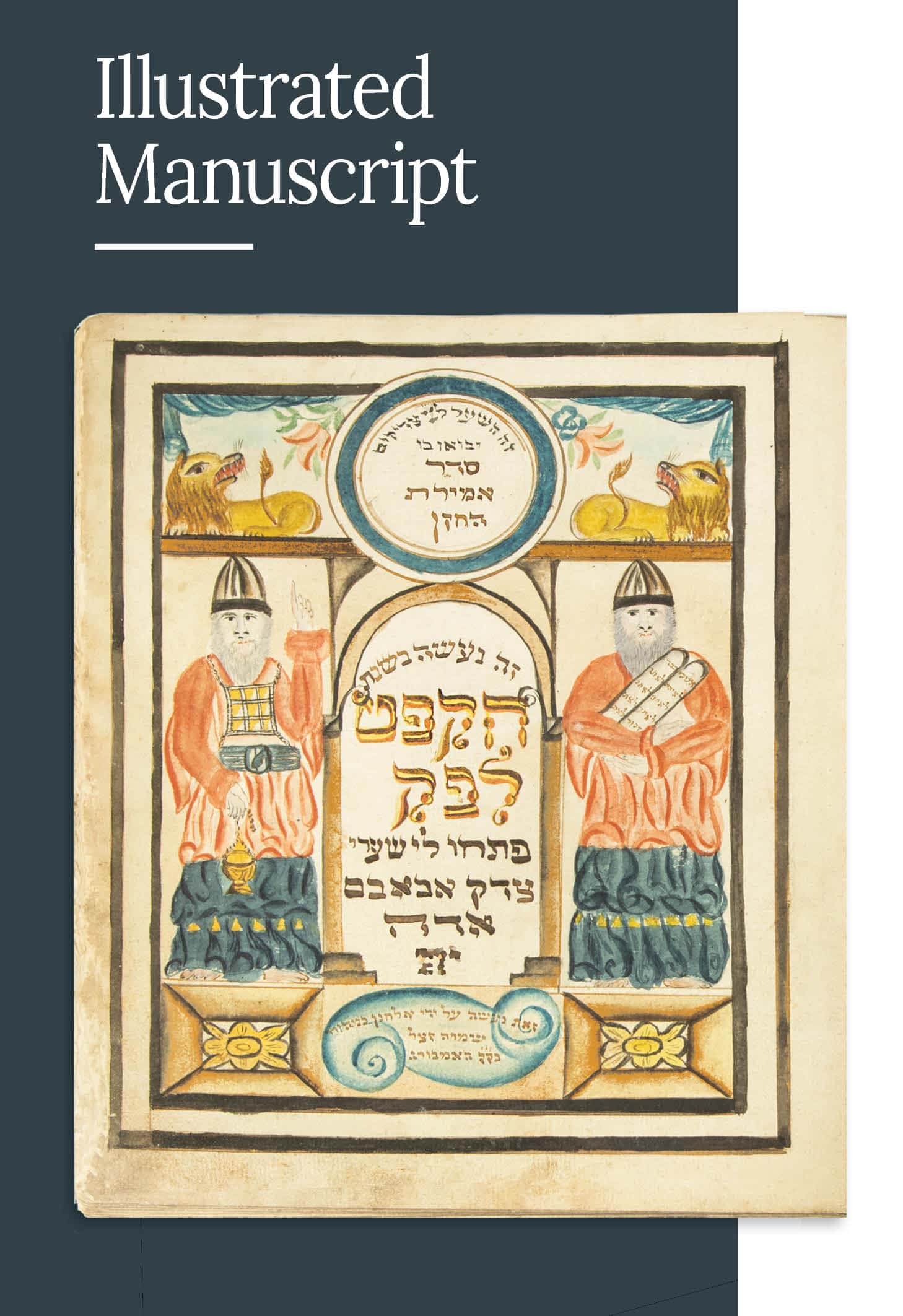
Lot : 47

Handwritten Halachic Teshuvah by Rabbi Yeshaya Zilberstein, Av Beis Din of Weitzen
Handwritten Halachic Teshuvah by Rabbi Yeshaya Zilberstein, Av Beis Din of Weitzen & Author of Maase Lamelech Handwritten halachic teshuvah by Rabbi Yeshaya Zilberstein, Av Beis Din Weitzen, regarding work on Chol Hamoed. Rabbi Yeshaya Zilberstein, Av Beis Din of Weitzen (1857-1930), Author of Maase Lamelech on the Rambam,   was the son of the Shvilei Dovid and a leading Hungarian Rabbi who served as Rav of Weitzen for forty-six years. Already in his early youth, he corresponded with the greatest Torah luminaries of his times, among them Maharam Schick and Maagalei Tzedek. Throughout his life, he fought to uphold Orthodox tradition and strongly opposed the rising Neolog movement. [1] leaf, undated. Written on stationery. Page size: 23x14 cm. Good condition. ............................................... . Any inquiries about this lot ? We are available also on WhatsApp >>>
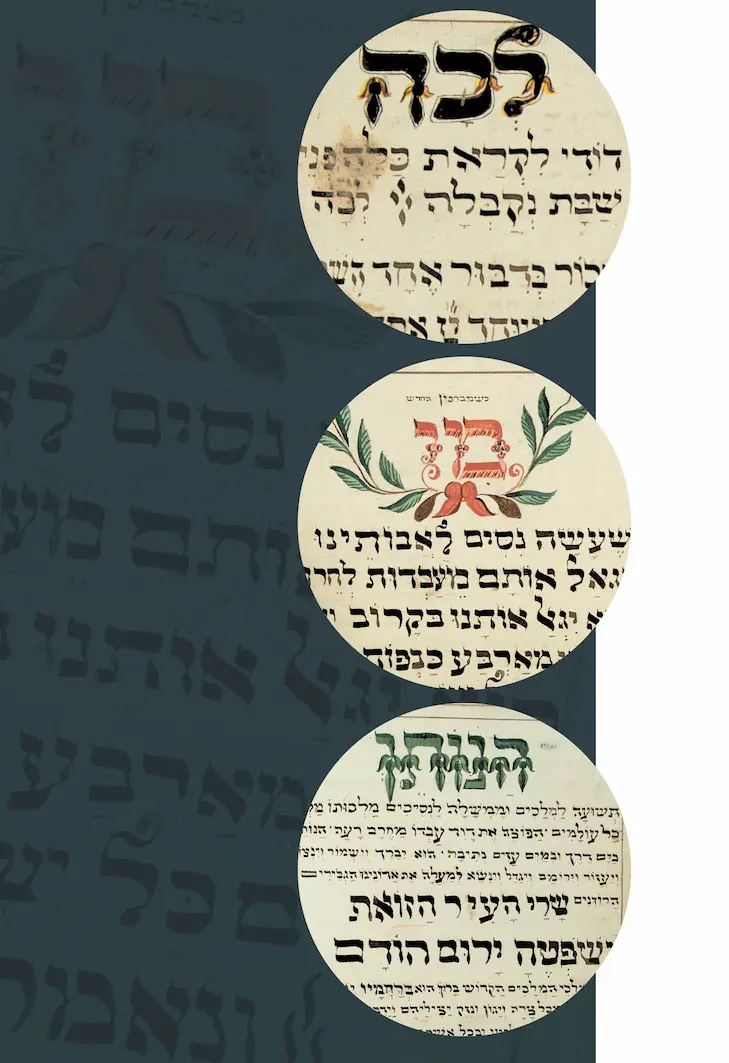
Lot : 48

Letter of Chiddushei Torah by Rabbi Eliezer Deitsch, Av Beis Din of
Letter of Chiddushei Torah by Rabbi Eliezer Deitsch, Av Beis Din of Bonyhad & Author of Pri Hasadeh. 1908 Letter signed by Rabbi Eliezer Deitsch, Av Beis Din of Bonyhad,   replete with divrei Torah and practical halachic ramifications regarding the definition of “near the walled city" as to what date to practice purim.  To the best of our knowledge, this letter was never printed. Harav Eliezer Deitsch (1850-1916) served as Av Beis Din of Bonyhád and was revered as one of the prominent sages in Hungary. He received letters and questions from across the Jewish world and authored myriad halachic teshuvos. He was a disciple of Rabbi Yehuda Assad and Rabbi Menachem Eisenstad(Ash), and in the course of his studies in Ungvar, dwelled in the home of Rabbi Shlomo Ganzfried, author of the Kitzur Shulchan Aruch, whom he assisted in his writings. In 1897, he was appointed Rav of Bonyhad where he founded a prominent yeshivah. Rabbi Eliezer Deitsch’s celebrated works include the 4-volume Shu”t Pri Hasadeh, 6-volume Tevuas Hasadeh and others.  Paks, 1908. Double-sided, handwritten letter. Page size: 23x14 cm. Good condition. ............................................... . Any inquiries about this lot ? We are available also on WhatsApp >>>

Lot : 49

Sefer Zohar. Shapira Edition. Slavita (1824-1827) Three Magnificent Volumes on Green Paper
Sefer Zohar. Shapira Edition. Slavita (1824-1827) Three Magnificent Volumes on Green Paper  Zohar by the Tanna Rabbi Shimon Bar Yochai.  Printed by Rabbi Avraham Shmuel Shapiro ben Rabbi Moshe Shapiro, Av Beis Din of Slavita. The sefer includes the approbation of the Ohev Yisrael, as presented below. It was written on the 9th of Tammuz 1824, a mere 9 days before his passing. “… [printed] in the printing press of Slavita with a generous and discerning eye…the son of Rabbi Moshe Shapiro, Av Beis Din of Slavita. Hashem has helped him succeed in beautifying his sefarim. How good it is that he now wants to reprint the Zohar, so I warn others, lest anyone impinge on his rights…and he who heeds will be blessed…Avraham Yehoshua Heschel of Apta, here in Mezibuzh.” Slavita, 1824-1827 Vol. 1 (Bereishis) 1824: [4] 252, 2-17 leaves. Vol. 2 (Shmos) 1824 [1], 17,19-278 leaves. Vol 3. (Vayikra, Bamidbar, Devarim) 1827 115; [1], 117-309 leaves. Page size: 21.5 cm. 3 volumes with 3 title pages in red ink and additional internal title pages for Bamidbar and Devarim. All volumes are perfectly intact. Professional restoration of margins on first pages in all 3 volumes. Partial leather binding “All those who fear Hashem should try to acquire old printings of sefarim, which were mostly printed by G-d fearing Jews, especially those of the Slavita and Zhitomir printings, printed by the grandsons of the Rabbi of Koritz, exceptionally holy printers” (Taharas Hakodesh by the Shomer Emunim ch. 6). ............................................... . Any inquiries about this lot ? We are available also on WhatsApp >>>
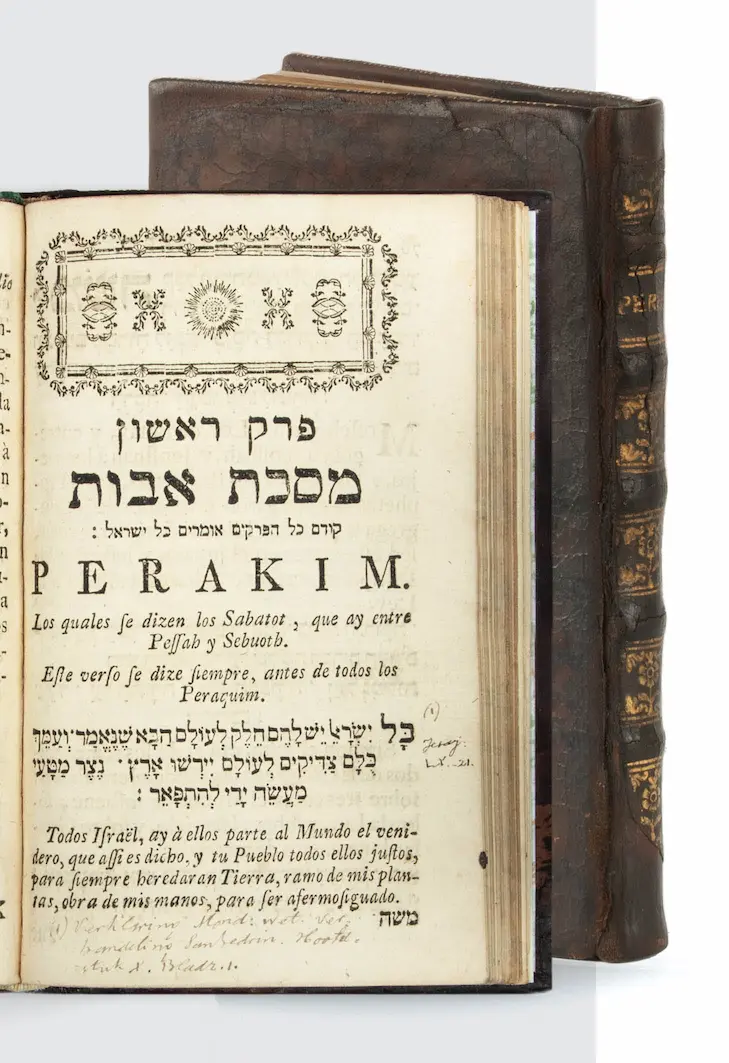
Lot : 50

The first Zohar printed in Eretz Yisrael! Zohar. Jerusalem, 1844-1846. Complete Set.
The first Zohar printed in Eretz Yisrael! Zohar. Jerusalem, 1844-1846. Complete Set. Sefer Zohar by the holy Tana Rabi Shimon Bar Yochai with the glosses and commentaries of the Ramaz and the Chida. 4 volume set completely intact, bound in new matching bindings. Printed by Rabbi Yisrael Beck, the first printer in Jerusalem. In his introduction he lists 11benefits of this particular edition, the 11th being “that it was printed in a holy city by Jews who are a holy nation” With approbations by the Rishon Letziyon Rabbi Avraham Chaim Gegin Vol. 1 and Rabbi Chaim Palagi Vol. 3. “Eretz Yisrael is the innermost part of the world, and outside of Eretz Yisrael is the external part of the world, and therefore all of the innermost parts of Torah are revealed in EretzYisrael, meaning the Zohar, with tikkunim and all the writings of the Arizal” (Rabbi Pinchas of Kortiz, Imrei Pinchas Hashalem p. 213). Jerusalem. 1844-1846. Vol. 1: [6], 252, 2-19 leaves. Vol. 2: 279 leaves. Vol. 3: 115 leaves. Vol 4.:[1], 117-318 leaves . Vol. 1 has two title pages. Beautiful white paper; margins of several leaves have been restored. S. Halevi, Sifrei Yerushalayim Harishonim # 35, 27, 22. Item description from the 'William L. Gross Collection' ................................................ Any inquiries about this lot ? We are available also on WhatsApp >>>
of 3 pages