









To attend this auction live or leave absentee bids
Lot : 38
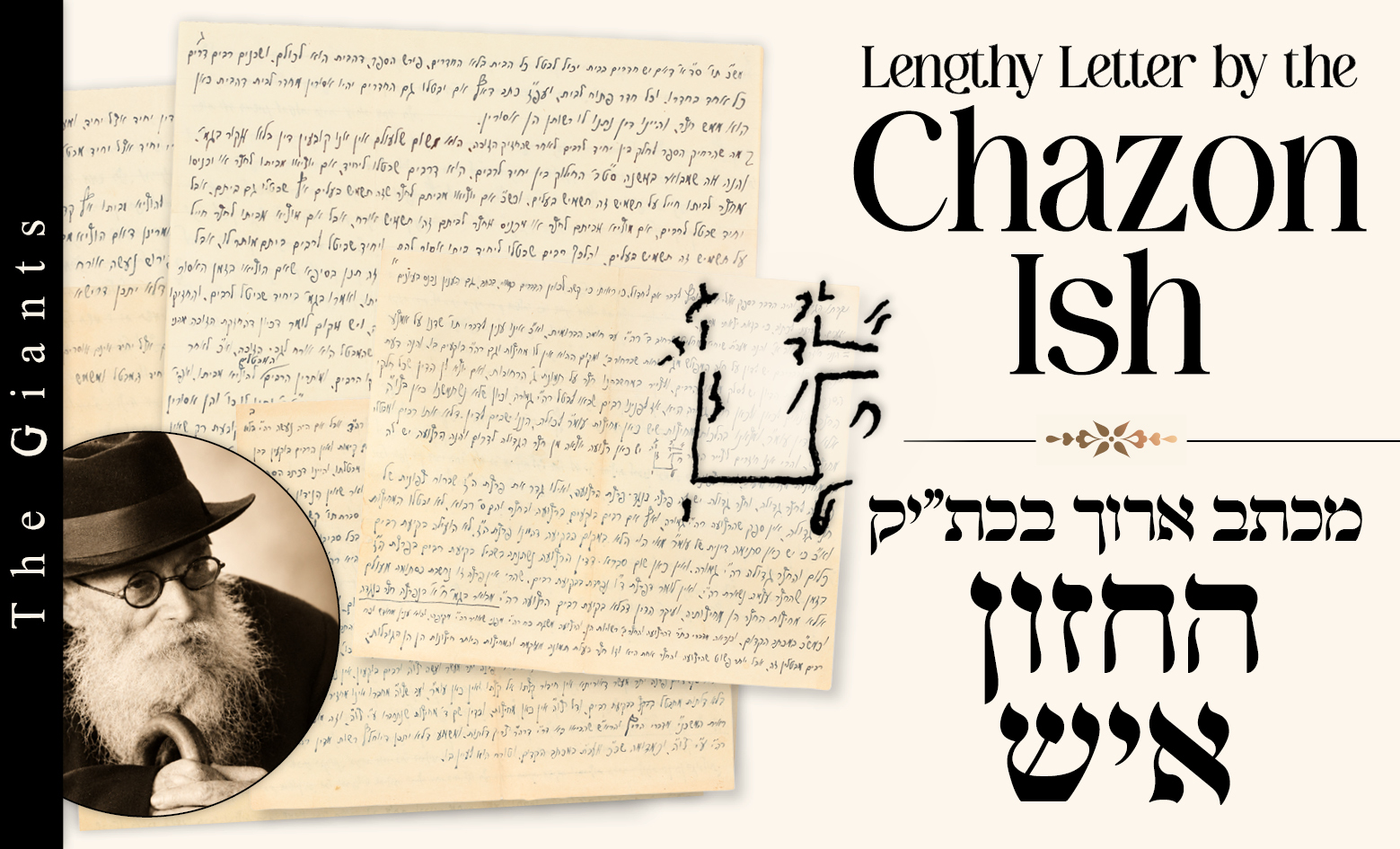
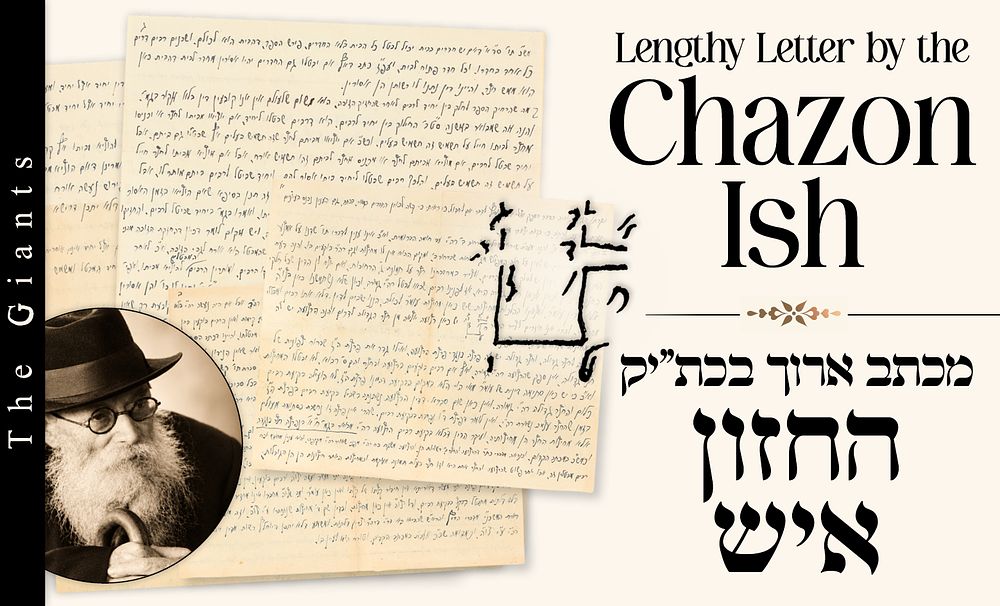
Lengthy and Detailed Letter on Eruvin with a Hand-Drawn Diagram by the Chazon Ish
Lengthy and Detailed Letter on Eruvin with a Hand-Drawn Diagram by the Chazon Ish
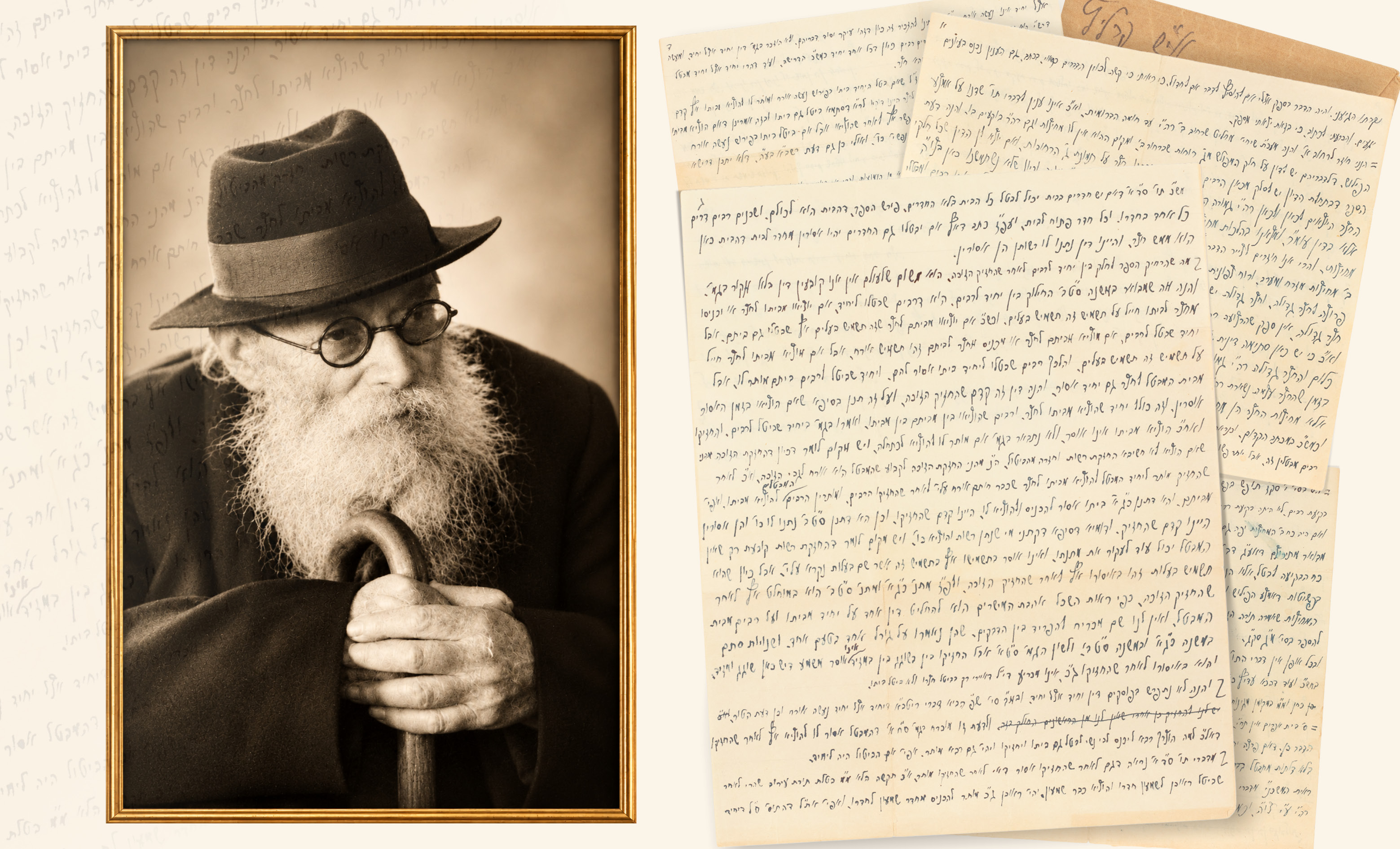
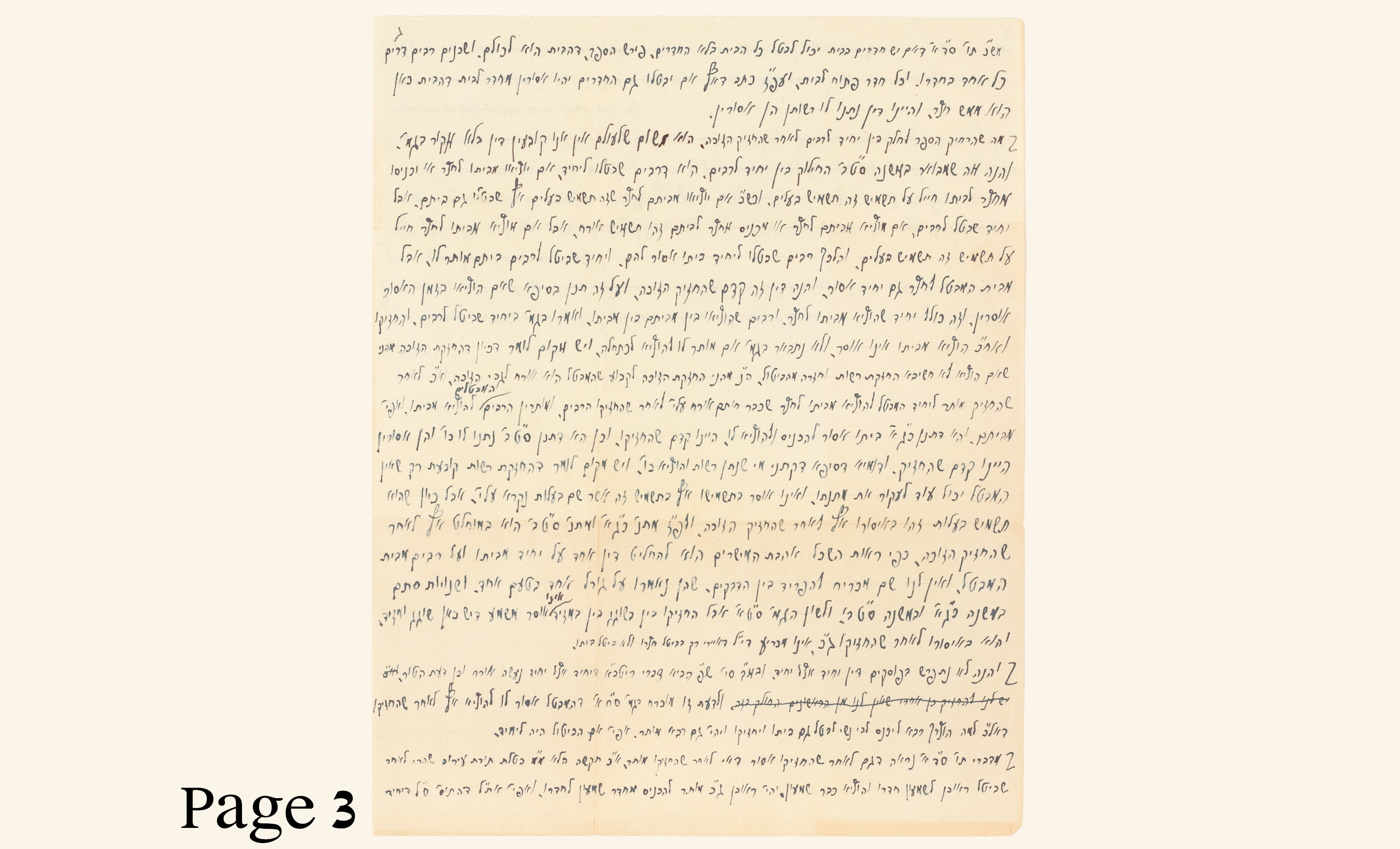
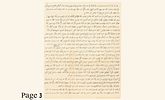
Four full pages in the handwriting of the Chazon Ish – Rabbi Avraham Yeshaya Karelitz.
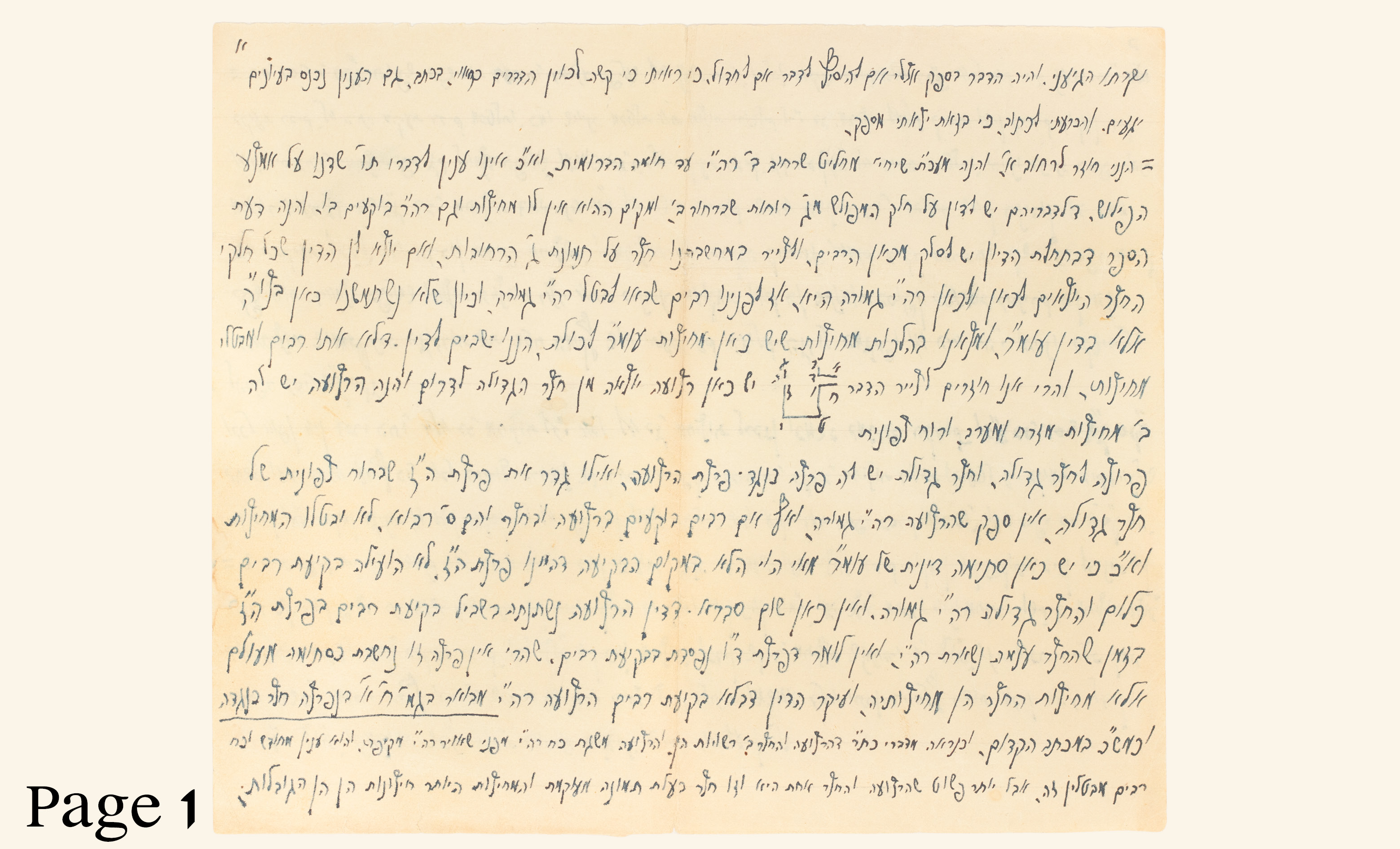
To clarify his words, the Chazon Ish drew a geometric diagram within the text of the letter.
The letter was written in response to comments on his sefer Chazon Ish on Eruvin. In it, the Chazon Ish explains and defends passages from his work, and the letter has since been extensively discussed and analyzed by contemporary Torah scholars.
He opens the letter with the words: “I received your letter and hesitated whether to continue our exchange, for I realized how difficult it is to express these complex ideas in writing, as the subject demands deep analysis. In the end, I decided to write, believing this was the proper course.”
The laws of Eruvin are one of the most intricate and complex areas of halachah. The Chazon Ish devoted exceptional effort to mastering this subject, clarifying many of its most challenging questions and establishing new halachic principles in his landmark sefer Chazon Ish on Eruvin (Vilna, 1929). After settling in Eretz Yisrael, he played a central role in the establishment and supervision of eruvin in towns and agricultural communities.
Page Count: [2] leaves, comprising four written pages. One leaf measuring 16 × 19 cm, the second 19 × 25 cm. Altogether, 70 generously spaced lines, including the original envelope, addressed and signed: "IS”H. Karelitz, Bnei Brak." .
Condition: Good. Published in Chazon Ish – Shu"t VeChiddushim (Bnei Brak, 2016).
The Diagrams in the Chazon Ish’s Sefarim
The Chazon Ish’s diagrams on the laws of the calendar and eruvin are well known. However, unlike the illustrations in his printed sefarim, which were executed by others according to his instructions, the diagram found here was drawn by the Chazon Ish himself in his own handwriting!
Saved Through His Study of Eruvin
The Chazon Ish once related that during the war, while in Minsk, he had no passport, and anyone caught without one was immediately executed. When he heard that soldiers had entered the city searching for such people, he fled — but mistakenly ran toward the very place where the soldiers were stationed. They stood in two rows, and he walked directly between them. Astonishingly, no one stopped him. After passing through, he escaped safely. He later remarked that he had been certain that he would be spared because he had just completed writing his sefer on Eruvin (Orchos Yosher, Rabbi Chaim Kanievsky, entry “Hashgachah, ” p. 27).
On another occasion, while pointing to a particular passage in his chiddushim on Maseches Eruvin, he told his disciple Rabbi Shlomo Cohen: “I thought of this chiddush in a cellar in Stowbtsy while bullets were flying over my head” (ibid., vol. I, p. 19).
Three Consecutive Years Studying Maseches Eruvin
Rabbi Chaim Brim recounted that it took the Chazon Ish three months merely to gain an initial grasp of Maseches Eruvin — what he called “the first entry into Eruvin.” Yet, from that point on, he studied with such enthusiasm and vigor that for three consecutive years he maintained the same intensity with which a yeshiva student learns a four-hour seder — or an exceptional masmid studies for six hours. After completing his study of Maseches Eruvin, however, the Chazon Ish was so exhausted that he remained physically weak for an entire year (ibid., vol. VI, p. 34).
_____________
Transcript of the Letter:
Page 1
I received your esteemed letter. I was uncertain whether to continue discussing the matter or to leave it, since I saw how difficult it is to express these points properly in writing, and the matter also involves laborious analysis. I ultimately decided to write, for in this way I will have resolved my uncertainty.
I return now to Street A. His Honor concludes that Street B is a reshus hayachid as far as the southern wall. If so, this has no bearing on the words of Tosafos, who discuss the middle of the thoroughfare. According to their view, the question would concern the section of Street B that is open on three sides. That area has no partitions, and the public passes through it.
The approach of the sefer is that, at the outset of the discussion, we must disregard the people passing through and picture in our minds a courtyard shaped like the three streets. If the resulting halachic conclusion is that all the sections of the courtyard extending in the various directions constitute a full-fledged reshus hayachid, then what we have before us is a case of the public coming to nullify an established reshus hayachid. Since we have not relied here upon a tzuras hapesach, but rather upon the principle of omed merubeh, and we find under the laws of partitions that there are sufficient standing partitions here—omed merubeh—for the entire area, we return to the principle that the public cannot come and nullify the partitions.
Let us picture the situation again. There is a strip extending southward from the large courtyard. This strip has two partitions, to the east and west, while its northern side is open to the large courtyard. The large courtyard, in turn, has an opening directly opposite the opening of the strip. If the opening marked H-Z on the northern side of the large courtyard were fenced in, there is no question that the strip would constitute a full-fledged reshus hayachid. Even if the public passed through both the strip and the courtyard, and numbered 600,000, they would not nullify the partitions.
If so, what difference does it make that the closure here is a halachic one, by virtue of omed merubeh? At the point where the public passes — namely, the opening H-Z — their passage has accomplished nothing whatsoever, and the large courtyard remains a full-fledged reshus hayachid. There is no reason whatsoever to say that the status of the strip should change because the public passes through the opening H-Z while the courtyard itself remains a reshus hayachid.
Nor can it be said that the opening D-V is invalidated by the public passing through it, since this opening was never regarded as closed. Rather, the partitions of the courtyard serve as its partitions. The fundamental principle that, in the absence of public traffic, the strip constitutes a reshus hayachid is explicit in the Gemara, 8a, in the case of a courtyard that was breached opposite it, as I wrote in my previous letter.
It appears from His Honor’s words that the strip and the courtyard are two separate domains, and that the strip acquires the status of reshus hayachid because it is surrounded by the airspace of a reshus hayachid. This would be a novel concept, which public traffic could perhaps nullify. It is far simpler, however, to understand the strip and courtyard as a single entity: one courtyard of an irregular shape, whose boundaries are formed by its outermost partitions.
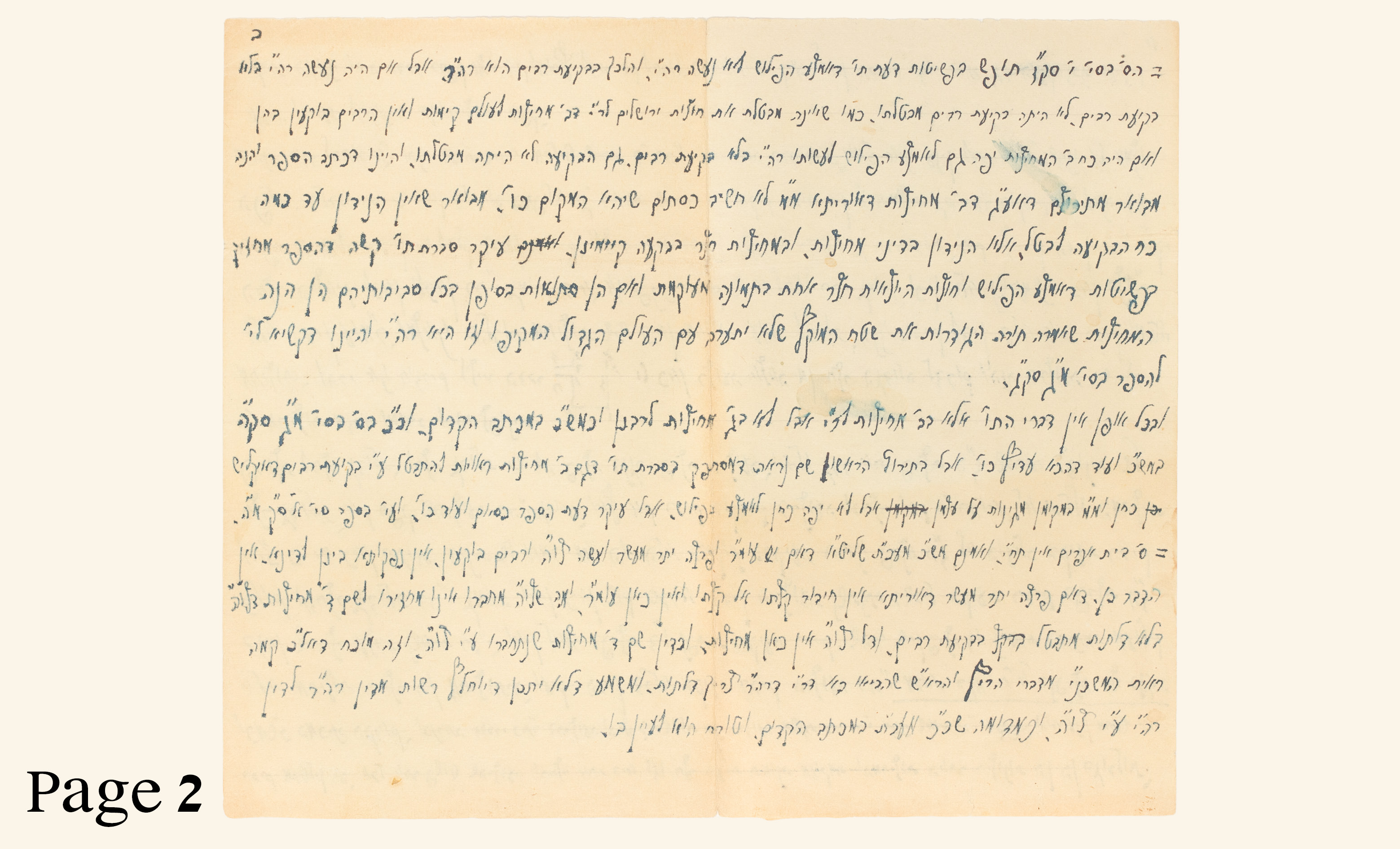
Page 2
In siman 10, se’if katan 4, the sefer takes it as obvious that Tosafos maintains that the middle of the thoroughfare does not become a reshus hayachid, and therefore, when the public passes through it, it is a reshus harabim. But if it would have become a reshus hayachid in the absence of public traffic, then public traffic would not nullify that status, just as, according to Rabbi Yehudah, it does not nullify the status of the streets of Yerushalayim. The two partitions always remain in place, and the public does not pass through the partitions themselves.
If the force of the two partitions were sufficient to make even the middle of the thoroughfare a reshus hayachid in the absence of public traffic, then public traffic would likewise not nullify it. This is what the sefer means when it writes: “It is evident from their answer that although two partitions are valid by Torah law, nevertheless they are not considered closed so as to render the area…” It is clear, then, that the issue is not how powerful public traffic is in nullifying the partitions; rather, the issue concerns the laws governing partitions themselves, and we are dealing here with the partitions of a courtyard in an open area.
The underlying reasoning of Tosafos is indeed difficult, for the sefer clearly assumes that the middle of the thoroughfare together with the streets extending from it constitute a single courtyard of an irregular shape. If those streets are closed at their ends on all sides, those very closures are the partitions prescribed by the Torah, enclosing the entire area so that it does not merge with the larger world surrounding it. That is precisely what constitutes a reshus hayachid. This is the difficulty raised by the sefer in siman 107, se’if katan 3.
In any event, the words of Tosafos apply only to two partitions according to Rabbi Yehudah, but not to three partitions according to the Rabbanan, as I wrote in my previous letter. The sefer likewise writes this in siman 107, se’if katan 5, in the passage beginning, “Furthermore, here the case is stronger…” In its first answer there, however, it appears uncertain regarding the reasoning of Tosafos: perhaps even the effectiveness of two partitions can be weakened by public traffic. They nevertheless protect the areas where the partitions themselves stand, but their force is insufficient to extend to the middle of the thoroughfare. The sefer’s primary conclusion, however, is the final answer beginning, “Furthermore…” See also the sefer, siman 65, se’if katan 45.
I do not have the sefer Beis Ephraim at hand. However, His Honor writes that if there is omed merubeh, together with an opening wider than ten amos for which a tzuras hapesach was made, and the public passes through it, there is no practical difference between the cases. This is not correct. If an opening wider than ten amos is invalid by Torah law, the two sections are not joined together, and there is therefore no omed merubeh. The fact that the tzuras hapesach joins them does not restore the status of four partitions, because a tzuras hapesach without doors is nullified by public traffic. Remove the tzuras hapesach, and there are no partitions here. The same applies to four partitions that are joined together only by means of a tzuras hapesach.
This is necessarily so, for otherwise the proof of the Mishkenos Yaakov from the words of the Rif and the Rosh would stand. They cite Rabbi Yehudah’s ruling that doors are required, implying that a domain cannot be transformed from a reshus harabim into a reshus hayachid merely through a tzuras hapesach. I believe His Honor wrote the same in the previous letter, but it would be burdensome to go back and examine it now.
Page 3
Regarding what Tosafos write on 64a, that if a house contains rooms one may relinquish rights to the entire house without relinquishing the rooms, the sefer explains that the house belongs to all of them: numerous neighbors live there, each in his own room, and every room opens into the house. Based on this, the sefer writes that even if they relinquished their rights to the rooms as well, it would still be forbidden to carry from a room into the house, because the house here is literally equivalent to a courtyard. This is the law of “if they gave him their rights, they are forbidden.”
The reason the sefer goes to such lengths to distinguish between an individual and a group after the recipient has taken possession is that we never establish a halachic rule without a source in the Gemara.
The distinction between an individual and a group that is explicit in the Mishnah on 69b is as follows: when a group relinquishes its rights in favor of an individual, if they carry from his house into the courtyard, or bring something from the courtyard into his house, such use assumes the character of an owner’s use. Certainly, if they carry from their own houses into the courtyard, that is an owner’s use, even if they also relinquished their rights to their houses.
When, however, an individual relinquishes his rights in favor of a group, if he carries from their houses into the courtyard, or from the courtyard into their houses, that is the use of a guest. But if he carries from his own house into the courtyard, that assumes the character of an owner’s use. Therefore, when a group relinquishes its rights to an individual, his house is forbidden to them, whereas when an individual relinquishes his rights to a group, their houses are permitted to him. Carrying from the house of the person who relinquished his rights into the courtyard, however, is forbidden even to an individual.
This law applies before the recipient has taken possession. Regarding this, the latter clause of the Mishnah teaches that if they carried at a time when carrying was forbidden to them, they render it forbidden. This includes both an individual who carried from his own house into the courtyard and a group who carried from their own houses—or from his house.
The Gemara states that when an individual relinquished his rights to a group, and they took possession, if he subsequently carried from his own house he does not render it forbidden. The Gemara does not clarify whether he is permitted to carry there in the first instance.
There is room to argue that since the recipient’s taking possession is effective to the extent that, if the person who relinquished his rights subsequently carries, his act is not regarded as reasserting ownership and retracting the relinquishment, the recipient’s possession may likewise establish the person who relinquished his rights as a guest in relation to the recipient. If so, once they have taken possession, the individual who relinquished his rights would be permitted to carry from his own house into the courtyard, for he has already acquired the status of a guest once the group took possession. Similarly, a group that relinquished its rights would be permitted to carry from his house, and even from their own houses.
Accordingly, the Mishnah on 23a, “His house is forbidden to them for bringing in and taking out, ” would refer specifically to the period before they took possession. Likewise, the Mishnah on 69b, “They gave him their rights…and they are forbidden, ” would refer to the period before he took possession, paralleling the latter clause, which states, “One who gave his rights and then carried out…”
On the other hand, there is room to say that taking possession merely establishes that the person who relinquished his rights can no longer revoke his grant. Consequently, his use does not render the domain forbidden, even when that use is regarded as an owner’s use. Nevertheless, since the act itself remains an owner’s use, it remains forbidden even after the recipient has taken possession. According to this understanding, the Mishnah on 23a and the Mishnah on 69b apply without qualification, even after the recipient has taken possession.
Reason and consistency favor applying a single rule both to an individual carrying from his own house and to a group carrying from the house of the person who relinquished his rights. We have no compelling basis for separating cases that are inherently linked, were stated with the same outcome and for the same reason, and appear without qualification in the Mishnah on 23a and the Mishnah on 69b.
The language of the Gemara on 69a, “But if they took possession, whether inadvertently or deliberately, he does not render it forbidden, ” implies that there is an inadvertent and deliberate act involved, and that the act remains forbidden even after they have taken possession. This, however, is not conclusive, since it can be said that the Gemara is discussing only a case where he relinquished his rights to the courtyard but not to his house.
The poskim do not explicitly discuss the law of one individual vis-à-vis another individual. The Mishnah Berurah, siman 380, cites the Ritva that one individual in relation to another does acquire the status of a guest, and this is also the view of the Tur. According to this view, the Gemara on 68a necessarily indicates that the person who relinquished his rights is forbidden to carry out even after the others have taken possession.
It appears from Tosafos on 64a that the prohibition likewise remains even after they have taken possession. For if carrying were permitted after they had taken possession, the difficulty would remain: the entire institution of eiruv would still be undermined. Once Reuven had relinquished his room to Shimon and Shimon had already carried out, Reuven too would then be permitted to carry from Shimon’s room into another room. And even if one were to say that Tosafos holds that one individual —
Page 4
— in relation to another individual does not acquire the status of a guest, our Rabbis should have mentioned this, since it would be the fundamental basis of their argument. Yet the Gemara nowhere explicitly discusses the law of one individual in relation to another.
Furthermore, the incident involving Rashi concerns one individual in relation to another individual. Even if there were numerous rooms there, each room was occupied by a single individual, as the Derishah writes. Moreover, one individual may relinquish his rights to another individual, and we do not fear that this will undermine the institution of eiruv for an entire courtyard.
The position of the Rambam is not explicit. It would appear, however, that his view is that if an individual explicitly relinquished his rights to his house, he acquires the status of a guest and is permitted to carry from his house even before the others have taken possession.
He understands the rule that an individual is forbidden to carry from his house into the courtyard as applying specifically according to Rabbi Eliezer, who maintains that when one relinquishes his rights without qualification he also relinquishes his rights to his house. In such a case we say that if he carries from his house, he cannot be regarded as a guest before they have carried out, and perhaps even after they have carried out. But if he explicitly relinquished his rights to his house, he acquires the status of a guest.
This is also consistent with the language of the Gemara on 26b: “A person does not ordinarily remove himself…” Perhaps this is also the view of the Rashba in Avodas HaKodesh, for it is difficult to say that the first clause refers to a case after they have taken possession when neither the Rambam nor the Rashba makes any such qualification.
When the Sages said that a group cannot be regarded as guests, the meaning is not that this is inherently impossible. After all, if a large number of actual guests were staying with a single individual, they would not render the courtyard forbidden. Rather, the meaning is that their use has the appearance of an owner’s use. Consequently, there is no advantage to the use made by a group who relinquished their rights in the recipient’s house over the use made by an individual who relinquished his rights and then uses his own house.
