





Lot : 25

Important  Teshuva by Rabbi Akiva Sofer, Av Beis Din of Pressburg and Author of Daas Sofer – Pressburg, 1926

Images

Important  Teshuva by Rabbi Akiva Sofer, Av Beis Din of Pressburg and Author of Daas Sofer – Pressburg, 1926


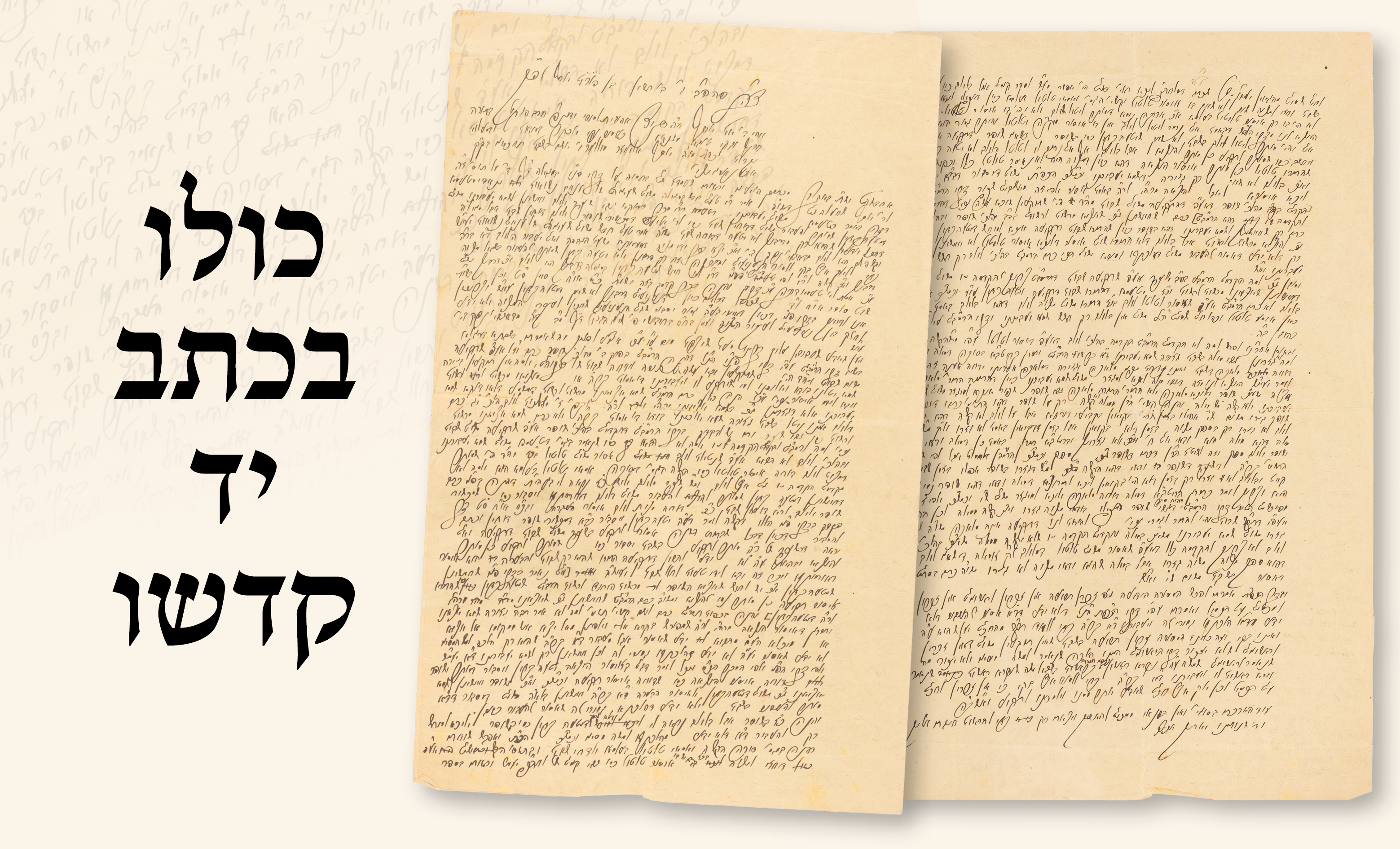
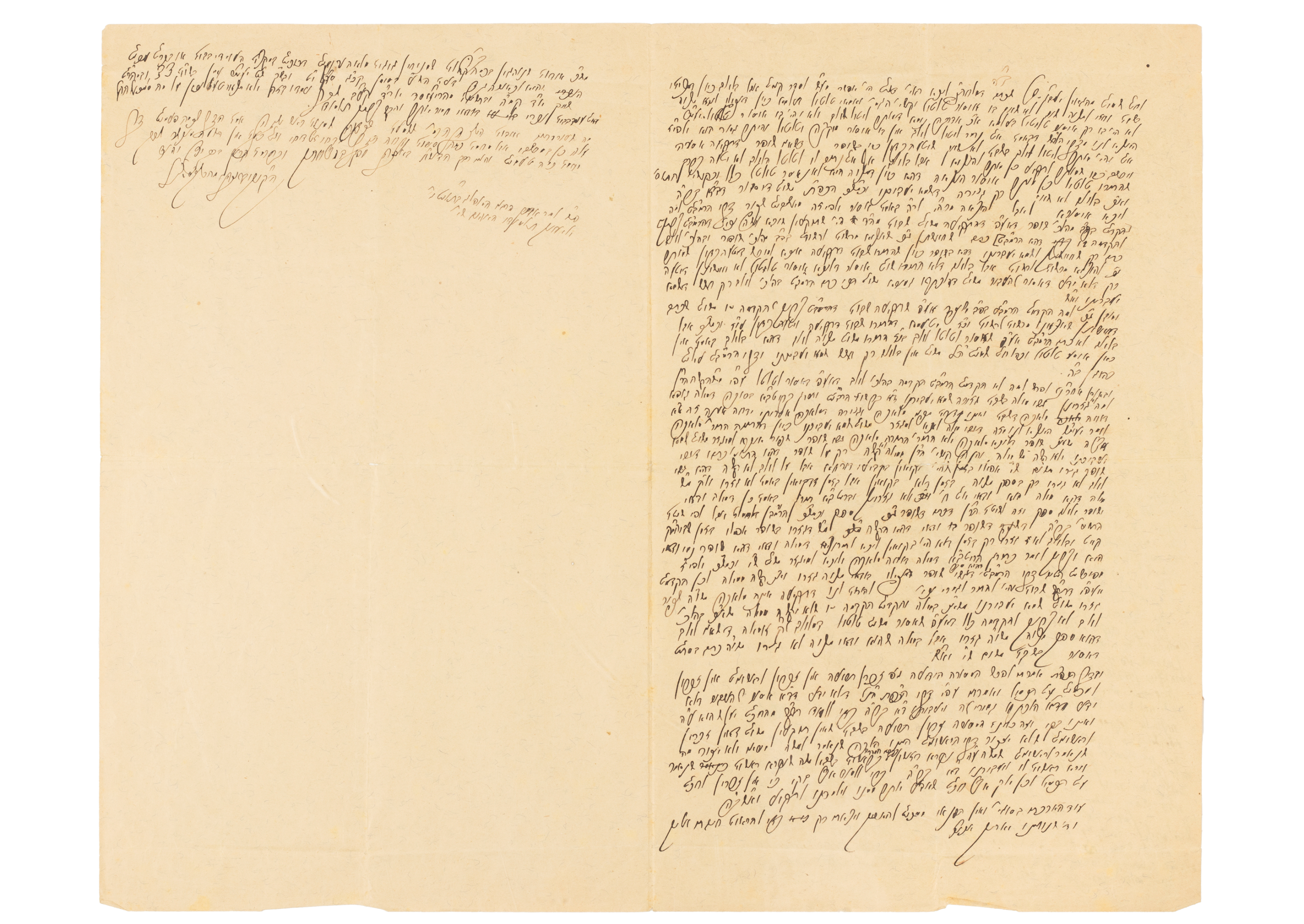
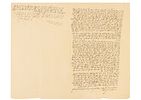
A lengthy handwritten teshuva containing an in-depth halachic discussion on the question of reading the megillah on Shabbos, written by the gaon Rabbi Akiva Sofer, Av Beis Din of Pressburg, author of Daas Sofer.

Rabbi Akiva Sofer, Av Beis Din of Pressburg and author of Daas Sofer

(1878–1960), was the last to carry forward the illustrious Sofer dynasty as Rav and Rosh Yeshiva of the great Pressburg yeshiva, continuing the legacy of the Chasam Sofer, Ksav Sofer, and Shevet Sofer. Already in his youth, he began delivering shiurim in the yeshiva, and from 1907, he succeeded his father as Rav of the city. In 1940, he settled in Jerusalem, where he reestablished the renowned Pressburg yeshiva. Among his major works are Shu"t Daas Sofer on the four sections of the Shulchan Aruch and Daas Sofer on the Torah and Yamim Tovim.

Sent to his disciple, Rabbi Yosef Eliezer Miller Hy”d, who later served as dayan in Sopron (see Chasam Sofer U’Talmidav, p. 641).

Published in Shu”t Daas Sofer, Orach Chaim, siman 124. The present manuscript contains numerous variations and additions not found in the printed version. The final two passages on the third page were omitted entirely from the published teshuva.

Pressburg, 1926.

Page Count: One large folded leaf (21 × 34 cm), comprising two full written pages and part of a third page.

Condition: Good.

_________________________

Transcription of the Letter:

B”H. Pressburg, 2 Cheshva, acccording to the year "Ben Porat Yosef"


“And Hashem was with Yosef” — to my honored and beloved student and dear friend, the distinguished Rav and Torah scholar, brilliant and thoroughly versed, whose learning is pure and refined, and who is crowned with admirable and precious qualities, our teacher Rabbi Yosef Eliezer Miller, נ"י, who dwells among the scholars of the holy community of Edenburg,


After lovingly inquiring after your welfare and extending greetings:

Your letter reached me, and I saw that you expressed surprise at the words of the Pnei Yehoshua in Megillah, leaf 4, regarding Tosafos, beginning with the words “L’Rabbi Yosef.” He explains there that the reason Rabbi Yosef gives a new reason regarding the Megillah — because the eyes of the poor are raised in anticipation of the Megillah reading — rather than adopting Rabbah’s reason, that we are concerned lest one carry it, is because Rabbi Yosef maintains that only with regard to shofar and lulav are we concerned that one might carry it. A person might mistakenly rule that carrying is permitted because these mitzvos override Shabbos, just as, according to Rabbi Eliezer, the preparations necessary for shofar and lulav override Shabbos. With Megillah, however, everyone knows that the entire obligation is only Rabbinic, and one would therefore not mistakenly think that it overrides Shabbos. Rabbi Yosef therefore gives the new reason that the eyes of the poor are raised in anticipation of the Megillah reading. See there.


Your difficulty is that with a lulav, once a person has lifted it he has already fulfilled the Torah obligation. Thus, if he subsequently carries it four amos in a public domain in order to go to an expert to learn the proper movements and the bracha, this concerns only a Rabbinic requirement. He should therefore not mistakenly rule that carrying is permitted for the sake of a Rabbinic mitzvah. According to the Pnei Yehoshua’s explanation, then, Rabbi Yosef’s position is difficult: if Rabbi Yosef is not concerned that one will make such a mistake regarding the Rabbinic mitzvah of Megillah, the remaining aspects of lulav are likewise Rabbinic, yet there he necessarily accepts Rabbah’s reason. This is the substance of your question.


In fact, you have already been preceded in raising this point by the Shu”t Ksav Sofer, Orach Chaim §69, and likewise the Shu”t Shevet Sofer, Orach Chaim §34. They write that since the movements of the lulav are Rabbinic, there should be no concern that one will mistakenly rule in this manner. See there. We must therefore explain the words of the Pnei Yehoshua somewhat narrowly: since we are dealing with a complete am ha’aretz, he may assume that the movements are themselves part of the essential mitzvah and will not know how to distinguish between the movements and the primary mitzvah. This is unlike Megillah, whose entire obligation is Rabbinic. See also the Chasam Sofer on Perek Lulav HaGazul, leaf 42, beginning with the words “Mid’agbeih nafak bei.” See there.


Since I know how dear our Torah discussions have been to you ever since you served me as a student, I will present to you something I said on Shabbasa D’Rigla, resolving the words of the Rambam in accordance with the above-mentioned words of the Pnei Yehoshua.


The Rambam writes in Chapter 2 of Hilchos Shofar:

“Although sounding the shofar is prohibited as a shevus, strictly speaking it should have been sounded, for a Torah commandment should come and override a Rabbinic shevus. Why, then, is it not sounded? It is a decree lest one take it in his hand and bring it to someone who can sound it for him, and thereby carry it four amos in a public domain, or carry it from one domain to another, and thus come to transgress a prohibition.”


Here the Rambam writes that perhaps one will carry it from one domain to another, implying that the concern is not specifically that he may carry it four amos, but that we are also concerned that he may carry it from a private domain into a public domain.


Yet in Chapter 7 of Hilchos Lulav, halacha 13, he writes that a lulav is not taken because of the decree that perhaps one will carry it four amos in a public domain. He does not write, as he does regarding shofar, that perhaps one will carry it from one domain to another.


The wording of the Rambam also deserves careful attention. In Hilchos Shofar he first states, “Although sounding the shofar is prohibited as a shevus, ” whereas in Hilchos Lulav he does not first state that although taking a lulav involves the prohibition of muktzeh and carrying, strictly speaking it should nevertheless be permitted because the mitzvah of lulav overrides the prohibition of carrying. This is indeed the Gemara’s question in Sukkah: “Why? It is merely carrying!” Why, then, does the Rambam not give this introduction regarding lulav as well? What distinction is there between shofar and lulav?


To resolve all of this, it appears to me, with Hashem’s help, as follows.

The Pnei Yehoshua writes that we are concerned that a person might mistakenly rule that carrying is permitted because lulav is a Torah obligation. He might reason that just as, according to Rabbi Eliezer, the preparations for shofar and lulav override Shabbos, so too the mitzvah of lulav overrides the prohibition against carrying.


The Ksav Sofer, Orach Chaim §69, already notes a difficulty with the Pnei Yehoshua: it is difficult to say that an am ha’aretz would make a halachic error and assume the position of Rabbi Eliezer, that the preparations for shofar override Shabbos. He therefore explains that throughout the year it is forbidden to sound a shofar on Shabbos because of the Rabbinic prohibition of shevus. If a person sees that on Rosh Hashanah it is permitted to sound the shofar on Shabbos, he may reason that just as it is permitted to sound it, so too it is permitted to carry it. Being an am ha’aretz, he will not understand that sounding the shofar was permitted because it involves only a shevus, whereas carrying is a Torah prohibition. This may lead him mistakenly to desecrate Shabbos. See there.


If, as the Pnei Yehoshua says, we are concerned that he may make an error in halacha, then we must also be concerned that he may carry the shofar from a private domain into a public domain. He may mistakenly reason that just as the prohibition against sounding the shofar was permitted, carrying it out is likewise permitted. This is why the Rambam writes that we are also concerned that he may carry it from one domain to another.


The Kapos Temarim, however, resolves Tosafos’ difficulty as to why Rabbah did not say that the decree was lest one carry it out from a private domain into a public domain. He explains that the prohibition against carrying from a private domain into a public domain is explicit in Scripture — derived either from “Let no man go out from his place, ” interpreted as “let no man carry out, ” or from “and the people ceased from bringing.” A person therefore knows that this is prohibited. Carrying four amos in a public domain, however, is known only through a halacha transmitted to Moshe at Sinai. An am ha’aretz will not know this tradition, and therefore we are concerned specifically that he might carry it four amos. See there.


According to the Pnei Yehoshua, as explained by the Ksav Sofer, we may say that even regarding the prohibition against carrying out, a person could make a halachic error and think it permitted. He may reason that the mitzvah of shofar overrides the prohibition against carrying out just as it overrides the prohibition against sounding the shofar. Thus, regarding shofar we are concerned that he may also carry it out because of a mistaken halachic ruling. As for carrying four amos in a public domain, there is an independent concern: he may simply think that carrying four amos is permitted on Shabbos, since he does not know the tradition transmitted as a halacha to Moshe at Sinai that it is prohibited.


All this applies to shofar. Regarding lulav, however, it appears to me that we cannot say that he will make the same halachic error as with shofar. The only concern is that he may carry it four amos because he does not know the halacha transmitted to Moshe at Sinai. I will explain.


The Gemara in Sukkah asks, “Why? It is merely carrying! Let it override Shabbos.” Tosafos write that although the lulav is fit for use in a mitzvah, it nevertheless remains subject to the prohibition against carrying, just as the rods of the Lechem HaPanim are. See there.


Page 2:


I saw, however, in the sefer Lechem Shamayim by the Gaon, the Yaabetz, that there is no proof from the Lechem HaPanim. There, the rods could have been arranged before Shabbos. With a lulav, by contrast, since its mitzvah is performed on Shabbos and it is fit for the mitzvah, the prohibition against carrying should no longer apply. The Gemara’s question, “Why? It is merely carrying, ” means that even were there no mitzvah involved, the only prohibition would be that of ordinary carrying; all the more so, then, we should say that taking the lulav is permitted and that no prohibition against carrying applies. See there.


It emerges from the words of the Lechem Shamayim that if we permit taking the lulav, there is in fact no prohibition of muktzeh or carrying at all; it is completely permitted.


Accordingly, if taking a lulav on Shabbos is permitted, a person will not make the same halachic mistake that he might make regarding shofar. With shofar, sounding it is intrinsically prohibited, and he might think that just as sounding it was permitted, carrying it out was likewise permitted. With lulav, however, even if we permit him to handle it, he will not mistakenly reason that just as handling was permitted, so too the prohibition against carrying it out was permitted. Once it is required for a mitzvah, handling it was never prohibited in the first place, as Tosafos’ question indicates.


Thus, regarding lulav the only applicable decree is lest he carry it four amos, as the Kapos Temarim explains, because he may think that there is no prohibition against carrying four amos in a public domain. Carrying from a private domain into a public domain, however, he knows to be prohibited.

The Rambam’s words are now beautifully resolved. Why does he preface the law of shofar in Chapter 2 by saying that although sounding the shofar is prohibited as a shevus, strictly speaking it should have been permitted, etc.? The Rambam requires this introduction precisely because he subsequently writes that we are also concerned that one may carry it from one domain to another.


With shofar, since the shevus against sounding it has been permitted, we are concerned that a person may mistakenly rule that carrying it from one domain to another is likewise permitted. With lulav, by contrast, no prohibition has been waived at all, because handling the lulav is not prohibited in the first place. Thus, we are concerned only that the person does not know that carrying four amos is prohibited because this is a halacha transmitted by tradition. For this reason, in Hilchos Lulav the Rambam mentions only the concern that perhaps one will carry it four amos.


It is likewise clear why the Rambam begins Chapter 2 of Hilchos Shofar by saying, “Although sounding the shofar is a shevus.” This introduction is necessary because the Rambam writes that we are concerned that one may carry it from one domain to another, and that entire concern stems from the fact that the shevus against sounding the shofar was permitted, which could lead one to make a mistaken halachic ruling, as explained above.


Regarding lulav, however, the Rambam does not write that although it is forbidden to handle a lulav, it was nevertheless permitted for the sake of the mitzvah. In truth, there is no prohibition against handling the lulav at all. There is only the concern that one might carry it four amos. The words of the Rambam are thus entirely consistent, Baruch Hashem.


In another manner, it appears to me that we can explain why the Rambam did not introduce the laws of lulav by saying, “Although it is forbidden to handle it, ” etc., based on the Ran’s question: Why do we not similarly decree against performing a bris milah on Shabbos lest one carry the milah knife four amos in a public domain?


The Ritva in Sukkah answers that the act of milah itself overrides the melacha prohibitions of Shabbos. It cannot be that the mitzvah itself is not displaced by melacha, yet we would displace it because of a decree concerning some other melacha. See there.


It follows that regarding milah there is no basis for decreeing lest one carry, because the Torah itself permitted melacha for its sake. Shofar, by contrast, does not itself involve a melacha, and the Torah did not permit a melacha for the sake of shofar. Thus, the decree lest one carry can indeed be applied.

The Ran’s question, in fact, applies only to shofar. Tosafos write that regarding shofar the decree lest one carry applied even at a time when people were expert in establishing the calendar. With lulav, however, there is no difficulty, because the decree was imposed only when the mitzvah was uncertain, at a time when people were not expert in establishing the calendar. When they were expert, no such decree was imposed. There is therefore no comparison to milah, which is certainly performed on the eighth day.


The Ritva himself indeed answers that milah is certain whereas shofar and lulav are uncertain. This follows the position of the Ran, who maintains that shofar is also uncertain, as the Ramban writes in Milchamos. According to Tosafos in Rosh Hashanah 29b, however, shofar is a definite obligation, for Tosafos ask why with shofar the decree was imposed even when the Beis Hamikdash stood, whereas regarding lulav it was imposed only when people were no longer expert in establishing the calendar. We therefore cannot answer that milah is certain, since shofar is certain as well. We must instead give the Ritva’s other answer: milah itself overrides melacha, and therefore no decree lest one carry can be imposed, as explained above.

The Rambam’s words can thus be understood very well. He holds that regarding shofar the decree was imposed even when the mitzvah was certainly applicable. The question from milah therefore arises. For this reason, the Rambam first writes that although sounding the shofar is a shevus and should have been permitted, etc., thereby teaching us that sounding the shofar is not a melacha. It was therefore possible to impose the decree lest one carry, unlike milah.


In Hilchos Lulav, however, no such introduction is necessary. The comparison between lulav and milah presents no difficulty: lulav involves an uncertain mitzvah, and the decree was therefore imposed, whereas milah is certainly a mitzvah on the eighth day and no decree was imposed. Thus, the Rambam simply writes that it is prohibited on Shabbos because of the decree lest one carry, and all is well.


Regarding the words of the Kapos Temarim, I once offered an explanation of the well-known Masorah of three occurrences: “Zichron teruah”; “There is no remembrance of the former ones”; and “There is no remembrance of the wise man together with the fool.”


I explained this according to the Kapos Temarim’s words: the person does not know that carrying four amos is prohibited because he does not know that this prohibition is a halacha transmitted by tradition. He may therefore carry it four amos in a public domain in order to learn how to sound the shofar from a scholar, since he is an am ha’aretz and is not proficient himself.


This, then, is the meaning of the Masorah: “Zichron teruah” — on Shabbos we only make mention of the shofar and do not sound it, because “there is no remembrance of the former ones”: he may fail to remember the teachings of those who came before, namely, the halacha transmitted to Moshe at Sinai. He will not remember what was taught to “the former one, ” for Moshe Rabbeinu is called “the first, ” as the Midrash teaches concerning Moshe, who is called “the beginning, ” as it says, “He saw the first portion for himself.” He may therefore carry it four amos in a public domain in order to learn from an expert, for “there is no remembrance of the wise man together with the fool”: being less knowledgeable himself, he will go to a wise man who knows more than he does and carry the shofar to him so that he may sound it. Thus all is well, Baruch Hashem.


I discussed the sugiya at still greater length, but time does not permit me to elaborate. I have written only briefly, in order to demonstrate my affection for you. May Hashem lengthen our years. Amen, so may it be His will.


Page 3


Regarding what you wrote concerning the practice in several communities of placing a tub filled with . . .


This would seemingly be contrary to the ruling of the Shulchan Aruch in siman 123, se’if 19, and the Shach there; see there. See also Shu”t Tzemach Tzedek, and Maharam Schick, Yoreh De’ah 145, and the teshuvos of Mahari Assad, Yoreh De’ah, siman 172, who already addressed this matter and were unable to find a satisfactory explanation for what this practice is based upon. . . . In the home of a non-Jew, it is certainly more serious, and the matter requires further study.


Regarding what you brought to my attention concerning . . . It is true that I have already considered this many times, but for various reasons the matter has been repeatedly postponed, and the present time is also not suitable for it for several reasons.


Your devoted teacher, who sends warmest wishes for your continued success and advancement,  


Akiva, son of the Gaon Rabbi Shimon Sofer, zt”l


Please convey my regards to your father, the distinguished Rav and Torah scholar, נ"י, and to your brother, my beloved student, שיחי׳.


Lot : 25

Important  Teshuva by Rabbi Akiva Sofer, Av Beis Din of Pressburg and Author of Daas Sofer – Pressburg, 1926

Start price: $3,000
|
Est. Price: $5,000 - $7,000

Important  Teshuva by Rabbi Akiva Sofer, Av Beis Din of Pressburg and Author of Daas Sofer – Pressburg, 1926


A lengthy handwritten teshuva containing an in-depth halachic discussion on the question of reading the megillah on Shabbos, written by the gaon Rabbi Akiva Sofer, Av Beis Din of Pressburg, author of Daas Sofer.

Rabbi Akiva Sofer, Av Beis Din of Pressburg and author of Daas Sofer

(1878–1960), was the last to carry forward the illustrious Sofer dynasty as Rav and Rosh Yeshiva of the great Pressburg yeshiva, continuing the legacy of the Chasam Sofer, Ksav Sofer, and Shevet Sofer. Already in his youth, he began delivering shiurim in the yeshiva, and from 1907, he succeeded his father as Rav of the city. In 1940, he settled in Jerusalem, where he reestablished the renowned Pressburg yeshiva. Among his major works are Shu"t Daas Sofer on the four sections of the Shulchan Aruch and Daas Sofer on the Torah and Yamim Tovim.

Sent to his disciple, Rabbi Yosef Eliezer Miller Hy”d, who later served as dayan in Sopron (see Chasam Sofer U’Talmidav, p. 641).

Published in Shu”t Daas Sofer, Orach Chaim, siman 124. The present manuscript contains numerous variations and additions not found in the printed version. The final two passages on the third page were omitted entirely from the published teshuva.

Pressburg, 1926.

Page Count: One large folded leaf (21 × 34 cm), comprising two full written pages and part of a third page.

Condition: Good.

_________________________

Transcription of the Letter:

B”H. Pressburg, 2 Cheshva, acccording to the year "Ben Porat Yosef"


“And Hashem was with Yosef” — to my honored and beloved student and dear friend, the distinguished Rav and Torah scholar, brilliant and thoroughly versed, whose learning is pure and refined, and who is crowned with admirable and precious qualities, our teacher Rabbi Yosef Eliezer Miller, נ"י, who dwells among the scholars of the holy community of Edenburg,


After lovingly inquiring after your welfare and extending greetings:

Your letter reached me, and I saw that you expressed surprise at the words of the Pnei Yehoshua in Megillah, leaf 4, regarding Tosafos, beginning with the words “L’Rabbi Yosef.” He explains there that the reason Rabbi Yosef gives a new reason regarding the Megillah — because the eyes of the poor are raised in anticipation of the Megillah reading — rather than adopting Rabbah’s reason, that we are concerned lest one carry it, is because Rabbi Yosef maintains that only with regard to shofar and lulav are we concerned that one might carry it. A person might mistakenly rule that carrying is permitted because these mitzvos override Shabbos, just as, according to Rabbi Eliezer, the preparations necessary for shofar and lulav override Shabbos. With Megillah, however, everyone knows that the entire obligation is only Rabbinic, and one would therefore not mistakenly think that it overrides Shabbos. Rabbi Yosef therefore gives the new reason that the eyes of the poor are raised in anticipation of the Megillah reading. See there.


Your difficulty is that with a lulav, once a person has lifted it he has already fulfilled the Torah obligation. Thus, if he subsequently carries it four amos in a public domain in order to go to an expert to learn the proper movements and the bracha, this concerns only a Rabbinic requirement. He should therefore not mistakenly rule that carrying is permitted for the sake of a Rabbinic mitzvah. According to the Pnei Yehoshua’s explanation, then, Rabbi Yosef’s position is difficult: if Rabbi Yosef is not concerned that one will make such a mistake regarding the Rabbinic mitzvah of Megillah, the remaining aspects of lulav are likewise Rabbinic, yet there he necessarily accepts Rabbah’s reason. This is the substance of your question.


In fact, you have already been preceded in raising this point by the Shu”t Ksav Sofer, Orach Chaim §69, and likewise the Shu”t Shevet Sofer, Orach Chaim §34. They write that since the movements of the lulav are Rabbinic, there should be no concern that one will mistakenly rule in this manner. See there. We must therefore explain the words of the Pnei Yehoshua somewhat narrowly: since we are dealing with a complete am ha’aretz, he may assume that the movements are themselves part of the essential mitzvah and will not know how to distinguish between the movements and the primary mitzvah. This is unlike Megillah, whose entire obligation is Rabbinic. See also the Chasam Sofer on Perek Lulav HaGazul, leaf 42, beginning with the words “Mid’agbeih nafak bei.” See there.


Since I know how dear our Torah discussions have been to you ever since you served me as a student, I will present to you something I said on Shabbasa D’Rigla, resolving the words of the Rambam in accordance with the above-mentioned words of the Pnei Yehoshua.


The Rambam writes in Chapter 2 of Hilchos Shofar:

“Although sounding the shofar is prohibited as a shevus, strictly speaking it should have been sounded, for a Torah commandment should come and override a Rabbinic shevus. Why, then, is it not sounded? It is a decree lest one take it in his hand and bring it to someone who can sound it for him, and thereby carry it four amos in a public domain, or carry it from one domain to another, and thus come to transgress a prohibition.”


Here the Rambam writes that perhaps one will carry it from one domain to another, implying that the concern is not specifically that he may carry it four amos, but that we are also concerned that he may carry it from a private domain into a public domain.


Yet in Chapter 7 of Hilchos Lulav, halacha 13, he writes that a lulav is not taken because of the decree that perhaps one will carry it four amos in a public domain. He does not write, as he does regarding shofar, that perhaps one will carry it from one domain to another.


The wording of the Rambam also deserves careful attention. In Hilchos Shofar he first states, “Although sounding the shofar is prohibited as a shevus, ” whereas in Hilchos Lulav he does not first state that although taking a lulav involves the prohibition of muktzeh and carrying, strictly speaking it should nevertheless be permitted because the mitzvah of lulav overrides the prohibition of carrying. This is indeed the Gemara’s question in Sukkah: “Why? It is merely carrying!” Why, then, does the Rambam not give this introduction regarding lulav as well? What distinction is there between shofar and lulav?


To resolve all of this, it appears to me, with Hashem’s help, as follows.

The Pnei Yehoshua writes that we are concerned that a person might mistakenly rule that carrying is permitted because lulav is a Torah obligation. He might reason that just as, according to Rabbi Eliezer, the preparations for shofar and lulav override Shabbos, so too the mitzvah of lulav overrides the prohibition against carrying.


The Ksav Sofer, Orach Chaim §69, already notes a difficulty with the Pnei Yehoshua: it is difficult to say that an am ha’aretz would make a halachic error and assume the position of Rabbi Eliezer, that the preparations for shofar override Shabbos. He therefore explains that throughout the year it is forbidden to sound a shofar on Shabbos because of the Rabbinic prohibition of shevus. If a person sees that on Rosh Hashanah it is permitted to sound the shofar on Shabbos, he may reason that just as it is permitted to sound it, so too it is permitted to carry it. Being an am ha’aretz, he will not understand that sounding the shofar was permitted because it involves only a shevus, whereas carrying is a Torah prohibition. This may lead him mistakenly to desecrate Shabbos. See there.


If, as the Pnei Yehoshua says, we are concerned that he may make an error in halacha, then we must also be concerned that he may carry the shofar from a private domain into a public domain. He may mistakenly reason that just as the prohibition against sounding the shofar was permitted, carrying it out is likewise permitted. This is why the Rambam writes that we are also concerned that he may carry it from one domain to another.


The Kapos Temarim, however, resolves Tosafos’ difficulty as to why Rabbah did not say that the decree was lest one carry it out from a private domain into a public domain. He explains that the prohibition against carrying from a private domain into a public domain is explicit in Scripture — derived either from “Let no man go out from his place, ” interpreted as “let no man carry out, ” or from “and the people ceased from bringing.” A person therefore knows that this is prohibited. Carrying four amos in a public domain, however, is known only through a halacha transmitted to Moshe at Sinai. An am ha’aretz will not know this tradition, and therefore we are concerned specifically that he might carry it four amos. See there.


According to the Pnei Yehoshua, as explained by the Ksav Sofer, we may say that even regarding the prohibition against carrying out, a person could make a halachic error and think it permitted. He may reason that the mitzvah of shofar overrides the prohibition against carrying out just as it overrides the prohibition against sounding the shofar. Thus, regarding shofar we are concerned that he may also carry it out because of a mistaken halachic ruling. As for carrying four amos in a public domain, there is an independent concern: he may simply think that carrying four amos is permitted on Shabbos, since he does not know the tradition transmitted as a halacha to Moshe at Sinai that it is prohibited.


All this applies to shofar. Regarding lulav, however, it appears to me that we cannot say that he will make the same halachic error as with shofar. The only concern is that he may carry it four amos because he does not know the halacha transmitted to Moshe at Sinai. I will explain.


The Gemara in Sukkah asks, “Why? It is merely carrying! Let it override Shabbos.” Tosafos write that although the lulav is fit for use in a mitzvah, it nevertheless remains subject to the prohibition against carrying, just as the rods of the Lechem HaPanim are. See there.


Page 2:


I saw, however, in the sefer Lechem Shamayim by the Gaon, the Yaabetz, that there is no proof from the Lechem HaPanim. There, the rods could have been arranged before Shabbos. With a lulav, by contrast, since its mitzvah is performed on Shabbos and it is fit for the mitzvah, the prohibition against carrying should no longer apply. The Gemara’s question, “Why? It is merely carrying, ” means that even were there no mitzvah involved, the only prohibition would be that of ordinary carrying; all the more so, then, we should say that taking the lulav is permitted and that no prohibition against carrying applies. See there.


It emerges from the words of the Lechem Shamayim that if we permit taking the lulav, there is in fact no prohibition of muktzeh or carrying at all; it is completely permitted.


Accordingly, if taking a lulav on Shabbos is permitted, a person will not make the same halachic mistake that he might make regarding shofar. With shofar, sounding it is intrinsically prohibited, and he might think that just as sounding it was permitted, carrying it out was likewise permitted. With lulav, however, even if we permit him to handle it, he will not mistakenly reason that just as handling was permitted, so too the prohibition against carrying it out was permitted. Once it is required for a mitzvah, handling it was never prohibited in the first place, as Tosafos’ question indicates.


Thus, regarding lulav the only applicable decree is lest he carry it four amos, as the Kapos Temarim explains, because he may think that there is no prohibition against carrying four amos in a public domain. Carrying from a private domain into a public domain, however, he knows to be prohibited.

The Rambam’s words are now beautifully resolved. Why does he preface the law of shofar in Chapter 2 by saying that although sounding the shofar is prohibited as a shevus, strictly speaking it should have been permitted, etc.? The Rambam requires this introduction precisely because he subsequently writes that we are also concerned that one may carry it from one domain to another.


With shofar, since the shevus against sounding it has been permitted, we are concerned that a person may mistakenly rule that carrying it from one domain to another is likewise permitted. With lulav, by contrast, no prohibition has been waived at all, because handling the lulav is not prohibited in the first place. Thus, we are concerned only that the person does not know that carrying four amos is prohibited because this is a halacha transmitted by tradition. For this reason, in Hilchos Lulav the Rambam mentions only the concern that perhaps one will carry it four amos.


It is likewise clear why the Rambam begins Chapter 2 of Hilchos Shofar by saying, “Although sounding the shofar is a shevus.” This introduction is necessary because the Rambam writes that we are concerned that one may carry it from one domain to another, and that entire concern stems from the fact that the shevus against sounding the shofar was permitted, which could lead one to make a mistaken halachic ruling, as explained above.


Regarding lulav, however, the Rambam does not write that although it is forbidden to handle a lulav, it was nevertheless permitted for the sake of the mitzvah. In truth, there is no prohibition against handling the lulav at all. There is only the concern that one might carry it four amos. The words of the Rambam are thus entirely consistent, Baruch Hashem.


In another manner, it appears to me that we can explain why the Rambam did not introduce the laws of lulav by saying, “Although it is forbidden to handle it, ” etc., based on the Ran’s question: Why do we not similarly decree against performing a bris milah on Shabbos lest one carry the milah knife four amos in a public domain?


The Ritva in Sukkah answers that the act of milah itself overrides the melacha prohibitions of Shabbos. It cannot be that the mitzvah itself is not displaced by melacha, yet we would displace it because of a decree concerning some other melacha. See there.


It follows that regarding milah there is no basis for decreeing lest one carry, because the Torah itself permitted melacha for its sake. Shofar, by contrast, does not itself involve a melacha, and the Torah did not permit a melacha for the sake of shofar. Thus, the decree lest one carry can indeed be applied.

The Ran’s question, in fact, applies only to shofar. Tosafos write that regarding shofar the decree lest one carry applied even at a time when people were expert in establishing the calendar. With lulav, however, there is no difficulty, because the decree was imposed only when the mitzvah was uncertain, at a time when people were not expert in establishing the calendar. When they were expert, no such decree was imposed. There is therefore no comparison to milah, which is certainly performed on the eighth day.


The Ritva himself indeed answers that milah is certain whereas shofar and lulav are uncertain. This follows the position of the Ran, who maintains that shofar is also uncertain, as the Ramban writes in Milchamos. According to Tosafos in Rosh Hashanah 29b, however, shofar is a definite obligation, for Tosafos ask why with shofar the decree was imposed even when the Beis Hamikdash stood, whereas regarding lulav it was imposed only when people were no longer expert in establishing the calendar. We therefore cannot answer that milah is certain, since shofar is certain as well. We must instead give the Ritva’s other answer: milah itself overrides melacha, and therefore no decree lest one carry can be imposed, as explained above.

The Rambam’s words can thus be understood very well. He holds that regarding shofar the decree was imposed even when the mitzvah was certainly applicable. The question from milah therefore arises. For this reason, the Rambam first writes that although sounding the shofar is a shevus and should have been permitted, etc., thereby teaching us that sounding the shofar is not a melacha. It was therefore possible to impose the decree lest one carry, unlike milah.


In Hilchos Lulav, however, no such introduction is necessary. The comparison between lulav and milah presents no difficulty: lulav involves an uncertain mitzvah, and the decree was therefore imposed, whereas milah is certainly a mitzvah on the eighth day and no decree was imposed. Thus, the Rambam simply writes that it is prohibited on Shabbos because of the decree lest one carry, and all is well.


Regarding the words of the Kapos Temarim, I once offered an explanation of the well-known Masorah of three occurrences: “Zichron teruah”; “There is no remembrance of the former ones”; and “There is no remembrance of the wise man together with the fool.”


I explained this according to the Kapos Temarim’s words: the person does not know that carrying four amos is prohibited because he does not know that this prohibition is a halacha transmitted by tradition. He may therefore carry it four amos in a public domain in order to learn how to sound the shofar from a scholar, since he is an am ha’aretz and is not proficient himself.


This, then, is the meaning of the Masorah: “Zichron teruah” — on Shabbos we only make mention of the shofar and do not sound it, because “there is no remembrance of the former ones”: he may fail to remember the teachings of those who came before, namely, the halacha transmitted to Moshe at Sinai. He will not remember what was taught to “the former one, ” for Moshe Rabbeinu is called “the first, ” as the Midrash teaches concerning Moshe, who is called “the beginning, ” as it says, “He saw the first portion for himself.” He may therefore carry it four amos in a public domain in order to learn from an expert, for “there is no remembrance of the wise man together with the fool”: being less knowledgeable himself, he will go to a wise man who knows more than he does and carry the shofar to him so that he may sound it. Thus all is well, Baruch Hashem.


I discussed the sugiya at still greater length, but time does not permit me to elaborate. I have written only briefly, in order to demonstrate my affection for you. May Hashem lengthen our years. Amen, so may it be His will.


Page 3


Regarding what you wrote concerning the practice in several communities of placing a tub filled with . . .


This would seemingly be contrary to the ruling of the Shulchan Aruch in siman 123, se’if 19, and the Shach there; see there. See also Shu”t Tzemach Tzedek, and Maharam Schick, Yoreh De’ah 145, and the teshuvos of Mahari Assad, Yoreh De’ah, siman 172, who already addressed this matter and were unable to find a satisfactory explanation for what this practice is based upon. . . . In the home of a non-Jew, it is certainly more serious, and the matter requires further study.


Regarding what you brought to my attention concerning . . . It is true that I have already considered this many times, but for various reasons the matter has been repeatedly postponed, and the present time is also not suitable for it for several reasons.


Your devoted teacher, who sends warmest wishes for your continued success and advancement,  


Akiva, son of the Gaon Rabbi Shimon Sofer, zt”l


Please convey my regards to your father, the distinguished Rav and Torah scholar, נ"י, and to your brother, my beloved student, שיחי׳.


Important  Teshuva by Rabbi Akiva Sofer, Av Beis Din of Pressburg and Author of Daas Sofer – Pressburg, 1926


A lengthy handwritten teshuva containing an in-depth halachic discussion on the question of reading the megillah on Shabbos, written by the gaon Rabbi Akiva Sofer, Av Beis Din of Pressburg, author of Daas Sofer.

Rabbi Akiva Sofer, Av Beis Din of Pressburg and author of Daas Sofer

(1878–1960), was the last to carry forward the illustrious Sofer dynasty as Rav and Rosh Yeshiva of the great Pressburg yeshiva, continuing the legacy of the Chasam Sofer, Ksav Sofer, and Shevet Sofer. Already in his youth, he began delivering shiurim in the yeshiva, and from 1907, he succeeded his father as Rav of the city. In 1940, he settled in Jerusalem, where he reestablished the renowned Pressburg yeshiva. Among his major works are Shu"t Daas Sofer on the four sections of the Shulchan Aruch and Daas Sofer on the Torah and Yamim Tovim.

Sent to his disciple, Rabbi Yosef Eliezer Miller Hy”d, who later served as dayan in Sopron (see Chasam Sofer U’Talmidav, p. 641).

Published in Shu”t Daas Sofer, Orach Chaim, siman 124. The present manuscript contains numerous variations and additions not found in the printed version. The final two passages on the third page were omitted entirely from the published teshuva.

Pressburg, 1926.

Page Count: One large folded leaf (21 × 34 cm), comprising two full written pages and part of a third page.

Condition: Good.

_________________________

Transcription of the Letter:

B”H. Pressburg, 2 Cheshva, acccording to the year "Ben Porat Yosef"


“And Hashem was with Yosef” — to my honored and beloved student and dear friend, the distinguished Rav and Torah scholar, brilliant and thoroughly versed, whose learning is pure and refined, and who is crowned with admirable and precious qualities, our teacher Rabbi Yosef Eliezer Miller, נ"י, who dwells among the scholars of the holy community of Edenburg,


After lovingly inquiring after your welfare and extending greetings:

Your letter reached me, and I saw that you expressed surprise at the words of the Pnei Yehoshua in Megillah, leaf 4, regarding Tosafos, beginning with the words “L’Rabbi Yosef.” He explains there that the reason Rabbi Yosef gives a new reason regarding the Megillah — because the eyes of the poor are raised in anticipation of the Megillah reading — rather than adopting Rabbah’s reason, that we are concerned lest one carry it, is because Rabbi Yosef maintains that only with regard to shofar and lulav are we concerned that one might carry it. A person might mistakenly rule that carrying is permitted because these mitzvos override Shabbos, just as, according to Rabbi Eliezer, the preparations necessary for shofar and lulav override Shabbos. With Megillah, however, everyone knows that the entire obligation is only Rabbinic, and one would therefore not mistakenly think that it overrides Shabbos. Rabbi Yosef therefore gives the new reason that the eyes of the poor are raised in anticipation of the Megillah reading. See there.


Your difficulty is that with a lulav, once a person has lifted it he has already fulfilled the Torah obligation. Thus, if he subsequently carries it four amos in a public domain in order to go to an expert to learn the proper movements and the bracha, this concerns only a Rabbinic requirement. He should therefore not mistakenly rule that carrying is permitted for the sake of a Rabbinic mitzvah. According to the Pnei Yehoshua’s explanation, then, Rabbi Yosef’s position is difficult: if Rabbi Yosef is not concerned that one will make such a mistake regarding the Rabbinic mitzvah of Megillah, the remaining aspects of lulav are likewise Rabbinic, yet there he necessarily accepts Rabbah’s reason. This is the substance of your question.


In fact, you have already been preceded in raising this point by the Shu”t Ksav Sofer, Orach Chaim §69, and likewise the Shu”t Shevet Sofer, Orach Chaim §34. They write that since the movements of the lulav are Rabbinic, there should be no concern that one will mistakenly rule in this manner. See there. We must therefore explain the words of the Pnei Yehoshua somewhat narrowly: since we are dealing with a complete am ha’aretz, he may assume that the movements are themselves part of the essential mitzvah and will not know how to distinguish between the movements and the primary mitzvah. This is unlike Megillah, whose entire obligation is Rabbinic. See also the Chasam Sofer on Perek Lulav HaGazul, leaf 42, beginning with the words “Mid’agbeih nafak bei.” See there.


Since I know how dear our Torah discussions have been to you ever since you served me as a student, I will present to you something I said on Shabbasa D’Rigla, resolving the words of the Rambam in accordance with the above-mentioned words of the Pnei Yehoshua.


The Rambam writes in Chapter 2 of Hilchos Shofar:

“Although sounding the shofar is prohibited as a shevus, strictly speaking it should have been sounded, for a Torah commandment should come and override a Rabbinic shevus. Why, then, is it not sounded? It is a decree lest one take it in his hand and bring it to someone who can sound it for him, and thereby carry it four amos in a public domain, or carry it from one domain to another, and thus come to transgress a prohibition.”


Here the Rambam writes that perhaps one will carry it from one domain to another, implying that the concern is not specifically that he may carry it four amos, but that we are also concerned that he may carry it from a private domain into a public domain.


Yet in Chapter 7 of Hilchos Lulav, halacha 13, he writes that a lulav is not taken because of the decree that perhaps one will carry it four amos in a public domain. He does not write, as he does regarding shofar, that perhaps one will carry it from one domain to another.


The wording of the Rambam also deserves careful attention. In Hilchos Shofar he first states, “Although sounding the shofar is prohibited as a shevus, ” whereas in Hilchos Lulav he does not first state that although taking a lulav involves the prohibition of muktzeh and carrying, strictly speaking it should nevertheless be permitted because the mitzvah of lulav overrides the prohibition of carrying. This is indeed the Gemara’s question in Sukkah: “Why? It is merely carrying!” Why, then, does the Rambam not give this introduction regarding lulav as well? What distinction is there between shofar and lulav?


To resolve all of this, it appears to me, with Hashem’s help, as follows.

The Pnei Yehoshua writes that we are concerned that a person might mistakenly rule that carrying is permitted because lulav is a Torah obligation. He might reason that just as, according to Rabbi Eliezer, the preparations for shofar and lulav override Shabbos, so too the mitzvah of lulav overrides the prohibition against carrying.


The Ksav Sofer, Orach Chaim §69, already notes a difficulty with the Pnei Yehoshua: it is difficult to say that an am ha’aretz would make a halachic error and assume the position of Rabbi Eliezer, that the preparations for shofar override Shabbos. He therefore explains that throughout the year it is forbidden to sound a shofar on Shabbos because of the Rabbinic prohibition of shevus. If a person sees that on Rosh Hashanah it is permitted to sound the shofar on Shabbos, he may reason that just as it is permitted to sound it, so too it is permitted to carry it. Being an am ha’aretz, he will not understand that sounding the shofar was permitted because it involves only a shevus, whereas carrying is a Torah prohibition. This may lead him mistakenly to desecrate Shabbos. See there.


If, as the Pnei Yehoshua says, we are concerned that he may make an error in halacha, then we must also be concerned that he may carry the shofar from a private domain into a public domain. He may mistakenly reason that just as the prohibition against sounding the shofar was permitted, carrying it out is likewise permitted. This is why the Rambam writes that we are also concerned that he may carry it from one domain to another.


The Kapos Temarim, however, resolves Tosafos’ difficulty as to why Rabbah did not say that the decree was lest one carry it out from a private domain into a public domain. He explains that the prohibition against carrying from a private domain into a public domain is explicit in Scripture — derived either from “Let no man go out from his place, ” interpreted as “let no man carry out, ” or from “and the people ceased from bringing.” A person therefore knows that this is prohibited. Carrying four amos in a public domain, however, is known only through a halacha transmitted to Moshe at Sinai. An am ha’aretz will not know this tradition, and therefore we are concerned specifically that he might carry it four amos. See there.


According to the Pnei Yehoshua, as explained by the Ksav Sofer, we may say that even regarding the prohibition against carrying out, a person could make a halachic error and think it permitted. He may reason that the mitzvah of shofar overrides the prohibition against carrying out just as it overrides the prohibition against sounding the shofar. Thus, regarding shofar we are concerned that he may also carry it out because of a mistaken halachic ruling. As for carrying four amos in a public domain, there is an independent concern: he may simply think that carrying four amos is permitted on Shabbos, since he does not know the tradition transmitted as a halacha to Moshe at Sinai that it is prohibited.


All this applies to shofar. Regarding lulav, however, it appears to me that we cannot say that he will make the same halachic error as with shofar. The only concern is that he may carry it four amos because he does not know the halacha transmitted to Moshe at Sinai. I will explain.


The Gemara in Sukkah asks, “Why? It is merely carrying! Let it override Shabbos.” Tosafos write that although the lulav is fit for use in a mitzvah, it nevertheless remains subject to the prohibition against carrying, just as the rods of the Lechem HaPanim are. See there.


Page 2:


I saw, however, in the sefer Lechem Shamayim by the Gaon, the Yaabetz, that there is no proof from the Lechem HaPanim. There, the rods could have been arranged before Shabbos. With a lulav, by contrast, since its mitzvah is performed on Shabbos and it is fit for the mitzvah, the prohibition against carrying should no longer apply. The Gemara’s question, “Why? It is merely carrying, ” means that even were there no mitzvah involved, the only prohibition would be that of ordinary carrying; all the more so, then, we should say that taking the lulav is permitted and that no prohibition against carrying applies. See there.


It emerges from the words of the Lechem Shamayim that if we permit taking the lulav, there is in fact no prohibition of muktzeh or carrying at all; it is completely permitted.


Accordingly, if taking a lulav on Shabbos is permitted, a person will not make the same halachic mistake that he might make regarding shofar. With shofar, sounding it is intrinsically prohibited, and he might think that just as sounding it was permitted, carrying it out was likewise permitted. With lulav, however, even if we permit him to handle it, he will not mistakenly reason that just as handling was permitted, so too the prohibition against carrying it out was permitted. Once it is required for a mitzvah, handling it was never prohibited in the first place, as Tosafos’ question indicates.


Thus, regarding lulav the only applicable decree is lest he carry it four amos, as the Kapos Temarim explains, because he may think that there is no prohibition against carrying four amos in a public domain. Carrying from a private domain into a public domain, however, he knows to be prohibited.

The Rambam’s words are now beautifully resolved. Why does he preface the law of shofar in Chapter 2 by saying that although sounding the shofar is prohibited as a shevus, strictly speaking it should have been permitted, etc.? The Rambam requires this introduction precisely because he subsequently writes that we are also concerned that one may carry it from one domain to another.


With shofar, since the shevus against sounding it has been permitted, we are concerned that a person may mistakenly rule that carrying it from one domain to another is likewise permitted. With lulav, by contrast, no prohibition has been waived at all, because handling the lulav is not prohibited in the first place. Thus, we are concerned only that the person does not know that carrying four amos is prohibited because this is a halacha transmitted by tradition. For this reason, in Hilchos Lulav the Rambam mentions only the concern that perhaps one will carry it four amos.


It is likewise clear why the Rambam begins Chapter 2 of Hilchos Shofar by saying, “Although sounding the shofar is a shevus.” This introduction is necessary because the Rambam writes that we are concerned that one may carry it from one domain to another, and that entire concern stems from the fact that the shevus against sounding the shofar was permitted, which could lead one to make a mistaken halachic ruling, as explained above.


Regarding lulav, however, the Rambam does not write that although it is forbidden to handle a lulav, it was nevertheless permitted for the sake of the mitzvah. In truth, there is no prohibition against handling the lulav at all. There is only the concern that one might carry it four amos. The words of the Rambam are thus entirely consistent, Baruch Hashem.


In another manner, it appears to me that we can explain why the Rambam did not introduce the laws of lulav by saying, “Although it is forbidden to handle it, ” etc., based on the Ran’s question: Why do we not similarly decree against performing a bris milah on Shabbos lest one carry the milah knife four amos in a public domain?


The Ritva in Sukkah answers that the act of milah itself overrides the melacha prohibitions of Shabbos. It cannot be that the mitzvah itself is not displaced by melacha, yet we would displace it because of a decree concerning some other melacha. See there.


It follows that regarding milah there is no basis for decreeing lest one carry, because the Torah itself permitted melacha for its sake. Shofar, by contrast, does not itself involve a melacha, and the Torah did not permit a melacha for the sake of shofar. Thus, the decree lest one carry can indeed be applied.

The Ran’s question, in fact, applies only to shofar. Tosafos write that regarding shofar the decree lest one carry applied even at a time when people were expert in establishing the calendar. With lulav, however, there is no difficulty, because the decree was imposed only when the mitzvah was uncertain, at a time when people were not expert in establishing the calendar. When they were expert, no such decree was imposed. There is therefore no comparison to milah, which is certainly performed on the eighth day.


The Ritva himself indeed answers that milah is certain whereas shofar and lulav are uncertain. This follows the position of the Ran, who maintains that shofar is also uncertain, as the Ramban writes in Milchamos. According to Tosafos in Rosh Hashanah 29b, however, shofar is a definite obligation, for Tosafos ask why with shofar the decree was imposed even when the Beis Hamikdash stood, whereas regarding lulav it was imposed only when people were no longer expert in establishing the calendar. We therefore cannot answer that milah is certain, since shofar is certain as well. We must instead give the Ritva’s other answer: milah itself overrides melacha, and therefore no decree lest one carry can be imposed, as explained above.

The Rambam’s words can thus be understood very well. He holds that regarding shofar the decree was imposed even when the mitzvah was certainly applicable. The question from milah therefore arises. For this reason, the Rambam first writes that although sounding the shofar is a shevus and should have been permitted, etc., thereby teaching us that sounding the shofar is not a melacha. It was therefore possible to impose the decree lest one carry, unlike milah.


In Hilchos Lulav, however, no such introduction is necessary. The comparison between lulav and milah presents no difficulty: lulav involves an uncertain mitzvah, and the decree was therefore imposed, whereas milah is certainly a mitzvah on the eighth day and no decree was imposed. Thus, the Rambam simply writes that it is prohibited on Shabbos because of the decree lest one carry, and all is well.


Regarding the words of the Kapos Temarim, I once offered an explanation of the well-known Masorah of three occurrences: “Zichron teruah”; “There is no remembrance of the former ones”; and “There is no remembrance of the wise man together with the fool.”


I explained this according to the Kapos Temarim’s words: the person does not know that carrying four amos is prohibited because he does not know that this prohibition is a halacha transmitted by tradition. He may therefore carry it four amos in a public domain in order to learn how to sound the shofar from a scholar, since he is an am ha’aretz and is not proficient himself.


This, then, is the meaning of the Masorah: “Zichron teruah” — on Shabbos we only make mention of the shofar and do not sound it, because “there is no remembrance of the former ones”: he may fail to remember the teachings of those who came before, namely, the halacha transmitted to Moshe at Sinai. He will not remember what was taught to “the former one, ” for Moshe Rabbeinu is called “the first, ” as the Midrash teaches concerning Moshe, who is called “the beginning, ” as it says, “He saw the first portion for himself.” He may therefore carry it four amos in a public domain in order to learn from an expert, for “there is no remembrance of the wise man together with the fool”: being less knowledgeable himself, he will go to a wise man who knows more than he does and carry the shofar to him so that he may sound it. Thus all is well, Baruch Hashem.


I discussed the sugiya at still greater length, but time does not permit me to elaborate. I have written only briefly, in order to demonstrate my affection for you. May Hashem lengthen our years. Amen, so may it be His will.


Page 3


Regarding what you wrote concerning the practice in several communities of placing a tub filled with . . .


This would seemingly be contrary to the ruling of the Shulchan Aruch in siman 123, se’if 19, and the Shach there; see there. See also Shu”t Tzemach Tzedek, and Maharam Schick, Yoreh De’ah 145, and the teshuvos of Mahari Assad, Yoreh De’ah, siman 172, who already addressed this matter and were unable to find a satisfactory explanation for what this practice is based upon. . . . In the home of a non-Jew, it is certainly more serious, and the matter requires further study.


Regarding what you brought to my attention concerning . . . It is true that I have already considered this many times, but for various reasons the matter has been repeatedly postponed, and the present time is also not suitable for it for several reasons.


Your devoted teacher, who sends warmest wishes for your continued success and advancement,  


Akiva, son of the Gaon Rabbi Shimon Sofer, zt”l


Please convey my regards to your father, the distinguished Rav and Torah scholar, נ"י, and to your brother, my beloved student, שיחי׳.