




Lot : 24

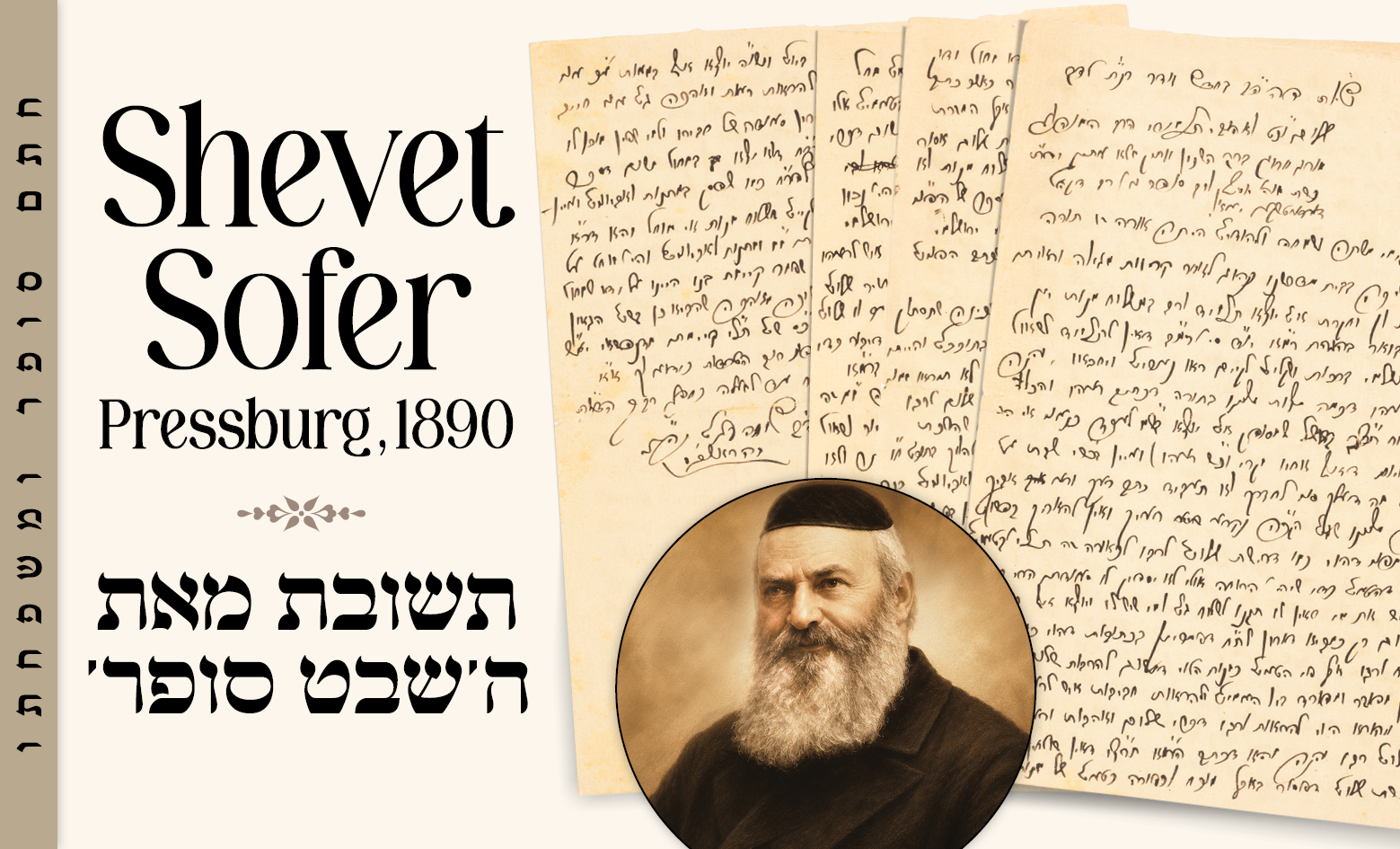
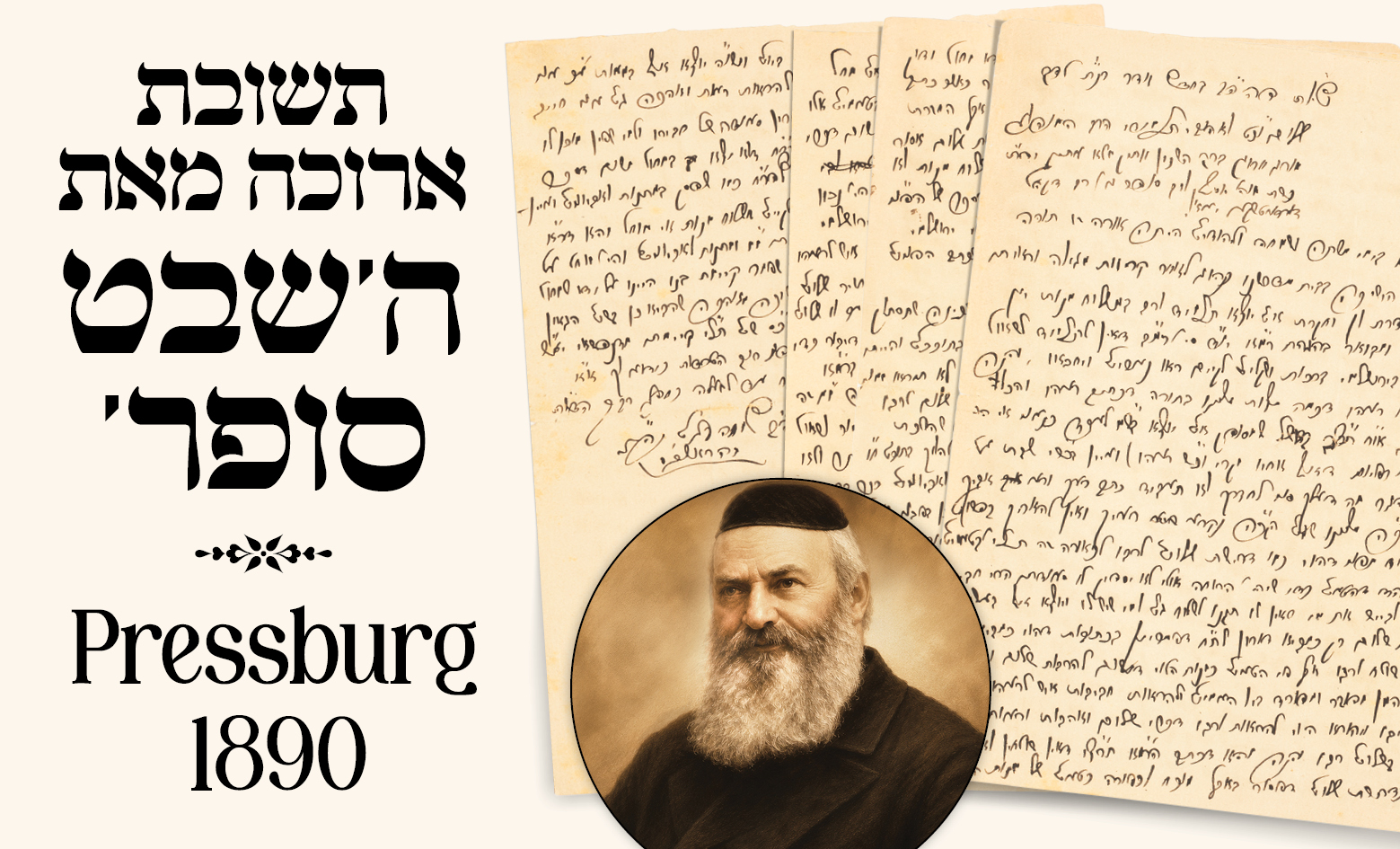
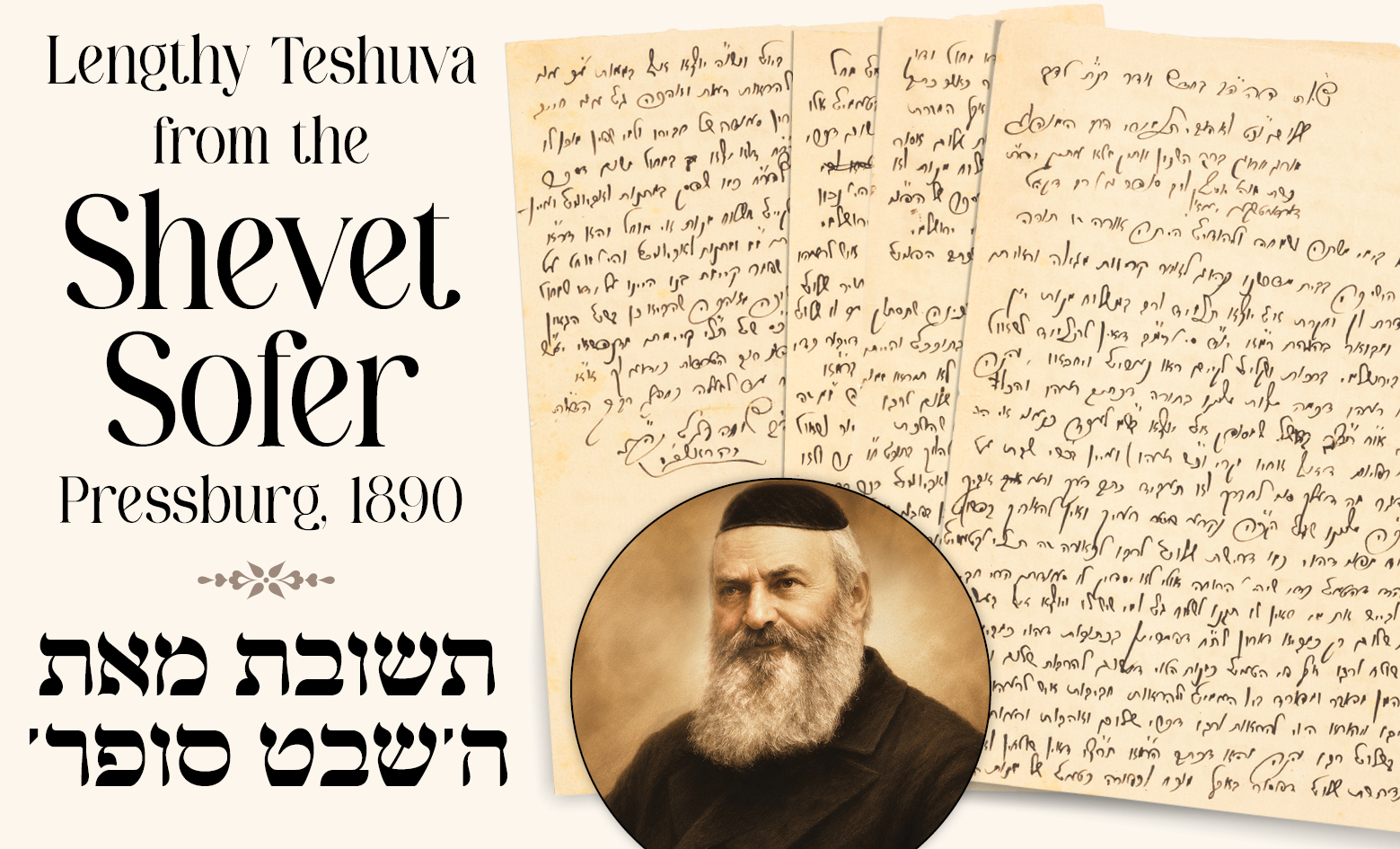
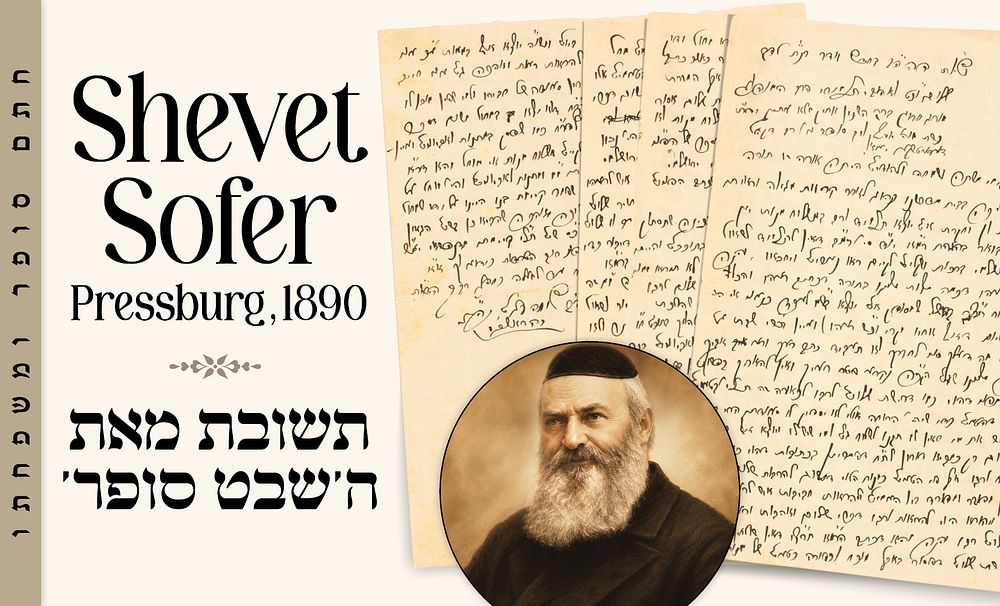
Lengthy Teshuva by the Shevet Sofer. 

Pressburg, 1890

Images

Lengthy Teshuva by the Shevet Sofer. 

Pressburg, 1890


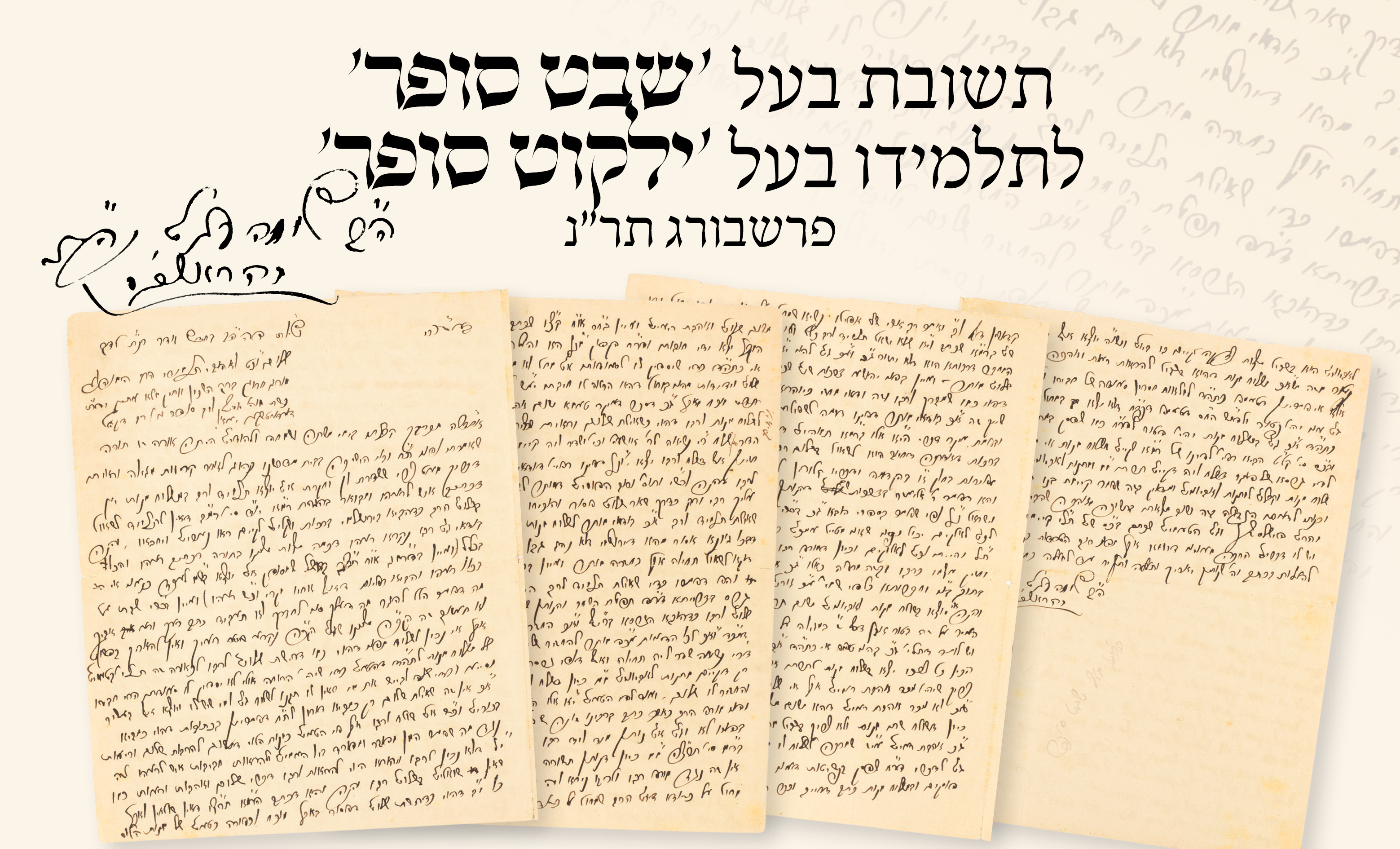
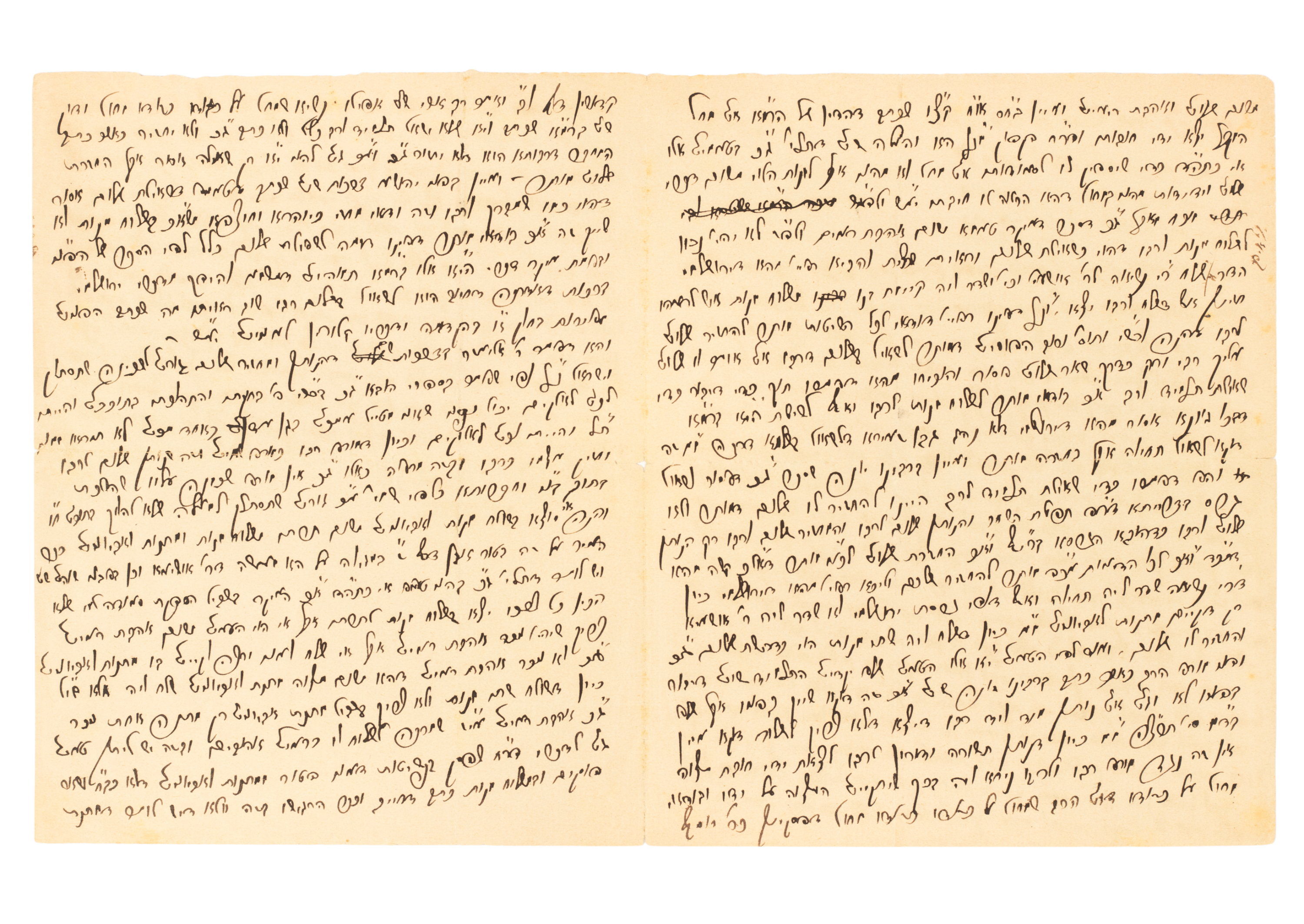
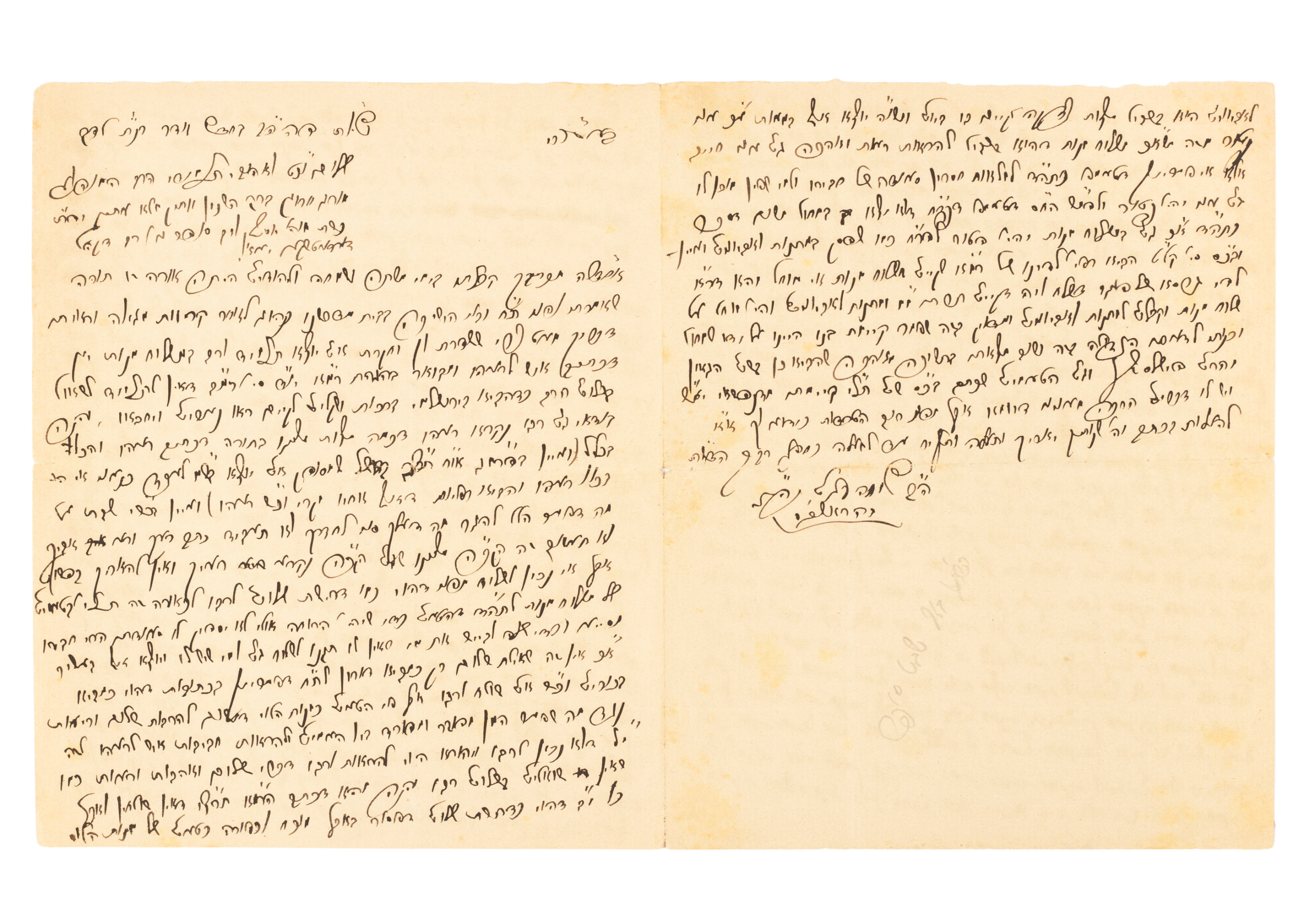
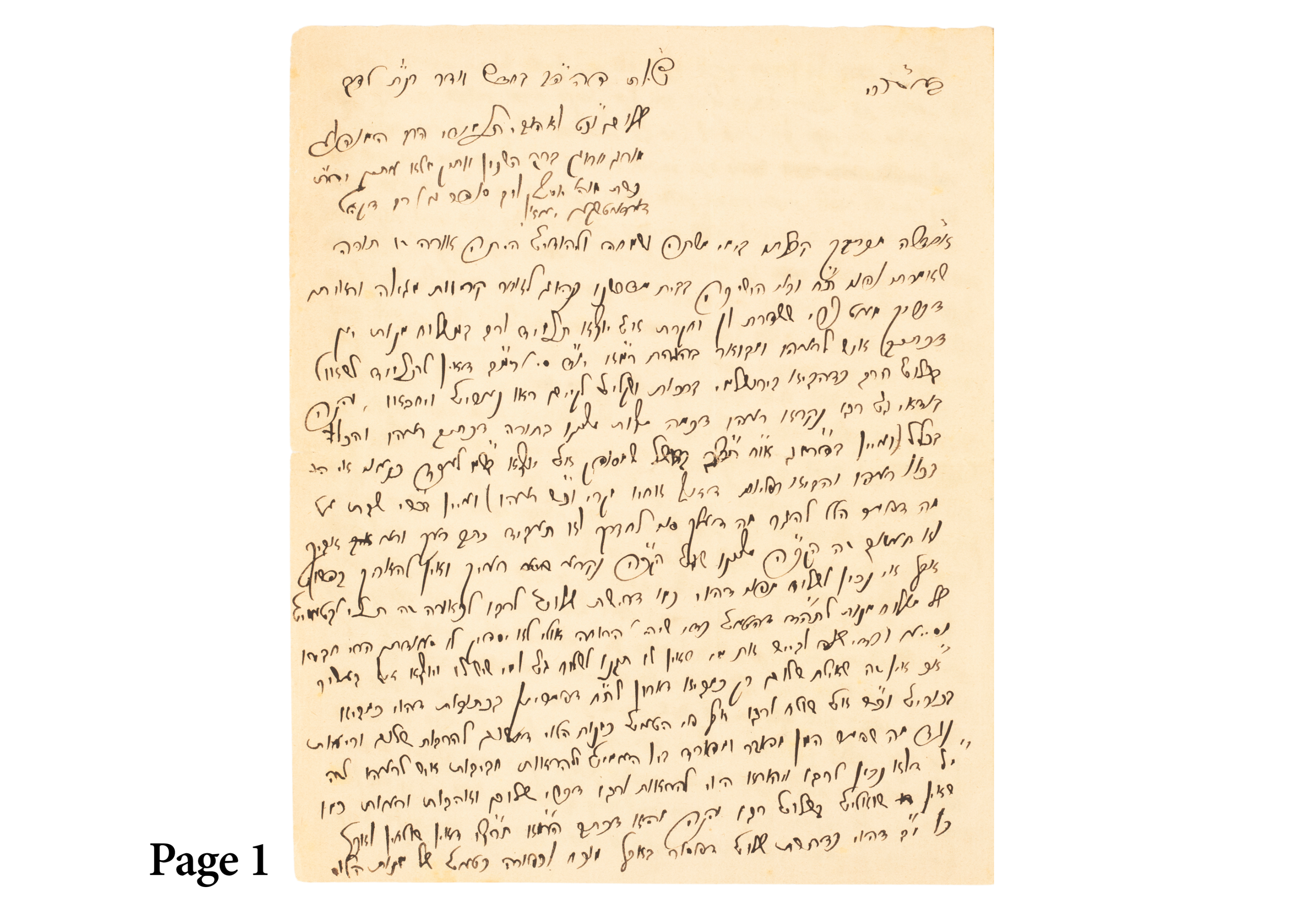
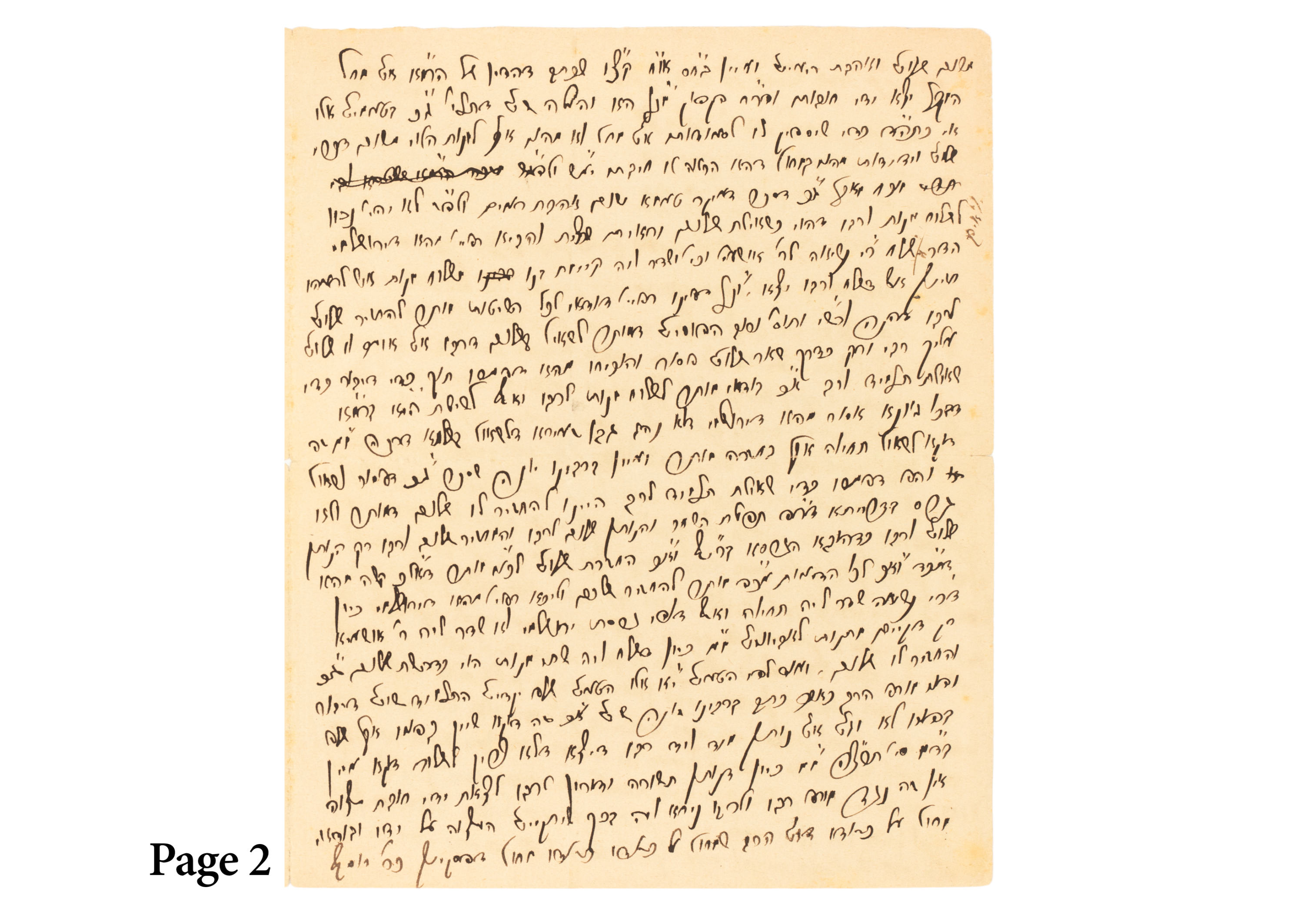
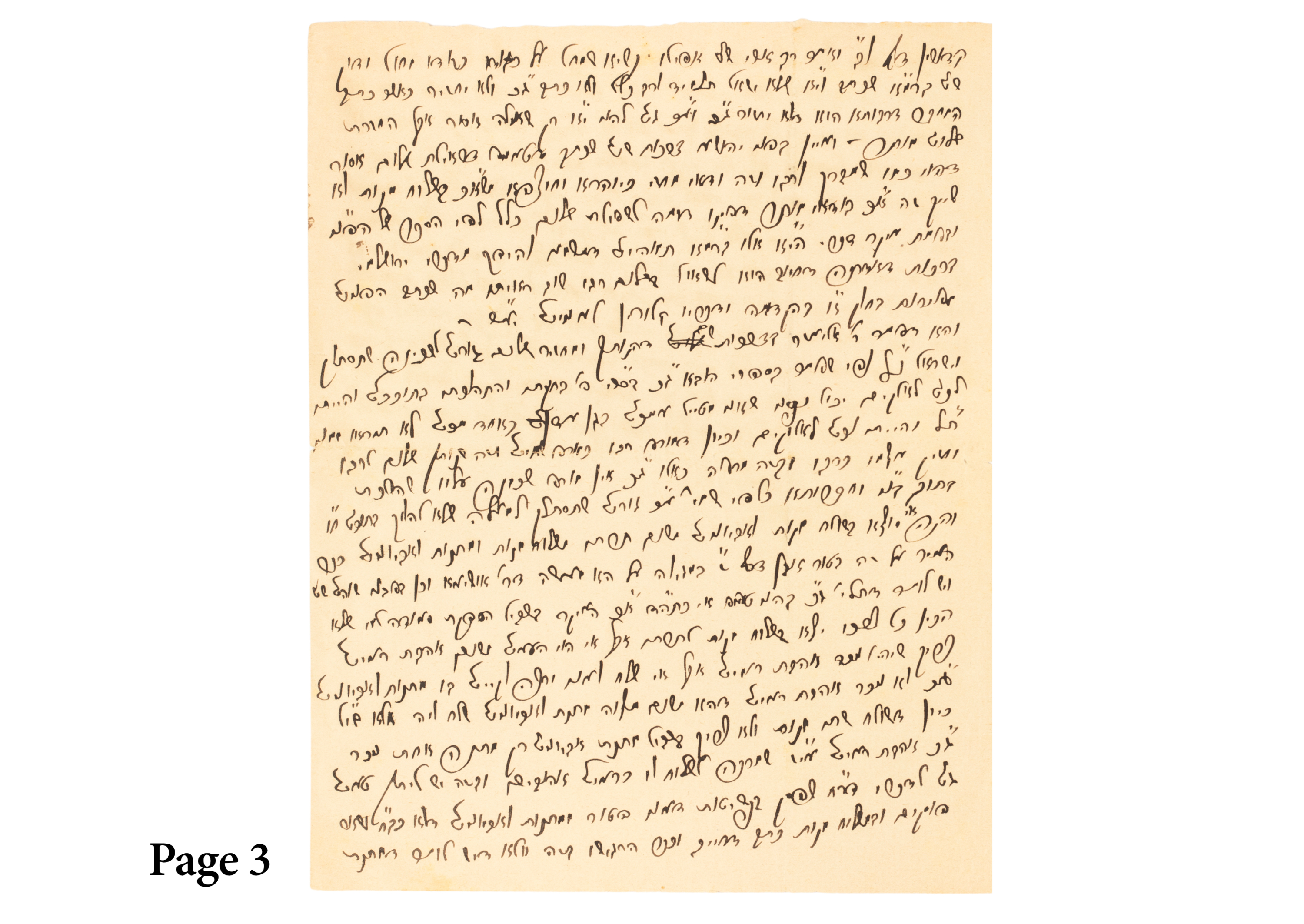
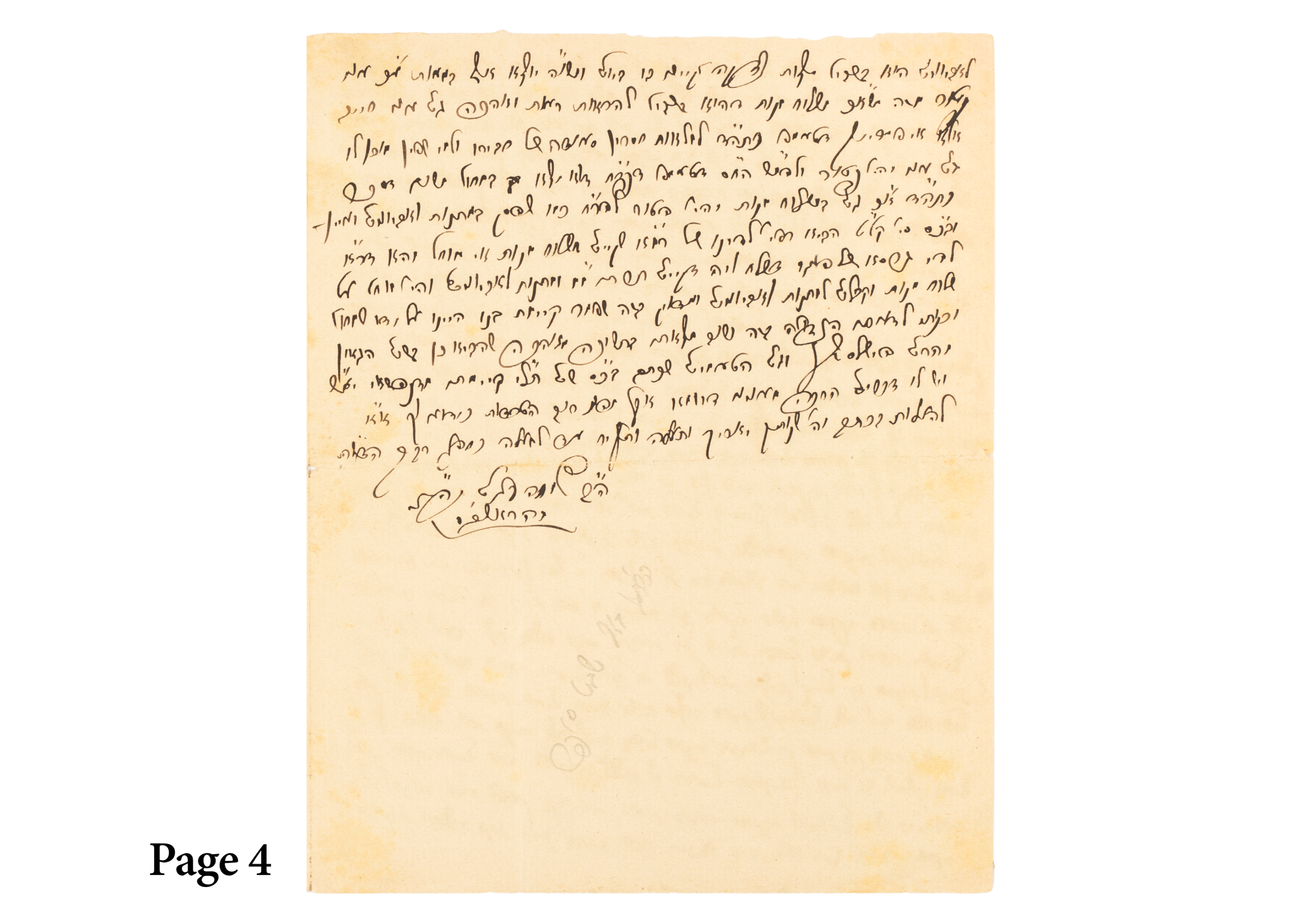
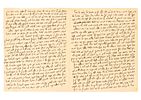
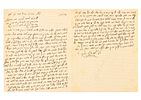
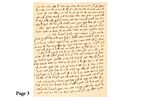
Handwritten halachic teshuva by Rabbi Simcha Bunim Sofer, Av Beis Din of Pressburg and author of Shevet Sofer, addressed to his disciple Rabbi Yosef Leib Sofer, Av Beis Din of Derecske and later of Paks, author of Yalkut Sofer.

The teshuva addresses an intriguing halachic question raised by Rabbi Yosef Leib Sofer: Can a student fulfill the mitzvah of mishloach manos by sending it to his Rebbi? The basis for the question is the verse in Megillas Esther, “u’mishloach manos ish l’re’eihu”—“and mishloach manos, each man to his friend” — and one’s Rebbi is not ordinarily described as a “friend.”

In his teshuva, the Shevet Sofer discusses at length the nature and underlying purpose of mishloach manos and rules unequivocally that a student does indeed fulfill the mitzvah by sending mishloach manos to his Rebbi.

He starts his teshuva with the warm words:

“I received your letter during these days of feasting and rejoicing, when ‘the Jews had light’ — which our Sages explain as referring to Torah. I gave it over to the Torah scholars and yeshiva students in our beis medrash, as is our custom after the reading of the Megillah, and greatly enjoyed the Torah thoughts you shared with us, together with the question you raised…”

Rabbi Simcha Bunim Sofer (1843–1907), author of Shevet Sofer, succeeded his illustrious forebears, the Chasam Sofer and the Ksav Sofer, as Av Beis Din of Pressburg and Rosh Yeshiva of its Yeshiva Gedolah. His influence extended throughout Hungary, where he taught thousands of disciples who became leading rabbanim and halachic authorities. Like his distinguished ancestors, he was a prolific Torah scholar, leaving behind dozens of volumes of chiddushim. Among the works that were published are Shu"t Shevet Sofer, Chiddushei Shevet Sofer on the Gemara, and Shaarei Simcha on the Torah.

The recipient, Rabbi Yosef Leib Sofer (1861–1918), author of Yalkut Sofer and Av Beis Din of Derecske and later Paks, was the son of Rabbi Eliezer Zusman Sofer, Av Beis Din of Paks and author of Yalkut Eliezer. A disciple of both his father and the Shevet Sofer, he served as Av Beis Din of Derecske from 1885 and succeeded his father in Paks in 1903. He is best known for his sefarim Likutei Sofer and Yalkut Sofer.

The Shevet Sofer held his disciple in especially high regard and wrote the approbation to his first sefer, Yalkut Sofer (Paks, 1894).

This teshuva was published in Shu"t Shevet Sofer, Orach Chaim, no. 28, with slight textual variations and omitting the concluding blessing: “May Hashem grant you many long years, and may you continue to grow and succeed to ever greater heights.”

Pressburg, Adar 1890.

Folded leaf, four written pages. Size: 17 × 21 cm. Condition: Good.
______________________________

Transcription of the Letter:

B”H

Pressburg, Adar, 1890


Greetings to my beloved student, the distinguished scholar, brilliant and incisive, accomplished and steeped in Torah wisdom, Rabbi Yosef Leib Sofer, נ"י, Rav of the community of Deretschke.


Shu’t Shevet Sofer, Orach Chaim §28


I received your letter during these days of feasting and rejoicing, when “the Jews had light” — which Chazal interpret as referring to Torah. I delivered your words before the talmidei chachamim and students of our yeshiva in our beis medrash, as is our custom following the reading of the Megillah. I saw the precious thoughts you sent me, in which you raised the question whether a student fulfills the mitzvah of mishloach manos by sending them to his rebbi. Since the pasuk states “one man to his fellow, ” you questioned whether this applies to a rebbi and his student, in light of the Rema in Yoreh De’ah §242, who rules that a student should not extend ordinary greetings to his rebbi, based on the Yerushalmi in Brachos and Shekalim.

Certainly, however, one’s rebbi is also considered his “fellow.” We find numerous mitzvos in the Torah stated in terms of one’s “fellow, ” yet all are included. See also Pri Megadim, Orach Chaim §692, who questions whether one fulfills mishloach manos by sending to a Canaanite slave, since perhaps he is not included in the term “fellow, ” and adduces proofs that even one’s brother is included, and certainly one’s rebbi. See also Rashi in Shabbos regarding Hillel’s statement to the convert, “What is hateful to you, do not do to your fellow.” Rashi cites the pasuk, “Do not forsake your fellow and your father’s fellow, ” interpreting “your fellow” as referring to Hashem Himself. Thus, we find that even Hashem is described as one’s “fellow, ” and there is no need to elaborate on such a straightforward point.


The question, however, is whether it is proper to send mishloach manos to one’s rebbi, since doing so might be comparable to extending greetings to him. At first glance, this would depend upon the different reasons given for the mitzvah of mishloach manos.

According to the Terumas HaDeshen, the purpose is to ensure that everyone has sufficient provisions for the Purim seudah. One person therefore assists another; and in order not to embarrass those who are lacking, Chazal instituted that everyone send gifts, even to those who are wealthy. According to this reasoning, sending mishloach manos is not an expression of greeting at all. Rather, it is comparable to presenting a gift to a talmid chacham, which the Gemara in Kesubos compares to bringing bikkurim — and certainly there is nothing improper about presenting such a gift to one’s rebbi.

According to the Manos HaLevi, however, the purpose of mishloach manos is to increase peace and friendship among the Jewish people, countering Haman’s description of them as “a people scattered and divided among the nations, ” and to demonstrate the affection that one Jew bears another. According to this reasoning, one might argue that it is inappropriate for a student to send mishloach manos to his rebbi, and could even appear presumptuous, since he is expressing feelings of friendship and affection toward his rebbi in the same manner as toward a peer, just as a student may not extend an ordinary greeting to his rebbi.

The Rema’s ruling in §696 that mishloach manos should not be sent to a mourner throughout the twelve months because it is considered a form of greeting would appear to support the reasoning of the Manos HaLevi — that the essence of mishloach manos is indeed an expression of friendship and affection.


The Chasam Sofer, Orach Chaim §196, discusses the Rema’s ruling that if the recipient waives the gift, the sender has nevertheless fulfilled his obligation. The Pri Chadash questions the source for this ruling. The Chasam Sofer explains that it likewise depends upon these two reasons for mishloach manos. According to the Terumas HaDeshen, whose reason is to provide the recipient with what he needs for his seudah, a waiver would not suffice. According to the Manos HaLevi, however, whose reason is to express peace and friendship, a waiver does suffice, since the sender has already demonstrated his affection. See there.


According to what we have explained, the law concerning a mourner would likewise indicate that the primary reason is the fostering of friendship. If so, perhaps it would indeed be improper to send mishloach manos to one’s rebbi, since this would resemble extending greetings to him.

I saw that you wished to bring proof from the Yerushalmi, which relates that Rabbi Yehudah Nesiah sent a gift to Rabbi Oshaya, who responded, “You have fulfilled through us ‘mishloach manos, one man to his fellow.’” This would seem to demonstrate that one fulfills the mitzvah even by sending to one’s rebbi.

In my opinion, however, this is not a proof. According to all opinions, a student may return his rebbi’s greeting. According to Rashi, Tosfos, and most poskim, a student may even initiate a greeting to his rebbi provided he says, “Shalom alecha, rebbi, ” and only greeting him in the ordinary manner is forbidden. They prove this from the definition of toch kedei dibbur as the amount of time required for a student to greet his rebbi. Accordingly, there would certainly be no prohibition against sending mishloach manos to one’s rebbi.

Even according to the opinion cited by the Rema that a student may not initiate a greeting to his rebbi under any circumstances, based upon the Yerushalmi, this applies only to initiating the greeting; returning his rebbi’s greeting is permitted. Rabbeinu Yonah likewise maintains that a student may not initiate a greeting, and explains that the phrase “the time required for a student to greet his rebbi” refers to the time needed to return his rebbi’s greeting, which is permitted. His version of the beraisa at the beginning of the fourth chapter of Brachos likewise contains only the prohibition against initiating a greeting to one’s rebbi, as in the Rif, and does not mention returning a greeting. Thus, according to all opinions, returning one’s rebbi’s greeting is permitted.


The Yerushalmi therefore provides no proof, since Rabbi Yehudah Nesiah had first sent to Rabbi Oshaya. Even according to the text of the Yerushalmi, in which Rabbi Oshaya’s response was not another gift but rather the declaration that Rabbi Yehudah Nesiah had fulfilled the mitzvah of matanos la’evyonim, nevertheless, since Rabbi Yehudah Nesiah had sent him two gifts, this itself constituted an expression of greeting, and Rabbi Oshaya was merely returning it.


Furthermore, according to those authorities, the reason a student may not initiate a greeting is that he should not presume to speak first in his rebbi’s presence, out of the reverence due to him, as Rabbeinu Yonah explains. This concern applies only in his rebbi’s presence, not when he is elsewhere.

Even when the student personally hands the mishloach manos to his rebbi — which is valid, since there is no requirement that they actually be sent through an intermediary; see Darkei Moshe §695 — he is presenting his rebbi with a gift in order to fulfill a mitzvah. This is not inconsistent with the reverence owed to one’s rebbi. On the contrary, the rebbi is pleased that his student fulfills the mitzvah through him, and certainly waives the honor due to him. The halacha follows Rabbi Yosef that “a rebbi who waives the honor due to him, his honor is waived, ” and Rav Ashi states in Kiddushin 32 that this applies even to a Nasi.

Note carefully that the Rema writes, “Some say that a student should not greet his rebbi at all, ” but does not add that he may not return his rebbi’s greeting, as the Mechaber does. Had returning a greeting also been forbidden, this would have been the greater novelty. Evidently, even according to this opinion, only initiating a greeting is prohibited, while returning one is permitted.

See also the Pnei Yehoshua in Brachos, who explains that the reason a student may not greet his rebbi is that doing so resembles bestowing a blessing upon his rebbi, which would certainly appear presumptuous and disrespectful.


This concern does not apply to mishloach manos at all. According to the Pnei Yehoshua’s explanation, therefore, sending mishloach manos to one’s rebbi is certainly permitted, since it bears no resemblance to extending a greeting.


Indeed, the very opinion cited by the Rema is difficult to understand, as the Yerushalmi in Brachos appears to indicate precisely the opposite — that there is actually an obligation to greet one’s rebbi. I subsequently saw the discussion of the Panim Meiros in the introduction to Part I, and his words shed great light on the matter; see there.

As for Rabbi Eliezer’s statement in Brachos that one who greets his rebbi or returns his greeting causes the Shechinah to depart from Yisrael, I would explain it in light of the Sifrei, also cited by Rashi in Parshas Bechukosai, on the pasuk, “I will walk among you and I will be your G-d.” One might think that because Hashem will walk with us in Gan Eden as though He were one of us, we need no longer fear Him; therefore the pasuk concludes, “I will be your G-d.”

Since the reverence due to one’s rebbi is compared to the reverence due to Heaven, one who greets his rebbi as an equal effectively places himself on the same level as his rebbi. In doing so, he similarly demonstrates a lack of awe toward the Shechinah when it dwells among Bnei Yisrael, treating closeness to Heaven as though it were a relationship between equals. He thereby causes the Shechinah, Heaven forbid, to withdraw and no longer dwell among them.

Regarding the question whether one can fulfill both mishloach manos and matanos la’evyonim simultaneously by sending mishloach manos to a poor person, the Turei Even on Megillah 7 already discusses this in connection with the episode involving Rabbi Oshaya, as does the Avnei Shoham there.

This question, too, may depend upon the two reasons mentioned above. According to the Terumas HaDeshen, the primary purpose is to provide for the Purim seudah of someone who has not prepared everything he needs.

 Accordingly, the same gift could perhaps fulfill both obligations. But according to the reason that mishloach manos is intended to express friendship and affection, that friendship must be evident. If one sends to a poor person while also intending to fulfill matanos la’evyonim, the expression of friendship is not apparent, since the gift may have been sent merely to fulfill the mitzvah of matanos la’evyonim.

One might answer, however, that since he sends two portions, whereas matanos la’evyonim requires only one gift to each poor person, the additional portion does demonstrate friendship, since he has given more than required, as one does for a beloved friend.

This may also explain the ruling of the Pri Chadash, who rules unequivocally that a poor person is exempt from matanos la’evyonim, unlike the Bach and other poskim, while ruling that he is nevertheless obligated in mishloach manos. This distinction has already been noted. It may be explained as follows: matanos la’evyonim is essentially the mitzvah of tzedakah specifically incumbent on Purim, and may therefore even be fulfilled with money. A poor person is consequently exempt. Mishloach manos, by contrast, serves to express friendship and affection, and therefore even a poor person is obligated.

If, however, we adopt the Terumas HaDeshen’s reason — that mishloach manos is intended to provide what one’s fellow lacks for his seudah — then a poor person should likewise be exempt. Yet according to the Chasam Sofer, the Pri Chadash’s ruling that a waiver by the recipient does not suffice is based precisely upon his acceptance of the Terumas HaDeshen’s reason. If so, according to the Pri Chadash, a poor person should likewise be exempt from mishloach manos, just as he rules that he is exempt from matanos la’evyonim. This requires further consideration.

In Ksav Sofer §139, he brings proof for the Rema’s ruling that the mitzvah of mishloach manos is fulfilled even when the recipient waives the gift, from the episode of Rabbi Oshaya. According to the version before us, Rabbi Oshaya said that through the gift sent to him, both mishloach manos and matanos la’evyonim had been fulfilled. Yet he effectively waived the mishloach manos by accepting the gifts as matanos la’evyonim. The wording “you have fulfilled through us” is thus precise: the mitzvah was fulfilled through him by virtue of his waiver. I was pleased to find that my own understanding coincided with his great opinion in this matter.

I subsequently found that the Teshuva Me’Ahavah cites this explanation in the name of the Gaon Rabbi Meir Fishels, zt”l. Likewise, with Hashem’s help, I independently arrived at the reasons given by the Ksav Sofer there; see there.


I have much more to write concerning inyanei deyoma, but because of my many obligations, as you well know, I am unable to commit them to writing.


May Hashem grant you many long years, and may you continue to grow and succeed to ever greater heights,

Hakatan Simcha Bunim


Lot : 24

Lengthy Teshuva by the Shevet Sofer. 

Pressburg, 1890

Start price: $4,000
|
Est. Price: $6,000 - $8,000

Lengthy Teshuva by the Shevet Sofer. 

Pressburg, 1890


Handwritten halachic teshuva by Rabbi Simcha Bunim Sofer, Av Beis Din of Pressburg and author of Shevet Sofer, addressed to his disciple Rabbi Yosef Leib Sofer, Av Beis Din of Derecske and later of Paks, author of Yalkut Sofer.

The teshuva addresses an intriguing halachic question raised by Rabbi Yosef Leib Sofer: Can a student fulfill the mitzvah of mishloach manos by sending it to his Rebbi? The basis for the question is the verse in Megillas Esther, “u’mishloach manos ish l’re’eihu”—“and mishloach manos, each man to his friend” — and one’s Rebbi is not ordinarily described as a “friend.”

In his teshuva, the Shevet Sofer discusses at length the nature and underlying purpose of mishloach manos and rules unequivocally that a student does indeed fulfill the mitzvah by sending mishloach manos to his Rebbi.

He starts his teshuva with the warm words:

“I received your letter during these days of feasting and rejoicing, when ‘the Jews had light’ — which our Sages explain as referring to Torah. I gave it over to the Torah scholars and yeshiva students in our beis medrash, as is our custom after the reading of the Megillah, and greatly enjoyed the Torah thoughts you shared with us, together with the question you raised…”

Rabbi Simcha Bunim Sofer (1843–1907), author of Shevet Sofer, succeeded his illustrious forebears, the Chasam Sofer and the Ksav Sofer, as Av Beis Din of Pressburg and Rosh Yeshiva of its Yeshiva Gedolah. His influence extended throughout Hungary, where he taught thousands of disciples who became leading rabbanim and halachic authorities. Like his distinguished ancestors, he was a prolific Torah scholar, leaving behind dozens of volumes of chiddushim. Among the works that were published are Shu"t Shevet Sofer, Chiddushei Shevet Sofer on the Gemara, and Shaarei Simcha on the Torah.

The recipient, Rabbi Yosef Leib Sofer (1861–1918), author of Yalkut Sofer and Av Beis Din of Derecske and later Paks, was the son of Rabbi Eliezer Zusman Sofer, Av Beis Din of Paks and author of Yalkut Eliezer. A disciple of both his father and the Shevet Sofer, he served as Av Beis Din of Derecske from 1885 and succeeded his father in Paks in 1903. He is best known for his sefarim Likutei Sofer and Yalkut Sofer.

The Shevet Sofer held his disciple in especially high regard and wrote the approbation to his first sefer, Yalkut Sofer (Paks, 1894).

This teshuva was published in Shu"t Shevet Sofer, Orach Chaim, no. 28, with slight textual variations and omitting the concluding blessing: “May Hashem grant you many long years, and may you continue to grow and succeed to ever greater heights.”

Pressburg, Adar 1890.

Folded leaf, four written pages. Size: 17 × 21 cm. Condition: Good.
______________________________

Transcription of the Letter:

B”H

Pressburg, Adar, 1890


Greetings to my beloved student, the distinguished scholar, brilliant and incisive, accomplished and steeped in Torah wisdom, Rabbi Yosef Leib Sofer, נ"י, Rav of the community of Deretschke.


Shu’t Shevet Sofer, Orach Chaim §28


I received your letter during these days of feasting and rejoicing, when “the Jews had light” — which Chazal interpret as referring to Torah. I delivered your words before the talmidei chachamim and students of our yeshiva in our beis medrash, as is our custom following the reading of the Megillah. I saw the precious thoughts you sent me, in which you raised the question whether a student fulfills the mitzvah of mishloach manos by sending them to his rebbi. Since the pasuk states “one man to his fellow, ” you questioned whether this applies to a rebbi and his student, in light of the Rema in Yoreh De’ah §242, who rules that a student should not extend ordinary greetings to his rebbi, based on the Yerushalmi in Brachos and Shekalim.

Certainly, however, one’s rebbi is also considered his “fellow.” We find numerous mitzvos in the Torah stated in terms of one’s “fellow, ” yet all are included. See also Pri Megadim, Orach Chaim §692, who questions whether one fulfills mishloach manos by sending to a Canaanite slave, since perhaps he is not included in the term “fellow, ” and adduces proofs that even one’s brother is included, and certainly one’s rebbi. See also Rashi in Shabbos regarding Hillel’s statement to the convert, “What is hateful to you, do not do to your fellow.” Rashi cites the pasuk, “Do not forsake your fellow and your father’s fellow, ” interpreting “your fellow” as referring to Hashem Himself. Thus, we find that even Hashem is described as one’s “fellow, ” and there is no need to elaborate on such a straightforward point.


The question, however, is whether it is proper to send mishloach manos to one’s rebbi, since doing so might be comparable to extending greetings to him. At first glance, this would depend upon the different reasons given for the mitzvah of mishloach manos.

According to the Terumas HaDeshen, the purpose is to ensure that everyone has sufficient provisions for the Purim seudah. One person therefore assists another; and in order not to embarrass those who are lacking, Chazal instituted that everyone send gifts, even to those who are wealthy. According to this reasoning, sending mishloach manos is not an expression of greeting at all. Rather, it is comparable to presenting a gift to a talmid chacham, which the Gemara in Kesubos compares to bringing bikkurim — and certainly there is nothing improper about presenting such a gift to one’s rebbi.

According to the Manos HaLevi, however, the purpose of mishloach manos is to increase peace and friendship among the Jewish people, countering Haman’s description of them as “a people scattered and divided among the nations, ” and to demonstrate the affection that one Jew bears another. According to this reasoning, one might argue that it is inappropriate for a student to send mishloach manos to his rebbi, and could even appear presumptuous, since he is expressing feelings of friendship and affection toward his rebbi in the same manner as toward a peer, just as a student may not extend an ordinary greeting to his rebbi.

The Rema’s ruling in §696 that mishloach manos should not be sent to a mourner throughout the twelve months because it is considered a form of greeting would appear to support the reasoning of the Manos HaLevi — that the essence of mishloach manos is indeed an expression of friendship and affection.


The Chasam Sofer, Orach Chaim §196, discusses the Rema’s ruling that if the recipient waives the gift, the sender has nevertheless fulfilled his obligation. The Pri Chadash questions the source for this ruling. The Chasam Sofer explains that it likewise depends upon these two reasons for mishloach manos. According to the Terumas HaDeshen, whose reason is to provide the recipient with what he needs for his seudah, a waiver would not suffice. According to the Manos HaLevi, however, whose reason is to express peace and friendship, a waiver does suffice, since the sender has already demonstrated his affection. See there.


According to what we have explained, the law concerning a mourner would likewise indicate that the primary reason is the fostering of friendship. If so, perhaps it would indeed be improper to send mishloach manos to one’s rebbi, since this would resemble extending greetings to him.

I saw that you wished to bring proof from the Yerushalmi, which relates that Rabbi Yehudah Nesiah sent a gift to Rabbi Oshaya, who responded, “You have fulfilled through us ‘mishloach manos, one man to his fellow.’” This would seem to demonstrate that one fulfills the mitzvah even by sending to one’s rebbi.

In my opinion, however, this is not a proof. According to all opinions, a student may return his rebbi’s greeting. According to Rashi, Tosfos, and most poskim, a student may even initiate a greeting to his rebbi provided he says, “Shalom alecha, rebbi, ” and only greeting him in the ordinary manner is forbidden. They prove this from the definition of toch kedei dibbur as the amount of time required for a student to greet his rebbi. Accordingly, there would certainly be no prohibition against sending mishloach manos to one’s rebbi.

Even according to the opinion cited by the Rema that a student may not initiate a greeting to his rebbi under any circumstances, based upon the Yerushalmi, this applies only to initiating the greeting; returning his rebbi’s greeting is permitted. Rabbeinu Yonah likewise maintains that a student may not initiate a greeting, and explains that the phrase “the time required for a student to greet his rebbi” refers to the time needed to return his rebbi’s greeting, which is permitted. His version of the beraisa at the beginning of the fourth chapter of Brachos likewise contains only the prohibition against initiating a greeting to one’s rebbi, as in the Rif, and does not mention returning a greeting. Thus, according to all opinions, returning one’s rebbi’s greeting is permitted.


The Yerushalmi therefore provides no proof, since Rabbi Yehudah Nesiah had first sent to Rabbi Oshaya. Even according to the text of the Yerushalmi, in which Rabbi Oshaya’s response was not another gift but rather the declaration that Rabbi Yehudah Nesiah had fulfilled the mitzvah of matanos la’evyonim, nevertheless, since Rabbi Yehudah Nesiah had sent him two gifts, this itself constituted an expression of greeting, and Rabbi Oshaya was merely returning it.


Furthermore, according to those authorities, the reason a student may not initiate a greeting is that he should not presume to speak first in his rebbi’s presence, out of the reverence due to him, as Rabbeinu Yonah explains. This concern applies only in his rebbi’s presence, not when he is elsewhere.

Even when the student personally hands the mishloach manos to his rebbi — which is valid, since there is no requirement that they actually be sent through an intermediary; see Darkei Moshe §695 — he is presenting his rebbi with a gift in order to fulfill a mitzvah. This is not inconsistent with the reverence owed to one’s rebbi. On the contrary, the rebbi is pleased that his student fulfills the mitzvah through him, and certainly waives the honor due to him. The halacha follows Rabbi Yosef that “a rebbi who waives the honor due to him, his honor is waived, ” and Rav Ashi states in Kiddushin 32 that this applies even to a Nasi.

Note carefully that the Rema writes, “Some say that a student should not greet his rebbi at all, ” but does not add that he may not return his rebbi’s greeting, as the Mechaber does. Had returning a greeting also been forbidden, this would have been the greater novelty. Evidently, even according to this opinion, only initiating a greeting is prohibited, while returning one is permitted.

See also the Pnei Yehoshua in Brachos, who explains that the reason a student may not greet his rebbi is that doing so resembles bestowing a blessing upon his rebbi, which would certainly appear presumptuous and disrespectful.


This concern does not apply to mishloach manos at all. According to the Pnei Yehoshua’s explanation, therefore, sending mishloach manos to one’s rebbi is certainly permitted, since it bears no resemblance to extending a greeting.


Indeed, the very opinion cited by the Rema is difficult to understand, as the Yerushalmi in Brachos appears to indicate precisely the opposite — that there is actually an obligation to greet one’s rebbi. I subsequently saw the discussion of the Panim Meiros in the introduction to Part I, and his words shed great light on the matter; see there.

As for Rabbi Eliezer’s statement in Brachos that one who greets his rebbi or returns his greeting causes the Shechinah to depart from Yisrael, I would explain it in light of the Sifrei, also cited by Rashi in Parshas Bechukosai, on the pasuk, “I will walk among you and I will be your G-d.” One might think that because Hashem will walk with us in Gan Eden as though He were one of us, we need no longer fear Him; therefore the pasuk concludes, “I will be your G-d.”

Since the reverence due to one’s rebbi is compared to the reverence due to Heaven, one who greets his rebbi as an equal effectively places himself on the same level as his rebbi. In doing so, he similarly demonstrates a lack of awe toward the Shechinah when it dwells among Bnei Yisrael, treating closeness to Heaven as though it were a relationship between equals. He thereby causes the Shechinah, Heaven forbid, to withdraw and no longer dwell among them.

Regarding the question whether one can fulfill both mishloach manos and matanos la’evyonim simultaneously by sending mishloach manos to a poor person, the Turei Even on Megillah 7 already discusses this in connection with the episode involving Rabbi Oshaya, as does the Avnei Shoham there.

This question, too, may depend upon the two reasons mentioned above. According to the Terumas HaDeshen, the primary purpose is to provide for the Purim seudah of someone who has not prepared everything he needs.

 Accordingly, the same gift could perhaps fulfill both obligations. But according to the reason that mishloach manos is intended to express friendship and affection, that friendship must be evident. If one sends to a poor person while also intending to fulfill matanos la’evyonim, the expression of friendship is not apparent, since the gift may have been sent merely to fulfill the mitzvah of matanos la’evyonim.

One might answer, however, that since he sends two portions, whereas matanos la’evyonim requires only one gift to each poor person, the additional portion does demonstrate friendship, since he has given more than required, as one does for a beloved friend.

This may also explain the ruling of the Pri Chadash, who rules unequivocally that a poor person is exempt from matanos la’evyonim, unlike the Bach and other poskim, while ruling that he is nevertheless obligated in mishloach manos. This distinction has already been noted. It may be explained as follows: matanos la’evyonim is essentially the mitzvah of tzedakah specifically incumbent on Purim, and may therefore even be fulfilled with money. A poor person is consequently exempt. Mishloach manos, by contrast, serves to express friendship and affection, and therefore even a poor person is obligated.

If, however, we adopt the Terumas HaDeshen’s reason — that mishloach manos is intended to provide what one’s fellow lacks for his seudah — then a poor person should likewise be exempt. Yet according to the Chasam Sofer, the Pri Chadash’s ruling that a waiver by the recipient does not suffice is based precisely upon his acceptance of the Terumas HaDeshen’s reason. If so, according to the Pri Chadash, a poor person should likewise be exempt from mishloach manos, just as he rules that he is exempt from matanos la’evyonim. This requires further consideration.

In Ksav Sofer §139, he brings proof for the Rema’s ruling that the mitzvah of mishloach manos is fulfilled even when the recipient waives the gift, from the episode of Rabbi Oshaya. According to the version before us, Rabbi Oshaya said that through the gift sent to him, both mishloach manos and matanos la’evyonim had been fulfilled. Yet he effectively waived the mishloach manos by accepting the gifts as matanos la’evyonim. The wording “you have fulfilled through us” is thus precise: the mitzvah was fulfilled through him by virtue of his waiver. I was pleased to find that my own understanding coincided with his great opinion in this matter.

I subsequently found that the Teshuva Me’Ahavah cites this explanation in the name of the Gaon Rabbi Meir Fishels, zt”l. Likewise, with Hashem’s help, I independently arrived at the reasons given by the Ksav Sofer there; see there.


I have much more to write concerning inyanei deyoma, but because of my many obligations, as you well know, I am unable to commit them to writing.


May Hashem grant you many long years, and may you continue to grow and succeed to ever greater heights,

Hakatan Simcha Bunim


Lengthy Teshuva by the Shevet Sofer. 

Pressburg, 1890


Handwritten halachic teshuva by Rabbi Simcha Bunim Sofer, Av Beis Din of Pressburg and author of Shevet Sofer, addressed to his disciple Rabbi Yosef Leib Sofer, Av Beis Din of Derecske and later of Paks, author of Yalkut Sofer.

The teshuva addresses an intriguing halachic question raised by Rabbi Yosef Leib Sofer: Can a student fulfill the mitzvah of mishloach manos by sending it to his Rebbi? The basis for the question is the verse in Megillas Esther, “u’mishloach manos ish l’re’eihu”—“and mishloach manos, each man to his friend” — and one’s Rebbi is not ordinarily described as a “friend.”

In his teshuva, the Shevet Sofer discusses at length the nature and underlying purpose of mishloach manos and rules unequivocally that a student does indeed fulfill the mitzvah by sending mishloach manos to his Rebbi.

He starts his teshuva with the warm words:

“I received your letter during these days of feasting and rejoicing, when ‘the Jews had light’ — which our Sages explain as referring to Torah. I gave it over to the Torah scholars and yeshiva students in our beis medrash, as is our custom after the reading of the Megillah, and greatly enjoyed the Torah thoughts you shared with us, together with the question you raised…”

Rabbi Simcha Bunim Sofer (1843–1907), author of Shevet Sofer, succeeded his illustrious forebears, the Chasam Sofer and the Ksav Sofer, as Av Beis Din of Pressburg and Rosh Yeshiva of its Yeshiva Gedolah. His influence extended throughout Hungary, where he taught thousands of disciples who became leading rabbanim and halachic authorities. Like his distinguished ancestors, he was a prolific Torah scholar, leaving behind dozens of volumes of chiddushim. Among the works that were published are Shu"t Shevet Sofer, Chiddushei Shevet Sofer on the Gemara, and Shaarei Simcha on the Torah.

The recipient, Rabbi Yosef Leib Sofer (1861–1918), author of Yalkut Sofer and Av Beis Din of Derecske and later Paks, was the son of Rabbi Eliezer Zusman Sofer, Av Beis Din of Paks and author of Yalkut Eliezer. A disciple of both his father and the Shevet Sofer, he served as Av Beis Din of Derecske from 1885 and succeeded his father in Paks in 1903. He is best known for his sefarim Likutei Sofer and Yalkut Sofer.

The Shevet Sofer held his disciple in especially high regard and wrote the approbation to his first sefer, Yalkut Sofer (Paks, 1894).

This teshuva was published in Shu"t Shevet Sofer, Orach Chaim, no. 28, with slight textual variations and omitting the concluding blessing: “May Hashem grant you many long years, and may you continue to grow and succeed to ever greater heights.”

Pressburg, Adar 1890.

Folded leaf, four written pages. Size: 17 × 21 cm. Condition: Good.
______________________________

Transcription of the Letter:

B”H

Pressburg, Adar, 1890


Greetings to my beloved student, the distinguished scholar, brilliant and incisive, accomplished and steeped in Torah wisdom, Rabbi Yosef Leib Sofer, נ"י, Rav of the community of Deretschke.


Shu’t Shevet Sofer, Orach Chaim §28


I received your letter during these days of feasting and rejoicing, when “the Jews had light” — which Chazal interpret as referring to Torah. I delivered your words before the talmidei chachamim and students of our yeshiva in our beis medrash, as is our custom following the reading of the Megillah. I saw the precious thoughts you sent me, in which you raised the question whether a student fulfills the mitzvah of mishloach manos by sending them to his rebbi. Since the pasuk states “one man to his fellow, ” you questioned whether this applies to a rebbi and his student, in light of the Rema in Yoreh De’ah §242, who rules that a student should not extend ordinary greetings to his rebbi, based on the Yerushalmi in Brachos and Shekalim.

Certainly, however, one’s rebbi is also considered his “fellow.” We find numerous mitzvos in the Torah stated in terms of one’s “fellow, ” yet all are included. See also Pri Megadim, Orach Chaim §692, who questions whether one fulfills mishloach manos by sending to a Canaanite slave, since perhaps he is not included in the term “fellow, ” and adduces proofs that even one’s brother is included, and certainly one’s rebbi. See also Rashi in Shabbos regarding Hillel’s statement to the convert, “What is hateful to you, do not do to your fellow.” Rashi cites the pasuk, “Do not forsake your fellow and your father’s fellow, ” interpreting “your fellow” as referring to Hashem Himself. Thus, we find that even Hashem is described as one’s “fellow, ” and there is no need to elaborate on such a straightforward point.


The question, however, is whether it is proper to send mishloach manos to one’s rebbi, since doing so might be comparable to extending greetings to him. At first glance, this would depend upon the different reasons given for the mitzvah of mishloach manos.

According to the Terumas HaDeshen, the purpose is to ensure that everyone has sufficient provisions for the Purim seudah. One person therefore assists another; and in order not to embarrass those who are lacking, Chazal instituted that everyone send gifts, even to those who are wealthy. According to this reasoning, sending mishloach manos is not an expression of greeting at all. Rather, it is comparable to presenting a gift to a talmid chacham, which the Gemara in Kesubos compares to bringing bikkurim — and certainly there is nothing improper about presenting such a gift to one’s rebbi.

According to the Manos HaLevi, however, the purpose of mishloach manos is to increase peace and friendship among the Jewish people, countering Haman’s description of them as “a people scattered and divided among the nations, ” and to demonstrate the affection that one Jew bears another. According to this reasoning, one might argue that it is inappropriate for a student to send mishloach manos to his rebbi, and could even appear presumptuous, since he is expressing feelings of friendship and affection toward his rebbi in the same manner as toward a peer, just as a student may not extend an ordinary greeting to his rebbi.

The Rema’s ruling in §696 that mishloach manos should not be sent to a mourner throughout the twelve months because it is considered a form of greeting would appear to support the reasoning of the Manos HaLevi — that the essence of mishloach manos is indeed an expression of friendship and affection.


The Chasam Sofer, Orach Chaim §196, discusses the Rema’s ruling that if the recipient waives the gift, the sender has nevertheless fulfilled his obligation. The Pri Chadash questions the source for this ruling. The Chasam Sofer explains that it likewise depends upon these two reasons for mishloach manos. According to the Terumas HaDeshen, whose reason is to provide the recipient with what he needs for his seudah, a waiver would not suffice. According to the Manos HaLevi, however, whose reason is to express peace and friendship, a waiver does suffice, since the sender has already demonstrated his affection. See there.


According to what we have explained, the law concerning a mourner would likewise indicate that the primary reason is the fostering of friendship. If so, perhaps it would indeed be improper to send mishloach manos to one’s rebbi, since this would resemble extending greetings to him.

I saw that you wished to bring proof from the Yerushalmi, which relates that Rabbi Yehudah Nesiah sent a gift to Rabbi Oshaya, who responded, “You have fulfilled through us ‘mishloach manos, one man to his fellow.’” This would seem to demonstrate that one fulfills the mitzvah even by sending to one’s rebbi.

In my opinion, however, this is not a proof. According to all opinions, a student may return his rebbi’s greeting. According to Rashi, Tosfos, and most poskim, a student may even initiate a greeting to his rebbi provided he says, “Shalom alecha, rebbi, ” and only greeting him in the ordinary manner is forbidden. They prove this from the definition of toch kedei dibbur as the amount of time required for a student to greet his rebbi. Accordingly, there would certainly be no prohibition against sending mishloach manos to one’s rebbi.

Even according to the opinion cited by the Rema that a student may not initiate a greeting to his rebbi under any circumstances, based upon the Yerushalmi, this applies only to initiating the greeting; returning his rebbi’s greeting is permitted. Rabbeinu Yonah likewise maintains that a student may not initiate a greeting, and explains that the phrase “the time required for a student to greet his rebbi” refers to the time needed to return his rebbi’s greeting, which is permitted. His version of the beraisa at the beginning of the fourth chapter of Brachos likewise contains only the prohibition against initiating a greeting to one’s rebbi, as in the Rif, and does not mention returning a greeting. Thus, according to all opinions, returning one’s rebbi’s greeting is permitted.


The Yerushalmi therefore provides no proof, since Rabbi Yehudah Nesiah had first sent to Rabbi Oshaya. Even according to the text of the Yerushalmi, in which Rabbi Oshaya’s response was not another gift but rather the declaration that Rabbi Yehudah Nesiah had fulfilled the mitzvah of matanos la’evyonim, nevertheless, since Rabbi Yehudah Nesiah had sent him two gifts, this itself constituted an expression of greeting, and Rabbi Oshaya was merely returning it.


Furthermore, according to those authorities, the reason a student may not initiate a greeting is that he should not presume to speak first in his rebbi’s presence, out of the reverence due to him, as Rabbeinu Yonah explains. This concern applies only in his rebbi’s presence, not when he is elsewhere.

Even when the student personally hands the mishloach manos to his rebbi — which is valid, since there is no requirement that they actually be sent through an intermediary; see Darkei Moshe §695 — he is presenting his rebbi with a gift in order to fulfill a mitzvah. This is not inconsistent with the reverence owed to one’s rebbi. On the contrary, the rebbi is pleased that his student fulfills the mitzvah through him, and certainly waives the honor due to him. The halacha follows Rabbi Yosef that “a rebbi who waives the honor due to him, his honor is waived, ” and Rav Ashi states in Kiddushin 32 that this applies even to a Nasi.

Note carefully that the Rema writes, “Some say that a student should not greet his rebbi at all, ” but does not add that he may not return his rebbi’s greeting, as the Mechaber does. Had returning a greeting also been forbidden, this would have been the greater novelty. Evidently, even according to this opinion, only initiating a greeting is prohibited, while returning one is permitted.

See also the Pnei Yehoshua in Brachos, who explains that the reason a student may not greet his rebbi is that doing so resembles bestowing a blessing upon his rebbi, which would certainly appear presumptuous and disrespectful.


This concern does not apply to mishloach manos at all. According to the Pnei Yehoshua’s explanation, therefore, sending mishloach manos to one’s rebbi is certainly permitted, since it bears no resemblance to extending a greeting.


Indeed, the very opinion cited by the Rema is difficult to understand, as the Yerushalmi in Brachos appears to indicate precisely the opposite — that there is actually an obligation to greet one’s rebbi. I subsequently saw the discussion of the Panim Meiros in the introduction to Part I, and his words shed great light on the matter; see there.

As for Rabbi Eliezer’s statement in Brachos that one who greets his rebbi or returns his greeting causes the Shechinah to depart from Yisrael, I would explain it in light of the Sifrei, also cited by Rashi in Parshas Bechukosai, on the pasuk, “I will walk among you and I will be your G-d.” One might think that because Hashem will walk with us in Gan Eden as though He were one of us, we need no longer fear Him; therefore the pasuk concludes, “I will be your G-d.”

Since the reverence due to one’s rebbi is compared to the reverence due to Heaven, one who greets his rebbi as an equal effectively places himself on the same level as his rebbi. In doing so, he similarly demonstrates a lack of awe toward the Shechinah when it dwells among Bnei Yisrael, treating closeness to Heaven as though it were a relationship between equals. He thereby causes the Shechinah, Heaven forbid, to withdraw and no longer dwell among them.

Regarding the question whether one can fulfill both mishloach manos and matanos la’evyonim simultaneously by sending mishloach manos to a poor person, the Turei Even on Megillah 7 already discusses this in connection with the episode involving Rabbi Oshaya, as does the Avnei Shoham there.

This question, too, may depend upon the two reasons mentioned above. According to the Terumas HaDeshen, the primary purpose is to provide for the Purim seudah of someone who has not prepared everything he needs.

 Accordingly, the same gift could perhaps fulfill both obligations. But according to the reason that mishloach manos is intended to express friendship and affection, that friendship must be evident. If one sends to a poor person while also intending to fulfill matanos la’evyonim, the expression of friendship is not apparent, since the gift may have been sent merely to fulfill the mitzvah of matanos la’evyonim.

One might answer, however, that since he sends two portions, whereas matanos la’evyonim requires only one gift to each poor person, the additional portion does demonstrate friendship, since he has given more than required, as one does for a beloved friend.

This may also explain the ruling of the Pri Chadash, who rules unequivocally that a poor person is exempt from matanos la’evyonim, unlike the Bach and other poskim, while ruling that he is nevertheless obligated in mishloach manos. This distinction has already been noted. It may be explained as follows: matanos la’evyonim is essentially the mitzvah of tzedakah specifically incumbent on Purim, and may therefore even be fulfilled with money. A poor person is consequently exempt. Mishloach manos, by contrast, serves to express friendship and affection, and therefore even a poor person is obligated.

If, however, we adopt the Terumas HaDeshen’s reason — that mishloach manos is intended to provide what one’s fellow lacks for his seudah — then a poor person should likewise be exempt. Yet according to the Chasam Sofer, the Pri Chadash’s ruling that a waiver by the recipient does not suffice is based precisely upon his acceptance of the Terumas HaDeshen’s reason. If so, according to the Pri Chadash, a poor person should likewise be exempt from mishloach manos, just as he rules that he is exempt from matanos la’evyonim. This requires further consideration.

In Ksav Sofer §139, he brings proof for the Rema’s ruling that the mitzvah of mishloach manos is fulfilled even when the recipient waives the gift, from the episode of Rabbi Oshaya. According to the version before us, Rabbi Oshaya said that through the gift sent to him, both mishloach manos and matanos la’evyonim had been fulfilled. Yet he effectively waived the mishloach manos by accepting the gifts as matanos la’evyonim. The wording “you have fulfilled through us” is thus precise: the mitzvah was fulfilled through him by virtue of his waiver. I was pleased to find that my own understanding coincided with his great opinion in this matter.

I subsequently found that the Teshuva Me’Ahavah cites this explanation in the name of the Gaon Rabbi Meir Fishels, zt”l. Likewise, with Hashem’s help, I independently arrived at the reasons given by the Ksav Sofer there; see there.


I have much more to write concerning inyanei deyoma, but because of my many obligations, as you well know, I am unable to commit them to writing.


May Hashem grant you many long years, and may you continue to grow and succeed to ever greater heights,

Hakatan Simcha Bunim