To attend this auction live or leave absentee bids

Lot : 1
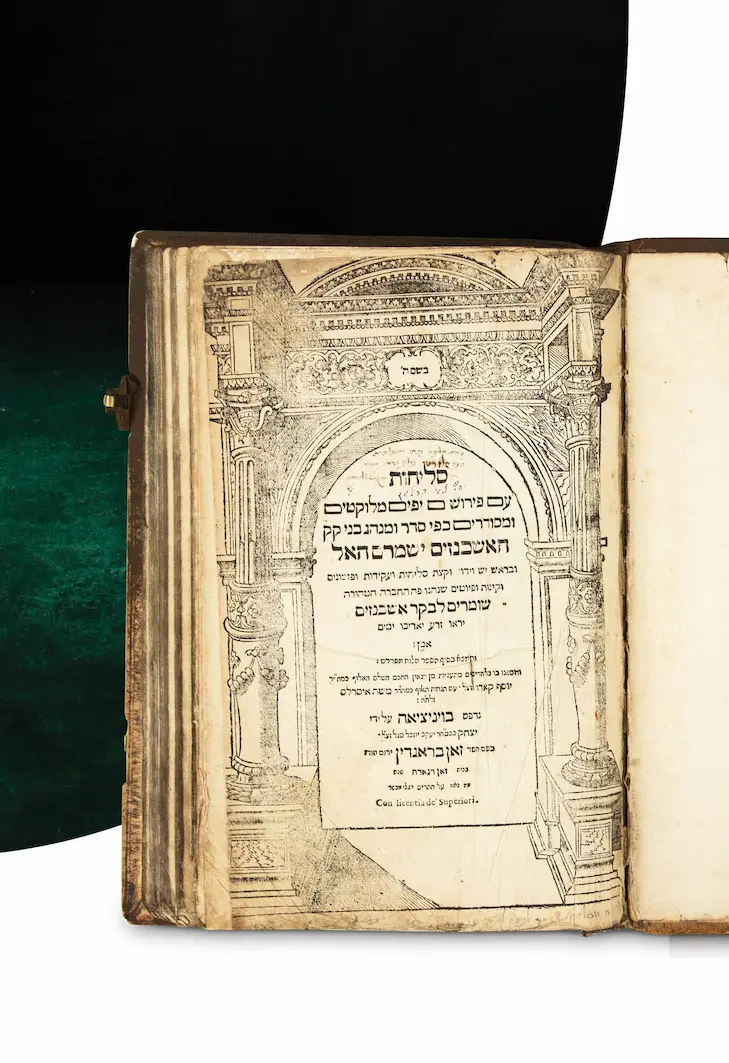
Selichos in Ashkenazic Rite. Venice, 1600
Selichos for the whole year according to the customs of the Ashekenazic community in Italy, including commentaries, dinim and minhagim.
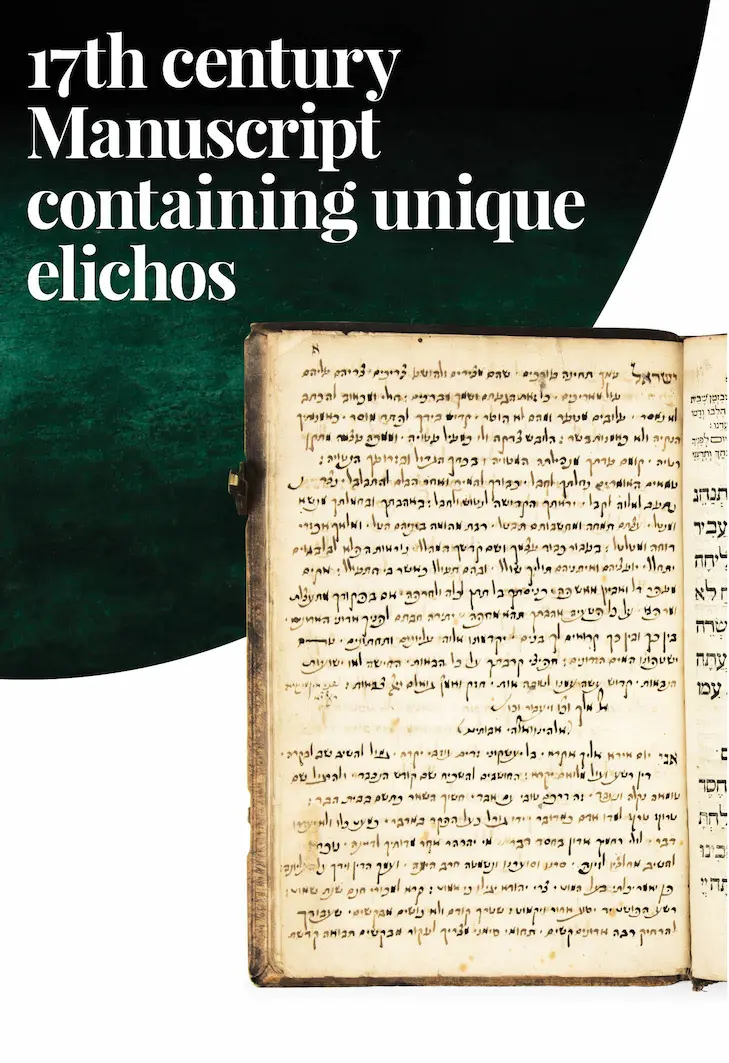
Additional Selichot in the back of the sefer, 8 leaves (16 sides), in 17th century German script along with a separate leaf with the text of “Kel Melech Yoshev” with Yiddish translation.
Contains Selichos for the month of Elul, Aseres Yemei Teshuvah, Yom Kippur and public fast days, prayers for bris millah as well as piyyutim and selichos for tikkun chatzos.
Written on leaf 129b: “Customs for the group of ‘early risers’ of the Ashhekazic [communities], which began here in Venice on the third day of the month of Adar 1596.
This Selichos was printed according to the Venice edition of Selichos 1548, with additional selichos and prayers.
Venice, 1600. Page Count: 132 leaves. Page size: 29 cm. Description: several leaves with tears; signs of use and wax drippings. Condition: Good with all text intact. Antique parchment-coated wooden binding with remnants of clasps.
Provenance: Carlebach Hamburg-Lakewood.
Title page with autograph of Rabbi Yosef Tzvi Carlebach
............................................
Any inquiries about this lot ?
We are available also on WhatsApp >>>

Lot : 2
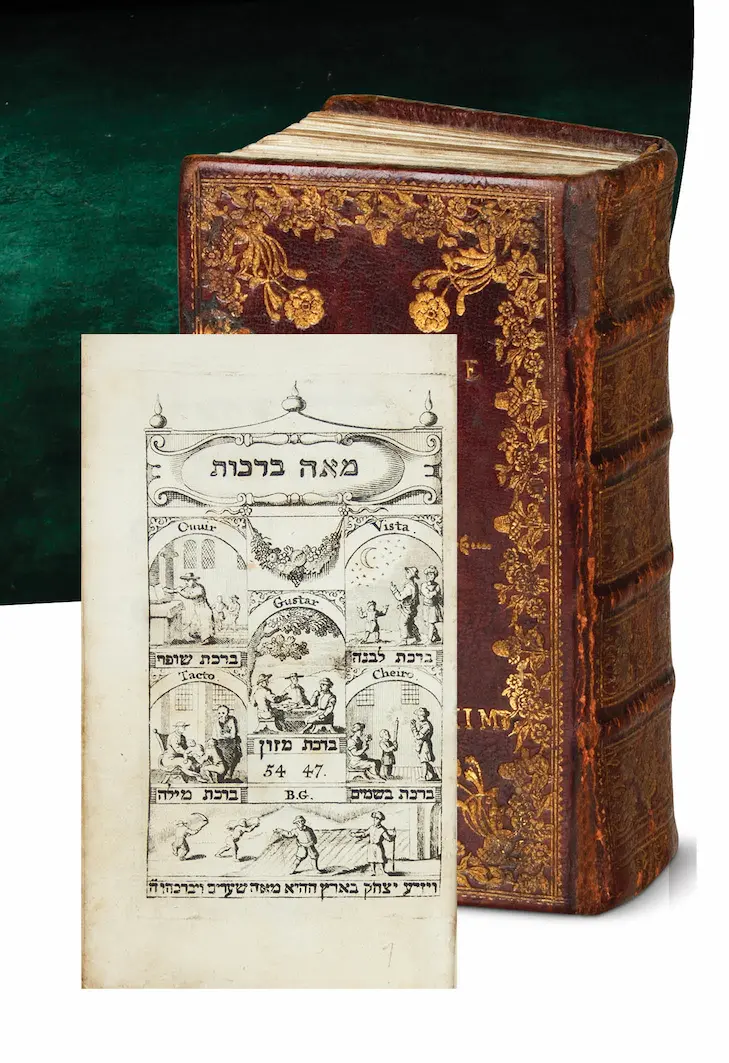
Seder Meah Brachos. Amsterdam, 1687
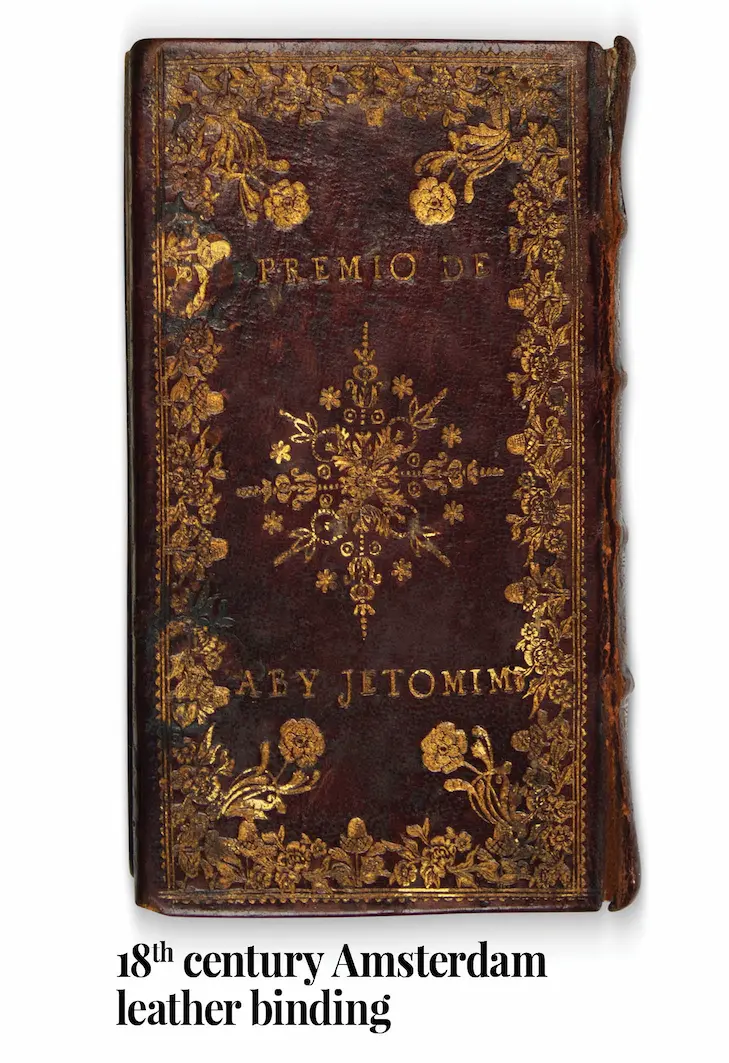
18th century Amsterdam leather binding
Seder Meah Brachos (order of a Hundred Blessings) - contains all the Birkos Hamitzvos and Birkos Nehenin that can be recited throughout one’s life, along with various prayers, Haggadah shel Pesach, halachos pertaining to blessings and shechitah, Jewish customs and a Jewish calendar, all printed in Hebrew and Spanish on facing sides of the page.
The sefer has two title pages, the first featuring intricate copperplate engravings composed of five miniature illustrations of different blessings.
This book includes (leaf 300), a prayer recited by descendants of Kedoshim who perished in the notorious autos-da-fé held during the Inquisition period.
A Jewish calendar and chronological list of Jewish historical events up until the Chmielnicki Massacres of 1648 appear at the end of the sefer.
Amsterdam, 1687. Page Count: [1] Illustrated title page [10] leaf 303, 54 [11], [15], 7, [20] sides. Description: Complete copy printed on thin white paper with gilded edges.
Condition: Good with miniscule holes in binding. Binding: Impressive 18th century
Amsterdam binding with gilded engravings of leaves, and Engraving of the name of the Avi Yesomim Society which was active in Amsterdam during this period of time: Premio de Aby Jetomin Anno, 5530.
Provenance: The William Gross Collection
.......................................
Any inquiries about this lot ?
We are available also on WhatsApp >>>

Lot : 3
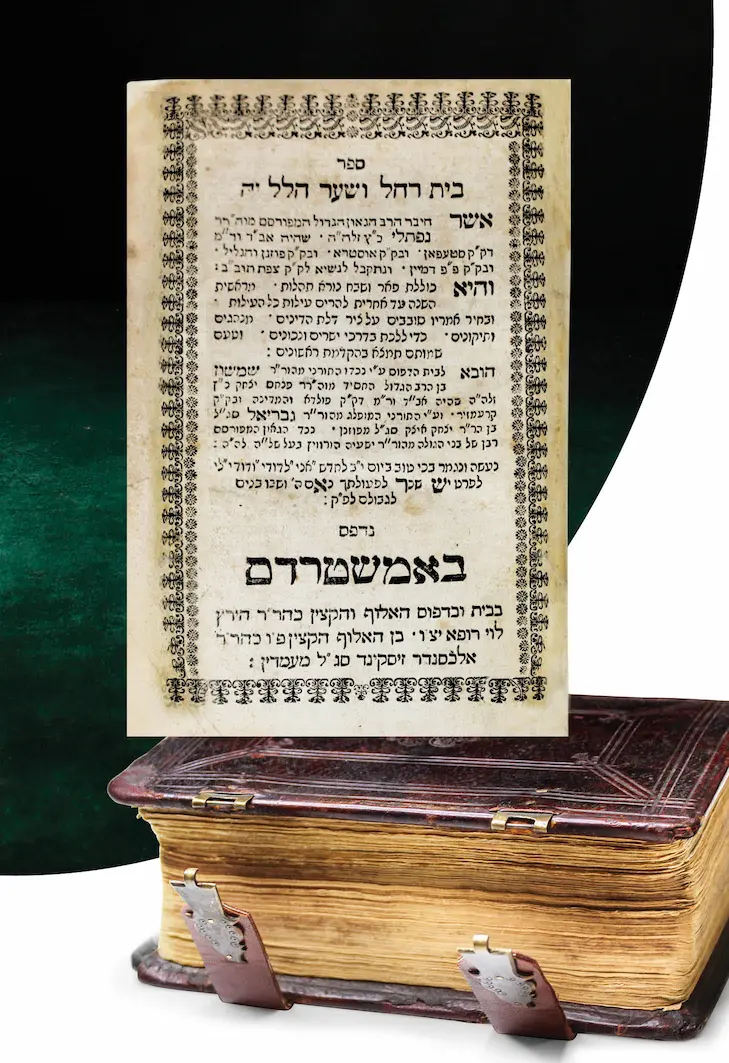
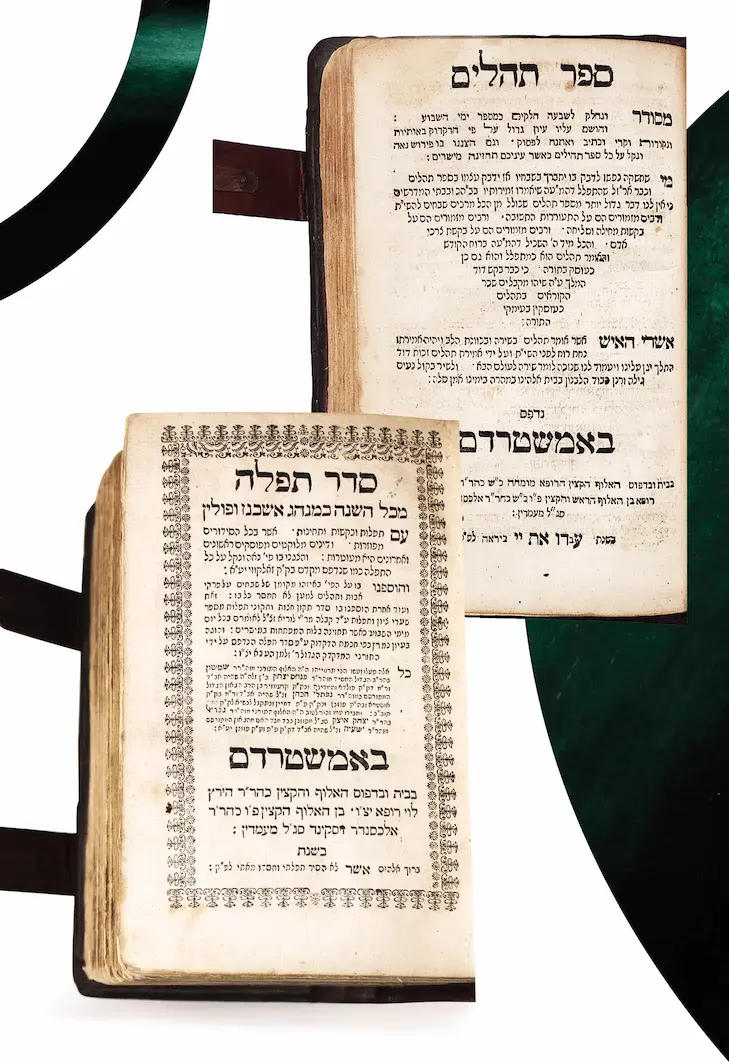
Siddur with Beis Rachel and Shaar Hallel Ka by the Semichas Chachamim. Rare First Edition. Amsterdam, 1741
Rare siddur brought to print by the grandchildren of the Semichas Chachamim and Shl”a Hakadosh!
Siddur in Ashkenazic-Polish right with kabbalistic prayers. The siddur includes the sefer Beis Rachel and Shaar Hallel Ka, a book of prayers, entreaties, zemiros, confessions and Tikkunim for the whole year by Rabbi Naftali Katz, Av Beis Din of Posen and Frankfurt and author of the Semichas Chachamim. Including Sefer Thillim with a separate title page.
Published by the Semichas Chachamim’s grandson Rabbi Shimshon Katz and the Shl”a Hakadosh’s grandson Rabbi Gavriel of Posen. Throughout the past centuries, the sefer Beis Rachel was printed in numerous editions, both independently and as an appendix to many siddurim: This first edition of Sefer Bais Rachel is exceedingly rare.
Rabbi Naftali Katz (1650-1719), Av Beis Din of Posen and Frankfurt and author of Semichas Chachamim, was a saintly kabbalist whom the Chida describes as “A wondrous kabbalist in practical kabbalah and G-dly kabbalah”. He was a tzaddik and miracle-worker, and countless stories were told about his piety and the wonders he enacted.
The present siddur is an important work, replete with halachos and commentary, as well as many other additions. The siddur was edited following the text of Rabbi Shlomo Zalman Henna’s siddur, and includes prayers from Shaarei Tzion as well as kabbalistic prayers from the Arizal. It also includes a Tehillim and Pirkei Avos with commentary, all edited by the publishers, the righteous and scholarly grandchildren of the Semichas Chachamim and Shl”a Hakadosh.
Amsterdam, 1741. First edition. Page Count: [6], 400, 90: 16 leaves. Condition: Several pages have signs of wear; one leaf has minor tear affecting text. Separate title page for Tehillim.
..............................................
Any inquiries about this lot ?
We are available also on WhatsApp >>>

Lot : 4
Important Kabbalistic Siddur
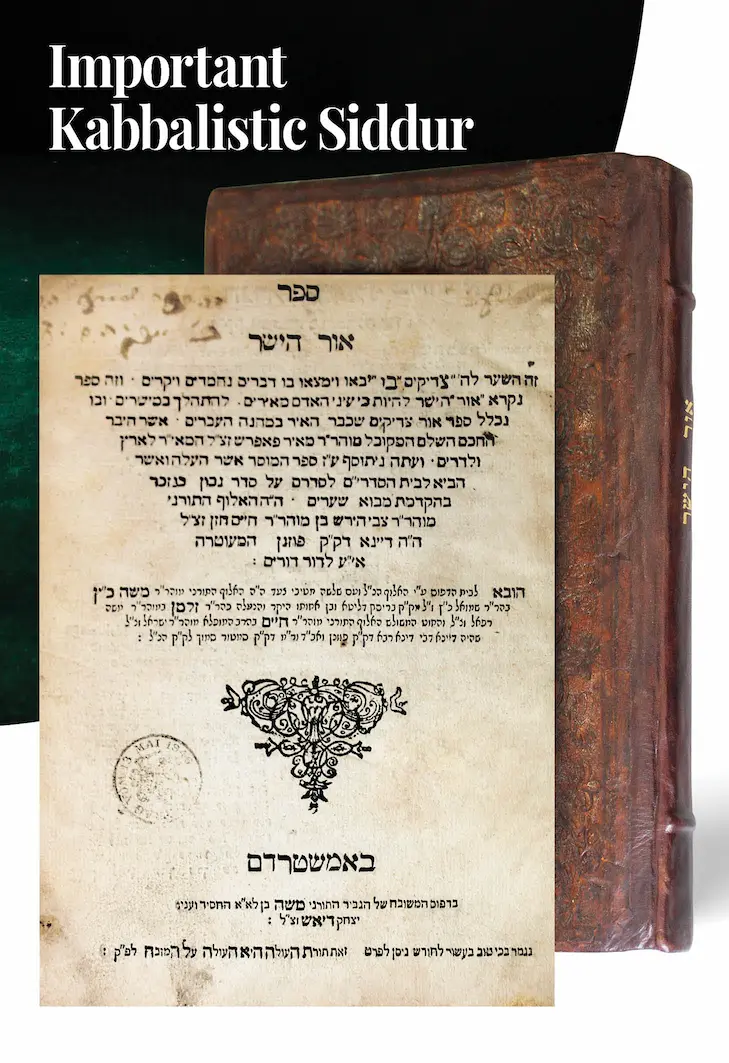
Siddur Ha’Ar”i – Ohr Hayashar by Rabbi Meir Paprish. First Edition. Amsterdam, 1709
Siddur with the kavanos of the Arizal in Ashkenazic-Polish rite, and the sefer Ohr Tzaddikim which lists customs for daily conduct. by the holy kabbalist Rabbi Meir Paprish, edited by Rabbi Tzvi Hersh Chazzan.
Leaves 12-35: Tefillah Yeshara B’Kavanas Halev – Siddur with the kavanos of the Arizal.
This is the original printing of this foundational kabbalistic siddur.
The siddur is based on the customs of Ashkenazic-Polish Jewry, with the Arizal’s customs “as per the Sephardic version” added separately.
sefer Ohr Hayashar was widely used amongst Kabbalists and they prayed according to the texts in this sefer. The Sar Shalom of Belz attests that his “entry to yiras shamayim was through this siddur” (see the approbation of his son, the Admor Rabbi Yehoshua of Belz, to Rabbi Moshe of Premishla’s siddur [printed in 1892]).
Many of the customs and rituals instituted by Rabbi Meir Paprish were widely accepted and are followed daily.
Rabbi Meir Paprish originally named his sefer Ohr Tzaddikim (Hamburg, 1690), the present edition was edited by Rabbi Tzvi Hersh Chazzan who changed its name to Ohr Hayashar and appended the siddur to it . This edition has since been used as the basis for all future editions of Ohr Hayashar.
Amsterdam, 1709. First edition. Page Count: [2], 46 leaves. Description: This siddur does not contain vowels.
Bibliography: Stefansky, Sifrei Yesod #419
...............................................
Any inquiries about this lot ?
We are available also on WhatsApp >>>

Lot : 5
Unknown Chassidic Siddur
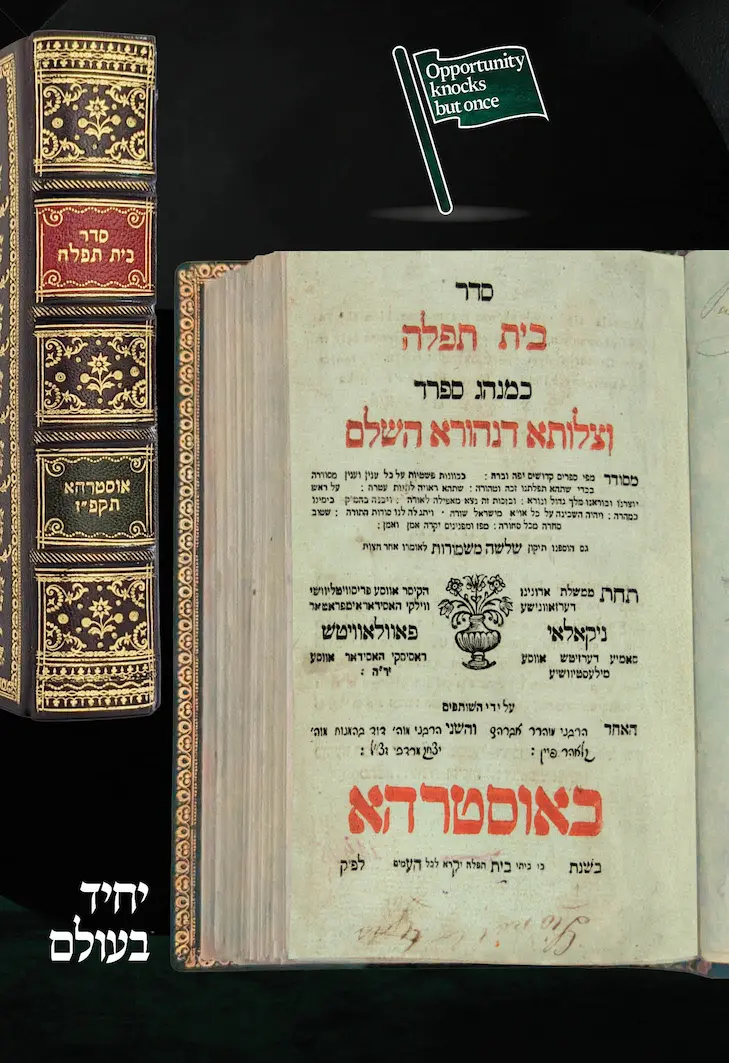
Siddur Beis Tefillah and Tzlosa D’Nehorah Hashalem. Ostroh, 1827
Siddur in Sephard-Chassidic rite with commentary, kavanos and halachos compiled and edited by Rabbi Aharon ben Rabbi Yechiel Meir Halevi Segal of Mikailiškės.
The siddur includes prayers for weekday and Shabbos, Shalosh Regalim, Yamim Noraim, Pirkei Avos, Haggadah shel Pesach, Hoshanos, Yotzros, Selichos and Zemiros for Shabbos.
This siddur contains the passage ‘K’gavna’ before Maariv of Shabbos and ‘Hodu’ before ‘Baruch she’amar’, consistent with Chassidic custom.
Leaf 51a presents the psalm ‘Lamnatzeach’ in the shape of a menorah with two lions positioned at the foot of the menorah.
Tzlosa D’Nehorah - nusach Sephard, was enthusiastically received and used by Chassidic congregations across Europe and was reprinted in numerous editions.
This siddur is unknown; it has not been studied by researchers nor listed by any bibliographers.
It is not included in Yaari’s comprehensive list of sefarim printed in Ostroh (Alei Sefer Vol. 2) or mentioned in Yulov’s essay on Siddur Nehorah (Alei Sefer Vol. 3), nor do Rivkind and Schechter, who devoted a great deal of time to studying Siddur Nehorah (Kiryat Sefer 9 p. 525; Kiryat Sefer 10 p. 250) mention it, and not even the famous bibliographer Chaim Lieberman who dealt extensively in sefarim printed in Russia and Poland (Ohel Rachel Vol. 1 p. 366).
Ostroh, 1827. 112, 40, 40. Page Size: 18.5 cm. Light green paper. Part of the title page is in red ink. Complete. Several pages professionally restored, with the restoration virtually indiscernible. Ornate new leather binding.
............................................
Any inquiries about this lot ?
We are available also on WhatsApp >>>

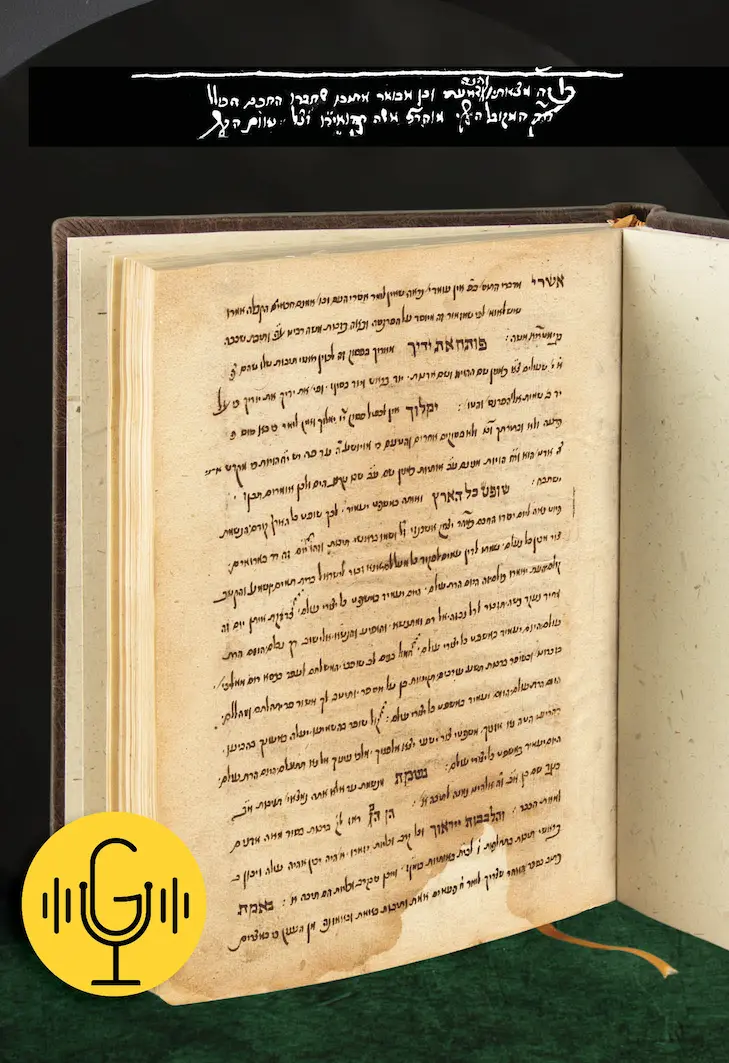
Lot : 6
Manuscript
Ramak’s Commentary on Rosh Hashanah and Yom Kippur Prayers with Piyyut by the Arizal. Prague, circa 1575
Important old manuscript (nearly 450-years-old) recording the teachings of the saintly kabbalist Rabbi Moshe Cordovero, the Ramak. The manuscript, written only several years after the Ramak’s passing, is a kabbalistic commentary on the prayers of Rosh Hashanah and Yom Kippur.
The manuscript is written in a beautiful, thin handwriting, with all prayer text inscribed in larger block letters.
The Ramak’s commentary on the prayers of Yamim Nora’im was first printed in the Constantinople Machzor (1576) and later under the name Zivchei Shalmim (Lublin, 1613).
The first page includes the piyyut, “Yom zeh Dar B’Meromim” by the Arizal as well as a collection of prayers identical to the anthology of prayers included in the Lublin edition (with minute variances).
This manuscript is sourced from a volume of kabbalistic writings, some of which are explicitly marked as written in the 1575. The present manuscript parallels the above both in script and style.
The colophon at the end of the manuscript reads: “All this I found and heard, and the content clarifies that it was composed by the all-encompassing sage and saintly kabbalist Moreinu Harav Moshe Cordovero zt”l.”
Prague, circa 1575. Page Count: [44] leaves. Page Size: 18x15 cm. Condition: Good with light water stains. Tear on margins of last page with the end of the colophon missing. New binding.
Provenance: Carlebach Family Collection, Hamburg-Lakewood
................................................
Any inquiries about this lot ?
We are available also on WhatsApp >>>

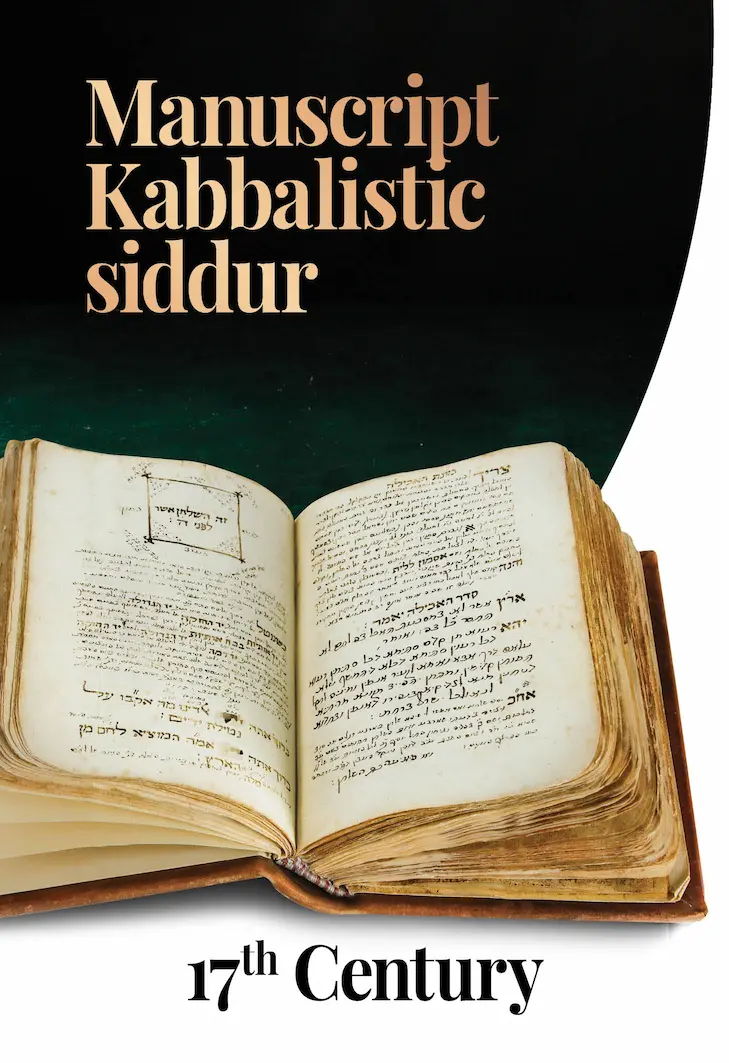
Lot : 7
Manuscript
17th Century Kabbalistic Siddur with Kavanos of the Arizal
as Edited by the Kabbalist Rabbi Nosson Shapira.
Siddur for weekdays and Shabbos with the kavanos of the Arizal, arranged by the saintly kabbalist Rabbi Nosson Shapira, author of Meoros Nosson.
The siddur opens with the title: “Sephardic prayer with kavanos, based upon Moreinu Harav Nosson Shapira ztvk”l.”
The present siddur encompasses the order of prayers for weekday, Shabbos and Rosh Chodesh and concludes with Intentions for Learning (leaf 108a); Intentions for Eating (leaf 111a) and Order of Conduct at Night and Krias Shema al Hamittah (leaf 118b and on).
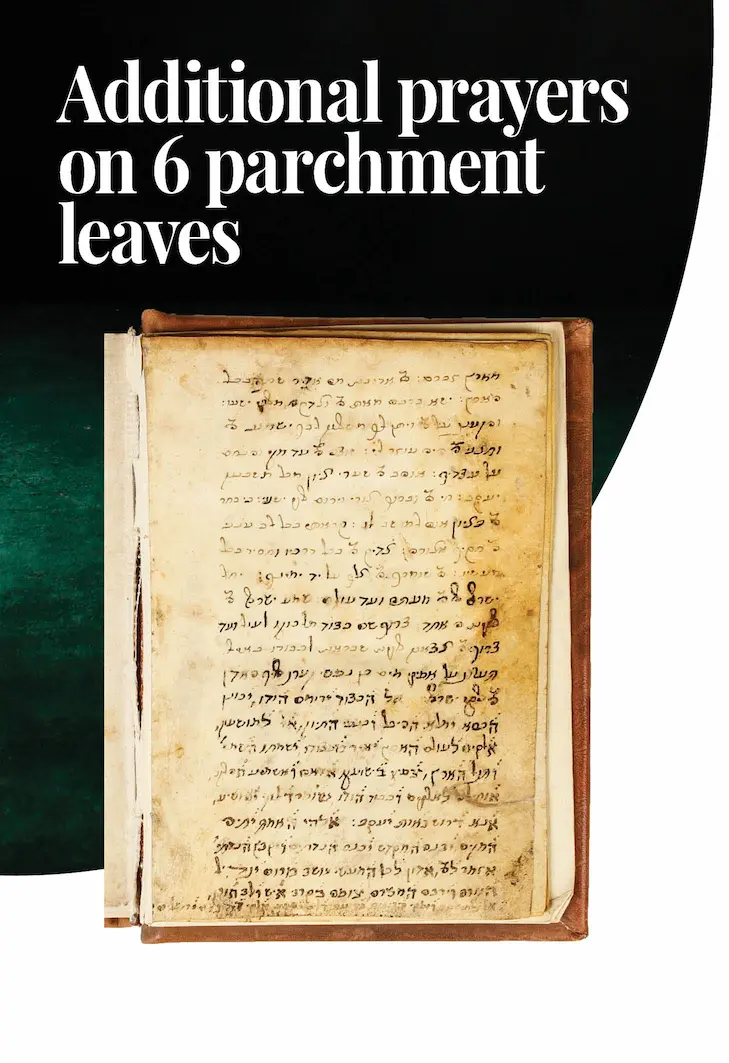
6 parchment leaves containing different Tefillos are bound to the front of the siddur.
The majority of handwritten kabbalistic siddurim with the Arizal’s kavanos are those that were arranged by Rabbi Meir Poppers, but siddurim with the kavanos of the Arizal based on Rabbi Nosson Shapira’s writings are rare.
The kabbalist Harav Nosson Shapira of Yerushalayim departed the Holy Land in 1656 and journeyed to Italy to fundraise for the destitute Yishuv in Jerusalem. He ultimately lived there until his passing in 1662. Rabbi Nosson carried with him many writings containing the wisdom of the Arizal and Rabbi Chaim Vital, which he edited and arranged. He writes that previously, “…these writings were scattered, with one here and one there.”
Rabbi Nosson Shapira compiled the Arizal’s kavanos in tefillah into a single sefer which he named Meoros Nosson; it was widely spread throughout Italy. Later, these writings would be reprinted in various editions, although not in their entirety, in Pri Eitz Chaim (Koritz, 1882) and Machberes Hakodesh (Koritz, 1883).
Italy, 17th Century. Page Count: [125] leaves. Page Size: 13x10 cm. Description: Italian script. Kabbalistic glosses in margins. Condition: Used. The ink on some of the leaves is very light. Tears on margins, all professionally restored.
...............................................
Any inquiries about this lot ?
We are available also on WhatsApp >>>

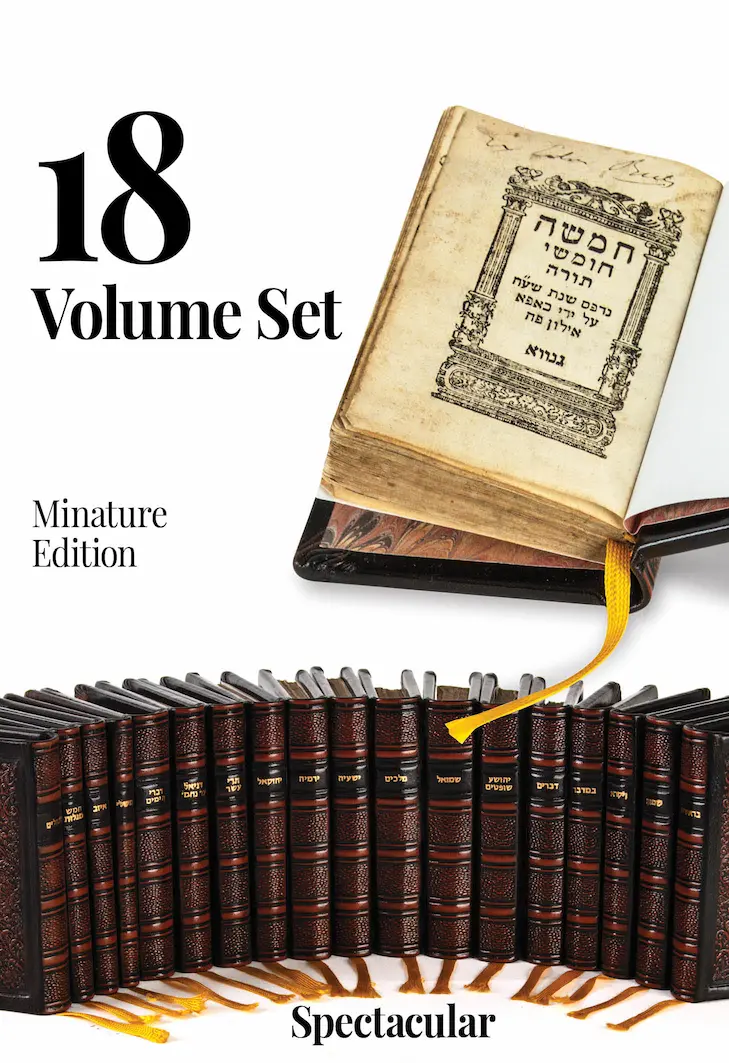
Lot : 8
18-Volume Spectacular Miniature Edition of Tanach. Geneva, 1617
Only 11 cm!
Pocket-size edition of Torah, Nevi’im, and Kesuvim with vowels and cantillation marks.
18-volume set printed in Geneva between 1617-1618. All 18 volumes are complete with separate title page, and are ornately bound in new leather binding, with an leather-bound box
Torah: Bereishis: [128]; Shmos: [108]; Vayikrah: [74]; Bamidbar [107]; Devarim [95] leaves
Early Nevi’im: Yehoshua-Shoftim: [130]; Shmuel: [151]; Melachim [143] leaves
Later Nevi’im: Yeshaya: [108]; Yirmiya: [138]; Yechezkel: [119]; Trei Asar: [91]
Kesuvim: Tehillim: [135] leaves, including index of psalms; Mishlei: [47]; Shir
Hashirim, Rus, Eichah, Koheles, Esther: [64]; Iyov: [54]; Daniel, Ezra-Nechemia: [100]; Divrei Hayamim: [159] leaves.
Description: Sefer Vayikra has several stains. Sefer Tehillim with two title pages. The first title page, (rare) is specific for Tehillim, and the second is a general title page for Tehillim, Koheles and Shir Hashirim.
......................................... ....
Any inquiries about this lot ?
We are available also on WhatsApp >>>

Lot : 9
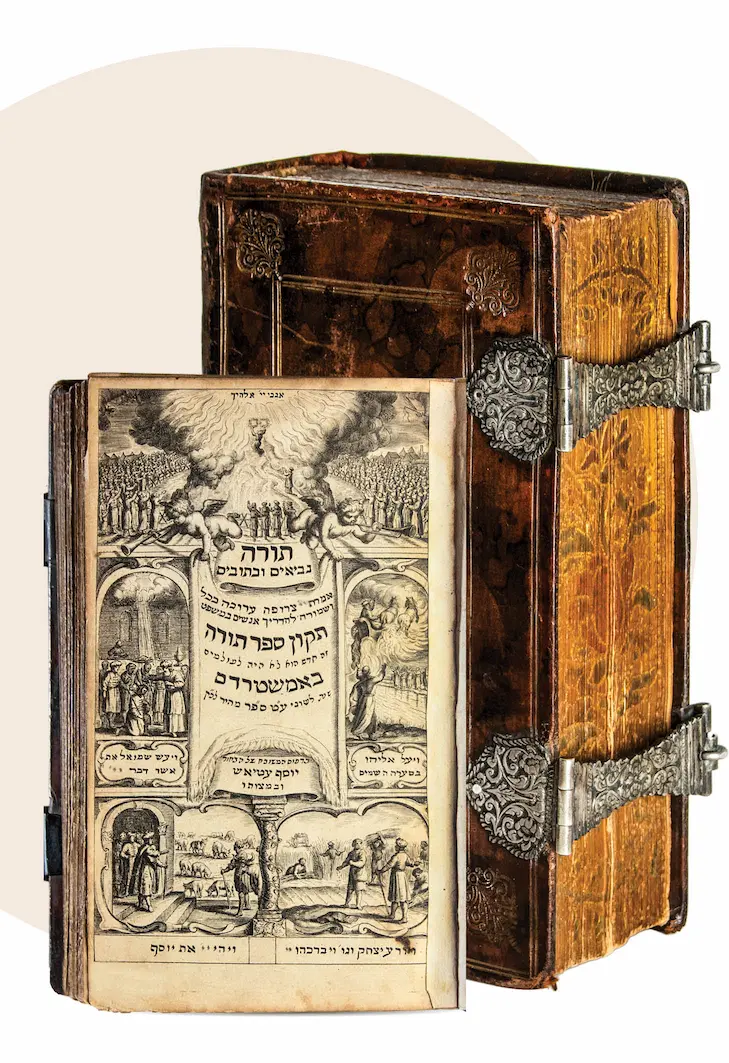
Tikkun Sefer Torah. Amsterdam, 1659
Spectacular edition in ornate antique leather binding and silver clasps
Chamish Chumshei Torah, with the Five Megillos and Haftaros for the entire year, in Ashkenazic and Sephardic rite. Precisely edited and proofread for utmost accuracy.
Extraordinarily beautiful Chumash, printed in clear font on thick, high-quality paper, with an ornate title page of five copperplate illustrations depicting episodes from Tanach.
The Chumash is encased in an impressive shiny leather over wood binding, with delicate engravings and silver clasps.
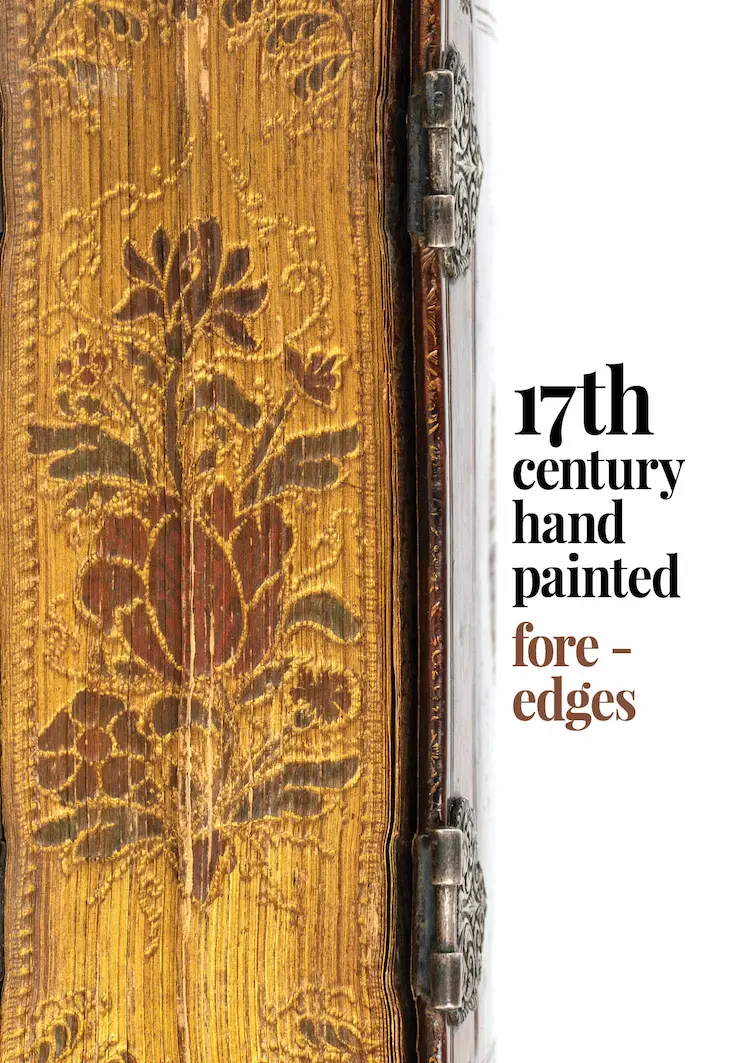
Gilded edges are artistically decorated with hand-painted red and green leaves.
The Art of Marginal Illustrated Fore-Edges
One unique form of bookbinding art in previous eras was handmade artistic illustrations on the edges of a book (known as Fore-edge). The craft took place by placing a book beneath a high-pressure roller to eliminate any space or air between the pages, and the artist would then draw or paint on its edges.
The Attias Chumash
This Chumash is regarded as one of the most precise Chumashim. In their preface, the proofreaders boast of their precise work and commend the accuracy and precision of this meticulously reviewed edition of Chumash. They describe that each page was proofread three times before printing, and an additional time after printing.
The famous Jewish grammarian Rabbi Ezriel of Vilna praises this edition in his preface to Michtav Me’Eliyahu (Homburg, 1738), leaf 3b, .
Joseph Attias – Jewish Printer of Amsterdam
This Chumash was the first sefer printed by the famous Jewish printer Joseph Attias of Amsterdam.
Joseph Attias (1635-1700) was born in Spain to a family of anusim. His father R’ Avraham (Jorge Mendez de Castro) sacrificed his life al Kiddush Hashem and perished in an auto-de-fe in Córdoba. Young Joseph escaped and fled to Amsterdam where he established a printing press at the age of only 23.
In 1661, he was accepted into the prestigious Association of Printers of Amsterdam, and his press soon gained reputation as one of the most prominent presses in the world.
(See Haberman, Hamadpis HaAmsterdami Joseph Attias pp. 293-310.)
Amsterdam, 1659. Joseph Attias Press. Page Count: [4], 234: [2], 235-380 leaves. Page size: 18.3 cm. Additional Information: Separate title page for Haftaros. Condition: Good. Preserved in matching case.
Provenance: The William Gross collection - Tel Aviv.
...............................................
Any inquiries about this lot ?
We are available also on WhatsApp >>>


Lot : 10
Beer Mayim Chaim by the Admor Rabbi Chaim of Czernowitz. First Edition. Mohyliv-Sedilkov, 1818-1820
Complete and attractive set!
Chamisha Chumshei Torah with Beer Mayim Chaim by the great tzaddik, kabbalist and Admor Rabbi Chaim of Czernowitz.
Sefer Beer Mayim Chaim was described by the Apter Rav “all its words are sweeter than honey” and his teachings are “flames of a holy fire” that guide a Jew in avodas Hashem and the path of Torah and Chassidus. Replete with foundations of Chassidus, the sefer Beer Mayim Chaim swiftly earned its place of honor in the Jewish library and is regarded as one of the classic Chassidic works.
Impressive 5 volume set of Chumash with Targum Unkekus and Rash”i along with the Beer Mayim Chaim.
Each volume with separate title page partially in red ink.
All in ornate new leather bindings.
The Admor Rabbi Chaim of Czernowitz (1760-1818), author of Be’er Mayim Chaim and Sidduro shel Shabbos, was among the progenitors of Chassidus and a genius in both the Revealed and Hidden Torah.
Rabbi Chaim acquired Torah and wisdom from the holy Admor Rabbi Yechiel Michel of Zlotchov. He served as Rav in the prominent communities of Czernowitz, Botoshan, Mohyliv, and Kishinev in Romania, and was one of the preeminent disseminators of Chassidus in Romania and Bukovina. In 1813, he fulfilled his lifelong dream of traveling to Eretz Yisrael where he settled in Tzfas and dwelled until his passing five years later.
After the author’s passing, the manuscript of this sefer was dispatched from Tzfas to the Admor Rabbi Mordechai of Kremnitz, son of the Admor Rabbi Yechiel Michel of Zlotchov, who was the Rabbi Chaim of Czernowitz’s Rebbe.
In his approbation to the sefer, the Admor Rabbi Mordechai of Kremnitz writes, “When the manuscripts arrived… I accepted this task upon myself, and I gave them to be copied and edited… [as a result of] the sweet love and friendship of my father the holy, pious and famous Admor…Moreinu Harav Yechiel Michel ztvk”l to him, as he loved him and cherished him greatly…with an eternal love.”
The title pages of all five volumes bear the publishing date 1820, it seems that this was done in order to avoid the censors, and it is unclear exactly when each sefer was printed. The first volume to be printed was Sefer Shmos (see printer’s notes on leaf 37b) in 1818 (see approbation of Rabbi Mordechai of Kremnitz), and the other volumes were printed in Sedilkov between the years 1820-1825.
Mohyliv-Sedilkov, 1818-1820. First edition.
Page Count: Bereishis: [2], 5-354 leaves; Shmos: 282, 14, 19-38 leaves; Vayikrah: 120:8:10 leaves; Bamidbar: 16, 19-181; Devarim: 172 leaves.
Bibliography: Stefansky, Sifrei Chassidus #216, Sifrei Yesod: 388
...............................................
Any inquiries about this lot ?
We are available also on WhatsApp >>>

Lot : 11
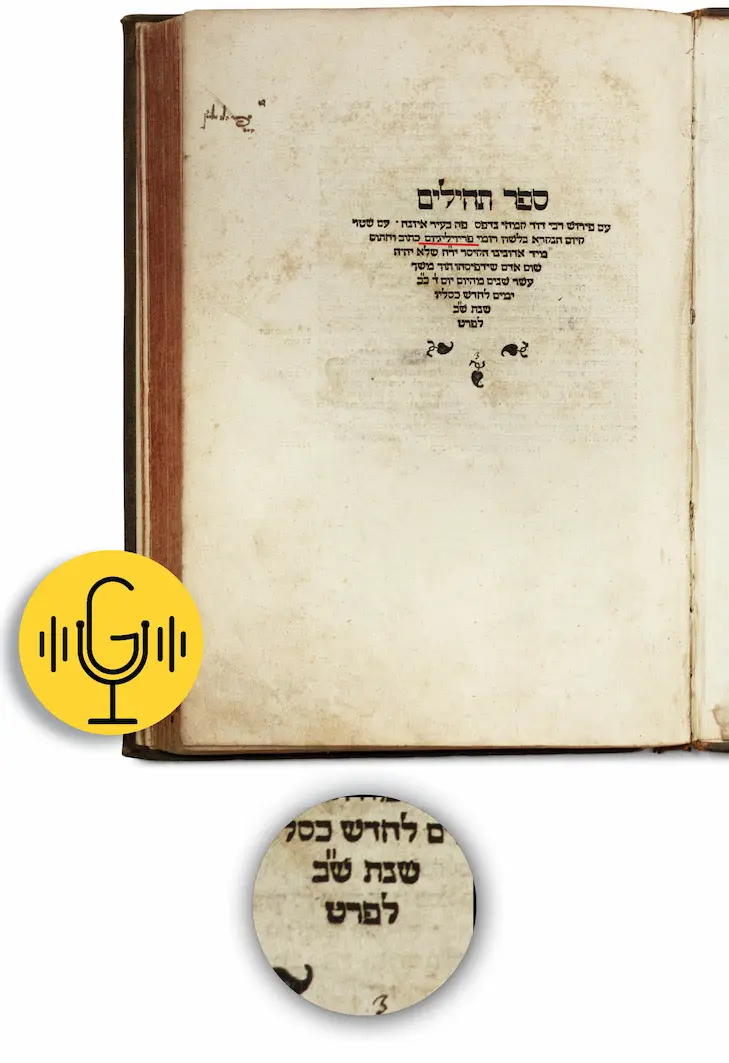
Tehillim with Radak’s Commentary. Isny, Germany, 1542
Sefer Tehillim with the commentary of Rabbi Dovid Kimchi, the Radak.
The present edition features the Radak’s complete expansive commentary on Tehillim, in contrast to later editions (Cremona 1561) which substantially abridged the commentary, most future editions of Radak published only the abridged version; this edition presents the original full commentary and is very rare.
Rabbeinu Dovid Kimchi, known to many as “Gadol Hamedakdekim, Greatest of the Grammarians”. The Radak dwelled in Narbonne, Provence and then in Spain, where he engaged in several famous debates against Christians and defended the Rambam from his critics. His commentary on Nach is regarded as one of the most fundamental commentaries of all time. It was said “If there is no ‘kemach’ [flour], there is no Torah, ” which is an allusion to his name ‘Kimchi’ (Rabbi Dovid Ibn Yichya in his introduction to Kav V’naki [Lisbon, 1492).
The Chida in Shem Hagedolim (Vol. 2) recommends learning Sefer Tehillim with the Radak’s commentary.
The last [2] leaves are entitled “Responses by the Radak to Christians”. These pages which contain arguments against Christianity were omitted by the censorship from the majority of copies and are extremely rare, yet are excellently preserved in the present copy. (See Haberman, Hamadpis Paulos Baggios V’sifrei Beit Defuso p. 163 #8).
Isna, 1542. Page Count: 108, [2] leaves. Page Size: 29.5 cm. Condition: water stains. Old cloth binding.
...............................................
Any inquiries about this lot ?
We are available also on WhatsApp >>>

Lot : 12
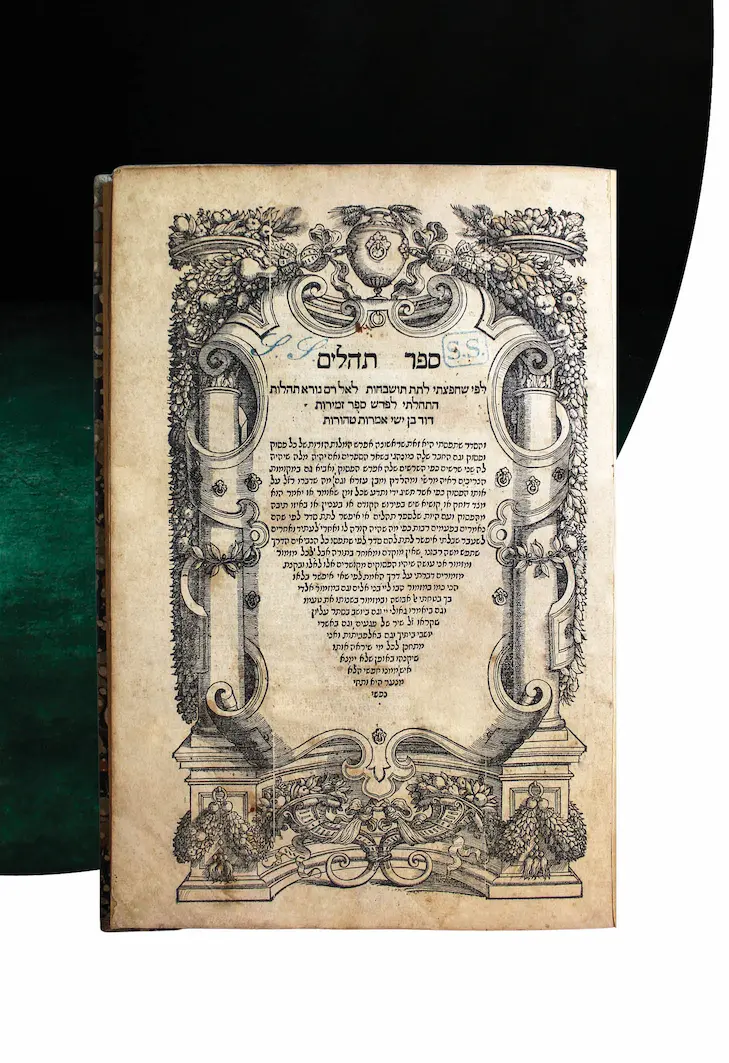
Tehillim with kabbalistic commentary. First and Only Edition. Venice, 1549
Sefer Tehillim with kabbalistic commentary by Chacham Rabbi Shlomo ben Rabbi Shem Tov Attia.
Rabbi Shlomo Attia was a disciple of the Ralbach and other great Rabbies in Salonika. He journeyed to Eretz Yisrael where he passed away in 1560.
The introduction to the Sefer Tehillim offers an important historic first-hand testimony and portrayal of the Chachamim of Turkey, Salonika and Italy in the post-Expulsion era. In his introduction, the author describes the sages he met with whom he made a personal acquaintance throughout his wanderings in these countries.
Venice, 1549. Singular edition. Page Count: 42, 41-65. [1] leaf. Page Size: 30.2 cm. Condition: Good. Handwritten marginalia and comments in European Spanish Rabbinical writing.
..............................................
Any inquiries about this lot ?
We are available also on WhatsApp >>>

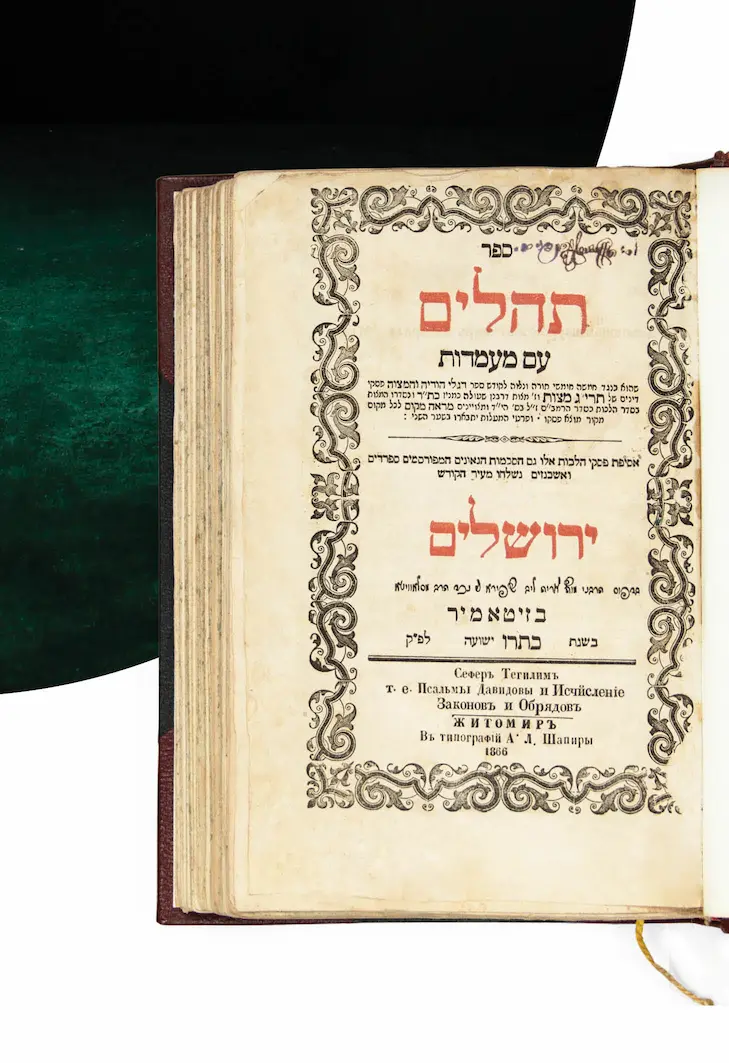
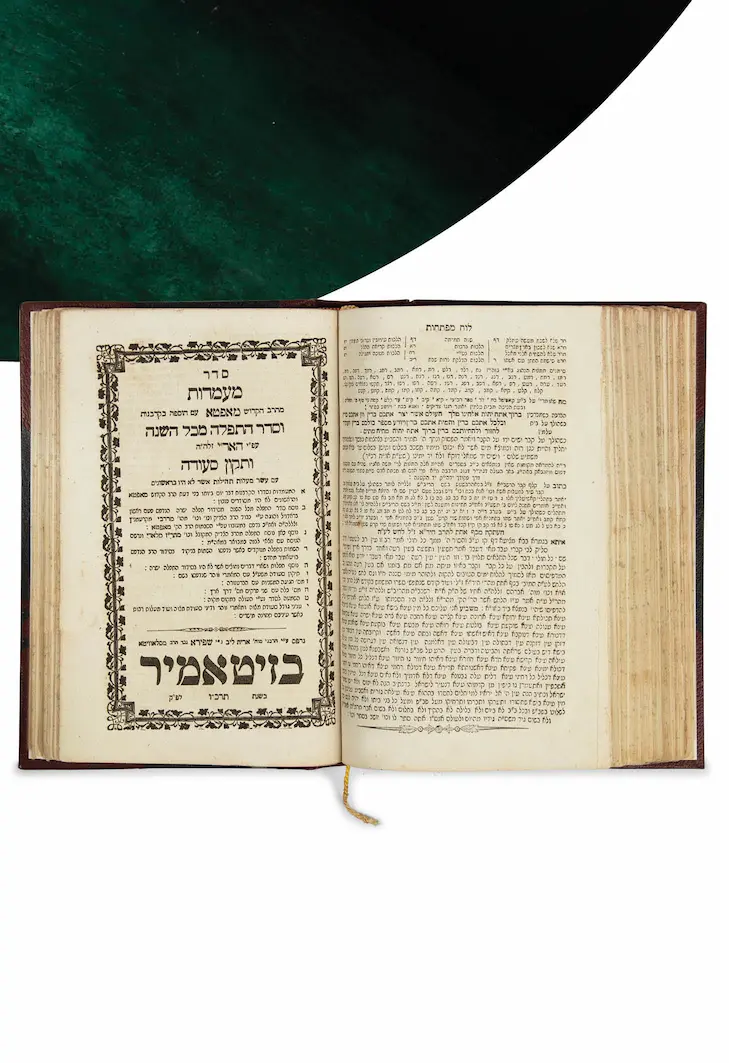
Lot : 13
Sefer Tehillim and Maamados with Nusach Sephard-Chassidic Siddur.
Zhitomir, 1866
Complete, beautiful copy!
The Sefer Tehillim preferred by Chassidic Rebbes.
Sefer Tehillim with Diglei Hodaya V’Hamitzvah an anthology of halachos on the 613 mitzvos and division of the Tikkunei HaZohar into the 30 days of the month by Rabbi Yehuda Yudel Landau.
With Seder Maamados by the Admor Rabbi Avraham Yehoshua Heschel of Apta. with a separate title page. and a siddur with prayers for the whole year in Chassidic rite (based on the Tefillah Yesharah siddur printed in Radvil and Mezhibuz. Chassidic tradition relates that this siddur was originally printed under the supervision of the Apter Rav.)
The Sefer Tehillim of the Chassidic Masters
Sefer Tehillim with Diglei Hodaya V’Hamitzvah was the Tehillim preferred by the great Chassidic masters, many of whom davened and learned from this edition of Tehillim, which became known as a segulah. (See the approbations of the Maggid of Trisk and Rabbi Dovid of Tolna to the Josephov Edition, 1875.)
At the beginning of the sefer are the names of distinguished figures who subscribed to the sefer, including all the sons of the holy Rabbi Yitzchak of Skver, the Admorim Rabbi Avraham Yeshoshua Heschel of Skver, Rabbi Menachem Nachum of Shpikov, Rabbi Yisrael and Rabbi Dovid of Skver.
The present edition was printed anonymously, although the author’s name is mentioned in the later Josefov edition (1875).
Rabbi Yehuda Yudel Landau was a shochet u’bodek who spent many years in the home of the Admor Rabbi Yisrael of Ruzhin (Shu”t Birkas Yosef, Yoreh Deah Ch. 11). Rabbi Yudel ultimately journeyed to Eretz Yisrael where he passed away at an old age in the year 1885.
Zhitomir, 1866. First edition. Printed by Rabbi Aryeh Leib Shapira, grandson of the Slavita Rav.
Page Count: Tehillim: 440, 221-225, [11]. Siddur, Maamados and Tikkun Seudah: [4], 1212, 57-64, 61-64, 28 sides. Page Size: 20.5 cm. Condition: Good condition. A pre-title page for Tehillim is printed in red ink, followed by an additional detailed title page.Separate title page for Maamados.
...............................................
Any inquiries about this lot ?
We are available also on WhatsApp >>>

Lot : 14
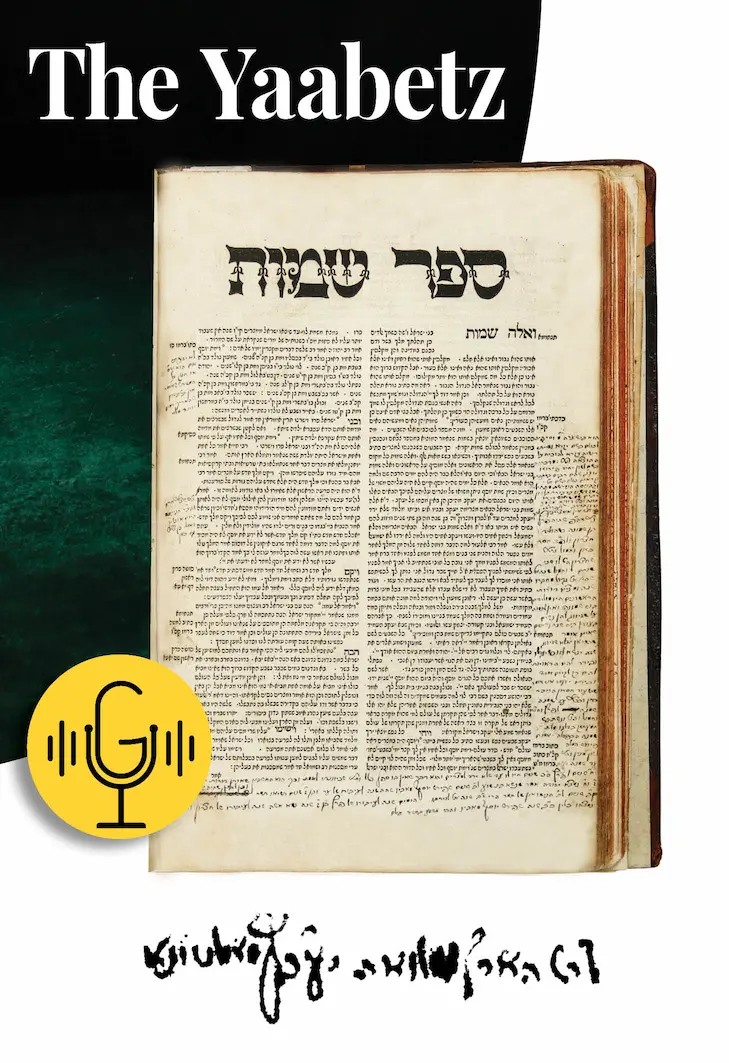
The Yaabetz - Rabbi Yaakov Emden
Over 120 hagahos handwritten by Rabbi Yakov Emdin on Yalkut Shimoni, autographed.
Rabbi Yaakov Emden’s autographed copy of sefer Yalkut Shimoni on Chamishah Chumshei Torah (Frankfurt am Main, 1687), with over 120 handwritten glosses which the Yaabetz wrote over a period of many years while learning this sefer time and again.
The title page features the following inscription in the holy hand of the Yaabetz:
“La’Hashem ha’aretz u’meloah. Yaabetz of Altona.”
The Yaabetz’s Story
In his preface to Shu”t Sheilas Yaabetz (Altona, 1739) Rabbi Yaakov Emden recounts why he signed his name by the acronym ‘Yaabetz.’
“When I was an infant carried in the arms of my father the gaon and chassid Tzvi, glory of Yisrael, (author of Chacham Tzvi), I once asked him about his signature, which he wrote merely as ‘Tzv”i’ without noting his father’s name at all. He replied that ‘Tzvi’ is the acronym of the name ‘Tzvi ben Yaakov.’ He then added that ‘When you are old enough to be wise in Torah and write sefarim and words of wisdom, sign your name in this way: ‘Yaabetz, ’ which is the acronym of ‘Yaakov ben Tzvi.’”
The Yaabetz, Rabbi Yaakov Emden (1698-1776) was the son of the Chacham Tzvi and among the greatest Achronim, Unparalleled in the scope of his writings and his unique style, he is also known for waging an impassioned battle against the Sabbateans. He was a prolific author whose works were universally acclaimed throughout the diaspora.
Among his famous works are Mor U’ketziah, Shu”t Sheilas Yaabetz, Biras Migdal Oz, Lechem Shamayim, Eitz Avos, Luach Eress and many others.
Rabbi Yaakov Emden was born in Altona. He served briefly as Av Beis Din in Emden, and after resigning from this position and returning to his hometown of Altona, would comment that he makes a blessing, “That He did not make me an eved – an abad [Av Beis Din]!” (Shu”t She’elas Yaabetz Vol. 2 Ch. 168). In Altona, he formed a minyan in his house and established a printing house where he published his sefarim.
The marginalia in this sefer were printed in the Kerem Shlomo (New York, Bobov Press, edited by Rabbi Shmerel Citronenbaum).
Yalkut Shimoni al HaTorah (Frankfurt am Main, 1687) with the Yaabetz’s marginalia. Page Count: 313 leaves. Page Size: 32 cm. Slight tears to the illustrated title page. restored antique leather binding.
Provenance : The Sdeh Zhofim Collection
...............................................&am p;am p;am p;am p;am p;am p;am p;nb sp;
Any inquiries about this lot ?
We are available also on WhatsApp >>>

Lot : 15
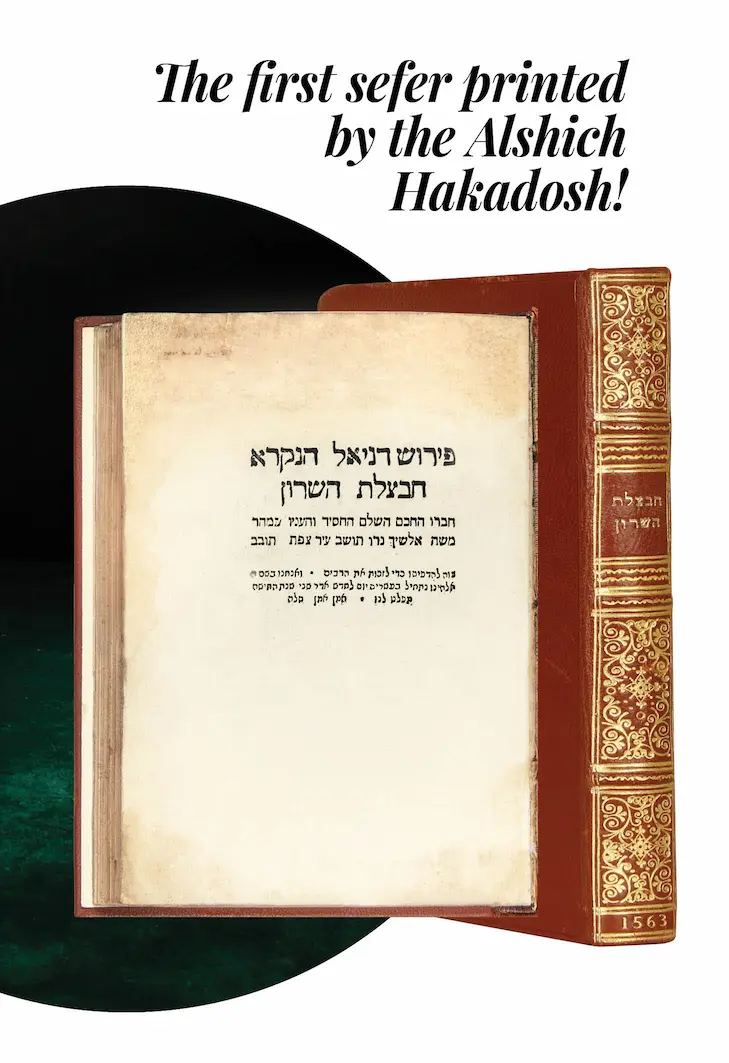
Chavatzeles Hasharon by the Alshich Hakadosh. First Edition. Constantinople, 1563
The first sefer printed by the Alshich Hakadosh!
Sefer Daniel with a lengthy, comprehensive commentary by Rabbi Moshe Alshich. This is the first sefer from among the Alshich Hakadosh’s works brought to print!
The sefer opens with a historic preface by the Alshich himself, in which he describes his deliberations regarding becoming a Rav or darshan - “to seclude himself in the beis medrash and delve into Shas and Poskim or become a ‘doresh tov l’amo, ’” and how he ultimately chose the latter. (Rabbi Chaim Vital writes in Sefer Hagilgulim that the Arzial revealed to the Alshich that the purpose of his soul in its present gilgul is to engage in drush).
Further in his preface, the Alshich describes the stages of authoring the present work: On Shabbosos throughout the year he would lecture to his talmidim, and on Motza'ei Shabbos he would record his lectures in writing and eventually created this sefer from these lectures.
The text of Sefer Daniel printed in vowelized block letters, with the Alshich’s commentary in Rashi script.
Alshich Hakadosh
Four Sages in Eretz Yisrael merited the illustrious title “Hakadosh - the holy one”: the Ari Hakadosh, the Alshich Hakadosh, the Shl”a Hakadosh, and Ohr Hachaim Hakadosh.
Rabbi Moshe Alshich (circa 1508-1600) was a talmid of Rabbi Yosef Karo and received semichah from him.
The Alshich Hakadosh, as he is famously called, served as a dayan and Rosh Yeshivah in Tzfas and authored teshuvos in halacha. But he is acclaimed for his drashos and commentary on the Torah, Nevi’im and Megillos which were universally accepted by Jews throughout the Diaspora.
Constantinople, 1563. First edition. Page Count: [116] leaves. Page Size: 20.5 cm. Description: Dark water stains, especially on top third of the first pages. Minor restoration in left corner of title page. Attractive new leather binding.
Bibliography: Stefansky Sifrei Yesod #19; Yaari, Hadfus Ha’Ivri b’Kushta #165.
Scholars of previous generations, among them the bibliographer Steinshneider believed that this sefer was first printed in Tzfas, and based on this theory, stated that the press in Tzfas was extant already in 1563.
............................................ ...
Any inquiries about this lot ?
We are available also on WhatsApp >>>

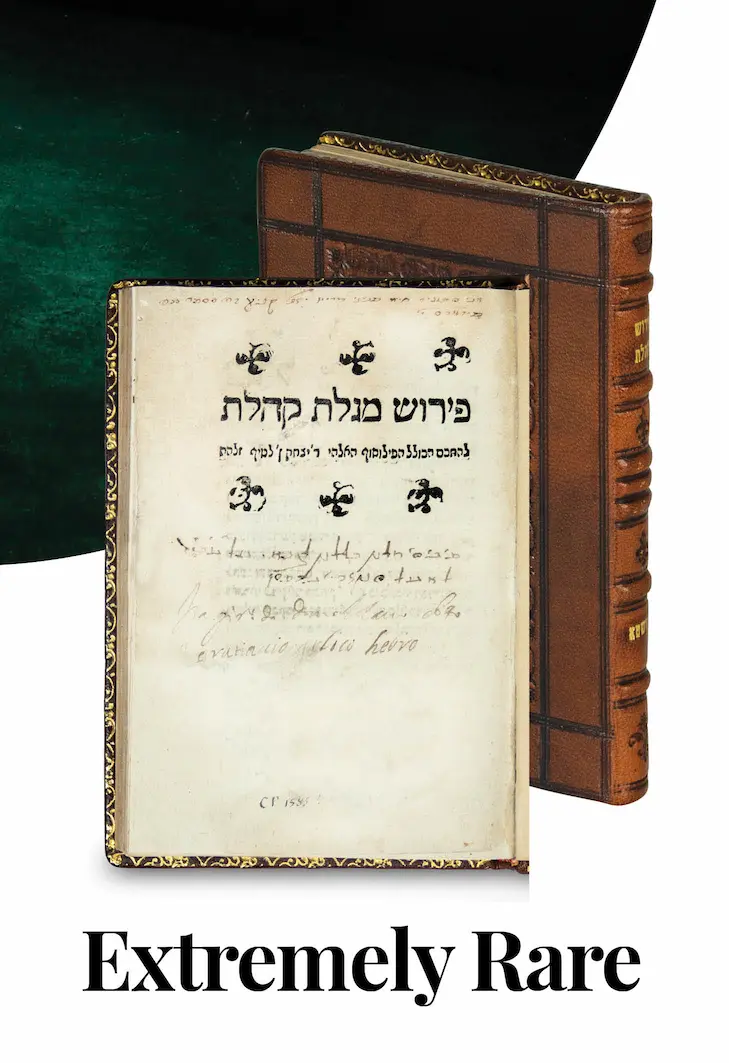
Lot : 16
Exceedingly rare treasure!
Commentary on Megillas Koheles by Rabbi Yitzchak ben Latif. First Edition. Constantinople, circa 1575
Megillas Koheles with Commentary by the great Chacham Yitzchak ben Latif.
The text of the Megillah is printed in block letters with vowels, the commentary by Chacham Yitzchak ben Latif appears in Rashi letters.
Chacham Yitzchak ben Latif was a thirteenth century Spanish kabbalist and philosopher. He dwelled in Toledo until his final years when he fulfilled his lifelong dream of settling in the Holy Land. His written legacy includes the famous sefarim Shaar Hashamayim and Tzel Ha’olam.
Many great Rabbis quoted and drew from his writings, among them Rabbi Yosef Albo, author of Sefer Ha’Ikrim; Rabbi Yitzchak Arama, the Baal Ha’Akeidah; and the Abarbanel.
Constantinople, circa 1575. First edition.
Page Count: [56] leaves. Size: 14.8 cm. Condition: Title page margins restored; miniscule holes; otherwise beautiful sefer. Very rare.
Additional Information: Print year based on Yudelov, Ginzei Yisrael #622 and opinion of Professor Hacker (Areset 5 p. 492); Yaari: circa 1585.
Bibliography: Yaari, Constantinople #224 Ginzei Yisrael (Hellman Collection) # 622.
...............................................
Any inquiries about this lot ?
We are available also on WhatsApp >>>

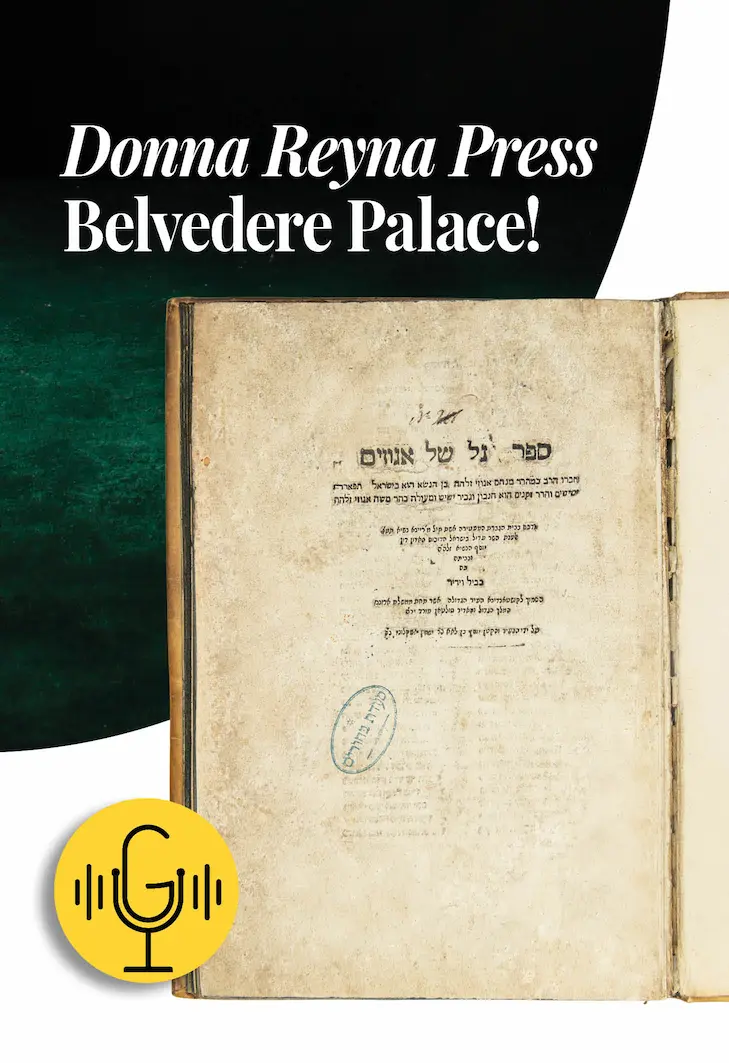
Lot : 17
Lady Reyna Press - Belvedere Palace!
Gal shel Egozim. Belvedere, circa 1593
Commentary and drashos on Sefer Bereishis by Rabbi Menachem Egozi.
The title page bears the following inscription:
Printed in the home of the noble and honorable woman Donna Reyna Nassi, may she be blessed, amen!
Widow of the great minister of Israel Don Yosef Hanassi, zy”a
In her home here, in Belevedere.
Lady Reyna Nassi, the daughter of the famed Jewish philanthropist Donna Gracia Nassi, was the wife of Don Yosef Nassi and scion of a family of Spanish anusim (marranos) who returned to their Jewish roots. Following the passing of her husband, Reyna founded a Hebrew printing press in her palace in Belvedere, which was in close proximity to Constantinople, and purchased a new type for the press.
Over the course of four years, between 1593 and 1597, only seven sefarim were printed using Donna Reyna’s private press.
Rabbi Menachem Egozi served as Rav for the Greek migrants in Constantinople and on the Beis Din of the Maharanach. The Beis Yosef appealed to him with a request to send financial aid to Greek migrants who had arrived in Tzefas (Yosef Bechiri p. 607).
Belvedere, circa 1593. Singular edition!
Page Count: 93 [61]. Page Size: 28 cm. Condition: Title page professionally restored, and several margins of leaves lightly restored. Water stains.
Bibliography: Yaari, Constantinople #28.
...............................................
Any inquiries about this lot ?
We are available also on WhatsApp >>>

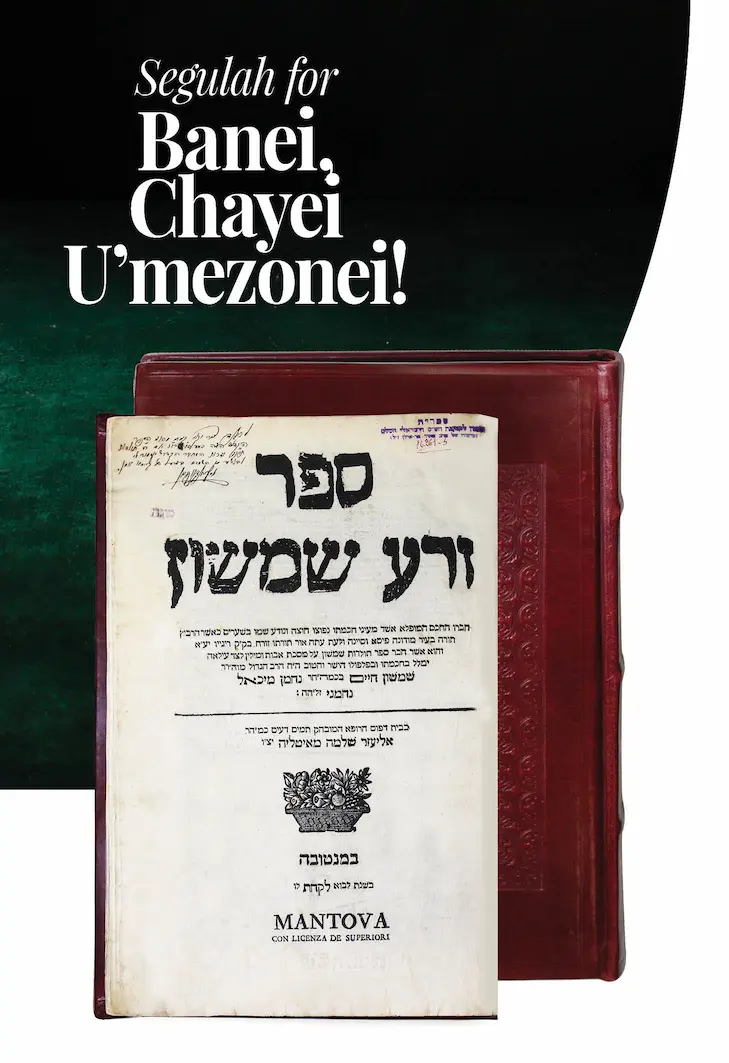
Lot : 18
Segulah for banei, chayei u’mezonei!
Zera Shimshon. First Edition. Mantua, 1778
Drashos and commentary on Chamishah Chumshei Torah and Megillos by the great kabbalist Rabbi Chaim Shimshon Nachmani.
Segulah of the Zera Shimshon
In his preface, the author relates that after his only son passed away without children, he named his sefer Zera Shimshon, literally the “seed of Shimshon”, as his spiritual legacy.
He further beseeches to learn this sefer in his memory and blesses the learners: “May the Master of reward repay you for this merit with great reward to all who perform true loving-kindness with…banei, chayei u’mezonei, children, life and good prosperity…And your eyes shall see children and descendants who are as olive shoots around your tables, scholarly and wise, and wealth and honor shall never depart your seed until the [verse] ‘They shall see the Honor of Hashem’ shall be fulfilled in you…”
In recent times, the segulah of the Zera Shimshon has gained increased popularity and become widespread. As seen from the inscription on the title page, this sefer was regarded as a segulah for bearing children as early as 130 years ago!
Rabbi Shimshon Chaim Nachmani (1707-1779), renowned by the name of his sefer Zera Shimshon, was a venerable Italian rabbi and kabbalist, who was a disciple of Rabbi David Finzi, Av Bein Din of Mantua and father-in-law of the Maharal. The Zera Shimshon studied the wisdom of kabbalah under the Rabach. Prior to his passing, he instructed his followers to bury his kabbalistic writings with him in his grave. Since he had no living descendants, he named his sefarim Zera Shimshon and Toldos Shimshon, alluding that these were his spiritual legacy. There is a famous segulah to learn from the sefer Zera Shimshon in order to be blessed with children.
Miracles by the Zera Shimshon
Rabbi Chananel Nepi, Av Beis Din of Cento, relates a marvelous story in his work Zecher Tzaddik Livrachah which he heard firsthand from the Av Beis Din of Reggio Rabbi Chananya Elchanan Cohen, prime disciple of the Zera Shimshon:
A fire once broke out right next to the Zera Shimshon’s house, and it grew to horrific proportions until it reached the walls of his porch. The Zera Shimshon opened his window and stood facing the conflagration while immersed in prayer, and then sat down. All at once, the fire miraculously died, and the Zera Shimshon suffered no damage (Toldos Gedolei Yisrael [Trieste, 1853] p. 325 #25; p. 105).
Mantua, 1778. First edition. Page Count: 105, 108-115, 115, [1], 17-[100] 62; 21, [1] leaf.
......................................... ......
Any inquiries about this lot ?
We are available also on WhatsApp >>>

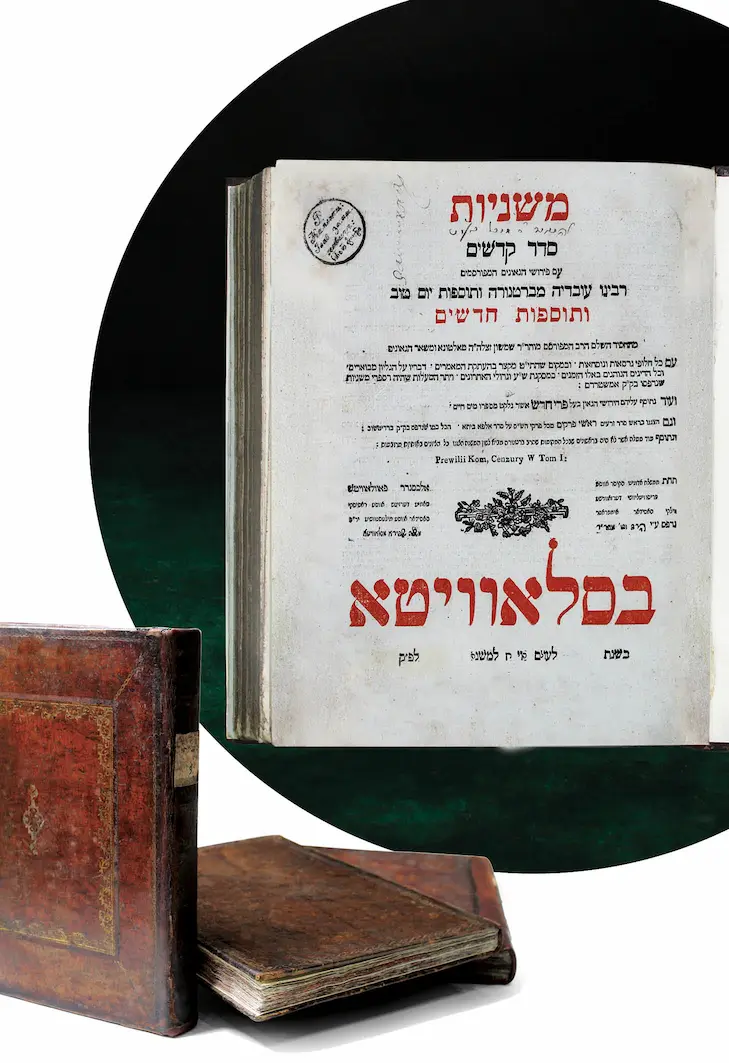
Lot : 19
Mishnayos Slavita – Complete 6 volume Set!
Shisha Sidrei Mishnah. Shapira Press. Slavita, 1830
Beautiful and ornate set of Shisha Sidrei Mishnah printed by the Admor Rabbi Moshe Shapira, Av Beis Din of Slavita, son of the saintly Admor and talmid of the Baal Shem Tov Rabbi Pinchas of Koritz.
The present set contains six large volumes of Mishna with the commentaries of Rabbi Ovadia of Bartenura and Tosfos Yom Tov, Tosfos Chodoshim and a collection of chiddushim by the Kedushas Levi.
Magnificent set with six title pages, partially in redink and original Shapira Press bindings.
The Slavita press edition of Shisha Sidrei Mishnah features approbations by the author of Shu”t Mayim Chaim (see below); the dayanim of Ostroh who write, “Many desire to learn from the sefarim printed by the Rabbi”; and Rabbi Efraim of Sedilkov who inscribes, “The reputation of this press and beauty of his paper and letters
This set of Mishnayos was printed in the sacred printing house of the Admor Rabbi Moshe Shapira of Slavita.
“The rabbi and great luminary, pious and famous, son of Kedoshim…Moreinu Harav Moshe, Rav of the holy congregation of Slavita, was inspired to print the volumes of Mishnayos in his praiseworthy and glorious press, and it is renowned among all our generation that the above Rabbi toiled and labored over every word so that [the text] shall emerge without errors.” (Rabbi Chaim Hakohein Rappaport, Av Beis Din of Ostroh, Shu”t Mayim Chaim.
Slavita
Zeraim, Moed (1821)
Nezikin, Kodshim (1822)
Nashim, Taharos (1830)
Page Count: Zeraim: [4], 132 leaves; Moed: 173 leaves; Nashim: 160 leaves; Nezikin: [1], 196 leaves; Kodshim: 163 leaves; Taharos: 224 leaves. Page Size: 24-26 cm.
......................................... ...
Any inquiries about this lot ?
We are available also on WhatsApp >>>

Lot : 20
Distinguished provenance!
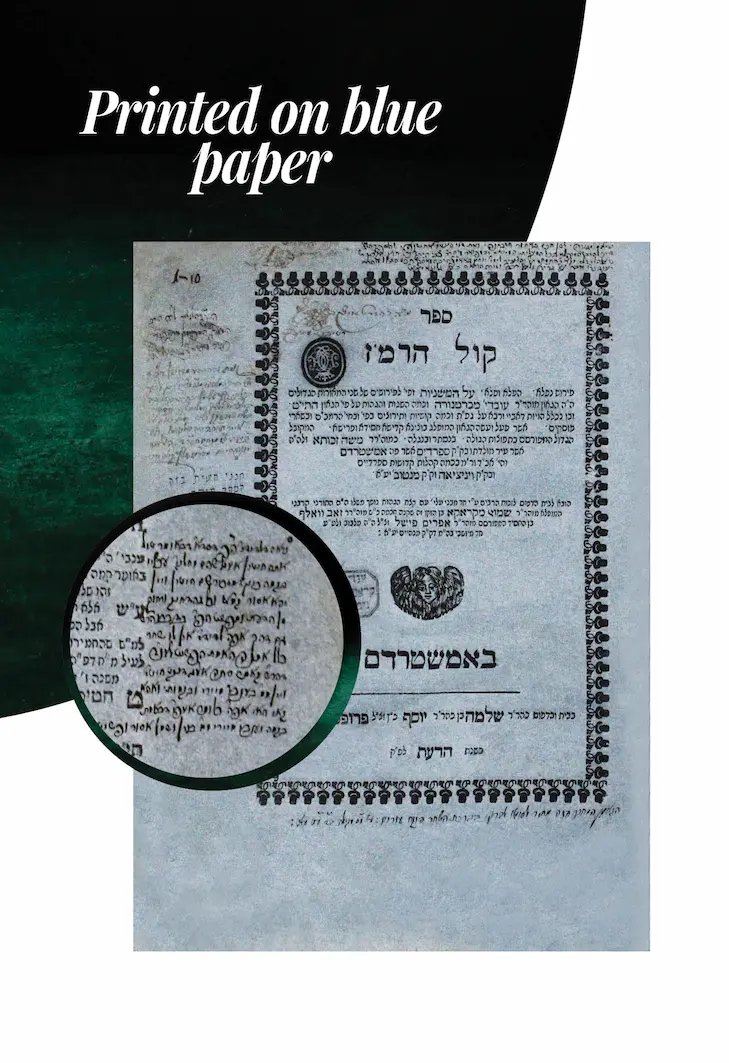
Kol HaRamaz. First Edition. Amsterdam, 1712.
Special blue paper copy
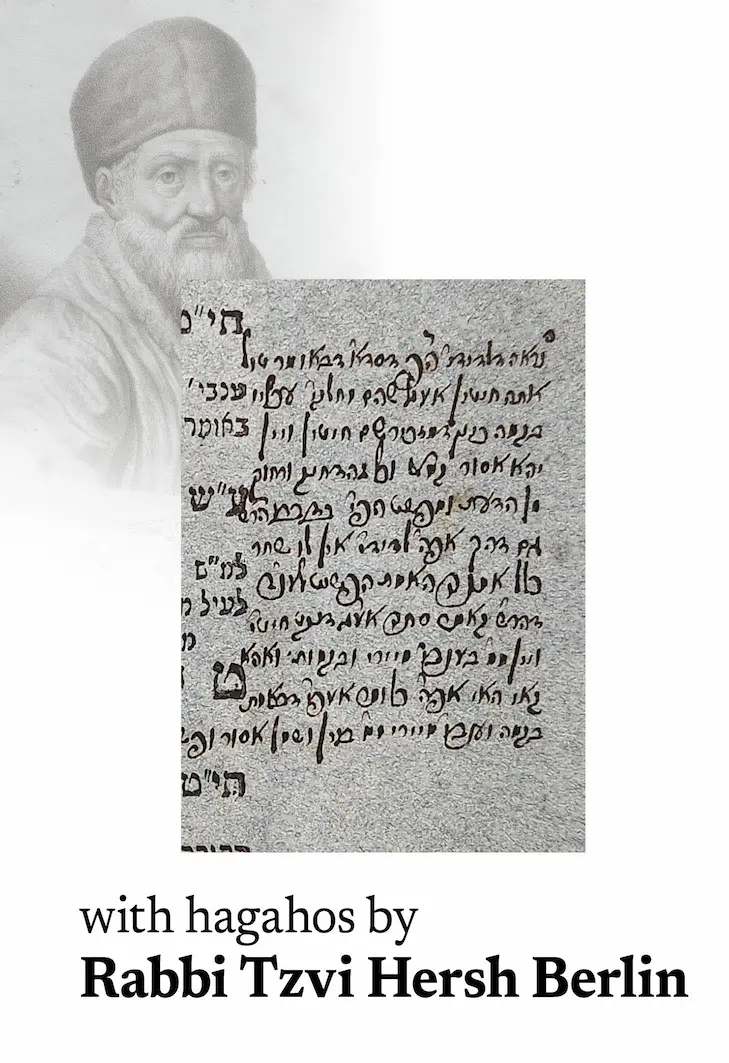
Personal copy of Rabbi Tzvi Hersh Berlin with handwritten glosses
Commentary on Shisha Sidrei Mishnah and discussion on the Bartenura and Tosfos Yom Tov by the great kabbalist Rabbi Moshe Zacuto, the Ramaz.
Beautiful, ornate copy printed entirely on blue paper. The margins boast lengthy glosses and annotations by the hand of Rabbi Tzvi Hersh Berlin, grandson of the Chacham Tzvi.
Kol HaRamaz was the primary work authored by the Ramaz on talmud whose other writings are mostly on matters of kabbalah.
Rabbi Moshe Zacuto (1625-1698) the greatest Italian kabbalists of his era, as well as one of the primary kabbalists who transmitted the Arizal’s legacy.His famous house of study for kabbalah in Mantua was among the most eminent in all of Italy, and its scholars produced many landmark works of kabbalah and were instrumental in arranging the Arizal’s writings.
The author of Machaneh Chaim in his sefer Kol Sofer on Mishnayos (Munkacs, 1881). He opens with the words “I was privileged to [learn] sefer Kol HaRamaz which is a very precious sefer by the genius…Rabbi Moshe Zacuto zt”l.”
The sefer contains several lengthy handwritten glosses by Rabbi Tzvi Hersh Berlin. The title page notes that the sefer belonged to “The wondrous Rabbi who is outstanding in all his attributes, of respected and glorious lineage, Moreinu Harav Tzvi Hersh ny”v, son-in-law of the Rabb’ Tevely z”l [of Galuga]”. This inscription was handwritten by Rabbi Yochanan ben Rabbi Yaakov, Av Beis Din of Graidetz and Raavad of Galuga (son of Rabbi Tzvi Hersh of Pintchov Hy”d). A second inscription dated 1869 reveals that the sefer was purchased by his grandson Rabbi Yitzchak Nosson Nutta Berliner, Av Beis Din of Bilgoraj. All comments are written in script identical to the handwriting of Rabbi Tzvi Hersh Berliner.
Rabbi Tzvi Hersh Berliner (1721-1800) was one of the greatest German Rabbis of his time, a son of Rabbi Aryeh Leib, Av Beis of Amsterdam; grandson of the Chacham Tzvi; and brother of Rabbi Shaul of Amsterdam. Throughout his life, Rabbi Tzvi Hersh Berliner served as Rav in the cities as London, Manheim, Halberstadt and Berlin, and waged a fierce battle against the Maskilim during the early period of the Enlightenment. His written legacy includes Tzva Rav and Tzvi Latzaddik.
Amsterdam, 1712. First edition. Page Count: [4], 170 leaves. Description: Printed entirely on blue paper.
.............................................
Any inquiries about this lot ?
We are available also on WhatsApp >>>

Lot : 21
Talmud Bavli
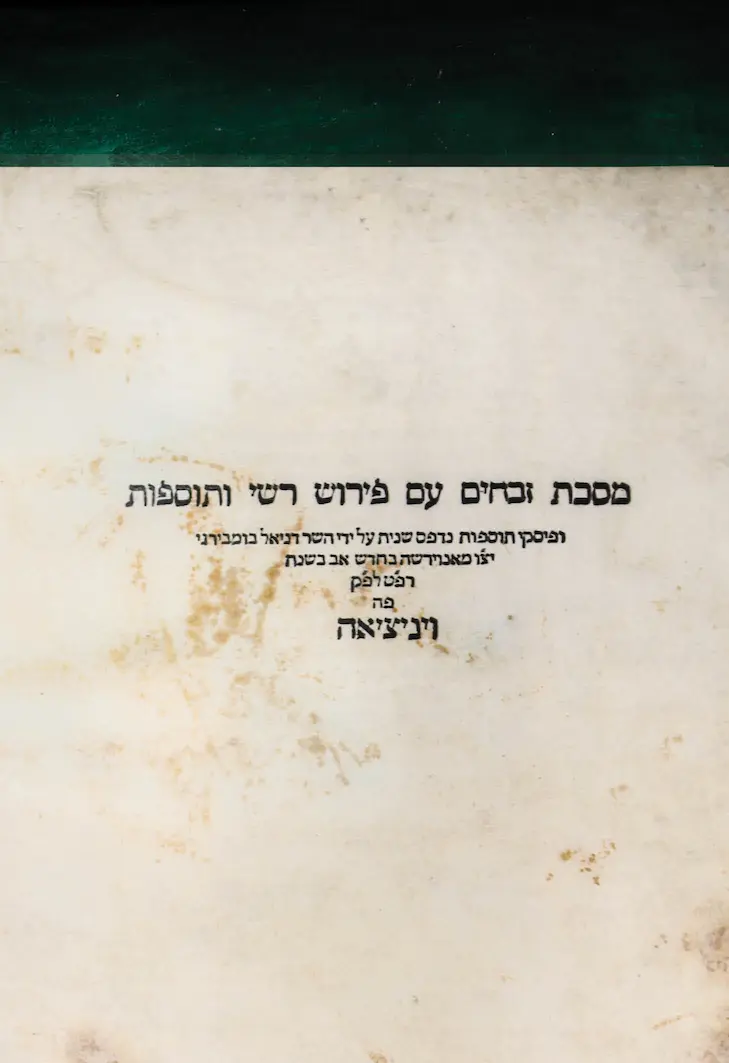
Maseches Zevachim. Bomberg Press. Second Edition. Venice, 1529
Complete volume of Maseches Zevachim with Rashi and Tosfos. This volume was part of the second edition of Talmud printed by the acclaimed Venetian printer Daniel Bomberg
Venice, 1529. Daniel Bomberg Press. Second edition. Page Count: 121 leaves.
Bibliography: Stefansky, Sifrei Yesod p. 18
Title page stained. Dark stains on leaf 2a; otherwise in good condition.
The Venice Shas
The first complete set of Talmud Bavli was printed by Daniel Bomberg in his famed printing house in Venice between the years 1520-1523. The complete set was a masterpiece, with attractive, clear type and practically free of censorship. It likewise contained new additions that were printed for the first time ever, based on handwritten manuscripts. Only three years after completing the first edition of Shas, which was joyously received by Jews the world over, Bomberg set about typesetting the second edition and completed the project in 1531.
Commonly regarded as the prototype for all future editions, the Venice Shas established the famous tzuras hadaf which fixed the page numbers in each tractate and served as the basis for all future printings of the Gemara. Until this very day, anyone who cites a source in Shas references the daf as established in Bomberg’s Venice Shas.
...............................................
Any inquiries about this lot ?
We are available also on WhatsApp >>>

Lot : 22
Talmud Bavli
First Printing of Maseches Krisus!
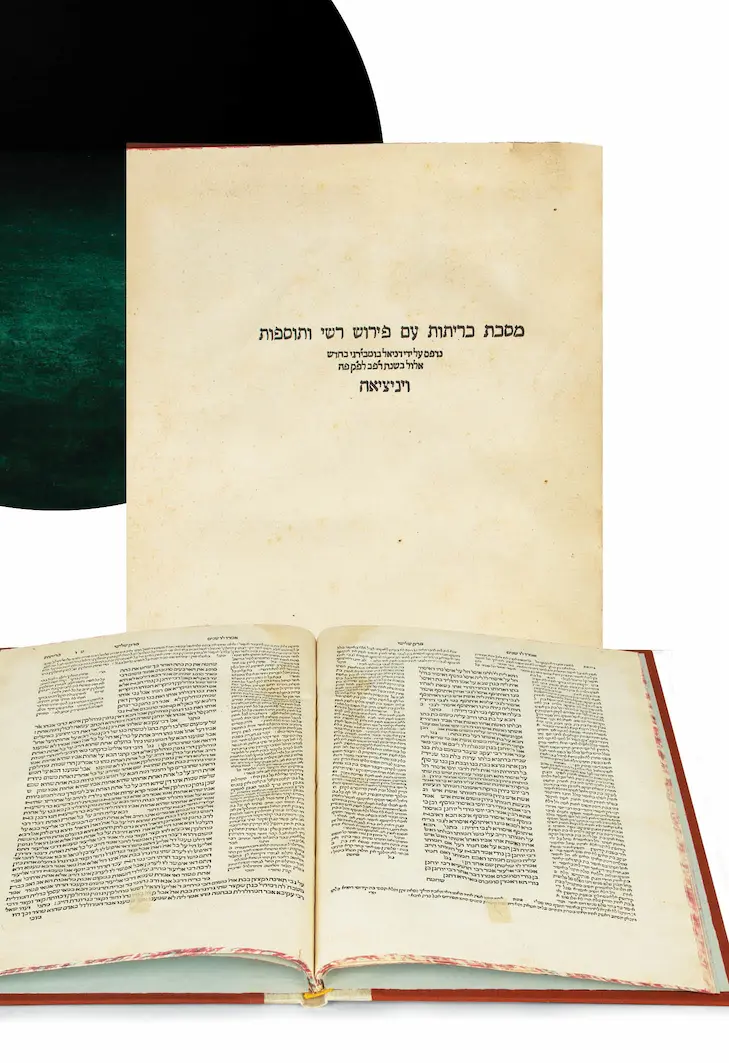
Maseches Krisus. First Edition. Bomberg Press. Venice, 1522
Maseches Krisus with Rashi’s commentary. Complete volume from the original Bomberg Edition of the Talmud, printed by the celebrated Italian printer Daniel Bomberg of Venice.
This is the first edition of any maseches Krisus to be printed.
This masechta was not printed during the incunabula or even the post-incunabula era, since financial constraints limited the printing of the first volumes of Shas to the masechtos studied in yeshivos (see preface of Gershon Soncino to Sefer Michlol [Constantinople, 1533]). Hence, until this print, only those who were able to acquire a handwritten manuscript of the masechta were able to study Maseches Krisus..
High-quality print with dark ink on thick paper.
Venice, 1522. Daniel Bomberg Press. Page Count: 91 leaves. Page Size: 36.5 cm.
Bibliography: Stefansky, Sifrei Yesod #41.
The Bomberg Shas – Prototype for All Future Gemaras
The first complete set of Talmud Bavli was printed by Daniel Bomberg in his famed printing house in Venice between the years 1520-1523. The complete set was a masterpiece, with attractive, clear type and practically free of censorship. It likewise contained new additions that were printed for the first time ever, based on handwritten manuscripts.
Commonly regarded as the prototype for all future editions, the Venice Shas established the famous tzuras hadaf which fixed the page numbers of each tractate and served as the basis for all future printings of the Gemara. Until this very day, anyone who cites a source in Shas references the daf as established in Bomberg’s Venice Shas.
Rabbi Refael Nosson Notta Rabinowitz, world-acclaimed expert on various editions of Talmud, writes, “In its format and appearance, this Talmud is the epitome of beauty and glory. The paper is fine, and the letters dark and clear… No subsequent editions have approached its beauty” (Essay on the Printing of the Talmud p. 41).
Bibliography: Stefansky, Sifrei Yesod p. 18; Appendix p. 168
............................................ ....
Any inquiries about this lot ?
We are available also on WhatsApp >>>

Lot : 23
Fundamental
Extremely rare!
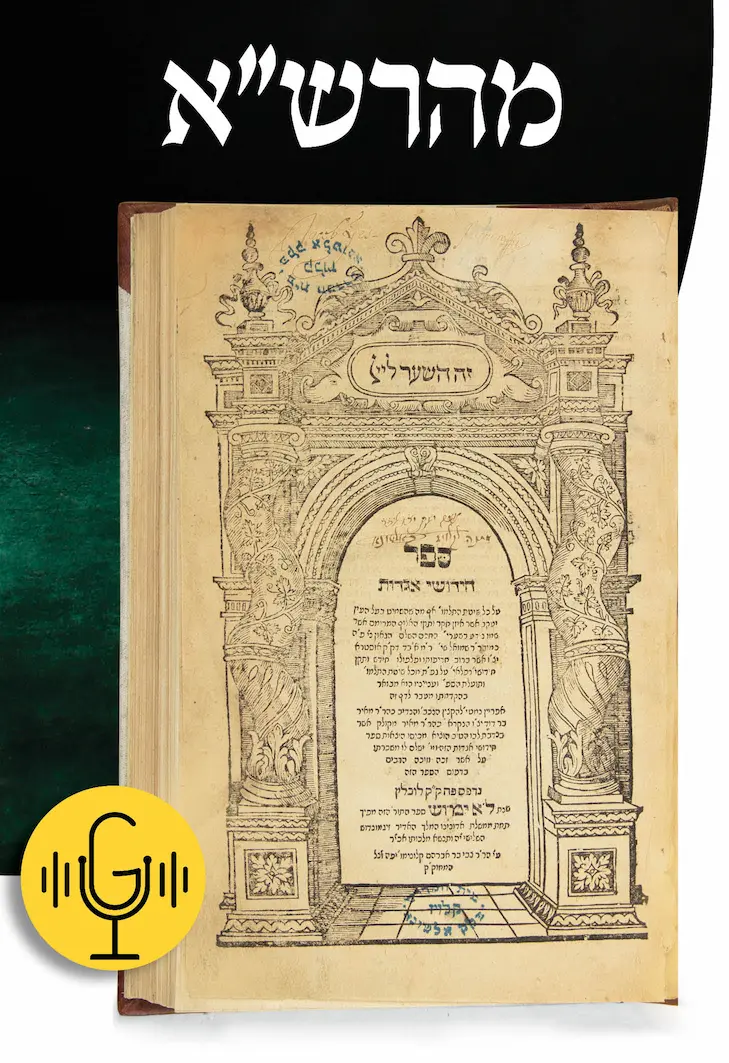
Maharsha, Chiddushei Aggados. First Edition. Lublin, 1627
Commentary on Aggados of Shas by Rabbi Shmuel ben Eliezer Edeles, the Maharsha.
Beautiful, complete copy in exquisite condition!
First volume of the Maharsha’s Chiddushei Aggados, this sefer was brought to print during the Maharsha’s lifetime.
It was edited by his brother, Rabbi Shaul Shimon Edeles of Lublin.
In his famous preface to his magnum opus, the Maharsha outlines the foundations of his commentary on Aggados in Shas, demonstrating how Chazal drew their drashos from the pesukim in the Torah, and presents guidance on how to interpret the deep words of chaza”l, which are often written in the form of parables and seem difficult to comprehend.
The Maharsha Rabbi Shmuel ben Eliezer Edeles (1555-1632) was one of the greatest Torah luminaries in the era of the early Achronim. He served as Rav in Ostroh where he led a prominent yeshivah. His chiddushim on Shas, divided into Chiddushei Halachos and Chiddushei Aggados, are foundational to the understanding of Gemara, Rashi and Tosfos.
Written with Ruach Hakodesh
The Maharsha’s chiddushim on Shas are renowned for their depth and razor-sharp precision as they clarify the very essence of the Gemara. They were universally accepted as foundational to the study and clarification of peshat of the Gemara, Rashi and Tosfos.
Gedolei Yisrael throughout the generations effusively praised his works, describing them as “Illuminating our eyes in all of Shas” (Shu”t Noda B’Yehudah, Even Haezer Ch. 31) to the extent that many said they were written with ruach hakodesh (She’eris Yisrael by Rabbi Yisrael Vilednik citing the Baal Shem Tov; Pri Megadim in Rosh Yosef).
The Maharsha’s chiddushim on Aggados in Shas are likewise elemental to the study of Aggadeta: “And from there, the darshanim and interpreters attach it to the foundations of their explanations” (Chida in Shem Hagedolim).
This volume encompasses the Maharsha’s chiddushim on Masechtos Brachos, Shabbos and some Mishnayos in Zeraim, Yevamos, Kesubos, Gittin, Kiddushin, Nedarim, Sotah, Bava Kama, Bava Metziah, Bava Basra, Sanhedrin, Makkos, Shevuos, Edios, Avodah Zara, Horiyos, Zevachim, Menachos, Chullin, Bechoros, Erchin, Temurah, Krisus, Meilah, Kinnim, Tamid, Middos, Keilim, Negaim, Niddah, Yadayim and Uktzin.
Since its publication it has become an integral part of gemara study beloved by learners of all levels and has been added to the gemara in nearly all editions.
It is exceedingly rare to discover a copy of the Maharsha in such complete and exquisite condition.
Lublin, 1627. First edition. Page Count: [1], 125: 28, 7, 20, 54 leaves. Page Size: 20 cm. Title page lightly restored; margins of several leaves are cropped, but otherwise in good condition. New half-leather binding.
Bibliography: Stefansky Sifrei Yesod #67
Provenance: This copy was the property of Rabbi Mordechai Gumpel Shnaver, a talmid of the author of Korban Ha’eidah, a scholar, statesman and doctor by profession, renowned by the name Professor Levison. This sefer was bequeathed by the owner to the Great Synagogue in Altona.
............................................
Any inquiries about this lot ?
We are available also on WhatsApp >>>

Lot : 24
Foundations of Gemara Study
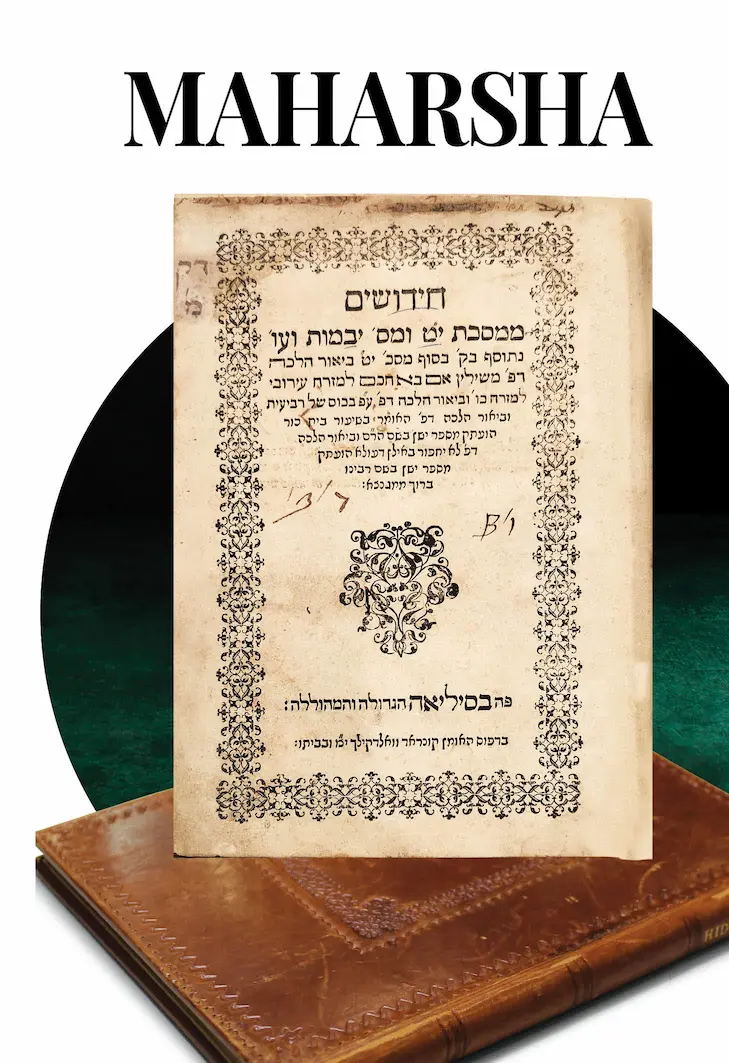
Maharsha on Masechtos Beitzah and Yevamos. First Edition. Basel, 1600
Rare find!
Chiddushim of the Maharsha, Rabbi Shmuel ben Eliezer Edeles, on Masechtos Beitzah and Yevamos.
This first edition was printed during the Maharshah’s lifetime.
This was the very first complete sefer printed by the Maharshah (other than a 6-leaf pamphlet printed in Prague in 1598 on Maseches Yevamos 2-13).
The Maharshah’s chiddushim were printed at the requests of his talmidim in the order they were studied in the Maharshah’s yeshivah, without the mention of the author’s name.
The Maharshah’s chiddushim were originally printed in segments over the course of thirty years, and were then later compiled into a single masterpiece, eventually they were added to the volumes of the Gemara as is familiar to all learners today.
Basel, 1600. First edition. Page Count: 50 leaves.
Bibliography: Stefansky, Sifrei Yesod #65.
Written with Ruach Hakodesh
The Maharsha’s chiddushim on Shas are renowned for their depth and razor-sharp precision that clarify the very essence of the Gemara. They were universally accepted as foundational to the study and clarification of pshat of the Gemara, Rashi and Tosfos.
Gedolei Yisrael throughout the generations effusively praised his works, describing them as “Illuminating our eyes in all of Shas” (Shu”t Noda B’Yehudah, Even Haezer Ch. 31) to the extent that many postulated that they were written with ruach hakodesh (She’eris Yisrael by Rabbi Yisrael Villednik citing the Baal Shem Tov; Pri Megadim in Rosh Yosef).
In his letters, the Chazon Ish condemned those who abandoned the study of the Maharshah, as they thereby lost the elemental knowledge of pshat and grew accustomed to learning pilpul only (Kovetz Igros Chazon Ish Vol. 1 Letter 1).
Provenance: The Valmadona - Lunzer Collection
...............................................
Any inquiries about this lot ?
We are available also on WhatsApp >>>

Lot : 25
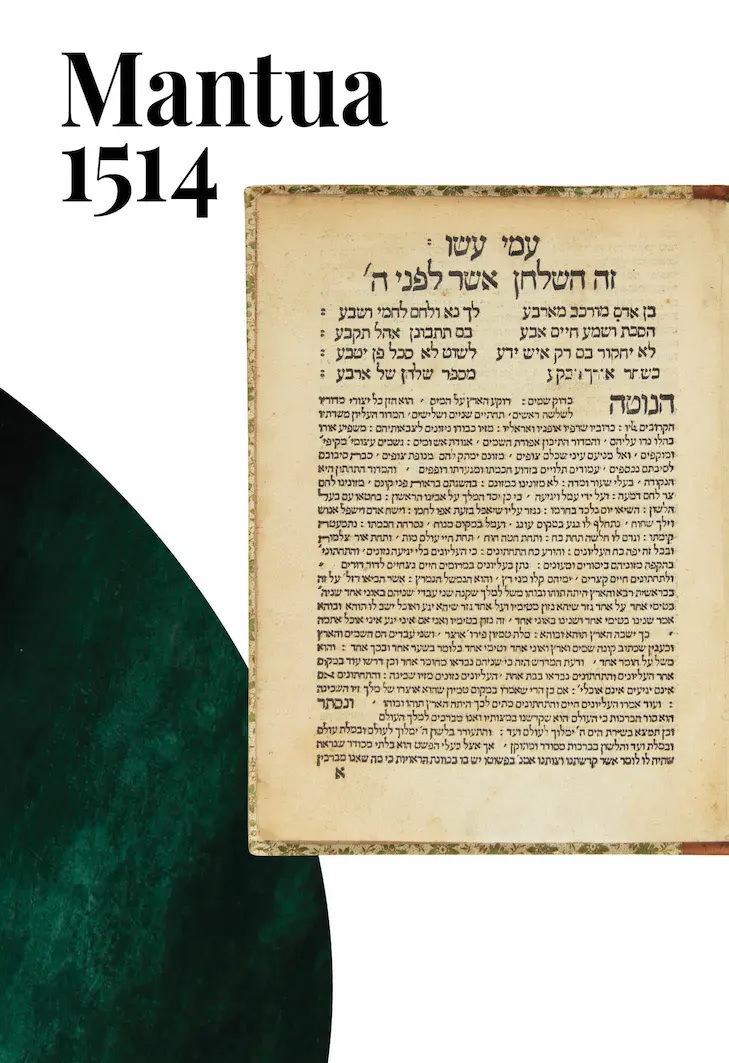
Shulchan shel Arba by Rabbeinu Bachya. Mantua, circa 1514
Fundamental sefer on Hilchos Brachos, eating and meals, along with mussar kabbala and rules of conduct.
The sefer is divided into four sections, with the last one discussing and the future seudah of tzaddikim at the end of days and the resurrection of the dead.
Rabbi Yosef Caro cites this sefer several times in his landmark work Beis Yosef regarding the laws of brachos and matters pertaining to eating.
Rabbeinu Bachya ben Rabbi Asher ibn Halawa (circa 1255-1340) of the great commentators on the chumash, as well as one of the earliest known kabbalists. Rabbeinu Bachya, who dwelled in Saragossa, Spain in the thirteenth and fourteenth centuries, was the prime disciple of the Rashba; his study of kabbalah followed that of the Ramban. His sefarim cite kabbalists and midrashim of Chazal that are today unknown.
The colophon of this edition incorrectly attributes the sefer to the Ramban.
During this same period of time, this sefer was also printed in Constantinople, and bibliographers estimate that it was also printed circa 1514.
Mantua, 1514. Shmuel ben Meir Latif Press. Page Count: [14] leaves. Page Size: 18.3 cm. Printed in block letters, without title page.
...............................................
Any inquiries about this lot ?
We are available also on WhatsApp >>>

Lot : 26
Rare Constantinople Work!
Foundational Halachah Sefer!
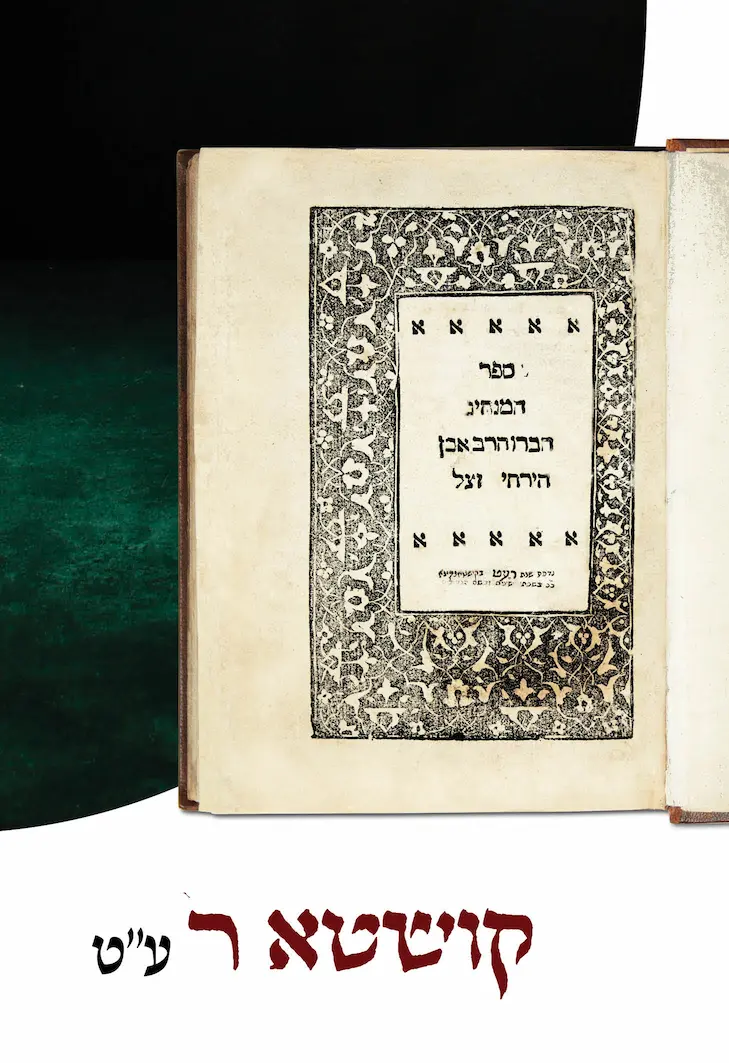
Sefer Hamanhig. First Edition. Constantinople, 1519
Halachos and halachic rulings mainly on the topic of Orach Chaim, by Rabbi Avraham ben Rabbi Nosson Hayarchi.
Sefer Hamanhig is from the basic sifrei halachah from the early Rishonim. The Tur, along with many other great Rishonim, among them the Orchos Chaim, Avudraham, Rivash and Tashbetz, all cite many rulings from Sefer Hamanhig as halachah.
In the Beis Yosef’s introduction, he mentions the Sefer Hamanhig in the list of sefarim he references and, indeed, quotes him dozens of times in his Sefer.
This sefer is the source of many French and Spanish Jewish customs.
Throughout his journeys, the author observed the customs of these Jewish communities and recorded them in his sefer (The preface to Sefer Hamanhig Yitzchak Rephael Edition pages 44-46 includes a comprehensive list of over 250 customs, all mentioned in the sefer.)
Rabbi Avraham ben Rabbi Nosson Hayarchi (circa 1155-circa 1215) was born in Lonil, Provence, in southern France. Lonil in French is cognate with lune, ‘moon’, and this was the source of his moniker ‘Hayarchi.’. Rabbi Avraham studied under great Rishonim including the Raavad, Ri Hazaken, and his relative the Baal HaItur. He spent many years wandering throughout France, Germany and Spain, eventually accepting a position as dayan in the Beis Din of Rabbi Meir Halevi Abulafia in Toledo, where he wrote this sefer.
Colophon: “Until now, the Helper has aided us, and we completed words of gems, sapphires and diamonds of the distinguished Rabbi Moreinu Harav Avraham ben Nosson Yarchi… In it, we discover Orach Chaim and all halachos that a man will ever need… It was completed on Tuesday, the 8th of Tammuz, year 1519 in greater Constantinople… These are the words of the youngest of the tribe… Shlomo ben Rabbi Mazal Tov zt”l.”
Page Count: [130] leaves. Page Size: 19.6 cm. Description: Title page is decorated with a border of leaves. Condition: Several leaves lightly restored. Antique restored leather binding with new leather spine.
Bibliography: Yaari, Constantinople #63; Stefansky Sifrei Yesod #241.
............................................... .
Any inquiries about this lot ?
We are available also on WhatsApp >>>

Lot : 27
Fundamental
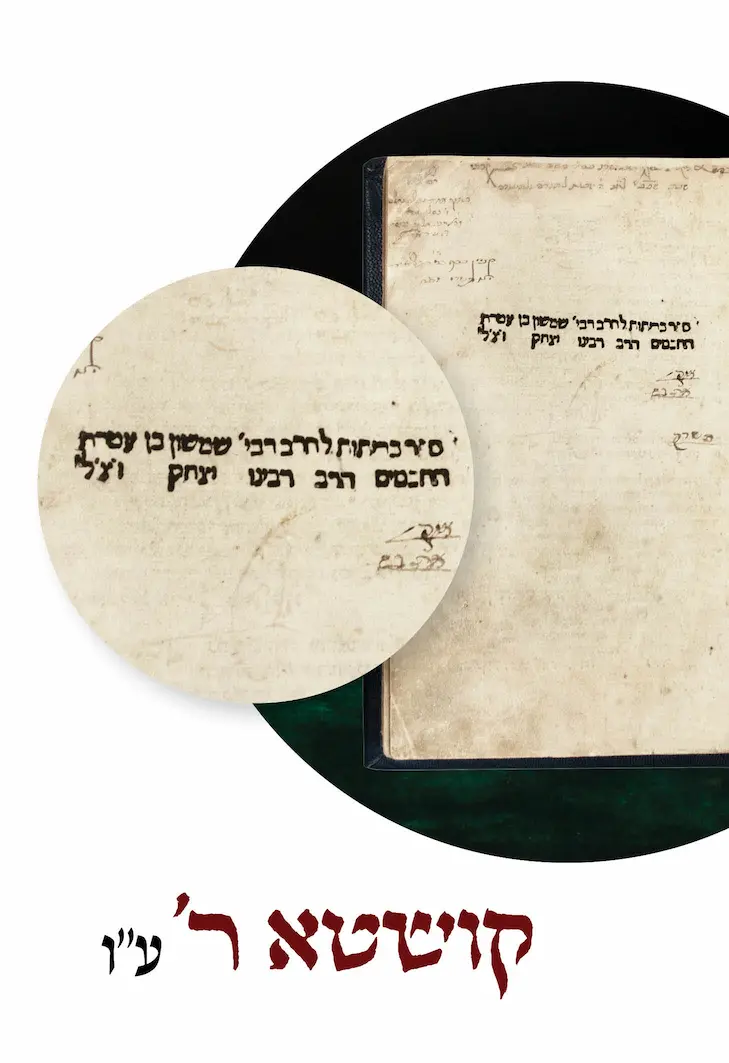
Sefer Krisus. First Edition. Constantinople, 1516
Laws of the Mishnah and Talmud, principles of rulings in halachah, the chronological order of the Tannaim and Amora’im and explanations of the attributes by which Torah is studied, by Rabbi Shimshon of Kinon. This work was one of the original works to outline the principles of Talmudic study, and it is regarded as one of the most fundamental among them.
The printer’s details appear in the colophon: “Sefer Krisus was completed…in the year 1516 and its symbol is ‘Ura kvodi b’Constantina, my honor should be awakened in Constantinople!’”
Rabbi Shimshon of Kinon (d. 1312) was one of the great sages in France in the late 13th and early 14th centuries. He corresponded in halachah with the Rashba. The Rivash cites his master Rabbeinu Peretz that “Rabbeinu Shimshon was the greatest rabbi of his generation” (Shu”t Rivash Ch. 157). Following the Jewish expulsion from France in 1306, Rabbi Shimshon settled in Provence.
Constantinople, 1516. First edition. Page Count: 64 leaves. Page Size: 18.8 cm. Minor holes professionally restored; light water stains. Censor’s stamp on last page. Attractive new leather binding.
Bibliography: Yaari #47; Stefansky Sifrei Yesod #527.
..............................................< /p>
Any inquiries about this lot ?
We are available also on WhatsApp >>>

Lot : 28
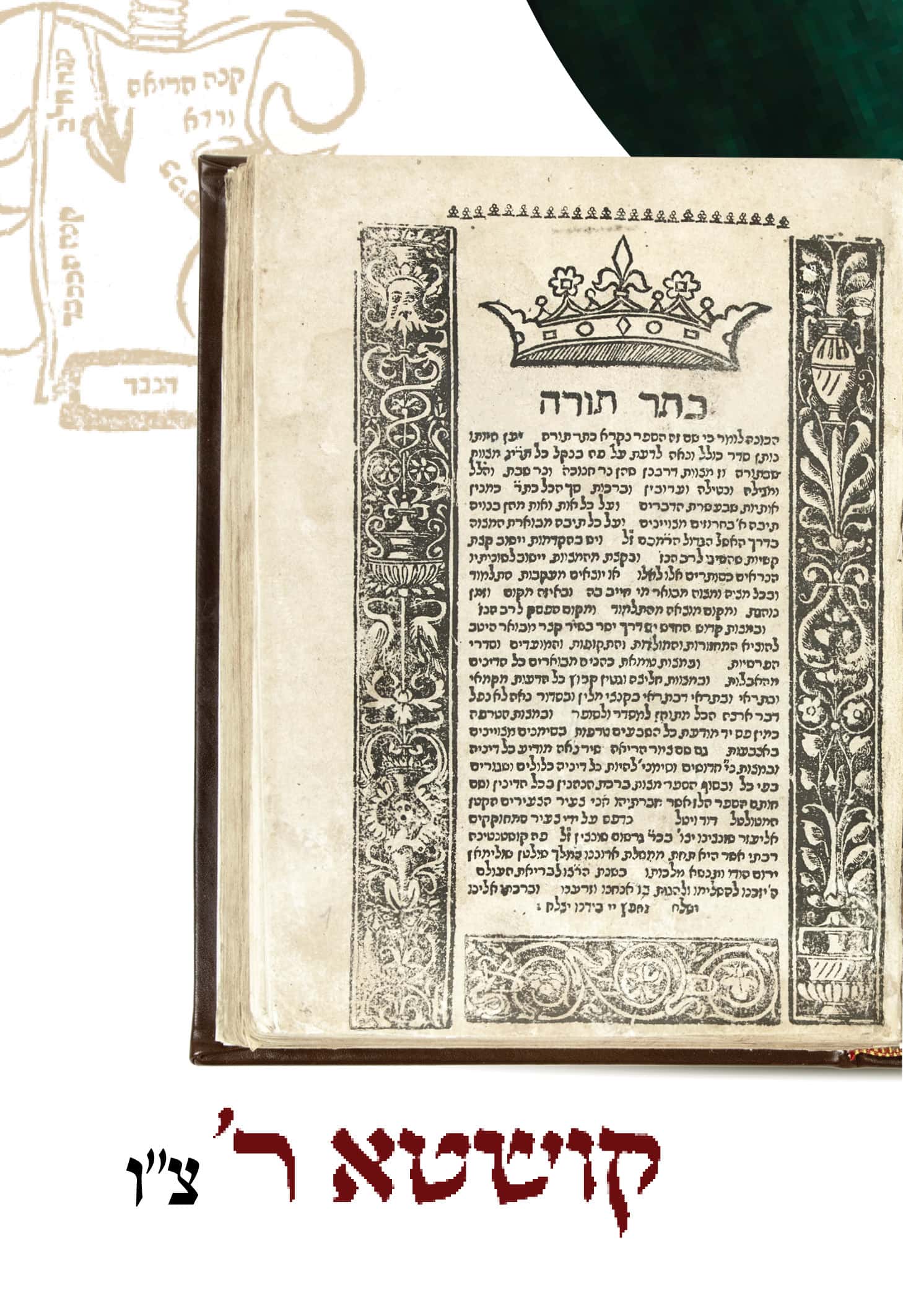
Kesser Torah. First Edition. Constantinople, 1536
Halachos of the 613 mitzvos and 7 mitzvos d’Rabbanan in poetic form by Rabbi Dovid Vital.
This sefer is based on a lengthy poem which the author printed in the beginning of his sefer. The poem comprises 620 words (the sum of 613 mitzvos d’Oraysa and 7 mitzvos d’Rabbanan), and the remainder of the sefer is a commentary on the 613 mitzvos.
The acrostic of the poem is the words of the Ten Commandments.
This sefer also contains the poem written about the 70 treifos of the lung (kashrus of meat). This poem became famous and was reprinted in many sefarim. (One example is the Seder Meah Brachos, featured in this Catalog lot #2). It was likewise copied into numerous manuscripts.
Prior to the poem on the treifos (Leaf 92b), there is a printed drawing of the shape of the lung.
Three illustrations in the shapes of the palm of the hand (Leaf 14b) are printed prior to the poem regarding calculating the calendar.
Rabbi Dovid Vital was a 15th century Rabbi, posek, lecturer and poet. He married the daughter of Rabbi Dovid Hakohein of Corfu, author of Shu”t HaRadach. In his youth, he was expelled from Spain, and from there he wandered to Turkey and later to Patras, Greece. Rabbi Dovid Vital corresponded extensively with the great Torah luminaries in his generation, among them Maharam of Padua who wrote to him , “Your essays reached my hands…and I rejoiced in them as with great wealth, and I blessed God with the blessing on seeing the wise, and that Avraham Avinu has a son like you” (Shu”t Maharam Padua Ch. 31).
Constantinople, 1536. Eliezer ben Gershom Soncino Press. First edition. Page Count: [128] leaves. Page Size: 21 cm. Additional Information: Title page enhanced with border and crown, alluding to the title of the sefer. Condition: Good with light restorations to the first pages.
Bibliography: Yaari, Constantinople #120.
......................................... ......
Any inquiries about this lot ?
We are available also on WhatsApp >>>

Lot : 29
Rare treasure!
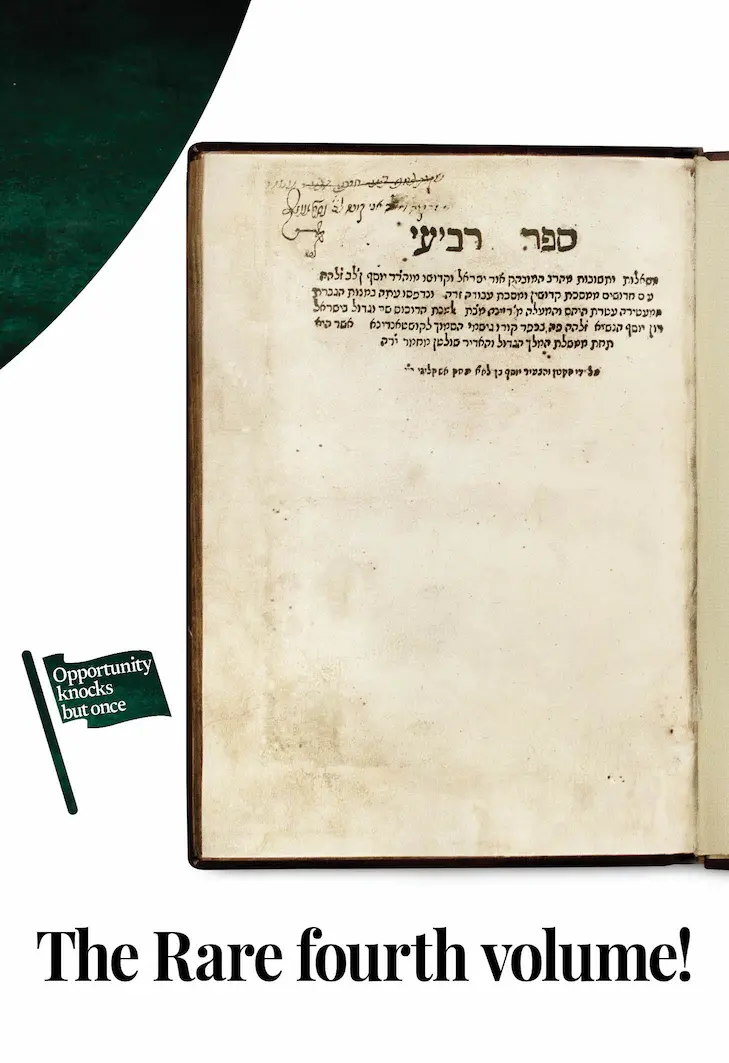
Shu”t Mahar”i Ben Lev. Kuru Chesme, 1598
Shailos and teshuvos by Rabbi Yosef ben Lev. The present sefer is the fourth volume of his teshuvos and includes as well his chiddushim on the tractates Kiddushin and Avodah Zara.
Volumes 1-3 of Shu”t Maharival were printed in Salonika and Constantinople between the years 1557-1573. The present fourth volume was printed separately in 1598 and is an extremely rare edition and unknown to some of the greatest bibliographers (not mentioned by Di Rossi, Steinschneider, Zander, Wolf and was not even registered in Ben Ya'akov’s book nor does it appear in the lists by Rabbi David Oppenheim and Chaim Michal) . Its rarity was already evident 400 years ago as it required a second printing in Venice, 1606.
The following inscription appears in the center of the title page:
“These were printed now at the behest of the righteous noblewoman who is crowned in all glory Donna Reyna, wife of the duke and great minister of Israel, Don Yosef Hanassi, here in Kuru Chesme near Constantinople.”
Donna Reyna Nassi was the daughter of the famed Jewish philanthropist Mrs Donna Gracia Nassi, a family of Spanish anusim (marranos) who returned to their Jewish roots, and the wife of Don Yosef Nassi. Following the passing of her husband, Donna Reyna founded a Hebrew printing press in her palace in Belvedere, a suburb of Constantinople. Over the course of four years, between 1593 and 1597, seven sefarim were printed in Donna Reyna’s private press. In 1597, Donna Reyna moved to Kuru Chesme which is also a suburb of Constantinople and founded a printing press there as well. Between 1597-1598 eight books were printed in the Hebrew press in Kuru Chesme.
Known as the Maharival, Rabbi Yosef ben Lev (circa 1500-1580) numbered among the l the great Spanish Rabbanim and poskim.His present work of shailos and teshuvos was one of the most noteworthy teshuvos sefarim printed in the era of the Beis Yosef.
The Chida writes that ”During the generation of the Beis Yosef, there were three Rabbanim named Yosef who were worthy of compiling the Shulchan Aruch: Rabbi Yosef Karo, Rabbi Yosef ben Lev, and Rabbi Yosef Tiatchik” (Shem Hagedolim).
Kuru Chesme, 1598. First edition. Page Count: 4, [91] leaves.
Bibliography: Stefansky, Sifrei Yesod #293; Yaari, Constantinople #237 Deinard p. 35
......................................... ......
Any inquiries about this lot ?
We are available also on WhatsApp >>>

Lot : 30
Fundamental
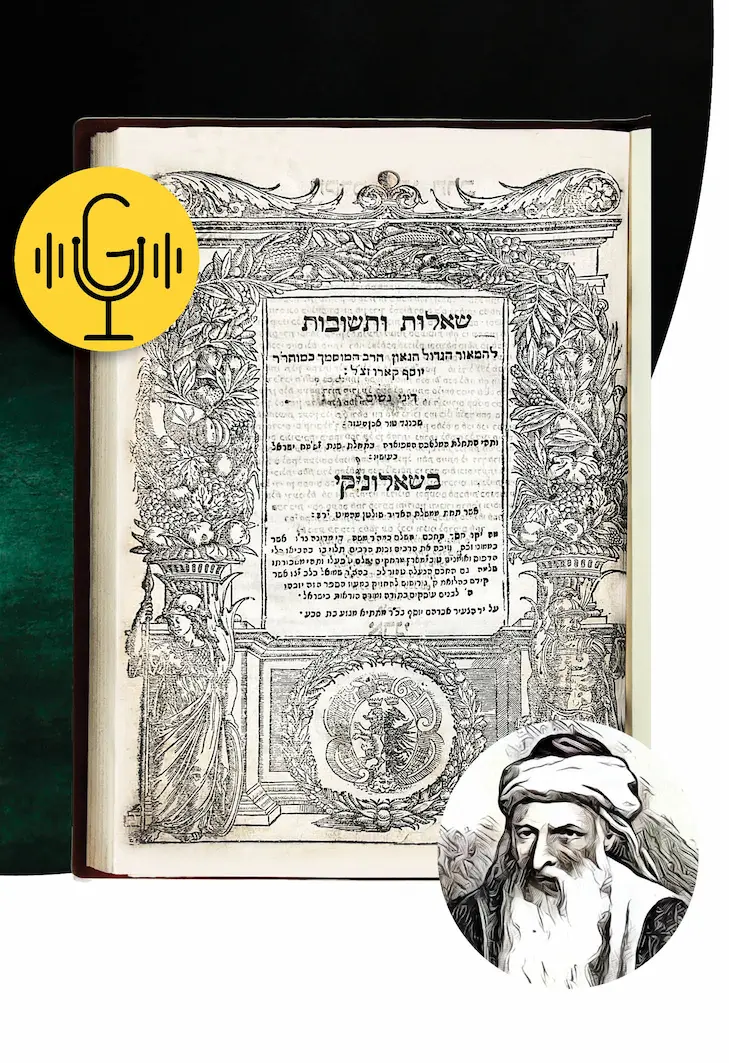
Shu”t Rabbi Yosef Karo. First Edition. Salonika, 1598
Shailos and teshuvos on Even Haezer by Rabbi Yosef Karo, author of Shulchan Aruch and Beis Yosef.
Like all of the Beis Yosef’s works, Shu”t Rabbi Yosef Karo numbers among the foundational works in the Jewish library. All later halachic authorities drew from his infinite wells of wisdom and referenced his teshuvos on Kiddushin, Gittin, Ksubos, agunos and others.
Already during his lifetime, Rabbi Yosef Karo (1488-1575) gained acclaim as a supreme halachic authority, and he responded to weighty questions sent from countries around the world to his residence in Tzfas. The present sefer offers interesting insights to life in 16th century Tzfas as well as the complex halachic shailos that arose during this period following the Spanish expulsion.
The present sefer was brought to print by the Beis Yosef’s son, Rabbi Yehuda Karo. In his foreword to the sefer, Rabbi Yehuda Karo recounts that his father’s will included instructions to his children to edit and print his teshuvos.
Included in this sefer is one particularly long and fascinating teshuvah authored by Rabbi Moshe Cordovero, the Ramak (Dinei Kesubah Ch. 3).
Salonika, 1598. First edition. Page Count: [4], 152 leaves.
Bibliography: Stefansky, Sifrei Yesod #283
Provenance: Sothbeys 12/05/1984.,
......................................... ......
Any inquiries about this lot ?
We are available also on WhatsApp >>>

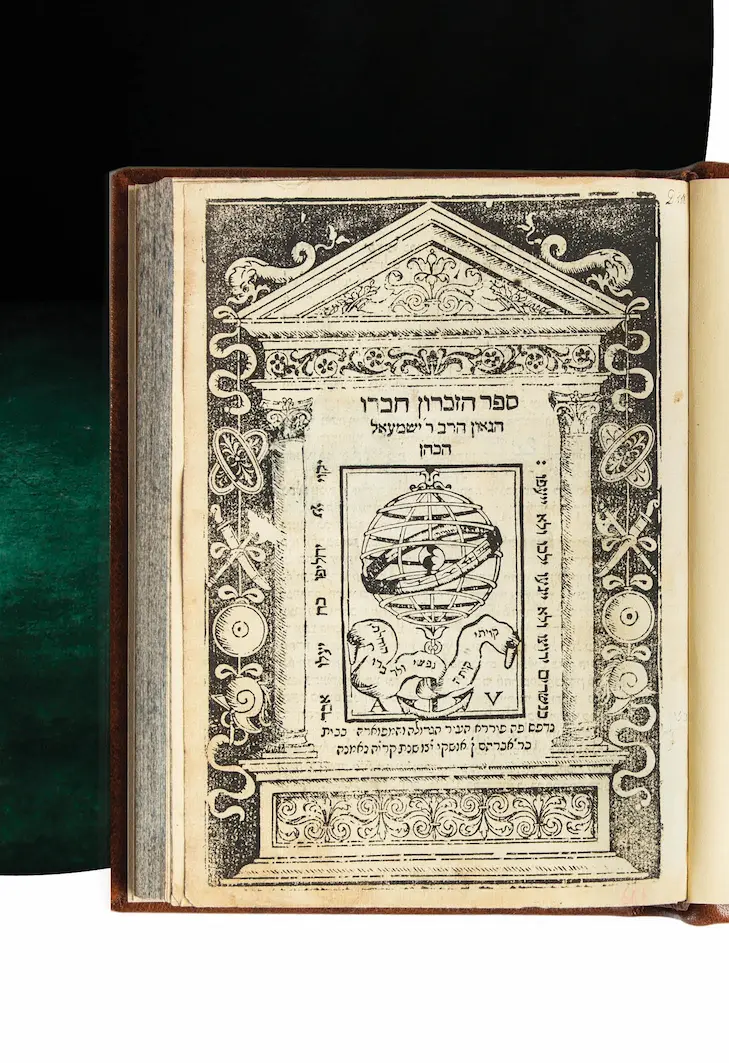
Lot : 31
Sefer Hazikaron. First Edition. Ferrara, 1555
Halachic rulings arranged in order of Shas by Rabbi Yishmael Hakohein Tanuji, foremost Egyptian rabbi in the 16th century.
Rabbi Yishmael Hakohein Tanuji descended from an illustrious family of Tunisian kohanim. He relocated to Egypt where he became the great leaders in the land. His signature appears first on the letter dated 1569 in support of Don Yosef Nasi which was printed in Shu”t Ranach Vol. 2 Ch.55. He also signed his name on letters printed in Teshuvos HaMabit Vol. 2 Ch. 206. He authored the present Sefer Hazikaron in 1543. The synagogue where he prayed, Beit Haknesset Rabbi Yishmael, named after him, was extant until the early 20th century.
The Chida in Shem Hagedolim praises this sefer and writes that it is written in “a clear, concise language.” He also cites Rabbi Yishmael Hakohein Tanuji in his halachic works.
This sefer was meticulously edited and proofread. The first pages bear a handwritten notification regarding errors that entered the print, and many leaves in the sefer feature handwritten corrections in the same handwriting. It is likely that these corrections were either instructed by the author, or he himself wrote it.
Ferrara, 1555. First and only edition a photocopied edition was printed in London, 1974. Page Count: [216] leaves. Page Size: 20.5 cm. Binding: Attractive new leather binding. Condition: Good.
............................................... .
Any inquiries about this lot ?
We are available also on WhatsApp >>>

Lot : 32
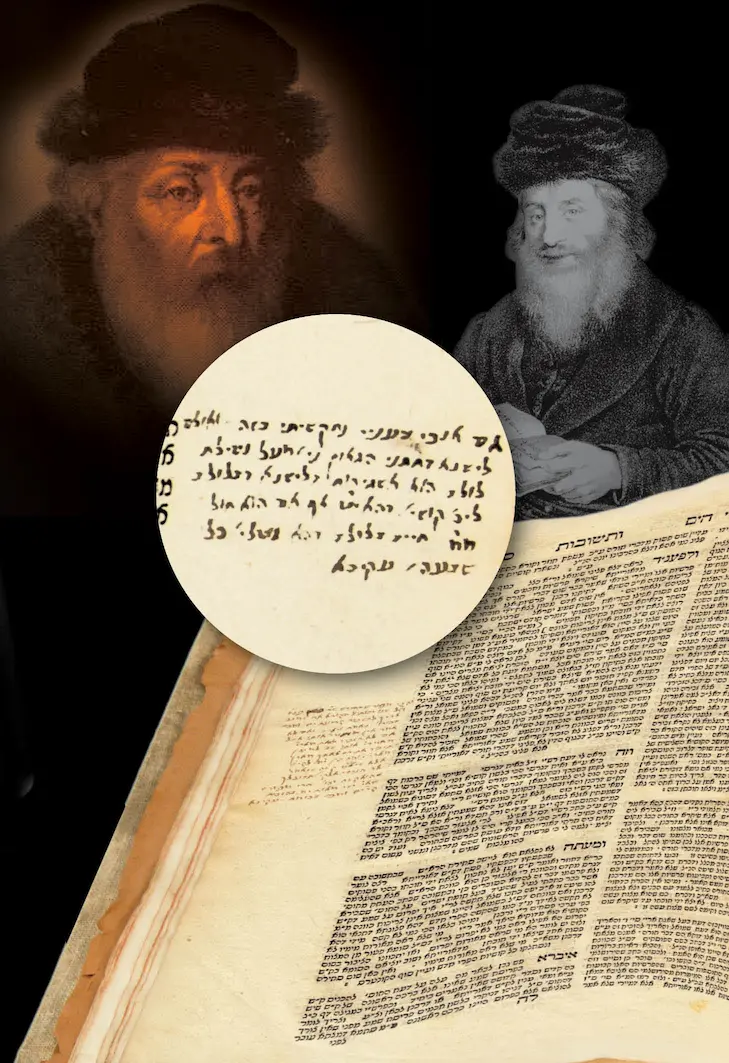
Handwritten and Autographed Glosses by Rabbi Akiva Eiger on the Chassam Sofer responsa
Handwritten glosses by Rabbi Akiva Eiger in the margins of a teshuvah authored by his son-in-law the Chasam Sofer. The teshuvah was printed at the end of the sefer Yam Hatalmud (Zolkova, 1828) pps. 69a-69b.
Rabbi Akiva Eiger inscribed two glosses in his holy hand, to one of them he added his autograph. One of these glosses begins with the astounding remark, “ Also I with this, but the wording of my son-in-law, the genius…”
Rabbi Akiva Eiger’s glosses are handwritten and autographed in capital kesav Ashuris Letters. This script can be found used by Rabbi Akiva Eiger in other writings.
The two Gedolei Hador Rabbi Akiva Eiger (1762-1838) and his son-in-law the Chasam Sofer (1763-1840) venerated one another and accorded utmost respect to each other at all times.
Rabbi Akiva Eiger appealed to the Chasam Sofer to pray for him (Iggros Sofrim Letter 10), and the Chasam Sofer would often refer to Rabbi Akiva Eiger as “hakadosh v’hatahor, – the sacred and pure, ”, expressing tearfully in his eulogy, “Who can compare to him, and to whom will I liken him?” (Drashos Chasam Sofer pgs. 390-392).
Important discovery
The first gloss was partially printed in Gilyon Rabbi Akiva Eiger on Shulchan Aruch (Orach Chaim Ch. 67). However, in the printed gloss, Rabbi Akiva Eiger opens with praises of the Chasam Sofer’s statement, but cites a proof to the contrary, which has led to great confusion, to the understanding of the words of Rabbi Akiva Eiger.
The original gloss presented here sheds new light on the topic clarifying and resolving the issue. ( where we can see that Rabbi Akiva Eiger actually is quoting from the Midrash, which confirms the opinion of the Chasam Sofer).
Description: Sefer Yam Hatalmud on maseches Bava Kama with the Mefarshei Hayam commentary by the illustrious brothers-in-law Rabbi Yosef Shaul Nathanson, Av Beis Din of Lvov, and Rabbi Mordechai Zev Segal Ettinger.
The end of the sefer includes assorted teshuvos authored by Gedolei Yisrael, among them from Rabbi Akiva Eiger and the Chasam Sofer, and their endorsements also appear in the beginning of the sefer. In his endorsement, Rabbi Akiva Eiger writes, “When the printing is complete, I request from your honor to send me a copy, and I will bli neder send full payment, as much as asked.”
This is the actual copy sent to Rabbi Akiva Eiger!
Distinguished provenance!
The title page bears the stamp of Rabbi Akiva Eiger’s son, Rabbi Yitzchak Leib Eiger (I.L. Eger, Johannesburg) who printed the gelyonos( glosses) of Rabbi Akiva on the Shulchan Aruch (Berlin, 1862).
It also bears the signature and stamp of the Admor Rabbi Moshe Halberstam of Bardejiov (1850-1904), beloved grandson of the Admor Rabbi Chaim of Sanz - the Divrei Chaim, who merited to study with his granfather and was appointed by him to edit his work Shu”t Divrei Chaim.
Zolkova, 1828. First edition. Page Count: 10, 81 leaves. Page Size: 37 cm. Condition: Beautiful copy with wide margins and antique cloth binding, with leather spine and new corners. (Stefansky, Sifrei Yesod #99). this sefer was previously in Kedem auction number 66
Gilyonos of Rabbi Akiva Eiger
Rabbi Akiva Eiger inscribed many notes and comments in the margins of his sefarim, over the years, these notes were published either together with his Chiddushim or as separate works.
Rabbi Akiva Eiger’s writings, known to be precise, intellectually deep, and at the same time so sweet and enjoyable to learn, are cherished by those learning gemara. The Hagahos of Rabbi akiva Eiger are specifically beloved for their concise and exact words, talmidim continuously toil to decipher their secrets and answer his queries, and many sefarim have been written discussing his notes.
First Teshuvos Printed by the Chasam Sofer
Teshuvos authored by the Chasam Sofer first began appearing in print in 1841, a short while after his passing. However, even during his lifetime, several teshuvos were printed in other sefarim, among them Chiddushei HaRi Migash on Shavuos (Prague, 1826), Shu”t Rabbi Akiva Eiger (Warsaw, 1838), and the present sefer Yam HaTalmud which features comments by the Chasam Sofer’s father-in-law, Rabbi Akiva Eiger. ............................................ ....
Any inquiries about this lot ?
We are available also on WhatsApp >>>

Lot : 33
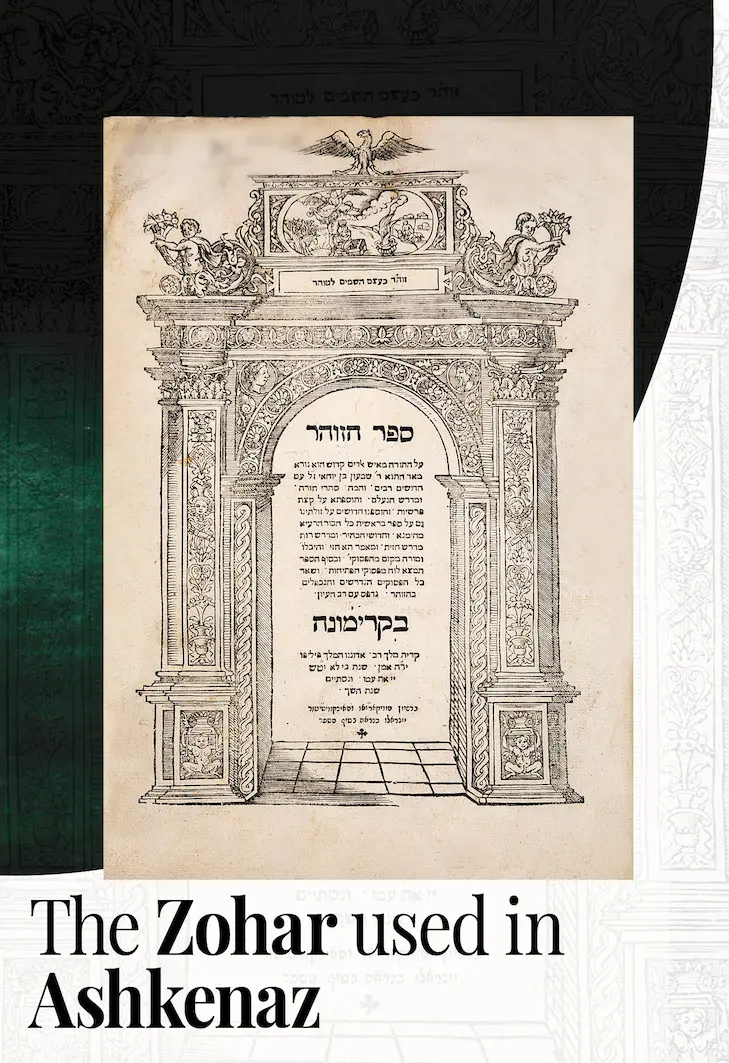
Sefer HaZohar, Cremona 1559-1560. Magnificent Copy!
Sefer HaZohar by the Holy Tanna Rabbi Shimon bar Yochai
Printed and edited based on ancient manuscripts with marginal references.
Glowing with the Radiance of the Heavens…
“These are Rabbi Shimon bar Yochai and his colleagues…who glow with the radiance of the heavens. When they composed this work, the heavens awarded their consent, and they called it Sefer HaZohar” (Tikkunei HaZohar p. 17).
The great kabbalists of the generation regarded the publishing and dissemination of this work to the masses as a heavenly sign heralding the redemption of the Jewish people from exile. “And it shall be for us as a shield in these dreadful generations, to grasp with a full heart onto our Father in heaven” (Preface of Harav Chaim Vital to Eitz Chaim).
It is intriguing to note that in the very same year that the kabbalists assented to the publication and dissemination of Sefer HaZohar, two printing houses in two Italian cities (Cremona and Mantua) commenced the work of publishing it simultaneously.
The Cremona Edition of Sefer HaZohar was printed in large format, whereas the publishing house in Mantua printed it in a smaller format. To distinguish between the two, the Cremona Edition was referred to as the ‘Large Zohar’ and the Mantua Edition ‘Small Zohar’.
The Mantua Edition of Sefer HaZohar was dispatched to Eretz Yisrael where it was studied in depth by the Arizal and his disciples, as well as by many famed Italian kabbalists. The Cremona Edition, in contrast, was sent primarily to Europe where numerous Ashkenazic Torah luminaries, as the Rema, etc authored commentaries upon it.
Unsurprisingly, there are numerous textual differences between the two editions of Zohar.
Cremona, 1559-1560. First edition.
Bereishis: 132 leaves; Shemos: 122 leaves; Vayikrah-Devarim: 146 leaves. Page size: 29.5 cm. Two columns of block letters.
Title page features impressive architectural design. Good condition! Very rare!
Stefansky Sifrei Yesod—Classic #325
Benayahu, Hebrew Press of Cremona. P. 206, 118-139.
......................................... ......
Any inquiries about this lot ?
We are available also on WhatsApp >>>

Lot : 34
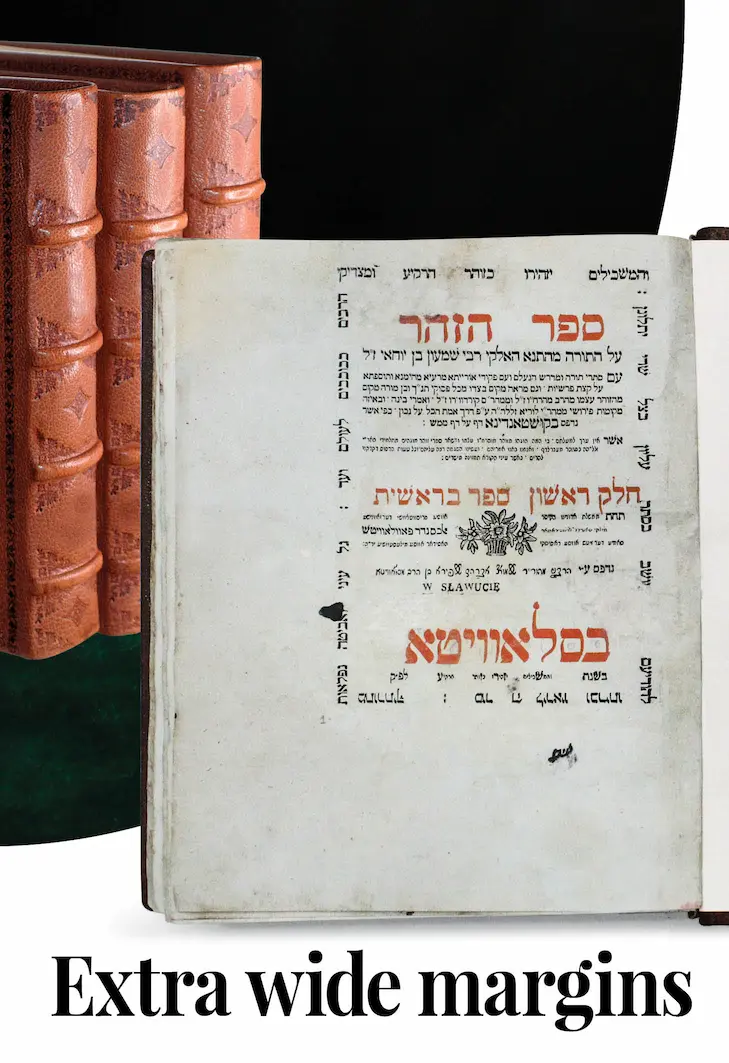
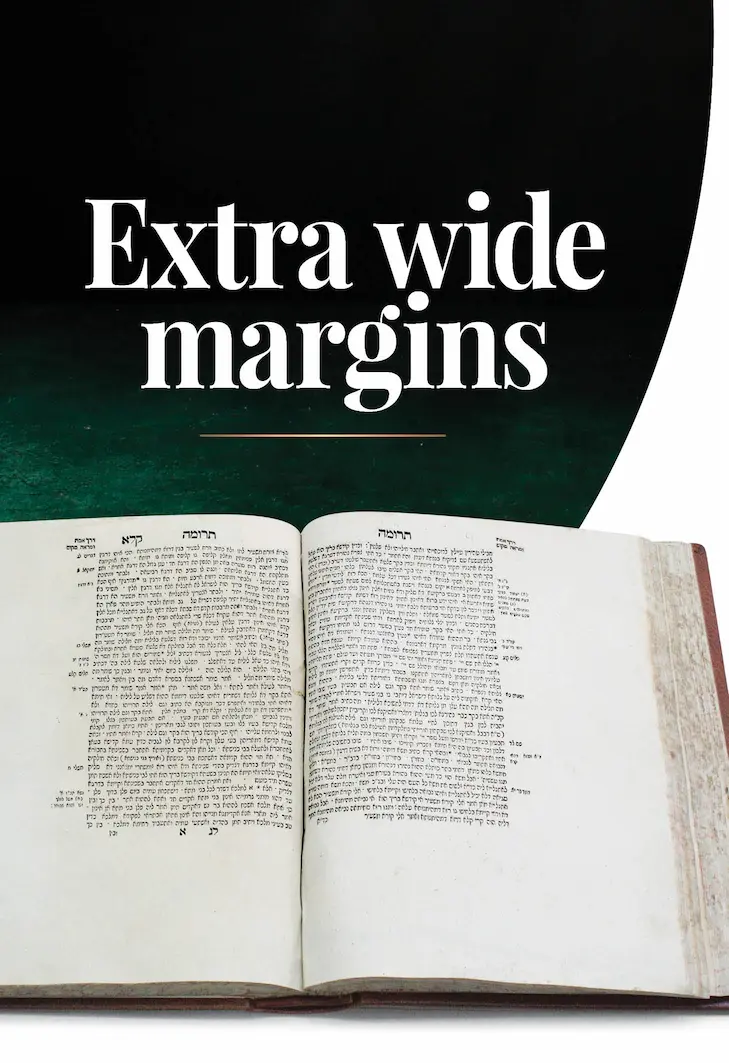
Sefer HaZohar. Shapira Press. Slavita, 1824
Complete set with extra wide margins.
Complete set of Zohar by the Tanna Rabbi Shimon bar Yochai, edited and amended based on the Constantinople edition and printed in the famed Shapira Press.
The set was printed on light green paper with title pages in red ink and features wide margins and beautiful bindings.
This edition of Sefer HaZohar was printed by Rabbi Avraham Shmuel Shapira, son of the illustrious Slavita Rav, Rabbi Moshe Shapira.
The sefer begins with an effusive approbation by the Ohev Yisrael of Apta, dated 9 Tammuz 5584 (1824), only nine months before his passing.
“The beauty of the press in the holy congregation of Slavita is known throughout the land, as it is carried under the watchful eye … of the honorable Rav and famous chassid Moreinu Harav Moshe Shapira, Av Beis Din of the holy congregation of Slavita, and may Hashem grant that he shall succeed in making his sefarim beautiful with all glory and splendor. And now, how wonderful and pleasant it is that he wishes to reprint the Sifrei HaZohar, and I hereby deliver a warning to people to avoid infringing on his property… And those who listen shall be blessed with goodness… Hakatan Avraham Yehoshua Heschel of Apta, Mezhibuz.”
Slavita, 1824. Vol. 1 (Bereishis): [4], 251, 17 leaves; Vol. 2 (Shmos): [1], 17-, 19-278 leaves; Vol. 3 (Vayikra-Bamidbar-Devarim): 115; [1], 117-309 leaves. Page size: 21.5 cm.
Description: Extra-wide margins. The title page of Shmos has regular margins with professionally restored margins to fit size of sefer. Minor stains on titles pages and several pages. 3 volumes with 3 title pages in red ink and an additional internal title page for Bamidbar-Devarim. Pristine copy bound in new leather bindings.
Shapira Press
“Therefore, every man who fears Hashem should strive to purchase sefarim from old printings, the majority of which were printed by G-d-fearing men, and especially from the Slavita and Zhitomir Presses [which were owned] by the grandchildren of the Admor of Koritz, who were exalted and exceedingly pious printers.” (The Shomer Emunim in his Taharas Hakodesh Ch. 6)
......................................... ......
Any inquiries about this lot ?
We are available also on WhatsApp >>>

Lot : 35
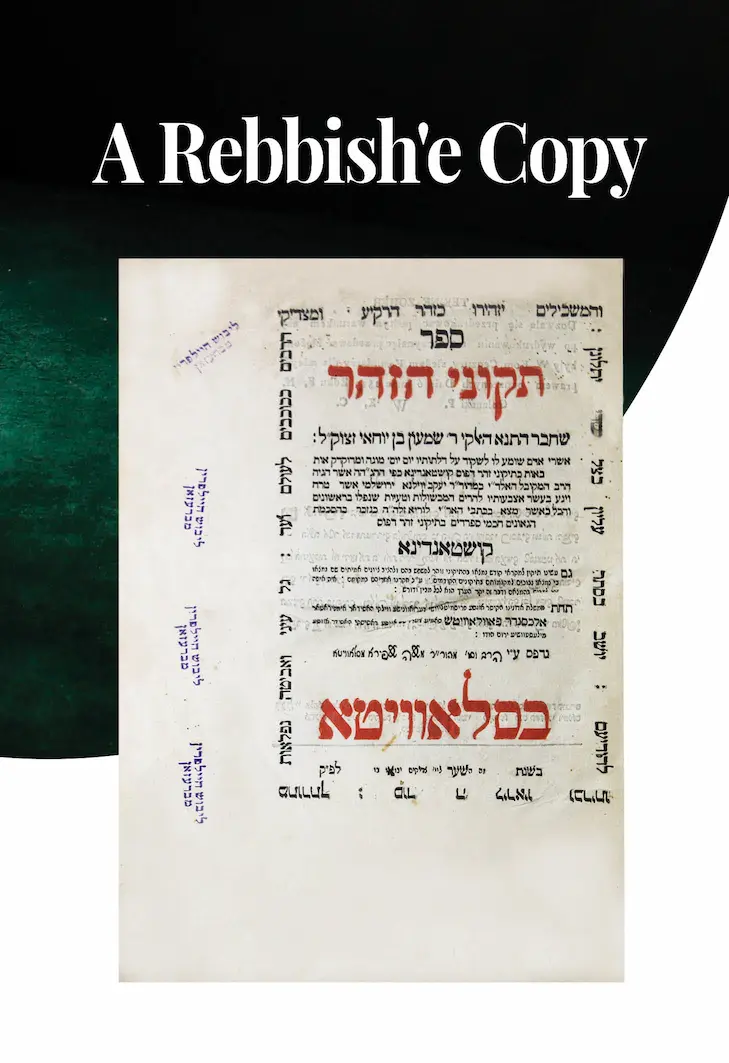
Tikkunei HaZohar. Shapira Press. Slavita, 1821
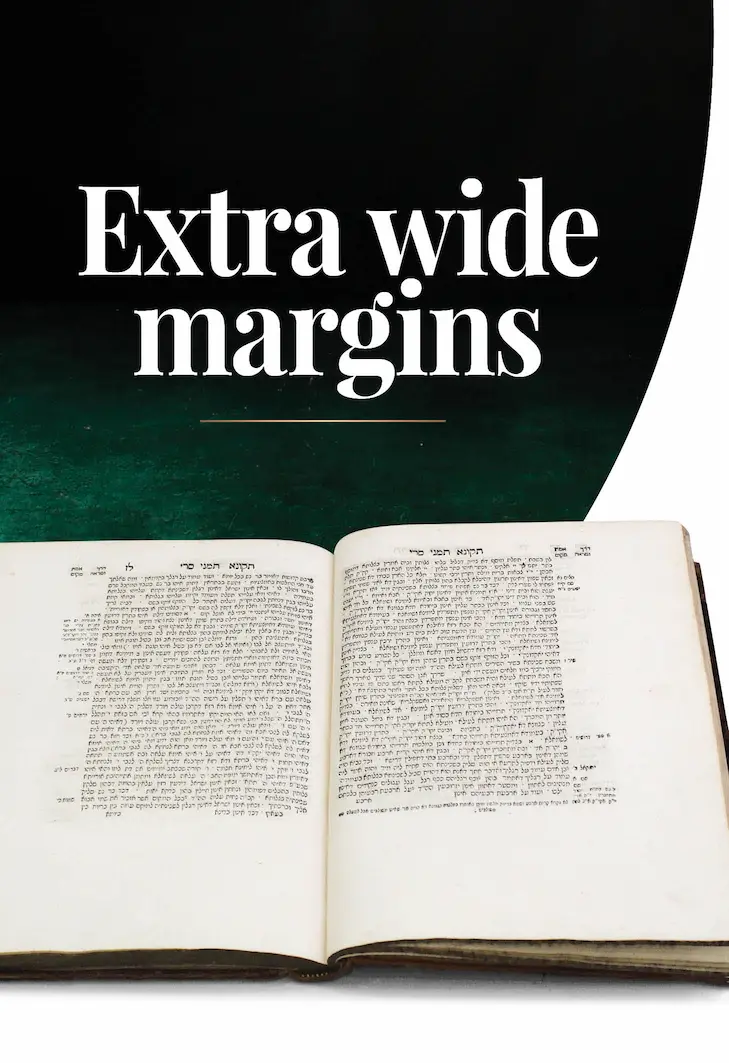
Exceptional copy with wide margins! REBBISHER COPY !!!
This beautiful and impressive sefer, featuring extra wide margins, was the first edition of Tikkunei HaZohar printed in Slavita.
This sefer was printed in Slavita by the Admor Rabbi Moshe Shapira, son of the Admor Rabbi Pinchas of Koritz.
Tikunei Zohar contains seventy tikkunim on the first word in the Torah, “Bereishis, ” as taught by the holy Tanna Rabbi Shimon bar Yochai. It was edited and proofread based on the Constantinople edition.
Glosses by the Ramaz and sources, entitled Derech Emes, were printed in the margins.
Slavita, 1821 . Page Count: 154 leaves. The title and city where the sefer was printed are embossed in red ink.
Distinguished provenance! The personal copy of the Admor Rabbi Leibish Halperin of Brezhen!
The Admor Rabbi Leibish Halperin of Brezhen (circa 1848-1929) was the prime disciple of the Admor Rabbi Chaim of Sanz who instructed his talmid to open a Chassidic court and promised him that he would engender miracles and salvations. The Admor of Shinova quoted his father in expressing that Rabbi Leibish Halperin was an “adam gadol” and the Maharsham would often consult with him regarding issues related to the spiritual elements of the city, such as the mikveh and accepting a new shochet. Rabbi Leibish married the daughter of the Admor Rabbi Yoel of Shatz. His teachings are eternalized in his sefer Imrei Yehudah (Munkacs, 1908).
...............................................
Any inquiries about this lot ?
We are available also on WhatsApp >>>

Lot : 36
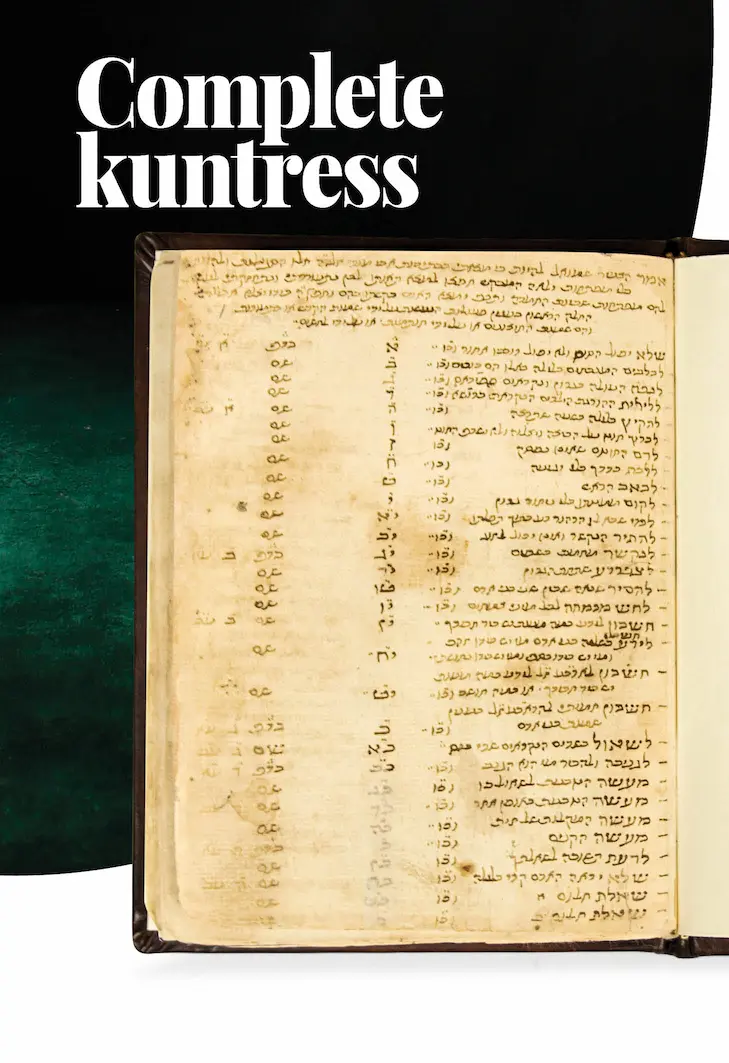
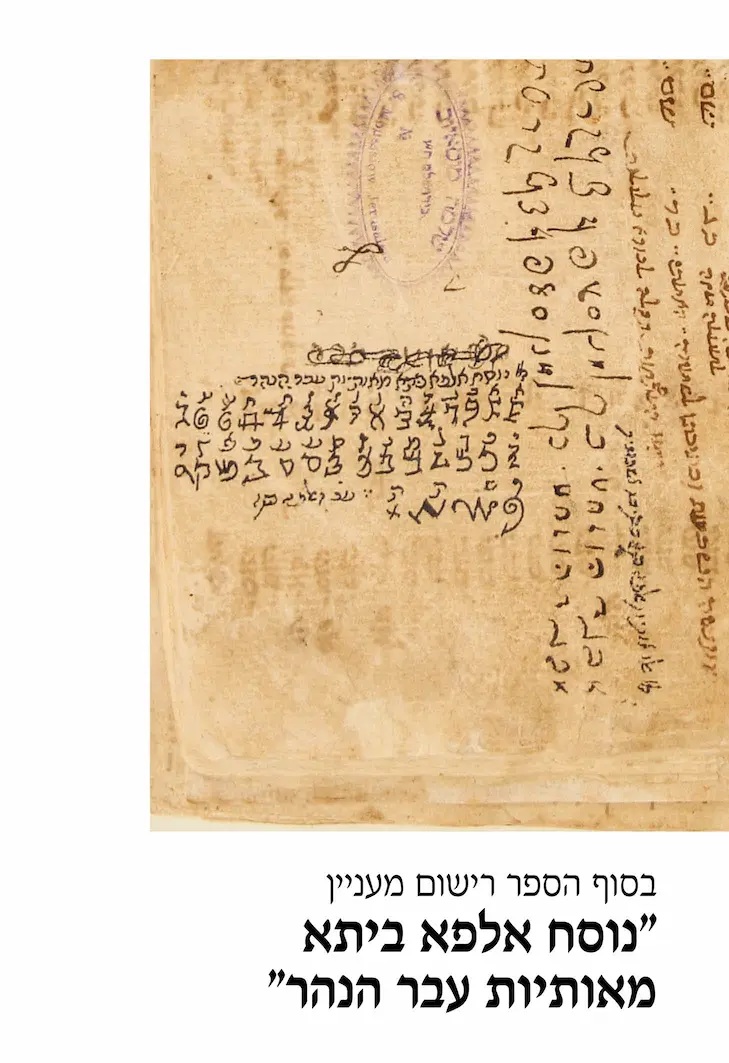
List to Rabbi Chaim Vital’s Sefer Hasegulos V’harefuos handwritten by His Son Rabbi Shmuel Vital
Complete Manuscript 24 leaves (48 Handwritten Sides)
One of the most extraordinary legacies of Rabbi Chaim Vital is a lengthy sefer discussing segulos, amulets and remedies.
Importance of the Index
The length and scope of Rabbi Chaim Vital’s Sefer Hasegulos V’harefuos makes it challenging for the learner to find what he seeks. Rabbi Chaim Vital’s son, Rabbi Shmuel Vital, took the initiative to resolve this difficulty by creating a detailed index for his father’s work.
He writes at the start of Index:
“The youth Shmuel said, being that these segulos in my father and master’s writings are without an index, the learner will tire of finding what he desires. Therefore, I was motivated and inspired to create an index, which allows a person to immediately find what he seeks, and Hashem should grant that he should succeed.”
Rabbi Shmuel studied his father’s sefer comprehensively and presented a clear and organized index that greatly facilitates the learner in his study of the sefer.
An important advantage to Rabbi Shmuel Vital’s index is that the original sefer written by Rabbi Chaim Vital is incomplete, with several pages missing. The present detailed 48-page Index enables the learner to obtain a bit of understanding of the content of the missing pages. For example, the entire first section of the original sefer is missing, yet this detailed index gives us a glimpse into its contents, with titles and summaries of omitted chapters clearly documented in the index.
On one page (leaf 8b), Rabbi Shmuel inserted his own comments into the text: “Shmuel says, that it is always hung on the infant…and experience has shown that it also benefits an adult suffering from epilepsy.”
The kabbalist Rabbi Shmuel Vital (1598-1677) was the son and foremost disciple of his father Rabbi Chaim Vital, who was the prime disciple of the Arizal and who who disseminated his teachings to the nation. Rabbi Shmuel was the chief editor of his father’s kabbalistic writings, and it was he who arranged Rabbi Chaim Vital’s epic sefer Eitz Chaim into its classic eight “Gates”. This sefer would ultimately become the basic work in the study of the Arizal’s kabbalah.
The Chid”a writes: “It’s been thirty years since the ‘Eight Gates’ were published by the son of Moreinu Rabbi Chaim Vital, Moreinu Rabbi Shmuel Vital, and we can rely on it… Therefore, one who aspires to learn from the most accurate sefarim should study the ‘Eight Gates’ that he arranged. Aside from his greatness in the wisdom of kabbalah, he was also great in Torah, and now we have also merited seeing the publication of his chiddushim on the Rambam and his own teshuvos.”
Rabbi Shmuel Vital was born in Damascus and married the daughter of the Rav Hamusmach Rabbi Yoshiyahu Pinto. In his later years he settled in Egypt and passed away there.
Autographed manuscript. Damascus, early 17th century. Page Count: 24 leaves (48 sides) Page Size: 20x15 cm. Condition: Used, but otherwise in good condition. Last page has tear with minor omission in text. New leather binding and attractive leather case.
..............................................& amp; amp; lt; /p>
Any inquiries about this lot ?
We are available also on WhatsApp >>>

Lot : 37
Manuscript
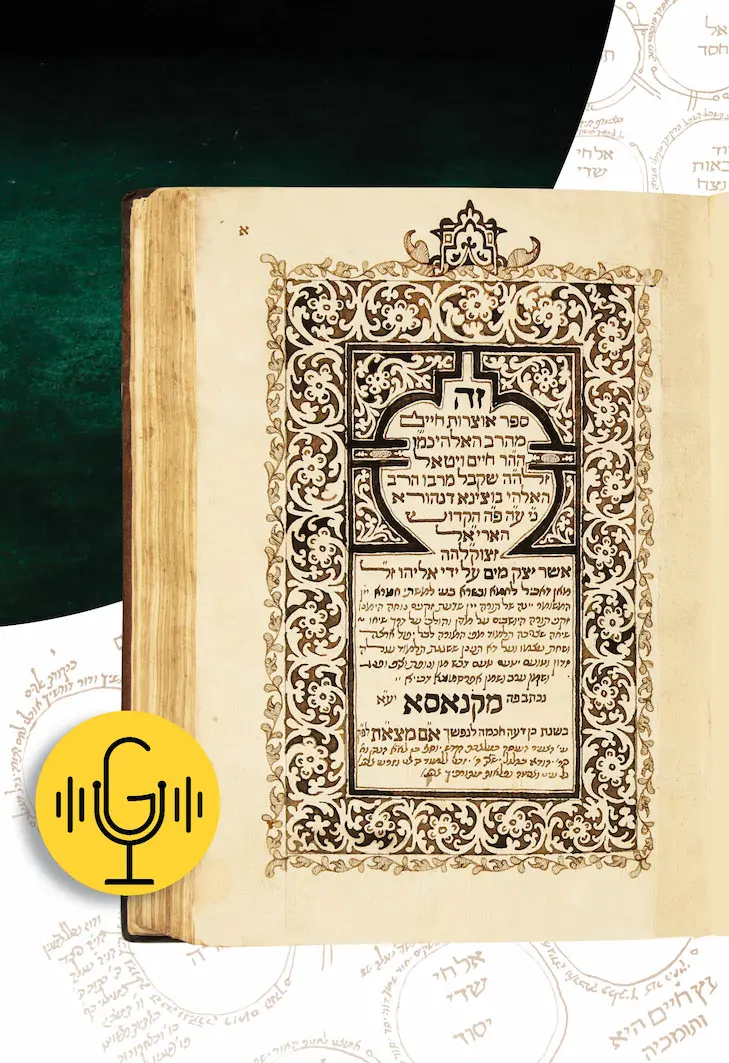
Otzros Chaim Edited by the Maghreb Kabbalist, Meknes, 1812
Elementary principles and introduction to the wisdom of kabbalah received by Rabbi Chaim Vital from his spiritual master, the Ari za"l . Written in Oriental script by Rabbi Yosef Bahloul of Meknes and features a decorative title page with kabbalistic illustrations.
The title page bears the scribe’s autograph and inscription: “Written here in Meknes in the year…1812 by the youth who engages in sacred work, Yosef son of my wise and scholarly father Rabbi Yehuda Bahloul. May Hashem grant that I and my children should learn it, amen. Uncover my eyes, and I will gaze at the wonders of your Torah.”
It is likely that the scribe Rabbi Yosef Bahloul, was of the Rabbis in Meknes whose halachic rulings and signature appears in several works of his contemporaries.(see Malchi Rabanan pg 61)
Otzros Chaim B’Arichah Maaravis
The present manuscript of Otzros Chaim is a combination of two sefarim—Otzros Chaim and Mevo She’arim, with the majority drawing from the latter work. It was thus officially named Otzros Chaim B’Arichah Maaravis (Edited by the Rabbis of North Africa) and eventually printed as is in Livorno in 1849. The present sefer differs fundamentally from the original Otzros Chaim printed in Koritz, 1783, which was edited by Rabbi Yaakov Tzemach.
This is a complete manuscript of the sefer and features the annotations of Magrabi kabbalists Rabbi Avraham Azoulay of Marrakech and Rabbi Avraham ben Musa.
Glosses by Magrabi sages were added by hand in “sidebars”. Some of these passages begin with the letters א"א, an acronym for “Amar Avraham (Avraham said)”, and the signature אב"מ, an acronym for Avraham ben Musa.
Between the title page and body of the sefer, the author included a full-page chart of the Sefiros presented in circles. On the next page, he writes, “This is what I discovered in the manuscripts of the G-dly kabbalist, the pious and humble Moreinu Harav Avraham Azoulay ztvk”l…This is what I found in Safra D’tzniusa” and includes the twenty-two principles of the wisdom of kabbalah presented in Safra D’tzniusa D’Yaakov (Amsterdam, 1669).
Meknes, 1812. Page Count: 1, [6], 2-140 leaves; 287 handwritten sides. Page Size: 21x15 cm. Condition: Water damage to upper margins, miniscule holes in margins; original Moroccan binding. Bibliography: See Hakdamos U’shearim L’Baal HaLeshem p. 59a; Y. Avivi; Binyan Ariel p. 59 note 31.
...............................................
Any inquiries about this lot ?
We are available also on WhatsApp >>>

Lot : 38
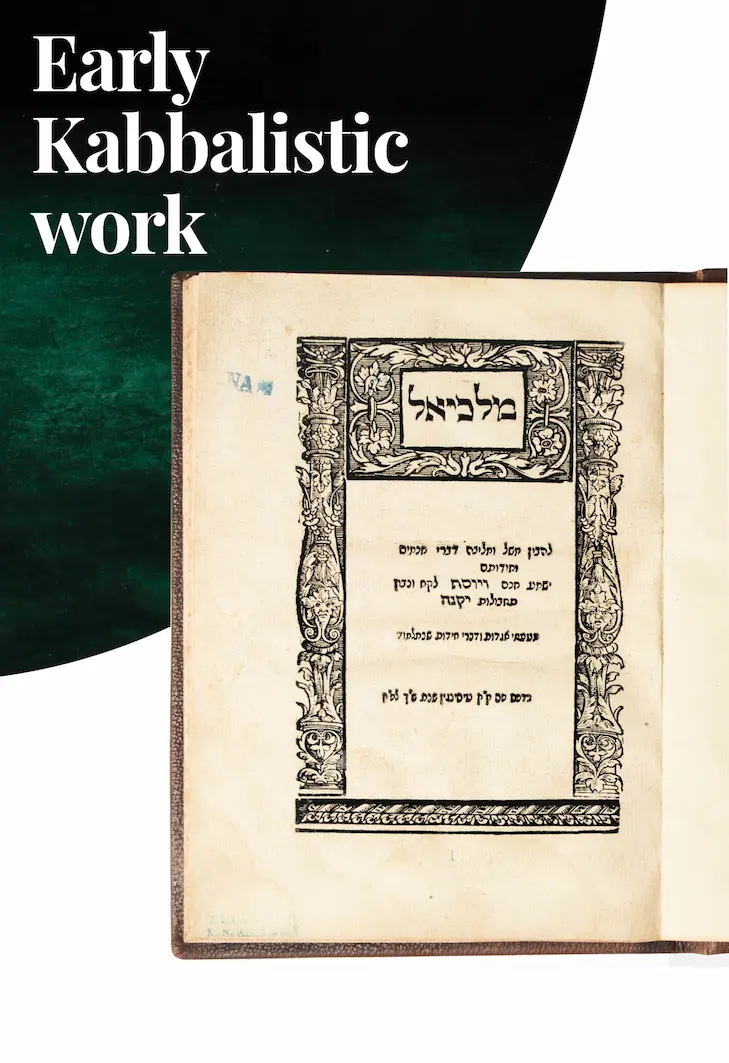
Sefer Malkiel. Tihingen , 1560
Sefer Malkiel An ancient and exceedingly rare essential kabbalistic work by Rabbi Malkiel Chizkiya ben Rabbi Avraham, on the topics of reward and punishment; the sin of eating from the Tree of Knowledge; Og Melech HaBashan; the prohibition of zugos (pairs); and explanations of Aggados Chazal.
There is little information known of the author or even his time period, yet the Shl”a Hakadosh (Maseches Psachim #511) cites his writings at length when elaborating upon the concept of the “Secret of the Zugos”:
“Sefer Malkiel already wrote extensively about this and explained the matter at length, and all his words are sweeter than honey and nectar…”
There are some bibliographers who believe that the author should be identified as Rabbi Malkiel Ashkenazi, founder of the first Jewish settlement in Chevron in the early 1500s.
Tihingen, 1560. Page Count: 22 leaves. Page Size: 18 cm. Condition: Good, with water stains at margins.
The city of Tihingen was home to a Hebrew press that functioned for one year only - 1560. Although only a total of six books were printed that year, each one is a rare Jewish treasure that left its stamp on Hebrew literature. Aside from the present Sefer Malkiel, the Tihingen press published Siddur Rabbi Hertz, Zohar Chadash on Megillas Rus and Shir Hayichud.
...............................................
Any inquiries about this lot ?
We are available also on WhatsApp >>>

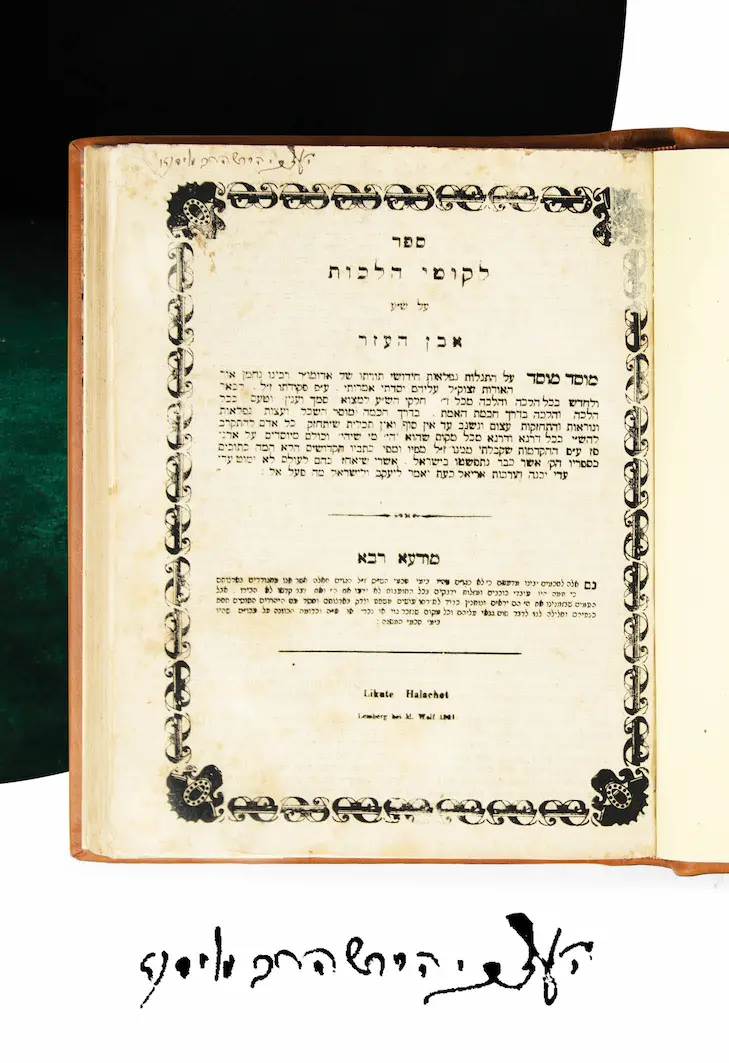
Lot : 39
Likutei Halachos by Rabbi Nosson of Breslov on Even Haezer and Choshen Mishpat. Lemberg, 1861
Autographed by Rabbi Tzvi Hersh of Liska!
Sefer Likutei Halachos by Rabbi Nosson of Breslov contains profound explanations of lessons taught by the Arizal and Rabbi Nachman of Breslov regarding extracting rules of proper conduct and drawing closer to Hashem through the laws of the Shulchan Aruch.
Rabbi Nosson compiled and authored this work at the behest of his spiritual master, Rabbi Nachman of Breslov.
1. Even Haezer: from chapter 1 up until chapter 187. Lemberg, 1861. Page Count: [2], 38, 10 leaves.
2. Choshen Mishpat: Laws of collateral - laws of preserving the soul (Ch. 291-427). Lemberg, 1861. Page Count: [2], 3, 5=23; [39], 3, [32] 18 leaves. 18 leaves of index to Likutei Halachos on Choshen Mishpat and Even Haezer. The present copy states the place and year of printing (most titles pages only state “Amsterdam”, without a year).
The title page boasts the sacred autograph of the holy Admor Rabbi Tzvi Hersh of Liska on the top right corner “Hak[atan] Tzvi Hersh, Rabbi of Liska.”
Rabbi Tzvi Hersh Friedman of Liska (1798-1874) was renowned throughout Hungary as the “Tzaddik Rabbi Hershele Lisker”. One of the illustrious progenitors of Chassidus who was revered for the “Glory of his holiness and purity, ” as the Divrei Chaim of Sanz wrote in his approbation to Ach Pri Tevuah, he gained fame throughout Europe for the miracles and wonders that he performed for countless Jews who flocked to him for blessings.
Born in Ihel and raised in the home of the Yismach Moshe, Rav Hershele Lisker was a genius who was thoroughly versed in both the Revealed and Hidden Torah. Following the passing of the Yismach Moshe, thousands streamed to him for blessing and counsel. His prime disciple was the famous tzaddik and miracle-worker Rabbi Yeshaya’le of Kerestir who served his master faithfully for eleven years and only agreed to open his court after Rabbi Hershele’s passing. Until his last days, Rabbi Yeshaya’le of Kerestir would sign his name as “The Shamash of the holy Rav of Liska”.
Rabbi Tzvi Hersh Friedman’s legacy includes Ach Pri Tevuah and Hayashar V’hatov, his biography and stories and wonders of his life are recorded in Darkei Hayashar V’hatov .
Description: both volumes are bound together in one ornate leather binding. Slight stains and reinforcements (in particular beneath the autograph).
Bibliography: Stefansky, Sifrei Chassidus #278-279.
...............................................
Any inquiries about this lot ?
We are available also on WhatsApp >>>

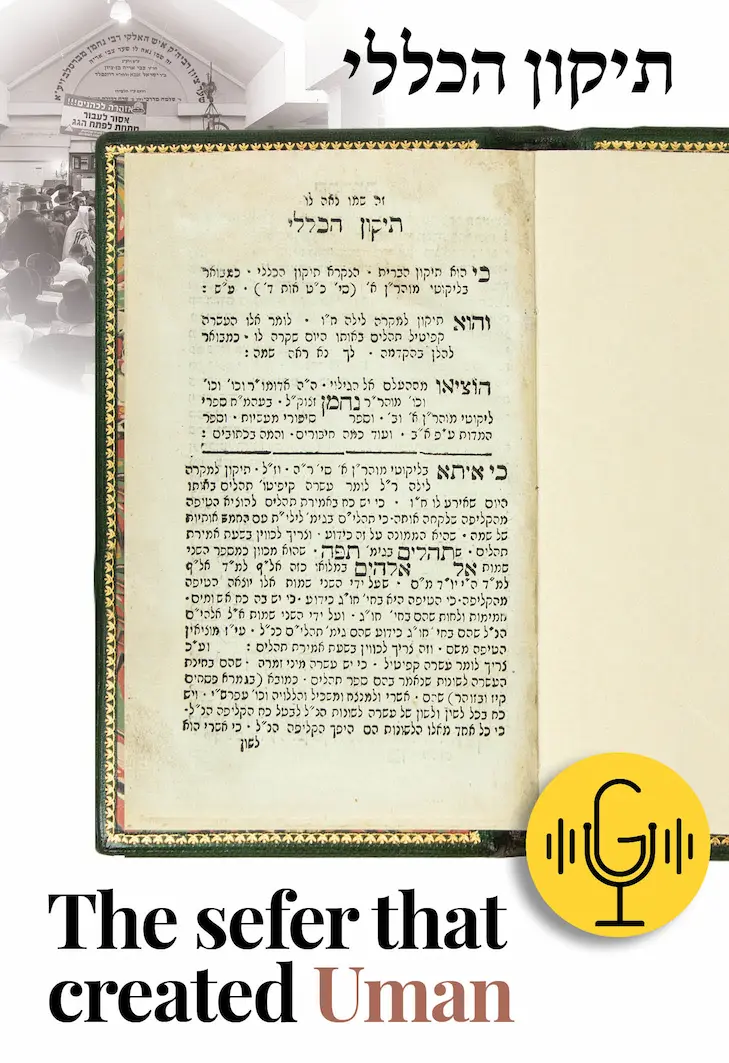
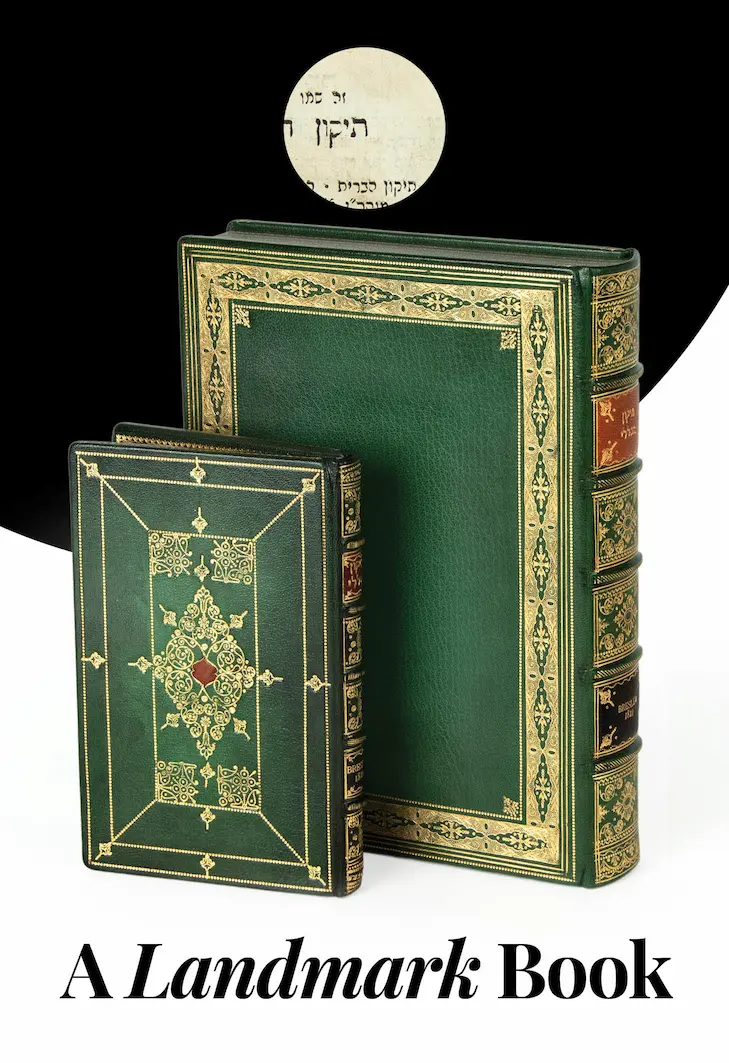
Lot : 40
Rabbi Nachman of Breslov
Tikkun Haklali. First Edition. Breslov, 1821
Printed in the home of Rabbi Nosson of Breslov!
Ten chapters of Tehillim that are effective for tikkun habris, revealed by Rabbi Nachman of Breslov. The present Tikkun Haklali was brought to print for the very first time by Rabbi Shachna of Breslov, in the home of his father Rabbi Nosson of Breslov, and it is an exceedingly valuable and rare sefer!
Rabbi Nachman’s Promise
Prior to his passing, Rabbi Nachman expressed: “Anyone who comes to my tomb and gives a coin to charity and recites these ten kappitelach of Tehillim… I shall endeavor with all my might to affect good for him” (Tikkun Haklali 1b).
Revealing the Ten Mizmorim
In 1805, Rabbi Nachman of Breslov first revealed the wondrous, exalted secret of reciting ten chapters of Tehillim, yet he did not reveal which chapters. Four years later, in 1809, his disciple Rabbi Nosson of Breslev entered his rebbi’s sanctum and glimpsed a handwritten list of ten chapters of Tehillim, yet overcome by awe and fear of his master, he could not recall which chapters had been included in that list. He entreated Rabbi Nachman to reveal the secret to him but Rabbi Nachman refused, only a year later did he reveal them to the public.
Until this very day, multitudes who make the pilgrimage to Rabbi Nachman’s tomb in Uman have kept this awesome segulah revealed by Rabbi Nachman and recite these ten chapters of Tehillim.
Leaves 4-6 open with the prayer “Ashirah la’Hashem b’chayai, " which Rabbi Nosson authored to recite after the Tikkun Haklali. This was also the very first prayer printed from the anthology of Tefillos Moharanat (see Y'mei Moharanat leaf 45).
The sefer was printed without a title page, and the first half of the first leaf functions as a semi-title page. The present sefer is a wondrous, rare find. G. Shalom inscribed in the record of Rabbi Nosson’s works that “It is a very rare treasure, and there is one such sefer at the burial site of Rabbi Nachman in Uman."
Breslov, 1821. First edition. Page Count: 6 leaves. Complete.
Bibliography: Eileh Shmos #146; Neve Tzaddikim p. 67; Ginzei Yisrael #1167, Sifrei Yesod in comments of #386.
............................................ ...
Any inquiries about this lot ?
We are available also on WhatsApp >>>

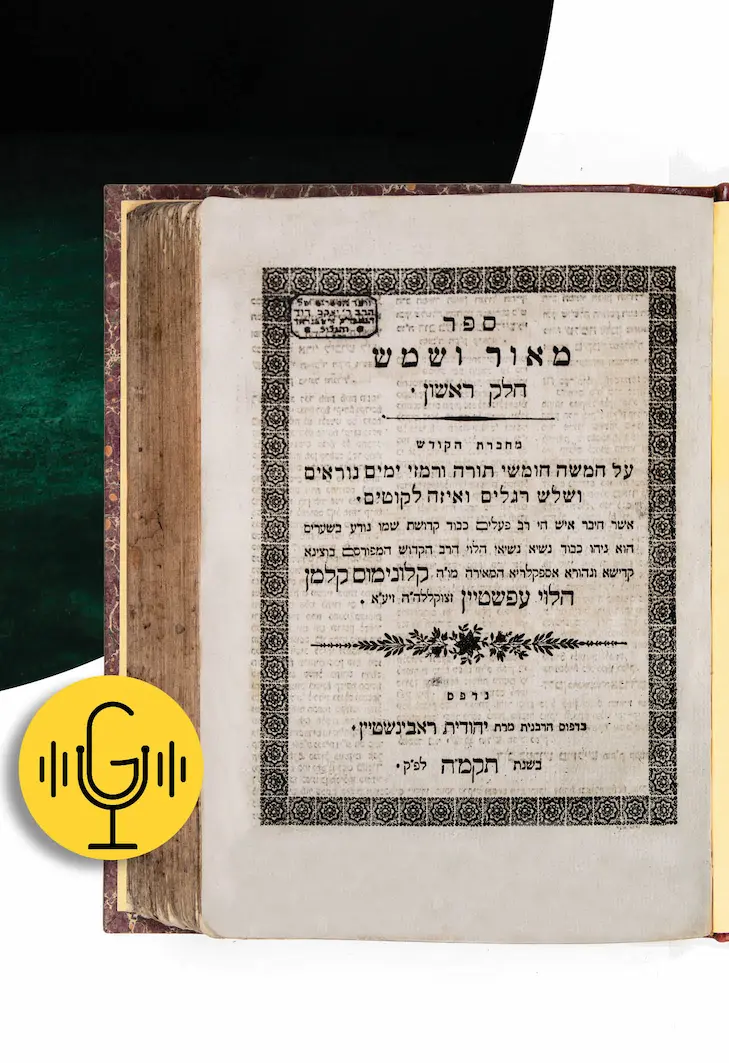
Lot : 41
Fundamental Sefer Chassidus
Distinguished provenance!
Maor Vashemesh. First Edition. Breslau 1842
Personal copy of the Admor Rabbi Nechemia of Bichov, son of the Yid Hakadosh of Peshischa!
Maor Vashemesh al HaTorah by the Admor Rabbi Klonimus Kalman Halevi Epstein, A prime disciple of the Admor Rabbi Elimelech of Lizhensk.
Sefer Maor Vashemesh is one of the fundamental sifrei chassidus, both in terms of its content as well as the sacred teachings, quotes and customs that the author included from his spiritual masters.
In this sefer, the Admor Rabbi Klonimus Kalman describes the principal role that the tzaddik plays in Chassidus and in annulling evil decrees against the nation. He also discusses the importance of traveling to the tzadidk, and the tzaddik’s spiritual force and ability to impact the chassidim who come to be in his presence both spiritually and materially.
The Admor Rabbi Klonimus Kalman Halevi Epstein of Cracow (d. 1823) was one of the prime disciples of Rabbi Elimelech of Lizhensk . Following the passing of Rabbi Elimelech, Rabbi Klonimus Kalman began traveling regularly to Lublin to the holy Chozeh of Lublin. Founding a Chassidic beis medrash in the city of Cracow during the Chozeh’s lifetime, he became one of the primary disseminators of Chassidus in Poland, despite being persecuted for his beliefs and teachings.
sacred provenance copy
This sacred copy of Maor Vashemesh bears a distinguished provenance, having belonged to the Admor Rabbi Nechemia of Bichov, as evident from inscriptions on both the first and last pages of the sefer. The sefer also contains lists of kvittelach inscribed by chassidim.
“The ‘Yid’ was a Yid who left another Yid after him, ” expressed the Apta Rav, author of Ohev Yisrael, upon the Admor Rabbi Nechemia Yechiel Rabinowitz of Bichov, son of the Yid Hakadosh of Peshischa.
The Admor Rabbi Nechemia Yechiel Rabinowitz of Bichov (1808-1853) was a tzaddik and miracle worker who was renowned for his holy, pious ways. Tat brought salvation to countless Jews in need. In his early youth, he drew close to the Admor of Ruzhin who manifested deep love for his young disciple. At the age of only twenty, Rabbi Nechemia was instructed by the Ruzhiner to settle in Bichov, a town in the Lublin district and open a Chassidic court.
His emotional, fervent prayers were legendary; and he distributed tzedakah open handedly to anyone in need. He passed away at a young age on the very same day as his father, 19 Tishrei. His holy conduct, the miracles he engendered, along with his teachings and legacy were eternalized in the sefer Maase Nechemia (Frampol, 1913).
Breslau, 1842. First edition. Page Count: [2], 144 leaves. [1], 145-190, 192-277, [2] leaves. Description: The title page in the present sefer has a forged date to mislead the censors. The title page purports to have been printed in the Rubinstein Jewish Press (Lvov, 1788), and it is known that there are a number of variants of title pages for this book. Bibliography: Stefansky, Sifrei Chassidus #307, Yesod #392.
The title page also bears the stamp of the Admor Rabbi Yaakov Dovid Biderman, Av Beis Din of Visegrád, Hungary (1806-1863), author of Hagahos Maharid. Rabbi Yaakov Dovid was one of the famous chassidim of Kotzk and Peshischa and an ancestor of the Pnei Menachem of Gur. Other leaves in the sefer feature the autograph of his son and successor Rabbi Yechezkel Biderman, Av Beis Din of Visegrád and the autograph of the Admor Rabbi Moshe Rokach of Kozlov (1896-1971) of the Belzer dynasty. (For further information, see Encyclopedia L’Chassidus Vol. 2 p. 317).
............................................... .
Any inquiries about this lot ?
We are available also on WhatsApp >>>

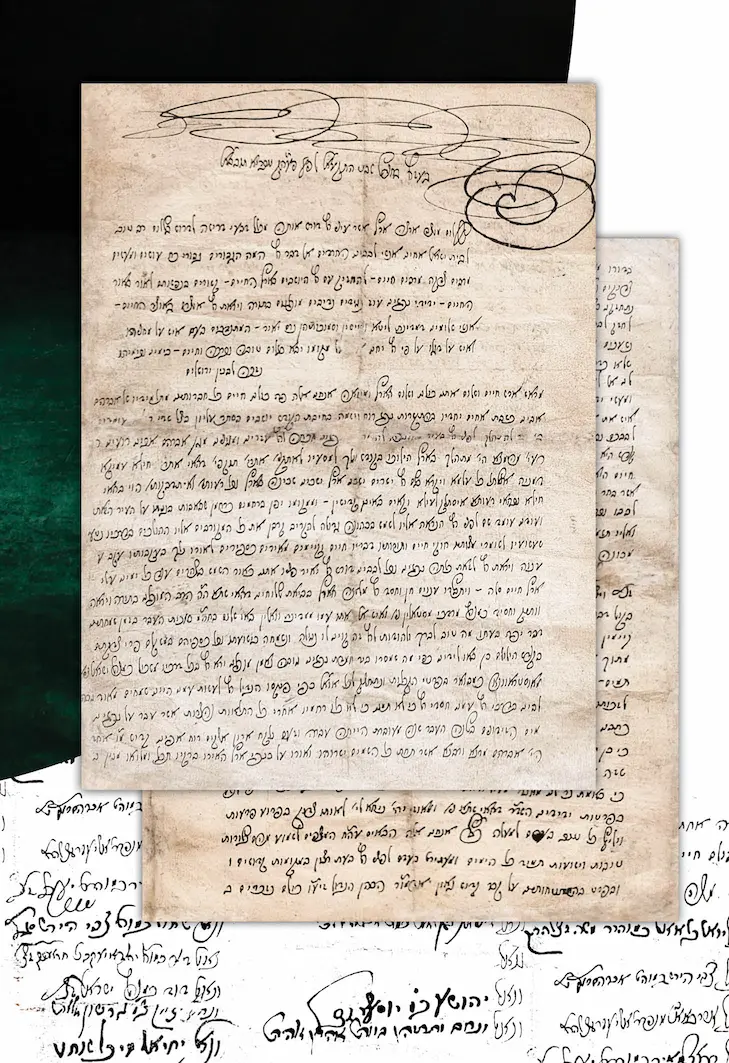
Lot : 42
Letter by the Leaders of the Chevraya Kadishta in Teveria
to Chassidim in Lithuania and Reisin
following the passing of the Admor Rabbi Avraham of Kalisk
Teveria, 1811
Historic letter by the saintly spiritual leaders of the chaburah of chassidim who journeyed to Eretz Yisrael at the behest of the Maggid and settled in the city of Teveria.
The members of this exalted chaburah, renowned as the Chevraya Kadishta, were all illustrious tzaddikim and chassidim, close talmidim of the Admorim Rabbi Menachem Mendel of Vitebsk and Rabbi Avraham Hakohein of Kalisk. Some were known to possess ruach hakodesh.
The present letter is written entirely by Rabbi Shaul Harker, one of the leaders of the Chevraya Kadishta (see below). It is dated Shvat 1811, precisely one year to the passing of the Admor Rabbi Avraham of Kalisk (d. Shvat, 1810). In this letter, the members of the Chevraya dispatch an urgent appeal to their fellow chassidim in Lithuania and Reisin with their request to continue sending their support to the poverty-stricken residents of the Yishuv of Eretz Yisrael as they did during Rabbi Avraham of Kalisk’s lifetime.
The letter was dispatched by messenger, and heeding the request of the Chevraya Kadishta, the chassid Rabbi Yitzchak ben Rabbi Shlomo Zalman Katz set out upon the harrowing journey from Teveria to Volhynia to raise funds for the Yishuv.
Aliyah of Chassidim to Teveria under the direction of the Admor Rabbi Menachem Mendel of Vitebsk
In 1777, Rabbi Menachem Mendel of Vitebsk, a talmid of the Maggid of Mezritch, led a large group of Jewish settlers to Eretz Yisrael and settled in the holy city of Tzfas. Four years later, in 1781, he relocated to Teveria where he stood at the forefront of the Chassidic community until his passing in 1788. The Admor Rabbi Avraham Hakohein of Kalisk, also a talmid of the Maggid, then assumed spiritual leadership of the congregation until his own passing in 1810.
The lives of the pioneer settlers were fraught with difficulties and challenges. They suffered daily hunger , poverty and illness, and were frequently forced to pay astronomical sums of money to their Turkish oppressors.
To enable the survival and perpetuation of the Yishuv, the Admorim Rabbi Menachem Mendel of Vitebsk and his colleague Rabbi Avraham Hakohein of Kalisk instituted the concept of Maamados, which charged their fellow chassidim who had remained behind in Lithuania and Reisin to send steady support to the fledgling community in Teveria.
In the present letter, the leaders of the Chassidic community in Teveria appeal to their friends and colleagues, leaders of Chassidic communities in Lithuania and Reisin, to continue sending the life-saving funds, just as they did during the lifetime of their spiritual leader the Admor of Kalisk.
The following is an excerpt from the text of the letter: “…The Ark of Hashem, our living spirit, our holy master and teacher, the one and only, Avraham… Avraham is worthy to safeguard the entire world with his merits… And regarding the Maamad of the Admor zy”a [Rabbi Avraham of Kalisk], it should be consistent and steady just as it was during his lifetime, for the following emerged from his holy mouth prior to his passing, asking this of you that it should be for the purpose of repaying our debts. This was truly his life’s spirit, and surely a tzaddik rules and says, and each one shall fulfill our requests… Truly, it pains us deeply that the yoke of debt is heavy upon us, and our lives are not lives due to the oppressors… And it will be very pleasant to the tzaddik… and he shall advocate for you in the heavens… praying for you before Hashem at this time of desire in the sacred places, and especially when we pray at the tomb of our holy gaon Admor Hakohein Hagadol zy”a…”
This letter is signed by the holy leaders of the Chevraya Kadishta, each one of whom was a great Torah luminary, a tzaddik, and genius in the Revealed and Hidden Torah and in Chassidus:
Right Column:
Rabbi Moshe Halevi: (d. 1813) The eldest of the Chevraya Kadishta and greatest among them, Rabbi Moshe Halevi was one of the talmidim of Rabbi Menachem Mendel of Vitebsk, and his autograph appears in many letters written to his fellow chassidim following the passing of Rabbi Avraham Hakohein of Kalisk.
Rabbi Yoel ben Rabbi Moshe of Samlein was one of the prime disciples of Rabbi Avraham Hakohein of Kalisk. After Rav Avraham’s passing, his fellow members wanted to appoint him as leader of the Chevraya. In 1789, he set out as a Rabbinical emissary to Europe, and the Baal Hatanya provided him with a warm recommendation letter which described him as “a genuine servant of Hashem with a pure soul, clean and righteous”.
Rabbi Tzvi Hersh ben Rabbi Avraham Segal [Harker] was one of the great disciples of Rabbi Menachem Mendel of Vitebsk. Great Chassidic masters extolled Rabbi Tzvi Hersh’s noble character and attested that he possessed ruach hakodesh. Following the passing of Rabbi Avraham Hakohein of Kalisk, the Admor Rabbi Baruch of Mezhibuz assigned him to lead the congregation of chassidim from Reisin in Teveria, alongside Rabbi Meir Bichover.
Rabbi Asher ben Rabbi Eliezer [Ashkenazy] (d. 1819) was a Rabbinical emissary of the Kollel in Teveria. In 1791, Rabbi Asher set out to raise money for both Sephardic and Ashkenazic kollels together with the Chida’s son Rabbi Avraham Azzoulay. He was laid to rest in the Jewish cemetery in Teveria.
Rabbi Refael Meir ben Rabbi Yaakov: Renowned as the Admor Rabbi Meir Bichover, he was a close disciple of Rabbi Menachem Mendel of Vitebsk, a close and beloved relative of the Admor Rabbi Elimelech of Lizhensk and one of the leaders of the Chevraya Kadishta in Teveria. When he set out as a Rabbinical emissary from Eretz Yisrael to raise money for the poverty-stricken Yishuv, he visited many of the great Chassidic masters in Europe, among them the Degel Machaneh Efraim, Rabbi Baruch of Mezhibuz, Baal Hatanya and many others. Following the passing of Rabbi Avraham Hakohein of Kalisk, Rabbi Baruch of Mezhibuz appointed him alongside Rabbi Tzvi Hersh Harker to lead the congregation of chassidim from Reisin in Teveria.
Rabbi Shaul ben Rabbi Tzvi Hersh Segal, more commonly known as Rabbi Shaul Harker, was one of the leaders of the Chevraya Kadishta and a great kabbalist. As a child, he was privileged to see Rabbi Menachem Mendel of Vitebsk, and as he matured, he gained renown for his unparalleled humility. He traveled several times throughout his life as a Rabbinical emissary to benefit the Yishuv in Teveria, always visiting the great Chassidic masters of Europe during his journeys, among them the Admor Rabbi Mordechai of Lechovitz, Rabbi Baruch of Mezhibuz and the Admor of Ruzhin who welcomed him with great love and warmth. The present letter was written by Rabbi Shaul Harker.
Rabbi Dovid ben Rabbi Yehuda Yaakov (d.1837) was known as the Admor Rabbi Dovid Hakatan of Bichov. As a talmid of both Rabbi Menachem Mendel of Vitebsk and Rabbi Avraham of Kalisk, he was appointed as one of the spiritual leaders of the Chassidic congregation in the Old Yishuv. His signature appears on an open letter written to the Ten Tribes together with the Bas Ayin. He perished in the tragic earthquake that decimated the Galilee in 1837.
Left Column:
Rabbi Dovid ben Yisrael [Ashkenazy] was known as Rabbi Dovid Hagadol. As one of the most illustrious of the Chevraya Kadishta during the period of Rabbi Avraham of Kalisk, the latter sent him to meet with the Chida to discuss the greatness of the talmidim of the Baal Shem Tov and Ohr Hachaim Hakadosh.
Rabbi Yitzchak ben Rabbi Gershon: His signature appears on several letters sent by the Chevraya Kadishta of Teveria.
Rabbi Yechiel Michel Shochet: One of the veteran members of the Chevraya Kadishta, Rabbi Yechiel Michel was an exalted and pious tzaddik whose shechitah was trusted implicitly by Rabbi Menachem Mendel of Vitebsk and Rabbi Avraham of Kalisk. In a letter abroad dated Nissan 1781, Rabbi Menachem Mendel lists Rabbi Yechiel Michel’s appointment as official shochet as one of the attributes that glorified and elevated Eretz Yisrael from the time of the settlers’ arrival. He expresses: “My friends shall be informed of the elevation of the Holy Land which was elevated in several things, with one of them being that Moreinu Harav Michel Shochet, from my men, was appointed shochet in this holy city of Teveria.”
Rabbi Yisrael ben Rabbi Yosef: His name and signature appears on several letters dispatched by the member of the Chevraya Kadishta in Teveria.
Rabbi Daniel ben Rabbi Avraham [of Politshuk] was one of the illustrious chassidim in Teveria. Both Rabbi Menachem Mendel of Vitebsk and Rabbi Avraham of Kalisk mention him in their letters with great honor and esteem.
Rabbi Yehoshua ben Rabbi Yosef: His name and signature appears on several letters dispatched by the member of the Chevraya Kadishta in Teveria.
Rabbi Menachem Mattisyahu ben Aharon: His name and signature appears on several letters dispatched by the member of the Chevraya Kadishta in Teveria.
For further information about the tzaddikim whose autographs appear on this letter, see Yesud Hamaalah Vol. 1 Ch. “Ha’arayos Shebachaburah”.
Teveria, Shvat, 1811. Folded leaf written on 3 sides. Page Size: 23xq7 cm. Condition: Several words missing on centerfold and miniscule holes in margins, all fully restored. Provenance: Collection of the Weinberg family (Slonim)
The text of this letter was reprinted based on the present letter in Yesud Hamaalah Vol. 2 Letter 104. The above records that that the scribe was Rabbi Shaul Harker, whose signature appears sixth on this letter.
................................................< /p>
Any inquiries about this lot ?
We are available also on WhatsApp >>>

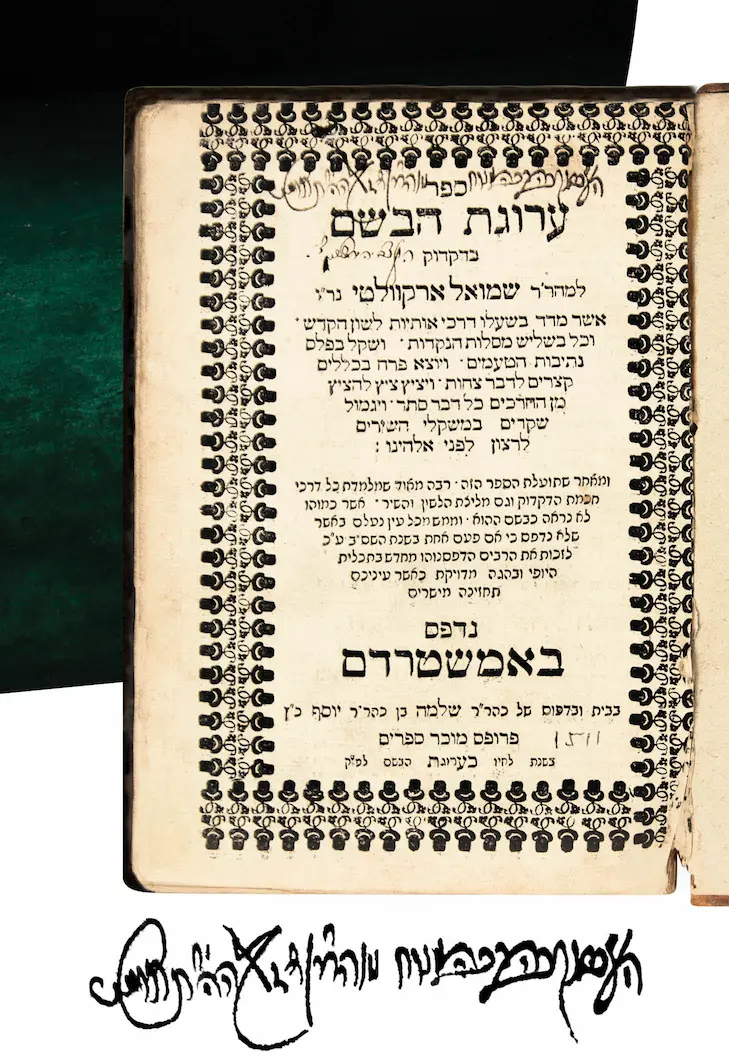
Lot : 43
The Baruch Ta’am’s Personal Autographed Copy of Sefer Arugas Habosem. Amsterdam, 1730
Rabbi Baruch Frankel-Thumim’s personal copy of sefer Arugas Habosem with his sacred autograph. The title page of the sefer features the owner’s signature: “Hakatan Baruch b[en] Harav Hamanoach Maharif zt”l Thumim.”
The Arugas Habosem is an important sefer, authored by the early 17th century Italian scholar Rabbi Shmuel Archivolti, and fundamental to the study of Hebrew grammar.
Rabbi Baruch Frenkel-Thumim (1760-1828), author of the Baruch Ta’am and Ateres Chachamim, numbered among the great geniuses and tzaddikim in the era of the Achronim. It was said that his brilliance and piety were unmatched in his generation.
Rabbi Baruch Frenkel-Thumum was born in Ostrovtza in Poland to Rabbi Yehoshua Yechezkel Feivel Thumim and his wife. At a remarkably young age, he was invited to serve as Av Beis Din of Vizhnitz in West Galicia, and thereafter as Av Beis Din Leipnik, Moravia, where countless aspiring scholars flocked to his yeshivah to learn from his holy teachings and ways.
The Baruch Ta’am was universally revered by all his contemporaries. The Chasam Sofer expressed in his tearful eulogy: “A genius in Yisrael, his reasoning and teachings are blessed; he disseminated Torah to Yisrael with sharpness and scope, and the depth of his teachings and precision were so intense that even his talmidim lack in fully comprehending it” (Drashos Chasam Sofer p. 326).
In the Chassam Sofer’s endorsement to the sefer Baruch Ta’am, printed after his passing, he writes, “Does this need my endorsement... Do I not know his strength and glory and majesty, and behold all his words shine with the radiance of the heavens?”
Rabbi Chaim of Sanz, author of Divrei Chaim, was both the Baruch Ta’am’s prime disciple and his son-in-law. Rabbi Chaim learned the majority of Shas together with the Baruch Ta’am in depth. In Teshuvos Divrei Chaim, he cites many halachic rulings and methods in halachah that he acquired from his illustrious father-in-law, the Baruch Ta’am, and it was also he who prepared his father-in-law’s sefer for print (see preface).
Amsterdam, 1730. Second edition. Page Count: [1], 108 leaves. Page size: 19 cm. Slightly worn.
................................................
Any inquiries about this lot ?
We are available also on WhatsApp >>>

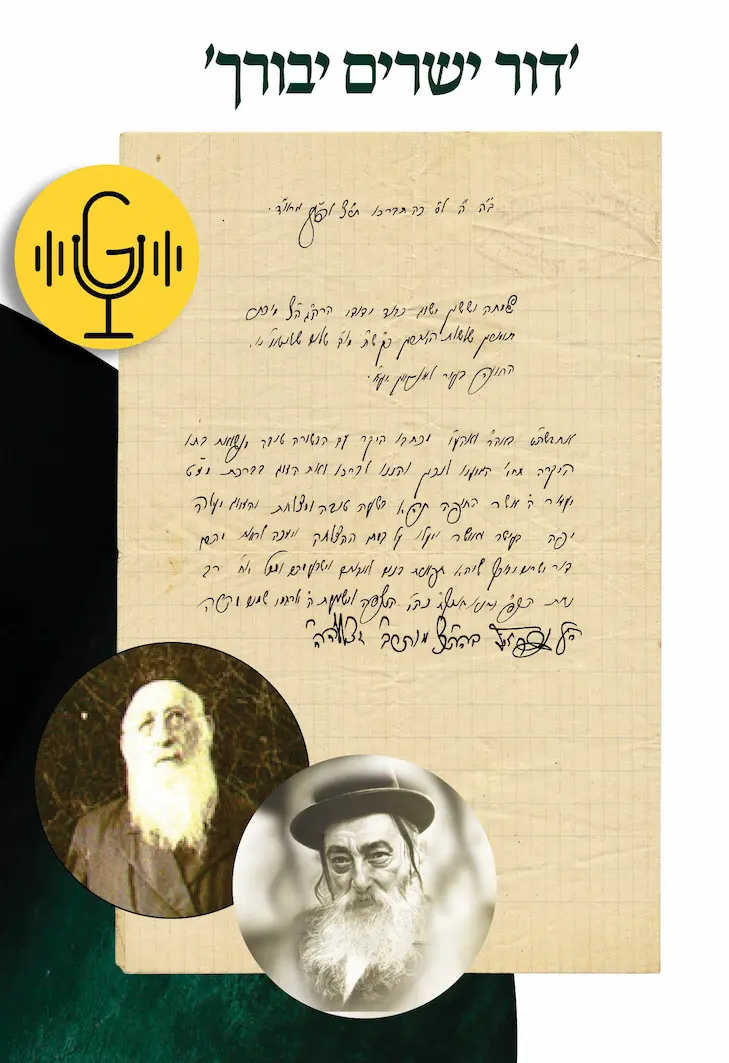
Lot : 44
Dor yesharim yevorach!
Letter by the Ahavas Yisrael of Vizhnitz to the Admor Rabbi Shalom of Shatz. Grosswardein, 1930
Autographed letter by the Admor Rabbi Yisrael Hager of Vizhnitz, author of Ahavas Yisrael, to the Admor Rabbi Shalom Moskowitz of Shatz-London. At the end of the letter, he signs his name “Hakatan Yisrael ben Harav Hatzaddik Moreinu Harav Baruch zy”a.”
Letter of blessing and congratulations in honor of the marriage of the daughter of the Admor Rabbi Shalom of Shatz’s. “I wish to bless you and the couple with a blessing of mazal tov. May Hashem grant that the chuppah shall take place at a good and successful hour, and the union should be beautiful, with wealth and happiness and success, and you shall merit seeing from them blessed righteous generations that will be a glory for their fathers, and he should reap from them and from all their descendants much nachas.”
The Ahavas Yisrael, the Admor Rabbi Yisrael Hager of Vizhnitz (1860-1936) was the son of the Admor Rabbi Baruch of Vizhnitz, author of Mekor Baruch. Rabbi Yisrael was raised in the court of his exalted grandfather, the Admor Rabbi Menachem Mendel of Vizhnitz, author of Tzemach Tzaddik. In 1875, he moved into the home of his father-in-law, the Admor Rabbi Meir Horowitz of Dzhikov, but in 1878, returned to Vizhnitz where he became his grandfather’s right hand.
The addressee, the Admor Rabbi Shalom Shatz (1875-1958) was renowned as a holy and pious Jew to whom many flocked for blessing, counsel and salvation. At the age of 25, he was appointed Rav of Shatz, and his disciples included Rabbi Meir Shapiro of Lublin, founder and Rosh Yeshivah of Yeshivas Chachmei Lublin. Until this day, thousands pilgrimage to his tomb in London to pray for salvation. In 1827, he deferred to the request of his chassidim in London and settled there until the end of his days.
Grosswardein, 1930. Page Size: 23x15 cm. Description: The Ahavas Yisrael’s stamp appears on the upper right corner of the letter.
................................................
Any inquiries about this lot ?
We are available also on WhatsApp >>>

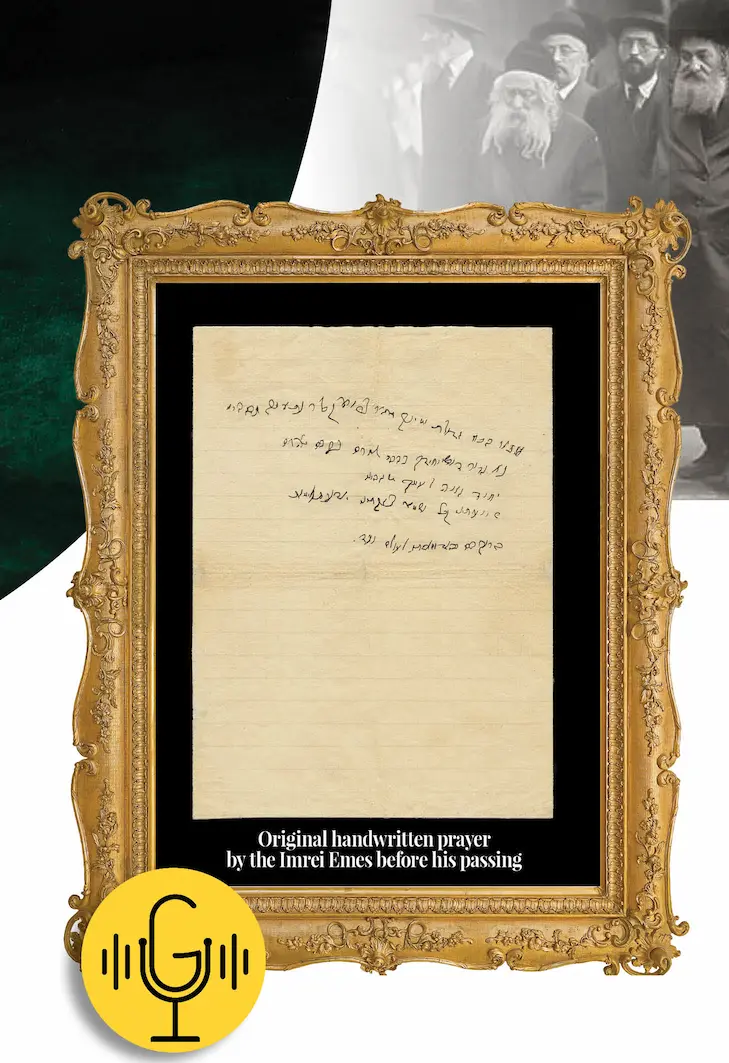
Lot : 45
Segulah and Shemirah!
Ana B’Koach Handwritten by the Admor Imei Emes of Gur
Four lines from the Ana B’Koach, handwritten by the Admor Rabbi Avraham Mordechai Alter of Gur, author of Imrei Emes. At the end, he inscribes the words “Baruch Shem kevod malchuso l’olam va’ed.”
Shortly before his passing in 1948, the Imrei Emes was visited in his home by his private doctor who asked him to write several lines in order to gauge his medical condition. The Imrei Emes chose these lines from the exalted tefillah “Ana B'Koach.”
With his body weak and frail, and with his heart shattered by Klal Yisrael’s suffering, the Imrei Emes lifted his pen and inscribed the following words with a trembling hand:
Tatir tzrurah
Kabel rinas amcha
K’vavas shamrem
Barchem taharem
Shavaseinu kabel u’shma tzaakaseinu
Who can fathom the exalted thoughts and intentions of the Imrei Emes as he inscribed these words?
Ana B’Koach
The short prayer “Ana B'Koach” is an ancient prayer attributed to the Tanna Rabbi Nechunia ben Hakaneh (Shu”t HaRashba Vol. 1 CH. 220), and many exalted segulos are associated with it. The tefillah is based on the 42-letter Holy Name that is the acronym of its words. Due to the sanctity of the Name, it is customary to conclude the recitation of this prayer with the words “Baruch Shem kevod malchuso l’olam va’ed”.
The Imrei Emes, the Admor Rabbi Avraham Mordechai Alter of Gur (1866-1948) was the son of the Sfas Emes. He succeeded his father as Admor of Gur in 1905, filling this position for 43 years. The Imrei Emes was one of the leaders of Torah Jewry during the catastrophic era of both World Wars, and his legacy left an indelible impact upon Torah society forevermore.
Miraculously escaping the burning soil of Poland, the Imrei Emes arrived in Eretz Yisrael in 1940, sickly and weakened from the trials and tribulations endured by his nation. As horrific news of atrocities and death continued filtering in from Poland, the Imrei Emes grew steadily weaker until he returned his soul to his Creator.
1948. Page Count: [1] leaf. Page Size: 17x 12 cm. 5 lines; 33 words, handwritten by the Imrei Emes of Gur. Condition: Good. Affidavit of authentication attached.
............................................... .
Any inquiries about this lot ?
We are available also on WhatsApp >>>

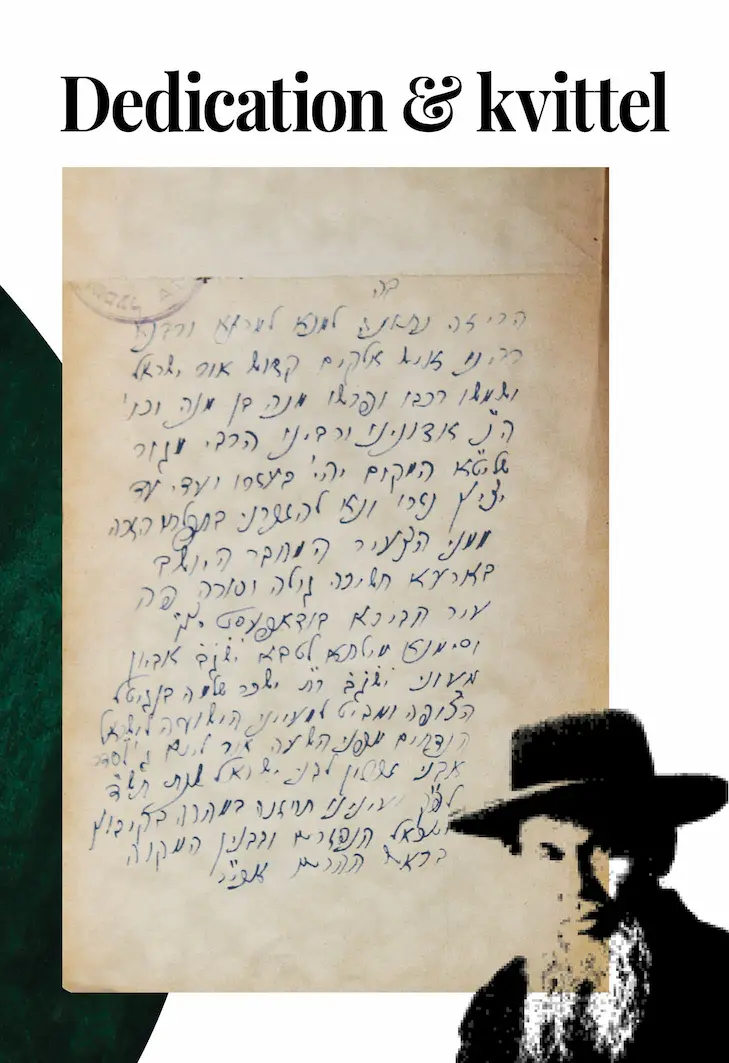
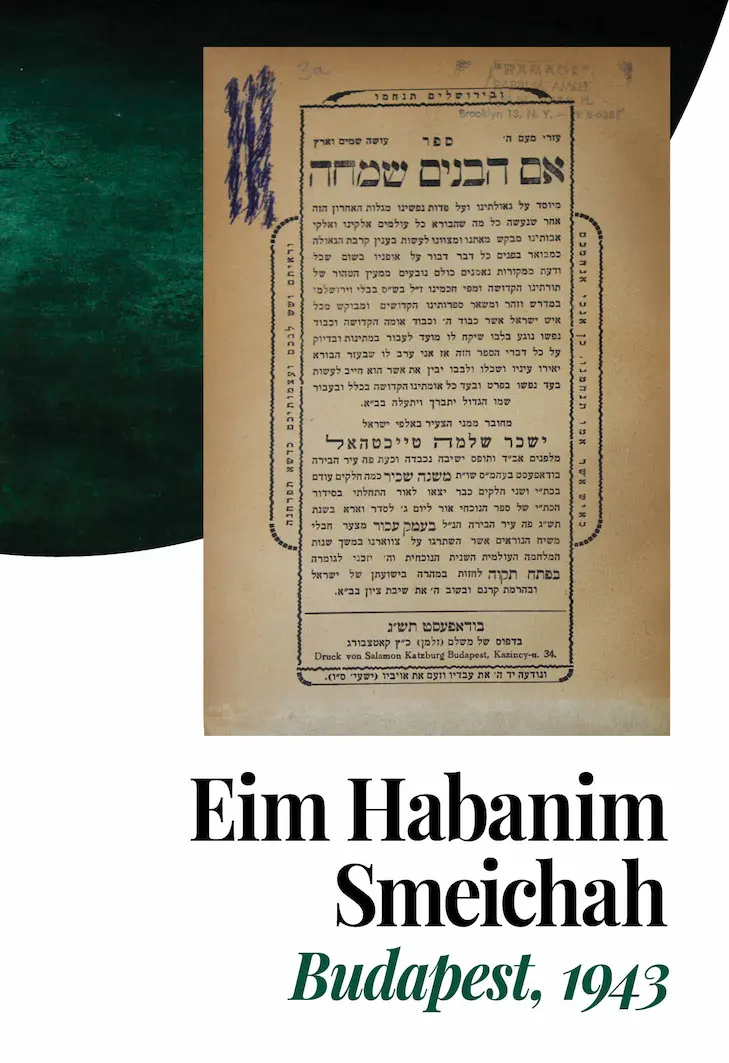
Lot : 46
“Please mention me in your pure prayers… Yissachar Shlomo ben Gittel… From me, the young author who sits here in the dark land, in the capital city of Budapest”
Autographed Copy of Eim Habanim Semeichah by Rabbi Yissachar Shlomo Teichtal Hy”d. First Edition. Budapest, 1944
with handwritten dedication and kvittel to the Admor Imrei Emes of Gur dated 19 Adar, 5704 (1944).
Essays on the praises of Eretz Yisrael and dwelling in it, as well as essays on the practical need to settle Eretz Yisrael at the time, written in Budapest at the during the Holocaust years by Rabbi Yissachar Shlomo Teichtal, Av Beis Din of Pishtian.
The flyleaf bears a lengthy full-page handwritten and autographed dedication by the author “To the master and Rabbi, Our Master, Man of G-d, Holy Light of Israel…the Rebbe of Gur shlit”a [Imrei Emes]” along with a heartfelt request to the Admor to mention his name, Yissachar Shlomo ben Gittel, in his pure prayers.
Rabbi Teichtal concludes with a brokenhearted prayer of his own, “from me who waits and hopes for the springs of salvation for Yisrael who are rejected in this time…and may our eyes see the gathering of Yisrael speedily.”
This chilling dedication was inscribed on 19 Adar, 5704 (March 14, 1944), only five days before the Nazi invasion of Hungary and ensuing massacre of Hungarian Jewry.
Eim Habanim Semeichah
Rabbi Yissachar Shlomo Teichtal was regarded as the leader of Hungarian Rabbanim and fierce opponent of any movement or party that espoused or supported Zionism. His opinions mirrored those of the Minchas Elazar of Munkacs, until the Holocaust years when word of the atrocities and indiscriminate murder of Jews throughout Europe instigated a stark change in his beliefs, and he began advocating for mass Jewish emigration to Eretz Yisrael. His changed sentiments are expressed in the present sefer Eim Habanim Semeichah, which he authored while hiding out in an attic for two years in an attempt to flee the claws of the Nazis. Amazingly, this sefer replete with talmudic sources was written almost entirely by memory, since the author had virtually no access to any sefarim during this period.
In this sefer (see p. 238), Rabbi Teichtal laments the fact that European Jewry did not emigrate to Eretz Yisrael which would have spared the bloodshed and carnage (p. 16). He further calls for the mass emigration of Jews of all congregations, streams and factions to Eretz Yisrael which he presents as a key factor for the dawn of the final redemption.
The sefer Eim Habanim Smeichah was written with the author’s lifeblood, first in a hideaway in Slovakia and later while fleeing the Nazi in Budapest. In his writings, he mentions the “killings and murders and all forms of brutalities, from infant and child…” and the destruction of Polish and Slovakian Jewry (p. 80). He then expresses his belief that the root of all these tragic decrees was Bnei Yisrael’s choice to remain in exile among the gentiles instead of returning to their Land.
A colophon states that the printing of the sefer concluded on Thursday, Parshas Mikeitz, Chanukah 5704 (December 23, 1943).
Rabbi Yissachar Shlomo Teichtal Hy”d (1885-1945), Av Beis Din and Rosh Yeshivah of Pishtian in west Slovakia, was one of the illustrious Rabbanim in Hungary and Slovakia in the pre-Holocaust era. He corresponded frequently with his contemporaries and authored Shu”t Mishnah Sachir.
During the early years of World War Two, he delved into the subjects of exile, redemption and settling in Eretz Yisrael and published his thoughts and opinions in his famous sefer Eim Habanim Smeichah. With the Nazi conquest of Slovakia, he fled to Hungary, where he spent two years in hiding in Budapest. When false rumors were spread that the deportation of Jews from Slovakia had ceased, he returned to his hometown only to be captured and sent to Auschwitz where he was killed al kiddush Hashem in 10 Shvat, 5705 (Fbruary 24, 1945).
Budapest, 1943. First edition. [11], 2-360 leaves.
................................................
Any inquiries about this lot ?
We are available also on WhatsApp >>>

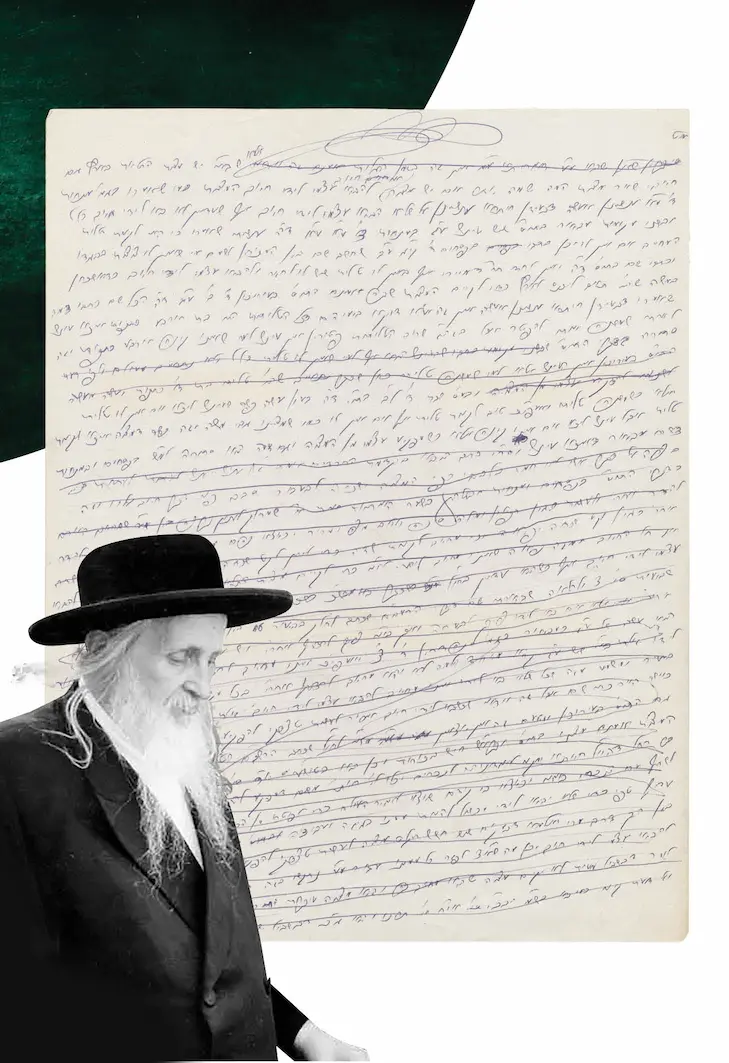
Lot : 47
Handwritten by the Satmar Rav
Handwritten Page from the Admor Rabbi Yoel of Satmar from the Essay on Yishuv Eretz Yisrael
This is a sacred leaf from the Admor Rabbi Yoel Teitelbaum of Satmar’s landmark essay “Yishuv Eretz Yisrael” which was printed in his magnum opus Vayoel Moshe.
This leaf presents the Admor Harav Yoel Teitelbaum of Satmar’s handwritten discussion regarding the relevance of dwelling in Eretz Yisrael in this day and age.
The holy Admor Harav Yoel of Satmar (1887-1979), author of Divrei Yoel and Vayoel Moshe, waged a mighty battle against the Zionist movement, vigorously protesting against those who journeyed to Eretz Yisrael in order to join the battle to conquer the Jewish homeland. His sefer Vayoel Moshe encompasses a long essay clarifying his beliefs regarding the mitzvah of setting in Eretz Yisrael during this era.
Handwritten manuscript. Page Size: 28x21 cm. The contents of his manuscript appear in his sefer Vayoel Moshe “Yishuv Eretz Yisrael”. The majority of text has a thin eraser line running through it, although it is still perfectly legible. Condition: Good.
............................................... .
Any inquiries about this lot ?
We are available also on WhatsApp >>>

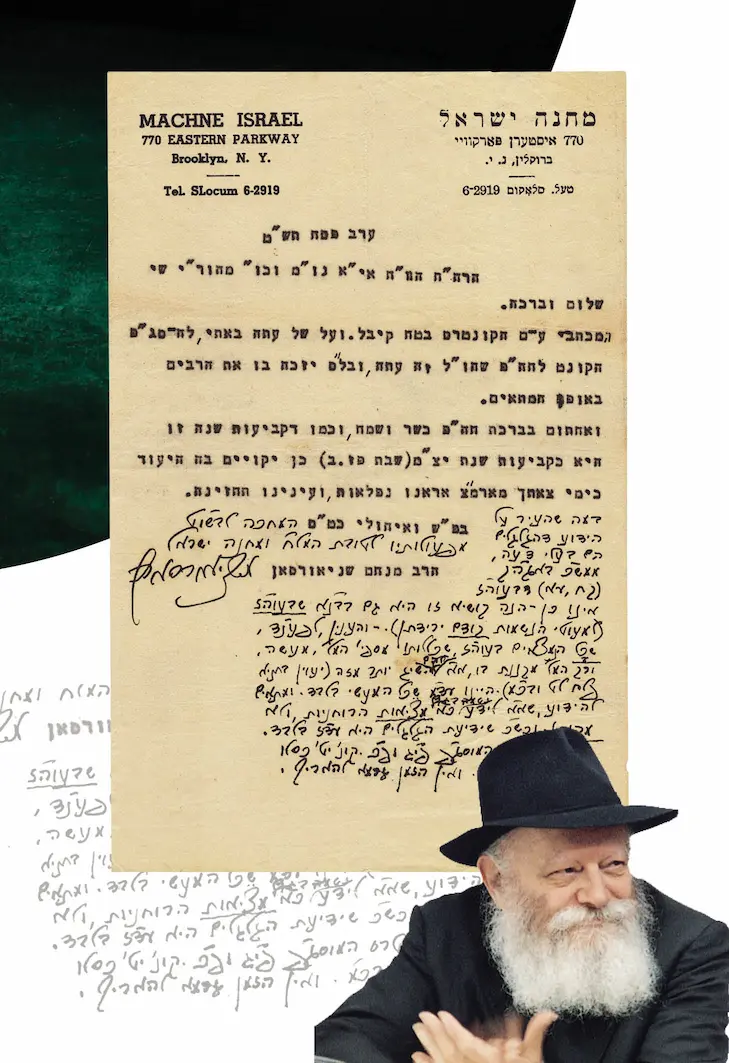
Lot : 48
The Lubavitcher Rebbe explains the teachings of the Alter Rebbe
Letter by the Admor Rabbi Menachem Mendel Schneerson of Lubavitch with Lengthy Glosses added in his handwriting. Brooklyn, 1949
Autographed letter of blessings by the Lubavitcher Rebbe Rabbi Menachem Mendel Schneerson with a lengthy addition on esoteric concepts in kabbalah to explain the teachings of the Alter Rebbe added in his handwriting.
The Admor Rabbi Menachem Mendel Schneerson (1902-1994) was the seventh Admor of the Chabad-Lubavitch dynasty and one of the foremost Chassidic leaders in the last generation. The Torah empire he built extends to points all around the globe, where his emissaries actively engage in outreach until this very day, promoting mitzvah observance among the unaffiliated in order to hasten the coming of Mashiach.
Brooklyn, NY. Erev Pesach, 1949. Page Size: 21x14 cm. Description: Written on Machaneh Yisrael stationery. Machaneh Yisrael was founded by the Admor Rayatz in 1941, and he appointed his son-in-law the future Lubavitcher Rebbe to manage its activities.
Condition: Good. Bibliography: Printed in Iggros Kodesh Vol. 3, Letter 477; part of the addition was printed beforehand in Likutei Sichos.
............................................... .
Any inquiries about this lot ?
We are available also on WhatsApp >>>

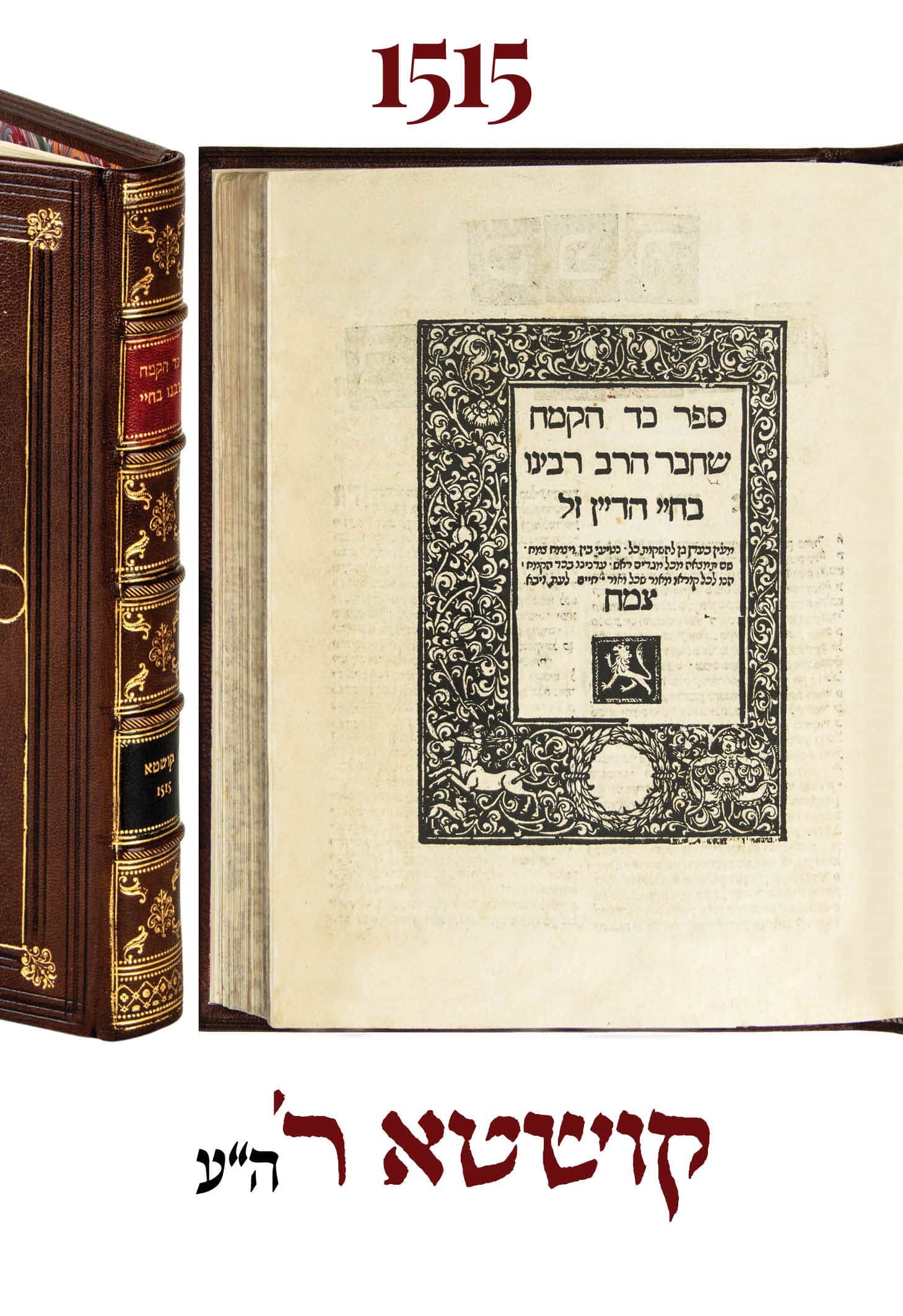
Lot : 49
Kad Hakemach by Rabbeinu Bachya. First Edition. Constantinople, 1515
Rare Sefer from the Constantinople Press!
Fundamental
The basics of Jewish faith and the mitzvot, and moral conduct, organized into alphabetically ordered categories by the famous Torah commentator Rabbeinu Bachya.
This sefer also includes commentaries on Megillas Esther (entry Purim), Sefer Iyov (entry Hashgachah) and Sefer Yonah (entry Kippurim).
Rabbeinu Bachya ben Rabbi Asher (circa 1255-1340) was one of greatest commentators of all times, as well as one of the earliest known kabbalists. Rabbeinu Bachya, who dwelled in Saragossa, Spain in the thirteenth and fourteenth centuries, was the prime disciple of the Rashba, and acquired his path in kabbalah from the Ramban. His sefarim frequently cite kabbalists and midrashim of Chazal which are today unknown.
The Hebrew press in Constantinople was founded by refugees of the Spanish Expulsion or Jews who fled other Christian-ruled countries. In its early years (1504-1530), the Constantinople printing house published many foundational classic Jewish works, which over the years became very rare and are highly sought-after sefarim, by collectors
Colophon: “This sefer was completed, today, on the first of the month of Iyar, 5275, and printed in the great metropolis of Constantinople which is under the rule of our master His Royal Highness and king Sultan Salim, may his kingdom be exalted in his days, and may Yehuda be redeemed in our days, and may Yisrael dwell in security, and may the Redeemer come to Zion, may it be His will. Amen.”
Constantinople, 1515. First edition. Page Count: 87 [1] leaves. Page Size: 28.5 cm. Condition: Good. Minor restoration to title page; top margins cropped and title cropped on some pages.
Ornate new leather binding. The printer’s emblem of R’ Yehuda ben Shushan, which features an illustration of a lion standing on its hind legs, appears on both the title page and after the colophon on the last page of the book.
Bibliography: Stefansky Sifrei Yesod #496, Yaari, Constantinople #40.
...............................................
Any inquiries about this lot ?
We are available also on WhatsApp >>>

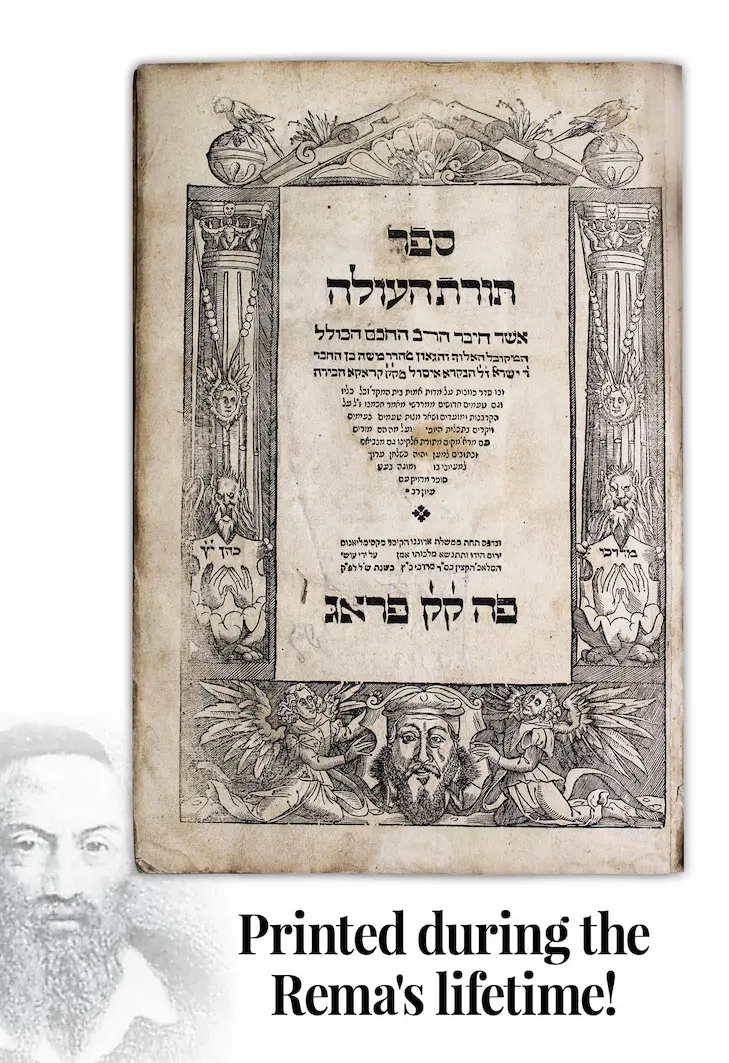
Lot : 50
Fundamental
Toras HaOlah, by the Rema . First Edition. Prague, 1570
Printed during the Rema’s lifetime!
Insights and elaborate discussions on the significance and meaning of the Beis Hamikdash, its detailed and precise measurements, the holy vessels, and the priestly garments, as well as discussions on the reasons and meaning of korbanos.
The Rema himself wrote of his sefer that it contains “wonderful explanations in the wisdom of kabbalah” (Shu”t Rema Ch. 121).
The Rema integrates both kabbalah and philosophy in this sefer, expressing that “the wisdom of kabbalah is the wisdom of philosophy; they are just speaking in two languages” (Toras Ha’olah Vol. 3 Ch. 4). The present work repeatedly cites the Rambam’s Guide to the Perplexed.
Sefer Toras Ha’olah was the second sefer that the Rema brought to print.
Prague, 1570. Page Count: [6], 173 leaves. Description: Illustrated title page with border. Bibliography: Stefansky, Sifrei Yesod #500.
Rabbi Moshe Isserless, known as the Rem"a, was born in Krakow, sometime around the year 1535. He traveled to Lublin in his youth where he studied by the great Rabbi Shalom Shachna of Lublin, later marrying his daughter. Following his marriage he settled in Krakow and began teaching Torah. Many of his disciples went on to become leading rabbis, such as the Sm"a, the Levush, the Masas Binyamin, Rabbi Avraham Horowitz – father of the Shla"h, and others.
The Rema was appointed Rabbi of the great city of Krakow despite his young age and served in this position for twenty years. He passed away at a young age, on Lag (33rd) Ba'omer of 5333 (1573).
The Rema is looked upon as the Father of Ashkenazic Jewry and his authority in Halacha is the highest for Ashkenaz Jewry. Until the rise of the Nazi regime, thousands would flock to his grave and a large gathering took place by his gravesite on Lag Ba'omer.
......................................... ......
Any inquiries about this lot ?
We are available also on WhatsApp >>>
of 2 pages
