
Lot : 20

Segulah for Protection and Healing!

The Chasam Sofer’s Handwritten Drasha for Purim - Pressburg, 1834

Images

Segulah for Protection and Healing!


The Chasam Sofer’s Handwritten Drasha for Purim – Pressburg, 1834


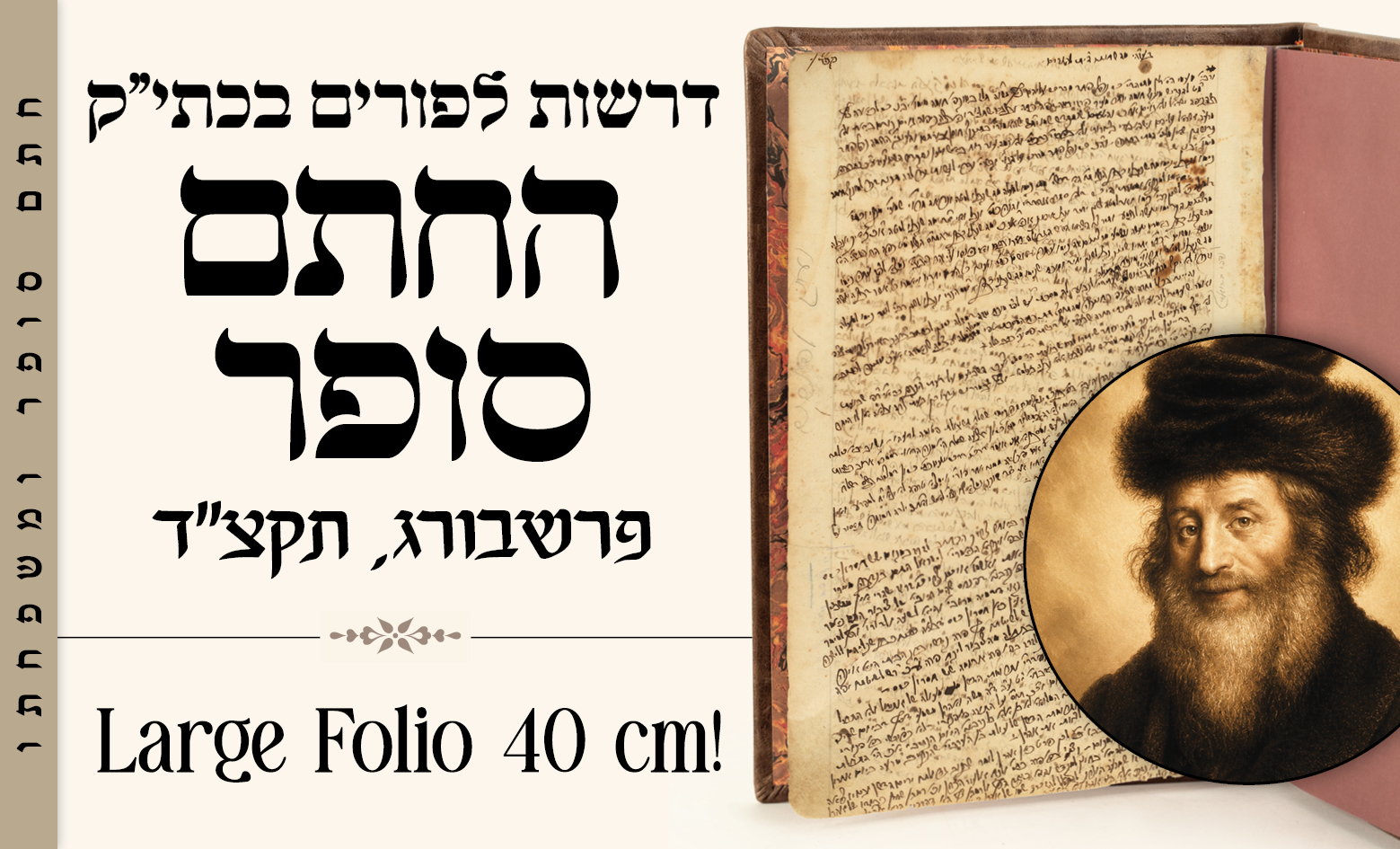
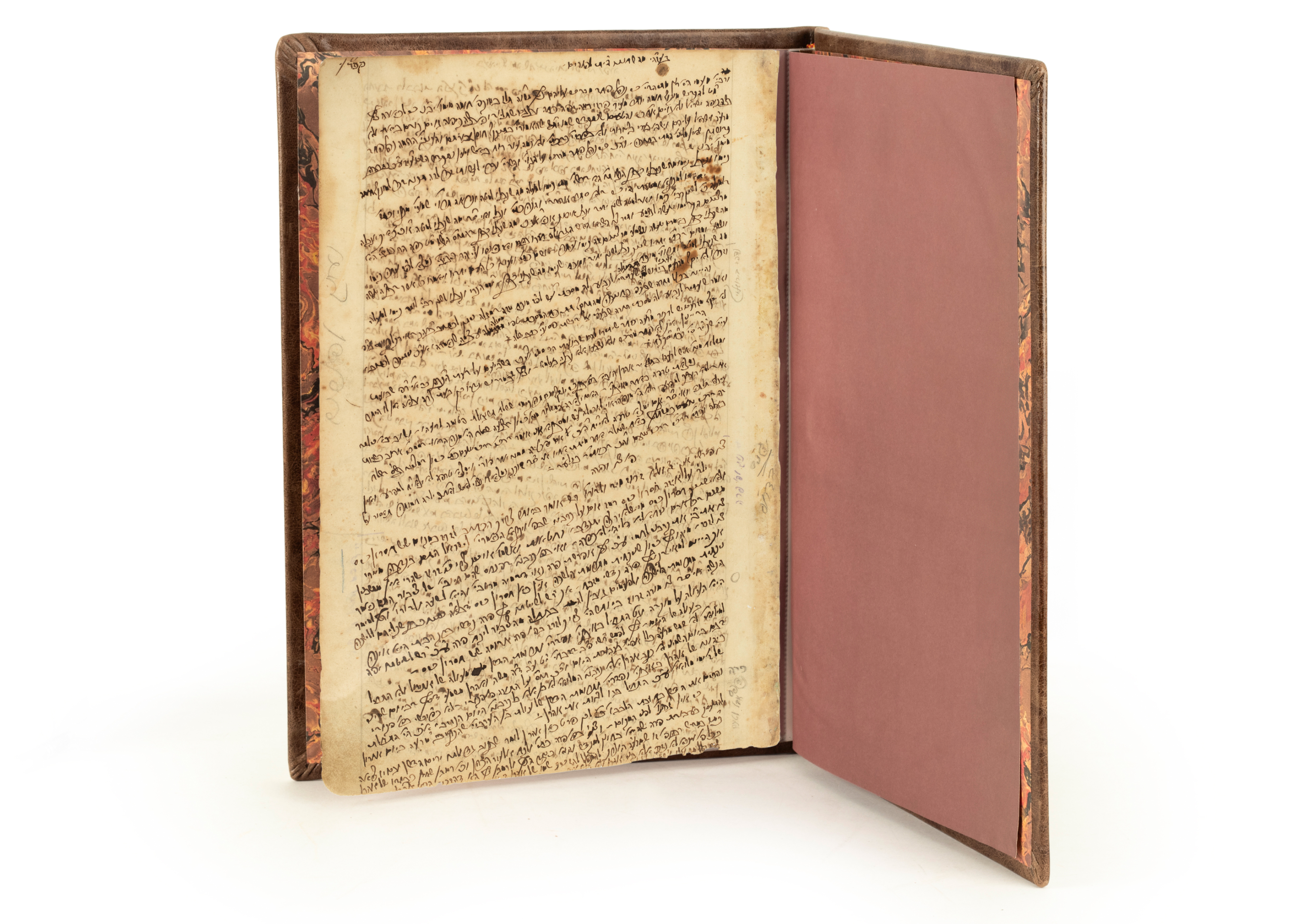
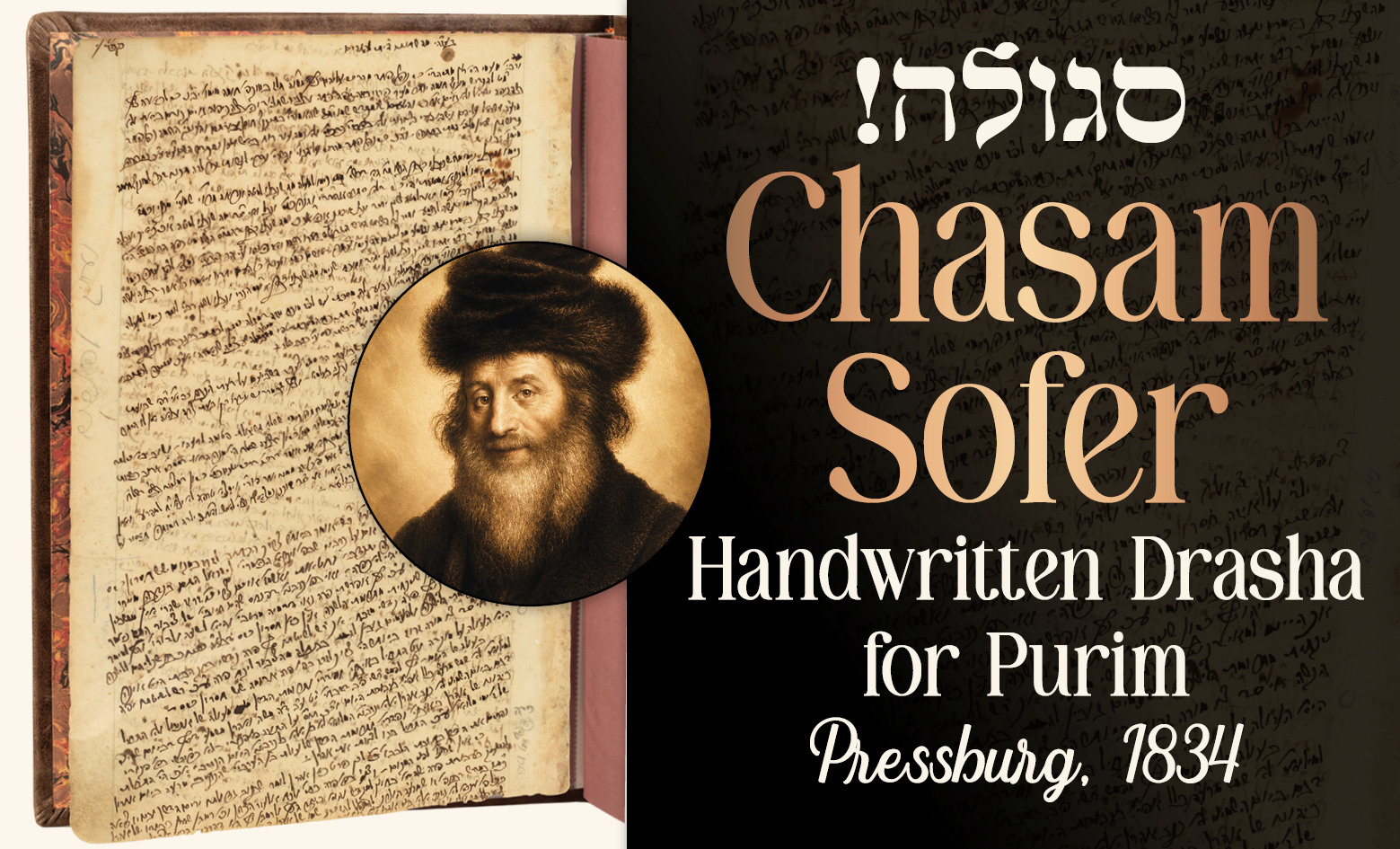
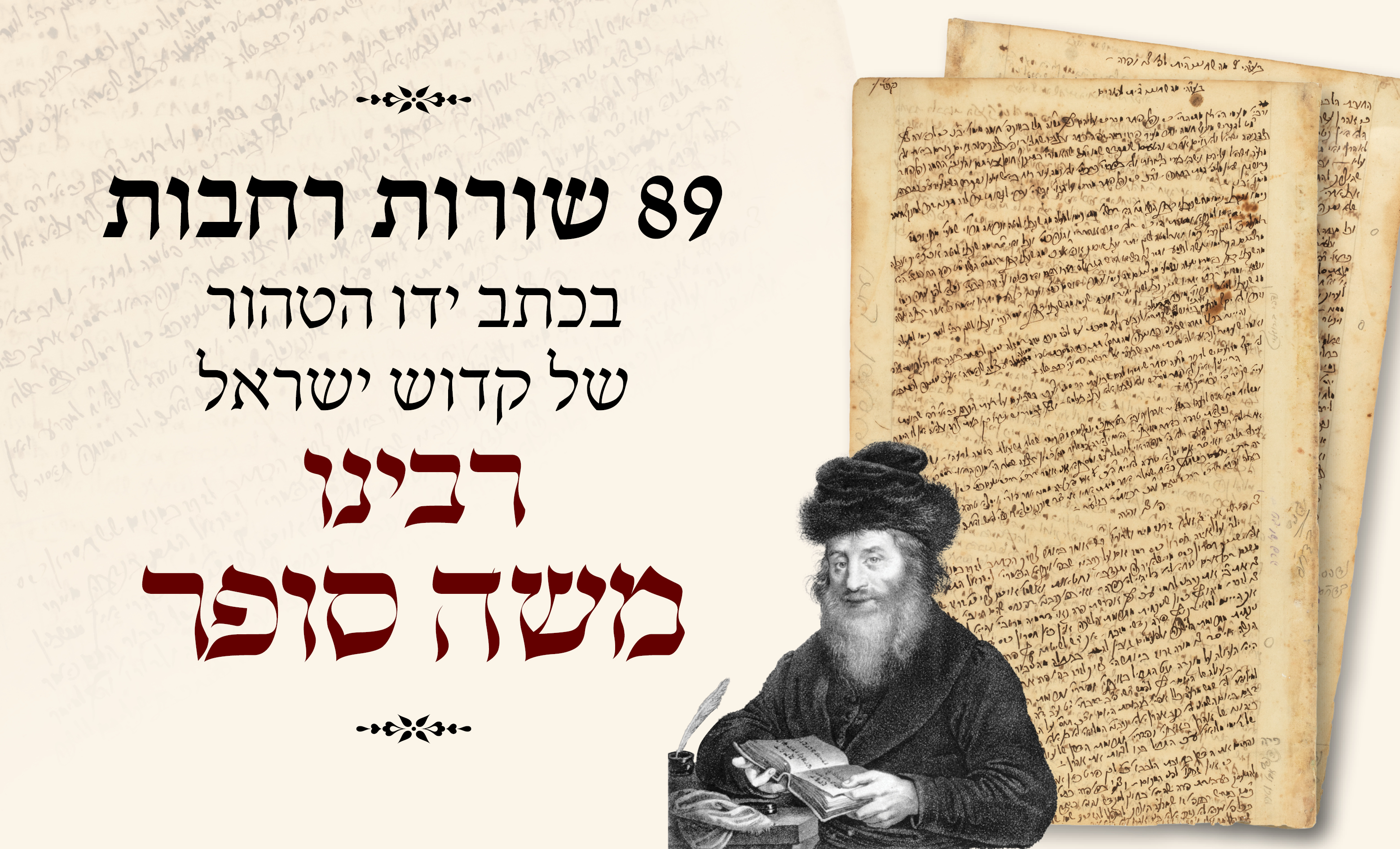
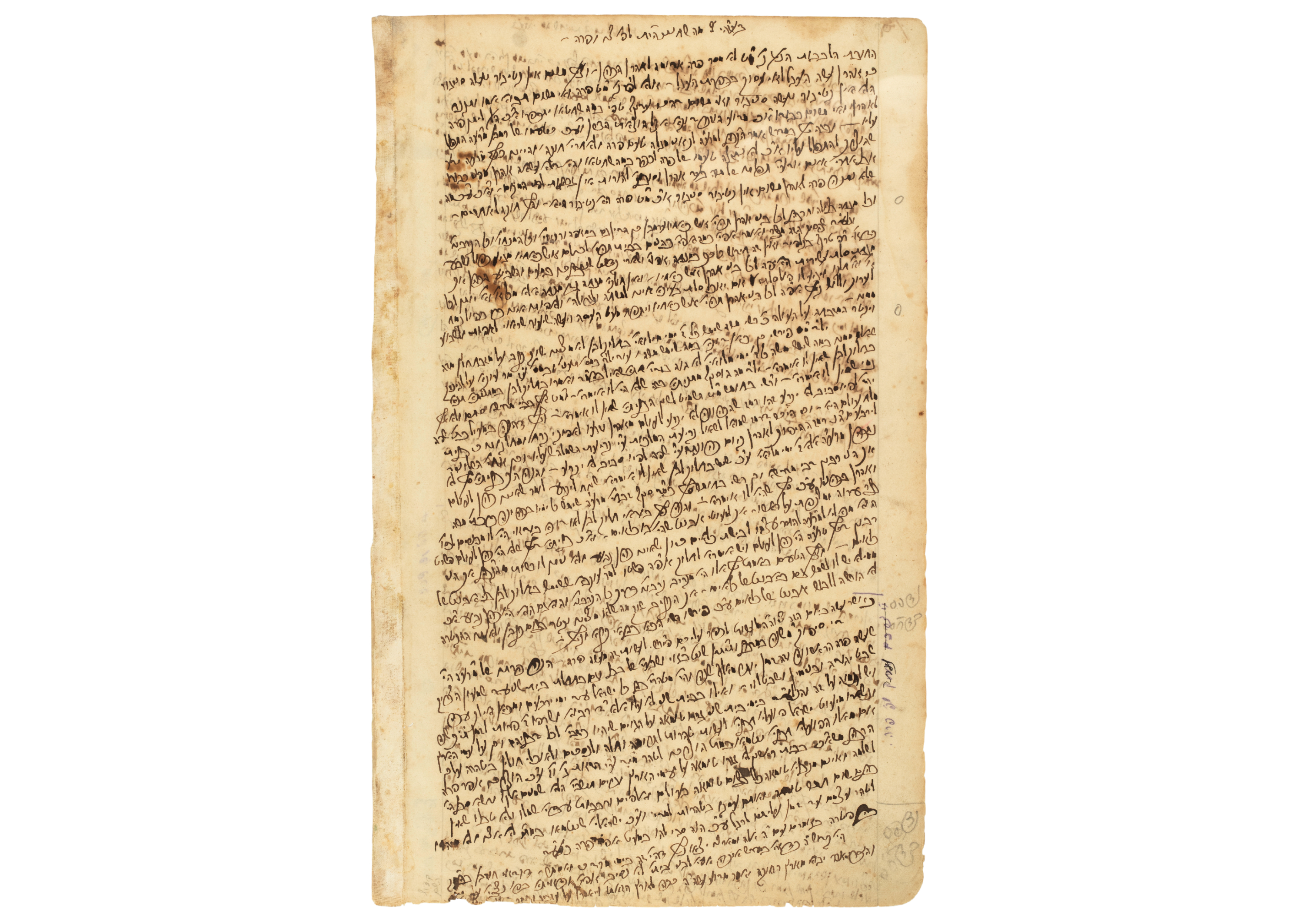
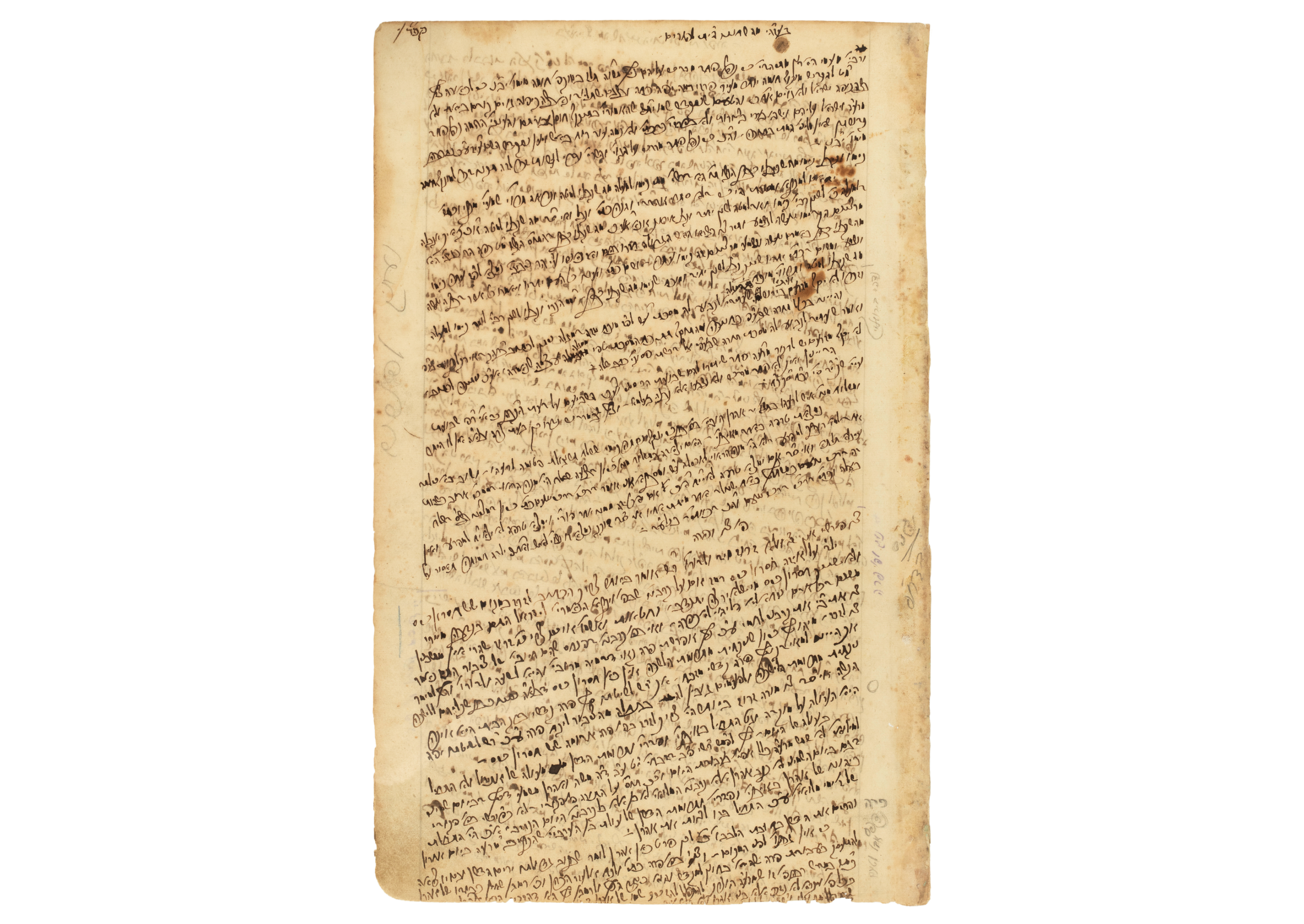
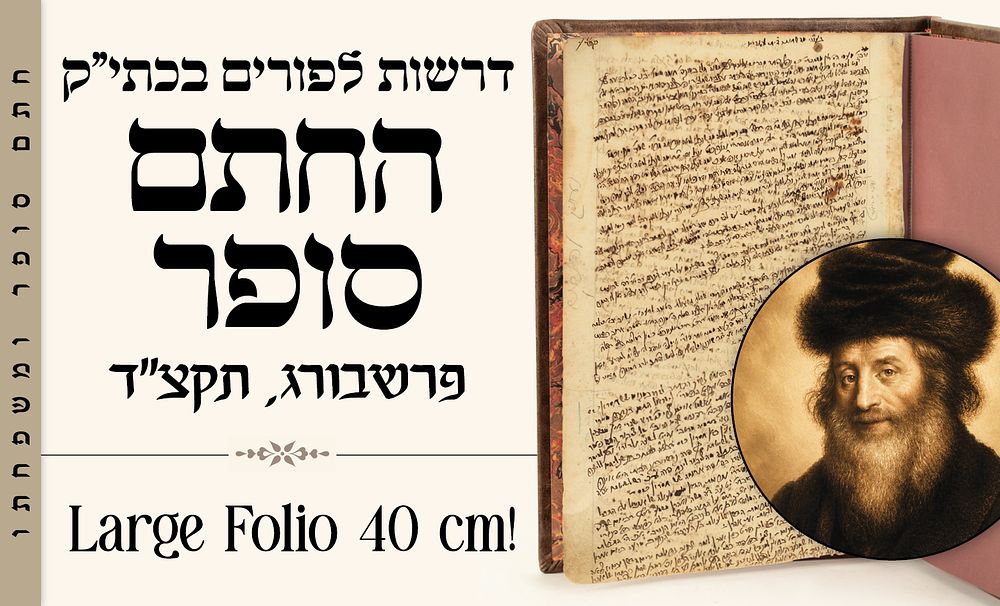
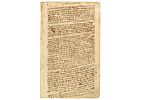
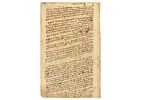
An especially large leaf, written on both sides, comprising ten complete passages – 89 wide lines – in the holy handwriting of Rabbi Moshe Sofer, Av Beis Din and Rosh Yeshiva of Pressburg and author of the sefer Chasam Sofer.

These chiddushim originate from his notebook of drashos and Torah discourses written in Pressburg in 1834.

This notebook was described by Rabbi Yosef Naftali Stern, who possessed the manuscript and used it as the source for the publication of Drashos Chasam Sofer and Toras Moshe on the Torah:

“Drashos and Torah discourses on the Chumash, …. in large folio format, beginning with a drasha for Parshas Ki Savo, 1829, followed by a drasha for the 26th of Elul, then for Rosh Hashanah 1829, and continuing in sequence on the Torah year after year until Parshas Bechukosai, 1834” (introduction of Sha’ar Yosef to Drashos Chasam Sofer, p. 13, sec. 4).

The present manuscript contains ten complete passages with three headings:

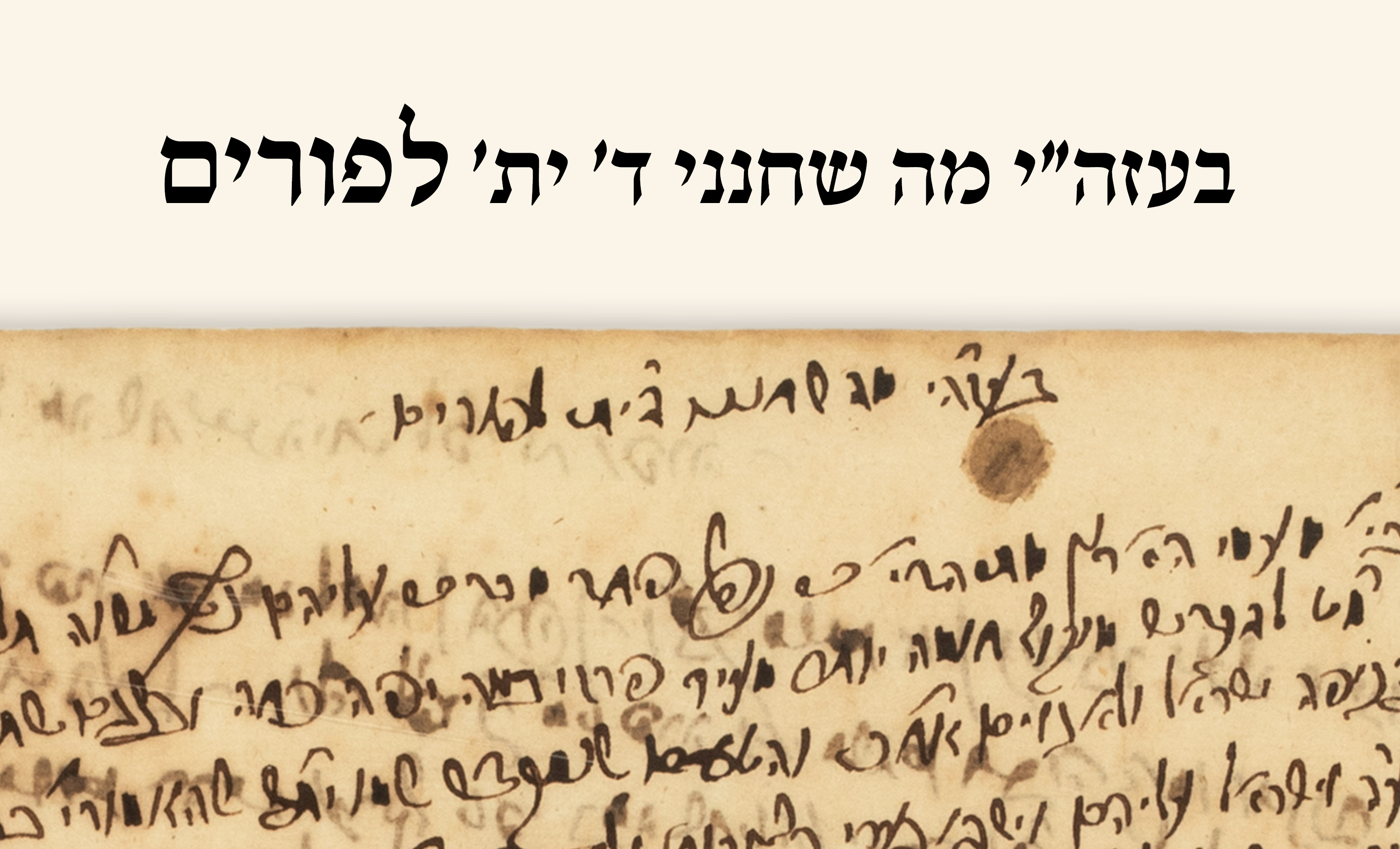
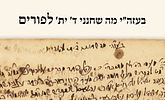
1. “With Hashem’s help, what Hashem has granted me for Purim.”
2. “Parshas Tzav and Parah.”
3. “With Hashem’s help, what Hashem has granted me for Parshas Tzav and Parah.”

Regarding his notebooks of Torah insights on the weekly parshiyos, the Chasam Sofer wrote:

“Every year I compile a separate notebook in which I record the Torah insights Hashem grants me every Shabbos, during my study of the weekly parshah and while listening to the Torah reading” (Shu”t Chasam Sofer, vol. VI, no. 61).

The Ramban and the Chovos HaLevavos


The present manuscript contains discussions by the Chasam Sofer drawing upon the teachings of two of the great Rishonim: the Ramban and the author of Chovos HaLevavos.

It is known that the Chasam Sofer studied extensively the Ramban’s commentary on the Torah, referring to it as the “foundation of faith and root of [the Jewish] religion, ” and he regarded his soul as being that of the holy Ramban (see further details in Genazym 11, Item 89).

Here, the Chasam Sofer discusses several passages from the Ramban, alongside discussions from Chovos HaLevavos — a work to which he was especially devoted. He delivered regular daily shiurim on Chovos HaLevavos before beginning his main shiur (see the section “Sifra de-Libba” in Otzros HaSofer, vol. 28).

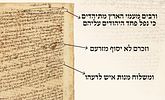
The margins contain various handwritten notes by Rabbi Y. N. Stern, son-in-law of Rabbi Shlomo Sofer, son of the Michtav Sofer, and one of the leading editors and disseminators of the teachings of the Chasam Sofer.
Rabbi Stern later published these chiddushim, some in Drashos Chasam Sofer and others in Toras Moshe on Parshas Tzav.


Pressburg, 1834

Size: 40 cm. 89 lines in the Chasam Sofer’s handwriting.
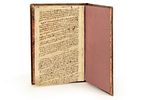
Condition: Good. Preserved in a large, beautiful leather binding.

_________________

Toras Moshe al HaTorah

“Had the Chasam Sofer left behind no other work but Toras Moshe on the Torah, it alone would have been sufficient to reveal his extraordinary greatness. While all of his works are holy, Toras Moshe is kodesh kedoshim.”

— Rabbi Meir Arik, cited in the introduction to Haggadah Shel Pesach Chasan Sofer.

_________________

The Segulah of the Chasam Sofer’s Handwriting

A Segulah for Yiras Shamayim 
The Maharam Benet stated that a mere glance at the sacred writing of the Chasam Sofer is a segulah for Yiras Shamayim.

It is told that Maharam Benet once received a handwritten teshuvah from the Chasam Sofer and he spent a great deal of time perusing it. When his students asked if the letter perplexed him, he replied, “No, but I am delving into this teshuvah, since the mere sight of his sacred writing increases fear of heaven” (Drashos Chasam Sofer, Preface, p. 6).

 
The Admor Rabbi Yoel of Satmar similarly expressed that seeing the handwriting of the Chasam Sofer is a segulah for Yiras Shamayim.


 A Segulah for Protection

It is known that the Chasam Sofer’s family members and descendants would safeguard his letters and writings as a segulah for protection.

His son, the Michtav Sofer, would carry his father’s handwritten manuscripts with him when attending sessions of the Austrian Parliament. Whenever he faced a particularly difficult issue, he would open the manuscripts and carefully peruse them to find a solution to the issue.

 A Segulah for Health and Recovery

The Daas Sofer would instruct sick patients to place a handwritten letter of the Chasam Sofer beneath their pillow as a segulah for health and recovery (Beis Sofrim p. 173).

A Segulah for Easy Childbirth

The Chasam Sofer’s family would place a handwritten letter by the Chasam Sofer beneath the head of a woman going through a difficult labor as a segulah for a quick and safe childbirth (Shu”t Shevet Halevi Vol. 6 Ch. 162 #2).
 
The Chasam Sofer’s Text Markings
The Chasam Sofer marked the end of every paragraph in his writings with a line and period. Rabbi Asher Anshel Weiss, Av Beis Din of Nagy-Falu, noted that the Chasam Sofer inserted these symbols into his writings based on the wisdom of Kabbalah. (See Rabbi Nosson Stern in his preface to Drashos Chasam Sofer p. 19a, in the comment.)

_____________

Transcript of the Letter:

Page 1

With Hashem’s help — insights with which Hashem has favored me for Purim
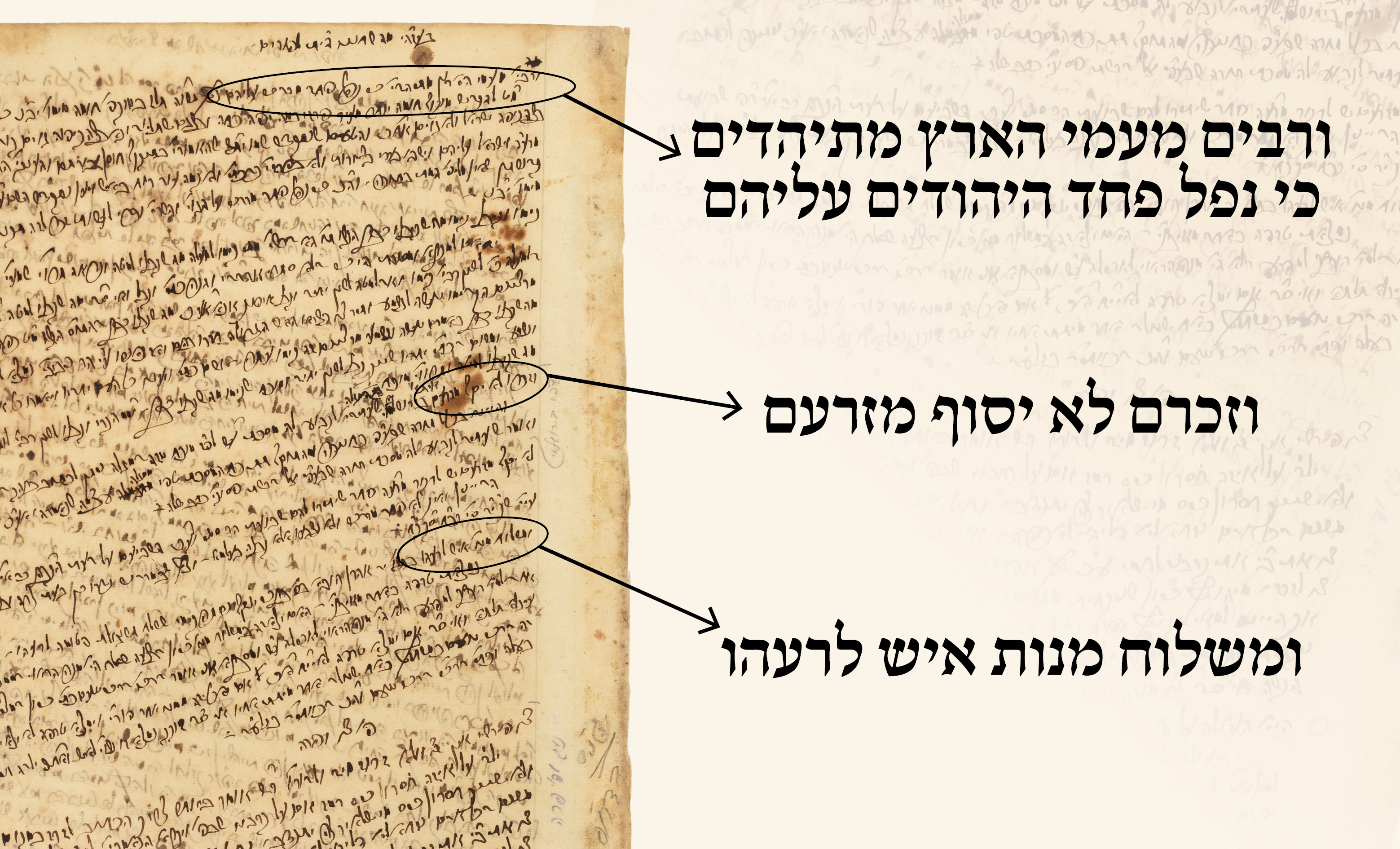
“And many of the people of the land became Jews, for the fear of the Jews had fallen upon them.”

It appears to me that this is why the law of Purim is made dependent upon whether a city was surrounded by a wall in the days of Yehoshua bin Nun. At first glance, this requires explanation: Why should a walled city take precedence over an unwalled city? What gives it this distinction? Moreover, the determining factor is specifically whether the non-Jewish inhabitants had surrounded it with a wall before the arrival of Klal Yisrael, rather than whether Klal Yisrael themselves fortified it, or whether non-Jews did so afterward.

The reason is that Hashem’s Name was sanctified when the Emorites, despite the strength of their mighty fortifications and those formidable giants, were overcome by fear of Moshe Rabbeinu and Klal Yisrael. They therefore remained in fortified cities rather than in unwalled settlements, as it is written, “There was no longer any spirit left in any man.” Since this brought about a sanctification of Hashem’s Name, these cities acquired an added degree of sanctity, to the extent that the dead may not be left overnight within them.

The same occurred in the days of Mordechai, when fear of him fell upon the nations and their officials. To commemorate this, Chazal established a remembrance through those cities that had been surrounded by walls since the days of Yehoshua bin Nun.
“Kiyemu v’kiblu — they established and accepted.” Chazal interpret this as: “They established what they had already accepted.” Tosafos have already asked that this same phrase is expounded to mean that they established Above what had been accepted below.

It appears that both interpretations can be derived from the verse, from the way it is read and the way it is written, since we follow both the reading and the written tradition when the two do not contradict one another. The word is written v’kibel, “and he accepted, ” in the singular. If it referred to what was accepted below, however, there is an obvious difficulty: why is kiyemu, referring to Above, written in the plural, while v’kibel, referring to below, is singular? One could just as readily reverse the interpretation.

Rather, it must refer to “what they had already accepted.” Tosafos ask why Hashem needed to hold the mountain over them like a barrel at Har Sinai when they had willingly declared, “We will do and we will hear.” They answer that when the people saw the great fire, they withdrew from their original acceptance, and it was then that they were compelled through the mountain being held over them.

Accordingly, at the time of Purim they now confirmed what they had previously accepted voluntarily when they said, “We will do and we will hear.” There the Torah states, “And all the people answered together and said: Everything that Hashem has spoken, we will do and we will hear.” Since they answered together, the singular form v’kibel is appropriate. This demonstrates that they now established what they had previously accepted. Nevertheless, the word is read v’kiblu, in the plural, teaching that they established Above what had been accepted below. Thus, both interpretations are indicated.

“And their remembrance shall not cease from their descendants.” The Yerushalmi, in the first chapter of Maseches Megillah, states that a maseches would eventually be established for Megillas Esther.

Accordingly, this statement alone would not prove that the Megillah was given to be written with Ruach Hakodesh. If it were intended only to be read orally and were part of the Oral Torah, as with Chanukah, what additional force would the establishment of a maseches give it beyond the Megillah itself, which had originally been transmitted orally? It must therefore be that the Megillah was given to be written, and the statement means that a maseches of the Oral Torah would eventually be established around the exposition of the pesukim of its written text.

“Shall not cease from their descendants.”
There is room to investigate the following question: Moshe Rabbeinu was concerned that Klal Yisrael might have their oath at Har Sinai annulled, and he therefore administered the oath upon the understanding of Hashem, as stated at the beginning of the chapter Shevuas HaDayanim. Why was Mordechai not similarly concerned? In his time, they merely accepted the obligation without an oath.
It must be that in the days of Mordechai they undertook this as a vow made in a time of distress, which in any event cannot be annulled. See Shach, Yoreh De’ah 228:28.
“And sending portions, one man to his fellow.”

In Shu”t Yad Aharon, cited in Birkei Yosef, the following question is raised: A person sent his fellow a fattened chicken for mishloach manos. Later, when it was eaten, the chicken was discovered to be treif because of a defect in one of its organs. Did the sender fulfill the mitzvah of mishloach manos? At the time it was sent, it was considered food fit for consumption, since we rely upon the presumption that most animals are kosher. Or perhaps the subsequent discovery retroactively establishes that it had never been fit for consumption. See there.

Logically, I would say that he did fulfill the mitzvah, for it is written, “Her ways are ways of pleasantness.” We find in the Gemara that a calf was sent as mishloach manos. If we were to say that the mitzvah is not fulfilled should the animal later be discovered to be treif, then someone might eat from it only after Purim, discover that it was treif, and thereby retroactively lose the mitzvah he had believed he had fulfilled. This would not be consistent with “Her ways are ways of pleasantness.”

Chazal employ a similar argument regarding a brother born after the death of his brother: if we were to say that he creates a bond of yibbum, a woman who had already married another man could suddenly become forbidden to her husband when her mother-in-law subsequently gave birth. Yet Scripture says, “Her ways are ways of pleasantness.” The same reasoning applies here, in my humble opinion.

Parshas Tzav and Parah

“Tzav — command.” Rashi explains: The term tzav always implies urging, both immediately and for future generations. Rabbi Shimon says that Scripture must especially urge a person where monetary loss is involved.

We must understand what monetary loss is being referred to. If it refers to the korbanos in Parshas Vayikrah that were commanded to Klal Yisrael, those are voluntary offerings, so monetary loss is hardly relevant; anyone who does not wish to bring one need not volunteer it. As for sin-offerings and guilt-offerings, they require no special urging, since collateral is not taken to compel their offering, because every person wishes to obtain atonement.

If it refers to the korbanos in Parshas Pinchas, which are communal obligations, there the Torah itself says, “Command Bnei Yisrael concerning My offering, My food.”
I therefore believe that Rabbi Shimon’s statement refers to Parshas Parah, since the Parah Adumah is extremely expensive and applies both to the immediate generation and to future generations. It would therefore have been appropriate to use the word tzav there to emphasize the need for urging.

One might object that since the Parah Adumah is purchased from the communal funds, there is no direct monetary loss; the people have already contributed their shekalim to the treasury. But that is only according to our accepted halacha that the Parah is considered among the sacred offerings of the mizbe’ach. Rabbi Shimon, however, follows his own opinion that the Parah belongs to the category of items consecrated for the upkeep of the Beis Hamikdash. It is therefore not purchased from the regular communal treasury, and at times a special collection must be made from the public in order to purchase it.

Thus, Rabbi Shimon, consistent with his own position, rightly asks: if tzav indicates special urging, it would have been especially appropriate to use that expression in the section of the Parah Adumah, where there is substantial monetary loss.
“This is the burnt-offering upon its fire…”

The Torah begins with the limbs and fats and the removal of the ashes from the previous day’s offering, rather than beginning with the burnt-offering of the new day.
This may be explained according to Rashi in Zevachim 19b, s.v. Moshe v’Aharon, who appears to maintain that on the eighth day of the Miluim, Moshe Rabbeinu did not perform the avodah at all, even the special avodah of that day. Tosafos on the Torah in Parshas Pekudei likewise write this, contrary to Rashi’s interpretation there. It was not that Aharon merely refrained from offering the special korbanos of the Miluim on the eighth day; rather, he offered all the korbanos of that day.

It follows that Aharon’s service as Kohen began with the limbs and fats and with the removal of the ashes from the afternoon burnt-offering that Moshe Rabbeinu had offered on the final day of the seven days of the Miluim. The Torah therefore begins with this service when commanding Aharon.

“And he shall lift up the ashes.”
The Chovos Halevavos writes that Aharon is specifically mentioned here to teach that, despite his great stature, he himself was to lift up the ashes and carry them out, because there is no place for pride before Hashem.

This requires consideration. Regarding the Parah Adumah, the Torah says, “Elazar HaKohen shall take it, ” and the Ramban explains that it was beneath Aharon’s dignity to occupy himself with the service of the Parah, which takes place outside the Beis Hamikdash. This would seem to contradict the above.

According to the Ramban, however, the reason Aharon is specifically mentioned here may be explained in accordance with the Midrash Rabbah on this parashah: Moshe Rabbeinu had to daven that Aharon’s name should be mentioned, because throughout Parshas Vayikrah only “the sons of Aharon” are mentioned, but not Aharon himself. Moshe therefore davened on his behalf. See there.

But according to the explanation of the Chovos Halevavos cited above—

Page 2

With Hashem’s help — insights with which Hashem has favored me for Parshas Tzav and Parah

—the difficulty remains: Why was the Parah Adumah not entrusted to Aharon HaKohen?
We must say that this was because “a prosecutor cannot become a defender.” Since Aharon had made the Golden Calf, he could not perform the service that served to atone for the sin of the Calf.

But this itself raises a difficulty concerning the reason for the Parah Adumah. If its purpose is that “the mother should come and clean up the mess of her child, ” then how can this be reconciled with the principle that a prosecutor cannot become a defender? And if, on the contrary, it is preferable that the very thing involved in the sin should serve as its atonement, then the Parah should indeed have been entrusted to Aharon. If it was withheld from him merely because of his dignity, then why is Aharon specifically mentioned regarding the removal of the ashes?

We must therefore accept the Ramban’s explanation, that Moshe Rabbeinu davened on Aharon’s behalf.

With this, we can explain the Midrash which states that Hashem said to Moshe Rabbeinu: “To you I reveal the reason for the Parah, but to others it remains a statute.”

This is precisely the point. Moshe Rabbeinu knew that he had needed to daven on Aharon’s behalf. He therefore understood the reason for the Parah: atonement comes through the very thing with which they sinned, and the reason Aharon himself did not perform it was because of his dignity. Others, however, were unaware of Moshe’s prayer on Aharon’s behalf. They therefore understood Aharon’s being mentioned in connection with the ashes as teaching that there is no place for pride before Hashem. Consequently, they were forced to conclude that the Parah was not entrusted to Aharon because “a prosecutor cannot become a defender.” But if so, why should a cow itself serve as atonement when it is the “prosecutor”? Thus, for everyone else the Parah remains an inexplicable statute.

“And every meal-offering mixed with oil, or dry, shall belong to all the sons of Aharon, each man like his brother.”

See the Ramban, who explains that the same law applies to baked offerings, wafers, all meal-offerings, and indeed all korbanos.

In my humble opinion, this pasuk conveys a promise: Even if there are thousands of Kohanim in the Beis Hamikdash, each of them will receive his share just like his fellow, and there will be enough to satisfy him many times over, as stated at the beginning of the chapter Taraf BaKalpi.

This is not such a novelty regarding baked meal-offerings and other sacred foods, since a blessing entered the Kohen’s stomach and satisfied him. But consider a meal-offering consisting of one-tenth of an ephah of flour: it is divided among all the sons of Aharon, each man like his brother. One meal-offering cannot be exchanged against another; rather, from each individual offering every Kohen must be given his portion. His share might therefore amount to no more than a tiny amount of flour. Eating raw flour would hardly constitute a dignified and satisfying meal, while there would not be enough flour in his portion to prepare, knead, and bake.

The pasuk therefore teaches that nevertheless, “it shall belong to all the sons of Aharon, each man like his brother”: the small amount of dough would expand sufficiently to form a portion fit to be baked and to satisfy him.

“And he shall burn it upon the mizbe’ach, upon the burnt-offering.”
Rashi writes that Moshe served throughout all seven days of the Miluim wearing a white garment, and that nowhere else do we find the breast and thigh being burned upon the mizbe’ach except here.

We must understand why Rashi chooses specifically here to explain what Moshe wore during his service.

There is another point requiring explanation. In Maseches Taanis and Maseches Avodah Zarah, it is related that Mar Ukva arrived in Ginzak, where he was asked: In what garments did Moshe serve throughout the seven days of the Miluim? He did not know the answer, so he went and asked in the beis medrash. They answered that he wore a white garment. A Baraisa teaches: “A white garment without a hem.”
What does the Baraisa add by telling us that it had no hem? And why did those in the beis medrash simply tell him that it was a white garment without adding that it had no hem? Furthermore, why does Rashi on the Chumash omit the Baraisa’s detail that it had no hem?

This may be explained as follows. Regarding the Me’il, the Torah states, “It shall have a border around its opening… it shall not be torn.” This alludes to the fact that the Kehunah would never be torn away from Aharon and his descendants, in contrast to Korach and his assembly, for “it is an eternal covenant of salt.”

Just as Shmuel symbolized the tearing away of the monarchy from Shaul through the tearing of the garment upon him, and Achiyah HaShiloni similarly did so for Yeravam, here the opposite was symbolized for Aharon: the permanence of his Kehunah was represented by the border around the opening of the Me’il and the command that “it shall not be torn.”

The Baraisa maintains that Moshe Rabbeinu served as Kohen only during the seven days of the Miluim. He therefore wore a white garment without a hem, one that could readily be torn, symbolizing that he would not remain a Kohen permanently.

The Rabbanan of the beis medrash, however, as well as Rashi on the Chumash, follow the opinion at the end of Zevachim that Moshe Rabbeinu served as a Kohen throughout his life, as the pasuk states, “Moshe and Aharon among His Kohanim.” They therefore maintain that his garment did have a hem.

It also appears obvious to me that “a white garment” is not meant literally as his only garment. He certainly wore trousers to cover himself and a head covering. Rather, the expression comes to exclude the Avnet, which contained shatnez.

According to the Baraisa, which holds that Moshe was not permanently a Kohen, it is readily understandable why he could not wear the Avnet: what authority did Moshe have to permit himself to wear shatnez if he was not a permanent Kohen and had received no authorization from Hashem to do so?

But the Rabbanan, who hold that Moshe remained a Kohen throughout his life and that his garment had a hem, nevertheless answered Mar Ukva that he served in a white garment, meaning without the Avnet containing shatnez.

The reason may be explained as follows. Had Moshe offered korbanos in the ordinary manner, and had he himself been a permanent Kohen, he would naturally have been permitted to serve while wearing the Avnet of shatnez. Here, however, he offered the thigh upon the mizbe’ach, something that we do not find with any other korban. For this unusual act of burning, he had not been granted permission to wear an Avnet containing shatnez.

This is therefore why Rashi explains specifically here, on this pasuk, that Moshe served wearing a white garment. This is readily understood.

“As he has done this day, Hashem commanded to do, to atone for you.” Rashi explains: “To do” refers to the procedure of the Parah Adumah.

The Parah prepared by Moshe Rabbeinu provided enough ashes for the forty years in the Midbar, the 850 years in Eretz Yisrael, the seventy years of Bavel, and even the beginning of the Second Beis Hamikdash period, until Shimon HaTzaddik prepared the next Parah. 

The Parah prepared by Moshe Rabbeinu provided enough ashes for the forty years in the Midbar, the 850 years in Eretz Yisrael, the seventy years of Bavel, and even the beginning of the Second Beis Hamikdash period, until Shimon HaTzaddik prepared the first Parah of that period. This amounts to more than a thousand years, during which its ashes were used to purify all of Klal Yisrael until the days of Yeravam, and from then onward, at the very least, the tribes of Yehudah and Binyamin and the tribe of Levi.

Yet during the Second Beis Hamikdash period, when only forty thousand people had returned, seven Parahs were burned over the course of 420 years. This is remarkable.
It appears to me that during the Second Beis Hamikdash period, Chazal decreed that non-Jews should have the status of zavim with regard to all matters of tumah, and they likewise enacted decrees of tumah concerning amei ha’aretz. Consequently, only a minority of Klal Yisrael remained as workers who were chaverim and could prepare items in a state of taharah for terumah, challah, nesachim, and for those who ate ordinary food in a state of taharah. Therefore, whenever one of these workers who was a chaver became tamei through contact with a corpse, he had to purify himself immediately through the sprinkling on the third and seventh days. As a result, large quantities of the ashes of the Parah Adumah were required.

This was not the case during the First Beis Hamikdash period. At that time, no decree of tumah had been enacted upon amei ha’aretz. Moreover, there were resident aliens—indeed, Shlomo had eighty thousand burden-bearers—who were not susceptible to tumah at all. There were also many thousands of servants who had undergone milah but had not immersed, concerning whom there was likewise no concern of tumah. These people were sufficiently available to handle items requiring taharah.

Consequently, when members of Klal Yisrael became tamei through contact with the dead, they were under no pressure to purify themselves immediately, and could wait until the time came to ascend to Yerushalayim for the Regel. Therefore, a relatively small quantity of ashes of the Parah Adumah was sufficient for them, in my humble opinion.

Regarding the Haftarah
“When they said of them, ‘These are the people of Hashem, yet they have gone forth from His land.’”

It appears to me that this occurred in the days of Mordechai and Esther. Certainly, the destruction of the Beis Hamikdash itself constituted a sanctification of Hashem’s Name, as stated in Midrash Eichah: “Even toward the members of His own household He showed no favor.”

Likewise, as stated in Parshas Nitzavim: “And the foreigner who will come from a distant land will say: Why has Hashem done such a thing to this land?” And they will answer: “Because they forsook…”


Lot : 20

Segulah for Protection and Healing!

The Chasam Sofer’s Handwritten Drasha for Purim - Pressburg, 1834

Start price: $35,000
|
Est. Price: $50,000 - $70,000

Segulah for Protection and Healing!


The Chasam Sofer’s Handwritten Drasha for Purim – Pressburg, 1834


An especially large leaf, written on both sides, comprising ten complete passages – 89 wide lines – in the holy handwriting of Rabbi Moshe Sofer, Av Beis Din and Rosh Yeshiva of Pressburg and author of the sefer Chasam Sofer.

These chiddushim originate from his notebook of drashos and Torah discourses written in Pressburg in 1834.

This notebook was described by Rabbi Yosef Naftali Stern, who possessed the manuscript and used it as the source for the publication of Drashos Chasam Sofer and Toras Moshe on the Torah:

“Drashos and Torah discourses on the Chumash, …. in large folio format, beginning with a drasha for Parshas Ki Savo, 1829, followed by a drasha for the 26th of Elul, then for Rosh Hashanah 1829, and continuing in sequence on the Torah year after year until Parshas Bechukosai, 1834” (introduction of Sha’ar Yosef to Drashos Chasam Sofer, p. 13, sec. 4).

The present manuscript contains ten complete passages with three headings:

1. “With Hashem’s help, what Hashem has granted me for Purim.”
2. “Parshas Tzav and Parah.”
3. “With Hashem’s help, what Hashem has granted me for Parshas Tzav and Parah.”

Regarding his notebooks of Torah insights on the weekly parshiyos, the Chasam Sofer wrote:

“Every year I compile a separate notebook in which I record the Torah insights Hashem grants me every Shabbos, during my study of the weekly parshah and while listening to the Torah reading” (Shu”t Chasam Sofer, vol. VI, no. 61).

The Ramban and the Chovos HaLevavos


The present manuscript contains discussions by the Chasam Sofer drawing upon the teachings of two of the great Rishonim: the Ramban and the author of Chovos HaLevavos.

It is known that the Chasam Sofer studied extensively the Ramban’s commentary on the Torah, referring to it as the “foundation of faith and root of [the Jewish] religion, ” and he regarded his soul as being that of the holy Ramban (see further details in Genazym 11, Item 89).

Here, the Chasam Sofer discusses several passages from the Ramban, alongside discussions from Chovos HaLevavos — a work to which he was especially devoted. He delivered regular daily shiurim on Chovos HaLevavos before beginning his main shiur (see the section “Sifra de-Libba” in Otzros HaSofer, vol. 28).

The margins contain various handwritten notes by Rabbi Y. N. Stern, son-in-law of Rabbi Shlomo Sofer, son of the Michtav Sofer, and one of the leading editors and disseminators of the teachings of the Chasam Sofer.
Rabbi Stern later published these chiddushim, some in Drashos Chasam Sofer and others in Toras Moshe on Parshas Tzav.


Pressburg, 1834

Size: 40 cm. 89 lines in the Chasam Sofer’s handwriting.
Condition: Good. Preserved in a large, beautiful leather binding.

_________________

Toras Moshe al HaTorah

“Had the Chasam Sofer left behind no other work but Toras Moshe on the Torah, it alone would have been sufficient to reveal his extraordinary greatness. While all of his works are holy, Toras Moshe is kodesh kedoshim.”

— Rabbi Meir Arik, cited in the introduction to Haggadah Shel Pesach Chasan Sofer.

_________________

The Segulah of the Chasam Sofer’s Handwriting

A Segulah for Yiras Shamayim 
The Maharam Benet stated that a mere glance at the sacred writing of the Chasam Sofer is a segulah for Yiras Shamayim.

It is told that Maharam Benet once received a handwritten teshuvah from the Chasam Sofer and he spent a great deal of time perusing it. When his students asked if the letter perplexed him, he replied, “No, but I am delving into this teshuvah, since the mere sight of his sacred writing increases fear of heaven” (Drashos Chasam Sofer, Preface, p. 6).

 
The Admor Rabbi Yoel of Satmar similarly expressed that seeing the handwriting of the Chasam Sofer is a segulah for Yiras Shamayim.


 A Segulah for Protection

It is known that the Chasam Sofer’s family members and descendants would safeguard his letters and writings as a segulah for protection.

His son, the Michtav Sofer, would carry his father’s handwritten manuscripts with him when attending sessions of the Austrian Parliament. Whenever he faced a particularly difficult issue, he would open the manuscripts and carefully peruse them to find a solution to the issue.

 A Segulah for Health and Recovery

The Daas Sofer would instruct sick patients to place a handwritten letter of the Chasam Sofer beneath their pillow as a segulah for health and recovery (Beis Sofrim p. 173).

A Segulah for Easy Childbirth

The Chasam Sofer’s family would place a handwritten letter by the Chasam Sofer beneath the head of a woman going through a difficult labor as a segulah for a quick and safe childbirth (Shu”t Shevet Halevi Vol. 6 Ch. 162 #2).
 
The Chasam Sofer’s Text Markings
The Chasam Sofer marked the end of every paragraph in his writings with a line and period. Rabbi Asher Anshel Weiss, Av Beis Din of Nagy-Falu, noted that the Chasam Sofer inserted these symbols into his writings based on the wisdom of Kabbalah. (See Rabbi Nosson Stern in his preface to Drashos Chasam Sofer p. 19a, in the comment.)

_____________

Transcript of the Letter:

Page 1

With Hashem’s help — insights with which Hashem has favored me for Purim
“And many of the people of the land became Jews, for the fear of the Jews had fallen upon them.”

It appears to me that this is why the law of Purim is made dependent upon whether a city was surrounded by a wall in the days of Yehoshua bin Nun. At first glance, this requires explanation: Why should a walled city take precedence over an unwalled city? What gives it this distinction? Moreover, the determining factor is specifically whether the non-Jewish inhabitants had surrounded it with a wall before the arrival of Klal Yisrael, rather than whether Klal Yisrael themselves fortified it, or whether non-Jews did so afterward.

The reason is that Hashem’s Name was sanctified when the Emorites, despite the strength of their mighty fortifications and those formidable giants, were overcome by fear of Moshe Rabbeinu and Klal Yisrael. They therefore remained in fortified cities rather than in unwalled settlements, as it is written, “There was no longer any spirit left in any man.” Since this brought about a sanctification of Hashem’s Name, these cities acquired an added degree of sanctity, to the extent that the dead may not be left overnight within them.

The same occurred in the days of Mordechai, when fear of him fell upon the nations and their officials. To commemorate this, Chazal established a remembrance through those cities that had been surrounded by walls since the days of Yehoshua bin Nun.
“Kiyemu v’kiblu — they established and accepted.” Chazal interpret this as: “They established what they had already accepted.” Tosafos have already asked that this same phrase is expounded to mean that they established Above what had been accepted below.

It appears that both interpretations can be derived from the verse, from the way it is read and the way it is written, since we follow both the reading and the written tradition when the two do not contradict one another. The word is written v’kibel, “and he accepted, ” in the singular. If it referred to what was accepted below, however, there is an obvious difficulty: why is kiyemu, referring to Above, written in the plural, while v’kibel, referring to below, is singular? One could just as readily reverse the interpretation.

Rather, it must refer to “what they had already accepted.” Tosafos ask why Hashem needed to hold the mountain over them like a barrel at Har Sinai when they had willingly declared, “We will do and we will hear.” They answer that when the people saw the great fire, they withdrew from their original acceptance, and it was then that they were compelled through the mountain being held over them.

Accordingly, at the time of Purim they now confirmed what they had previously accepted voluntarily when they said, “We will do and we will hear.” There the Torah states, “And all the people answered together and said: Everything that Hashem has spoken, we will do and we will hear.” Since they answered together, the singular form v’kibel is appropriate. This demonstrates that they now established what they had previously accepted. Nevertheless, the word is read v’kiblu, in the plural, teaching that they established Above what had been accepted below. Thus, both interpretations are indicated.

“And their remembrance shall not cease from their descendants.” The Yerushalmi, in the first chapter of Maseches Megillah, states that a maseches would eventually be established for Megillas Esther.

Accordingly, this statement alone would not prove that the Megillah was given to be written with Ruach Hakodesh. If it were intended only to be read orally and were part of the Oral Torah, as with Chanukah, what additional force would the establishment of a maseches give it beyond the Megillah itself, which had originally been transmitted orally? It must therefore be that the Megillah was given to be written, and the statement means that a maseches of the Oral Torah would eventually be established around the exposition of the pesukim of its written text.

“Shall not cease from their descendants.”
There is room to investigate the following question: Moshe Rabbeinu was concerned that Klal Yisrael might have their oath at Har Sinai annulled, and he therefore administered the oath upon the understanding of Hashem, as stated at the beginning of the chapter Shevuas HaDayanim. Why was Mordechai not similarly concerned? In his time, they merely accepted the obligation without an oath.
It must be that in the days of Mordechai they undertook this as a vow made in a time of distress, which in any event cannot be annulled. See Shach, Yoreh De’ah 228:28.
“And sending portions, one man to his fellow.”

In Shu”t Yad Aharon, cited in Birkei Yosef, the following question is raised: A person sent his fellow a fattened chicken for mishloach manos. Later, when it was eaten, the chicken was discovered to be treif because of a defect in one of its organs. Did the sender fulfill the mitzvah of mishloach manos? At the time it was sent, it was considered food fit for consumption, since we rely upon the presumption that most animals are kosher. Or perhaps the subsequent discovery retroactively establishes that it had never been fit for consumption. See there.

Logically, I would say that he did fulfill the mitzvah, for it is written, “Her ways are ways of pleasantness.” We find in the Gemara that a calf was sent as mishloach manos. If we were to say that the mitzvah is not fulfilled should the animal later be discovered to be treif, then someone might eat from it only after Purim, discover that it was treif, and thereby retroactively lose the mitzvah he had believed he had fulfilled. This would not be consistent with “Her ways are ways of pleasantness.”

Chazal employ a similar argument regarding a brother born after the death of his brother: if we were to say that he creates a bond of yibbum, a woman who had already married another man could suddenly become forbidden to her husband when her mother-in-law subsequently gave birth. Yet Scripture says, “Her ways are ways of pleasantness.” The same reasoning applies here, in my humble opinion.

Parshas Tzav and Parah

“Tzav — command.” Rashi explains: The term tzav always implies urging, both immediately and for future generations. Rabbi Shimon says that Scripture must especially urge a person where monetary loss is involved.

We must understand what monetary loss is being referred to. If it refers to the korbanos in Parshas Vayikrah that were commanded to Klal Yisrael, those are voluntary offerings, so monetary loss is hardly relevant; anyone who does not wish to bring one need not volunteer it. As for sin-offerings and guilt-offerings, they require no special urging, since collateral is not taken to compel their offering, because every person wishes to obtain atonement.

If it refers to the korbanos in Parshas Pinchas, which are communal obligations, there the Torah itself says, “Command Bnei Yisrael concerning My offering, My food.”
I therefore believe that Rabbi Shimon’s statement refers to Parshas Parah, since the Parah Adumah is extremely expensive and applies both to the immediate generation and to future generations. It would therefore have been appropriate to use the word tzav there to emphasize the need for urging.

One might object that since the Parah Adumah is purchased from the communal funds, there is no direct monetary loss; the people have already contributed their shekalim to the treasury. But that is only according to our accepted halacha that the Parah is considered among the sacred offerings of the mizbe’ach. Rabbi Shimon, however, follows his own opinion that the Parah belongs to the category of items consecrated for the upkeep of the Beis Hamikdash. It is therefore not purchased from the regular communal treasury, and at times a special collection must be made from the public in order to purchase it.

Thus, Rabbi Shimon, consistent with his own position, rightly asks: if tzav indicates special urging, it would have been especially appropriate to use that expression in the section of the Parah Adumah, where there is substantial monetary loss.
“This is the burnt-offering upon its fire…”

The Torah begins with the limbs and fats and the removal of the ashes from the previous day’s offering, rather than beginning with the burnt-offering of the new day.
This may be explained according to Rashi in Zevachim 19b, s.v. Moshe v’Aharon, who appears to maintain that on the eighth day of the Miluim, Moshe Rabbeinu did not perform the avodah at all, even the special avodah of that day. Tosafos on the Torah in Parshas Pekudei likewise write this, contrary to Rashi’s interpretation there. It was not that Aharon merely refrained from offering the special korbanos of the Miluim on the eighth day; rather, he offered all the korbanos of that day.

It follows that Aharon’s service as Kohen began with the limbs and fats and with the removal of the ashes from the afternoon burnt-offering that Moshe Rabbeinu had offered on the final day of the seven days of the Miluim. The Torah therefore begins with this service when commanding Aharon.

“And he shall lift up the ashes.”
The Chovos Halevavos writes that Aharon is specifically mentioned here to teach that, despite his great stature, he himself was to lift up the ashes and carry them out, because there is no place for pride before Hashem.

This requires consideration. Regarding the Parah Adumah, the Torah says, “Elazar HaKohen shall take it, ” and the Ramban explains that it was beneath Aharon’s dignity to occupy himself with the service of the Parah, which takes place outside the Beis Hamikdash. This would seem to contradict the above.

According to the Ramban, however, the reason Aharon is specifically mentioned here may be explained in accordance with the Midrash Rabbah on this parashah: Moshe Rabbeinu had to daven that Aharon’s name should be mentioned, because throughout Parshas Vayikrah only “the sons of Aharon” are mentioned, but not Aharon himself. Moshe therefore davened on his behalf. See there.

But according to the explanation of the Chovos Halevavos cited above—

Page 2

With Hashem’s help — insights with which Hashem has favored me for Parshas Tzav and Parah

—the difficulty remains: Why was the Parah Adumah not entrusted to Aharon HaKohen?
We must say that this was because “a prosecutor cannot become a defender.” Since Aharon had made the Golden Calf, he could not perform the service that served to atone for the sin of the Calf.

But this itself raises a difficulty concerning the reason for the Parah Adumah. If its purpose is that “the mother should come and clean up the mess of her child, ” then how can this be reconciled with the principle that a prosecutor cannot become a defender? And if, on the contrary, it is preferable that the very thing involved in the sin should serve as its atonement, then the Parah should indeed have been entrusted to Aharon. If it was withheld from him merely because of his dignity, then why is Aharon specifically mentioned regarding the removal of the ashes?

We must therefore accept the Ramban’s explanation, that Moshe Rabbeinu davened on Aharon’s behalf.

With this, we can explain the Midrash which states that Hashem said to Moshe Rabbeinu: “To you I reveal the reason for the Parah, but to others it remains a statute.”

This is precisely the point. Moshe Rabbeinu knew that he had needed to daven on Aharon’s behalf. He therefore understood the reason for the Parah: atonement comes through the very thing with which they sinned, and the reason Aharon himself did not perform it was because of his dignity. Others, however, were unaware of Moshe’s prayer on Aharon’s behalf. They therefore understood Aharon’s being mentioned in connection with the ashes as teaching that there is no place for pride before Hashem. Consequently, they were forced to conclude that the Parah was not entrusted to Aharon because “a prosecutor cannot become a defender.” But if so, why should a cow itself serve as atonement when it is the “prosecutor”? Thus, for everyone else the Parah remains an inexplicable statute.

“And every meal-offering mixed with oil, or dry, shall belong to all the sons of Aharon, each man like his brother.”

See the Ramban, who explains that the same law applies to baked offerings, wafers, all meal-offerings, and indeed all korbanos.

In my humble opinion, this pasuk conveys a promise: Even if there are thousands of Kohanim in the Beis Hamikdash, each of them will receive his share just like his fellow, and there will be enough to satisfy him many times over, as stated at the beginning of the chapter Taraf BaKalpi.

This is not such a novelty regarding baked meal-offerings and other sacred foods, since a blessing entered the Kohen’s stomach and satisfied him. But consider a meal-offering consisting of one-tenth of an ephah of flour: it is divided among all the sons of Aharon, each man like his brother. One meal-offering cannot be exchanged against another; rather, from each individual offering every Kohen must be given his portion. His share might therefore amount to no more than a tiny amount of flour. Eating raw flour would hardly constitute a dignified and satisfying meal, while there would not be enough flour in his portion to prepare, knead, and bake.

The pasuk therefore teaches that nevertheless, “it shall belong to all the sons of Aharon, each man like his brother”: the small amount of dough would expand sufficiently to form a portion fit to be baked and to satisfy him.

“And he shall burn it upon the mizbe’ach, upon the burnt-offering.”
Rashi writes that Moshe served throughout all seven days of the Miluim wearing a white garment, and that nowhere else do we find the breast and thigh being burned upon the mizbe’ach except here.

We must understand why Rashi chooses specifically here to explain what Moshe wore during his service.

There is another point requiring explanation. In Maseches Taanis and Maseches Avodah Zarah, it is related that Mar Ukva arrived in Ginzak, where he was asked: In what garments did Moshe serve throughout the seven days of the Miluim? He did not know the answer, so he went and asked in the beis medrash. They answered that he wore a white garment. A Baraisa teaches: “A white garment without a hem.”
What does the Baraisa add by telling us that it had no hem? And why did those in the beis medrash simply tell him that it was a white garment without adding that it had no hem? Furthermore, why does Rashi on the Chumash omit the Baraisa’s detail that it had no hem?

This may be explained as follows. Regarding the Me’il, the Torah states, “It shall have a border around its opening… it shall not be torn.” This alludes to the fact that the Kehunah would never be torn away from Aharon and his descendants, in contrast to Korach and his assembly, for “it is an eternal covenant of salt.”

Just as Shmuel symbolized the tearing away of the monarchy from Shaul through the tearing of the garment upon him, and Achiyah HaShiloni similarly did so for Yeravam, here the opposite was symbolized for Aharon: the permanence of his Kehunah was represented by the border around the opening of the Me’il and the command that “it shall not be torn.”

The Baraisa maintains that Moshe Rabbeinu served as Kohen only during the seven days of the Miluim. He therefore wore a white garment without a hem, one that could readily be torn, symbolizing that he would not remain a Kohen permanently.

The Rabbanan of the beis medrash, however, as well as Rashi on the Chumash, follow the opinion at the end of Zevachim that Moshe Rabbeinu served as a Kohen throughout his life, as the pasuk states, “Moshe and Aharon among His Kohanim.” They therefore maintain that his garment did have a hem.

It also appears obvious to me that “a white garment” is not meant literally as his only garment. He certainly wore trousers to cover himself and a head covering. Rather, the expression comes to exclude the Avnet, which contained shatnez.

According to the Baraisa, which holds that Moshe was not permanently a Kohen, it is readily understandable why he could not wear the Avnet: what authority did Moshe have to permit himself to wear shatnez if he was not a permanent Kohen and had received no authorization from Hashem to do so?

But the Rabbanan, who hold that Moshe remained a Kohen throughout his life and that his garment had a hem, nevertheless answered Mar Ukva that he served in a white garment, meaning without the Avnet containing shatnez.

The reason may be explained as follows. Had Moshe offered korbanos in the ordinary manner, and had he himself been a permanent Kohen, he would naturally have been permitted to serve while wearing the Avnet of shatnez. Here, however, he offered the thigh upon the mizbe’ach, something that we do not find with any other korban. For this unusual act of burning, he had not been granted permission to wear an Avnet containing shatnez.

This is therefore why Rashi explains specifically here, on this pasuk, that Moshe served wearing a white garment. This is readily understood.

“As he has done this day, Hashem commanded to do, to atone for you.” Rashi explains: “To do” refers to the procedure of the Parah Adumah.

The Parah prepared by Moshe Rabbeinu provided enough ashes for the forty years in the Midbar, the 850 years in Eretz Yisrael, the seventy years of Bavel, and even the beginning of the Second Beis Hamikdash period, until Shimon HaTzaddik prepared the next Parah. 

The Parah prepared by Moshe Rabbeinu provided enough ashes for the forty years in the Midbar, the 850 years in Eretz Yisrael, the seventy years of Bavel, and even the beginning of the Second Beis Hamikdash period, until Shimon HaTzaddik prepared the first Parah of that period. This amounts to more than a thousand years, during which its ashes were used to purify all of Klal Yisrael until the days of Yeravam, and from then onward, at the very least, the tribes of Yehudah and Binyamin and the tribe of Levi.

Yet during the Second Beis Hamikdash period, when only forty thousand people had returned, seven Parahs were burned over the course of 420 years. This is remarkable.
It appears to me that during the Second Beis Hamikdash period, Chazal decreed that non-Jews should have the status of zavim with regard to all matters of tumah, and they likewise enacted decrees of tumah concerning amei ha’aretz. Consequently, only a minority of Klal Yisrael remained as workers who were chaverim and could prepare items in a state of taharah for terumah, challah, nesachim, and for those who ate ordinary food in a state of taharah. Therefore, whenever one of these workers who was a chaver became tamei through contact with a corpse, he had to purify himself immediately through the sprinkling on the third and seventh days. As a result, large quantities of the ashes of the Parah Adumah were required.

This was not the case during the First Beis Hamikdash period. At that time, no decree of tumah had been enacted upon amei ha’aretz. Moreover, there were resident aliens—indeed, Shlomo had eighty thousand burden-bearers—who were not susceptible to tumah at all. There were also many thousands of servants who had undergone milah but had not immersed, concerning whom there was likewise no concern of tumah. These people were sufficiently available to handle items requiring taharah.

Consequently, when members of Klal Yisrael became tamei through contact with the dead, they were under no pressure to purify themselves immediately, and could wait until the time came to ascend to Yerushalayim for the Regel. Therefore, a relatively small quantity of ashes of the Parah Adumah was sufficient for them, in my humble opinion.

Regarding the Haftarah
“When they said of them, ‘These are the people of Hashem, yet they have gone forth from His land.’”

It appears to me that this occurred in the days of Mordechai and Esther. Certainly, the destruction of the Beis Hamikdash itself constituted a sanctification of Hashem’s Name, as stated in Midrash Eichah: “Even toward the members of His own household He showed no favor.”

Likewise, as stated in Parshas Nitzavim: “And the foreigner who will come from a distant land will say: Why has Hashem done such a thing to this land?” And they will answer: “Because they forsook…”